the Craniolateral muscles
This group comprises the tibialis cranialis, peroneus tertius, and the long and lateral digital extensors. All are flexors of the hock, and those that proceed farther are extensors of the digit.
The tibialis cranialis arises from the lateral condyle and tuberosity of the tibia and continues distally, closely applied to the bone (Figure 24-7/5). The insertion tendon begins just above the level of the hock and passes through a split in the tendon of the peroneus tertius before dividing itself. The larger dorsal branch continues to the metatarsal tuberosity. The smaller medial branch diverges to cross the medial collateral ligament before inserting on the combined first and second tarsal bones (Figure 24-10). When the muscle contracts, it presses on the seat of spavin. Although the tibialis cranialis appears to be a flexor of the hock, it is difficult to be certain of its function. According to one view, its prime role is to counteract the bending moment applied to the tibia by the action of other muscles and by gravity.The peroneus tertius is almost exclusively tendinous (Figure 24-7/4). It arises from the lower end of the femur together with the long extensor; for much of its course it is recessed in the deep surface of that muscle. It bifurcates at the hock; the lateral branch inserts on the calcaneus and fourth tarsal bone, the dorsal one on the proximal part of the third tarsal and third metatarsal bones (Figure 24-12/7). The tendon links the actions of the stifle and hock joints, which is a function convincingly demonstrated should it be ruptured (see Figure 24-16); there then appears an ability to extend
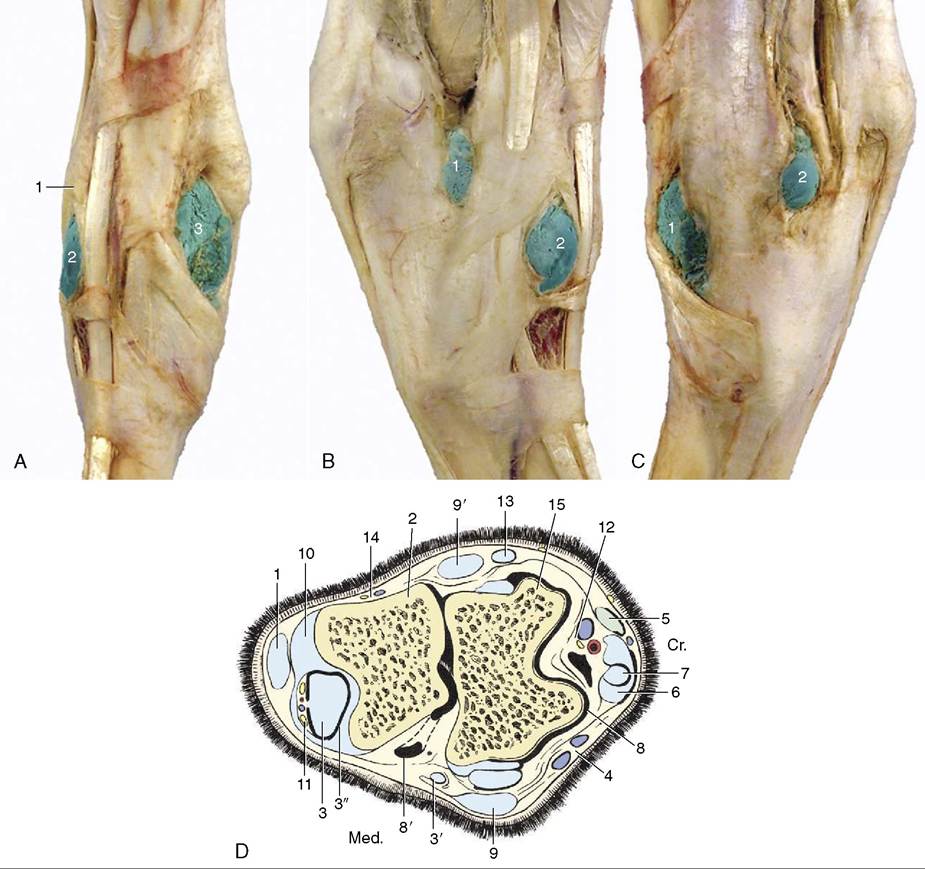
Figure 24-10 A-C, All illustrations of hock. A, Dorsal view of right hock. 1, Long digital extensor; 2, 3, Iaterodorsal and mediodorsal pouches of tarsocrural joint, respectively, are filled with latex.
B, Lateral view of right hock. 1, 2, Lateral plantar and laterodorsal pouches of tarsocrural joint, respectively, filled with latex. C, Medial view of right hock. 1, 2, Mediodorsal and medioplantar pouches of tarsocrural joint, respectively. D, Bursae, tendon sheaths, and joint pouches of the left hock. 1, Superficial digital flexor; 2, calcaneus; 3, lateral deep digital flexor and tibialis caudalis (combined tendon in B); 3', tendon of medial deep digital flexor; 3", tarsal sheath; 4, cranial branch of medial saphenous vein; 5, long digital extensor; 6, peroneus tertius; 7, tibialis cranialis and underlying bursa; 8,8', dorsal and medioplantar pouches of tarsocrural joint; 9, 9', medial and lateral collateral ligaments (superficial parts); 10, long plantar ligament; 11, plantar nerves and saphenous vessels; 12, cranial tibial vessels and deep peroneal nerve; 13, lateral digital extensor; 14, caudal cutaneous sural nerve and lateral saphenous vein; 15, talus.the hock while retaining a flexed stifle, which is a combination of movements normally impossible.
The long digital extensor, the largest muscle of the group, arises in common with the peroneus tertius by a short tendon. This is soon succeeded by a broad belly that covers the tibialis cranialis (Figure 24-13/5). The insertion tendon begins in the lower leg and continues to the extensor process of the distal phalanx, with passing attachments to the proximal and middle phalanges. It is joined by the smaller tendon of the lateral extensor (Figure 24-13/d) near the middle of the cannon. As it descends on the dorsal surface of the limb it is surrounded by a synovial sheath from midtarsal level to the tendon union and is held in place by three
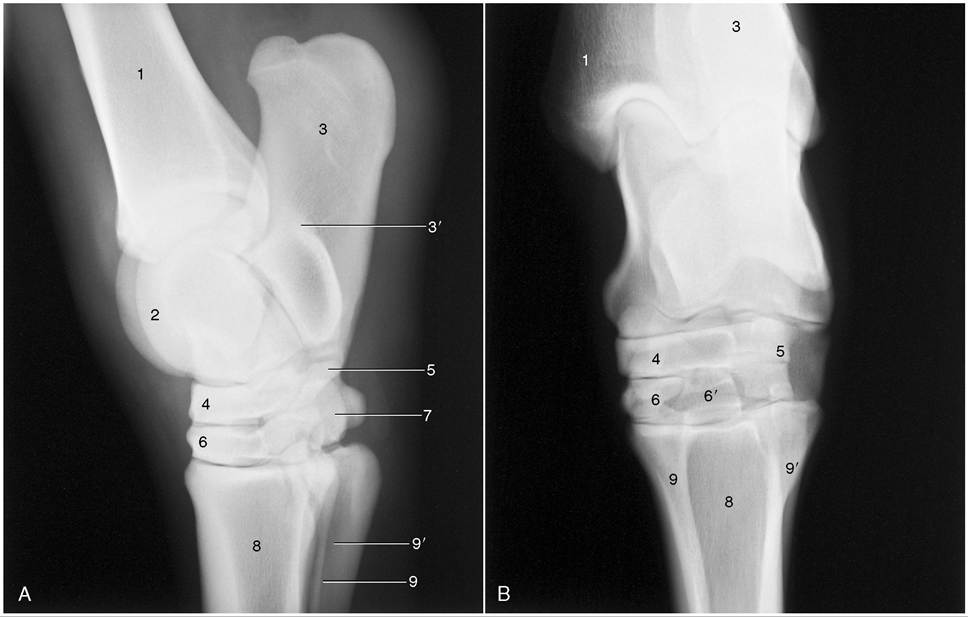
Figure 24-11 Lateral (A) and dorsoplantar (B) radiographs of the hock joint. 1, Tibia; 1', medial malleolus (outlined); 2, talus; 3, calcaneus; 3', sustentaculum tali; 4, central tarsal; 5, fourth tarsal; 6, third tarsal (in B superimposed on tarsal 1 and 2); 6', plantar projection of third tarsal; 7, tarsal 1 and 2; 8, large metatarsal bone; 9, 9', medial and lateral splint bones.
retinacula where it crosses the hock. This muscle is capable of flexion of the hock and extension of the digit.
The lateral digital extensor runs between the long extensor and the deep flexor on the lateral aspect of the limb. It arises from the lateral collateral ligament of the stifle and adjacent parts of both tibia and fibula and ends by joining the long extensor tendon. Its tendon is also held down by retinacula and protected by a synovial sheath where it crosses the hock. A very small, short digital extensor muscle (extensor digitalis brevis) occupies the angle between the converging tendons of the larger muscles (Figure 24-13/70). It is of no importance.
All muscles of the craniolateral group are supplied by the peroneal nerve.