The eyeball (bulbus oculi) of the domestic mammals is nearly spherical but with some anteroposterior* compression in horses and cattle.
In addition, the cornea, the transparent part of the eyeball, bulges from the anterior surface by virtue of its smaller radius of curvature (Fig. 9.2).
The optic axis is the straight line passing through the highest point on the cornea, the anterior pole, and the highest point on the posterior surface, the posterior pole of the eyeball.
The equator is an imaginary line about the eyeball that, like that of the Earth, is equidistant from the poles. A meridian is one of the many lines passing from pole to pole that intersect the equator at right angles. The optic nerve (Fig. 9.2/6) leaves the eyeball slightly ventral to the posterior pole.The eyeball has three thin tunics that, being in close apposition, form a laminated sheet that surrounds the partly liquid, partly gelatinous center. The three tunics are (1) an external fibrous tunic, the only complete tunic, that provides form and protection to the eyeball; (2) a middle vascular tunic, rich in blood vessels and smooth muscle, that supplies nutrients to the eyeball and contributes to the regulation of the shape of the lens and size of the pupil; and (3) an internal nervous tunic, consisting largely of nervous tissue, that is the layer most directly concerned with vision—the translation of visual stimuli into nerve impulses for interpretation by the brain.
The Fibrous Tunic
The fibrous tunic of the eyeball is made up of very dense collagenous tissue that, by resisting the internal pressure, gives the eye shape and stiffness. It consists of the sclera and cornea, which meet at the limbus (Fig. 9.2/7).
437" class="lazyload" data-src="/files/uch_group31/uch_pgroup304/uch_uch7239/image/image437.jpg">
FIG. 9.1 Visual fields of (top to bottom) cat, rabbit, and horse. 1, Binocular vision; 2, monocular vision; 3, blind area; 4, visual axis of eye in central position.
The sclera is the opaque posterior part of the fibrous tunic.
It consists of a dense feltwork of collagenous and elastic fibers and is generally white ("the white of the eye"), though with a bluish tinge; in some species it contains pigmented cells that render it gray. Ventral to the posterior pole, the sclera consists of a small cribriform area (Fig. 9.3/13) through which the fibers of the optic nerve pass. The nerve is surrounded by a connective tissue sheath that continues the dura mater to the sclera. The sclera is also pierced by several small ciliary arteries and nerves and by larger veins known as vorticose veins. The sclera provides attachment to the tendons of the ocular muscles anterior to the equator. Posteriorly, except for the areas taken up by the retractor bulbi muscle, the sclera is covered by a thin membrane (vagina bulbi; Fig. 9.3/5) that separates it from the retrobulbar fat, which forms a socket in which the eyeball can rotate. Near the limbus, the sclera is covered by conjunctiva (see later), which provides a connection to the inside of the lids (Fig. 9.3/19).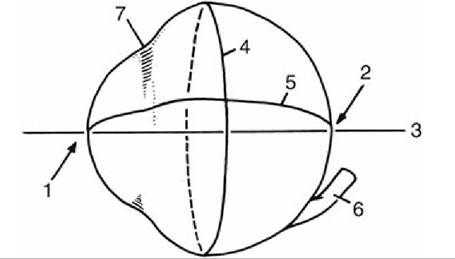
FIG. 9.2 Medial view of right eyeball. 1, Anterior pole; 2, posterior pole; 3, optic axis; 4, equator; 5, a meridian; 6, optic nerve; 7, limbus.
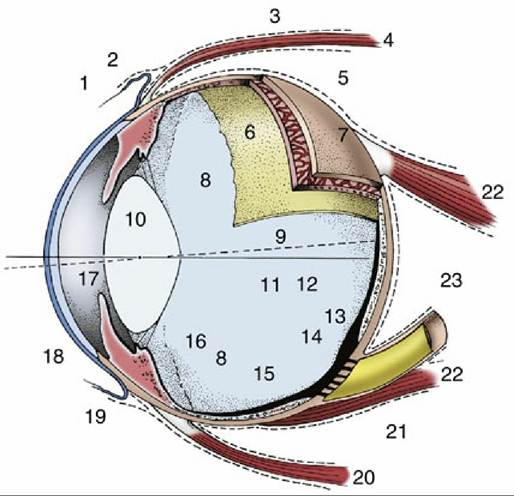
FIG. 9.3 Eye opened to show the three tunics, which have been drawn thicker than they actually are. 1, Limbus; 2, upper fornix; 3, deep muscular fascia; 4, dorsal rectus muscle; 5, vagina bulbi; 6, choroid; 7, sclera; 8, ora serrata; 9, retina; 10, lens; 11, optic axis; 12, visual axis; 13, area cribrosa; 14, optic disk; 15, retina; 16, ciliary body; 17, iris; 18, cornea; 19, conjunctiva; 20, ventral rectus muscle; 21, optic nerve; 22, retractor bulbi; 23, sheath of optic nerve.
The cornea, which forms about one quarter of the fibrous tunic and bulges forward (Fig. 9.4), is composed of a special kind of dense connective tissue arranged in lamellar form.
It is generally recognized that, in addition to the careful arrangement of its fibers, transparency is not only a structural but also a physiologic phenomenon and depends on the continuous pumping out of interstitial fluids, a process that occurs in the posterior epithelium. The main bulk of the cornea, the substantia propria, is continuous with the sclera (Fig. 9.5/6 and 9) and is encased by anterior and posterior limiting membranes and epithelial layers. The anterior epithelial layer is continuous with the epithelium of the conjunctiva, whereas the posterior epithelial layer is continuous with the anterior surface of the iris across the iridocorneal angle (Fig. 9.5/4). The cornea does not contain blood vessels; nutrients for its cells permeate the substantia propria from vessels in the limbus or are carried to its surfaces in the lacrimal fluid and aqueous humor. The surface of the cornea is very sensitive owing to the presence of free nerve endings near the anterior epithelium. They arise from the long ciliary nerves, which are branches of the ophthalmic nerve (described later).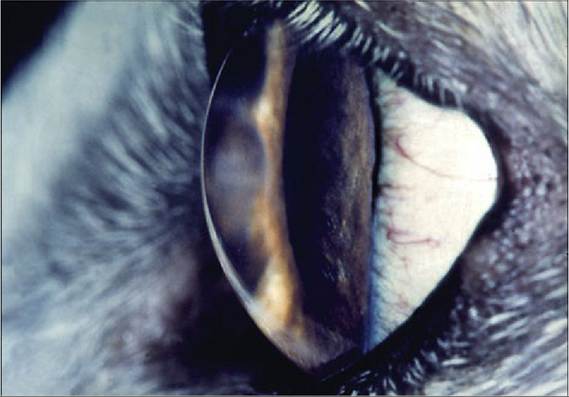
FIG. 9.4 Curvature of canine cornea.
The Vascular Tunic
The vascular tunic of the eye (also known as the uvea) lies deep to the sclera to which it is apposed. It consists of three zones: choroid, ciliary body, and iris, in posteroanterior sequence (see Fig. 9.3). The choroid, the most posterior zone, lines the sclera from the optic nerve almost to the limbus; the ciliary body is a thickened zone opposite the limbus; the iris projects into the cavity of the eyeball posterior to the cornea. The iris is the only internal structure readily seen through the cornea without the use of an instrument such as an ophthalmoscope. The principal function of the vascular tunic is to provide a blood supply to structures of the eye, but it also serves to suspend the lens, regulate the lens curvature, and adjust the size of the pupil by means of the smooth muscle in the ciliary body and iris (see Fig.
9.5).The choroid contains a dense network of blood vessels embedded in heavily pigmented connective tissue. The network is supplied by the posterior ciliary arteries and is drained by the vorticose veins. A flat sheet of capillaries on the internal surface is responsible for the nutrition of the external layers of the nervous tunic (retina), which lies deep (internal) to the choroid. The blood in these capillaries produces the redness of the fundus (interior surface of the posterior hemisphere) seen when the eye is examined with an ophthalmoscope. In the dorsal part of the fundus, the choroid forms a variously colored, light-reflecting area known as the tapetum lucidum (Fig. 9.6). This is an avascular layer (cellular in carnivores, fibrous in ruminants and horses) between the capillaries and the network of larger vessels. The tapetal cells contain crystalline rods arranged in such a way that light striking them is split into its components, which results in the characteristic iridescence. In the fibrous tapetum, the packaging of the collagen has the same effect. The tapetum makes the eyes of animals "shine" when they look toward a light, such as the headlights of an oncoming car. The eyes of the human and the pig do not have a tapetum and therefore do not give this effect. It is believed that the tapetum is a nocturnal adaptation: by reflecting incident light, it increases the stimulation of the light-sensitive receptor cells in the overlying retina and thus aids vision in dark places. The choroid adheres closely to the pigmented external layer of the retina, so that the pigmented layer remains attached to the choroid when the bulk of the retina is removed during dissection. The retina is without pigment where it overlies the tapetum lucidum.
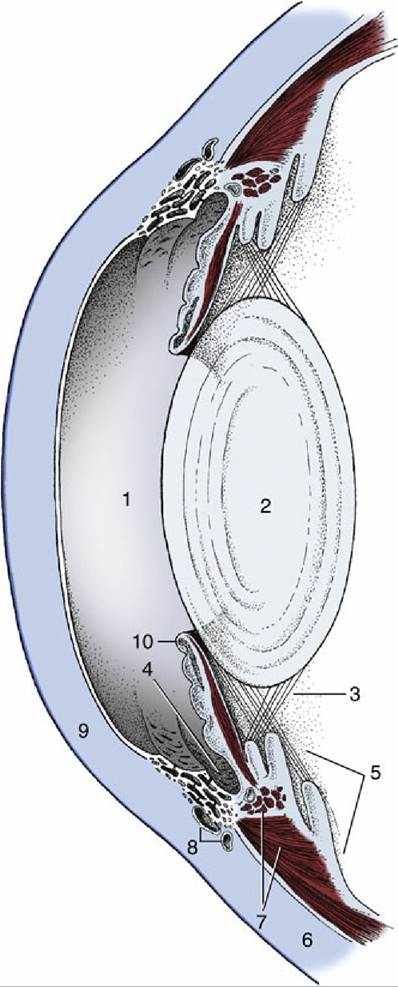
FIG. 9.5 Anterior part of the eye in section. 1, Anterior chamber; 2, lens; 3, zonular fibers; 4, iridocorneal angle; 5, ciliary body; 6, sclera; 7, ciliary muscles; 8, venous plexus of sclera; 9, cornea; 10, iris with the sphincter and dilator muscles shown.
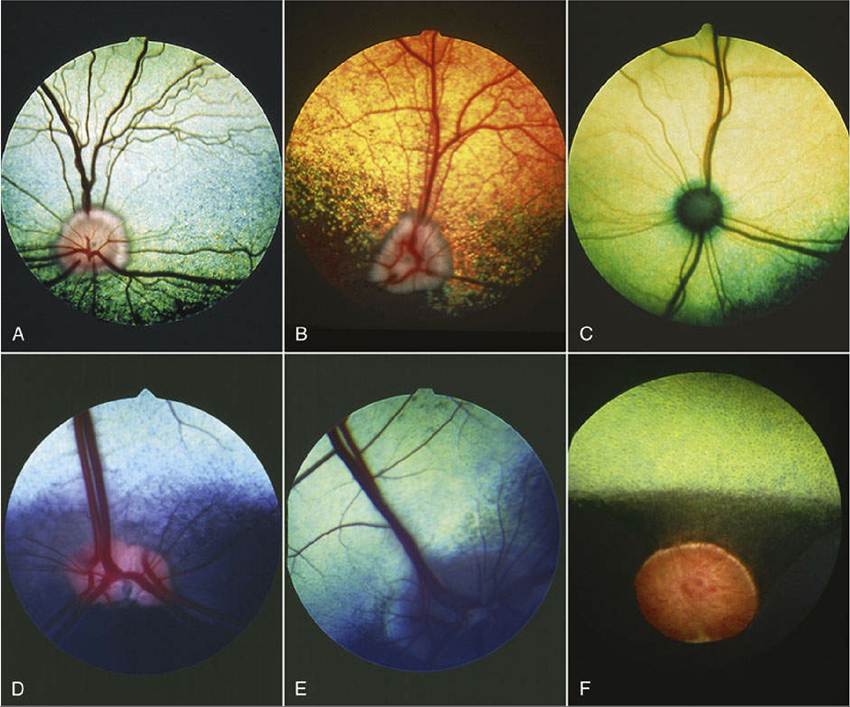
FIG. 9.6 Fundus of the eye of (A) Dutch Sheepdog, (B) Old English Sheepdog, (C) cat, (D) cow, (E) goat, and (F) horse.
Toward the limbus, the choroid thickens to form the ciliary body (Fig. 9.5/5). This structure is a raised ring with ridges converging toward the lens in the center; anteriorly the ring is continued by the iris. One can best understand the ciliary body when seeing it in its entirety by looking into the anterior part of the eye from behind (Figs. 9.7/2 and 9.8). The radial ridges, known as the ciliary processes, extend zonular fibers (Fig. 9.5/3) to the equator of the lens, suspending it around its periphery. Between the ciliary body and the sclera is the smooth ciliary muscle (Fig. 9.5/7), which functions in accommodation, the ability of the eye to focus on near or distant objects by changing the shape of the lens (described later).
The third and smallest part of the vascular tunic is the iris (Fig. 9.5/10), which is suspended between the cornea and lens. It is a flat ring of tissue attached at its periphery to the sclera (by the pectinate ligament; Fig. 9.12/7) and to the ciliary body. The opening in the center is the pupil (Fig. 9.9) through which light enters the posterior part of the eye. The size of the pupil and therefore the amount of light reaching the retina are regulated by two smooth muscles in the iris: the sphincter (constrictor) muscle and the dilator muscle. The sphincter lies near the pupillary margin, but the fibers of the dilator are arranged radially and, on contraction, enlarge the pupil. Irregular outgrowths (iridic granules; Fig. 9.9) containing coils of capillaries are often seen on the upper and lower pupillary margins of ungulates; their significance is not known, although there are suggestions that they act as "shades."
The iris divides the space between the lens and cornea into anterior and posterior chambers that communicate through the pupil (see Fig.
9.9). Both are filled with aqueous humor, a clear watery fluid (described later).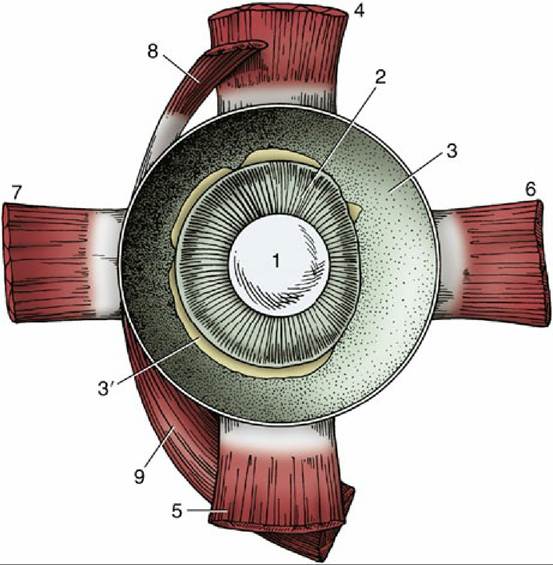
FIG. 9.7 Anterior half of the left equine eye, viewed from behind. 1, Lens; 2, ciliary body; 3, choroid covered by pigmented outer layer of retina; 3', remnants of inner nervous layer of retina, which has been removed; 4, 5, 6, and 7, dorsal, ventral, medial, and lateral rectus muscles; 8 and 9, dorsal and ventral oblique muscles.
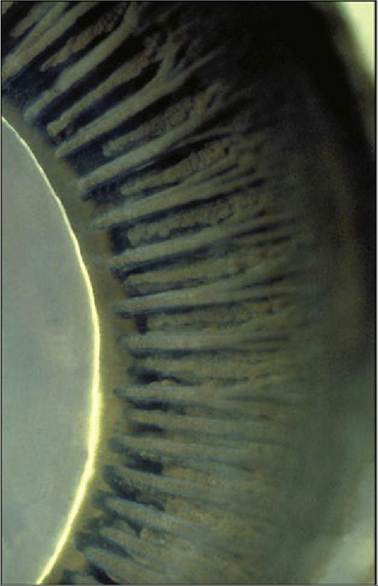
FIG. 9.8 Posterior view of ciliary body with ciliary processes (horse).
The iris consists of three layers: an anterior epithelial layer that is continuous across the
iridocorneal angle and blends with the posterior epithelium of the cornea; a middle layer of connective tissue stroma that contains the two smooth muscles; and a posterior layer of pigmented epithelium that is the forward extension of the pigmented layer of the retina mentioned earlier. The posterior layer is known as the iridic part of the retina and is adjacent to the dilator muscle (Fig. 9.5/10).
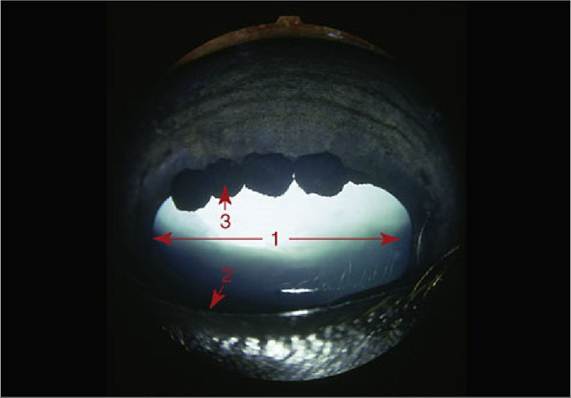
FIG. 9.9 Anterior surface of the equine iris with characteristic iridic granules. 1, Pupil; 2, pupillary margin; 3, iridic granule.
The color of the iris determines the "color of the eye" and depends both on the number of pigmented cells present in the stroma and on the type of pigment present in the cells. If the pigmented cells (melanocytes) are tightly packed, the iris is dark brown (Fig. 9.10); with fewer cells the iris is lighter and yellowish; a minimum of pigmented cells results in a bluish appearance. In albino animals, pigment is absent from the iridic part of the retina, such that the iris is totally devoid of pigment; albino eyes appear red because the blood in the capillaries is not obscured by pigment.
The Internal Tunic
The internal or nervous tunic of the eyeball contains the light-sensitive receptor cells and is known as the retina (Fig. 9.3/9 and 15). The retina develops as an extension of the brain to which it remains connected by the optic nerve. The retina begins where the nerve penetrates the choroid; shaped like a hollow cup, it lines the inner surface of the eye and ends at the pupillary margin. Only the posterior two thirds or so of the retina can be reached by light entering the pupil. Consequently, only that portion (pars optica retinae) is provided with photoreceptor cells and is relatively thick. The remaining anterior third is without photoreceptors and is therefore "blind" (pars ceca retinae) and constitutes the pigmented layer that continues on to the ciliary body and the back of the iris. The edge caused by the abrupt decrease in retinal thickness at the junction of optic and blind parts is the ora serrata (Fig. 9.3/8); it also demarcates the choroid from the ciliary body. The two layers of the retina develop from the inner and outer layers of the optic cup with which the eye makes its appearance in the embryo. The gap between the layers of the optic cup, though obliterated postnatally, remains a weakness where delamination produces "detachment" of the retina.
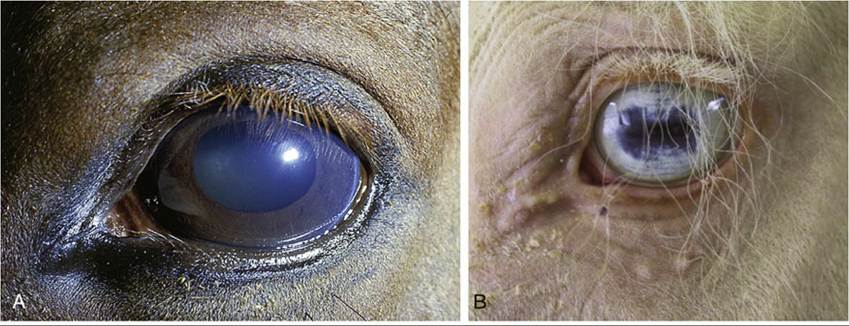
FIG. 9.10 (A) Left equine eye. Note the brown pigmentation of the iris. (B) Left equine eye of an albino animal. Note the absence of pigment.
The presence of large amounts of retinal and choroidal pigment makes the interior of the posterior part of the eye dark like the inside of a camera so that the pupil appears black. The black walls absorb scattered and reflected light and prevent it from striking the retina a second time, which would contribute to blurred vision.
The layers in the pars optica retinae are as follows, beginning at the choroid and moving inward: a single layer of pigmented cells; a neuroepithelial layer containing the photoreceptor cells—that is, the rods and cones (the rods, so far as we know, are concerned with black and white [night] and the cones with color [day] vision) (Fig. 9.11/2); a layer of bipolar ganglion cells (Fig. 9.11/3); and a layer of multipolar ganglion cells whose nonmyelinated axons, lying internal (deep) to the cells, pass to the optic disk, where they aggregate to form the optic nerve (Fig. 9.11/4). It is clear from this arrangement that light passes through all layers except the first before reaching and stimulating the rods and cones.
The area where the axons of the fourth layer converge to leave the eye, the optic disk, can easily be seen when the fundus is examined with an ophthalmoscope (see Fig. 9.6). Because the axons here turn in toward the cribriform area of the sclera, there is no room for receptor cells; the optic disk, therefore, is a blind spot. In contrast, an area of maximum optical resolution (macula) is located a short distance dorsolateral to the optic disk. It is believed that when we examine objects intently, we focus them on the macula. It is not known whether animals do the same. In some species the macula is faintly visible with the ophthalmoscope. The visual axis is the line connecting the macula, the center of the lens, and the object viewed. It does not quite coincide with the optic axis because the macula is slightly dorsal to the posterior pole of the eyeball (see Fig. 9.3).
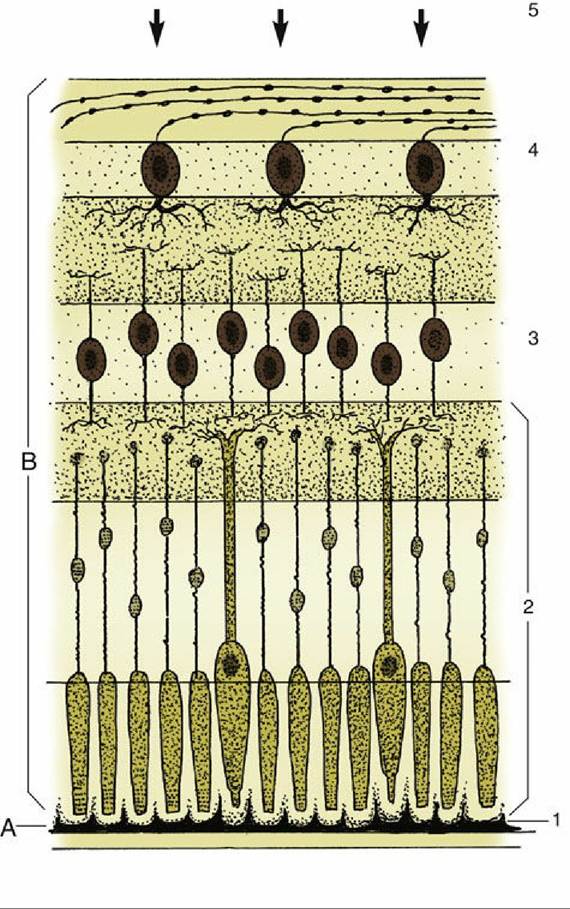
FIG. 9.11 (A) Outer pigmented layer and (B) inner neuroepithelial layer of retina. 1, Pigmented cells; 2, receptor cells (rods and cones); 3, bipolar ganglion cells; 4, multipolar ganglion cells; 5, incoming light (arrows).
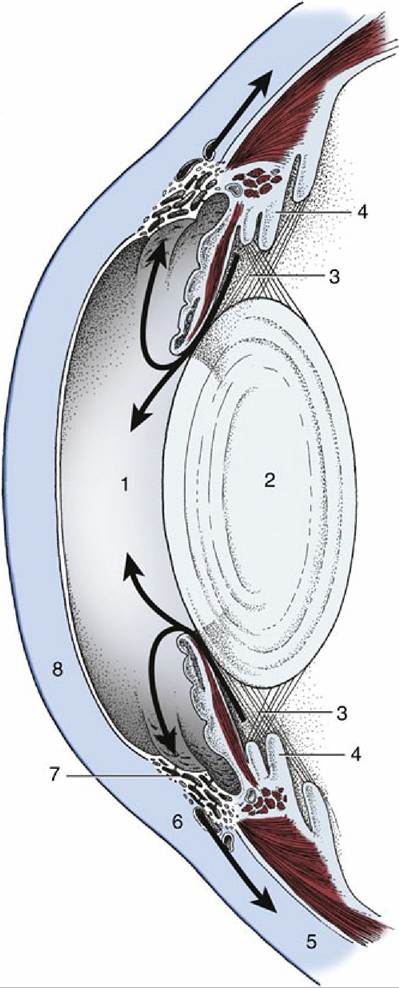
FIG. 9.12 The flow (arrows) of aqueous humor. 1, Anterior chamber; 2, lens; 3, posterior chamber; 4, ciliary body; 5, sclera; 6, venous plexus; 7, pectinate ligament; 8, cornea.
Arterioles and venules emerging from the optic disk spread out in various species-specific patterns to nourish and drain the retina (see Fig. 9.6). The arterioles are branches of the central artery of the retina, which arrives at the optic disk in the center of the optic nerve.
The anteroposterior compression of the equine eyeball has led to the assumption that the horse has a ramp retina. A ramp retina is one in which all parts of the retina are not equidistant from the posterior pole of the lens; the distance from the lens becomes progressively greater as the retina is followed dorsally. Presumably, as increasingly closer objects are viewed, they are focused on the more dorsal parts of the retina; focal length is automatically increased, and little accommodation of the lens is required (p. 516).
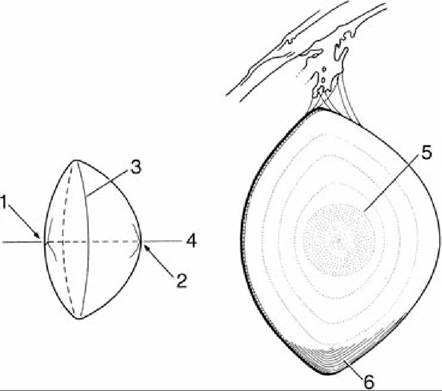
FIG. 9.13 Bovine lens; on the right, a meridional section. 1, Anterior pole with lens star; 2, posterior pole with lens star; 3, equator; 4, optic axis; 5, nucleus; 6, layers of lens fibers, shown only in part.
The Refractive Media of the Eyeball
Now that the layers of the wall of the eyeball have been explained, the interior of the eyeball is described by following the path taken by light entering the eye.
Light first enters the cornea, an integral part of the supporting fibrous tunic. Although dense and tough, it has the quality of being transparent and thus enables light to enter the eye. The cornea plays a major role in refraction; that is, it is capable, as is the lens, of bending light so that what is seen by the animal is miniaturized sufficiently to be focused on the retina.
The rays next encounter the aqueous humor filling the space between cornea and lens. The aqueous humor is a clear watery fluid that, apart from its refractive properties, plays an important role in the maintenance of intraocular pressure. It is continuously produced by cells of the ciliary processes and enters the system in the posterior chamber, caudal to the iris. From here it passes through the pupil into the anterior chamber and thence through the spaces in the trabecular tissue (pectinate ligament) at the iridocorneal angle. These spaces carry the fluid to venous sinuses in the sclera and thus into the bloodstream (Fig. 9.12). In the healthy eye, the rate of production balances the rate of drainage, maintaining a constant pressure. Interference with drainage allows excess fluid to accumulate, causing the intraocular pressure to rise (glaucoma). This serious condition is less common in domestic animals than it is in humans.
The lens (Fig. 9.13), in contrast to its liquid neighbors, is a solid structure, though sufficiently elastic to be able to change in shape. It is biconvex and has anterior and posterior poles, an equator, and a central axis that coincides with the optic axis of the eye. The posterior surface is usually more convex than the anterior. The lens has an outer capsule that is thicker anteriorly and thickest at the equator, where the zonular fibers of the ciliary body are attached. The capsule of the lens is elastic and is permanently under tension, which, if unopposed by the pull exerted at the periphery, would cause the lens to assume a more spherical shape. The substance of the lens consists of very regularly arranged fibers. They form concentric sheets that can be peeled off like the layers of an onion. Within each sheet, the fibers are arranged so that they loop from a point on the anterior surface to one on the posterior surface. Their ends are cemented to the ends of other fibers, forming visible sutures shaped like little three-pointed stars (radii lentis; Fig. 9.13/1 and 2). In the peripheral, or cortical, part of the lens the fibers are relatively soft; they are firmer and thinner toward the center of the lens where they form a harder nucleus. Owing to its elastic properties the cortex can be molded so that the lens changes shape during accommodation. In many older animals the lens becomes cloudy, impairing vision; the condition is known as cataract (Fig. 9.14).
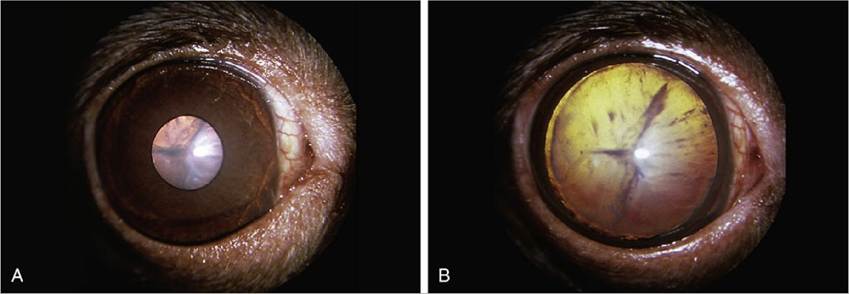
FIG. 9.14 (A) Slightly constricted canine pupil. Cataract of lens visible. (B) Canine pupil in mydriasis (enlarged pupil). Lens is now totally visible; opacity is seen to affect the entire lens.
Accommodation
As previously mentioned, the elastic capsule of the lens would squeeze the relatively soft cortex of the lens into a rounder shape unless opposed by the zonular fibers that arise from the ciliary processes, which exert a constant radial pull on the equator. This pull flattens the lens into the resting shape adapted for far vision and present during sleep. When the animal wants to focus on a near object, the muscle on the surface of the ciliary body contracts, thickening the ciliary body. This change displaces the processes toward the lens and thus relaxes the zonular fibers. The lens, released from the tension at its equator, rounds out and brings the object into focus. In comparison with the muscle in humans, the ciliary muscle, and therefore, the ability to accommodate, is poorly developed in domestic animals.
After passing through the lens the light rays enter the vitreous body. A gel-like mass consisting mainly of water (vitreous humor), the vitreous body has a stroma of fine transparent fibers that condenses into a membrane at the surface. The body occupies the space between lens and retina and holds the latter against the choroid. In the embryo, the lens is nourished by the hyaloid artery, a branch of the central retinal artery that passes through the vitreous body. The artery usually degenerates after birth, and the lens is then nourished by diffusion (Fig. 9.15). Unlike the aqueous humor, the vitreous humor is not continuously replaced; it is therefore constant in volume.