The foot of the horse is a highly modified single digit, adapted for rapid running across grasslands.
The structures from the carpus (which lay people frequently call the knee) distad in the thoracic limb of the horse correspond to the wrist and hand of humans. These structures constitute the manus, and an examination of the bony components will reveal the same basic plan for both species: two rows of carpal bones, a single fully formed metacarpal bone for each digit (of which there is only one in the horse), and three phalanges within each digit.
Likewise, the hock and more distal structures in the equine pelvic limb are homologous to the ankle and foot of humans; these constitute the pes. From the cannon bone distad, the equine manus and pes are nearly identical, except in a few details of blood supply and innervation. In common usage, the term foot is used to describe both manus and pes (Fig. 14-1). Among domestic horses, most lameness is referable to the foot (and most of these are associated with the forefoot, which bears more weight).The hoof, presented in general terms in the preceding chapter, is only one part of the complex that is the equine foot. This chapter discusses the detailed anatomy of the hoof and the other components of the foot, along with the specialized ligamentous apparatus (stay apparatus and reciprocal apparatus) characteristic of the limbs of Equidae.
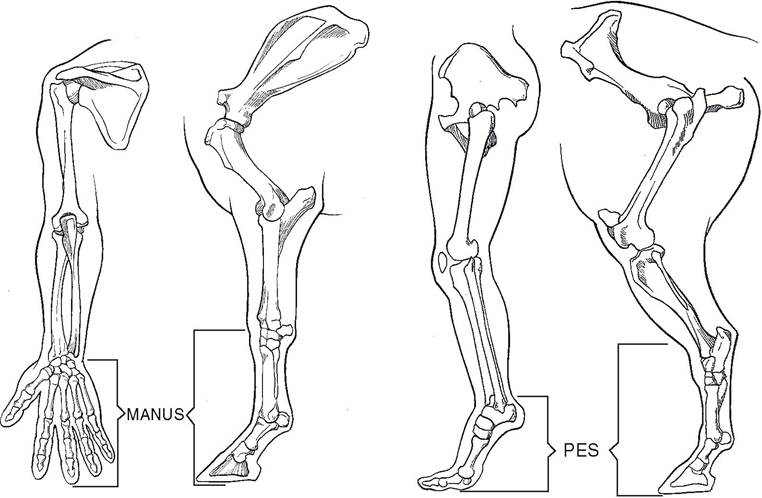
Figure 14-1. Comparative anatomy of human and equine limbs. In the thoracic limb, the manus comprises the carpus and elements more distal (corresponding to the human wrist and hand). In the pelvic limb, the pes includes the tarsus and elements more distal (the human ankle and foot). The horse therefore stands on a single digit, homologous to the human finger or toe.