The indoor flocks of the modern poultry industry are particularly prone to respiratory infections, which may be very costly.
Employed by birds for vocalization and thermoregulation in addition to gaseous exchange, the respiratory apparatus differs considerably from that of mammals. In particular, the lungs are small, undergo little change in volume during breathing, and are extended by air sacs that do not participate in gaseous exchange but act as bellows effecting the flow of air.
The segregation of ventilation and exchange allows a continuous air flow as opposed to the "in- and-out" tidal flow in mammals. This explains how birds are able to extract up to 10 times the amount of oxygen from the air as is possible by mammals. The different manner of breathing is also related to the absence of a muscular diaphragm; its place is taken by a passive horizontal septum that merely holds the viscera in place.Distinctions of lesser importance include the separation of a vocalization organ (syrinx) from the larynx and the possession of closed and possibly mineralized tracheal rings.
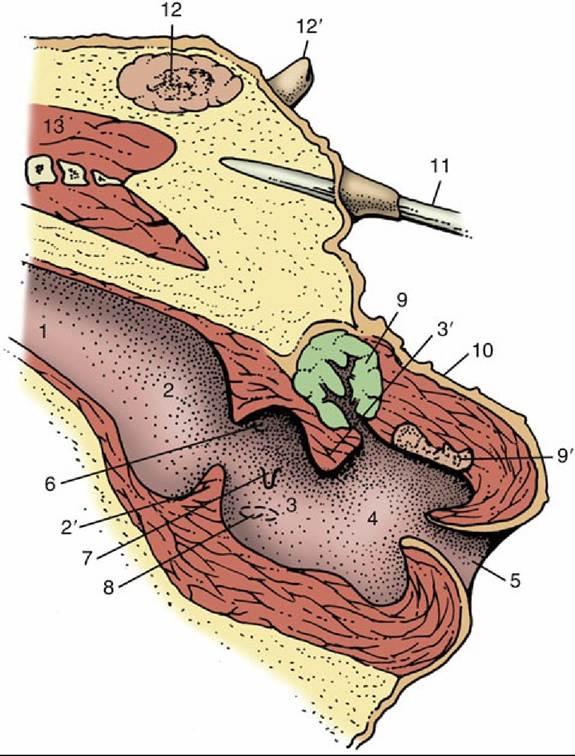
FIG. 37.22 Median section of the cloaca (semi-schematic). 1, Colon; 2, coprodeum; 2, Coprourodeal fold; 3, urodeum; 3', Uroproctodeal fold; 4, proctodeum; 5, vent; 6, ureteric orifice; 7, papilla of deferent duct; 8, position of oviduct orifice (only on left side); 9, cloacal bursa; 9', dorsal proctodeal gland; 10, skin;
11, tail feather; 12, uropygial gland; 12', papilla of uropygial gland; 13, muscles surrounding caudal vertebrae.