THE LIVER AND PANCREAS
The avian liver is dark brown (except in the first 2 weeks after hatching when it obtains a yellow color from yolk pigments, which continue to be absorbed from the intestine before the yolk sac finally regresses).
It consists of right and left lobes, connected cranially by a bridge dorsal to the heart (Figure 37-16). Since there is no diaphragm, the lobes of the liver embrace the caudal portion of the heart. The larger right lobe carries the gallbladder on its visceral surface and is perforated by the caudal vena cava; the left lobe is divided (Figure 37-24). The convex parietal surface lies against the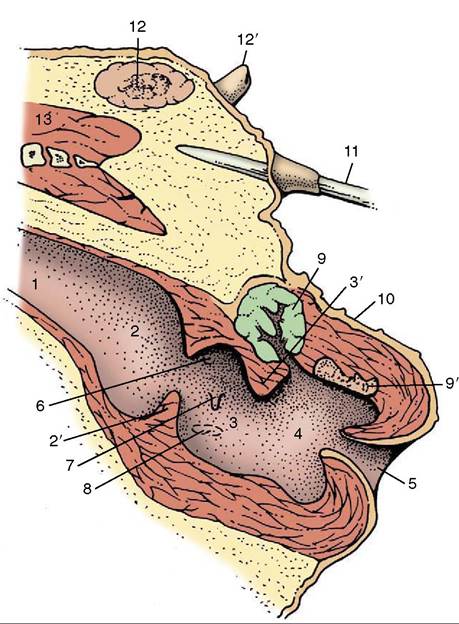
Figure 37-22 Median section of the cloaca, semischematic. 1, Colon; 2, coprodeum; 2', coprourodeal fold; 3, urodeum; 3', uroproctodeal fold; 4, proctodeum; 5, vent; 6, ureteric orifice; 7, papilla of deferent duct; 8, position of oviduct orifice (only on left side); 9, cloacal bursa; 9', dorsal proctodeal gland; 10, skin; 11, tail feather; 12, uropygial gland; 12', papilla of uropygial gland; 13, muscles surrounding caudal vertebrae.
sternal ribs and sternum and is exposed when the breast muscles and sternum are removed in postmortem examination. The liver is covered by a peritoneal sac (Cava peritonaei hepatis) that can contain much fat; in certain diseases it fills with transudate. The concave visceral surface makes contact with the spleen, proventriculus, gizzard, duodenum, jejunum, and ovary (or right testis). Two bile ducts, one from each lobe, enter the distal end of the duodenum close to the pancreatic ducts; only the duct from the right lobe is connected to the gallbladder. Pigeons, most parrots, budgerigars, and struthioformes lack a gallbladder. Except near the hilus, the hepatic lobules are indistinct because of the lack of perilobular connective tissue.
The elongated pancreas lies between the limbs of the duodenal loop (Figure 37-20Z2,2'). It consists of dorsal and ventral lobes distally connected. Two or three ducts convey pancreatic juice into the distal end of the duodenum.