The MAP Kinase Pathway Also Mediates the Stimulation of the Cell Cycle by Cell Adhesion
As noted earlier, the other major throttle mechanism to regulate the cyclin-CDK engines of the cell cycle is cell adhesion. Cell adhesion, as with growth factor stimulation, ultimately stimulates cyclin-CDK pairs through the MAP kinase pathway.
Two types of cell contact are involved in normal growth and proliferation. The most obvious is cell-cell adhesion; most cells are tightly attached to their neighboring cells. The second type is cell adhesion to an extracellular matrix (ECM) of fibrous proteins. Eighty percent of human and mouse cancers arise from epithelial cells (carcinomas), and all epithelial layers are attached to an ECM. The adhesion proteins that bind to other cells or to the ECM are adhesion receptors. Adhesion receptors are responsible for the mechanical aspect of attachment, but also act similar to other receptors in transducing information across the plasma membrane. In this case, adhesion receptors communicate the information that the cell is anchored and can divide.Both cell-cell and cell-ECM adhesion activate the MAP kinase pathway, similar to growth factors, but the Ras intermediate is less important here. Figure 2-7 shows the activation of the MAP kinase pathway as a result of cell-ECM adhesion. The adhesion receptors that bind to ECM are called integrins and these activate the MAP kinase pathway via two important intermediates that are themselves oncogenes. One is Src (“sark”), a protein tyrosine kinase and the first oncogene (src) to be discovered. Unlike the RTKs previously described, Src is not itself a receptor. However, Src is located on the inside face of the plasma membrane, where it can interact with adhesion receptors. Another important intermediate is also a protein tyrosine kinase, called Fak (focal adhesion kinase). As before, activation of Src and Fak activate the MAP kinase pathway, leading to increased cell division.
Once again, mutation Oroverexpression of src and fak sends inappropriate stimulation to the cell cycle machinery, which facilitates cancer. As mutant oncogenes, fak is associated with aggressive melanomas in humans. The src oncogene was named because of its ability to cause sarcomas in chickens.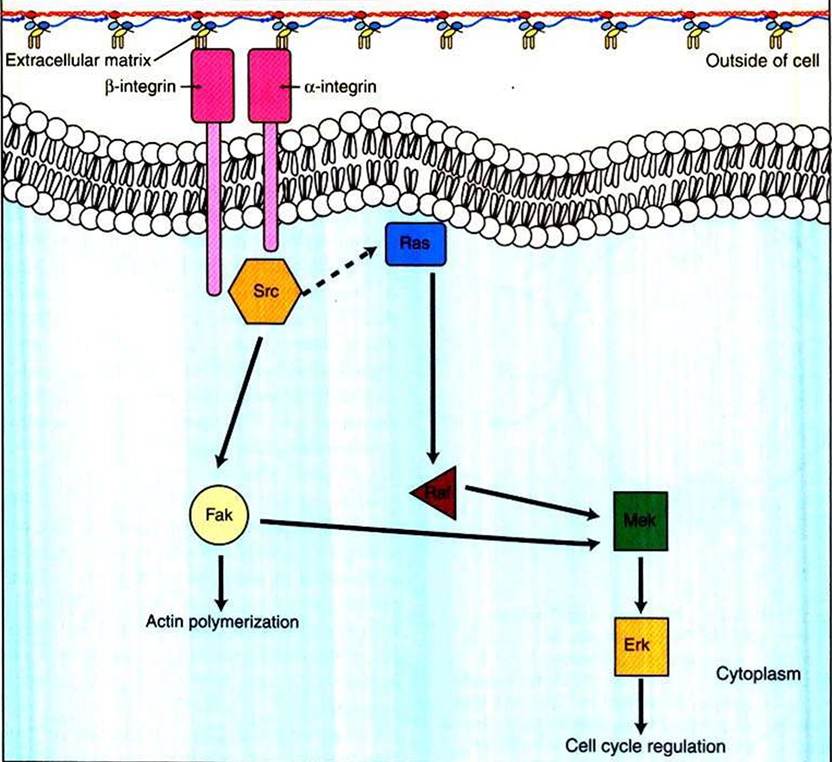
FIGURE 2-7 Cell adhesion functions through the MAP kinase pathway to stimulate cell division. In addition to the growth factor stimulation of proliferation shown in Figure 2-5, normal epithelial cells also require stimulation of the MAP kinase pathway through adhesion to the extracellular matrix. The "adhesion receptors" are integral membrane proteins called integrins, which are activated by binding proteins of the extracellular matrix. Activation of integrins leads to activation of two protein kinases, Src and focal adhesion kinase (Fak), which in turn activate the MAP kinase pathway.
Several other growth stimulatory pathways work in much the same manner as the growth factor and adhesion pathways. Most stimulatory pathways involve protein kinases and G proteins controlling the transcription of genes encoding proteins that are part of or close to the workings of the cyclin-CDK engines.
Having introduced the fundamentals of stimulatory pathways in the cell cycle, we now change our focus to consider the equally Rube Goldberg-Iike pathways that provide the brakes to the cell cycle.