The Mechanism of the Larynx
The larynx protects the lower respiratory passages against entry of food and drink and produces voice (phonation). On swallowing, the larynx is drawn forward, and the epiglottis, tilted somewhat backward by coming against the root of the tongue, forms a partial cover to the laryngeal entrance.
The resemblance between the outlines of the epiglottis and the aditus suggests a much closer fit than actually occurs. Solid foods are swiftly carried over the laryngeal entrance by the pharyngeal muscles, whereas fluids are deflected by the epiglottis through the piriform recesses of the pharyngeal floor. It is known that removal of the larger part of the human epiglottis does not interfere with normal swallowing. A second, active protection is provided at a deeper level by the glottis, which is closed by the adduction of the vocal folds. Inhibition of inspiration at this time further reduces the risk that food will be drawn into the larynx. In fact, food comparatively rarely "goes down the wrong way," but when it does, its contact with the vestibular mucosa initiates reflex coughing.On inspiration, abduction of the vocal folds may widen the rima glottidis, but the effect is pronounced only when breathing is unusually vigorous. Although the dorsal cricoarytenoideus is the abductor and the lateral cricoarytenoideus muscle is the adductor (Fig. 4.15/5 and 6 and arrows), both muscles are supplied by the caudal (recurrent) laryngeal nerve.
Closure of the glottis also occurs when free passage of air to or from the lungs must be prevented. A buildup of expiratory forces against a closed glottis allows for a forceful expulsion when the air is eventually released, as during coughing to clear the lower passages of mucous accumulations or foreign matter. Sustained closure with elevation of the intrathoracic pressure is also used in activities such as defecation, micturition, and parturition.
The blockage of the escape route for air helps maintain the intrathoracic pressure and, by so stabilizing the diaphragm, aids the action of the muscles of the abdominal wall. The skeleton of the thorax can also be more effectively fixed to provide a firm base for muscles attaching to the ribs when the glottis is closed. This combination of activities is well illustrated in ourselves when we attempt to lift a heavy weight or to draw the trunk toward a handhold above the head.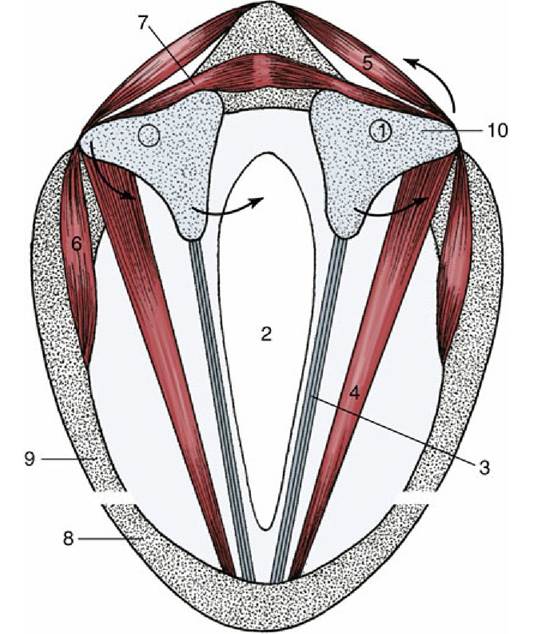
FIG. 4.15 Schematic transverse section of the larynx. Arrows on the left indicate action of cricoarytenoideus lateralis (6) on arytenoid cartilage, and arrows on the right, action of cricoarytenoideus dorsalis (5) on arytenoid cartilage (10). 1, Location of the cricoarytenoid joint; 2, glottic cleft; 3, vocal ligament in vocal fold; 4, thyroarytenoideus; 5, cricoarytenoideus dorsalis; 6, cricoarytenoideus lateralis; 7, arytenoideus transverse; 8, thyroid cartilage; 9, cricoid cartilage; 10, arytenoid cartilage.
The production of voice is a further important function of the larynx. Humans can produce more complex sounds than other species even though the larynx is no more complex. An animal in which the larynx had to be surgically removed due to malignant disease can produce some sounds through the expulsion of air from the esophagus. Even normally the laryngeal sounds are much modified and "colored" by the resonance chambers provided by other cavities of the head. Some controversy exists over the mechanism of sound production in the larynx. The airstream is made to vibrate as it passes through the glottis. The pitch is controlled by the thickness, the length, and the tension of the vocal folds and is thus to some extent variable and to some extent determined by permanent (or semipermanent, in that a boy's voice breaks with growth) and individual features of laryngeal anatomy.
The tension of the folds, or of part of them, is varied by the cricothyroideus muscle, which acts as the coarse adjustment, and the vocalis muscle, as the fine adjustment. Most authorities believe that the folds are made to vibrate passively by the flow of air passing between them. An alternative theory suggests that the muscles contract and relax at the appropriate rate. However, this latter theory is weak because some tones of the human voice exceed 200 cycles per second and tonic contraction of the vocalis muscle occurs with stimuli repeated 67 times per second. Electromyographic studies show that purring in cats is produced by fast twitching of the laryngeal muscles and the diaphragm. The laryngeal muscles rapidly narrow and widen the glottis, causing the respiratory air to vibrate and make the sound.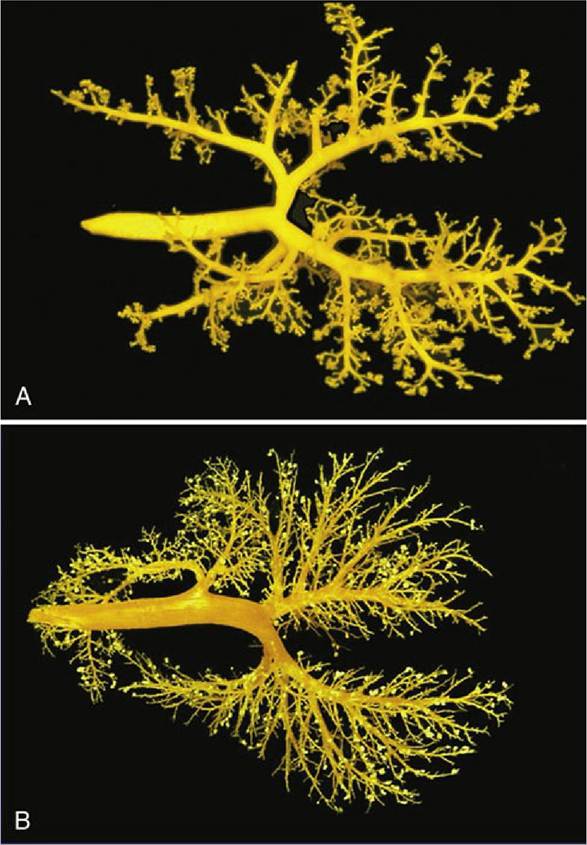
FIG. 4.16 Dorsal views of corrosion casts of the bronchial tree and lungs of (A) the cat and (B) the calf.