The Most Important Feedback Control for Hormones Is the Negative-Feedback System, in Which Increased Hormone Concentrations Result in Less Production of the Hormone, Usually Through an Interaction with the Hypothalamus or Pituitary Gland
The effects of hormones are proportional to their concentrations in blood, and therefore control of these concentrations is an important aspect in ensuring that physiological function is normal.
As indicated previously, the primary factor affecting hormone concentrations in blood is the secretion rate by a particular organ. Feedback-loop control systems have evolved in which concentrations of hormones are monitored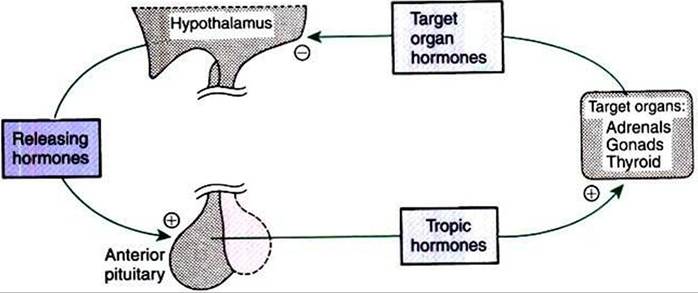
FIGURE 33-9 Negative feedback of tropic and releasing hormones by target organ hormones. Plus signs indicate stimulation, and the minus sign indicates inhibition. In some cases, such inhibition occurs at the pituitary gland. (From Hedge GA, Colby HD, Goodman RL: Clinical endocrine physiology, Philadelphia, 1987, Saunders.)
at the controlling point either to increase or to decrease secretion of a hormone by an endocrine organ. The most common feedback system is negative feedback, in which continuous monitoring allows the system to counteract changes in hormone secretion or to maintain a relatively constant environment.
An example of systems in which negative-feedback control involves both the endocrine and the nervous system is shown in Figure 33-9. The hypothalamus, which controls secretion of tropic hormones in the anterior pituitary through the secretion of peptide-releasing hormones, has cells with a certain set point by which they compare concentrations of hormone in the blood with the output of releasing hormones. Ifblood concentrations fall below the physiological set point, releasing-hormone output increases; this in turn increases production of tropic hormones by the anterior pituitary and subsequently the secretion of the hormone by the target organ. Conversely, if the hormone concentration increases above acceptable physiological limits, a shutdown of releasing- hormone production occurs within the hypothalamus, tropic hormone secretion by the anterior pituitary decreases, and production of the hormone by the target organ decreases.
This type of control system is not an “all-or-none” arrangement because changes and adjustments are being continuously made to maintain an optimal concentration of hormone.In the negative-feedback system an increase in secretion of hormone results in a decrease in tropic hormone secretion. It is also possible to have a negative-feedback system in which an increase in a physiological substance, such as glucose, causes an increase in a hormone, in this case insulin, which plays an important role in glucose metabolism. This is considered to be a negative-feedback system because blood glucose concentrations are being “dampened,” or returned toward normal levels, through the action of insulin.
Positive-feedback systems also exist, although they are much less common than negative-feedback systems. One example is the preovulatory release of LH, in which the pulsatile rate of LH secretion greatly increases during the late stages of ovarian follicular development because of increased estrogen production by the follicle. In this situation, there is a definitive end point: ovulation results in a decline in the stimulus, estrogen, although the duration of the LH surge is probably determined within the hypothalamus, and therefore the LH response to estrogen is modulated.