The nervous system consists of the brain, the spinal cord, and the peripheral nerves, which connect the various parts of the body to either the brain or spinal cord.
A variety of cell types are found within the nervous system, but the primary functional cell is the neuron. A major function of the other cell types (the glia), which outnumber neurons ten to one, appears to be to maintain the cellular environment to support the activity of the neurons.
The basic functions of the nervous system can be summarized thus:
1. Initiate and/or regulate movement of body parts by initiating and/or regulating the contraction of skeletal, cardiac, and smooth muscles
2. Regulate secretions from glands
3. Gather information about the external environment and about the status of the internal environment of the body, using senses (sight, hearing, touch, balance, taste) and mechanisms to detect pain, temperature, pressure, and certain chemicals, such as carbon dioxide, hydrogen, and oxygen
4. Maintain an appropriate state of consciousness
5. Stimulate thirst, hunger, fear, rage, and sexual behaviors appropriate for survival
All functions of the nervous system require the rapid transmission of information from one site within the body to another. This transmission is possible because neurons have the
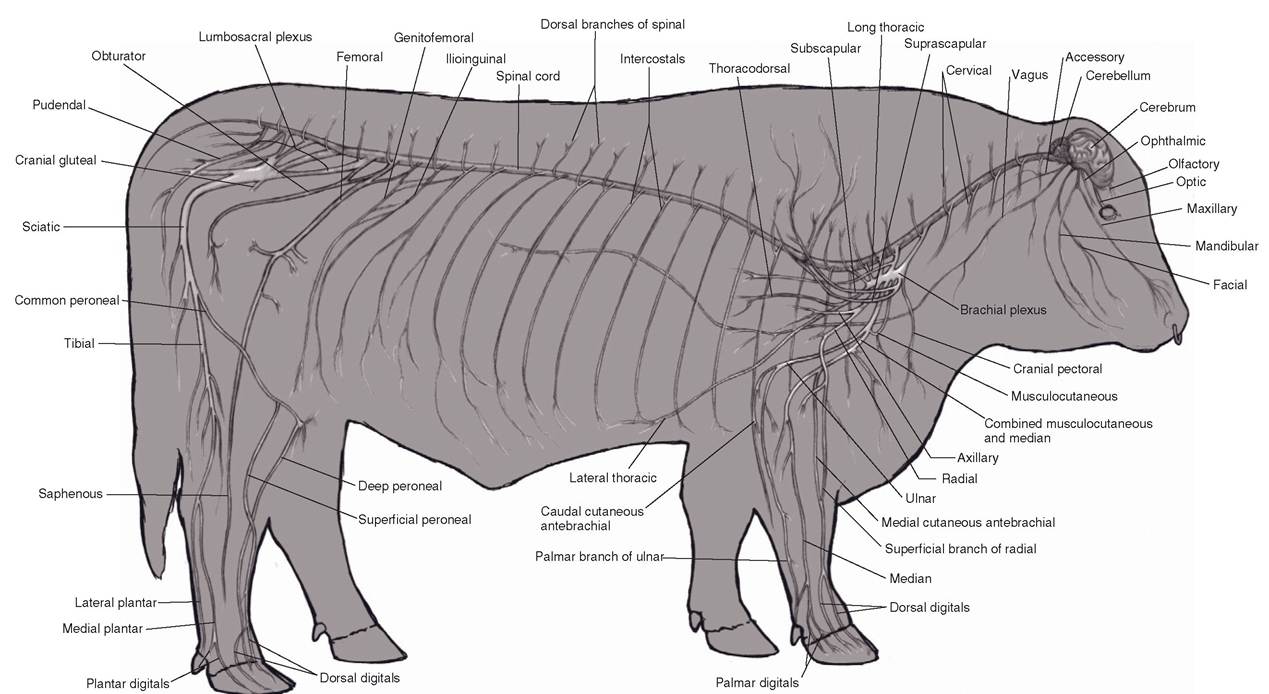
Figure 9-1. Nervous system of the bull. (Reprinted with permission of Wiley-Blackwell from McCracken T.O., Kainer R.A. and Spurgeon T.L. Spurgeon’s Color Atlas of Large Animal Anatomy. Baltimore: Lippincott Williams CrWilkins, 1999.)
property of excitability. This property (see Chapter 2) permits neurons to develop action potentials and rapidly propagate them along their individual cellular processes (axons). When an action potential reaches the end of an axon, the information encoded in the action potential is transmitted to another neuron or some other type of cell (notably, muscle cells). This transmission is accomplished at specialized junctions known as synapses.
For descriptive purposes the entire nervous system (Fig. 9-1) can be divided into two parts: the central nervous system (CNS), which includes the brain and spinal cord, and the peripheral nervous system (PNS), which consists of cranial nerves and spinal nerves going to and from somatic (body) structures. A further distinction is the autonomic nervous system (ANS), which coordinates activity of visceral structures (smooth muscle, cardiac muscle, and glands). The ANS has elements in both the central and peripheral nervous systems, and it features both sensory and motor components.
In the BNS, sensory (afferent) nerves gather information about the external and internal environments and relay this information to the CNS. The information is obtained by specialized organs, cells, or axon terminals that react to specific environmental energies and initiate action potentials in associated sensory axons. The specialized structures that detect environmental stimuli are sensory receptors. Sensory systems are discussed more completely in Chapter 11.
The CNs receives information arriving via the BNS, integrates that information, and initiates appropriate movement of body parts, glandular secretion, or behavior in response. It may do this via voluntary or involuntary (i.e., autonomic or reflexive) processing. Communication between the CNS and the target muscles and glands in the periphery is accomplished via motor (efferent) nerves of the BNS.