THE PASSIVE STAY-APPARATUS
The caudal end of the trunk rests on the head of the femur. A vertical line dropped from the center of the support passes caudal to the stifle joint and cranial to the hock, fetlock, and pastern joints before intersecting the hoof (Figure 24-15, A).
If unsupported, the bony column of the hindlimb would collapse by flexion of the stifle and hock and overextension of the fetlock and pastern joints. The tendons and ligaments of the passive stay-apparatus enable the horse to prevent this collapse using only a minimum of muscular effort.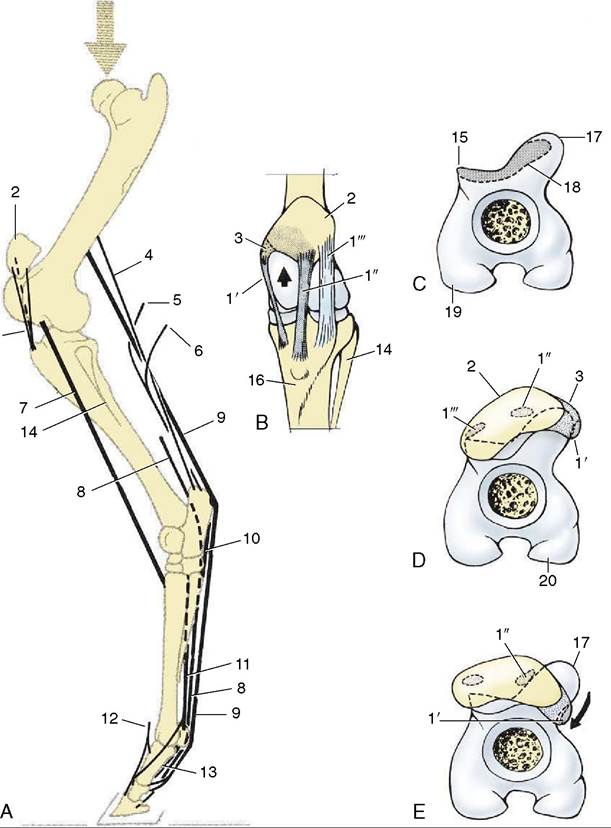
Figure 24-15 A, Stay-apparatus of the left hindlimb, lateral view. B, Left stifle joint, cranial view. C-E, Distal end of left femur, looking distally; in D, position of patella in horse standing square; in E, the stifle is locked. 1, patellar ligaments; 1', medial; 1", intermediate; 1"", lateral patellar ligaments; 2, patella; 3, parapatellar flbrocartilage; 4, fibrous band associated with gastrocnemius; 5, tarsal tendon of semitendinosus; 6, tarsal tendon of biceps; 7, peroneus tertius; 8, deep digital flexor; 9, superficial digital flexor; 10, long plantar ligament; 11, interosseous; 12, long digital extensor; 13, sesamoidean ligaments; 14, fibula; 15, lateral trochlear ridge; 16, tibia; 17, tubercle on proximal end of medial trochlear ridge; 18, resting surface on proximal end of trochlea; 19, lateral condyle; 20, medial condyle.
The supportive mechanisms below the hock are very similar to those of the forelimb (p. 614). However, the accessory ligament of the deep digital flexor tendon, which arises from the caudal aspect of the hock, is weak and occasionally absent. This is compensated by the firm, intermediate attachment of the superficial digital flexor tendon to the point of the hock, which is broadly comparable in function to the accessory ligament of the corresponding tendon of the forelimb.
The part of the superficial flexor tendon between its attachments proximal and distal to the fetlock joint is tensed when weight is on the limb and assists the interosseous in supporting the fetlock.Fixation of the stifle and hock joints depends on the locking mechanism of the former joint and the existence of the so-called reciprocal mechanism, which associates the movements of the two joints. For the horse to “lock” the stifle, the patella is first brought into the resting position (by extending the joint) and then fixed by being rotated medially through about 15°
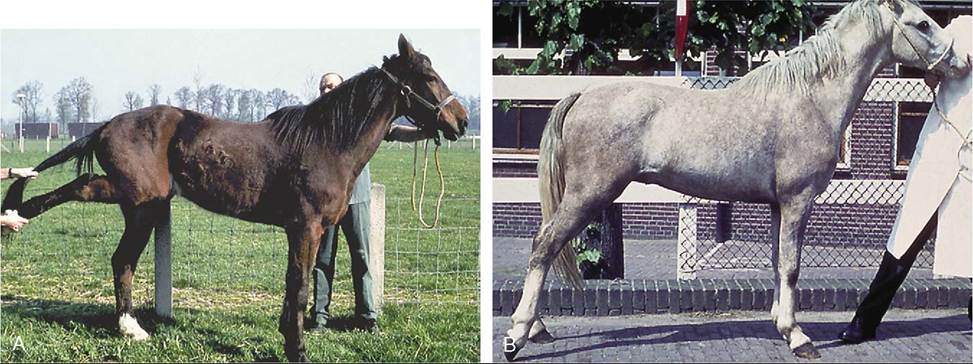
Figure 24-16 A, Rupture of peroneus tertius B, Locked patella.
(Figure 24-15, Elarrow). This hooks the parapatellar cartilage and medial patellar ligament securely over the protuberance of the medial trochlear ridge (Figure 24-15l77); palpation confirms that the medial ligament now runs more caudally than before, being displaced as much as 2 cm behind the crest of the medial ridge. Secured in this position, the patella firmly resists displacement, and a larger part of the body weight can be lowered onto the locked joint, which enables the other hindlimb to be rested with only the toe of the hoof on the ground. The “unlocking” is effected quite briskly: the patella is rotated laterally and snaps back into its usual place; the joint may now be flexed.
The reciprocal mechanism is provided by two tendinous cords—the peroneus tertius and the superficial flexor—that pass between the distal end of the femur and the hock, one on the cranial, the other on the caudal aspect of the tibia (Figure 24-15l7,9). (Figure 24-16, A, demonstrates the result of the rupture of the peroneus tertius.) These ensure that the two joints move in unison; flexion or extension of one necessitates a similar movement of the other joint. However, some looseness in the system renders it unnecessary for the angular changes at the two joints to be exactly the same, especially during fast gaits when large forces must be absorbed by the tendons.
When the stifle is locked, the weight of the hindquarters tends to flex the hock joint; this is opposed by tension in the superficial flexor caudal to the tibia. The peroneus tertius is not involved at this time, and it seems that it is superfluous in the animal standing quietly.
The stifle joint is fully locked only when the horse takes most of the weight on that limb and rests the other on the toe of the hoof. It should be emphasized that while the arrangement conserves energy, it does not eliminate muscular effort; every few minutes the animal shifts its support from one side to the other as muscles tire or, perhaps, as tension in the passive supporting structures becomes uncomfortable.
Sometimes a neuromuscular disorder makes unlocking of the stifle difficult or even impossible (Figure 24-16, B). A temporary “lock” may be broken by startling a horse into sudden movement; a persistent “lock” may be alleviated by section of the medial ligament to break the retention loop (Figure 24-15, Bl 1'). The operation is easily and safely performed because a considerable thickness of fat lies deep to the ligament, protecting the synovial membrane.