The pituitary gland, or hypophysis cerebri, is composed of the adenohypophysis (pars distalis, or anterior lobe), the neurohypophysis (pars nervosa, or posterior lobe), the pars intermedia (intermediate lobe), and the pars tuberalis (Figure 33-10).
The adenohypophysis is formed from an area of the roof of the embryonic oral ectoderm called Rathke's pouch, which extends upward to meet the neurohypophysis, which extends downward as an outpouching of neural ectoderm from the floor of the third ventricle.
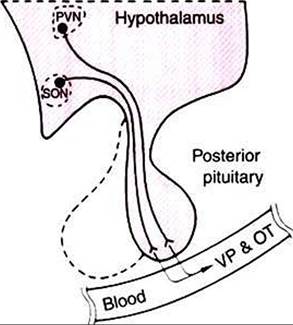
FIGURE 33-11 The hypothalamoneurohypophyseal system, which secretes vasopressin (VP) and oxytocin (OT). PVNr Paraventricular nucleus; SON, supraoptic nucleus. (From Hedge GA, Colby HD, Goodman RL: Clinical endocrine physiology, Philadelphia, 1987, Saunders.)
More on the topic The pituitary gland, or hypophysis cerebri, is composed of the adenohypophysis (pars distalis, or anterior lobe), the neurohypophysis (pars nervosa, or posterior lobe), the pars intermedia (intermediate lobe), and the pars tuberalis (Figure 33-10).:
-
Veterinarian -