THE RECTUM AND ANAL CANAL
The principal features of visceral topography and peritoneal disposition are shown in Figures 22-5, 22-6, and 22-7.
The rectum continues the descending colon beyond the pelvic inlet.
Initially it resembles the colon in structure and in relationship to the peritoneum, but as it proceeds caudally the mesentery shortens and the peritoneal covering is gradually lost (commencing with the dorsal aspect); finally the rectum is wholly retroperitoneal and embedded in a fat-rich connective tissue. The proportion of the rectum that is retroperitoneal appears to vary between individuals and is relevant to the perforations of the wall of the rectum that are the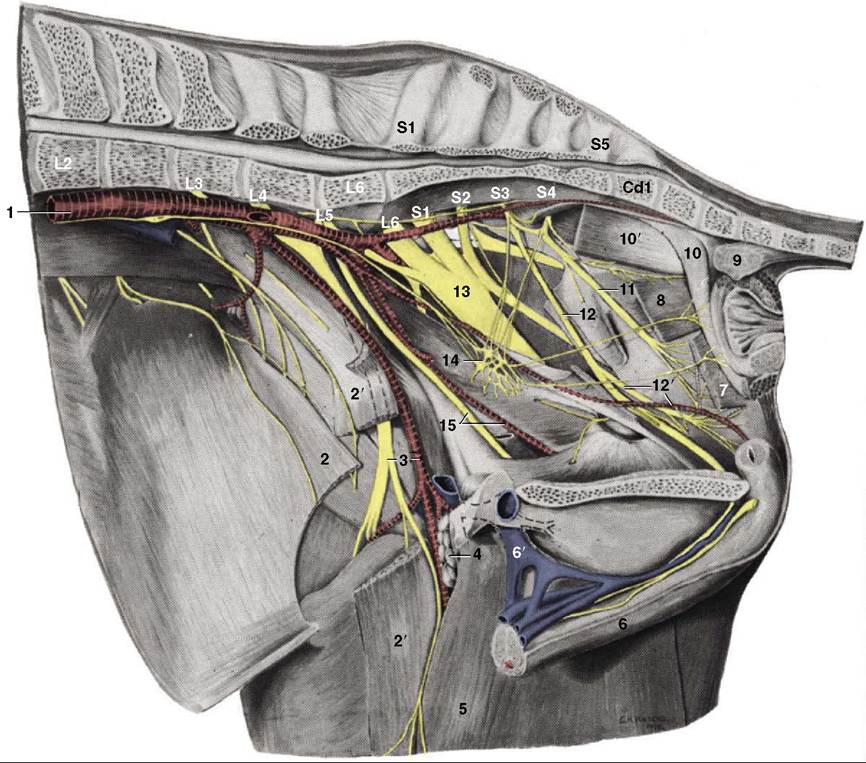
Figure 22-4 Dissection of the pelvic wall; medial view. 1, Aorta; 2, internal abdominal oblique; 2', sartorius, resected; 3, femoral a. and n.; 4, deep inguinal lymph nodes; 5, gracilis; 6, penis; 6', (accessory) external pudendal v.; 7, levator ani, resected; 8, coccygeus; 9, rectococcygeus; 10, retractor penis; 10', ventral tail muscle; 11, caudal rectal n.; 12, pudendal n.; 12', deep perineal n. and internal pudendal a.; 13, sciatic n.; 14, pelvic plexus; 15, obturator n. and vessels.
unfortunate and highly embarrassing mishaps that occasionally complicate rectal exploration. The terminal part of the rectum loses the sacculated character and forms a wide flasklike expansion (ampulla) just before it joins the anal canal. The ampulla stores feces before evacuation. A change of lesser importance is the regrouping of the dorsal and lateral longitudinal muscles into bundles that break free, pass above the anus, and anchor the rectum to the fourth or fifth caudal vertebra; these bundles constitute the smooth rectococcygeus (Figure 22-4/9).
The relations of the rectum depend on its fullness and on the sex.
In the mare, the rectum lies on the uterus and vagina unless, as often happens, these are displaced to one side and the rectum is enabled to make contact with the bladder. In male animals the ventral surface lies on the bladder, the urethra, and the accessory reproductive glands; the extents of the individual contacts depend on the state of the bladder and the development of the glands, which are naturally smaller in the gelding.The anal canal continues the rectum but, unlike this, is generally empty of feces. It is closed by the apposition and interdigitation of longitudinal mucosal folds and by the contraction of the internal and external anal sphincters. The extent of the canal is sharply defined by anorectal and anocutaneous lines marking the limits of epithelial specialization. The canal is embraced by the pelvic diaphragm (Figure 22-4/7,8); the part caudal to the pelvic diaphragm projects as a cylindrical eminence within the perineal region.
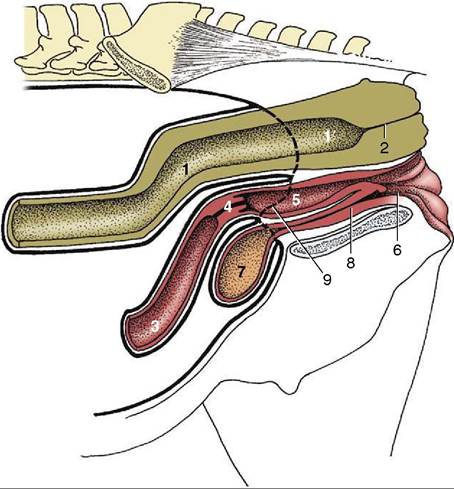
Figure 22-5 Schematic median section of the pelvis of the mare. 1,1', Peritoneal and retroperitoneal parts of the rectum; 2, anal canal; 3, uterus; 4, cervix; 5, vagina; 6, vestibule; 7, bladder; 8, urethra; 9, caudal extent of peritoneum.