THE SOUND-CONDUCTING APPARATUS
The main function of the middle ear is seen more as a pressure regulator than a conductor of sound waves. Recent theoretical perspectives suggest that the entire middle ear, including the tympanic membrane, ossicles, and muscles, is more focused on equalizing pressures rather than transmitting sound to the inner ear.
Essentially, these structures work to protect the inner ear from excessive stress caused by sound waves, contributing to a more effective hearing process. While the middle ear may also play a role in sound conduction, its destruction or removal does not result in complete deafness, emphasizing the significance of bone and tissue conduction, along with the direct excitability of the auditory nerve to sound waves.Comparatively, some animals lack or have underdeveloped middle ear structures, such as the tympanic membrane
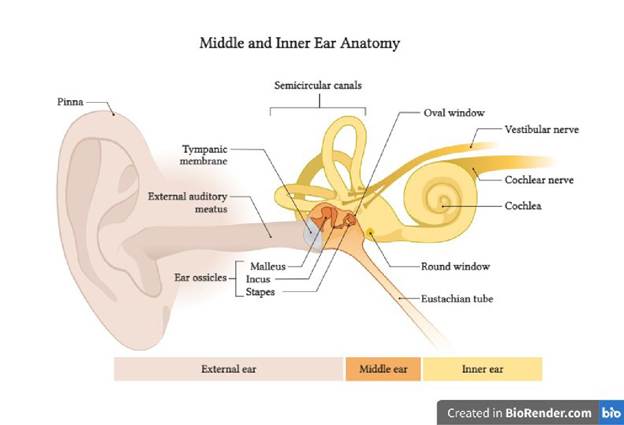
FIGURE 10.1 Structural components of the external, middle, and inner ear. The tympanic membrane separates the external ear from the middle ear.
or middle ear cavity, yet still exhibit good hearing. This discrepancy raises questions about the correlation between anatomical observations in lower animals and physiological studies. The absence or rudimentary state of these structures in amphibians, reptiles, and certain animals closer to humans might be associated with less advanced hearing abilities. Experimental evidence from studies on animals like frogs, turtles, and snakes suggests a potential lack of a true sense of hearing in species with underdeveloped middle ear structures.
10.3.1 The Tympanic Membrane
The tympanic membrane, or eardrum, possesses a compound nature attributed to its irregular funnel-like shape and the uneven length and tension of its fibers. Each of its individual radial fibers vibrates in response to specific sounds, their resonance determined by length and tension.
The uncertainty surrounding whether the membrane oscillates as a whole has prompted extensive scrutiny over the past 70 years, particularly during physiological activities like swallowing and breathing, seemingly unrelated to direct hearing. Various techniques, including direct microscopy, manometry, and even photographic methods employing mirrors, have been utilized to study its movements. Despite these efforts, the results, as noted by Mangold, have not provided profound insights into explaining the unique qualities of different sounds. This has led to the intriguing suggestion that the middle ear may play a relatively minor role in the direct transmission of sound to the inner ear. Functionally, the tympanic membrane, a thin cone-shaped structure present in humans and several tetrapods, serves to transmit sound vibrations from the outer air to the ossicles in the middle ear and further to the cochlea.10.3.2 The Ossicles
The auditory ossicles, including the malleus, incus, and stapes, function as a unit, forming a bent lever that serves to transfer and amplify air vibrations into the inner ear for processing as sound. Acting as a protective mechanism, the ossicular lever system, while debated, may prevent damage to the inner ear during forceful movements caused by loud sounds. Despite variations in opinions regarding certain protective aspects, the ossicular system’s main purpose is to transmit vibrations efficiently. This lever system operates in a 3:2 ratio, significantly increasing pressure at the oval window, resulting in a thirtyfold amplification of sound. Furthermore, the ossicular system, in collaboration with the tympanic membrane, facilitates impedance matching, allowing optimal energy utilization in sound waves. The intricate interplay of the auditory ossicles and the tensor tympani and stapedius muscles ensures the delicate balance required for effective sound transmission while safeguarding the inner ear from potential damage caused by loud noises.
10.3.3 Round Window
The function of the Round Window is a subject with varying perspectives. Common ground among researchers is the acknowledgment that the membrane covering the Round Window permits the temporary displacement of perilymph, moving inward as transmitted sound waves tilt the stapes towards the organ of Corti. In the absence of the ossicular chain and equal exposure of both fenestrae to sound waves, perilymph movement would not occur. Functioning as one of the two openings from the middle ear into the inner ear, the Round Window is sealed by the secondary tympanic membrane, vibrating with an opposite phase to vibrations entering through the oval window. This movement of fluid in the cochlea stimulates hair cells on the basilar membrane, ensuring the occurrence of audition and serving as a vital communication point between the middle and inner ear.
10.4