The thyroid gland lies on the trachea directly behind, and sometimes overlapping, the larynx.
Its form varies greatly: in the dog and the cat the gland consists of separate masses that are occasionally connected by an isthmus (Fig. 6.4A); in the horse paired lobes are widely dissociated but connected by an insubstantial isthmus (Fig.
6.4B); in cattle the lobes are connected by a wide isthmus of parenchymal tissue (Fig. 6.4C); in small ruminants the isthmus is inconstant and when present is a mere connective tissue strand. In pigs and humans the thyroid has a more compact form and exhibits a relatively large median (pyramidal) lobe in addition to the lateral lobes to provide a cover on the trachea that extends toward the thoracic inlet (Fig. 6.4D).The gland develops as a median outgrowth from the part of the pharyngeal floor that contributes to the tongue (p. 133). The primordium extends caudally on the ventral surface of the trachea before dividing at its apex into divergent processes that extend dorsolaterally to reach the boundary between the trachea and the esophagus (Fig. 6.5/2). In most mammals the connection with the developing tongue (thyroglossal duct) is never patent, and it later regresses in its entirety.
The mature gland is enclosed within a connective tissue capsule that is loosely attached to neighboring organs. The gland has many follicles that gives it substance, generally brick-red, and a rather granular texture. The surface of the intact organ is irregular in some species (e.g., cattle) but smooth in others (e.g., dog). The tissue is relatively firm, and this consistency, allied to the form, size, and location, enables the lobes to be identified in larger species by palpation caudal to the larynx although not in healthy dogs.
The size of the thyroid gland varies greatly, depending to a large extent on the iodine content of the diet. Because iodine deficiency leads to enlargement (goiter), iodine is added to table salt in many parts of the world.
In dogs the relative weight of the thyroid may vary by a factor of as much as 6, although the increasing use of commercial foods (of uniform composition) now tends to reduce this variation. Average dimensions in medium-sized dogs are of the order of 6 ? 1.5 ? 0.5 cm. Accessory masses of thyroid tissue are sometimes located along the cervical trachea and are occasionally carried into the thorax by the descending heart.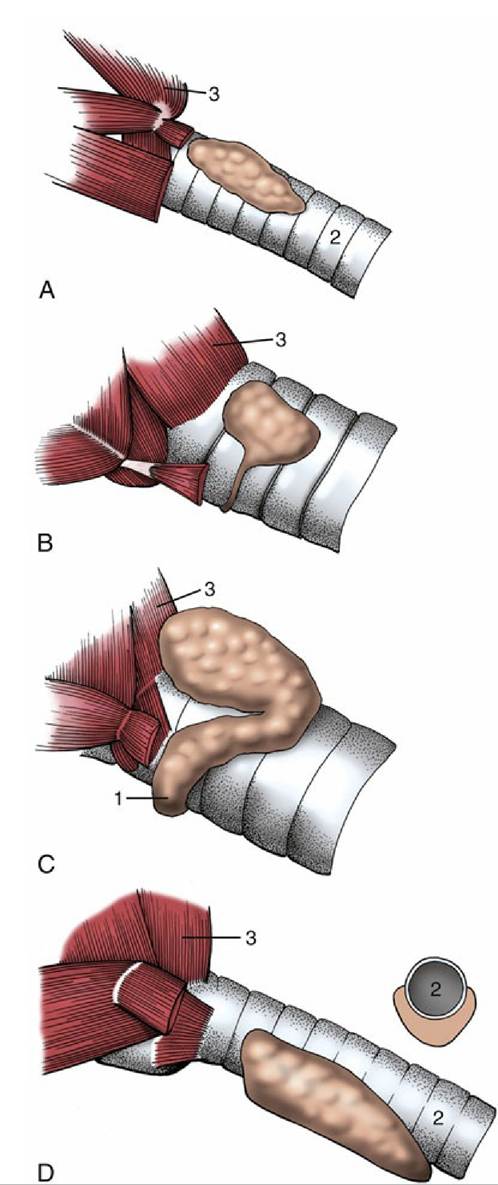
FIG. 6.4 The thyroid gland of the (A) dog, (B) horse, (C) cattle, and (D) pig. The inset to (D) illustrates the subtracheal connection in transverse section in the pig. 1, Isthmus; 2, trachea; 3, cricopharyngeus.
The gland is mainly supplied by the cranial thyroid artery, which arises from the common carotid artery and arches around the cranial pole. A subsidiary supply is occasionally provided by a caudal thyroid artery, which takes a more proximal origin. In the dog the two vessels are connected by a substantial anastomosis along the dorsal margin. The venous drainage is to the internal jugular vein. The glandular tissue receives both sympathetic and parasympathetic fibers routed through the cranial cervical ganglia and the laryngeal branches of the vagus nerves, respectively. The fibers are
predominantly vasomotor, and denervation has little effect on secretory activity. The main lymph drainage of the thyroid in the dog proceeds to the cranial deep cervical nodes.
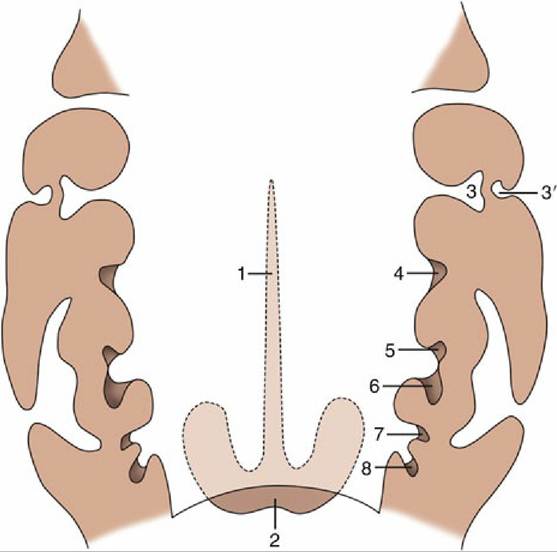
FIG. 6.5 The pharyngeal primordia of certain endocrine structures; dorsal view, schematic. 1, Thyroglossal duct; 2, thyroid gland; 3, first pharyngeal pouch; 3', external acoustic meatus; 4, palatine tonsil (second pouch); 5, parathyroid III; 6, thymus; 7, parathyroid IV; 8, ultimobranchial body.
A small portion of the parenchyma is provided by parafollicular (or C) cells. These appear to have their origin in the ultimobranchial bodies that derive from epithelial clusters of the fourth pharyngeal pouches that are invaded by neural crest cells (Fig. 6.5/8). C cells produce calcitonin, a hormone antagonistic to parathormone in some species. This hormone also seems to play a role in fetal bone growth, and it protects the maternal skeleton against excessive demineralization.
The thyroid hormones, which regulate metabolism and growth, are produced by the follicular cells that compose the bulk of the parenchyma. They are stored in the follicular fluid and later broken down to yield the final products, which are released into the bloodstream.