THE VESTIBULE AND VULVA
The vestibule, much shorter than the vagina, lies mainly if not entirely caudal to the ischial arch, which is a circumstance that permits it to slope ventrally to its opening at the vulva.
The amount of “drop” is variable, both among species and individuals (Figure 5-61). The resulting inflection of the axis of the genital passage must be borne in mind when introducing a vaginal speculum or other instrument.The walls of the vestibule are less elastic than those of the vagina and come together at rest, reducing the
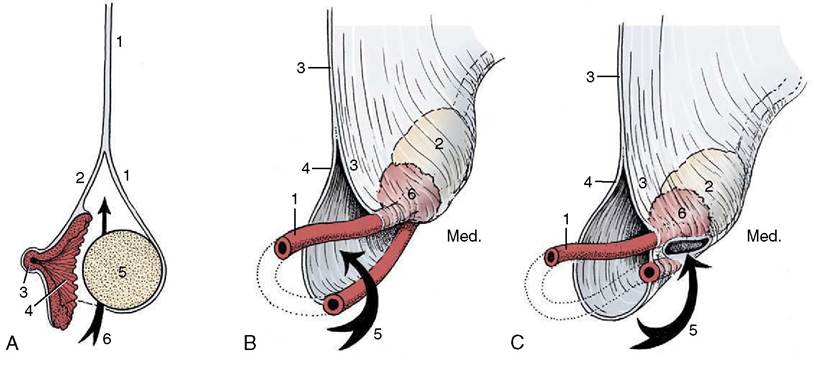
Figure 5-60 A, Schematic representations of the ovary and the suspensory system of the ovary and uterine tube and of the varying form of the ovarian bursa. 1, Mesovarium; 2, mesosalpinx; 3, abdominal opening of uterine tube; 4, infundibulum; 5, ovary; 6, the arrow is in the ovarian bursa. Schematic representation of the suspensory system of the ovary and uterine tube and of the varying form of the ovarian bursa. B, Spacious bursa with large entrance (cow, mare). C, Bursa with constricted entrance and entrapped ovary (bitch). 1, Uterine tube; 2, ovary; 3, mesovarium; 4, mesosalpinx; 5, arrow entering the ovarian bursa; 6, infundibulum.
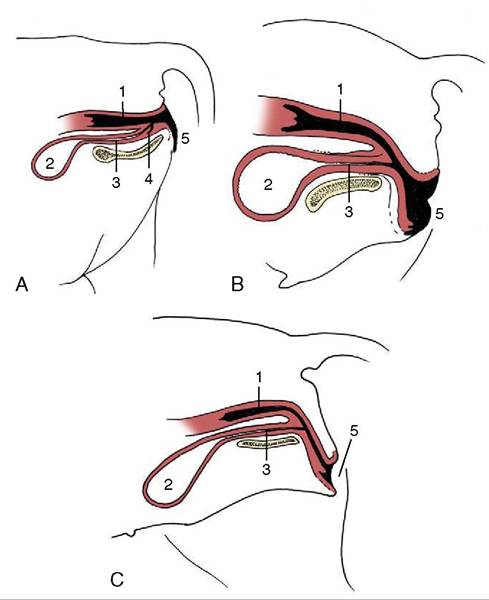
Figure 5-61 Variation in the position of the vestibule in relation to the ischial arch (A, cow; B, mare; C, bitch). 1, Vagina; 2, bladder; 3, urethra; 4, suburethral diverticulum; 5, vulva.
lumen to a vertical cleft. The urethra opens on the floor, directly caudal to whatever indication of a hymen (Figure 5—62/4) may exist. In some animals, for example, the bitch, the urethral opening is raised above the general level of the vestibular floor (Figure 5-35); in others, such as the cow, it is associated with a suburethral diverticulum (Figure 5-32/72'). More caudally, the vestibular walls are marked by the entrances of the ducts of vestibular glands.
In certain species (e.g., bitch) the glands are small but numerous and the duct orifices form linear series; in others (e.g., cow) a large glandular mass to each side drains by a single duct (Figure 5-59/13). In a few species (e.g., ewe) both minor and major vestibular glands are present. These glands produce a mucous secretion that lubricates the passage at coitus and at parturition. At estrus the odor of the secretion has a sexually stimulating effect on the male. The vestibular wall is exceptionally well vascularized with a concentration of veins forming a lateral patch of erectile tissue known as the vestibular bulb and regarded as the homologue of the bulb of the penis.The vestibule opens to the exterior at the vulva. The vertical vulvar opening is bounded by labia that meet at dorsal and ventral commissures. Except in the mare, the dorsal commissure is rounded, the ventral one pointed and raised above the level of the surrounding skin. The labia correspond to the (inner) labia minora of human anatomy; the (outer) labia majora are suppressed in domestic species.
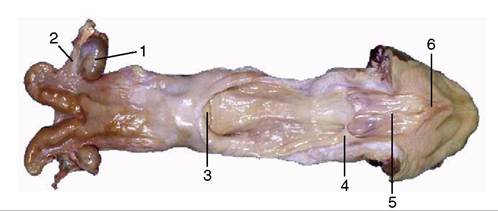
Figure 5-62 Uterus and opened vagina of the cow. 1, Ovary; 2, uterine tube; 3, cervix; 4, hymen; 5, vestibule; 6, glans of clitoris.
The clitoris, the female homologue of the penis, lies just within the ventral commissure (Figure 5-59/74). It is formed of two crura, a body and a glans, in the same fashion as its much larger male homologue. Without dissection, only the glans is visible where it projects within a fossa on the vestibular floor, partly enveloped by a mucosal fold constituting a prepuce.