There are three types of muscle in the body: skeletal, cardiac, and smooth muscle.
Skeletal muscle makes up about 40% of the body, and smooth muscle and cardiac muscle make up almost 10% more. Because most veterinary patients with disease of the neuromuscular system exhibit abnormalities of movement, it is important to understand how skeletal muscle functions and how it is controlled by the nervous system.
Abnormalities of cardiac muscle and smooth muscle feature prominently in many other clinical disorders (e.g., dilated cardiomyopathy, hypertension, detrusor hypertrophy), and such muscle is often the target of pharmacological clinical intervention (e.g., sympathomimetic drugs, adrenergic receptor antagonists).This chapter explains the physiology of skeletal muscle and includes brief comparisons with cardiac and smooth muscle. Cardiac muscle is discussed more extensively in Section III chapters, and the role of smooth muscle in other body systems is mentioned throughout this book.
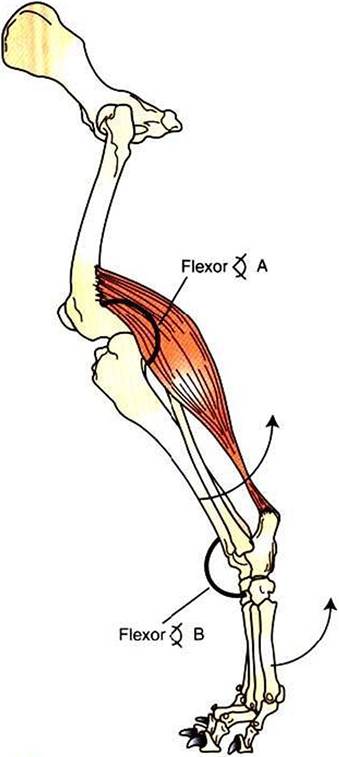
FIGURE 6-1 All noticeable movement is the result of contraction (shortening) of a skeletal muscle attached across a movable joint. Contraction of the muscle will decrease the flexor angle at joint A (the stifle joint) and increase the flexor angle at joint B (the tarsal joint).This will produce the respective movements about the joints indicated by the arrows.