THERMOREGULATION
Reptiles are ectothermic (Fig. 2.2), that is, they are unable to generate their own body heat and so rely on external sources to regulate their body temperature. This basically means that reptiles draw their heat from their environment and not from their food.
Some metabolic heat is produced but the poor insulation due to the lack of fur and body fat means it cannot be retained. Thermogenesis is only reported in two species: the giant leatherback sea turtle (Dermochelys coriacea), which can retain heat because it has large amounts of body fat, and incubating female Indian pythons (Python molorus), which generate heat by muscle contractions (Bartholomew 1982; Bennett & Dawson 1976; Gregory 1982; Seymour 1982).Advantages of ectothermy
The advantage of ectothermy is that reptiles do not waste energy maintaining their body temperature. While a small mammal, like a mouse, has high energy demands, a reptile of the same size will have just a tenth of the energy requirements. In fact, the food required by a small avian insec- tivore for 1 day would last a lizard of equivalent size about
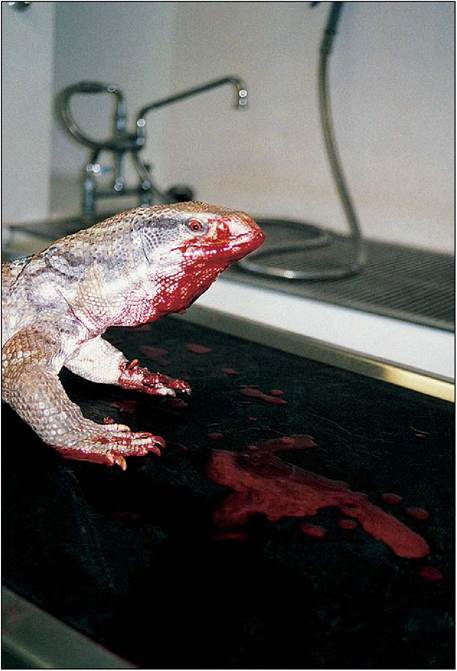
Figure 2.2 • As can be seen by this hemorrhaging Bosc monitor (Varanus exanthematicus), reptiles are not cold blooded as previously thought but are ectotherms.
35 days (Bennett & Nagy 1977). This lower food requirement and efficient food conversion has enabled reptiles to adapt to niche environments like arid deserts. It also enables them to survive hibernation and night cooling much better than mammals that need energy to keep warm at night (King 1996a; Pough et al.1998a).
Disadvantages of ectothermy
The main disadvantage of ectothermy is that all activity is limited by the ambient temperature. This means that the environmental range of reptiles can be limited and they become grounded when it is cold or at night.
They are also unable to sustain high levels of activity for long because, unlike endotherms, they have poor aerobic capacity and so rapidly switch to anaerobic metabolism. This leads to fatigue when lactic acid builds up (King 1996a; Pough et al. 1998a).Control of thermoregulation
Thermoregulation is controlled by the pre-optic nucleus of the hypothalamus in the brain. This receives blood from the heart via the internal carotid arteries. Temperature sensors can then stimulate behavior and physiological behavior according to the temperature. In lizards, the pineal gland and, in some species, the parietal eye may also play a role in regulating body temperature (Firth & Turner 1982; Pough et al. 1998c).
Preferred optimum temperature zone
The preferred optimum temperature zone (POTZ) is the temperature range of the reptile's natural habitat (Fig. 2.3). It can vary by 4-10° C, depending on the species, but is usually within a range of 20-38° C. The exception is the tuatara, which has a range of 12.8-20° C. Within this range, reptile species will have a preferred body temperature (PBT) for each metabolic function, like digestion and reproduction, which varies according to season, age, pregnancy, etc. (Pough et al. 2002b).
Reptiles
19
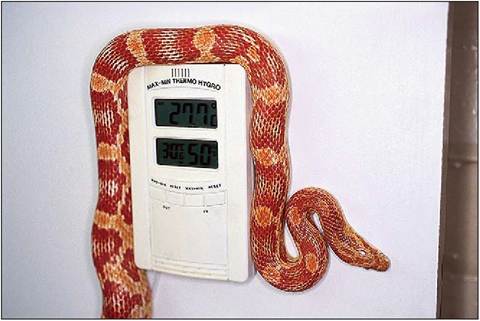
Figure 2.3 • All reptiles have a POTZ (preferred optimum temperature zone) which is the temperature range of their natural habitat. This cornsnake (Elaphe guttata) has a POTZ of 25-30° C.
CLINICAL NOTE
In order to be able to heat up and cool down a wild reptile follows a temperature gradient. For example, lizards will shuttle between basking in the sun to warm up and seeking shade to cool down. Consequently, in captivity both adequate temperature gradients and facilities to heat up and cool down must be provided (Barten 1996).
Reptiles
20
Behavioral fever
Sick mammals exposed to bacterial endotoxins release endogenous pyrogens which act on the hypothalamus to raise the temperature and create fever.
This increase in temperature helps fight the immune system. Reptiles are unable to do this, but if ill or exposed to infection they actively seek extra heat; this is known as behavioral fever (Firth & Turner 1982).Mechanisms of thermoregulation
Reptiles derive their heat via heliothermy or thigmothermy, or a combination of the two. Heliothermy means obtaining radiant heat by basking in the sun and is used by many diurnal reptiles, especially lizards. Thigmothermy is common in nocturnal or forest dwelling species, which acquire thermal energy via conduction with hot surfaces. The lack of insulation produced by scales enhances this thermal conduction (Bellairs 1969c; Espinoza & Tracy 1997).
Effect of heart rate and blood shunting
Reptiles have the ability to heat up faster than they cool down and this is facilitated by variations in heart rate and in blood shunting (Bartholomew 1982; White 1976).
The reptile heart rate depends on many factors, such as temperature, body size and respiration rate. It increases as the body heats up and with active respiration but decreases during periods of apnea. In general, reptile heart rates are much lower than mammals but they can rise rapidly at high temperatures. This raised heart rate pumps warm core blood to heat up the periphery speedily. The reverse happens during night cooling (Bellairs 1969c; Firth & Turner 1982; Pough et al. 1998c).
Their 3-chambered heart provides a rapid right to left cardiac shunt. This enables reptiles to bypass the evaporative process of the lungs completely and shunt blood systemically to avoid cooling.
■ Vasomotor dilation and constriction of peripheral blood vessels also aids thermoregulation. During the day, the extremities heat up first and there is peripheral vasodilation. When temperature drops the heart rate slows down causing peripheral vasoconstriction, which results in blood being diverted rapidly to the core to prevent further heat loss (Pough et al.
1998c).Body mass and shape
Many smaller reptiles have a high ratio of surface area to body weight and so lose and absorb heat rapidly. Large species have thermal inertia, that is, they take a long time to heat up and cool down, which enables them to resist rapid temperature change (Espinoza & Tracy 1997).
Reptiles can alter their body shape so that temperature can vary considerably along the body. In order to avoid exposing whole body parts to predators when it is cool, many lizards heat up their heads first in the morning and the body later. They can also lie flat on rocks for maximum heat exchange and elevate themselves onto their toes to reduce heat conduction and cool down in the hot desert sun. They also angle the long axis of their body perpendicular to the sun's rays to gain maximum heat, and face the sun when they want to cool down (Bellairs 1969c; Pough et al. 1998a; White 1976).
Behavior
Snakes and lizards tend to use much greater behavioral thermoregulation than chelonians, which have the shell to help retain heat. Snakes coil up to conserve heat and uncoil to cool down. Lizards select a dark background to heat up or even darken their skin by increasing melanin pigment at the skin surface (Espinoza & Tracy 1997). This darkened skin increases light absorption, which then converts into heat. Many lizards cool down by panting or gular fluttering, which is when they hold their mouth open and vibrate their throat, causing evaporation of water and cooling of the blood in this area (Bartholomew 1982).
Heat can also be lost by seeking shade, plunging into water or climbing higher in the trees to avail of the cooler convection currents. Some desert tortoises, which are unable to seek shade in rocks and crevices as easily as snakes and lizards, hypersalivate and even urinate for emergency cooling by evaporation (Bellairs 1969c; Minnich 1982).
Lighting
Ultraviolet light is important for behavior and vitamin D3 metabolism. UVA (320-400 nm) affects behavior and wellbeing and helps trigger reproduction. UVB (290-320 nm) is necessary for the conversion of provitamin D3 to previtamin D3 (Fig. 2.4) and so is essential for calcium metabolism. Unlike mammals, reptiles utilize cholecalciferol (vitamin D3) rather than ergocalciferol (vitamin D2), so when supplementing reptiles only reptile vitamin supplements should be used. Where possible, the best source of UV light is unfiltered natural sunlight because artificial lighting cannot compare to the UV light from the sun (Boyer 1996).