Unlike the sensory system, which transforms physical energy into neural information, the motor system transforms neural information into physical energy.
All movement is the result of the contraction of varying numbers of extrafusal skeletal muscle fibers within varying numbers of motor units. These extrafusal muscle fibers do not contract until commanded to do so by the alpha (α) lower motor neuron.
The a motor neuron, in turn, does not send such an action potential command until signaled to do so by descending upper motor neurons or from incoming sensory neurons (or interneurons) in a reflex arc. Thus the a motor neuron is the "final common neural pathway” by which the nervous system can initiate the extrafusal muscle contractions that result in movement.Movement can be divided into two general forms. The first is a largely learned, voluntary, conscious, and skilled form, often dominated by flexor muscle activation. The second form is characterized by postural, antigravity muscle activity that is generally subconscious, involuntary, and dominated by extensor muscle contraction. The skilled movement results from fairly discrete contraction of a few muscle groups, many of which are distal to the spinal column. The maintenance of posture often includes longer-term contraction of larger groups of muscles, many of which are located closer (proximal) to the spinal column. Correspondingly, in the spinal cord gray matter, the α motor neurons that control the more distal muscles tend to be located laterally; those controlling the more proximal and axial muscles for posture are located more medially.
Initiating the learned, skilled, voluntary movement of the distal musculature is largely the responsibility of a subgroup of upper motor neuron tracts that project through more lateral regions of the spinal cord white matter and terminate in lateral regions of the spinal cord gray matter. Initiating antigravity and postural muscle activity is the responsibility of upper motor neuron tracts that are associated with more medial regions of the spinal cord white and gray matter, respectively.
This lateral-medial distinction is a significant organizational principle in central nervous system (CNS) motor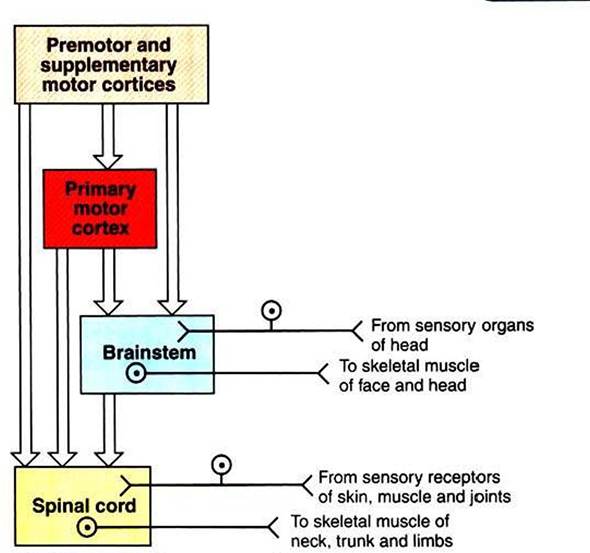
FIGURE 10-1 Motor system hierarchy.
control. Skilled, voluntary movement of the distal musculature is primarily controlled by a lateral system of lower motor neurons and upper motor neuron spinal tracts. More medial systems of such neurons and tracts primarily control postural and antigravity activity of the proximal and axial musculature.
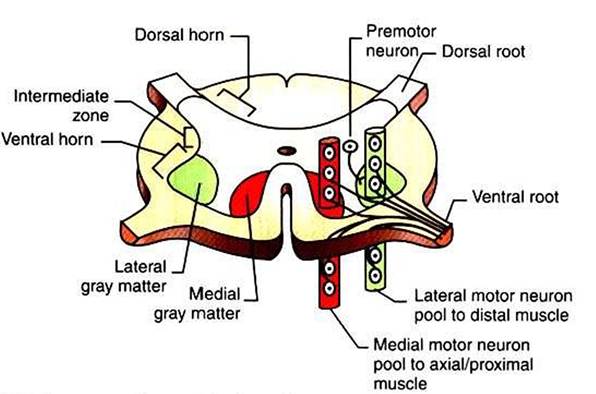
FIGURE 10-2 Somatotopic organization of lower motor neurons in the ventral horn of the spinal cord that respectively supply the distal and axial/proximal musculature. Cell bodies of motor units supplying a given muscle are arranged in longitudinal columns within the ventral horn called motor neuron pools. Motor neuron pools to more distal muscles lie laterally to those supplying the axial and proximal musculature. Spinal premotor neurons, which synapse on the motor neurons supplying muscles, are located in the intermediate zone of spinal cord gray matter and also have a Somatotopic organization. (Modified from Kandel ER, Schwartz JH, JesseIITM: Principles of neural science, ed 3, NewYork, 1991, Elsevier Science Publishing.)