URINARY SYSTEM REPRODUCTIVE SYSTEM
Kidneys
The kidneys are large, flat, Iobulated organs lying under the caudal carapace, just caudal to the acetabulum (Fig. 3.26). Unlike those in other reptiles, they lie symmetrically.
Short ureters and genital ducts enter into a urogenital sinus, which opens into the floor of the cloaca. Urine passes from the urodeum retrograde into a large, saclike, ventrally placed urinary bladder. This is usually bilobed with the liver lying over the right lobe.Terrestrial species use this to store water for long periods to facilitate water resorption. Some species have cloacal bladders, which may be extra water storage chambers and may also serve as respiratory chambers for species that hibernate underwater for weeks (Bentley 1976; Fox 1977).
CLINICAL NOTE
The proximity of the genital ducts to the bladder means eggs may drop into the bladder if the female strains while laying.
SEXUAL DETERMINATION
• The male plastron is concave while the female's is flat or convex. This is more pronounced in species with high domed shells, to facilitate copulation (Zangerl 1970).
• The tail is often longer and thicker in the male.
• The vent in the male is situated beyond the outer margin of the carapace.
• Male aquatic species have longer claws on the forelimbs (Evans 1986).
Sex determination
Temperature-dependent sex determination is common in Chelonia and discussed in more detail in Chapter 2.
Male
The testes are long, yellow and oval and attached to the cranioventral pole of the kidneys. The vasa deferentia run alongside the ureters to the cloaca. The ventral proctodeum is modified and thickened into a single phallus (Fig. 2.13).
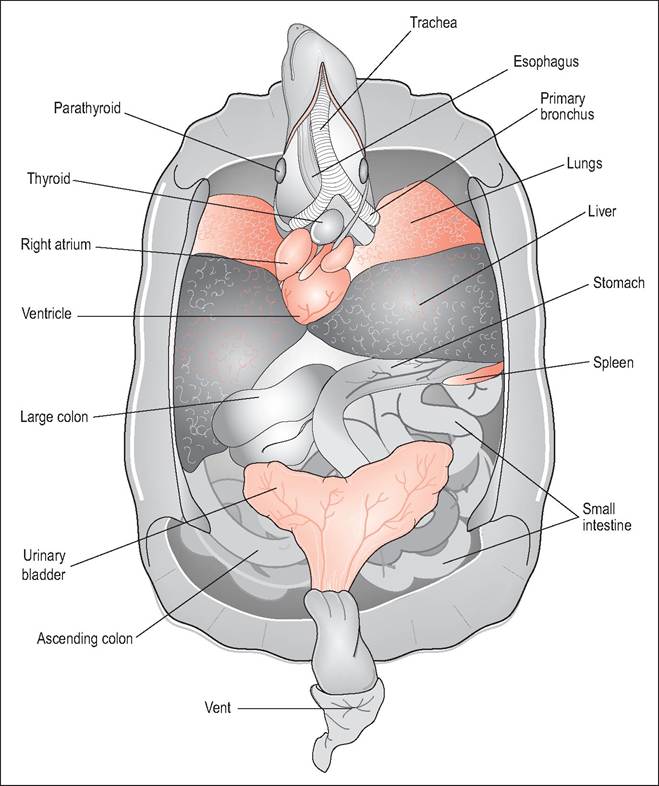
Figure 3.25 • Ventral view of chelonian after plastron and trunk muscles have been removed to show gross anatomy.
This consists of two pairs of fibrous tissue separated by a central trough that, unlike in snakes and lizards, cannot be inverted. This tissue is highly vascular and when inserted into the cloaca of the female it becomes engorged. Semen is conveyed down the central sulcus. A retractor muscle then returns the phallus back into the cloaca (Bellairs 1969c).
Female
The paired ovaries lie symmetrically, cranial to the kidneys. They are irregular, saclike, and paired, with different sized ova that become prominent with mature follicles (Fig. 3.27). The females in some species can retain sperm in their uterus so they can successfully fertilize two or more clutches, often several years after copulation (Pough 1998a).
All chelonians are oviparous. Temperate species lay eggs with soft, flexible leathery shells that can absorb or lose moisture. Tropical species and most land tortoises lay an egg with a hard brittle shell to prevent water loss. In general soft-shelled eggs develop more rapidly than hard- shelled ones. Incubation can be as little as 2 months in some temperate species but 8-9 months in some tropical species. Egg hatching will depend on climate conditions like spring warmth or seasonal rains (Minnich 1982; Pough 1998b).
Copulation
Courtship and mating is very vocal with lots of grunting, crying, and barking. The male mounts from the rear and fertilization is internal.
GENERAL INTEREST
The male Red-eared slider swims backward in front of the female, stroking her face with his long claws and eventually luring her underwater for copulation. As it can take over an hour they have to occasionally surface for air!
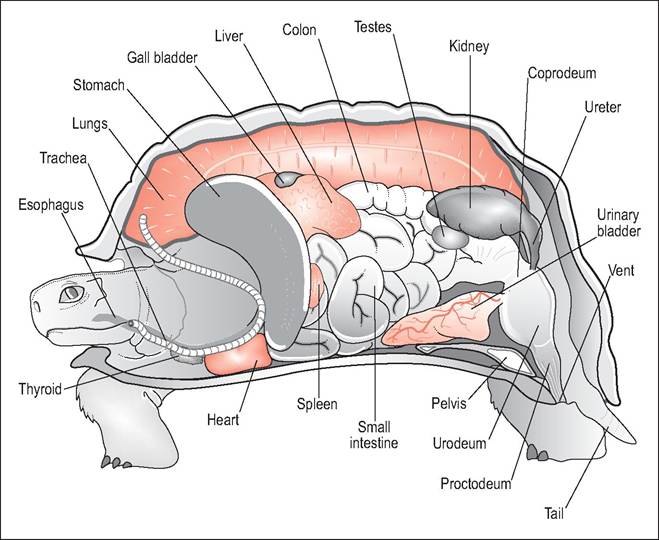
Figure 3.26 • Midsagittal view of chelonian to show gross anatomy.
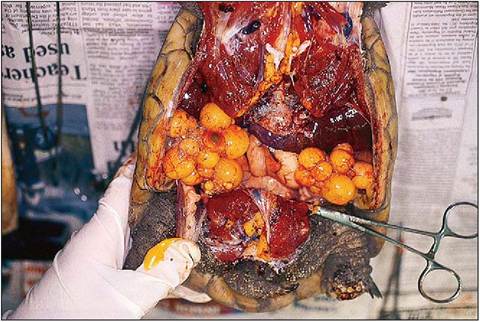
Figure 3.27 • Post mortem appearance of ovarian follicular stasis in a solitary kept Spur-thigh tortoise (Testudo graeca) that died from pneumonia.
Note the huge muscles mass of the cranial and caudal trunk muscles.GENERAL INTEREST
Female sea turtles have often been described as weeping as they dig their nest and lay their eggs. This is not for sentimental reasons but simply due to tear overflow from the salt gland that occurs because of the absence of a lacrimal duct.
an adaptation to terrestrial and aquatic existence. Chelonians also have an upwardly tilted palpebral aperture to aid swimming with the head on the surface of the water (Underwood 1970). The retina is avascular.
Olfaction
SENSES
Sight
Vision is highly developed and based on color vision. The orbit is walled on three sides and, as in lizards and birds, the globe is surrounded by scleral ossicles. They have scaled eyelids and a third eyelid is usually present. The lacrimal gland is modified into a salt gland in marine turtles. They have no nasolacrimal ducts and so lose tears by evaporation (Underwood 1970).
Accommodation occurs by contraction of both the ciliary muscles and the iris sphincter muscle, which is presumably The sense of smell is well developed and linked both to the nasal cavity and Jacobson’s organ. In chelonians, however, this organ is not a distinct outpouching but just a localized area of sensory epithelium (Parsons 1970).
Hearing
Hearing is poor. There is no external ear but an inconspicuous tympanic membrane covered in skin is present in some species. The columella and tympanic cavity are large and a common site for aural abscesses. The middle ear communicates with the pharynx through the narrow auditory (eustachian) tube which is visible inside the pharynx just caudal to the jaw (Murray 1996a; Young 1997).
CLINICAL NOTE
Chelonia with a diet deficient in Vitamin A develop squamous metaplasia of the tympanic cavity lining. This allows bacteria ascending the eustachian tube from the pharynx to colonize, leading to chronic aural abscessation. Unlike in mammals, this pus is caseous and solid because reptiles lack the lysozymes to produce liquid pus; hence surgery is necessary to debride and curette the lesion, along with a requirement to improve husbandry and diet (Murray 1996a).
KEY POINTS
• Lymphatics lie very close to blood vessels so lymphdilution is common
• Trachea is short and lungs have large volume
• Dive reflex and easy anaerobic metabolism can complicate anesthesia
• Bladder is large
• Temperature sensitive determination is common
• Vision and smell are advanced but hearing is poor