DIGESTIVE SYSTEM
Terrestrial (tortoises)
The four groups of abdominal muscles vary between terrestrial and aquatic species.
Inspiration
The serratus muscle arises from the front of the carapace to insert on the coracoid while the abdominal obliquus inserts on the skin of the hindlimb.
When these two muscles contract they create negative pressure and active inspiration. The forelimbs rotate out of the shell, pulling the septum ventrally and causing the lungs to expand and draw in air via the trachea and bronchi (Gans & Hughes 1967; Pough 2002; Wood & Lenfant 1976).Expiration
The pectoralis muscle extends from the plastron to the humerus, and the tranversus abdominus originates from the back of the carapace. When these two muscles contract, the forelimbs rotate back into the shell, pulling the membrane forward and putting pressure on ventral viscera to expel gas (Gans & Hughes 1967; Pough et al. 2002).
About 25% of Chelonia are herbivorous (King 1996) and there are also many omnivores eating some plant matter in their diet. Omnivores tend to favor sedentary prey like molluscs and worms.
Chelonians have no teeth so are unable to chew. Instead, like birds, they have a short horny beak with sharp edges. Most herbivorous species have a row of hard chewing ridges on the palate to allow more precise biting of food. Snapping turtles have very sharp cutting edges to the jaws and can give quite a ferocious bite (King 1996).
The tongue is short and fleshy and the salivary glands produce mucus but no digestive enzymes. The esophagus leads to a simple, spindle-shaped and thicker walled stomach, which lies embedded in the left lobe of the liver. The liver is large and divided into two lobes, and a gall bladder may be found in the right lobe (Figs 3.25 and 3.26). In herbivores the large intestines are wide in circumference and are the site for microbial digestion. A cecum may be present but even in herbivores is not well developed. Digestive enzymes are produced by the stomach, small intestine, pancreas, liver, and gall bladder. Passage of food is slow and can take up to two to four weeks, allowing maximal nutrition to be absorbed (King 1996).
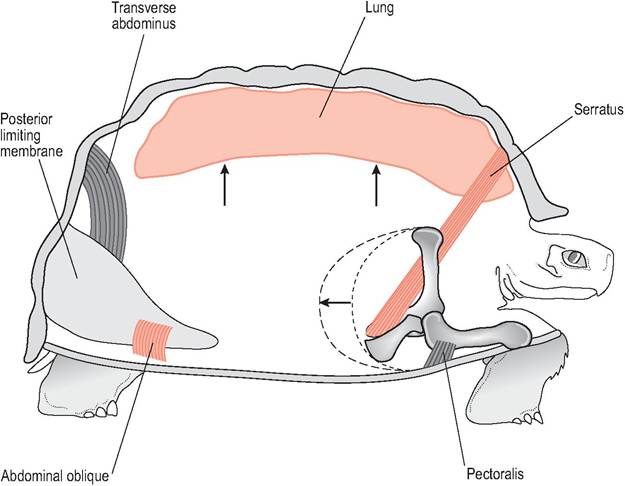
Figure 3.24 • Lateral view of tortoise showing lungs and demonstrating inspiratory and expiratory muscles of respiration.
Red = Inspiratory muscles
Gray = Expiratory muscles
Red = Inspiratory muscles Gray = Expiratory muscles