Vomiting Is a Complex Reflex Coordinated from the Brainstem
Vomiting is a complex reflex activity, and its integration, or coordination, is centered in the brainstem. The act of vomiting involves many striated muscle groups and other structures outside the GI tract.
Vomiting is associated with the following actions:1. Relaxation of the muscles of the stomach and lower esophageal sphincter and closing of the pylorus.
2. Contraction of the abdominal musculature, creating an increase in intraabdominal pressure.
3. Expansion of the chest cavity while the glottis remains closed; this action lowers intrathoracic pressure and thus the pressure in the body of the esophagus.
4. Opening of the upper esophageal sphincter.
5. Antiperistaltic motility (peristaltic motility propelling ingesta toward the mouth) in the duodenum, which may precede the previous actions; thus vomiting may include ingesta of intestinal origin.
The efferent limb of this reflex arc involves motor fibers in many different peripheral nerves.
Afferent stimulation of the vomiting reflex comes from a large number of receptors. Of particular importance are mechanoreceptors in the pharynx and tension receptors and chemoreceptors in the gastric and duodenal mucosa. Stimulation of these receptors sends signals to the vomit center in the brainstem. Thus, noxious tactile or chemical stimulation of the GI mucosa can result in vomiting, clearing, or attempting to clear the offending stimulus from the GI tract. Direct irritation of GI structures, however, is not the only stimulus for vomiting. The vomit center receives afferent input from a variety of organs; thus vomiting is not always an indication of a primary GI problem.
An important structure outside the GI tract that supplies afferent input in the vomit center is the chemoreceptor trigger zone. This is an area of the brainstem that lies in contact with the third ventricle. The chemoreceptor trigger zone is sensitive to the presence of some drugs and toxins in the blood. When stimulated, this zone sends signals to the vomit center and induces vomiting. Some of the products of inflammation stimulate the chemoreceptor trigger zone. Thus, inflammatory disease, even outside the GI tract, can sometimes lead to vomiting.
The semicircular canals of the inner ear are other important structures that supply afferent input to the vomit center. Constant stimulation of the semicircular canals may induce vomiting, as occurs in motion sickness. Other sites in the body also may stimulate the vomit center; thus vomiting is a rather nonspecific sign of disease.
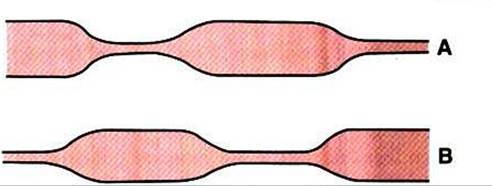
FIGURE 28-9 Segmentation in the small intestine. A, Areas of circular muscle constriction close the lumen and divide the gut into dilated segments containing ingesta. B, At periodic intervals the areas of constriction and dilation alternate, exerting a mixing and circulating action on the ingesta.