Anhidrosis
Babetta Breuhaus
Description of Disease that Thoroughbreds and warmbloods, especially those with a family history of having developed anhidrosis, were more likely to develop the condition.1 The study also supported earlier beliefs that horses that performed more strenuous work and horses that were not born in Florida were at increased risk for becoming anhidrotic.
The prevalence of anhidrosis was increased, both in terms of percent of farms that housed at least one anhidrotic animal and of overall percent of affected horses, in horses residing farther south within the state.1Etiology and Pathophysiology
The cause of anhidrosis is unknown. Presumably, there is an abnormality in stimulation or production of sweat. Equine sweat glands produce sweat as an ultrafiltrate from plasma; water and electrolytes are secreted into sweat gland ducts, and this fluid is transported to the skin surface as sweat. Physiologic stimulation of sweating in horses is achieved by activation of α2-adrenergic receptors, by direct neural stimulation and from circulating catecholamines.2-4 It is unclear whether nerve fibers act directly on the sweat glands themselves or on local capillaries, thereby altering delivery of circulating agonists.5 Purinoceptors of the P2Y family may also be involved in stimulation of sweat production. Sweat glands from anhidrotic horses do not respond normally to direct stimulation, and there is histologic evidence of sweat gland atrophy.6,7 However, it is unknown whether the observed sweat gland atrophy is the primary cause of anhidrosis or merely secondary to disuse. Histologic examination of skin from anhidrotic horses showed no evidence of neural disruption to the sweat glands,7 and circulating concentrations of epinephrine are actually higher in anhidrotic horses than in horses that sweat normally.8 This suggests that the problem is more likely caused by decreased ability of sweat glands to respond to stimulation, rather than failure of the thermoregulatory system to perceive the need to sweat or failure of stimulation to sweat.
Cultured epithelial cells from sweat glands of anhidrotic horses had lower transepithelial resistance compared with cells derived from sweat glands of horses that were able to sweat freely.9 In addition, cells from anhidrotic horses failed to show a change in short circuit current (indicative of chloride secretion) in response to purinocep- tor or β-adrenoceptor agonists. Most theories of anhidrosis pathogenesis suggest that chronic stimulation to sweat in a hot, humid environment might lead to downregulation and7or desensitization of α2-adrenoreceptors. The observation that only some horses living in a given environment develop anhidrosis, as well as the recent evidence of a breed and familial predisposition to the problem, suggest a possible genetic predisposition as well. It seems likely that β-adrenoceptor polymorphisms exist in horses and that certain polymorphs are more susceptible to downregulation, though scientific evidence for this theory is currently lacking.In addition to a neural mechanism, there may also be an endocrine component to this disease. Pregnant mares were found to be somewhat less at risk of developing anhidosis than nonpregnant mares.10 An association of anhidrosis with hypothyroidism most likely stems from the observation that thyroid supplementation helped anhidrotic horses racing in Hong Kong in the 1950s.11 However, the author has not observed any improvement in anhidrotic pleasure horses supplemented with thyroid hormones, and measurement of thyroid hormones at rest and in response to TRH showed no difference between normal horses and horses with anhidrosis.12
There is evidence in some humans that acquired idiopathic anhidrosis may have an immunologic pathogenesis. Serum IgE concentration was increased in one reported case.13 Sweat gland atrophy with infiltration by lymphocytes and mast cells and IgG and C3 deposition in the basement membrane has been described.13,14 Steroid therapy improved the ability of one of
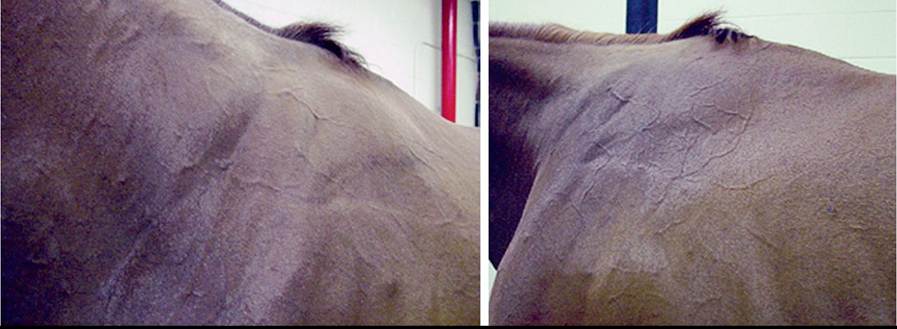
FIG.
41.10 Horses that cannot cool by sweat production will often show dilated peripheral skin vessels.these patients to sweat. An immune-mediated basis for anhidrosis has not been studied in the horse. Basement membrane was noted to be thickened in skin biopsies from 10 anhidrotic horses.7 However, inflammation (leukocyte infiltration) was noted in only one of six anhidrotic horses housed at ambient
7
conditions.7
Expression of the water channel aquaporin-5 was decreased in sweat glands from anhidrotic horses compared with sweat glands from horses that sweated normally.15 While these results may help explain why hypohidrotic or anhidrotic horses cannot produce as much sweat as normal horses, it is not clear whether loss of these water channels is a cause or a consequence of decreased sweat gland secretory capacity. A recent review provides additional detail on the physiology and pathophysiology of equine sweat gland function and dysfunction.16
Clinical Signs and Differential Diagnoses
Early clinical signs of hypohidrosis include exercise intolerance, particularly in warm humid weather, and tachypnea, initially during or after exercise, and then at rest as the severity of disease increases. Owners may initially suspect that their horse has a respiratory problem. As hypohidrosis worsens or the horse becomes anhidrotic, owners realize the horse is not sweating as much as would be expected for the level of work it is performing, or it is taking longer than normal to cool out after exercise. Areas of residual sweat production often include under the mane, in the axilla or inguinal areas, and under the saddle. Dilated vessels under the skin may be noted (Fig. 41.10). A few horses exhibit extrusion of salt crystals without accompanying water (Fig. 41.11). Body temperature can increase to dangerous levels if signs are not recognized and affected horses continue to work in hot weather. The hair coat often becomes dry and thin in chronically affected horses, particularly over the face (Fig.
41.12) and cannon bones.Clinical Pathology and Diagnostic Tests
Hypohidrosis or anhidrosis can be included in a differential diagnosis of exercise intolerance on the basis of history and clinical signs. The diagnosis can be confirmed by performing an intradermal sweat test.6,17-20 Six serial 10-fold dilutions of an α2-adrenergic agonist such as terbutaline (10-3 w/v to 10-8 w/v) are prepared. Each dilution (0.1 mL) is injected intradermally along the neck or pectoral region. In normal horses, a localized area of sweat will appear at the site of injection at all concentrations, except perhaps the most dilute concentration (10-8). The amount of sweat produced at each site is proportional to the concentration of terbutaline injected (Fig. 41.13). Sweating will
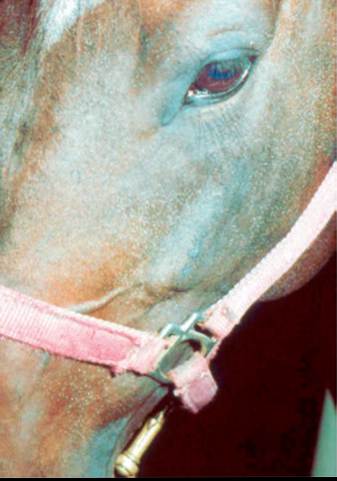
FIG. 41.11 Salt crystals secreted in response to exercise (lunge test) in an anhidrotic horse. Following a lunge test, this horse excreted the salt crystals shown here, without a fluid component to the sweat. The author has observed this in two horses diagnosed with anhidrosis.
first be noted in normal horses within 5 minutes of injection at the higher concentrations. Onset of sweat production may be delayed and amount of sweat produced reduced in hypohidrotic horses, or hypohidrotic horses may only sweat at the higher concentrations of terbutaline. Anhidrotic horses do not sweat, even at the highest concentration.
While failure to sweat in response to intradermal terbutaline injection confirms a diagnosis of anhidrosis, horses that are hypohidrotic may continue to produce sweat, even at the lower concentrations. For these horses, a lunge test will help confirm the diagnosis. Body temperature, heart rate, and respiratory rate are recorded. The horse is then lunged at a trot for 30 minutes on a hot day. During this time, the horse is observed for evidence of sweat production.
Body temperature, heart rate, and respiratory rate measurements are made immediately at the end of lunging and every 10 minutes thereafter for the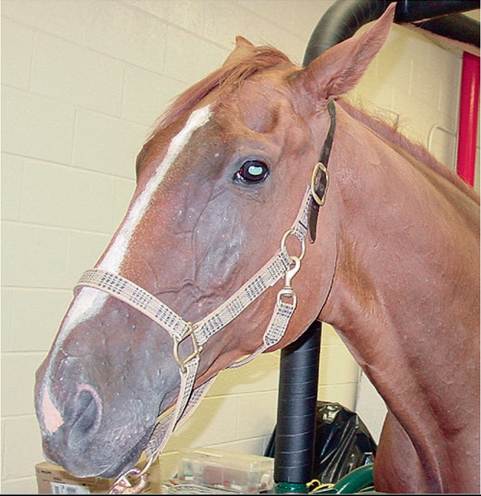
FIG. 41.12 Chronic anhidrosis often causes facial hair loss or thinning.
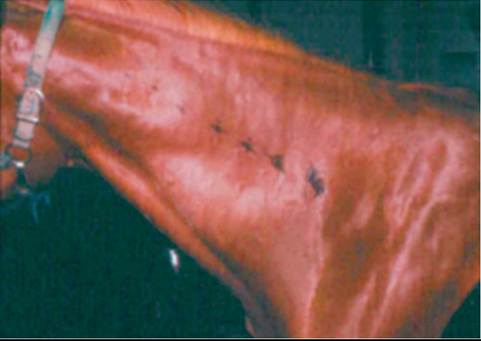
FIG. 41.13 Terbutaline intradermal sweat test. Six serial 10-fold dilutions of terbutaline are injected intradermally along the neck. Normal horses, such as the one shown here, will sweat at the injection site of all concentrations, except perhaps the most dilute (10-8 w/v). In the normal horse, sweating will typically begin within 5 minutes of injection. Reduction in the amount or delay in onset of sweating is diagnostic for hypohidrosis. A complete failure to sweat in response to all terbutaline concentrations is diagnostic for anhidrosis.
next 30 minutes. While the heart rate response reflects the degree of fitness, the body temperature and respiratory rate responses correlate better to the horse's ability to cool itself. If the horse's respiratory rate is not back to what it was before the onset of lunging by 30 minutes after the end of the exercise, it is highly likely that the horse is having a problem cooling.
The most likely differential diagnoses for hypohidrosis include various respiratory diseases. In the author's experience, some hypohidrotic or anhidrotic horses also have mild airway inflammation, documented most often by increased mast cells or eosinophils in bronchoalveolar lavage fluid. It is unknown whether the two problems coexist coincidentally or if there is a mechanistic link. Either way, it is likely that airway inflammation would decrease the ability of a horse to use its respiratory system to help cool itself, and this is likely to be more critical in a horse that cannot sweat.
Treatment, Prevention, and Prognosis
The only consistently successful treatment is movement of the horse to a cooler environment, although this is not always practical or feasible.
Other environmental or dietary alterations may or may not be helpful. For hypohidrotic horses or horses that are having their first episode of anhidrosis, it is important to stop any workload and decrease the stress level. Concurrent disease conditions, such as airway inflammation, should be appropriately treated. Shade, fans, misting fans, and window air conditioners can be used to try to decrease the temperature in the horse's local environment. Applying water by hose or sponging the horse with water during the hot part of the day can take the place of sweat. Electrolyte supplementation (especially KCl) has been advocated,18,19 and various products are available commercially that appear to help some, but not all, horses. One such supplement (One AC, MCPO, Phoenix, Ariz.) contains L-tyrosine, ascorbic acid, niacin, and cobalt and claims to improve sweat production by supplying precursors to dopamine synthesis. The theory is that dopamine improves skin vasodilation, resulting in increased blood flow to sweat glands during exercise. To the author's knowledge, there are no studies at present to support or deny this claim. Other treatments that have been used with mixed success include vitamin E administration,21,22 acupuncture, and Chinese herbs.18,19Medical therapy of anhidrosis has primarily been unrewarding. Anecdotally, the α2-adrenergic agonist clenbuterol increases sweat production in hypohidrotic horses and may be useful if used sparingly, only when weather conditions are particularly bad (i.e., extremely high heat and humidity). However, traditional recommendations are to avoid use of α2-adrenergic agonists in hypohidrotic horses because their use theoretically might precipitate complete anhidrosis.23 In a recent study, oral clenbuterol administration was shown to lose its beneficial effect on airway reactivity after 21 days of administration, but prolonged clenbuterol administration had no effect on results of intradermal terbutaline sweat tests.24 However, the horses used in that study were neither hypohydrotic nor anhidrotic. The effect of prolonged α2-adrenergic agonist administration on sweating or response to intradermal sweat tests in anhidrotic horses has not been reported. There is increasing evidence in human medicine that combination treatment of chronic airway disease with both α2-adrenergic agonists and corticosteroids results in a synergistic effect, with corticosteroids helping to prevent desensitization and tolerance to α2-adrenergic agonists and α2-adrenergic agonists potentiating the anti-inflammatory effects of the corticosteroids.25,26 Thus, combination therapy may be useful in hypohidrotic horses, but to date no controlled studies have been performed. Corticosteroid therapy may also be useful if there is an immune component to the pathogenesis of anhidrosis.
Once a horse has had an episode of anhidrosis, certain measures can be taken to try to prevent recurrence of the problem in subsequent years. Before the hot part of the year begins, start the horse on any supplements that have been helpful previously and make certain the horse is cardiovascularly fit. Also, make sure that any respiratory problems are under control before the onset of hot weather. As the hot season approaches, try to avoid procedures that might require administration of heavy doses of α2-adrenergic agonists (e.g., xylazine, detomidine) that stimulate the horse to sweat. Plan to do these procedures during the cooler parts of the year. During hot periods, work the horse only during the cool parts of the day. Use external water sources to cool the horse to decrease the need for the horse to sweat.
The prognosis for hypohidrotic horses is guarded for future athletic performance in a hot environment. It is the author's opinion that the longer an anhidrotic horse has been left untreated or unmanaged, the less likely the horse will be to sweat again despite any of the treatments described earlier. However, if an underlying disease or problem can be identified and treated successfully in a horse that is just becoming hypohidrotic, the likelihood that the horse will sweat better the following season is improved.