CALCULATION OF NUTRITIONAL REQUIREMENTS
Once a decision is made that nutritional support is indicated and that the GI tract can be used, the number of calories (kilocalories), grams of protein,

Figure 12-30 Percutaneous gastroduodenostomy tube placement.
A, Ventrodorsal view of the abdomen of a dog, depicting the location of the percutaneous endoscopic gastrostomy (PEG) tube (1) and the percutaneous gastroduodenostomy (PEGD) tube (2).The tip of the PEGD tube is at the caudal duodenal flexure. B, With the dog in right lateral recumbency, the enteral tube is pushed into the PEG tube after shortening the PEG tube and infusing it with 2.5 ml of water-soluble lubricant. C, Endoscopic view of the gastric fundus.The enteral tube is identified after pushing it through the cut end of the PEG tube (arrows).The suture is grasped with a standard biopsy instrument (large arrowhead). D, Endoscopic view of the duodenum.The dog is placed in left lateral recumbency to facilitate pyloric intubation. The endoscope is advanced aborally as far as possible. The biopsy forceps are advanced until moderate resistance is felt, then the suture is released. The biopsy forceps (large arrow) are retracted,leaving the enteral tube (small arrowheads) in the duodenum. E, Endoscopic view of the pylorus (large arrowheads). The endoscope is gently retracted from the pylorus, while the enteral tube stylet (thin arrows) remains in place. F, Endoscopic view of the pyloric antrum.The endoscope is withdrawn from the stomach, while the remaining length of the enteral tube is pushed into the stomach and the stylet is removed, leaving the enteral tube in place. Arrows indicate where the enteral tube exits the pylorus. (From McCrackin MA et al.: Endoscopic placement of a percutaneous gastroduodenostomy feeding tube in dogs, JAm Vet Med Assoc 203[6]:792,1993.)and milliliters of water required by the animal is calculated.
Energy Requirements
There are several ways to estimate the amount of calories required by a patient. Illness energy requirements may be estimated by using a multiple of resting energy requirements or some fraction of maintenance energy requirements. In addition, energy requirements may be calculated using a linear or exponential formula. These formulas are presented in Table 12-4.
Although estimates overlap in patients weighing between approximately 2 and 20 kg (5 to 45 lb), in larger dogs the linear formula often overestimates
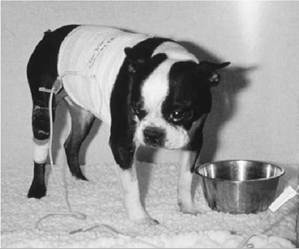
Figure 12-31 Use of a surgically placed enterostomy feeding tube in an adult Boston terrier.
energy requirements. As can be seen from the table, maintenance energy requirements are approximately two times resting energy requirements (RERs) for dogs and one and one-half times RERs for cats. In many patients that are ill, the stress of illness results in increased RERs; however, because of lack of physical activity, energy requirements during illness for most patients are less than maintenance. Numerous reports of critically ill humans indicate that metabolic rates are increased over RER: 25% to 35% postoperatively; 35% to 50% with trauma or cancer; 50% to 70% with sepsis; and 70% to 100% or more with major burns or head trauma. Energy requirements of critically ill humans rarely approach normal maintenance energy requirements. Based on data derived from humans, various factors have been suggested for estimating energy requirements of ill or injured animals. In most critically ill animals, the goal of nutritional support is to maintain body weight and body condition. Therefore a practical alternative to using a complex factoring system is to multiply the RER by a factor of 1.5 for dogs and cats. Alternatively, using the formula 100(BWk 0.75) provides the same results as multiplying the RER by 1.5. The clinician should notice that this represents estimated maintenance energy requirements in cats.
If cats are fed less than maintenance energy requirements, they are likely to lose weight.Protein Requirements
After energy requirements are calculated, protein requirements should be estimated. Dietary protein is necessary to facilitate recovery from illness and injury. Protein requirements of ill or injured patients vary on a patient-by-patient basis.Variables include dietary energy content; dietary protein quantity and quality; and individual patient differences reflecting species, life stage, and type, degree, and stage of injury or illness. Protein requirements of critically ill dogs and cats have not been determined. Unless a patient has compromised renal or hepatic function, intake of dietary protein should meet maintenance protein requirements. Adequate protein intake is necessary to facilitate recovery to provide structural protein for repair of injured tissues, and to optimize immune function. For maintenance, diets should provide a minimum of 4 g of protein per 100 kcal of metabolizable energy (16% of energy as protein) for dogs and 6 g of protein per 100 kcal of metabolizable energy (25% of energy as protein) for cats. Taking into account availability, digestion, and absorption of enterally provided protein, requirements may be estimated at 4 g/BWk for dogs and 6 g/BWk for cats. In patients with liver or renal failure, less protein should be provided, and in patients with hypoalbuminemia or protein loss through the GI tract or through loss of protein-rich fluids (e.g., peritonitis), protein intake should be increased; protein intake should be decreased with protein-losing nephropathy. Protein of high biologic value should be used in critically ill patients. Special importance has been ascribed to metabolism of specific amino acids in nutritional support, and they have been added to commercially available convalescent diets. Arginine is an essential amino acid for dogs and cats and is important in wound healing, immune function, and promoting a positive nitrogen balance.
Glutamine is a principal nutrient for enterocytes and is important in nitrogen metabolism. Branched-chain amino acids, valine, leucine, and isoleucine, decrease trauma- and sepsis-induced muscle catabolism and improve nitrogen retention. Taurine is an essential amino acid in cats and is important for cardiac function.Fluid Requirements
It is important to maintain adequate hydration when providing nutritional support. Fluid is provided in prepared liquid diets or added to canned pet foods to make a gruel for enteral nutrition. Dogs and cats require 50 to 100 ml of water per kilogram of body weight for daily maintenance, depending on environmental temperature, type of food, and level of activity. Canned pet foods typically contain
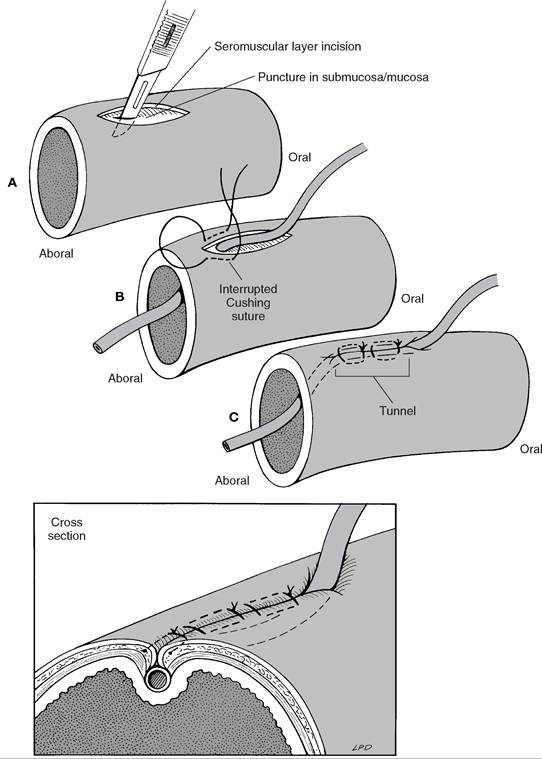
Figure 12-32 Placement of an enterostomy tube. A, Make a 1- to 1.5-cm linear incision in the seromuscular layers of the antimesenteric border of the selected jejunal segment; use the tip of a scalpel blade to puncture a hole in the aboral aspect of the seromuscular incision. B and C, Place the distal end of the feeding tube through the incision; lay the exiting portion of the tube in the 1- to 1.5-cm seromuscular incision and construct a “tunnel” by inverting the seromuscular layer over the tube with three or four Cushing sutures of 4-0 absorbable material. (From Fossum et al.: Small animal surgery, ed 2, St. Louis, 2002, Mosby.)
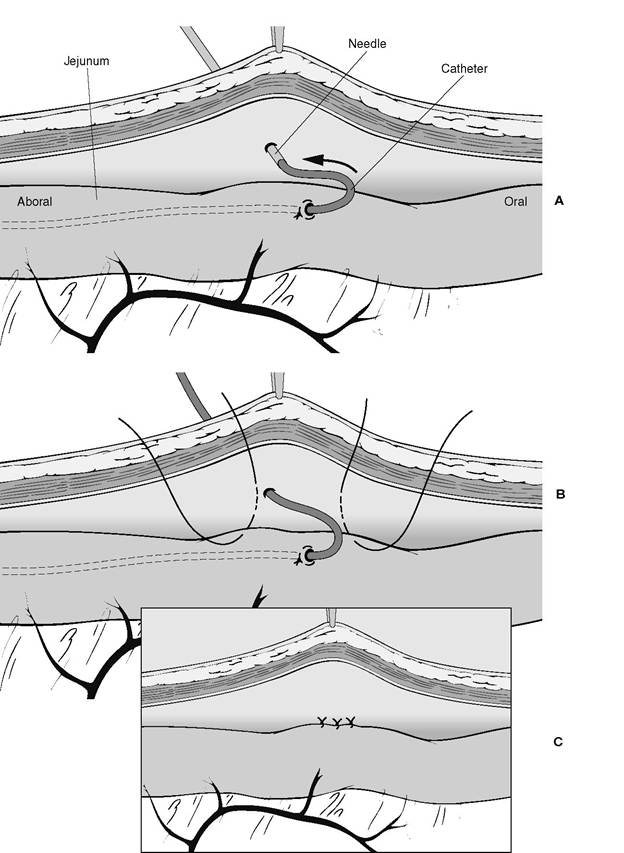
Figure 12-33 A, The catheter is exteriorized through a separate stab incision in the body wall. B and C, The jejunum is attached to the peritoneum with three to four simple interrupted sutures of 3-0 or 4-0 absorbable suture material. (From Fossum et al.: Small animal surgery, ed 2, St. Louis, 2002, Mosby.)
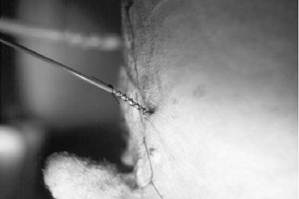
Figure 12-34 Combination of enterostomy feeding tube (red rubber feeding tube in foreground) and gastrostomy feeding tube (mushroom-tipped feeding tube in background) in an adult male West Highland white terrier with acute pancreatitis and hiatal hernia.
70% to 85% water. Normal daily fluid requirements are approximately equal to daily caloric requirements. Patients affected with diseases associated with excessive fluid losses (e.g., polyuria, diarrhea, vomiting, and third spacing of fluids) require more than calculated normal fluid amounts. Abrupt changes in body weight usually reflect hydration status; therefore fluid intake can be adjusted to maintain body weight. Fluid requirements should be met as part of nutritional support. A general recommendation is to mix water and canned diet in a 1:1 ratio to meet maintenance energy requirements for most patients.
Vitamins and Minerals
Little is known about vitamin and mineral status in critically ill patients, although deficiencies have been observed in veterinary medicine. One study in humans indicated that micronutrient deficiency was common (64% of 284 patients examined) in a wide variety of illnesses. Use of well-balanced diets should provide adequate amounts of micronutrients, especially when pet foods are used. Human enteral products may not provide adequate amounts. Oversupplementation should be avoided because excess vitamins and minerals may compromise the patient (e.g., iron supplementation may worsen bacterial infection and oxygen free radical production).