Client Needs
According to a study published in the Journal ofPalliative Medicine, a lack of preparedness when a person was dying resulted in a prolonged grieving period. It showed that caregivers whose loved ones were in a hospice program for as little as 4 days had a significantly reduced amount of depression and grieving than those who did not have hospice services (Hebert et al.
2006). The benefits of caregiver well-being with human hospice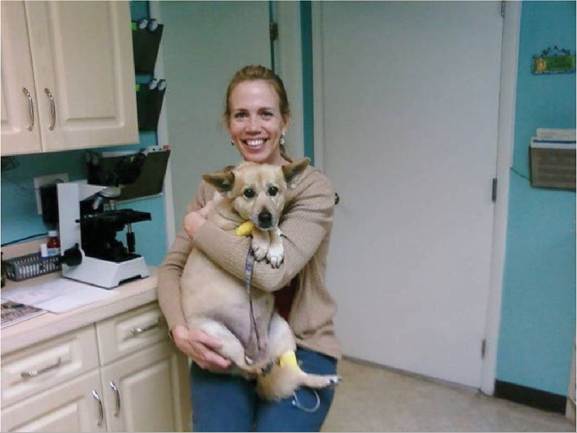
Figure 36.5 Dr. Mary Gardner and hospice patient Cali. Cali needed to be boarded for IV fluids and her owner was allowed to come in the morning and evening for visits and the clinic would send texts with pictures to the mom during the day.
may be carried over to pets in hospice. The more caregivers are able to cope with their decisions, feel confident in their ability to care for their pets, and are properly prepared for the death of their pet, grief and depression may be less - as seen with human hospice.
With all the diagnostic tools and treatment options, we sometimes fail to recognize the other half of the equation - the family and their budgets - what I call ‘The 4 Family Budgets”:
• Time: Caring for a chronically, terminally ill, or advanced-aged, pet requires more time than most realize. Owners must dedicate time to be at home, come home frequently, or make sure someone can care for the pet multiple times throughout the day and in many cases, give medications at an increased frequency. Many families don't have enough time for a healthy pet, let alone one that requires, in many cases, double the amount of time. Often caregivers will not take vacations or postpone work responsibilities just so they can care for their pet during this stage.
• Emotional: The stress of caring for a sick pet can tax the human system to a point where the owner becomes anxious, stressed, sick, and even angry.
I have helped families that struggle emotionally since this was not the first pet they had with a particular disease and they felt guilt for the way they handled their other pet. Or they simply have many personal, emotional issues to deal with (divorce, sick relative, themselves sick, bankruptcy, moving, etc.) and this can greatly compound the responsibility of a sick pet making it almost too much to bear.• Physical: (Particularly larger dogs with mobility issues.) Physically handling a pet with decreased abilities can be a challenge for many care givers or the home is not ideal when trying to care for particular ailments pets may face.
• Financial: The financial budget can be one of the most central of all four budgets however, in my experience, it's not the one that stresses the family the most. Care givers are often willing to pay for their pet's comfort and in most cases, hospice treatment is not an exorbitant amount of money - it's the other three budgets that make caring difficult.
A family may have any component of the budgets strained during the care of their pet - however, if one of the four budgets is exhausted, then humane intervention is not only acceptable, often encouraged. For example, if a pet requires medications every 6 hours as well as to be let out to go to the bathroom and the care giver works an 8 hour shift with an hour commute and has no one to assist them, quality of life for the pet is not sustainable.
Learning what the family most values, the boundaries surrounding their pet's daily life, where their “stop point” is in relation to the pet's disease condition, and what their idea of a “good death” is for their pet is key in helping address the client's needs. Using open-ended questions during the consultation will give the clinician a better understanding of their client's needs.
Below are some example questions to ask owners:
1) Have you ever been through the loss of a pet before? If so, what was your experience (good or bad, and why)?
2) What do you hope the life expectancy of your pet will be? What do you think it will be?
3) What is the ideal situation you wish for your pet's end of life experience? (at home, pass away in her sleep, etc.)
4) Do you hold any stress or anxiety about any of these issues? (This section is meant to help identify the main concerns the family has.)
• Pet suffering
• Desire to perform nursing care for pet
• Ability to perform nursing care for pet
• Pet dying alone
• Not knowing the right time to euthanize
• Coping with loss
• Concern for other household animals
• Concern for other members of the family (i.e., children).
Ideally, every family's budgets and boundaries align with the disease process at hand. It's vital to avoid having owners feel guilty about any of the budgets that they can't afford or if their values and boundaries are not what you would do for your pet in your situation.