Colostrum Supplements and Replacements
The principles of colostrum management are reviewed in Chapter 19. Although feeding 3 to 4 L of clean, high-quality maternal colostrum shortly after birth remains the gold standard, farms can experience periods when an adequate supply of high-quality fresh or stored maternal colostrum is not available.
Also, it may not always be practical or convenient to harvest first milking colostrum from fresh cows within a timely manner after calving (such, licensed products can guarantee safety, potency, purity, efficacy, and traceability. Products licensed by regulatory agencies as bovine IgG for treatment of FPT may not claim nutrient profiles on the label, so this information must be obtained from manufacturers' promotional materials. Table 21.1 lists licensed products currently available in Canada and the United States.Although products that do not have a USDA CVB license are not legally able to claim to supply IgG or to purport to be used for the prevention of FPT, their use for this purpose is widespread in the United States. Bovine colostrum and dried bovine colostrum are official feed ingredients under the Association of American Feed Control Officials (AAFCO) guidelines (www.aafco.org). As such, claims for nonlicensed CR or CS products must adhere to nutrition-based claims but can make no immunity claims. Under AAFCO guidelines, every state (i.e., state Department of Agriculture) adopts and regulates its own animal feed per its applicable laws and regulations relating to label specifications or guaranteed analysis. Although all U.S. manufacturers of non-CVB-licensed CR and CS products will conduct some kind of internal quality control testing, the design of these programs are at the manufacturer's discretion. External product testing or plant inspections by regulatory authorities (e.g., state Department of Agriculture) are not typically completed for non-CVB-licensed products unless a problem or complaint is brought to their attention.
Evaluating the Efficacy of Colostrum Replacement Products
Producers are strongly encouraged to consult their veterinarian and to select CR or CS products that have undergone independent evaluation of efficacy in controlled field studies. Evaluation of efficacy should ideally consider passive transfer of adequate IgG, nutritional support, and calf health and performance. In addition to the age of the calf at time of feeding, passive transfer of IgG will be determined primarily by the mass of IgG (g) administered as well as the apparent efficiency of absorption (AEA %) of the IgG; AEA % is a calculated estimate of the percentage of IgG administered that is absorbed systemically.14 Each product must be independently evaluated, since differences in manufacturing processes can have a significant impact on both AEA % and final mass of IgG in a package.14,15 Head-to-head studies are necessary to make valid comparisons between products. Table 21.2 presents the results of field efficacy studies for commercially available CR and CS products that were mixed and fed according to label directions.
MASS OF IGG PROVIDED IN COLOSTRUM REPLACEMENTS. Although experts originally estimated that producers should feed a minimum mass of 100 g of IgG in the first colostrum feeding, and this has been demonstrated to be sufficient under ideal conditions, most recent studies, especially if conducted under field conditions, have shown that at least 150 g, and preferably 200 g, of colostral IgG must be fed to consistently achieve acceptable passive transfer (APT; serum IgG ≥10 g/L) in the majority (≥90%) of calves.16-19 This dose effect was demonstrated in one study wherein three groups of calves fed either 100 g or 200 g of IgG in a colostrum-derived CR product or 3.8 L of fresh maternal colostrum achieved a mean serum IgG concentration at 24 hours of 9.6 g/L (46% with FPT), 19.0 g/L (0% with FPT), and 20.7 g/L (9% with FPT), respectively (see Table 21.2).19 Although many CR products are packaged to provide 100 to 130 g IgG per pack, some CR products now provide a larger mass of IgG per pack (e.g., 150 g) and/or provide label directions that suggest feeding increased masses of IgG, at the discretion of the producer.
APPARENT EFFICIENCY OF ABSORPTION (AEA %) OF IGG. When considering how APT can be achieved in calves, grams of IgG should be considered more important than absorption percentages. Under most circumstances, the total mass (g) of
■ TABLE 21.1
Licensed Colostrum Replacements and Supplements in the United States (US) and Canada (CA)a
| Product Name | Manufacturer/Distributor | Country | IgG Provided (g) |
| Colostrum Replacement Products | |||
| Replacer 115 | Manufacturer: SCCL (Sask., CA) Distributor: MWI Animal Health (Idaho, US) | US | 115 g in 640-g pack |
| CALF’S CHOICE TOTAL | Manufacturer: SCCL (Sask., CA). Distributors: SCCL (Sask., CA), Rafter 8 (Alta., CA), Grober (Ont., CA) | CA | 100 g in 470-g pack |
| Colostrum 150 | Manufacturer: SCCL (Sask., CA) Distributor: Alta Genetics (Alta., CA) | CA | 150 g in 830-g pack |
| GroStart | Manufacturer: SCCL (Sask., CA) Distributor: Grober Nutrition (Ont., CA) | CA | 100 g in 470-g pack |
| CALF’S CHOICE TOTAL | Manufacturer: SCCL (Sask., CA) | US | 100 g in 700-g pack |
| HiCal | Distributor: Alta Genetics (Wis., US) | CA | |
| Land O’ Lakes COLOSTRUM REPLACEMENT | Manufacturer: SCCL (Sask., CA) Distributor: Land O’ Lakes (Minn., US) | US | 100 g in 470-g pack |
| COLOSTRUM PLUS 100 with | Manufacturer & Distributor: La Belle Associates | CA | 100 g in 500-g pack |
| Escherichia coli Antibody | (Wash., US) | US | |
| COLOSTRX CR Colostrum Replacer | Manufacturer: La Belle Associates (Wash., US) Distributor: AgriLabs (Mont., US) | US | 100 g in 500-g pack |
| PREMOLAC PLUS Colostrum Replacement | Manufacturer: Zinpro Corp. (Minn., US) Distributor: Milk Products (Wis., US) | US | 152 g in 375-g pack |
| Land O’ Lakes COLOSTRUM REPLACEMENT for Kid | Manufacturer: SCCL (Sask., CA) Distributor: Land O’ Lakes (Minn., US) | US | 50 g in 235-g pack |
| Goats & Lambs | |||
| HeadStart Hi-Cal for Lamb & | Manufacturer and Distributor: SCCL (Sask., CA) | CA | 100 g in 700-g pack |
| Goat Kids | |||
| LambGRO/KidGRO Colostrum | Manufacturer: SCCL (Sask., CA) Distributor: Grober Nutrition (Ont., CA) | CA | 100 g in 700-g pack |
| PureStart Colostrum for organic Manufacturer: SCCL (Sask., CA) use Distributor: Alta Genetics (Wis., US) Colostrum Supplement Products | US | 100 g in 700-g pack | |
| Supplement 57 | Manufacturer: SCCL (Sask., CA) Distributor: MWI Animal Health (Idaho, US) | US | 57.5 g in 320-g pack |
| CALF’S CHOICE TOTAL Gold | Manufacturer: SCCL (Sask., CA) Distributor: Alta Genetics (Wis., US) | US | 60 g in 225-g pack |
| HeadStart | Manufacturer & Distributor: SCCL (Sask., CA) | CA | 60 g in 225-g pack |
| COLOSTRX CR Colostrum Supplement | Manufacturer: La Belle Associates (Wash., US) Distributor: AgriLabs (Mont., US) | US | 50 g in 300-g pack |
| Colostro | Manufacturer: SCCL (Sask., CA) Distributor: Federated Coop (Sask., CA) | CA | 50 g in 235-g pack |
| Bovine Dried Colostrum | Manufacturer & Distributor: SCCL (Sask., CA) | CA | 50 g in 350-g pack |
| FIRST COLOSTRUM 50 Colostrum Supplement | Manufacturer: La Belle Associates (Wash., US) | CA US | 50 g in 350-g pack |
| Immu-Start 50 with Escherichia coli Antibody | Manufacturer: Imu-Tek Animal Health (Colo., US) | CA US | 50 g in 400-g pack |
| Just Like Mom | Manufacturer: SCCL (Sask., CA) Distributor: Aspen Veterinary Resources (Mont., US) | US | 50 g in 300-g pack |
aProduct list may change in future. Specifications may change in future; read the label.
Licensing bodies: Canadian Center for Veterinary Biologics, Canadian Food Inspection Agency11; Center for Veterinary Biologics, U.S. Department of Agriculture.62 IgG source for all licensed products is bovine colostrum.IgG, Immunoglobulin G.
IgG fed and the age of the calf at feeding are the most important predictors of APT in calves fed CR products. That said, simply examining the mass of IgG provided by the CR is not an adequate predictor of product efficacy.20 There can be significant differences in AEA % among products due, but not limited, to such factors as manufacturing methods and IgG concentration after reconstitution, as well as inclusion of other nutrients or additives in the product. Controlled field studies using commercially available CR or CS products, mixed and fed according to label directions, have reported widely varying AEA % values (see Table 21.2). The AEA % reported for CS products has ranged between 16% and 28%.21,22 The AEA % reported for CR products has ranged between 14% and 51%.19,23-30 In comparison, the AEA % of IgG reported for calves fed 3 to 4 L of fresh maternal colostrum within 6 hours of birth has ranged between 21% and 36%.19,21,22,28,30
Studies to date have generally reported the AEA % to be significantly higher for colostrum-derived CR products compared to serum- or plasma-derived CR products. In one early CS study in which calves were fed two packs of a colostrum-derived CS (50 g IgG), two packs of one of two different serum-derived CS products (60 g or 90 g Ig, respectively), or 3.8 L of maternal colostrum, the AEA % reported for the colostrum-derived CS (16%) was inferior to that of the two serum-derived CS products (24% and 28%) and the maternal colostrum (22%) (see Table 21.2).21 However, because all three CS products delivered an
■ TABLE 21.2
Selected Efficacy Studies of Colostrum Supplement (CS) and Colostrum Replacement (CR) Products (Limited to Studies of Commercially Available Products Mixed and Fed According to Label Directions)
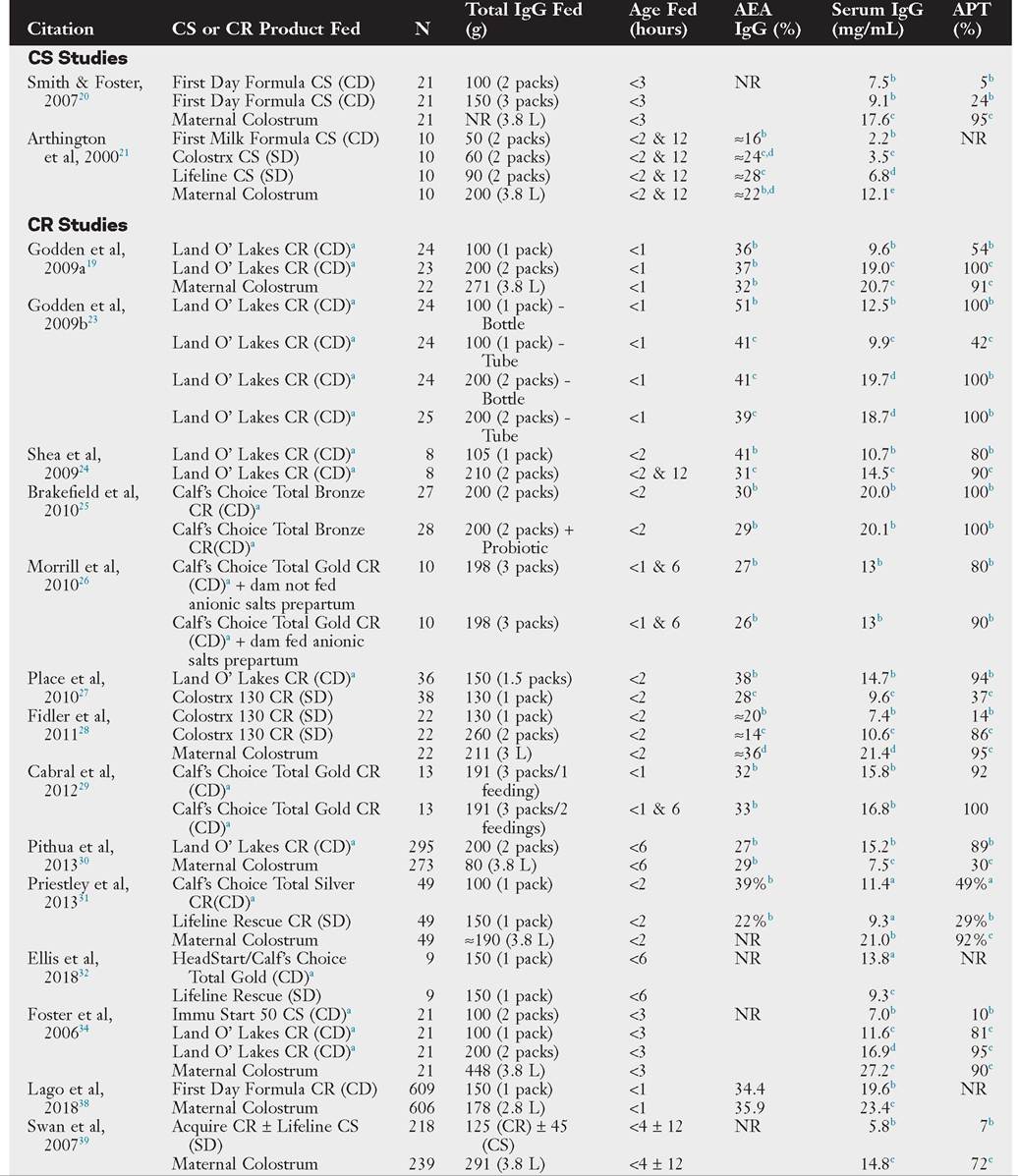
aProduct licensed through Center for Veterinary Biologics (Canadian Food Inspection Agency and/or U.S.
Department of Agriculture).b,c,d,eMeans within column within study with different superscripts differ (P odds ratio 0.52 [0.27 to 1.003]), compared to control calves fed maternal colostrum (11.9% test positive), demonstrating that CR products may be a useful management tool for dairy herds attempting to reduce the prevalence of Johne's disease.40 In addition, Pithua and colleagues determined that the colostrum treatment group had no significant effect on longevity, milk production, or reproductive performance during the first three lactations.41 In a different study of 147 calves at a Florida dairy, the percentage of calves with FPT, preweaning morbidity rates, and preweaning mortality rates for 49 calves fed 150 g of a plasma-derived CR were as follows: FPT 71%, morbidity 71.4%, and mortality 16.3%. For 49 calves fed 100 g of a colostrum-derived CR, these rates were FPT 51%, morbidity 67.3%, and mortality 24.5%. For the remaining 49 calves fed
3.8 L of maternal colostrum, with average IgG intake estimated to be 190 g, these rates were FPT 8%, morbidity 46.9%, and mortality 8.2%.31 The authors concluded that, under the conditions of the study, maternal colostrum was superior to CR, primarily due to an insufficient mass of Ig fed in the CR groups.
Conversely, two more recent studies that fed higher levels of colostrum-derived CR products reported similar or improved health in CR-fed calves compared to calves fed maternal colostrum. In a study of 1220 Jersey and Jersey-Holstein calves born at one California dairy, calves fed 150 g of IgG from a colostrum-derived CR product had lower, but still acceptable, mean blood IgG and serum total protein (STP) concentrations (IgG 19.6 g/L, STP 5.16 g/dL) compared to calves fed 2.8 L of maternal colostrum (IgG 23.4 g/L, STP 5.84 g/dL).38 Evaluating STP to classify calves as APT or FPT is discussed in detail later in this chapter. In that study, the preweaning risk for treatment for scours (CR 85.8%, maternal colostrum 89.0%), risk for treatment for pneumonia (CR 55.2%, maternal colostrum 58.6%), and risk for death (CR 9.4%, maternal colostrum 7.1%) were not different between treatments, although CR-fed calves were 1.5 kg lighter at weaning (CR 47.1 kg, maternal colostrum 48.6 kg).38
A second randomized controlled study of 568 calves at another California dairy reported higher serum IgG concentrations and improved health and growth in calves fed 200 g of IgG in a colostrum-derived CR at birth (serum IgG 15.2 g/L, scours 15.9%, weaning weight 58.9 kg) compared to calves fed 3.8 L of maternal colostrum (serum IgG 7.5 g/L, scours 24.5%, weaning weight 57 kg) (P ranging between 4.2 and 5.6 g/dL.15,27,31,39,58 Given the large variation in predicted STP cut-points, and particularly for the serum-derived CR products, veterinarians are encouraged to use refractometry to monitor the effectiveness of a CR feeding program only if independent studies are available describing the relationship between STP and serum IgG for the specific commercial CR product in use on the farm. If such studies are not available, veterinarians are advised to periodically submit frozen serum samples for serum IgG analysis using direct methods such as radial immunodiffusion or turbidimetric immunoassay.56,59,60
Use of Colostrum Supplements or Replacements for Organic Producers or Minor Species
While most CS and CR products target calves, products also exist for minor species, including goat kids, lambs, foals, llama or alpaca cria, pigs, fawns, and elk calves (see Table 21.1). Although many products available for minor species are not licensed, CVB-licensed products do exist for goat kids and lambs, meeting CFIA and USDA standards guaranteeing purity, potency, safety, efficacy, and traceability (see Table 21.1).61 Because the dose of IgG required for multispecies CR or CS products will vary by species, producers should follow individual product label directions for feeding. Currently one CVB-approved CR product, PureStart™ Colostrum (Manufacturer: SCCL; Distributor: Alta Genetics), is approved for use on organic dairy farms in the United States (see Table 21.1).
Summary
High-quality CR products can offer a consistent and convenient source of Ig and nutrients for newborn calves when clean, high-quality maternal colostrum is not available, plus they may be a useful management tool to help break the transmission cycle of some infectious diseases (e.g., Johne's disease). Additional controlled field studies are needed to further describe and compare efficacy among various CR products and particularly to describe the effects of feeding CR on short- and long-term health and performance outcomes. However, studies conducted to date demonstrate that when fed a large enough dose (150 to 200 g IgG) of a high-quality CR product within a short period of time after birth, calves can achieve passive transfer levels and health outcomes at least equal to those of calves fed fresh maternal colostrum. Given the significant differences in quality and efficacy among various commercially available products, producers may want to consider whether a product is CVB licensed and are strongly encouraged to select CR or CS products that have demonstrated efficacy in independently conducted controlled field studies.