Milk Replacers
The digestive anatomy of the newborn calf consists of a four- compartment stomach like the adult stomach, but the abomasum predominates with 60% of the total stomach capacity. During the first weeks of life the calf is essentially monogastric as milk is shunted directly to the abomasum by closure of the esophageal groove.
Closure is stimulated as a behavioral response associated with milk feeding by bottle or bucket. During this time the calf depends on the consumption of highly digestible nutrients provided by food-grade feedstuffs, as it depends on enzymatic digestion of proteins, fat, and simple sugars in the form of lactose. The consumption of limited quantities of dry feed along with free-choice water stimulates rapid colonization of the stomach with ruminal microorganisms and rapid differential growth of the stomach tissue, which enables it to digest more complex carbohydrates and vegetable proteins. The impact of diet on rumen development is depicted by Heinrichs.63There are multiple goals in feeding the preweaned calf, which requires a degree of compromise. Ultimately the goal should be to provide the environment and nutrient supply that enable the calf to achieve its genetic growth potential with minimal health problems at a reasonable cost. There are different philosophies as to what constitutes a successful calf-rearing program. A goal favored in more traditional programs has been limit feeding of the liquid diet to encourage dry feed intake and encourage early weaning. This practice reduces daily feed costs during the preweaning period, and there has been the perception that digestive disturbances could be substantially reduced by transitioning the calf to a dry diet as soon as possible. This feeding program frequently provides only enough energy from the liquid diet to meet maintenance requirements under thermoneutral conditions, with enough remaining to support only very modest growth.
This is especially true during the first weeks of life when calves consume negligible amounts of calf starter grain. More recent research supports calf feeding programs that provide nutrients to encourage more biologically normal growth rates of 700 to 1000 g/day during the preweaning period. These programs cost more per day but frequently result in lower costs per unit of gain. Higher protein and energy intake results in lower morbidity and mortality in dairy calves, particularly during the winter months.64 Ultimately the goal for the milk feeding program should be to foster the growth of the animal, which results in the most economical lifetime performance rather than the lowest daily rearing cost during the preweaning period. Recently, Soberon and Van Amburgh demonstrated that enhanced feeding programs providing 28% crude protein and 0.3 Mcal of metabolizable energy/kg of body weight (4.2 to 8.4 Mcal/day) compared to those providing only2.8 Mcal/day resulted in greater mammary secretory tissue in young heifer calves.65
Liquid Diets for the Dairy Calf
Calves can grow well on whole milk, waste milk, or milk replacers. Although the most recent National Animal Health Monitory System (NAHMS)66 survey indicates that more than 50% of calves are fed milk replacer, there is increased interest in the use of waste milk for calves, particularly on larger farms that pasteurize it prior to feeding to reduce risk of disease. Pasteurized waste milk has been viewed as a means of increasing nutrient intake and reducing feed cost. However, the manager must be aware of the challenges involved in these feeding systems, which include monitoring efficacy of the pasteurizer and milk solids level and accounting for variation in supply.67,68
Milk replacers were first developed in the early 1950s with the goal of reducing costs and increasing the convenience of feeding dairy calves. These milk replacers resembled gruels and frequently resulted in poor calf performance.
The challenge in using milk replacers is to provide sufficient nutrients to encourage acceptable growth at less cost than feeding whole milk. Table 21.3 compares the nutrient content of 4 L of average-quality whole milk and 4 L of a typical 20% protein- to-20% fat milk replacer diluted to approximately 12.5% solids. These milk replacers fed in the limited amounts shown here allow for lower daily feed costs and encourage early starter intake but at reduced rates of gain and possibly impaired health. More recent research has been directed toward achieving gains closer to those of whole milk feeding programs. The quality of milk replacers and expected performance is influenced by the ingredients used and manufacturing practices and quality control.Ingredients Used in Milk Replacers
Ingredients used in milk replacers providing the protein, fat, carbohydrate, and minerals should be of high digestibility and low bacteria count for the young calf. Traditionally these ingredients originate as products from the processing of milk, as shown in Fig. 21.1. The skim milk and cream portions, although highly desirable, are generally too expensive to be considered in milk replacer manufacture.
■ TABLE 21.3
Comparison of Four Liters of Whole Milk to Four Liters of a 20 : 20 Milk Replacer Diluted to 12.5% Solids
| Parameter | Whole Milk | 20 : 20 Milk Replacer |
| Total solids (%) | 12.5 | 12.5 |
| Fat % (liquid/DM) | 3.6/28.8 | 2.5/20 |
| Protein % (liquid/DM) | 3.0/24 | 2.5/20 |
| Fat g/4 L | 144 | 100 |
| Protein g/4 L | 120 | 100 |
20:20, 20% protein-to-20% fat; DM, dry matter.
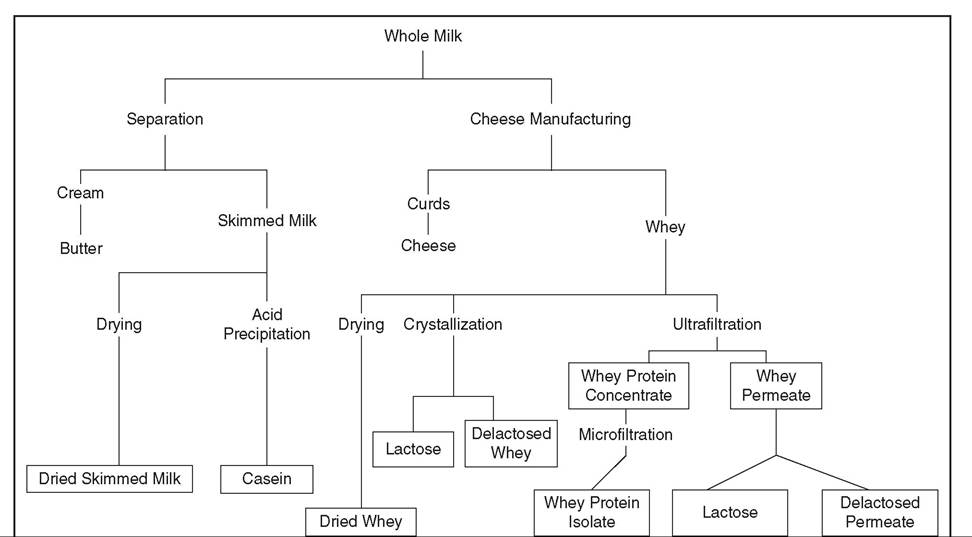
FIG.
21.1 Steps in milk processing and by-products potentially used in the manufacture of milk replacers. (Courtesy TJ. Earleywine.)■ TABLE 21.4
Chemical Composition of Ingredients Commonly Used in Milk Replacers69-71
| Ingredient | Dry Matter (%) | Crude Protein (%) | Crude Fat (%) | Crude Fiber (%) | Lactose (%) | Ash (%) | Salt (%) | |||||||||||||||||||||||||||||||||||||||||||||||||||||||||||||||||||||||||||||||||||||||||||||||||||||||||||||||||||||||||||||||||||||||||||||||||||||||||||||||||||||||
| Whole milk solids | 100 | 25.6 | 29.6 | 29.2 | 5.6 | |||||||||||||||||||||||||||||||||||||||||||||||||||||||||||||||||||||||||||||||||||||||||||||||||||||||||||||||||||||||||||||||||||||||||||||||||||||||||||||||||||||||||
| Dried skim milk | 98 | 34 | 0.1 | 52-54 | 8.5 | 3.5 | ||||||||||||||||||||||||||||||||||||||||||||||||||||||||||||||||||||||||||||||||||||||||||||||||||||||||||||||||||||||||||||||||||||||||||||||||||||||||||||||||||||||||
| Whey protein concentrate | 98 | 33.5 | 2.5-3.5 | 50-52 | 7.0 | 2.5 | ||||||||||||||||||||||||||||||||||||||||||||||||||||||||||||||||||||||||||||||||||||||||||||||||||||||||||||||||||||||||||||||||||||||||||||||||||||||||||||||||||||||||
| Delactosed whey | 98 | 21 | 1.0-1.5 | 55 | 16-18 | — | ||||||||||||||||||||||||||||||||||||||||||||||||||||||||||||||||||||||||||||||||||||||||||||||||||||||||||||||||||||||||||||||||||||||||||||||||||||||||||||||||||||||||
| Dried whey | 98 | 11.5 | 1.0-2.0 | 70-72 | 6-7 | 1.8-2.3 | ||||||||||||||||||||||||||||||||||||||||||||||||||||||||||||||||||||||||||||||||||||||||||||||||||||||||||||||||||||||||||||||||||||||||||||||||||||||||||||||||||||||||
| Soy protein isolate | 94 | 85-89 | plasma proteins from porcine or bovine blood have been used in milk replacers. The protein has an excellent amino acid profile that compares well with skim milk protein.74,75 Calves fed milk replacers in which 25% of the whey proteins had been replaced with plasma proteins were found to grow at a slightly lower rate during the first 28 days; however, growth rates were similar over a 56-day feeding period.74,75 Spray-dried whole egg is an undesirable alternative protein in milk replacers, as incorporation at levels above 5% of the total dry matter result in reduced rates of calf growth.76 Other proteins—including pea, lupine, potato, fish, red blood cells, meat solubles, yeast, and bacterial proteins—have shown be unacceptable sources of protein for milk replacers due to poor solubility, low digestibility, or inadequate amino acid content.77 Supplementation of plasma protein with isoleucine and threonine78 and vegetable protein-based milk replacers with lysine and methionine may have merit. , At present, there are no data to support supplementation of milk protein-based milk replacers with amino acids.CARBOHYDRATES. During the first weeks of life, the intestine of the young calf has limited carbohydrase activity except for lactase. The only carbohydrates usable in large amounts are lactose, glucose, and galactose. Lactose from whey is the main carbohydrate source in milk replacers. Whole milk contains approximately 29% lactose, 29% fat, 20% casein, 5% whey protein, and 5% ash on a dry matter basis. The most popular milk replacers containing 20% protein and 20% fat have substantial space for the addition of more lactose than is present in whole milk, given that high levels of ash are undesirable. Consumption of higher amounts of lactose from milk replacer than might be present in whole milk does not appear to be a concern.70 The inclusion of starch and other carbohydrates in milk replacers is not advised for calves younger than 2 to 3 weeks of age due to limited amylase and maltase activity. Toullec and colleagues81 suggest a limit of 2% to 3% starch in dry matter intake for younger calves. LIPIDS. Milk fat is highly digestible; however, it is too expensive to be included in milk replacers. Tallow, lard, choice white grease, and coconut and palm oil are the primary sources of fat used in milk replacers. A comparison of the fatty acid composition of a tallow-based milk replacer with that of one based on coconut oil to whole milk is shown in Table 21.5. Although digestibility of tallow and lard is somewhat lower than milk fat, performance is adequate. In general, highly unsaturated vegetable oils are poorly tolerated by the young calf. Two fat sources that have been used are palm and coconut oil. These fats are higher in medium chain fatty acids found in milk fat. Mills and colleagues82 studied the effect of adding medium chain fatty acids at a rate of 32% of the fat as coconut oil or oil high in caprylate. No differences were found in body composition, intake, or fecal score between the animal fat-based milk replacer or coconut oil treatments. Empty body fat was about 5% higher, and livers in heifers fed coconut oil contained 15% more fat than those in heifers fed animal fat. Hill and colleagues83,84 replaced part of the animal fat in a milk replacer with low levels of coconut oil or blends of coconut and canola oil and found higher average daily gains and less scouring than calves fed diets with only animal fat. The formulation of milk replacers with special attention to fatty acid composition is an active field of research.VITAMINS AND MINERALS. Vitamins and minerals are generally added to milk replacers to provide levels similar to those found in whole milk. The most recent (seventh) edition of Nutrient Requirements of Dairy Cattle (NRC)85 recommended a substantial increase in vitamin A from 4000 to 9000 IU∕kg of dry matter. Vitamin E recommendation was increased from 40 to 50 IU∕kg of milk replacer dry matter. These levels are sufficient to prevent deficiencies under stressful conditions of digestive or respiratory disease and to avoid a toxic response with higher levels of milk replacer observed with more intensive feeding programs. Recommended vitamin D is 600 IU∕kg of dry matter. Water-soluble vitamin and trace mineral recommendations are described in the seventh edition of the NRC.85 Osorio and colleagues86 evaluated the impact of supplementing organic trace minerals to calves fed diets formulated for a low or high plane of nutrition (568 g vs >1000 g milk replacer solids). Calves fed at a high plane, but not those fed at a low plane, of nutrition responded with increased growth. This suggests that growth of calves at a lower feeding rate was limited by factors other than trace mineral nutrition. Recommended Protein and Fat Levels in Milk Replacers The most important factors influencing the price of a milk replacer are the protein and fat content and the source of each. Replacers labeled as “all milk usually contain blends of dried whey, delactosed whey, and “whey protein concentrate.” Milk replacers with alternate proteins will have some of the whey proteins (up to 50%) replaced by soy, wheat, or animal plasma proteins. Table 21.6 represents industry classification of the suitability of protein sources for milk replacers. It should be noted that dried skim milk and casein are rarely present in milk replacers in sufficient amounts to affect nutrient content or quality due to their high cost. For calves younger than 3 weeks of age, digestibility and amino acid content of milk-derived proteins tend to be more suitable. ■ TABLE 21.5 Fatty Acid Composition of Milk Replacers Based on Animal Fat, Coconut Oil, and Palm Oil Compared to Whole Milk82
awww.chempro.in∕fattyacid.htm. ■ TABLE 21.6 Classification of Protein Sources Used in Milk Replacers Suitable for Young Calves77
Commercially available milk replacers contain between 18% and 28% protein. The level of protein and fat depends on the desired performance and conditions of the calf's environment. The seventh edition of the NRC85 continued to recommend limited feeding of milk and milk replacer solids to calves (454 g/ day) to encourage the early intake of calf starter and early weaning. At this level of intake, 18% to 20% protein is adequate with minimal rates of daily gain. However, more recent work focused on the nutritional requirements of calves growing to their genetic potential has resulted in the manufacture of milk replacers with higher protein content fed in amounts as high as 1.1 kg of milk or milk replacer solids.87-90 Work by Blome and colleagues87 suggests that lean tissue growth is optimal between 26% and 28% crude protein at higher feeding rates. Calf milk replacers usually contain between 10% and 25% fat. This is lower than the level found in cow's milk, which would be in excess of 28%, with milk containing 3.6% fat on a liquid basis. The impact of the fat content of the milk replacer on body composition and calf growth depends on the feeding rate and environmental conditions. At lower feeding rates (454 g solids/day), body fat deposition increases as the level of fat increases in the milk replacer. The optimal level of body fat for the preweaned calf has not been determined. Body fat at birth is heavily dependent on the body condition of the dam. During the end of the first week of life, it is not uncommon for calves to have less than 2% body fat.90 This is probably an inadequate reserve should the calf become ill, decrease dietary energy intake, and have increased energy requirements due to environmental temperature or the response to disease. Therefore, there is probably some benefit to the calf experiencing accretion of body fat, especially during the first weeks of life. Jersey calves fed a moderate amount of milk solids (700 g/ day) were found to have approximately 9% body fat at 5 weeks of age.90 As fat percentage and daily fat intake from milk replacer increases, calf starter grain intake is delayed or occurs at a lower rate. Most milk replacers contain approximately 10% to 20% fat, which is adequate over a wide range of intake levels and protein percentages. Bascom and colleagues90 suggested that smaller calves would benefit from higher levels of fat in the diet during periods when the environment is below the thermoneutral zone. However, during warmer months there appears to be little benefit to milk replacers with more than 15% fat. Milk replacers specially formulated to contain desired fatty acid composition with 10% fat provide sufficient energy for desired growth during summer months. It is important to note that the grams of nutrient intake and megacolories (Mcal) of energy intake are more important in meeting the calf's nutrient requirements than percentages. Therefore, greater attention should be paid to the amount of solids intake rather than percentages of protein or fat. Manufacturing Milk Replacers Production of milk replacers begins with procurement of quality ingredients and enactment of a strict quality assurance program at the manufacturing facility.91 Whey products are monitored for protein, fat, ash, pH, sodium, moisture, color, solubility, dispersibility, bacterial growth, lactic acid production, and evidence of overheating. With fats and oils, color, melting point, odor, peroxide, free fatty acid content, and fatty acid profile are considered. Most manufacturers rely on supplier histories as each incoming load of ingredient is tested. The main variables influencing the nutritional value of whey proteins are the type of cheese produced, heating history, length of storage, and sanitation. Sanitation factors are critical since they influence microbial and peroxide loads of the final product. Standard plate count must be less than 30,000 cfu/g, less than 10 cfu coliforms/g, less than 10 mold or yeast colonies/g, and no detectable Salmonella. Excessive heating can lead to denaturation of the protein, whereas underheating can contribute to excessive microbial growth. Reputable manufacturers use only ingredients that are edible by humans rather than feed grade. The next process in producing a milk replacer is to combine the ingredients into a product that has good wettability and mixability characteristics and does not separate. Wettability is a measure of how fast the powder breaks water tension and drops below the surface of the water. A test used is the amount of powder that drops below the surface of the liquid within 60 seconds. Wettability is related to ingredients used and the amount of surfactant added. Mixability is how completely the powder goes into solution and stays in suspension. Although wettability appears to make the product more convenient, mixability is more important to the calf. Separation is how much the ingredients separate from the rest of the solution, including those that float to the surface and those that sink to the bottom. Ingredients low in fiber (milk proteins, plasma, wheat gluten, and soy isolate) have better mixing characteristics than soy protein concentrate or flour. A powder that has all of the nutritional characteristics of a desirable milk replacer must also have physical characteristics that enable the calf to consume a uniform, digestible, and palatable product. Several methods are used in manufacturing milk replacer powders: dry blending, chilling towers, and agglomeration. Each method can provide a finished product of desirable nutrient content. However, differences in the three characteristics mentioned previously may affect the nutrients consumed by the calf. Dry blending is the simplest method because the dry protein and fat sources are mixed together, and additional liquid fat is sprayed on later. The issue with dry blended products is getting fat into suspension, since it is very hydrophobic. The nature of the fat product greatly determines how this is accomplished. Some fats used in milk replacers have protein sprayed on their surface, which improves mixing, whereas others use higher amounts of emulsifiers. Milk replacers may also be agglomerated to enhance wettability and mixability. These processes result in encapsulation of difficult ingredients such as fat with more hygroscopic ingredients and an increase in particle size, resulting in a powder that goes into solution quicker and stays in suspension. The process of agglomeration generally provides a finished product that is easiest to mix on the farm. Ideal mixing temperature for a milk replacer is heavily dependent on the ingredients and processing method used. Excessive temperature can result in disruption of the agglomerated product and separation of the fat and protein. Low temperatures will result in inadequate mixing. One must closely follow the recommendations for mixing temperature provided by the manufacturer. Typically, dry blended milk replacers require higher mixing temperatures. Another small but important detail is how milk replacer powder is mixed. Ideally about 50% to 70% of the total water needed for a batch is added to a receiving container followed by addition of the prescribed amount of powder. After initial mixing the remaining water is then added for the final mixing. During cold weather the temperature at the end of mixing should be warmer (46.1o C∕115o F), as the liquid will cool prior to feeding, especially in slower feeding systems. A thermometer should always be used to check mixing temperatures (see manufacturer recommendations) and feeding temperature (37.8o to 40.6o C∕100o to 105o F). Ideally both the water and the powder should be weighed for each batch of milk replacer liquid. Most milk replacer powders are approximately 96% to 97% dry matter. When powder is diluted, the final solution should be fed at a solids concentration of 12% to 15%. The influence of solids level on calf performance is relatively small within this range. However, formulation of liquid diets with higher dry matter percentages permits delivery of more nutrient solids within a given volume. Delivery of adequate nutrients to support desired growth can be challenging with feeding systems using 2-L bottles and twice-daily feeding. Under such systems it is difficult to deliver more than 500 g of milk solids per day to calves. Feeding milk replacer at solids levels above 15% has been associated with increased scouring in calves, especially if free- choice water is not available. For this reason, many calf operations have switched to the use of 3- to 4-L bottles or have fed calves in buckets allowing larger meal sizes. A degree of confusion exists on many operations about how to calculate the level of milk solids in a liquid feeding system. Adding 150 g of powder to 1 L of water does not result in a 15% solids solution, as 150 g of powder plus 1000 g of water equals 1150 g of final weight (150/1150 = 13.04% solids). The quality of water used to mix milk replacers has received increased emphasis, as it can influence how the final liquid is digested and metabolized by the calf. Suggested guidelines for water quality are shown in Table 21.7. Acidification of Milk Replacers Workers in Canada93 have described a system of free-choice feeding either cold milk or milk replacer treated with formic acid, which lowers the pH of the liquid to approximately 4.5. This system results in higher levels of liquid diet intake and lower initial calf starter intake but noticeable improvements in gains and labor efficiency. However, currently, formic acid is not permitted as a feed ingredient in the U.S. dairy industry. Nocek and Braund94 observed more gain in calves fed ad libitum to 35 days as compared to limit-fed calves offered a nonacidified milk replacer. However, there were no significant differences in scouring, and calves of both treatments reached 136 kg of body weight in the same number of days, likely due to weaning challenges and postweaning diets that were not adjusted for body weight differences. Jaster and colleagues95 compared calves fed twice daily at 10% of body weight either “sweet” or acidified milk replacers containing 12.5% solids. Citric acid was used to decrease the pH to 5.3. No differences were found in gains, and there was a slight reduction of scours in calves fed the acidified replacer. Acidified milk replacers using combinations of organic acids other than formic acid are commercially available. Cold liquid feeding systems will reduce feed efficiency due to the impact of liquid temperature on the energetic requirements of the calf. Additional challenges of free-choice systems using acidified milk include low palatability of the milk for calves during the first week of life. However, they tend to adjust to the taste and frequently consume more than 10 L/day. Higher levels of milk intake present challenges in weaning calves to dry feeds. Additives to Milk Replacers Before 2010, neomycin and oxytetracycline were added to milk replacers to aid in the control of bacterial enteritis. However, the Veterinary Feed Directive enacted in January 201796 restricts the use of oxytetracycline, chlortetracycline, and neomycin by or on the order of a licensed veterinarian. Commonly used milk replacer medications are shown in Table 21.8. Other additives used in milk replacers include yeast products, probiotics, and fermentable fibers. Heinrichs and colleagues97 found similar performance of calves fed a milk replacer diet with no additives or supplementation with the pre-2010 level of oxytetracycline/neomycin or with 4 g/day of mannan oligosaccharide (MOS). Addition of either the antibiotic or MOS reduced scours. Calf starter intake increased at a faster rate for those calves fed MOS. Inclusion of fermentable fibers from psyllium to a milk replacer powder at 1.1% of the dry matter intake increased populations of bifidobacteria and lactobacilli in the rumen and reticulum of preweaned dairy calves. It also increased the mass of the gastrointestinal tract.98 Daily addition of probiotics in the form of Lactobacillus acidophilus had no effect on body weight over a 6-week trial, but calf health and growth were improved during the first 2 weeks of life.99 Harris and colleagues100 found that supplementing milk replacer with yeast fermentation products improved calf starter intake and ■ TABLE 21.7 Calf Water Quality Guidelines92
aMay be concern level if complicated by other factors such as management, stress level, and variation in feeds fed. bAlso called aerobic, total, or standard plate count. cMay also be listed as just - or + (none or detected). ■ TABLE 21.8 Commonly Used Milk Replacer Medications77
improved fecal consistency after a mild Salmonella enterica challenge. The study of the efficacy of additives will continue as those in the milk replacer industry seek to find replacements for antibiotics in milk replacers. Feeding Recommendations for Dairy Calves Traditional calf feeding programs consisted of daily consumption of 454 g of milk or milk replacer solids in 4 L of liquid divided into two daily feedings. These recommendations existed solely to encourage calves to begin consumption of dry feed and promote early weaning. There is little evidence to support this from a biological perspective, as such limited intake during the first 2 to 3 weeks of life barely provides sufficient energy and protein to meet maintenance requirements in calves under thermoneutral conditions between 10o and 25o C. During periods of cold stress, intake of milk or milk replacer should increase by 30% to 50%. More recently, research has shown the benefits of “accelerated” or “intensive” calf feeding programs where liquid diet intake of milk or milk replacers with up to 28% protein is fed at rates up to 1 to 1.2 kg of solids per day. These terms are probably a misnomer, as the intake of milk or milk replacer are more similar to liquid feeding programs for sheep, pigs, and beef cattle. Ollivett and colleagues101 showed that calves challenged with Cryptosporidium parvum recovered faster and gained weight shortly after challenge if fed this more appropriate plane of nutrition, whereas controls fed the traditional diet continued to lose weight. The seventh edition of the NRC85 uses the factorial approach to estimate requirements for growth and maintenance with consideration of environmental temperature. More progressive calf feeding programs encourage enhanced growth, higher feed efficiency, and more economical gains, especially during the first 3 weeks of life, when calf starter intake is minimal. One concern expressed is that calf starter intake is delayed. However, calves quickly adjust, and weaning by 6 weeks of age is achievable. The seventh edition of the NRC85 was published in 2001. An eighth edition was in preparation as this chapter was being written. The reader is encouraged to consult this updated version for nutrient requirement recommendations for preweaned calves.
More on the topic Milk Replacers:
-
Veterinarian -
|