Diagnosing Pain in Livestock
Pain processing includes sensation and perception. Sensation refers to the lower-level neurologic and biochemical components (nociception), whereas higher cognitive processing, such as interpretation, is associated with perception.
A modification to the International Association for the Study of Pain definition of pain was suggested for application to animals: “an aversive sensory experience caused by actual or potential injury that elicits progressive motor and vegetative reactions, results in learned avoidance behavior, and may modify species-specific behavior, including social behavior.”7 Three functions of nociception include (1) warning the animal of actual damage to its tissues, (2) predicting when tissue damage is likely to occur, and (3) warning conspecifics of the presence of danger.Sensory information is communicated from nociceptors at tissue levels and modulated through spinal and supraspinal mechanisms. Integration of sensory and emotional components results in varied responses relative to species, ontogeny, and type of insult. Basic motor responses, such as withdrawal, occur in response to acute pain stimuli and are associated with protection from further tissue damage. However, simple withdrawal responses can occur consciously or unconsciously, in awake and anesthetized animals. More organized behavioral responses involving higher cognitive processing include aggression or escape attempts.
Increased pulse, respiratory rate, and tidal volume, pupil dilation, and other physiologic responses occur during pain, but these responses are nonspecific indicators because they also occur during arousal, such as during fear and excitement. Conversely, pain behaviors occur when pain is present versus absent and are absent or decrease when animals are provided with appropriate analgesia treatments versus placebo treatments, such as saline.
These pain behaviors can be measured objectively or subjectively. Subjective assessments traditionally have been the most practical for clinical application, but advances in technology provide opportunities for objective assessments outside the laboratory. Pain assessment should be measured across multiple domains, including resting, movement, hyperalgesia, function, and quality of life.8 Blurring of these constructs within a subjective pain scoring system can result in poor sensitivity and specificity, especially when observers are unclear about which construct is driving an evaluation.Clinical Scoring of Visual and Behavioral Indicators of Pain
Pain assessment in veterinary practice has typically relied on subjective global pain scales, with clinicians or animal caretakers providing proxy assessments for the animals in their care. Intangible measures, such as demeanor, attitude, or lethargy, are often cited for clinical scoring of pain but are poorly defined. Hence, challenges are likely to occur with interobserver and intraobserver reliability and interpretation. Subjective scoring systems may be improved when descriptions, photographic images (Fig. 3.1, A and B), or video clips of behaviors are provided for training clinicians and animal caretakers. A website developed by Dr. Joyce Kent and Dr. Vince Molony, Royal (Dick) School of Veterinary Studies, provides an excellent resource with photographic and video clips of pain responses in several livestock species to common clinical situations (“Guidelines for the Recognition & Assessment of Animal Pain”, http://www.link.vet.ed.ac.uk/animalpain/Default.htm).
Validation of subjective scoring systems for animal subjects is emerging and is a positive step in the evolution of pain research. A standardized facial grimace scale has been validated for assessing pain in mice, including distinct five components of which three are also observed in the human facial pain grimace.9 Livestock may display similar facial grimace components, such
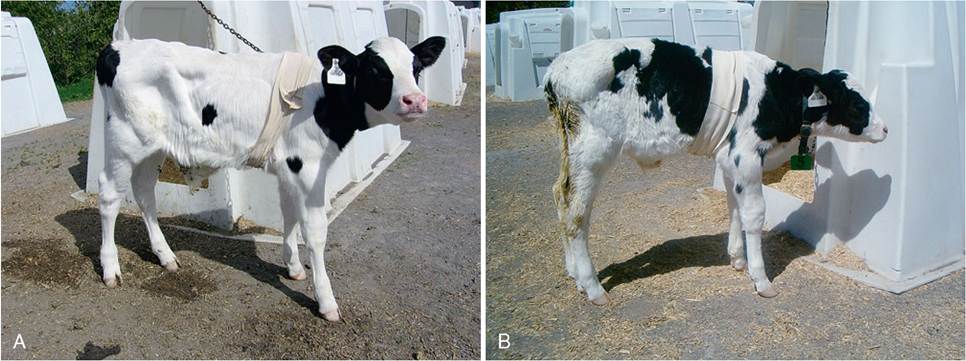
FIG.
3.1 Humans report severe abdominal pain associated with infection with Cryptosporidium parvum. Similarly, when compared with healthy calves (A), calves infected with C. parvum (B) display a dull eye, ear rotation, lower head carriage, and back arch postures characteristic of abdominal pain. (Courtesy Dr Cynthia Todd, University of Guelph.)as orbital tightening and ear position (horse,10 sheep,11 pig12). Since changes in posture are subtle and often characteristic of particular types of pain, it is wise to standardize the visual assessment of the animal, scoring sequentially from head to tail (Table 3.1). Furthermore, changes in motivation and motor patterns are also characteristic of the type and location of pain and should be scored systematically (Table 3.2). Effective pain scoring protocols are critical for evaluating the effectiveness of interventions and determination of humane endpoints when alleviation of pain cannot be achieved. Scoring of affective states, such as depression, can be refined with transparency regarding the responses recorded and use of specific tests to evoke behavioral responses (Table 3.3). Subjective pain scoring is most refined in terms of lameness and locomotion scoring, with excellent training resources available for bovine and equine practitioners and caretakers. Locomotion scoring systems that provide detailed descriptions of the observable changes in gait and allow observers to score components of the gait separately have been validated for identifying cows with severe hoof lesions13 and cows that have received a local anesthetic.14
Pain behavior responses can also be measured objectively, particularly in experimental applications where detailed observations are collected during live observations or more frequently from video recordings. In ethology, the science of animal behavior, a key component of research methodology is development of an appropriate ethogram, which consists of a list of definitions for mutually exclusive behaviors.15 For transparency and to avoid inherent bias associated with interpretation, definitions that focus on motor patterns or movements that an animal performs are preferred over those described in terms of an underlying motivation.
Pain behaviors can then be quantified in terms of frequency and duration of occurrence. For example, head-related behaviors, such as head shaking, rubbing, and scratching, occur at greater frequencies following disbudding surgery16 and ocular injury.17 Experiments can also be designed to provoke behavior and quantified in terms of latency to respond and thresholds of stimulus required for response. Although pain-specific behaviors are relatively straightforward to observe and quantify when detailed definitions are provided, manual collection of behavior data is labor intensive and difficult to record because these behaviors occur at low frequencies even when the animal is undisturbed by activity in the barn.New technologies are emerging for automated data collection, such as accelerometers for frequency and duration of activity and resting behavior (Fig. 3.2), and show promise for detecting
■ TABLE 3.1
Postures Associated With Different Acute, Visceral, Abdominal Pain and Chronic, Somatic Lameness Pain in Livestock
| Location | Abdominal Pain | Lameness Pain |
| Head | Dull, sunken eye (chronic) Wild, distracted eye (acute) Lip curl Wrinkled muzzle/ grimace Contracted jaw tone Contracted ear position (acute) Drooped ear position (chronic) | |
| Neck/back | Lowered head carriage Neck extension Arched back | Arched back |
| Abdomen | Tucked abdomen Prolonged urination stance | |
| Limbs | Standing with hind | Uneven weight bearing |
| limb extension | Treading hind limbs | |
| Lying with hind limb | Crossed forelimbsa | |
| extension | Perchingb | |
| Treading hind limbs | Increased abduction/ adduction of limbs | |
| Tail | Tail tuck Prolonged urination stance |
aStanding with crossed forelimbs results in weight transferred from the inner claw to the outer claw.
bPerching occurs in dairy stalls when weight is transferred to the rear hooves, which are placed in the gutter anterior to the stall while fore hooves are placed in the stall.
behavioral changes associated with lameness.18 Accelerometers are increasingly being incorporated into dairy management software programs, with changes in activity flagged for further investigation by the stockperson. Lameness detection can be aided by kinematic analysis during locomotion19,20 and pressure-sensing equipment incorporated in stalls to detect differences in weight bearing during standing and locomotion.20 During acutely painful procedures, livestock typically struggle or attempt to escape, and these behaviors can be quantified using exit velocity, latency for the animal to break an infrared beam, strain gauges to measure exertion forces on the restraint chute, or by software analysis of head movements captured with videoimages.21
■ TABLE 3.2
Behavior Changes Associated With Different Acute, Visceral, Abdominal Pain and Chronic, Somatic Lameness Pain in Livestock
| Behavior | Abdominal Pain | Lameness Pain |
| Redirected | Bruxism (teeth | Abnormal gait |
| and pain | grinding) | Crawling on knees |
| avoidance | Wound licking | Difficulty turning |
| behaviors | Wound scratching Self-mutilation (equine) Rolling (equine) “Looking”—nose to flank Pawing, stamping (fore) Kicking, stamping (hind) Abnormal gait Crawling on knees Tail flicking | |
| Activity | Statue standinga | Increased standing |
| Increased lying | inactive | |
| Increased standing | Increased lying | |
| inactive | Reduced standing/ | |
| Hyperactivity, | lying transitions | |
| restlessness | Abnormal | |
| Frequent standing/ | standing/lying | |
| lying transitions | transitions | |
| Reduced grooming | Reduced | |
| Reduced exploration | exploration | |
| Feeding | Anorexia (acute) | Reduced feeding |
| Reduced feeding duration Intermittent eating Intermittent drinking Playing with water Cessation of rumination | duration | |
| Social | Aggression | Reduced play |
| interactions | Social isolation Reduced play | |
| Vocalizations | Distress calls Groaning Grunting Snorting Sneezing (goats) |
aStanding immobile in a fixed, rigid posture.
Similarly, in some livestock species distress calls are performed during painful procedures and can be discriminated from other vocalizations, such as contact calls, by the increase in rate, pitch, and volume.22 Distress calls given during painful procedures are greater in intensity than other vocalizations, such as short calls at lower fundamental frequencies that are emitted from cattle when isolated.23 However, vocalizations may not be a robust measure of pain for cattle, since they rarely vocalize, and propensity to vocalize is associated with breed, perhaps due to variations in excitability.24 Conversely, goats are very expressive vocally, despite also being a prey species.
Nociceptive Threshold Tests
Several standard tests have been developed for assessing nociception in animal models for biomedical research, including von Frey filaments for mechanoreceptors and the Hargreaves' or plantar test for thermoreceptors. Increasingly, nociception tests are being modified or applied to livestock to ask about the sensory discriminatory perception of pain. To tease apart pain from other aversive experiences, such as fear or distress, attenuation of the response should occur when relevant analgesia is applied. Where possible, local anesthesia is preferable to opioids or sedatives due to confounding that results from direct impacts of the latter on animal behavior.
Pressure algometry is an example of a mechanical nociception test that has proven useful for assessing pain in livestock (Fig. 3.3). This tool measures the amount of force applied to a surface, and painful thresholds are determined using a withdrawal response. When applied around the horn buds, calves
■ TABLE 3.3
Example of Clinical Scoring Form for Transparency and Consistency in Subjective Assessment of "Demeanor" or "Depression"
Parameter Yes No N/A Comments
Does the animal orient toward handler entering pen?
Does the animal approach a novel object placed in its pen?
Does the animal approach the feed bunk when fresh feed is provided?
Does the animal require encouragement to consume daily ration?
Does the animal require encouragement to walk to the milking parlor? Etc.
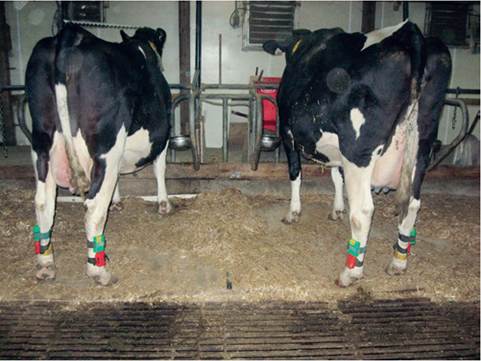
FIG. 3.2 Accelerometers quantify activity when affixed to the limb and may provide useful data for identifying lame cows. The output includes duration and frequency of standing and lying bouts, as well as number of steps. For some devices, output is integrated into dairy management software to alert the stockperson when changes in activity patterns occur. (Courtesy Dr. Janet Higginson Cutler, University of Guelph.)
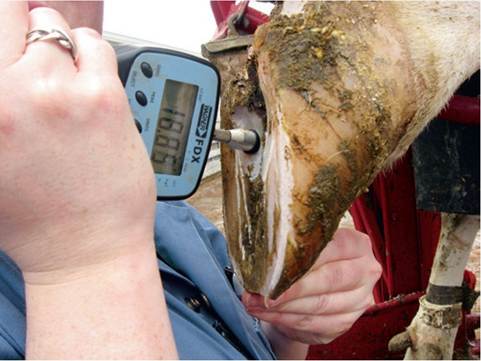
FIG. 3.3 Mechanical nociception threshold test using pressure algometry to test pain sensitivity at a sole ulcer lesion. Cattle tolerate less pressure before displaying an avoidance (hoof withdrawal) response when the pressure algometer tip is applied to the sole ulcer compared with normal sole. (Courtesy Dr. Janet Higginson Cutler, University of Guelph.)
display significantly lower nociception thresholds following disbudding when compared with pressure tolerated on the day before surgery. Furthermore, calves display less pressure sensitivity when treated with nonsteroidal antiinflammatory drugs (NSAIDs), including meloxicam,16 firocoxib,25 and car- profen.26 Pressure algometry data suggest that the duration of postsurgical pain is greater than estimates using neuroendocrine markers because significantly lower nociception thresholds are observed for 3 days following surgery relative to baseline values.16 Differences in mechanical nociceptive thresholds can also be used to identify lameness, with responses mitigated by NSAIDs.27 Pressure algometry appears to be a robust tool, with potential for clinical application because it is cheap and easy to use and differences in response are often large.
Thermal nociception threshold is quantified by the amount of time (latency) for an avoidance response to a radiant or laser thermal stimulus. A CO2 laser thermal stimulator was found to provoke a foot lift or kicking withdrawal response when skin temperature reached 45°C to 55°C, and because CO2 laser stimulators use a monochromatic, long-wavelength infrared source of radiation, absorption is not affected by pigmentation of the skin.28 Standard operating procedures for all thermal nociception tests require the skin surface to be free of hair, manure, and moisture, and safety precautions, such as maximum duration of stimulus application, to avoid tissue damage on different skin surfaces.29 A ceiling value of 20 seconds was successfully used as a safety precaution when a radiant thermal nociception stimulus (constant 80% beam intensity, 200C) was used during a lameness study in sows (Fig. 3.4).
Pain Aversion Tests
Classical pain tests that quantify reflexive nociceptive withdrawal responses to mechanical or thermal stimuli provide information about the sensory-discriminatory aspects of pain, but not the affective (emotional) components. There is some evidence that some species, such as chickens and sheep, choose to selfmedicate to avoid painful conditions. Conditioned avoidance tests are based on an animal's ability to recall an association of a stimulus, such as a location or a person, with a previous aversive experience. Conditioned place avoidance is commonly observed where livestock have previously experienced painful interventions, such as branding, dehorning, or castration. Similarly, cattle may associate the appearance or odor of a veterinary practitioner with previous aversive experience, resulting in difficulties with
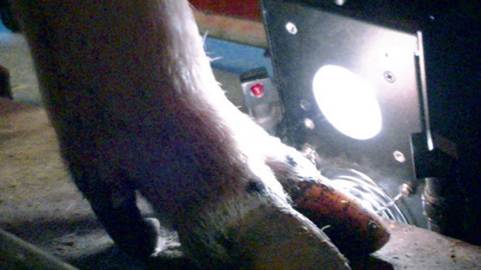
FIG. 3.4 Thermal nociception threshold test using a radiant thermal stimulus to test pain sensitivity at the coronary band on a lame sow. Effective analgesia is evident by increased tolerance of the thermal stimulus and corresponding greater latency for an avoidance (leg withdrawal) response. (Courtesy Ms. Kathleen Tapper, Iowa State University.)
handling. However, it is often difficult to tease apart aversion arising due to experiences associated with pain versus fear. This is especially problematic with extensively managed livestock that are unfamiliar with handlers and equipment. In several species, electrical stimulation results in startle and withdrawal reflexive behaviors, as well as higher pain processes associated with aggression and avoidance behaviors. However, it is used in livestock to facilitate movement (electric prods), for restraint (electroimmobilization), and for semen collection (electroejaculation). Aversiveness of electroimmobilization is evident by conditioned aversion responses by livestock, resulting in reluctance to move through handling chutes or avoidance of particular handlers.30 These results have been used to advise against the practice of electroimmobilization, such as animal welfare policies of the American Veterinary Medical Association and Canadian Veterinary Medical Association.