Pharmacologic Interventions to Treat Livestock Pain
Negative public perception of pain associated with routine animal management practices such as dehorning and castration is mounting, with increasing call for the development of practices to relieve pain and suffering in livestock.
Preemptive analgesia can be applied in advance of the painful stimulus, thereby reducing sensitization of the nervous system to subsequent stimuli that could amplify pain. Agents that could be used to provide preemptive analgesia include local anesthetics, NSAIDs, opioids, α2-agonists, and N-methyl D-aspartate receptor antagonists. However, less than 20% of U.S. veterinarians currently report using analgesia routinely at the time of dehorning and castration.31 The capacity to experience pain is considered to have a protective role by eliciting behavioral responses aimed at reducing further tissue damage and enhancing wound healing. However, persistent pain syndromes offer no biological advantage and are associated with suffering and distress. Pathologic pain states in cattle occur as a result of tissue damage, nerve damage, and inflammation and are frequently associated with pain hypersensitivity. Pain hypersensitivity manifests as hyperalgesia (exaggerated responses to painful stimuli) and allodynia (pain resulting from normally innocuous stimuli).Hyperalgesia has been reported to persist in dairy cattle and lame sheep for at least 28 days after the causal lesion has resolved.32,33 Consequently, chronic pain associated with lameness is considered one of the most significant welfare concerns in dairy cows. Inflammatory pain associated with lameness responds modestly to treatment with NSAIDs,34,35 but neuropathic pain (due to nerve damage or neuronal dysfunction) is considered refractory to the effects of NSAIDs and many opioid analgesics. Therefore there is a need to identify novel drugs and drug targets for alleviating chronic pain of neuropathic origin in animals.
Challenges Associated With Providing Analgesia in Food Animals
Several challenges are associated with providing effective analgesia in food animals in the United States. Firstly, before July 2017, there were no analgesic drugs specifically approved for the alleviation of pain in livestock. At the time of writing this chapter, only one compound (Banamine Transdermal, Merck Animal Health) is approved in the United States for the control of pain associated with foot rot. Administration of any drug to alleviate pain associated with other conditions therefore constitutes extralabel drug use (ELDU).36 Under the Animal Medicinal Drug Use Clarification Act of 1994 (AMDUCA), ELDU is permitted for relief of suffering in cattle provided specific conditions are met. These conditions include that (1) ELDU is allowed only by or under the supervision of a veterinarian, (2) ELDU is allowed only for U.S. Food and Drug Administration (FDA)-approved animal and human drugs, (3) ELDU is only permitted when the health of the animal is threatened and not for production purposes, (4) ELDU in feed is prohibited, and (5) ELDU is not permitted if it results in a violative drug residue in food intended for human consumption. Therefore use of an analgesic to alleviate pain associated with castration in calves in the United States would be required by law to comply with these regulations.
A second challenge to providing effective analgesia in cattle is that there is often a delay between the time of drug administration and the onset of analgesic activity. For example, local anesthetics require 2 to 5 minutes before a maximal effect is achieved. This may slow animal processing, as producers must wait for local anesthesia to take effect. This delay may serve as a disincentive for them to provide routine preemptive analgesia. Furthermore, the requirement for large numbers of animals to be processed quickly may result in procedures being initiated before optimal analgesia is achieved.
A third challenge is that the route or method of analgesic drug administration may require specialized training and expertise or may be hazardous to the operator. Therefore administration requires the animal to be adequately restrained and the operator to be proficient in intravenous administration. Similar issues are encountered with epidural analgesic drug administration and administration of local anesthesia into the scrotum. The latter procedure is also considered especially hazardous by many livestock handlers. In addition, the majority of analgesic drugs that are available in the United States have a short elimination half-life, necessitating frequent administration in order to be effective.36 This increases the stress on the individual animal and increases labor and drug costs.In addition to the regulatory considerations discussed previously, certain drug classes such as the opioid and NMDA receptor antagonists are designated as Schedule 3 drugs and are subject to regulation by the U.S. Drug Enforcement Administration (DEA). Therefore administration of these compounds to provide preemptive analgesia is restricted to use by licensed veterinarians. Finally, the cost associated with providing preemptive analgesia contributes to the reluctance of producers to adopt these measures, especially because there is no perceived economic benefit for doing so. It may also be difficult for producers and veterinarians to determine if analgesic compounds are effective because cattle may not show overt signs of pain and distress. Thus determining the need for analgesia and the dose, route, duration, and frequency of drug administration in cattle can be especially challenging.
Analgesic Compounds and Their Effect in Cattle Pain perception involves the transduction of chemical signals at the site of injury into electrical energy (Fig. 3.5). This is followed by transmission of the electrical signal via nerve fibers up the spinothalamic tracts where modulation may occur in the dorsal horn.
Finally, the impulse is projected to the brain where pain perception occurs. The initial response to a noxious stimulus is typically brief, well localized, and somewhat proportional to the intensity of the insult. The second phase of the response is prolonged, diffuse, and often associated with hypersensitivity around the point where the initial stimulus was applied. This effect may lead to persistent postinjury changes in the central nervous system resulting in pain hypersensitivity or central sensitization (“wind-up”). These effects lead to hyperalgesia (increased pain from previously painful stimuli) and allodynia (a previously nonpainful stimulus now produces pain).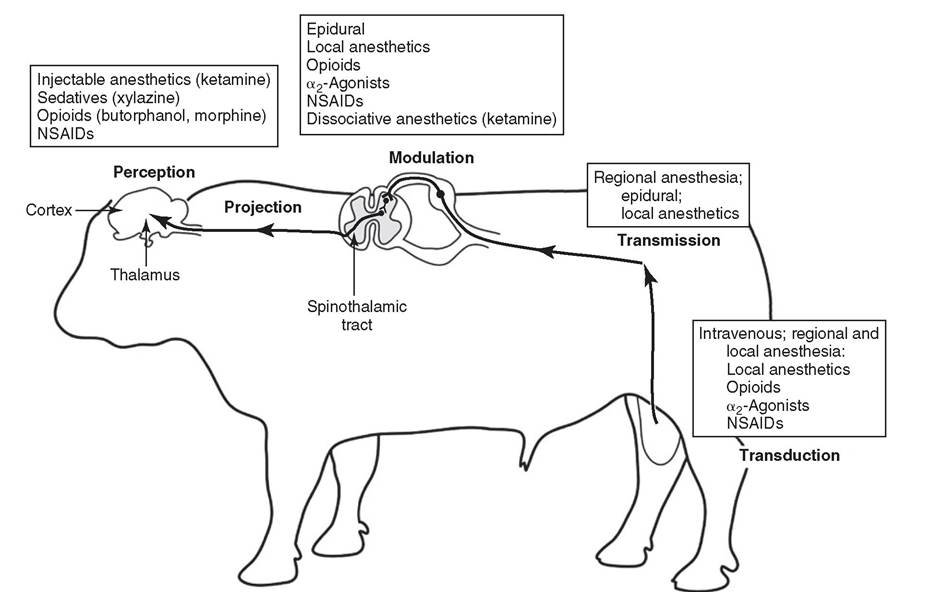
FIG. 3.5 Schematic representation of the nociceptive pathway in cattle indicating the anatomic location of target receptors for analgesic drug activity. (Courtesy of Mal Hoover, Kansas State University.)
Surgery-induced pain and central sensitization consist of two phases: an immediate incisional phase and a prolonged inflammatory phase that arises primarily due to tissue damage. The goal of administering analgesic compounds before castration is to mitigate both the incisional and inflammatory phase of the pain response. Effective analgesia therefore requires a multimodal approach using compounds that act on different receptor targets along the nociceptive pathway (Fig. 3.1). This can be achieved through a combination of local anesthesia, NSAIDs, and sedative-analgesic combinations of opioids, α2-agonists, and Wmethyl D-aspartate receptor antagonists.
More on the topic Pharmacologic Interventions to Treat Livestock Pain:
- Smith Bradford P., Van Metre David C., Pusterla Nicola (eds.). Large Animal Internal Medicine. Part 1. 6th edition. — Elsevier,2020. — 2279 p., 2020
- Summary
- COMPARATIVE BONE PHYSIOLOGY
- Feline megacolon