Diagnostic Indications for Bone Marrow Aspiration or Biopsy
Bone marrow evaluation provides important diagnostic information on the hematopoietic status of an animal; it is typically performed to evaluate hematopoiesis and to detect evidence of neoplastic or infectious disease (Box 28.1).
The complete blood cell count (CBC) is the most common method used to evaluate the hematopoietic system, but a more comprehensive evaluation includes bone marrow aspiration and/or biopsy. Bone marrow aspiration is commonly used to evaluate the cause of cytopenia. Unexplained nonregenerative anemia, neutropenia, thrombocytopenia, and pancytopenia are indications for bone marrow aspiration. In these cases, bone marrow evaluation is used to determine if the cytopenia is more likely a result of lack of production or of consumption or destruction of the cell in question. If an animal's clinical presentation and other laboratory data provide a reasonable explanation for cytopenia, a decision to perform the procedure may not be justified. For example, if another disease process is present that could explain nonregenerative anemia, such as a chronic inflammatory disease or chronic renal failure, bone marrow aspiration is not indicated in most cases.Another common reason for bone marrow aspiration is the observation of atypical cells, unexplained immature cells, or abnormal blood cell morphology on a peripheral blood film. In these cases bone marrow is evaluated for the diagnosis of leukemia, myelodysplastic syndromes, and infiltrative disease. Potential infiltrative disease is sometimes detected radiographically, and the presence of lytic or proliferative bone lesions can also be an indication for bone marrow aspiration. Because abnormalities within the bone marrow are not always reflected in the peripheral blood, it may be prudent to perform bone marrow aspiration if a neoplastic or infectious process is clinically suspected but cannot be found elsewhere.
This suspicion may arise from finding cytopenias or detecting an unexplained hypercalcemia or monoclonal gammopathy, conditions that are often associated with neoplasia; identifying a fever of unknown origin; or recognizing the probability of an infectious agent that may have bone marrow involvement.Even though complication rates are low, bone marrow aspiration should not be performed indiscriminately, and, as for all testing, the clinician should consider what question is being asked and if bone marrow evaluation is the appropriate diagnostic test for answering that question. Examination of a peripheral blood film often provides clues as to the necessity of bone marrow evaluation. In general, cytopenia should be persistent and confirmed before bone marrow evaluation is performed. Rechecking a low cell count by drawing a new blood sample, especially if initial results do not fit with the clinical presentation of the animal, is recommended. An ethylenediaminetetraacetic acid (EDTA)-associated pseudothrombocytopenia
■ BOX 28.1
Indications for Bone Marrow Evaluation
To assess regeneration in anemic horses To investigate cause of cytopenia Unexplained nonregenerative anemia Unexplained neutropenia Unexplained thrombocytopenia Pancytopenia
To investigate for neoplasia
Atypical cells in peripheral blood Lytic or proliferative bone lesions Hypercalcemia
Monoclonal gammopathy
To investigate for infectious disease
Fever of unknown origin
Lytic or proliferative bone lesions
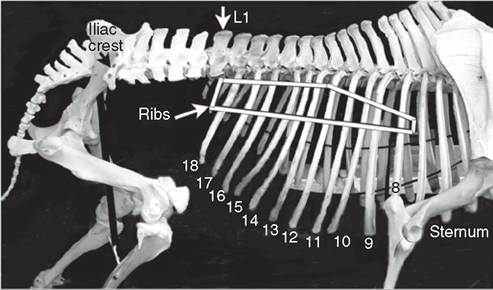
FIG. 28.1 Equine skeleton depicting sites for bone marrow aspiration: the sternum, iliac crest, vertebral ends of ribs 8 to 18, and first lumbar vertebra (L1).
has been reported in horses,9 which can be ruled out by drawing blood into a heparin or sodium citrate tube for platelet counts. A low platelet count can also be artefactual if platelet aggregation occurs during blood collection.
The presence of clumped platelets on a peripheral blood film is an indication that platelet aggregation has occurred and that a low platelet count should be viewed with skepticism. Repeated CBCs can also be used to assess persistence of an abnormality. It can take up to 5 days for the bone marrow to respond to acute anemia and for regeneration to be evident in the peripheral blood. Bone marrow aspiration is typically not indicated when there is evidence of regeneration in the peripheral blood. Evidence of erythroid regeneration in the peripheral blood includes an increase in the number of reticulocytes or polychromatophilic cells, basophilic stippling, and macrocytosis. Because the changes typically associated with regenerative anemia are rarely seen in horses, bone marrow aspiration is often the only way to assess erythropoiesis in this species. [See Color Plates 28.1 to 28.4 for an example of erythroid hyperplasia in a horse.] Evidence of regeneration in granulocytes includes the presence of a left shift and toxic changes.Cytologic evaluation of bone marrow aspirate is more commonly performed than core biopsy because results can be attained more quickly and the morphology of the cells is superior, allowing a more accurate assessment of cell types. The disadvantage of aspiration versus biopsy is that architecture cannot be assessed with an aspirate, and it can be impossible to confirm whether a poor cellular sample is a result of a pathologic process or an unsatisfactory sampling. The core biopsy provides a better assessment of bone marrow cellularity and is necessary for the confirmation of myelofibrosis, generalized bone marrow suppression, or necrosis. [See Color Plates 28.5 to 28.8 for core biopsy samples of generalized bone marrow hypoplasia from a bovine.] The core biopsy also provides a more accurate assessment of metastatic neoplasia because architecture can be assessed. It is generally recommended to submit both aspirates and biopsy for evaluation or, at least, collect a core biopsy to be stored in formalin for later evaluation, if needed.
If a bone marrow sample is being submitted for evaluation, a CBC should be submitted concurrently because interpretation of the bone marrow is dependent on CBC results and changes can occur quickly in the blood.