Echinocandins
The echinocandins are the only class of antifungal agents that directly target the fungal cell wall (Denning 2002; Mukherjee et al. 2011). They are semisynthetic amphiphilic lipopeptides formed during the fermentation of certain fungi such as Zalerion arboricola or A.
nidulans var. echinulatus (Nyfeler and Keller-Schierlein 1974). The echinocandins inhibit β-1,3-D-glucan synthase, which catalyzes the biosynthesis of β-1,3-D-glucan, a key component of the fungal cell wall (Kurtz and Douglas 1997). Of note, mammalian cells do not contain this enzyme, and, therefore, direct human cell toxicity is minimal (Eschenauer et al. 2007).The echinocandins are highly active (fungicidal) against Candida spp. including isolates that are resistant to triazoles (Bachmann et al. 2002a) and spp. that form biofilms (Bachmann et al. 2002b). These agents have modest activity (fungistatic) against Aspergillus spp. (Bowman et al. 2006) as well as dimorphic (Kohler et al. 2000) and melanized fungi (Seyedmousavi et al. 2014b) and weak activity against the Mucorales, Fusarium spp., Scedosporium spp., Cryptococcus spp., and Trichosporon spp. (Eschenauer et al. 2007).
The echinocandins that are currently approved for humans are not orally bioavail- able and, therefore, must be administered by slow intravenous infusion (1-2 h). The chemical structures of the three echinocandins, which are in clinical use, are shown in Fig. 16.5.
Caspofungin is derived from pneumocandin B0, a fermentation product of Glarea lozoyensis. It was the first echinocandin approved by the FDA and is recommended for adult and pediatric patients for the primary treatment of invasive Candida infections, salvage therapy of invasive aspergillosis infections in patients who are refractory or intolerant to other therapies, and empiric antifungal therapy for presumed fungal infections (such as those caused by Candida or Aspergillus) in persistently febrile patients with neutropenia (Maschmeyer and Glasmacher 2005).
Micafungin was the second marketed echinocandin synthesized by chemical modification of a fermentation product of Coleophoma empetri.
Micafungin is approved for the treatment of esophageal candidiasis and prophylaxis of invasive Candida infections in patients undergoing hematopoietic stem cell transplantation. The indication for its use was later expanded to include candidemia, acute disseminated candidiasis, Candida abscesses, and peritonitis (de la Torre and Reboli 2014).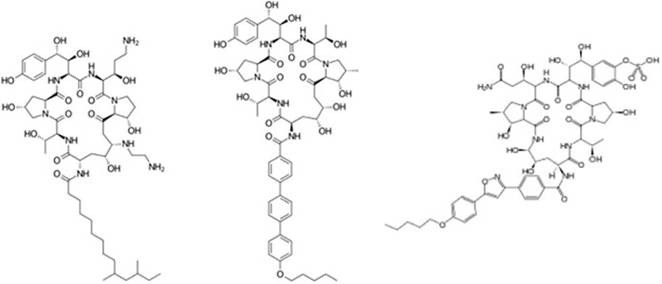
Fig. 16.5 Chemical structures of caspofungin (left), anidulafungin (middle), and micafungin (right)
Anidulafungin is derived from hexapeptides produced by A. nidulans and was the third echinocandin antifungal agent to receive approval from the FDA. It is approved for the treatment of candidemia and other Candida infections (intra-abdominal abscess and peritonitis) and esophageal candidiasis (Estes et al. 2009).
Although echinocandins hold promise for the treatment of systemic yeast infections in veterinary patients, their potential to treat the common dimorphic fungal infections in dogs and cats is poor (Foy and Trepanier 2010).
16.2.4