How AI can benefit entomology
In this section, we present some benefits on applying artificial intelligence techniques in areas that are of high importance on the control of vector-borne diseases. Over the last year, much attention is being dedicated to capture and kill harmful mosquitoes using different kinds of mosquito’s traps.
Also, several methods have been developed to help mosquito’s species classification process.A major benefit on the application of AI is to increase the community participation in the control of vector-borne diseases and therefore successfully decrease the burden of arboviruses' recurrent epidemics.
3.1 Mosquito’s trap
There are many mosquitos’ traps available to capture and kill mosquitoes. Some of them are dedicated to attract females to deposit its eggs in the trap. Others are designed to capture and kill larva or adult mosquitoes.
Among the studies analyzed, some were dedicated to evaluate the performance of traps of capture of adult mosquitoes. “In [9], an approach is presented to remotely collect and identify field mosquitoes captured by two traps, “BG-trap” and “CDC light.” The motivation of the work is justified considering that the activity of capture and classification requires the presence of entomological specialists and, therefore, faces constraints of budget and logistic feasibility.”
Entomologists recognize that monitoring the traps is crucial to accomplishing its goal. Once the traps attract mosquito’s female, if not periodically monitored, it might increase the density of mosquitos in the area the trap is located.
Another issue is the damage caused in the mosquito’s body during the capture process. Some samples have its parts destroyed and also dried, what makes difficult the taxonomist’s job to evaluate the morphological characteristics of the mosquito’s species. Figure 7 presents an image of Culex quinquefasciatus from Fiocruz— Oswaldo Cruz Foundation in Brazil.
Some of the morphological characteristics are no longer presented in the sample.Artificial intelligence can help the design of mosquito’s traps by incorporating new important functions. For instance, it helps identify the targeted mosquitoes and separate from the nontargeted ones. Also, using AI, it is possible to acquire and store important information that can help to understand the mosquito’s behavior and correlate data such as date and time of capture, species captured, and environmental data (humidity and temperature).
The application of machine learning techniques to design intelligent traps, using a laser sensor, and audio analysis techniques have been used to help insect recognition [5]. The device developed by the authors is able to attract and distinguish harmful from beneficial insects. Also let free the nontarget insects and kill the target ones, which can provide information to estimate the density of the target insect population. Different feature sets from audio analysis and machine learning algorithms achieved 98% accuracy in the insect classification.
Another example was the development of an automatic mosquito classification system consisted of an infrared recording device for profiling the wingbeat of the in-flight mosquito species. Also, a machine learning model was used for classifying the gender, genus, and species of the incoming mosquitoes by the signatures of their wingbeats [10]. To assess the performance of the system, the authors used living male and female Aedes albopictus, Aedes aegypti, and Culex quinquefasciatus. The results show that the accuracies of the proposed system are above 80% on identifying the gender and genus of the mosquitoes.
3.2 Mosquito classification
The correct identification of mosquito species is an essential step in the development of effective control strategies for vector-borne diseases. Ten years prior to
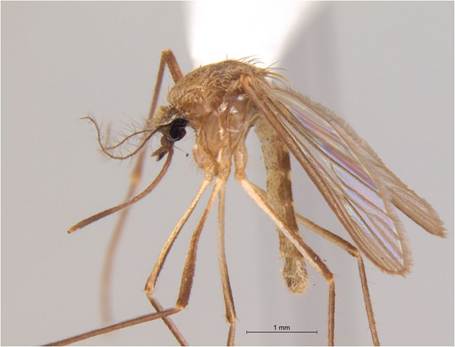
Figure 7.
Image of Culex quinquefasciatusfrom Fiocruz.
the occurrence of Zika virus, dengue, and chikungunya epidemic in Brazil, Aedes aegypti mosquito density increased almost 600 times.
Entomological characterization is fundamental to acquire information about mosquito’s behavior. This activity requires trained and experienced personnel. “While the general interest in documenting species diversity has grown exponentially over the years, the number of taxonomists and other professionals trained in species identification has steadily declined [11, 12].”
According to Fiocruz, “the traditional method of classifying mosquitoes uses dichotomous keys [13].” These keys consist in analyzing morphological characteristics of the insect. “The dichotomous keys are mostly used to classify species beyond the 4th stage of larval phase” [14]. Figure 8 represents the classification process using dichotomous keys for three different species—Aedes aegypti, Aedes albopictus, and Culex quinquefasciatus. The dichotomous keys are used to classify any species, not only the represented in Figure 8 and uses images/figures/draw- ings to support the taxonomist during classification.
In order to use the dichotomous keys, the taxonomist needs to prepare the sample—if it is an adult, assemble the mosquito on entomological pin and observe the specimen under the microscope to evaluate the morphological characters. Figure 9 represents the process of entomological characterization of an adult mosquito.
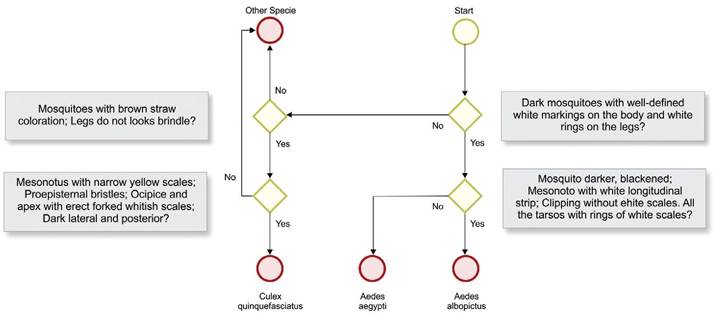
Figure 8.
Representation of the process using dichotomous keys for the classification of mosquitoes.
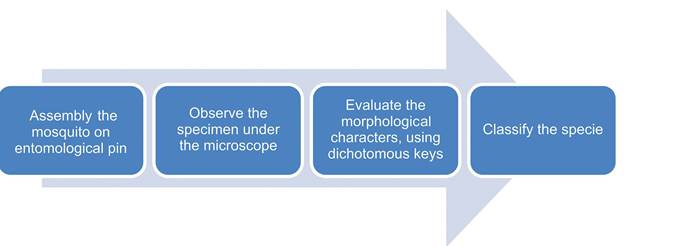
Figure 9.
Process of entomological characterization of an adult mosquito.
As already mentioned, some of the mosquito’s samples are damaged and lose morphological characteristics during the capture in the field and the transport to a laboratory.
Besides that, the waiting time during capture and transportation is also an issue and might dry the mosquito’s body, which affect some characteristics such as color.Another possibility for the “identification of species can be made through the use of molecular techniques that have been shown in different studies such DNA barcodes” [15]. Furthermore, molecular identification of mosquito remains a slow and expensive process for most laboratories.
Artificial intelligence can be applied to automatize the mosquito’s classification process. It can be used to classify in field by entomologists or even nontaxonomists and health workers. By doing that, AI can avoid the major issues presented previously, like the need of trained and experienced personnel and lose of the morphological characteristics. Artificial intelligence application also allows increasing the number of mosquito’s data, obtaining online information of population density, and the correlation with cases of incidence and mortality of vector-borne diseases.
In one AI application, deep learning was used to recognize Aedes-utilized wings morphology. “In [16], 17 species of the genera Anopheles, Aedes, and Culex were classified based on wing shape characteristics to test the hypothesis that classification using Artificial Intelligence was better than traditional classification method by discriminant analysis. The results demonstrated the AI correctly classified species more efficiently with an accuracy of 86%-100%.”
Some authors study support vector machine (SVM) techniques. “In [17], the authors use digital image processing and support vector machine (SVM) to detect Aedes aegypti mosquito. It is suggested for a method of identification as binary key of mosquitoes from the visual identification of their morphology. A camera is integrated with a circuit board, where images are fed to a support vector machine, corresponding to body characteristics of the insect. Photos of insects are taken and then delivered to the machine for data comparison, where photo properties are valued and then matched.
By the construction of the equipment, the system only responds if the identified mosquito is Aedes aegypti or not, to which it has an accuracy of 90% in the data.”In other applications, mosquito’s larva digital images were used in a machine learning algorithm for Aedes larva identification. “The authors proposed a method to identify larvae of Aedes mosquitoes using convolutional neural networks (CNN), a new method in multilayer neural network technology that has proven its performance especially in image analysis. Larva’s images were captured by cell phones. The classification method is divided into the following steps: 1) acquisition of images; 2) preprocessing the images; 3) CNN training; 4) Real-time classification. The results shown a good performance with 100% accuracy for identification of Aedes larva, however, for other mosquitoes the misclassification rate was 30% [18].” Although the sample size in this study was very small, it shows that artificial intelligence can be used for the mosquito’s species classification.
4.