Opportunistic and Pathogenic Fungi
The animal body can be regarded as an extreme environment for fungal growth; only a small fraction of the species known in the fungal kingdom is able to cause infection. When a fungus occupies an environmental niche but is able to survive in animal host tissue—because some of the factors needed in its environmental niche coincidentally enhance survival in the host—the infection is referred to as opportunistic.
However, the infection is non-transmissible and the etiologic agent will finally die with the animal host at the end of its life span (Fig. 1.1). Infection is thus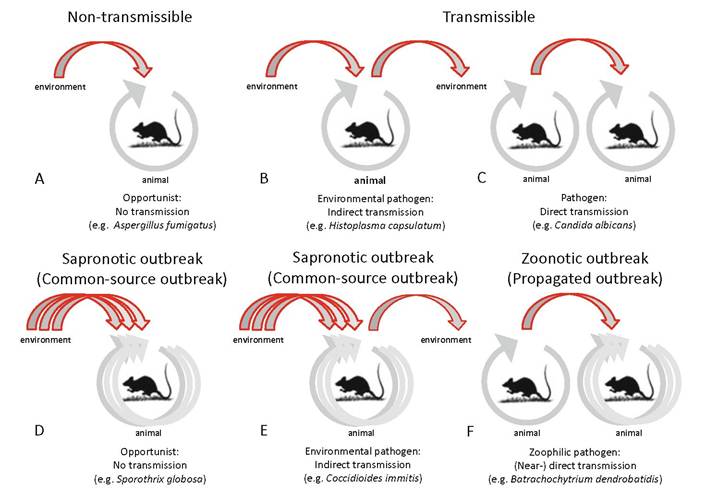
Fig. 1.1 Diagram of possible life cycles. (a) Non-transmissible opportunist; (b) transmissible environmental pathogen, with infectious propagule distribution via the environment; (c) transmissible zoopathogen via contagious hosts; (d) sapronosis by opportunist, non-transmissible; (e) sapronosis by environmental pathogen, with infectious propagule distribution via the environment; (f) zoonosis by transmissible zoophilic pathogen via contagious hosts
not profitable for the fungus: the infectious individuals will be lost for the fungal population and thus have a detrimental effect on the fitness of the species. For example, fungi belonging to Mucorales (Rhizopus, Lichtheimia, Saksenaea) are responsible for diseases with a severe morbidity, but do not propagate and are even difficult to culture from the host; their preferred habitat remains dead material such as foodstuffs, on which their sporulation is massive. Another common example is Aspergillus fumigatus, which is thermotolerant because of the conditions in its natural habitat of self-heated compost, and this factor also enables survival in immunocompromised patients or in birds whose internal body temperature (up to 43 °C) is much higher than in mammals.
In general, decreased host immunity allows extended fungal growth and increases severity of the infection.A small fraction of the extant fungal species is adapted to the animal host, i.e., have an increased fitness when a living mammal host is used in their life cycle. The infection is transmissible, so that mutations acquired during infection can be passed on to next generations. In a zoophilic pathogen, this transmission takes place from host-to-host; the infected animal is contagious. For most transmissible fungi, the animal host may be used as a vehicle for fungal dispersal, but the main reservoir of the fungus remains environmental. Such fungi have a double life cycle: in the environment versus in the animal; the host is infected via propagules that were produced in the environment, and thus infected individuals are not contagious. We call such fungi environmental pathogens.
Of the estimated 1.5 million extant fungal species, only about 625 have been reported to cause infection in vertebrates. The fungal kingdom presently contains 167 orders, of which 40 (24%) are listed in the Atlas of Clinical Fungi (de Hoog et al. 2017) containing members that were repeatedly cited in the medical literature. Recurrence indicates that these species have a certain predisposition to cause infection. If we count the number of fungal genera within the 40 orders, the distribution of fungi that are predisposed to infection is even more skewed: of the approximately 18,000 described genera (Crous et al. 2014), only 206 (0.01%) are listed in the Atlas. Considering that only 45 genera, dispersed over 10 orders, belong to the relatively common infectious agents, it is obvious that vertebrate pathogenicity is an extremely rare ability of fungal species. These figures (i.e., the number of species involved) have not really changed with the event of hospitalized patient populations with severe immune disorders; just the frequency of infectious species has increased and some have become quite common. Thus, the popular statement of the “immunocompromised host as a living Petri dish,” suggesting that such patients can be infected by “any” fungus, is far from correct.
Nevertheless, the number of known infectious agents is growing. This is largely due to developments in awareness and diagnostics and particularly in molecular taxonomic approaches which enable species distinction with much larger resolution. Also next-generation sequencing improves our knowledge of commensals on the skin and the intestinal microbiome, with concomitant increase of the number of known human- or animal-associated fungi.
1.2
More on the topic Opportunistic and Pathogenic Fungi:
- Preface
- Seyedmousavi S. et al. (eds). Emerging and Epizootic Fungal Infections in Animals. Springer International Publishing,2018. - 406 p, 2018
- Fungal Infections of the Equine Respiratory Tract
- Transmissible Fungal Infections