REFERENCES
The complete list of references can be found at www.expertconsult.com.
REFERENCES
Diagnostic Procedures for the Respiratory System-General Evaluation of the Patient With Respiratory Disease
1.
Roudebush P, Ryan J: Breath sound terminology in the veterinary literature, J Am Vet Med Assoc 194:1415, 1989.2. Murphy RL: Discontinuous adventitious lung sounds, Semm Respir Med 6:210-219, 1985.
3. Hammer EJ, Tulleners EP, Parente EJ, et al: Videoendoscopic assessment of dynamic laryngeal function during exercise in horses with grade-III left laryngeal hemiparesis at rest: 26 cases (1992-1995), J Am Vet Med Assoc 212:399, 1998.
4. Allen KJ, Franklin SH: Assessment of the exercise tests used during overground endoscopy in UK thoroughbred racehorses and how these may affect the diagnosis of dynamic upper respiratory tract obstructions, Equine Vet J 42:587, 2010.
5. Davison JA, Lumsden JM, Boston RC, et al: Overground endoscopy in 311 Thoroughbred racehorses: findings and correlation to resting laryngeal function, Aust Vet J 95:338, 2017.
6. Gerber V, Straub R, Martin E, et al: Endoscopic scoring of mucus quantity and quality: observer and horse variance and relationship to inflammation, mucus viscoelasticity and volume, Equine Vet J 36:576, 2004.
7. Hinchcliff K, Jackson MA, Brown JA, et al: Tracheobronchoscopic assessment of exercise-induced pulmonary hemorrhage in horses, Am J Vet Res 66:596,
2005.
8. Darien BJ, Brown CM, Walker RD, et al: A tracheoscopic technique for obtaining uncontaminated lower airway secretions for bacterial culture in the horse, Equine Vet J 22:170, 1990.
9. Hoffman AM, Viel L, Staempfli HR, et al: Sensitivity and specificity of bronchoalveolar lavage and protected catheter brush methods for isolating bacteria from foals with experimentally induced pneumonia caused by klebsiella pneumoniae, Am J Vet Res 54:1803, 1993.
10. Sweeney CR, Humber KA, Roby KAW: Cytologic findings of tracheobronchial aspirates from 66 thoroughbred racehorses, Am J Vet Res 53:1172, 1992.
11. Martin BB, Beech J, Parente EJ: Cytologic examination of specimens obtained by means of tracheal washes performed before and after high-speed treadmill exercise in horses with a history of poor performance, J Am Vet Med Assoc 214:673, 1999.
12. Klohnen A, Peroni JF: Thoracoscopy in horses, Vet Clin North Am Equine Pract 16:351, 2000.
13. Scharmer D, Dorn K, Brehm W: Bovine thoracoscopy: surgical technique and normal anatomy, Vet Surg 43:85, 2014.
14. Relave F, David F, Leclere M, et al: Thoracoscopic lung biopsies in heaves- affected horses using a bipolar tissue sealing system, Vet Surg 39:839, 2010.
15. Nelson NC, Zekas LJ, Reese DJ: Digital radiography for the equine practitioner: basic principles and recent advances, Vet Clin North Am Equine Pract 28:483, 2012.
16. Lascola KM, Joslyn S: Diagnostic imaging of the lower respiratory tract in neonatal foals: radiography and CT, Vet Clin North Am Equine Pract 31:497, 2015.
17. Textor JA, Puchalski SM, Affolter VK, et al: Results of computed tomography in horses with ethmoid hematoma: 16 cases (1993-2005), J Am Vet Med Assoc 240:1338, 2012.
18. Garrett KS, Woodie JB, Embertson RM, et al: Diagnosis of laryngeal dysplasia in five horses using magnetic resonance imaging and ultrasonography, Equine Vet J 41:766, 2009.
19. Manso-Dfaz G, Dyson SJ, Dennis R, et al: Magnetic resonance imaging characteristics of equine head disorders: 84 cases (2000-2013), Vet Radiol Ultrasound 56:176, 2015.
20. Fowler J, Stieger-Vanegas SM, Vanegas JA, et al: Comparison of thoracic radiography and computed tomography in calves with naturally occurring respiratory disease, Front Vet Sci 2017, doi:10.3389/fvets.201700101.
21. Adolf J, Dykes N, Semevolos S: The diagnosis and treatment of an abscess in an alpaca, Aust Vet J 79:675, 2001.
22. Wion L, Perkins G, Ainsworth SM, et al: Use of computed tomography to diagnose a Rhodococcus equi mediastinal abscess causing severe respiratory distress in a foal, Equine Vet J 33:523, 2001.
23. Reef VB, Boy MG, Reid CF, et al: Comparison between diagnostic ultrasonography and radiography in the evaluation of horses and cattle with thoracic disease: 56 cases (1984-1985), J Am Vet Med Assoc 198:2112,
1991.
24. Reimer JM, Reef VB, Spencer PA: Ultrasonography as a diagnostic aid in horses with anaerobic bacterial pleuropneumonia and/or pulmonary abscessation: 27 cases (1984-1986), J Am Vet Med Assoc 194:278, 1989.
25. Jean D, Laverty S, Halley J, et al: Thoracic trauma in newborn foals, Equine Vet J 31:149, 1999.
26. Buczinski S, Borris ME, Dubuc J: Herd-level prevalence of the ultrasonographic lung lesions associated with bovine respiratory disease and related environmental risk factors, J Dairy Sci 101:2423, 2018.
27. O’Callaghan MW, Hornof WJ, Fisher PE, et al: Ventilation imaging in the horse with (99m) technetium-DTPA radioaerosol, Equine Vet J 19:19, 1987.
28. Rush BR, Hoskinson JJ, Davis EG, et al: Pulmonary distribution of aerosolized technetium Tc99m pentetate after administration of a single dose of aerosolized albuterol sulfate in horses with recurrent airway obstruction, Am J Vet Res 60:764, 1999.
29. Willoughby RA, Ecker GL, McKee SL, et al: Use of scintigraphy for the determination of mucociliary clearance rates in normal, sedated, diseased and exercised horses, Can J Vet Res 55:315, 1991.
30. Looney AL, Ludders J, Erb HN, et al: Use of a handheld device for analysis of blood electrolyte concentrations and blood gas partial pressures in dogs and horses, J Am Vet Med Assoc 213:526, 1998.
31. Peiro JR, Borges AS, Gonςalves RC, et al: Evaluation of a portable clinical analyzer for the determination of blood gas partial pressures, electrolyte concentrations and hematocrit in venous blood samples collected from cattle, horses and sheep, Am J Vet Res 71:515, 2011.
32. West JB: Pulmonary pathophysiology: the essentials, ed 2, Baltimore, MD, 1982, Williams & Wilkins, p 22.
33. Bernard GR, Artigas A, Bringham KL, et al: The European-American Consensus Committee on ARDS.
Definitions, mechanisms, relevant outcomes and clinical trial coordination, Am J Respir Crit Care Med 149:818,1994.
34. Ranieri VM, Rubenfeld GD, Thompson BT, et al: Acute respiratory distress syndrome: the Berlin definition, JAMA 307:2526, 2012.
35. Wilkins PA, Otto CM, Dunkel B, et al: Acute lung injury (ALI) and acute respiratory distress syndromes (ARDS) in veterinary medicine: consensus definitions, J Vet Emerg Crit Care 17:433, 2007.
36. Hoffman AM, Mazan AR: How to test for airway hyper-reactivity: toward a better diagnosis of inflammatory airway disease. Proceedings of the 51st Annual Convention of the American Association of Equine Practitioners (AAEP), Seattle, WA. Available from International Veterinary Information Service (www.ivis.org), 2005; document no. P2643.1205.
37. Nolen-Walston RD, Kuehn H, Boston RC, et al: Reproducibility of airway responsiveness in horses using flowmetric plethysmography and histamine bronchoprovocation, J Vet Intern Med 23:631, 2009.
38. Couetil LL, Carwell JM, Gerber V, et al: Inflammatory airway disease of horses - revised consensus statement, J Vet Intern Med 30:503, 2016.
39. Lascola KM, Hoffman AM, Mazan MR, et al: Respiratory mechanics in sedated and nonsedated adult llamas, Am J Vet Res 68:676, 2007.
40. Pacheco AP, Bedenice D, Mazan MR, et al: Respiratory mechanics and results of cytologic examination of bronchoalveolar lavage fluid in healthy adult alpacas, Am J Vet Res 73:146, 2012.
41. Lumsden JM, Derksen FJ, Stick JA, et al: Use of flow-volume loops to evaluate upper airway obstruction in exercising Standardbreds, Am J Vet Res 54:766, 1993.
42. Holcombe SJ, Derken FJ, Robinson NE: Electromyographic activity of the palatinus and palatopharyngeus muscles in exercising horses, Equine Vet J 39:451, 2007.
43. Derksen FJ, Holcombe SJ, Hartmann W, et al: Spectrum analysis of respiratory sounds in exercising horses with experimentally induced laryngeal hemiplegia or dorsal displacement of the soft palate, Am J Vet Res 62:659,
2001.
44. Sides RH, Kirkpatrick R, Renner E, et al: Validation of masks for determination of VO2Max in horses exercising at high intensity, Equine Vet J 50:91, 2018.
45. Hoffman AM: Bronchoalveolar lavage: sampling technique and guidelines for cytologic preparation and interpretation, Vet Clin North Am Equine Pract 24:423, 2008.
46. Pringle JK, Viel L, Shewen PE, et al: Bronchoalveolar lavage of cranial and caudal lung regions in selected normal calves: cellular, microbiological, immunoglobulin, serological and histological variables, Can J Vet Res 52:239, 1998.
47. Mckane SA, Rose RJ: Radiographic determination of the location of a blindly passed bronchoalveolar catheter, Equine Vet Educ 5:329, 1993.
48. Bowser JE, Costa LRR, Rodil AU, et al: Effect of a syringe aspiration technique versus a mechanical suction technique and use of N-butylsco- polammonium bromide on the quantity and quality of bronchoalveolar lavage fluid samples obtained from horses with summer pasture endophenotype of equine asthma, Am J Vet Res 79:348, 2018.
49. Brumbaugh GW, Benson PA: Partial pressures of oxygen and carbon dioxide, pH, and concentrations of bicarbonate, lactate, and glucose in pleural fluid from horses, Am J Vet Res 51:1032, 1990.
50. Schott HC, Mansmann RA: Thoracic drainage in horses, Compend Cont Educ Pract Vet 12:251, 1990.
51. Bullone M, Helie P, Joubert P, et al: Development of a semiquantitative histological score for the diagnosis of heaves using endobronchial biopsy specimens in horses, J Vet Intern Med 30:1739, 2016.
52. Brown VA, Wilkins PA: Advanced techniques in the diagnosis and management of infectious pulmonary diseases in horses, Vet Clin North Am Equine Pract 22:633, 2006.
53. Mani RJ, Thachil AJ, Ramachandran A: Discrimination of Streptococcus equi subsp. equi and Streptococcus equi subsp. zooepidemicus using matrix-assisted laser desorption/ionization time-of-flight mass spectrometry, J Vet Diagn Invest 29:622, 2017.
54. Schnider D, Rieder S, Leeb T, et al: A genome wide association study for equine recurrent airway obstruction in European warmblood horses reveals a suggestive new quantitative trait locus on chromosome 13, Anim Genet 48:691, 2017.
55. Sarkar S, Bailey E, Cook RF, et al: Allelic variation in CXCL16 determines CD3+ T lymphocyte susceptibility to equine arteritis virus infection and establishment of long term carrier state in the stallion, PLoS Genet 12:e1006467, 2016.
56. Keele JW Kuehn LA, McDaneld TG, et al: Genome wide association study of lung lesions in cattle using sample pooling, J Anim Sci 93:956, 2015.
57. Man WO, de Steenhuijsen Piters WA, Bogaert D: The microbiota of the respiratory tract: gatekeeper to respiratory health, Nat Rev Microbiol 15:259,
2017.
58. Padalino B, Raidal SL, Knight P, et al: Behaviour during transportation predicts stress response and lower airway contamination in horses, PLoS ONE 13:e0194272, 2018.
59. Bond SL, Timsit E, Workentine M, et al: Upper and lower respiratory tract microbiota in horses: bacterial communities associated with health and mild asthma (inflammatory airway disease) and effects of dexamethasone, BMC Microbial 17:184, 2017.
60. Zeineldin M, Lowe J, de Godoy M, et al: Disparity in the nasopharyngeal microbiota between healthy cattle on feed, at entry processing, and with respiratory disease, Vet Microbiol 208:30, 2017.
61. Holman DB, Timsit E, Booker CW, et al: Injectable antimicrobials in commercial feedlot cattle and their effect on the nasopharyngeal microbiota and antimicrobial resistance, Vet Microbiol 214:140, 2018.
Pulmonary Function Testing
1. Hoffman A: Clinical application of pulmonary function testing in horses. In Lekeux P, editor: Equine respiratory diseases, Ithaca, NY, 2002, International Veterinary Information Service.
2. West J: Pulmonary pathophysiology, Baltimore, MD, 1982, Williams & Wilkins.
3. Amis TC, Jones HA: Measurement of functional residual capacity and pulmonary carbon monoxide uptake in conscious greyhounds, Am J Vet Res 45:1447, 1984.
4. Robinson NE, Olszewski MA, Boehler D, et al: Relationship between clinical signs and lung function in horses with recurrent airway obstruction (heaves) during a bronchodilator trial, Equine Vet J 32:393, 2000.
5. Couetil LL, Rosenthal FS, DeNicola DB, et al: Clinical signs, evaluation of bronchoalveolar lavage fluid, and assessment of pulmonary function in horses with inflammatory respiratory disease, Am J Vet Res 62:538, 2001.
6. Derksen FJ, Robinson NE, Armstrong PJ, et al: Airway reactivity in ponies with recurrent airway obstruction (heaves), J Appl Physiol 58:598, 1985.
7. Klein HJ, Deegen E: Histamine inhalation provocation test: method to identify nonspecific airway reactivity in equids, Am J Vet Res 47:1796,
1986.
8. Dubois A, Brody A, Lewis D, et al: Oscillation mechanics of lungs and chest in man, J Appl Physiol 8:587, 1956.
9. Mazan MR, Hoffman AM, Manjerovic N: Comparison of forced oscillation with the conventional method for histamine bronchoprovocation testing in horses, Am J Vet Res 60:174, 1999.
10. Hayden MJ, Petak F, Hantos Z, et al: Using low-frequency oscillation to detect bronchodilator responsiveness in infants, Am J Respir Crit Care Med 157:574, 1998.
11. Lutchen KR, Jensen A, Atileh H, et al: Airway constriction pattern is a central component of asthma severity: the role of deep inspirations, Am J Respir Crit Care Med 164:207, 2001.
12. Klein C, Smith HJ, Reinhold P: The use of impulse oscillometry for separate analysis of inspiratory and expiratory impedance parameters in horses: effects of sedation with xylazine, Res Vet Sci 80:201, 2006.
13. Obel N, Schimiterlow C: The action of histamine and other drugs on the bronchial tree in horses suffering from alveolar emphysema (heaves), Acta Pharmacol Toxicol 4:71, 1948.
14. Hoffman AM, Mazan MR, Ellenberg S: Association between bronchoalveolar lavage cytologic features and airway reactivity in horses with a history of exercise intolerance, Am J Vet Res 59:176, 1998.
15. Cohen KP, Panescu D, Booske JH, et al: Design of an inductive plethys- mograph for ventilation measurement, Physiol Meas 15:217, 1994.
16. Cohn MA, Rao AS, Broudy M, et al: The respiratory inductive plethys- mograph: a new non-invasive monitor of respiration, Bull Eur Physiopath Respir 18:643, 1982.
17. Hoffman A, Kuhn H, Riedelberger K, et al: Flow-metric comparison of respiratory inductance plethysmography and pneumotachography in horses, J Appl Physiol 91:2767, 2001.
18. Abraham WM, Watson H, Schneider A, et al: Noninvasive ventilatory monitoring by respiratory inductive plethysmography in conscious sheep, J Appl Physiol 51:1657, 1981.
19. Bedenice D, Mazan MR, Kuehn H, et al: Diaphragmatic paralysis due to phrenic nerve degeneration in a llama, J Vet Intern Med 16:603, 2002.
20. Schramel J, van den Hoven R, Moens Y: In vitro validation of a new respiratory ultrasonic plethysmograph, Vet Anaesth Analg 39:366, 2012.
21. Couetil LL, Rosenthal FS, Simpson CM: Forced expiration: a test for airflow obstruction in horses, J Appl Physiol 88:1870, 2000.
Equine Respiratory System-Disorders of the Lungs-Bacterial Pneumonia and Pleuropneumonia in Adult Horses
1. Bailey GD, Love DN: Oral associated bacterial infection in horses: studies on the normal anaerobic flora from the pharyngeal tonsillar surface and its association with lower respiratory tract and paraoral infections, Vet Microbiol 26:367, 1991.
2. Hoquet F, Higgins R, Lessard P, et al: Comparison of the bacterial and fungal flora in the pharynx of normal horses and horses affected with pharyngitis, Can Vet J 26:342, 1985.
3. Sweeney CR, Holcombe SJ, Barningham SC, et al: Aerobic and anaerobic bacterial isolates from horses with pneumonia or pleuropneumonia and antimicrobial susceptibility patterns of the aerobes, J Am Vet Med Assoc 198:839, 1991.
4. Arroyo MG, Slovis NM, Moore GE, et al: Factors associated with survival in 97 horses with septic pleuropneumonia, J Vet Intern Med 31:894, 2017.
5. Wood JL, Newton JR, Chanter N, et al: Association between respiratory disease and bacterial and viral infections in British racehorses, J Clin Microbiol 43:120, 2005.
6. Blunden AS, Hannant D, Livesay G, et al: Susceptibility of ponies to infection with Streptococcus pneumoniae (capsular type 3), Equine Vet J 26:22, 1994.
7. Sweeney CR, Divers TJ, Benson CE: Anaerobic bacteria in 21 horses with pleuropneumonia, J Am Vet Med Assoc 187:721, 1985.
8. Wood JL, Newton JR, Chanter N, et al: Inflammatory airway disease, nasal discharge and respiratory infections in young British racehorses, Equine Vet J 37:236, 2005.
9. Christley RM, Hodgson DR, Rose RJ, et al: A case-control study of respiratory disease in Thoroughbred racehorses in Sydney, Australia, Equine Vet J 33:256, 2001.
10. Wood JL, Chanter N, Newton JR, et al: An outbreak of respiratory disease in horses associated with Mycoplasma felis infection, Vet Rec 140:388, 1997.
11. Hoffman AM, Baird JD, Kloeze HJ, et al: Mycoplasma felis pleuritis in two show-jumper horses, Cornell Vet 82:155, 1992.
12. Ogilvie TH, Rosendal S, Blackwell TE, et al: Mycoplasma felis as a cause of pleuritis in horses, J Am Vet Med Assoc 182:1374, 1983.
13. Austin SM, Foreman JH, Hungerford LL: Case-control study of risk factors for development of pleuropneumonia in horses, J Am Vet Med Assoc 207:325,
1995.
14. Raphel CF, beech J: Pleuritis secondary to pneumonia or lung abscessation in 90 horses, J Am Vet Med Assoc 181:808, 1982.
15. Mair TS, Lane JG: Pneumonia, lung abscesses and pleuritis in adult horses: a review of 51 cases, Equine Vet J 21:175, 1989.
16. Raidal SL, Love DN, Bailey GD: Effect of a single bout of high intensity exercise on lower respiratory tract contamination in the horse, Aust Vet J 75:293, 1997.
17. Raidal SL, Love DN, Bailey GD: Inflammation and increased numbers of bacteria in the lower respiratory tract of horses within 6 to 12 hours of confinement with the head elevated, Aust Vet J 72:45, 1995.
18. Racklyeft DJ, Love DN: Influence of head posture on the respiratory tract of healthy horses, Aust Vet J 67:402, 1990.
19. Raidal SL, Taplin RH, Bailey GD, et al: Antibiotic prophylaxis of lower respiratory tract contamination in horses confined with head elevation for 24 or 48 hours, Aust Vet J 75:126, 1997.
20. Isawa T, Teshima T, Anazawa Y, et al: Effect of respiratory phases and gravity on mucociliary transport in the normal lungs, Sci Rep Res Inst Tohoku Univ [Med] 38:43, 1991.
21. Asmundsson T, Kilburn KH: Mucociliary clearance rates at various levels in dog lungs, Am Rev Respir Dis 102:388, 1970.
22. Raidal SL, Love DN, Bailey GD: Effects of posture and accumulated airway secretions on tracheal mucociliary transport in the horse, Aust Vet J 73:45, 1996.
23. Raidal SL, Bailey GD, Love DN: Effect of transportation on lower respiratory tract contamination and peripheral blood neutrophil function, Aust Vet J 75:433, 1997.
24. Traub-Dargatz JL, McKinnon AO, Bruyninckx WJ, et al: Effect of transportation stress on bronchoalveolar lavage fluid analysis in female horses, Am J Vet Res 49:1026, 1988.
25. Willoughby R, Ecker G, McKee S, et al: The effects of equine rhinovirus, influenza virus and herpesvirus infection on tracheal clearance rate in horses, Can J Vet Res 56:115, 1992.
26. Anderson NV, DeBowes RM, Nyrop KA, et al: Mononuclear phagocytes of transport-stressed horses with viral respiratory tract infection, Am J Vet Res 46:2272, 1985.
27. Crisman MV, Hodgson DR, Bayly WM, et al: Effects of transport on constituents of bronchoalveolar lavage fluid from horses, Cornell Vet 82:233,
1992.
28. Racklyeft DJ, Raidal S, Love DN: Towards an understanding of equine pleuropneumonia: factors relevant for control, Aust Vet J 78:334,
2000.
29. Horohov DW: Is exercise bad for the immune system?, Equine Vet J 35:113, 2003.
30. Raidal SL, Love DN, Bailey GD, et al: The effect of high intensity exercise on the functional capacity of equine pulmonary alveolar macrophages and BAL-derived lymphocytes, Res Vet Sci 68:249, 2000.
31. Raidal SL, Love DN, Bailey GD, et al: Effect of single bouts of moderate and high intensity exercise and training on equine peripheral blood neutrophil function, Res Vet Sci 68:141, 2000.
32. Raidal SL, Rose RJ, Love DN: Effects of training on resting peripheral blood and BAL-derived leucocyte function in horses, Equine Vet J 33:238,
2001.
33. Folsom RW, Littlefield-Chabaud MA, French DD, et al: Exercise alters the immune response to equine influenza virus and increases susceptibility to infection, Equine Vet J 33:664, 2001.
34. Horohov DW, Dimock A, Guirnalda P, et al: Effect of exercise on the immune response of young and old horses, Am J Vet Res 60:643, 1999.
35. Nesse LL, Johansen GI, Blom AK: Effects of racing on lymphocyte proliferation in horses, Am J Vet Res 63:528, 2002.
36. Carr EA, Carlson GP, Wilson WD, et al: Acute hemorrhagic pulmonary infarction and necrotizing pneumonia in horses: 21 cases (1967-1993), J Am Vet Med Assoc 210:1774, 1997.
37. Sweeney CR, Habecker PL: Pulmonary aspergillosis in horses: 29 cases (1974-1997), J Am Vet Med Assoc 214:808, 1999.
38. Rossier Y, Sweeney CR, Ziemer EL: Bronchoalveolar lavage fluid cytologic findings in horses with pneumonia or pleuropneumonia, J Am Vet Med Assoc 198:1001, 1991.
39. Darien BJ, Brown CM, Walker RD, et al: A tracheoscopic technique for obtaining uncontaminated lower airway secretions for bacterial culture in the horse, Equme Vet J 22:170, 1990.
40. Christley RM, Hodgson DR, Rose RJ, et al: Comparison of bacteriology and cytology of tracheal fluid samples collected by percutaneous transtracheal aspiration or via an endoscope using a plugged, guarded catheter, Equine Vet J 31:197, 1999.
41. Sweeney CR, Humber KA, Roby KA: Cytologic findings of tracheobronchial aspirates from 66 thoroughbred racehorses, Am J Vet Res 53:1172, 1992.
42. Reimer JM, Reef VB, Spencer PA: Ultrasonography as a diagnostic aid in horses with anaerobic bacterial pleuropneumonia and/or pulmonary abscessation: 27 cases (1984-1986), J Am Vet Med Assoc 194:278, 1989.
43. Wagner AE, Bennett DG: Analysis of equine thoracic fluid, Vet Clin Pathol 11:13, 1982.
44. Brumbaugh GW, Benson PA: Partial pressures of oxygen and carbon dioxide, pH, and concentrations of bicarbonate, lactate, and glucose in pleural fluid from horses, Am J Vet Res 51:1032, 1990.
45. Schott HC, Mansmann RA: Thoracic drainage in horses, Comp Contin Educ Pract Vet 12:251, 1990.
46. Vachon AM, Fischer AT: Thoracoscopy in the horse: diagnostic and therapeutic indications in 28 cases, Equine Vet J 30:467, 1998.
47. Credille BC, Giguere S, Berghaus LJ, et al: Plasma and pulmonary disposition of ceftiofur and its metabolites after intramuscular administration of ceftiofur crystalline free acid in weanling foals, J Vet Pharmacol Ther 35:259, 2012.
48. Giguere S, Sturgill TL, Berghaus LJ, et al: Effects of two methods of administration on the pharmacokinetics of ceftiofur crystalline free acid in horses, J Vet Pharmacol Ther 34:193, 2011.
49. Fultz L, Giguere S, Berghaus LJ, et al: Plasma and pulmonary pharmacokinetics of desfuroylceftiofur acetamide after weekly administration of ceftiofur crystalline free acid to adult horses, Equine Vet J 46:252, 2014.
50. Ensink JM, Smit JA, van Duijkeren E: Clinical efficacy of trimethoprim/ sulfadiazine and procaine penicillin G in a Streptococcus equi subsp. zooepidemicus infection model in ponies, J Vet Pharmacol Ther 26:247, 2003.
51. Ensink JM, Bosch G, van Duijkeren E: Clinical efficacy of prophylactic administration of trimethoprim/sulfadiazine in a Streptococcus equi subsp. zooepidemicus infection model in ponies, J Vet Pharmacol Ther 28:45,
2005.
52. McClure SR, Koenig R, Hawkins PA: A randomized controlled field trial of a novel trimethoprim-sulfadiazine oral suspension for treatment of Streptococcus equi subsp zooepidemicus infection of the lower respiratory tract in horses, J Am Vet Med Assoc 246:1345, 2015.
53. Nix DE, Goodwin SD, Peloquin CA, et al: Antibiotic tissue penetration and its relevance: impact of tissue penetration on infection response, Antimicrob Agents Chemother 35:1953, 1991.
54. Baldwin DR, Honeybourne D, Wise R: Pulmonary disposition of antimicrobial agents: in vivo observations and clinical relevance, Antimicrob Agents Chemother 36:1176, 1992.
55. McKenzie HC: Characterization of antimicrobial aerosols for administration to horses, Vet Ther 4:110, 2003.
56. McKenzie HC, III, Murray MJ: Concentrations of gentamicin in serum and bronchial lavage fluid after intravenous and aerosol administration of gentamicin to horses, Am J Vet Res 61:1185, 2000.
57. McKenzie HC, III, Murray MJ: Concentrations of gentamicin in serum and bronchial lavage fluid after once-daily aerosol administration to horses for seven days, Am J Vet Res 65:173, 2004.
58. Fultz L, Giguere S, Berghaus LJ, et al: Pulmonary pharmacokinetics of desfuroylceftiofur acetamide after nebulisation or intramuscular administration of ceftiofur sodium to weanling foals, Equine Vet J 47:473, 2015.
59. Chaffin MK, Carter GK, Byars TD: Equine bacterial pleuropneumonia. Part III. Treatment, sequelae, and prognosis, Comp Contin Educ Pract Vet 15:1585, 1994.
60. Singh G, Pitoyo CW, Nasir AU, et al: Update on the role of intrapleural fibrinolytic therapy in the management of complicated parapneumonic effusions and empyema, Acta Med Indones 44:258, 2012.
61. Nie W, Liu Y, Ye J, et al: Efficacy of intrapleural instillation of fibrinolytics for treating pleural empyema and parapneumonic effusion: a meta-analysis of randomized control trials, Clin Respir J 8:281, 2014.
62. Gervais DA, Levis DA, Hahn PF, et al: Adjunctive intrapleural tissue plasminogen activator administered via chest tubes placed with imaging guidance: effectiveness and risk for hemorrhage, Radiology 246:956, 2008.
63. Thommi G, Nair CK, Aronow WS, et al: Efficacy and safety of intrapleural instillation of alteplase in the management of complicated pleural effusion or empyema, Am J Ther 14:341, 2007.
64. Simpson G, Roomes D, Reeves B: Successful treatment of empyema thoracis with human recombinant deoxyribonuclease, Thorax 58:365, 2003.
65. Rahman NM, Maskell NA, West A, et al: Intrapleural use of tissue plasminogen activator and DNase in pleural infection, N Engl J Med 365:518,
2011.
66. Tomlinson JE, Reef VB, Boston RC, et al: The association of fibrinous pleural effusion with survival and complications in horses with pleuropneumonia (2002-2012): 74 cases, J Vet Intern Med 29:1410, 2015.
67. Hilton H, Pusterla N: Intrapleural fibrinolytic therapy in the management of septic pleuropneumonia in a horse, Vet Rec 164:558, 2009.
68. Rendle DI, Armstrong SK, Hughes KJ: Combination fibrinolytic therapy in the treatment of chronic septic pleuropneumonia in a Thoroughbred gelding, Aust Vet J 90:358, 2012.
69. Tomlinson JE, Byrne E, Pusterla N, et al: The use of recombinant tissue plasminogen activator (rTPA) in the treatment of fibrinous pleuropneumonia in horses: 25 cases (2007-2012), J Vet Intern Med 29:1403, 2015.
70. Peroni JF, Horner NT, Robinson NE, et al: Equine thoracoscopy: normal anatomy and surgical technique, Equine Vet J 33:231, 2001.
71. Hilton H, Aleman M, Madigan J, et al: Standing lateral thoracotomy in horses: indications, complications, and outcomes, Vet Surg 39:847, 2010.
72. Byars TD, Dainis CM, Seltzer KL, et al: Cranial thoracic masses in the horse: a sequel to pleuropneumonia, Equine Vet J 23:22, 1991.
73. Sanchez LC, Murphy DJ, Bryant JE, et al: Use of diagnostic thoracoscopy and partial pneumonectomy for the treatment of a pulmonary abscess and bronchopleural fistula in a thoroughbred filly, Equine Vet Educ 4:375, 2002.
74. Ainsworth DM, Erb HN, Eicker SW, et al: Effects of pulmonary abscesses on racing performance of horses treated at referral veterinary medical teaching hospitals: 45 cases (1985-1997), J Am Vet Med Assoc 216:1282,
2000.
75. Collins MB, Hodgson DR, Hutchins DR: Pleural effusion associated with acute and chronic pleuropneumonia and pleuritis secondary to thoracic wounds in horses: 43 cases (1982-1992), J Am Vet Med Assoc 205:1753, 1994.
76. Byars TD, Becht JL: Pleuropneumonia, Vet Clin North Am Equine Pract 7:63, 1991.
77. Seltzer KL, Byars TD: Prognosis for return to racing after recovery from infectious pleuropneumonia in thoroughbred racehorses: 70 cases (19841989), J Am Vet Med Assoc 208:1300, 1996.
Rhodococcus equi Infections
1. Donisi A, Suardi MG, Casari S, et al: Rhodococcus equi infection in HIV-infected patients, AIDS 10:359, 1996.
2. Harvey RL, Sunstrum JC: Rhodococcus equi infection in patients with and without human immunodeficiency virus infection, Rev Infect Dis 13:139,
1991.
3. Chaffin MK, Cohen ND, Martens RJ, et al: Evaluation of the efficacy of gallium maltolate for chemoprophylaxis against pneumonia caused by Rhodococcus equi infection in foals, Am J Vet Res 72:945, 2011.
4. Slovis NM, McCracken JL, Mundy G: How to use thoracic ultrasound to screen foals for Rhodococcus equi at affected farms, Proc Am Assoc Equine Pract 51:274, 2005.
5. Venner M, Kerth R, Klug E: Evaluation of tulathromycin in the treatment of pulmonary abscesses in foals, Vet J 174:418, 2007.
6. Chaffin MK, Cohen ND, Blodgett GP, et al: Evaluation of ultrasonographic screening methods for early detection of Rhodococcus equi pneumonia in foals, J Equine Vet Sci 32:S20-S21, 2012.
7. Venner M, Astheimer K, Lammer M, et al: Efficacy of mass antimicrobial treatment of foals with subclinical pulmonary abscesses associated with Rhodococcus equi, J Vet Intern Med 27:171, 2013.
8. Reuss SM, Chaffin MK, Cohen ND: Extrapulmonary disorders associated with Rhodococcus equi infection in foals: 150 cases (1987-2007), J Am Vet Med Assoc 235:855, 2009.
9. Zink MC, Yager JA, Smart NL: Corynebacterium equi infections in horses, 1958-1984: a review of 131 cases, Can J Vet Res 27:213, 1986.
10. Baldwin JL, Bertone JJ, Sommer MM, et al: Rhodococcus equi enteritis, colonic lymphadenitis, and peritonitis in three foals with nonresponsive Rhodococcus equi bronchopneumonia, Equine Pract 14:15, 1992.
11. Leadon D, Farrelly B, Fogarty U, et al: Platelet counting in diagnosis of Rhodococcus equi, Vet Rec 123:279, 1988.
12. Sweeney CR, Sweeney RW, Divers TJ: Rhodococcus equi pneumonia in 48 foals: response to antimicrobial therapy, Vet Microbiol 14:329, 1987.
13. Kenney DG, Robbins SC, Prescott JF, et al: Development of reactive arthritis and resistance to erythromycin and rifampin in a foal during treatment for Rhodococcus equi pneumonia, Equine Vet J 26:246, 1994.
14. Madison JB, Scarratt WK: Immune-mediated polysynovitis in four foals, J Am Vet Med Assoc 192:1581, 1988.
15. Wilkes EJA, Hughes KJ, Kessel AE, et al: Successful management of multiple extrapulmonary complications associated with Rhodococcus equi pneumonia in a foal, Equine Vet Educ 28:184, 2016.
16. Giguere S, Hondalus MK, Yager JA, et al: Role of the 85-kilobase plasmid and plasmid-encoded virulence-associated protein A in intracellular survival and virulence of Rhodococcus equi, Infect Immun 67:3548, 1999.
17. Huber L, Giguere S, Berghaus LJ, et al: Development of septic polysynovitis and uveitis in foals experimentally infected with Rhodococcus equi, PLoS ONE 13:e0192655, 2018.
18. Chaffin MK, Honnas CM, Crabill MR, et al: Cauda equina syndrome, diskospondylitis, and a paravertebral abscess caused by Rhodococcus equi in a foal, J Am Vet Med Assoc 206:215, 1995.
19. Giguere S, Lavoie JP: Rhodococcus equi vertebral osteomyelitis in 3 Quarter Horse colts, Equine Vet J 26:74, 1994.
20. Olchowy TW: Vertebral body osteomyelitis due to Rhodococcus equi in two Arabian foals, Equine Vet J 26:79, 1994.
21. Janicek JC, Kramer J, CoatesJR, et al: Intracranial abscess caused by Rhodococcus equi infection in a foal, J Am Vet Med Assoc 228:251, 2006.
22. Johns IC, Desrochers A, Wotman KL, et al: Presumed immune-mediated hemolytic anemia in two foals with Rhodococcus equi infection, J Vet Emerg Crit Care 21:273, 2011.
23. Freestone JF, Hietala S, Moulton J, et al: Acquired immunodeficiency in a seven-year-old horse, J Am Vet Med Assoc 190:689, 1987.
24. Fitzgerald SD, Yamini B: Rhodococcal abortion and pneumonia in an equine fetus, J Vet Diagn Invest 7:157, 1995.
25. Szeredi L, Molnar T, Glavits R, et al: Two cases of equine abortion caused by Rhodococcus equi, Vet Pathol 43:208, 2006.
26. Madarame H, Yaegashi R, Fukunaga N, et al: Pathogenicity of Rhodococcus equi strains possessing virulence-associated 15- to 17-kDa and 20-kDa antigens: experimental and natural cases in pigs, J Comp Pathol 119:397,
1998.
27. Takai S, Fukunaga N, Ochiai S, et al: Isolation of virulent and intermediately virulent Rhodococcus equi from soil and sand on parks and yards in Japan, J Vet Med Sci 58:669, 1996.
28. Flynn O, Quigley F, Costello E, et al: Virulence-associated protein characterisation of Rhodococcus equi isolated from bovine lymph nodes, Vet Microbiol 78:221, 2001.
29. Tkachuk-Saad O, Lusis P, Welsh RD, et al: Rhodococcus equi infections in goats, Vet Rec 143:311, 1998.
30. Stranahan LW, Plumlee QD, Lawhon SD, et al: Rhodococcus equi infections in goats: characterization of virulence plasmids, Vet Pathol 55:273,
2018.
31. Takai S, Martens RJ, Julian A, et al: Virulence of Rhodococcus equi isolated from cats and dogs, J Clin Microbiol 41:4468, 2003.
32. Bryan LK, Clark SD, Diaz-Delgado J, et al: Rhodococcus equi infections in dogs, Vet Pathol 54:159, 2017.
33. Hong CB, Donahue JM: Rhodococcus equi-associated necrotizing lymphadenitis in a llama, J Comp Pathol 113:85, 1995.
34. Kinne J, Madarame H, Takai S, et al: Disseminated Rhodococcus equi infection in dromedary camels (Camelus dromedarius), Vet Microbiol 149:269, 2011.
35. Takai S, Sekizaki T, Ozawa T, et al: Association between a large plasmid and 15- to 17-kilodalton antigens in virulent Rhodococcus equi, Infect Immun 59:4056, 1991.
36. Tkachuk-Saad O, Prescott J: Rhodococcus equi plasmids: isolation and partial characterization, J Clin Microbiol 29:2696, 1991.
37. Wada R, Kamada M, Anzai T, et al: Pathogenicity and virulence of Rhodococcus equi in foals following intratracheal challenge, Vet Microbiol 56:301, 1997.
38. Letek M, Ocampo-Sosa AA, Sanders M, et al: Evolution of the Rhodococcus equi vap pathogenicity island seen through comparison of host-associated vapA and vapB virulence plasmids, J Bacteriol 190:5797, 2008.
39. Takai S, Hines SA, Sekizaki T, et al: DNA Sequence and comparison of virulence plasmids from Rhodococcus equi ATCC 33701 and 103, Infect Immun 68:6840, 2000.
40. Takai S, Iie M, Watanabe Y, et al: Virulence-associated 15- to 17-kilodalton antigens in Rhodococcus equi: temperature-dependent expression and location of the antigens, Infect Immun 60:2995, 1992.
41. Tan C, Prescott JF, Patterson MC, et al: Molecular characterization of a lipid-modified virulence-associated protein of Rhodococcus equi and its potential in protective immunity, Can J Vet Res 59:51, 1995.
42. Jain S, Bloom BR, Hondalus MK: Deletion of vapA encoding Virulence Associated Protein A attenuates the intracellular actinomycete Rhodococcus equi, Mol Microbiol 50:115, 2003.
43. Coulson GB, Agarwal S, Hondalus MK: Characterization of the role of the pathogenicity island and vapG in the virulence of the intracellular actinomycete pathogen Rhodococcus equi, Infect Immun 78:3323, 2010.
44. von Bargen K, Polidori M, Becken U, et al: Rhodococcus equi virulence- associated protein A is required for diversion of phagosome biogenesis but not for cytotoxicity, Infect Immun 77:5676, 2009.
45. Rofe AP, Davis LJ, Whittingham JL, et al: The Rhodococcus equi virulence protein VapA disrupts endolysosome function and stimulates lysosome biogenesis, Microbiologyopen 6:2017.
46. Coulson GB, Miranda-CasoLuengo AA, Miranda-Casoluengo R, et al: Transcriptome reprogramming by plasmid-encoded transcriptional regulators is required for host niche adaption of a macrophage pathogen, Infect Immun 83:3137, 2015.
47. Ren J, Prescott JF: The effect of mutation on Rhodococcus equi virulence plasmid gene expression and mouse virulence, Vet Microbiol 103:219, 2004.
48. Russell DA, Byrne GA, O’Connell EP, et al: The LysR-type transcriptional regulator VirR is required for expression of the virulence gene vapA of Rhodococcus equi ATCC 33701, J Bacteriol 186:5576, 2004.
49. Kakuda T, Hirota T, Takeuchi T, et al: VirS, an OmpR/PhoB subfamily response regulator, is required for activation of vapA gene expression in Rhodococcus equi, BMC Microbiol 14:243, 2014.
50. Ren J, Prescott JF: Analysis of virulence plasmid gene expression of intra-macrophage and in vitro grown Rhodococcus equi ATCC 33701, Vet Microbiol 94:167, 2003.
51. Benoit S, Benachour A, Tiouji S, et al: H(2)O(2), which causes macrophage- related stress, triggers induction of expression of virulence-associated plasmid determinants in Rhodococcus equi, Infect Immun 70:3768, 2002.
52. Takai S, Fukunaga N, Kamisawa K, et al: Expression of virulence-associated antigens of Rhodococcus equi is regulated by temperature and pH, Microbiol Immunol 40:591, 1996.
53. Tripathi VN, Harding WC, Willingham-Lane JM, et al: Conjugal transfer of a virulence plasmid in the opportunistic intracellular Actinomycete Rhodococcus equi, J Bacteriol 194:6790, 2012.
54. Takai S, Fukunaga N, Ochiai S, et al: Identification of intermediately virulent Rhodococcus equi isolates from pigs, J Clin Microbiol 34:1034,
1996.
55. Valero-Rello A, Hapeshi A, Anastasi E, et al: An invertron-like linear plasmid mediates intracellular survival and virulence in bovine isolates of Rhodococcus equi, Infect Immun 2015.
56. Stranahan LW, Plumlee QD, Lawhon SD, et al: Rhodococcus equi infections in goats: characterization of virulence plasmids, Vet Pathol 55:273, 2018.
57. Takai S, Anzai T, Fujita Y, et al: Pathogenicity of Rhodococcus equi expressing a virulence-associated 20 kDa protein (VapB) in foals, Vet Microbiol 76:71, 2000.
58. Willingham-Lane JM, Berghaus LJ, Giguere S, et al: Influence of plasmid type on the replication of Rhodococcus equi in host macrophages, mSphere 1:2016.
59. Bryan LK, Alexander ER, Lawhon SD, et al: Detection of vapn in Rhodococcus equi isolates cultured from humans, PLoS ONE 13:e0190829, 2018.
60. Takai S, Sasaki Y, Ikeda T, et al: Virulence of Rhodococcus equi isolates from patients with and without AIDS, J Clin Microbiol 32:457, 1994.
61. Takai S, Imai Y, Fukunaga N, et al: Identification of virulence-associated antigens and plasmids in Rhodococcus equi from patients with AIDS, J Infect Dis 172:1306, 1995.
62. Ribeiro MG, Lara GHB, da Silva P, et al: Novel bovine-associated pVAPN plasmid type in Rhodococcus equi identified from lymph nodes of slaughtered cattle and lungs of people living with HIV/AIDS, Transbound Emerg Dis 65:321, 2018.
63. Bryan LK, Clark SD, Diaz-Delgado J, et al: Rhodococcus equi infections in dogs, Vet Pathol 54:159, 2017.
64. Letek M, Gonzalez P, Macarthur I, et al: The genome of a pathogenic rhodococcus: cooptive virulence underpinned by key gene acquisitions, PLoS Genet 6:e1001145, 2010.
65. Sutcliffe IC: Cell envelope composition and organisation in the genus Rhodococcus, Antonie Van Leeuwenhoek 74:49, 1998.
66. Gotoh K, Mitsuyama M, Imaizumi S, et al: Mycolic acid-containing glycolipid as a possible virulence factor of Rhodococcus equi for mice, Microbiol Immunol 35:175, 1991.
67. Sydor T, von Bargen K, Hsu FF, et al: Diversion of phagosome trafficking by pathogenic Rhodococcus equi depends on mycolic acid chain length, Cell Microbiol 15:458, 2012.
68. Boland CA, Meijer WG: The iron dependent regulatory protein IdeR (DtxR) of Rhodococcus equi, FEMS Microbiol Lett 191:1, 2000.
69. Linder R, Bernheimer AW: Oxidation of macrophage membrane cholesterol by intracellular Rhodococcus equi, Vet Microbiol 56:269, 1997.
70. Navas J, Gonzalez-Zorn B, Ladron N, et al: Identification and mutagenesis by allelic exchange of choE, encoding a cholesterol oxidase from the intracellular pathogen Rhodococcus equi, J Bacteriol 183:4796, 2001.
71. Wall DM, Duffy PS, Dupont C, et al: Isocitrate lyase activity is required for virulence of the intracellular pathogen Rhodococcus equi, Infect Immun 73:6736, 2005.
72. Pei Y, Parreira V, Nicholson VM, et al: Mutation and virulence assessment of chromosomal genes of Rhodococcus equi 103, Can J Vet Res 71:1, 2007.
73. van der Geize R, Grommen AW, Hessels GI, et al: The steroid catabolic pathway of the intracellular pathogen Rhodococcus equi is important for pathogenesis and a target for vaccine development, PLoS Pathog 7:e1002181, 2011.
74. Macarthur I, Parreira VR, Lepp D, et al: The sensor kinase MprB is required for Rhodococcus equi virulence, Vet Microbiol 147:133, 2011.
75. Miranda-Casoluengo R, Coulson GB, Miranda-Casoluengo A, et al: The hydroxamate siderophore rhequichelin is required for virulence of the pathogenic actinomycete Rhodococcus equi, Infect Immun 80:4106, 2012.
76. Bidaud P, Hebert L, Barbey C, et al: Rhodococcus equi’s extreme resistance to hydrogen peroxide is mainly conferred by one of its four catalase genes, PLoS ONE 7:e42396, 2012.
77. Barton MD, Embury DH: Studies of the pathogenesis of Rhodococcus equi infection in foals, Aust Vet J 64:332, 1987.
78. Johnson JA, Prescott JF, Markham RJ: The pathology of experimental Corynebacterium equi infection in foals following intragastric challenge, Vet Pathol 20:450, 1983.
79. Hooper-McGrevy KE, Wilkie BN, Prescott JF: Virulence-associated protein-specific serum immunoglobulin G-isotype expression in young foals protected against Rhodococcus equi pneumonia by oral immunization with virulent R. equi, Vaccine 23:5760, 2005.
80. Horowitz ML, Cohen ND, Takai S, et al: Application of Sartwell’s model (lognormal distribution of incubation periods) to age at onset and age at death of foals with Rhodococcus equi pneumonia as evidence of perinatal infection, J Vet Intern Med 15:171, 2001.
81. Giguere S, GaskinJM, Miller C, et al: Evaluation of a commercially available hyperimmune plasma product for prevention of naturally acquired pneumonia caused by Rhodococcus equi in foals, J Am Vet Med Assoc 220:59, 2002.
82. Martens RJ, Martens JG, Fiske RA: Rhodococcus equi foal pneumonia: pathogenesis and immunoprophylaxis, ProcAm Assoc Equine Pract 35:189, 1989.
83. Horohov DW, Sanz M, Sun L, et al: Reasons for the age-dependent susceptibility of young foals to Rhodococcus equi, J Equine Vet Sci 32:S12-S13, 2012.
84. Chaffin MK, Cohen ND, Martens RJ: Evaluation of equine breeding farm characteristics as risk factors for development of Rhodococcus equi pneumonia in foals, J Am Vet Med Assoc 222:467, 2003.
85. Cohen ND, O’Conor MS, Chaffin MK, et al: Farm characteristics and management practices associated with development of Rhodococcus equi pneumonia in foals, J Am Vet Med Assoc 226:404, 2005.
86. Chaffin MK, Cohen ND, Martens RJ: Evaluation of equine breeding farm management and preventative health practices as risk factors for development of Rhodococcus equi pneumonia in foals, J Am Vet Med Assoc 222:476, 2003.
87. Takai S, Narita K, Ando K, et al: Ecology of Rhodococcus (Corynebac- terium) equi in soil on a horse-breeding farm, Vet Microbiol 12:169, 1986.
88. Takai S, Fujimori T, Katsuzaki K, et al: Ecology of Rhodococcus equi in horses and their environment on horse-breeding farms, Vet Microbiol 14:233, 1987.
89. Grimm MB, Cohen ND, Slovis NM, et al: Evaluation of fecal samples from mares as a source of Rhodococcus equi for their foals by use of quantitative bacteriologic culture and colony immunoblot analyses, Am J Vet Res 68:63, 2007.
90. Takai S, Ohkura H, Watanabe Y, et al: Quantitative aspects of fecal Rhodococcus (Corynebacterium) equi in foals, J Clin Microbiol 23:794,
1986.
91. Takai S, Anzai T, Yamaguchi K, et al: Prevalence of virulence plasmids in environmental isolates of Rhodococcus equi from horse-breeding farms in hokkaido, J Equine Sci 5:21, 1994.
92. Cohen ND, Carter CN, Scott HM, et al: Association of soil concentrations of Rhodococcus equi and incidence of pneumonia attributable to Rhodococ- cus equi in foals on farms in central Kentucky, Am J Vet Res 69:385,
2008.
93. Martens RJ, Takai S, Cohen ND, et al: Association of disease with isolation and virulence of Rhodococcus equi from farm soil and foals with pneumonia, J Am Vet Med Assoc 217:220, 2000.
94. Muscatello G, Anderson GA, Gilkerson JR, et al: Associations between the ecology of virulent Rhodococcus equi and the epidemiology of R. equi pneumonia on Australian thoroughbred farms, Appl Environ Microbiol 72:6152, 2006.
95. Martens RJ, Cohen ND, Chaffin MK, et al: Association of pneumonia in foals caused by Rhodococcus equi with farm soil geochemistry, Am J Vet Res 63:95, 2002.
96. Kuskie KR, Smith JL, Wang N, et al: Effects of location for collection of air samples on a farm and time of day of sample collection on airborne concentrations of virulent Rhodococcus equi at two horse breeding farms, Am J Vet Res 72:73, 2011.
97. Cohen ND, Kuskie KR, Smith JL, et al: Association of airborne concentration of virulent Rhodococcus equi with location (stall versus paddock) and month (January through June) on 30 horse breeding farms in central Kentucky, Am J Vet Res 73:1603, 2012.
98. Muscatello G, Gerbaud S, Kennedy C, et al: Comparison of concentrations of Rhodococcus equi and virulent R. equi in air of stables and paddocks on horse breeding farms in a temperate climate, Equine Vet J 38:263,
2006.
99. Cohen ND, Chaffin MK, Kuskie KR, et al: Association of perinatal exposure to airborne Rhodococcus equi with risk of pneumonia caused by R equi in foals, Am J Vet Res 74:102, 2013.
100. Muscatello G, Gilkerson JR, Browning GF: Detection of virulent Rhodococcus equi in exhaled air samples from naturally infected foals, J Clin Microbiol 47:734, 2009.
101. Chicken C, Muscatello G, Freestone J, et al: Air sampling in the breathing zone of neonatal foals for prediction of subclinical Rhodococcus equi infection, Equine Vet J 44:203, 2012.
102. Cohen ND, Smith KE, Ficht TA, et al: Epidemiologic study of results of pulse-field gel electrophoresis of isolates of Rhodococcus equi obtained from horses and horse farms, Am J Vet Res 64:153, 2003.
103. Morton AC, Begg AP, Anderson GA, et al: Epidemiology of Rhodococcus equi strains on Thoroughbred horse farms, Appl Environ Microbiol 67:2167,
2001.
104. Burton AJ, Giguere S, Sturgill TL, et al: Macrolide- and rifampin-resistant Rhodococcus equi on horse breeding farm, Kentucky, USA, Emerg Infect Dis 19:282, 2013.
105. Bolton T, Kuskie K, Halbert N, et al: Detection of strain variation in isolates of Rhodococcus equi from an affected foal using repetitive sequence-based polymerase chain reaction, J Vet Diagn Invest 22:611,
2010.
106. Hondalus MK, Diamond MS, Rosenthal LA, et al: The intracellular bacterium Rhodococcus equi requires Mac-1 to bind to mammalian cells, Infect Immun 61:2919, 1993.
107. Garton NJ, Gilleron M, Brando T, et al: A novel lipoarabinomannan from the equine pathogen Rhodococcus equi. Structure and effect on macrophage cytokine production, J Biol Chem 277:31722, 2002.
108. Fernandez-Mora E, Polidori M, Luhrmann A, et al: Maturation of Rhodococcus equi-containing vacuoles is arrested after completion of the early endosome stage, Traffic 6:635, 2005.
109. Toyooka K, Takai S, Kirikae T: Rhodococcus equi can survive a phagoly- sosomal environment in macrophages by suppressing acidification of the phagolysosome, J Med Microbiol 54:1007, 2005.
110. Zink MC, Yager JA, Prescott JF, et al: Electron microscopic investigation of intracellular events after ingestion of Rhodococcus equi by foal alveolar macrophages, Vet Microbiol 14:295, 1987.
111. Sangkanjanavanich N, Kawai M, Kakuda T, et al: Rescue of an intracellular avirulent Rhodococcus equi replication defect by the extracellular addition of virulence-associated protein A, J Vet Med Sci 79:1323, 2017.
112. Wright LM, Carpinone EM, Bennett TL, et al: VapA of Rhodococcus equi binds phosphatidic acid, Mol Microbiol 107:428, 2018.
113. Luhrmann A, Mauder N, Sydor T, et al: Necrotic death of Rhodococcus equi-infected macrophages is regulated by virulence-associated plasmids, Infect Immun 72:853, 2004.
114. Hietala SK, Ardans AA: Interaction of Rhodococcus equi with phagocytic cells from R. equi-exposed and non-exposed foals, Vet Microbiol 14:307,
1987.
115. Darrah PA, Hondalus MK, Chen Q, et al: Cooperation between reactive oxygen and nitrogen intermediates in killing of Rhodococcus equi by activated macrophages, Infect Immun 68:3587, 2000.
116. von Bargen K, Wohlmann J, Taylor GA, et al: Nitric oxide-mediated intracellular growth restriction of pathogenic Rhodococcus equi can be prevented by iron, Infect Immun 79:2098, 2011.
117. Kasuga-Aoki H, Takai S, Sasaki Y, et al: Tumour necrosis factor and interferon-gamma are required in host resistance against virulent Rhodococ- cus equi infection in mice: cytokine production depends on the virulence levels of R. equi, Immunology 96:122, 1999.
118. Berghaus LJ, Giguere S, Bordin AI, et al: Effects of priming with cytokines on intracellular survival and replication of Rhodococcus equi in equine macrophages, Cytokine 102:7, 2018.
119. Martens RJ, Cohen ND, Jones SL, et al: Protective role of neutrophils in mice experimentally infected with Rhodococcus equi, Infect Immun 73:7040, 2005.
120. Martens JG, Martens RJ, Renshaw HW: Rhodococcus (Corynebacterium) equi: bactericidal capacity of neutrophils from neonatal and adult horses, Am J Vet Res 49:295, 1988.
121. Takai S, Morozumi Y, Higashiyama S, et al: Nitroblue tetrazolium reduction by neutrophils of newborn foals, adult horses, and a foal infected with Rhodococcus (Corynebacterium) equi, Jpn J Vet Sci 48:405, 1986.
122. Yager JA, Foster SF, Zink MC, et al: In vitro bactericidal efficacy of equine polymorphonuclear leukocytes against Corynebacterium equi, Am J Vet Res 47:438, 1986.
123. Hietala SK, Ardans AA: Neutrophil phagocytic and serum opsonic response of the foal to Corynebacterium equi, Vet Immunol Immunopathol 14:279,
1987.
124. Yager JA, Duder CK, Prescott JF, et al: The interaction of Rhodococcus equi and foal neutrophils in vitro, Vet Microbiol 14:287, 1987.
125. Cywes-Bentley C, Rocha JN, Bordin AI, et al: Maternal vaccination against Poly-N-acetyl glucosamine protects foals against intrabronchial infection with Rhodococcus equi, Proc Am Assoc Equine Pract 63:378, 2017.
126. Dawson DR, Nydam DV, Price CT, et al: Effects of opsonization of Rhodococcus equi on bacterial viability and phagocyte activation, Am J Vet Res 72:1465, 2011.
127. Prescott JF, Nicholson VM, Patterson MC, et al: Use of Rhodococcus equi virulence-associated protein for immunization of foals against R equi pneumonia, Am J Vet Res 58:356, 1997.
128. Fernandez AS, Prescott JF, Nicholson VM: Protective effect against Rhodococcus equi infection in mice of IgG purified from horses vaccinated with virulence associated protein (VapA)-enriched antigens, Vet Microbiol 56:187, 1997.
129. Hooper-McGrevy KE, Giguere S, Wilkie BN, et al: Evaluation of equine immunoglobulin specific for Rhodococcus equi virulence-associated proteins A and C for use in protecting foals against Rhodococcus equi-induced pneumonia, Am J Vet Res 62:1307, 2001.
130. Lopez AM, Hines MT, Palmer GH, et al: Identification of pulmonary T-lymphocyte and serum antibody isotype responses associated with protection against Rhodococcus equi, Clin Diagn Lab Immunol 9:1270,
2002.
131. Takai S, Nakata I, Fukii N, et al: Isotype-specific antibody responses to Rhodococcus equi in foals on a horse-breeding farm with a persistent incidence of R. equi infection, J Equine Sci 13:63, 2002.
132. Sanz MG, Villarino N, Ferreira-Oliveira A, et al: VapA-specific IgG and IgG subclasses responses after natural infection and experimental challenge of foals with Rhodococcus equi, Vet Immunol Immunopathol 164:10, 2015.
133. Jacks S, Giguere S, Crawford PC, et al: Experimental infection of neonatal foals with Rhodococcus equi triggers adult-like gamma interferon induction, Clin Vaccine Immunol 14:669, 2007.
134. Jacks S, Giguere S: Effects of inoculum size on cell-mediated and humoral immune responses of foals experimentally infected with Rhodococcus equi: a pilot study, Vet Immunol Immunopathol 133:282, 2010.
135. Yager JA, Prescott CA, Kramar DP, et al: The effect of experimental infection with Rhodococcus equi on immunodeficient mice, Vet Microbiol 28:363, 1991.
136. Kanaly ST, Hines SA, Palmer GH: Cytokine modulation alters pulmonary clearance of Rhodococcus equi and development of granulomatous pneumonia, InfectImmun 63:3037, 1995.
137. Madarame H, Takai S, Matsumoto C, et al: Virulent and avirulent Rhodococcus equi infection in T-cell deficient athymic nude mice: pathologic, bacteriologic and immunologic responses, FEMS Immunol Med Microbiol 17:251, 1997.
138. Ross TL, Balson GA, Miners JS, et al: Role of CD4+, CD8+ and double negative T-cells in the protection of SCID/beige mice against respiratory challenge with Rhodococcus equi, Can J Vet Res 60:186, 1996.
139. Kanaly ST, Hines SA, Palmer GH: Failure of pulmonary clearance of Rhodococcus equi infection in CD4+ T-lymphocyte-deficient transgenic mice, Infect Immun 61:4929, 1993.
140. Nordmann P, Ronco E, Nauciel C: Role of T-lymphocyte subsets in Rhodococcus equi infection, Infect Immun 60:2748, 1992.
141. Kanaly ST, Hines SA, Palmer GH: Transfer of a CD4+ Th1 cell line to nude mice effects clearance of Rhodococcus equi from the lung, Infect Immun 64:1126, 1996.
142. Hines MT, Paasch KM, Alperin DC, et al: Immunity to Rhodococcus equi: antigen-specific recall responses in the lungs of adult horses, Vet Immunol Immunopathol 79:101, 2001.
143. Patton KM, McGuire TC, Hines MT, et al: Rhodococcus equi-specific cytotoxic T lymphocytes in immune horses and development in asymptomatic foals, Infect Immun 73:2083, 2005.
144. Harris SP, Fujiwara N, Mealey RH, et al: Identification of Rhodococcus equi lipids recognized by host cytotoxic T lymphocytes, Microbiology 156:1836, 2010.
145. Pargass IS, Wills TB, Davis WC, et al: The influence of age and Rhodococ- cus equi infection on CD1 expression by equine antigen presenting cells, Vet Immunol Immunopathol 130:197, 2009.
146. Adkins B, Leclerc C, Marshall-Clarke S: Neonatal adaptive immunity comes of age, Nat Rev Immunol 4:553, 2004.
147. Flaminio MJ, Nydam DV, Marquis H, et al: Foal monocyte-derived dendritic cells become activated upon Rhodococcus equi infection, Clin Vaccine Immunol 16:176, 2009.
148. Boyd NK, Cohen ND, Lim WS, et al: Temporal changes in cytokine expression of foals during the first month of life, Vet Immunol Immunopathol 92:75, 2003.
149. Breathnach CC, Sturgill-Wright T, Stiltner JL, et al: Foals are interferon gamma-deficient at birth, Vet Immunol Immunopathol 112:199, 2006.
150. Nerren JR, Martens RJ, Payne S, et al: Age-related changes in cytokine expression by neutrophils of foals stimulated with virulent Rhodococcus equi in vitro, Vet Immunol Immunopathol 127:212, 2009.
151. Liu T, Nerren J, Liu M, et al: Basal and stimulus-induced cytokine expression is selectively impaired in peripheral blood mononuclear cells of newborn foals, Vaccine 27:674, 2009.
152. Ryan C, Giguere S, Hagen J, et al: Effect of age and mitogen on the frequency of interleukin-4 and interferon gamma secreting cells in foals and adult horses as assessed by an equine-specific ELISPOT assay, Vet Immunol Immunopathol 133:66, 2010.
153. Ryan C, Giguere S: Equine neonates have attenuated humoral and cell- mediated immune responses to a killed adjuvanted vaccine compared to adult horses, Clin Vaccine Immunol 17:1896, 2010.
154. Wagner B, Burton A, Ainsworth D: Interferon-gamma, interleukin-4 and interleukin-10 production by T helper cells reveals intact Th1 and regulatory T(R)1 cell activation and a delay of the Th2 cell response in equine neonates and foals, Vet Res 41:47, 2010.
155. Liu M, Bordin A, Liu T, et al: Gene expression of innate Th1-, Th2-, and Th17-type cytokines during early life of neonatal foals in response to Rhodococcus equi, Cytokine 56:356, 2011.
156. Liu M, Liu T, Bordin A, et al: Activation of foal neutrophils at different ages by CpG oligodeoxynucleotides and Rhodococcus equi, Cytokine 48:280, 2009.
157. Ryan C, Giguere S, Fultz L, et al: Effects of two commercially available immunostimulants on leukocyte function of foals following ex vivo exposure to Rhodococcus equi, Vet Immunol Immunopathol 138:198, 2010.
158. Sturgill TL, Strong D, Rashid C, et al: Effect of Propionibacterium acnes-containing immunostimulant on interferon-gamma (IFNgamma) production in the neonatal foal, Vet Immunol Immunopathol 141:124, 2011.
159. Bordin AI, Liu M, Nerren JR, et al: Neutrophil function of neonatal foals is enhanced in vitro by CpG oligodeoxynucleotide stimulation, Vet Immunol Immunopathol 145:290, 2012.
160. Sturgill TL, Giguere S, Franklin RP, et al: Effects of inactivated parapoxvirus ovis on the cumulative incidence of pneumonia and cytokine secretion in foals on a farm with endemic infections caused by Rhodococcus equi, Vet Immunol Immunopathol 140:237, 2011.
161. Caston SS, McClure SR, Martens RJ, et al: Effect of hyperimmune plasma on the severity of pneumonia caused by Rhodococcus equi in experimentally infected foals, Vet Ther 7:361, 2006.
162. Perkins GA, Yeagar A, Erb HN, et al: Survival of foals with experimentally induced Rhodococcus equi infection given either hyperimmune plasma containing R. equi antibody or normal equine plasma, Vet Ther 3:334, 2001.
163. Venner M, Rodiger A, Laemmer M, et al: Failure of antimicrobial therapy to accelerate spontaneous healing of subclinical pulmonary abscesses on a farm with endemic infections caused by Rhodococcus equi, Vet J 192:293,
2012.
164. Venner M, Credner N, Lammer M, et al: Comparison of tulathromycin, azithromycin and azithromycin-rifampin for the treatment of mild pneumonia associated with Rhodococcus equi, Vet Rec 173:397, 2013.
165. Chirino-Trejo JM, Prescott JF, Yager JA: Protection of foals against experimental Rhodococcus equi pneumonia by oral immunization, Can J Vet Res 51:444, 1987.
166. Harris SP, Hines MT, Mealey RH, et al: Early development of cytotoxic T lymphocytes in neonatal foals following oral inoculation with Rhodococ- cus equi, Vet Immunol Immunopathol 141:312, 2011.
167. McQueen CM, Dindot SV, Foster MJ, et al: Genetic susceptibility to Rhodococcus equi, J Vet Intern Med 29:1648, 2015.
168. Giguere S, Cohen ND, Keith CM, et al: Diagnosis, treatment, control, and prevention of infections caused by Rhodococcus equi in foals, J Vet Intern Med 25:1209, 2011.
169. Falcon J, Smith BP, O’Brien TR, et al: Clinical and radiographic findings in Corynebacterium equi pneumonia of foals, J Am Vet Med Assoc 186:593,
1985.
170. Ainsworth DM, Eicker SW, Yeagar AE, et al: Associations between physical examination, laboratory, and radiographic findings and outcome and subsequent racing performance of foals with Rhodococcus equi infection: 115 cases (1984-1992), J Am Vet Med Assoc 213:510, 1998.
171. Leclere M, Magdesian KG, Kass PH, et al: Comparison of the clinical, microbiological, radiological and haematological features of foals with pneumonia caused by Rhodococcus equi and other bacteria, Vet J 187:109,
2011.
172. Giguere S, Berghaus LJ, Miller CD: Clinical assessment of a point-of-care serum amyloid a assay in foals with bronchopneumonia, J Vet Intern Med 30:1338, 2016.
173. Giguere S, Roberts GD: Association between radiographic pattern and outcome in foals with pneumonia caused by Rhodococcus equi, Vet Radiol Ultrasound 53:601, 2012.
174. Ramirez S, Lester GD, Roberts GR: Diagnostic contribution of thoracic ultrasonography in 17 foals with Rhodococcus equi pneumonia, Vet Radiol Ultrasound 45:172, 2004.
175. Giguere S, Hernandez J, Gaskin JM, et al: Evaluation of WBC concentration, plasma fibrinogen concentration, and an agar gel immunodiffusion test for early identification of foals with Rhodococcus equi pneumonia, J Am Vet Med Assoc 222:775, 2003.
176. Giguere S, Hernandez J, Gaskin J, et al: Performance of five serological assays for diagnosis of Rhodococcus equi pneumonia in foals, Clin Diagn Lab Immunol 10:241, 2003.
177. Phumoonna T, Muscatello G, Chicken C, et al: Clinical evaluation of a peptide-ELISA based upon N-terminal B-cell epitope of the VapA protein for diagnosis of Rhodococcus equi pneumonia in foals, J Vet Med B Infect Dis Vet Public Health 53:126, 2006.
178. Martens RJ, Cohen ND, Chaffin MK, et al: Evaluation of 5 serologic assays to detect Rhodococcus equi pneumonia in foals, J Am Vet Med Assoc 221:825, 2002.
179. Hillidge CJ: Use of erythromycin-rifampin combination in treatment of Rhodococcus equi pneumonia, Vet Microbiol 14:337, 1987.
180. Lavoie JP, Fiset L, Laverty S: Review of 40 cases of lung abscesses in foals and adult horses, Equine Vet J 26:348, 1994.
181. Muller NS, Madigan JE: Methods of implementation of an immunoprophylaxis program for the prevention of Rhodococcus equi pneumonia: results of a 5-year field study, Proc Am Assoc Equine Pract 38:193,
1992.
182. Ardans AA, Hietala SK, Spensley MS, et al: Studies of naturally occuring and experimental Rhodococcus equi, Proc Am Assoc Equine Pract 32:129,
1986.
183. Pusterla N, Wilson WD, Mapes S, et al: Diagnostic evaluation of real-time PCR in the detection of Rhodococcus equi in faeces and nasopharyngeal swabs from foals with pneumonia, Vet Rec 161:272, 2007.
184. Sellon DC, Besser TE, Vivrette SL, et al: Comparison of nucleic acid amplification, serology, and microbiologic culture for diagnosis of Rhodococcus equi pneumonia in foals, J Clin Microbiol 39:1289, 2001.
185. Rodriguez-Lazaro D, Lewis DA, Ocampo-Sosa AA, et al: Internally controlled real-time PCR method for quantitative species-specific detection and vapA genotyping of Rhodococcus equi, Appl Environ Microbiol 72:4256,
2006.
186. Nakazawa M, Sugimoto C, Isayama Y: Quantitative culture of Rhodococcus equi from the feces of horse, Natl Inst Anim Health Q (Tokyo) 23:67, 1983.
187. Takai S, Iimori S, Tsubaki S: Quantitative fecal culture for early diagnosis of Corynebacterium (Rhodococcus) equi enteritis in foals, Can J Vet Res 50:479, 1986.
188. Shaw SD, Cohen ND, Chaffin MK, et al: Estimating the sensitivity and specificity of real-time quantitative PCR of fecal samples for diagnosis of Rhodococcus equi pneumonia in foals, J Vet Intern Med 29:1712, 2015.
189. Hashikura S, Higuchi T, Taharaguchi S, et al: Evaluation of nasotracheal aspiration as a diagnostic tool for Rhodococcus equi pneumonia in foals, Equine Vet J 32:560, 2000.
190. Deleted in review.
191. Prescott JF, Nicholson VM: The effects of combinations of selected antibiotics on the growth of Corynebacterium equi, J Vet Pharmacol Ther 7:61, 1984.
192. Davis JL, Gardner SY, Jones SL, et al: Pharmacokinetics of azithromycin in foals after i.v. and oral dose and disposition into phagocytes, J Vet Pharmacol Ther 25:99, 2002.
193. Jacks S, Giguere S, Gronwall PR, et al: Pharmacokinetics of azithromycin and concentration in body fluids and bronchoalveolar cells in foals, Am J Vet Res 62:1870, 2001.
194. Lakritz J, Wilson WD, Marsh AE, et al: Effects of prior feeding on pharmacokinetics and estimated bioavailability after oral administration of a single dose of microencapsulated erythromycin base in healthy foals, Am J Vet Res 61:1011, 2000.
195. Suarez-Mier G, Giguere S, Lee EA: Pulmonary disposition of erythromycin, azithromycin, and clarithromycin in foals, J Vet Pharmacol Ther 30:109,
2007.
196. Womble AY, Giguere S, Lee EA, et al: Pharmacokinetics of clarithromycin and concentrations in body fluids and bronchoalveolar cells of foals, Am J Vet Res 67:1681, 2006.
197. Nordmann P, Ronco E: In-vitro antimicrobial susceptibility of Rhodococcus equi, J Antimicrob Chemother 29:383, 1992.
198. Giguere S, Lee EA, Guldbech KM, et al: In vitro synergy, pharmacodynamics, and postantibiotic effect of 11 antimicrobial agents against Rhodococcus equi, Vet Microbiol 160:207, 2012.
199. Berghaus LJ, Giguere S, Sturgill TL, et al: Plasma pharmacokinetics, pulmonary distribution, and in vitro activity of gamithromycin in foals, J Vet Pharmacol Ther 35:59, 2012.
200. Jacks S, Giguere S, Nguyen A: In vitro susceptibilities of Rhodococcus equi and other common equine pathogens to azithromycin, clarithromycin and 20 other antimicrobials, Antimicrob Agents Chemother 47:1742, 2003.
201. Riesenberg A, Fessler AT, Erol E, et al: MICs of 32 antimicrobial agents for Rhodococcus equi isolates of animal origin, J Antimicrob Chemother 69:1045, 2014.
202. Giguere S, Jacks S, Roberts GD, et al: Retrospective comparison of azithromycin, clarithromycin, and erythromycin for the treatment of foals with Rhodococcus equi pneumonia, J Vet Intern Med 18:568, 2004.
203. Peters J, Block W, Oswald S, et al: Oral absorption of clarithromycin is nearly abolished by chronic comedication of rifampicin in foals, Drug Metab Dispos 39:1643, 2011.
204. Peters J, Eggers K, Oswald S, et al: Clarithromycin is absorbed by an intestinal uptake mechanism that is sensitive to major inhibition by rifampicin: results of a short-term drug interaction study in foals, Drug Metab Dispos 40:522, 2012.
205. Berlin S, Spieckermann L, Oswald S, et al: Pharmacokinetics and pulmonary distribution of clarithromycin and rifampicin after concomitant and consecutive administration in foals, Mol Pharm 13:1089, 2016.
206. Nordmann P, Kerestedjian JJ, Ronco E: Therapy of Rhodococcus equi disseminated infections in nude mice, Antimicrob Agents Chemother 36:1244,
1992.
207. Burton AJ, Giguere S, Berghaus LJ, et al: Activity of clarithromycin or rifampin alone or in combination against experimental Rhodococcus equi infection in mice, Antimicrob Agents Chemother 59:3633, 2015.
208. Cohen ND: Rhodococcus equi foal pneumonia, Vet Clin North Am Equine Pract 30:609, 2014.
209. Hildebrand F, Venner M, Giguere S: Efficacy of gamithromycin for the treatment of foals with mild to moderate bronchopneumonia, J Vet Intern Med 29:333, 2015.
210. Rutenberg D, Venner M, Giguere S: Efficacy of tulathromycin for the treatment of foals with mild to moderate bronchopneumonia, J Vet Intern Med 31:901, 2017.
211. Berghaus LJ, Giguere S, Guldbech K: Mutant prevention concentration and mutant selection window for 10 antimicrobial agents against Rhodococ- cus equi, Vet Microbiol 166:670, 2013.
212. Giguere S, Jordan LM, Glass K, et al: Relationship of mixed bacterial infection to prognosis in foals with pneumonia caused by Rhodococcus equi, J Vet Intern Med 26:1443, 2012.
213. Giguere S, Lee E, Williams E, et al: Determination of the prevalence of antimicrobial resistance to macrolide antimicrobials or rifampin in Rhodococcus equi isolates and treatment outcome in foals infected with antimicrobial-resistant isolates of R equi, J Am Vet Med Assoc 237:74,
2010.
214. Anastasi E, Giguere S, Berghaus LJ, et al: Novel transferable erm(46) determinant responsible for emerging macrolide resistance in Rhodococcus equi, J Antimicrob Chemother 70:3184, 2015.
215. Fines M, Pronost S, Maillard K, et al: Characterization of mutations in the rpob gene associated with rifampin resistance in Rhodococcus equi isolated from foals, J Clin Microbiol 39:2784, 2001.
216. Takai S, Takeda K, Nakano Y, et al: Emergence of rifampin-resistant Rhodococcus equi in an infected foal, J Clin Microbiol 35:1904, 1997.
217. Asoh N, Watanabe H, Fines-Guyon M, et al: Emergence of rifampin- resistant Rhodococcus equi with several types of mutations in the rpoB gene among AIDS patients in northern Thailand, J Clin Microbiol 41:2337,
2003.
218. Carlson K, Kuskie K, Chaffin K, et al: Antimicrobial activity of tulath- romycin and 14 other antimicrobials against virulent Rhodococcus equi in vitro, Vet Ther 11:E1-E9, 2010.
219. Berghaus LJ, Giguere S, Guldbech K, et al: Comparison of Etest, disk diffusion, and broth macrodilution for in vitro susceptibility testing of Rhodococcus equi, J Clin Microbiol 53:314, 2015.
220. Giguere S, Berghaus LJ, Lee EA: Activity of 10 antimicrobial agents against intracellular Rhodococcus equi, Vet Microbiol 178:275, 2015.
221. Stratton-Phelps M, Wilson WD, Gardner IA: Risk of adverse effects in pneumonic foals treated with erythromycin versus other antibiotics: 143 cases (1986-1996), J Am Vet Med Assoc 217:68, 2000.
222. Stieler Stewart AL, Sanchez LC, Mallicote MF, et al: Effects of clarithromycin, azithromycin and rifampicin on terbutaline-induced sweating in foals, Equine Vet J 49:624, 2017.
223. Stieler AL, Sanchez LC, Mallicote MF, et al: Macrolide-induced hyperthermia in foals: role of impaired sweat responses, Equine Vet J 48:590, 2016.
224. Gustafsson A, Baverud V, Gunnarsson A, et al: The association of erythromycin ethylsuccinate with acute colitis in horses in Sweden, Equine Vet J 29:314, 1997.
225. Baverud V, Franklin A, Gunnarsson A, et al: Clostridium difficile associated with acute colitis in mares when their foals are treated with erythromycin and rifampicin for Rhodococcus equi pneumonia, Equine Vet J 30:482,
1998.
226. Hoffman AM, Viel L: A percutaneous transtracheal catheter system for improved oxygenation in foals with respiratory distress, Equine Vet J 24:239, 1992.
227. Elissalde GS, Renshaw HW, Walberg JA: Corynebacterium equi: an interhost review with emphasis on the foal, Comp Immunol Microbiol Infect Dis 3:433, 1980.
228. Chaffin MK, Martens RJ: Extrapulmonary disorders associated with Rhodococcus equi pneumonia in foals: retrospective study of 61 cases (1988-1996), Proc Am Assoc Equine Pract 43:79, 1997.
229. Valdes A, Johnson JR: Septic pleuritis and abdominal abscess formation caused by Rhodococcus equi in a foal, J Am Vet Med Assoc 227:960, 919,
2005.
230. Venner M, Reinhold B, Beyerbach M, et al: Efficacy of azithromycin in preventing pulmonary abscesses in foals, Vet J 179:301, 2009.
231. Huber L, Trevisan Gressler L, Sanz MG, et al: Monitoring foals by thoracic ultrasonography, bacterial culture, and PCR: diagnostic of Rhodococcus subclinical pneumonia in South Brazil, J Equine Vet Sci 60:104, 2018.
232. Bernard B, Dugan J, Pierce S, et al: The influence of foal pneumonia on future racing performance, Proc Am Assoc Equine Pract 37:17, 1991.
233. Giguere S, Cohen ND, Keith CM, et al: Diagnosis, treatment, control, and prevention of infections caused by Rhodococcus equi in foals, J Vet Intern Med 25:1209, 2011.
234. Prescott JF, Machang’u R, Kwiecien J, et al: Prevention of foal mortality due to Rhodococcus equi pneumonia on an endemically affected farm, Can Vet J 30:871, 1989.
235. Cohen ND, Chaffin MK, Martens RJ: Control and prevention of Rhodococ- cus equi pneumonia in foals, Compend Contin Educ Pract Vet 22:1062, 2000.
236. Cohen ND, Chaffin MK, Vandenplas ML, et al: Study of serum amyloid a concentrations as a means of achieving early diagnosis of Rhodococcus equi pneumonia, Equine Vet J 37:212, 2005.
237. Madrigal RG, Shaw SD, Witkowski LA, et al: Use of serial quantitative PCR of the vapA gene of Rhodococcus equi in feces for early detection of R. equi pneumonia in foals, J Vet Intern Med 30:664, 2016.
238. Chaffin MK, Cohen ND, Blodgett GP, et al: Evaluation of hematologic screening methods for early detection of Rhodococcus equi pneumonia in foals, J Equine Vet Sci 32:S20, 2012.
239. McCracken JL, Slovis NM: Use of thoracic ultrasound for the prevention of Rhodococcus equi pneumonia on endemic farms, Proc Am Assoc Equine Pract 55:38, 2009.
240. Martens RJ, Martens JG, Fiske RA, et al: Rhodococcus equi foal pneumonia: protective effects of immune plasma in experimentally infected foals, Equine Vet J 21:249, 1989.
241. Sanz MG, Loynachan A, Horohov DW: Rhodococcus equi hyperimmune plasma decreases pneumonia severity after a randomised experimental challenge of neonatal foals, Vet Rec 178:261, 2016.
242. Higuchi T, Arakawa T, Hashikura S, et al: Effect of prophylactic administration of hyperimmune plasma to prevent Rhodococcus equi infection on foals from endemically affected farms, Zentralbl Veterinarmed B 46:641,
1999.
243. Hurley JR, Begg AP: Failure of hyperimmune plasma to prevent pneumonia caused by Rhodococcus equi in foals, Aust Vet J 72:418, 1995.
244. Madigan JE, Hietala S, Muller N: Protection against naturally acquired Rhodococcus equi pneumonia in foals by administration of hyperimmune plasma, J Reprod Fertil Suppl 44:571-578, 1991.
245. Chaffin MK, Cohen ND, Martens RJ, et al: Foal-related risk factors associated with development of Rhodococcus equi pneumonia on farms with endemic infection, J Am Vet Med Assoc 223:1791, 2003.
246. Chaffin MK, Martins RJ, Martens JG: Therapeutic effects of immune plasma in foals with Rhodococcus equi pneumonia, Equine Vet J 12(Suppl):23, 1991.
247. Martens RJ, Martens JG, Fiske RA: Failure of passive immunisation by colostrum from immunised mares to protect foals against Rhodococcus equi pneumonia, Equine Vet J 12(Suppl):19, 1991.
248. Cauchard J, Sevin C, Ballet JJ, et al: Foal IgG and opsonizing anti- Rhodococcus equi antibodies after immunization of pregnant mares with a protective VapA candidate vaccine, Vet Microbiol 104:73, 2004.
249. Oliveira AF, Ruas LP, Cardoso SA, et al: Vaccination of mice with salmonella expressing VapA: mucosal and systemic Thl responses provide protection against Rhodococcus equi infection, PLoS ONE 5:e8644, 2010.
250. Cardoso SA, Oliveira AF, Ruas LP, et al: Nasal vaccination with attenuated Salmonella expressing VapA: TLR2 activation is not essential for protection against R. equi infection, Vaccine 31:4528, 2013.
251. Haghighi HR, Prescott JF: Assessment in mice of vapA-DNA vaccination against Rhodococcus equi infection, Vet Immunol Immunopathol 104:215, 2005.
252. Lopez AM, Hines MT, Palmer GH, et al: Analysis of anamnestic immune responses in adult horses and priming in neonates induced by a DNA vaccine expressing the vapa gene of Rhodococcus equi, Vaccine 21:3815, 2003.
253. Lopez AM, Townsend HG, Allen AL, et al: Safety and immunogenicity of a live-attenuated auxotrophic candidate vaccine against the intracellular pathogen Rhodococcus equi, Vaccine 26:998, 2008.
254. Hines SA, Stone DM, Hines MT, et al: Clearance of virulent but not avirulent Rhodococcus equi from the lungs of adult horses is associated with intracytoplasmic gamma interferon production by CD4(+) and CD8(+) T lymphocytes, Clin Diagn Lab Immunol 10:208, 2003.
255. Pei Y, Nicholson V, Woods K, et al: Immunization by intrabronchial administration to 1-week-old foals of an unmarked double gene disruption strain of Rhodococcus equi strain 103, Vet Microbiol 125:100, 2007.
256. Chaffin MK, Cohen ND, Martens RJ: Chemoprophylactic effects of azithromycin against Rhodococcus equi-induced pneumonia among foals at equine breeding farms with endemic infections, J Am Vet Med Assoc 232:1035, 2008.
257. Harrington JR, Martens RJ, Cohen ND, et al: Antimicrobial activity of gallium against virulent Rhodococcus equiin vitro and in vivo, J Vet Pharmacol Ther 29:121, 2006.
258. Martens RJ, Miller NA, Cohen ND, et al: Chemoprophylactic antimicrobial activity of gallium maltolate against intracellular Rhodococcus equi, J Equine Vet Sci 27:341, 2007.
259. Martens RJ, Mealey K, Cohen ND, et al: Pharmacokinetics of gallium maltolate after intragastric administration in neonatal foals, Am J Vet Res 68:1041, 2007.
260. Martens RJ, Harrington JR, Cohen ND, et al: Gallium therapy: a novel metal-based antimicrobial strategy for potential control of Rhodococcus equi foal pneumonia, Proc Am Assoc Equine Pract 2006.
261. Lakritz J, Wilson WD, Mihalyi JE: Comparison of microbiologic and high-performance liquid chromatography assays to determine plasma concentrations, pharmacokinetics, and bioavailability of erythromycin base in plasma of foals after intravenous or intragastric administration, Am J Vet Res 60:414, 1999.
262. Burrows GE, MacAllister CG, Ewing P, et al: Rifampin disposition in the horse: effects of age and method of oral administration, J Vet Pharmacol Ther 15:124, 1992.
263. Castro LA, Brown MP, Gronwall R, et al: Pharmacokinetics of rifampin given as a single oral dose in foals, Am J Vet Res 47:2584, 1986.
264. Kohn CW, Sams R, Kowalski JJ, et al: Pharmacokinetics of single intravenous and single and multiple dose oral administration of rifampin in mares, J Vet Pharmacol Ther 16:119, 1993.
Pneumonia in Foals
1. Zent WW: Foal pneumonia, 1986. p 269. Proceedings of the 32 nd Annual Convention of the American Association of Equine Practitioners (AAEP).
2. Cohen ND: Causes of and farm management factors associated with disease and death in foals, J Am Vet Med Assoc 204:1644, 1994.
3. Lester GD: Respiratory disease in the newborn foal: radiographic and clinical findings, 1998. p 20. Dorothee R. Havemeyer Foundation Neonatal Septicemia Workshop, Boston, MA.
4. Bedenice D, Heuwieser W, Solano M, et al: Risk factors and prognostic variables for survival of foals with radiographic evidence of pulmonary disease, J Vet Intern Med 17:868, 2003.
5. LeBlanc P: Responses of plasma transfusion in clinically healthy and clinically ill foals, 1987. p 755. Proceedings of the 33rd Annual Convention of the American Association of Equine Practitioners (AAEP).
6. Zink MC, Johnson JA: Cellular constituents of clinically normal foal bronchoalveolar lavage fluid during postnatal maturation, Am J Vet Res 45:893, 1984.
7. Hines M: Development of pulmonary immunity in foals, 1999. p 604. Proceedings of the 45th Annual Convention of the American Association of Equine Practitioners (AAEP).
8. Prescott JF: Immunodeficiency and serious pneumonia in foals: the plot thickens, Equine Vet J 25:88, 1993.
9. Flaminio MJ, Rush BR, Cox JH, et al: CD4+ and CD8+ T-lymphocyto- penia in a filly with pneumocystis carinii pneumonia, Aust Vet J 76:399, 1998.
10. Bedenice D, Paradis MR: Equine neonatal pneumonia. In Brown CM, editor: 5-Minute veterinary Consult-Equine, Philadelphia, PA, 2002, Lippincott Williams & Wilkins.
11. Klingner MC, Kruse J: Meconium aspiration syndrome: pathophysiology and prevention, J Am Board Fam Pract 12:450, 1999.
12. Ghidini A, Spong CY: Severe meconium aspiration syndrome is not caused by aspiration of meconium, Am J Obstet Gynecol 185:931, 2001.
13. Holcombe SJ, Hurcombe SD, Barr BS, et al: Dysphagia associated with presumed pharyngeal dysfunction in 16 neonatal foals, Equine Vet J Suppl 41:105, 2012.
14. Vaala WE, Hamir AN, Dubovi EJ, et al: Fatal, congenitally acquired infection with equine arteritis virus in a neonatal thoroughbred, Equine Vet J 24:155, 1992.
15. Webb RF, Knight PR, Walker KH: Involvement of adenovirus in pneumonia in a thoroughbred foal, Aust Vet J 57:142, 1981.
16. Thompson DB, Spradborw PB, Studdert M: Isolation of an adenovirus from an Arab foal with a combined immunodeficiency disease, Aust Vet J 52:435, 1976.
17. Patterson-Kane JC, Carrick JB, Axon JE, et al: The pathology of bronchointerstitial pneumonia in young foals associated with the first outbreak of equine influenza in Australia, Equine Vet J 40:199, 2008.
18. Wilson W: Foal pneumonia: an overview, 1992. p 203. Proceedings of the 38th Annual Convention of the American Association of Equine Practitioners (AAEP).
19. Darien BJ, Brown CM, Walker RD, et al: A tracheoscopic technique for obtaining uncontaminated lower airway secretions for bacterial culture in the horse, Equine Vet J 22:170, 1990.
20. Hoffman AM, Viel L, Prescott JF, et al: Association of microbiologic flora with clinical, endoscopic, and pulmonary cytologic findings in foals with distal respiratory tract infection, Am J Vet Res 54:1615, 1993.
21. Lavoie JP, Fiset L, Laverty S: Review of 40 cases of lung abscesses in foals and adult horses, Equine Vet J 26:348, 1994.
22. Smith BP, Robinson RC: Studies of an outbreak of Corynebacterium equi pneumonia in foals, Equine Vet J 13:223, 1981.
23. Broux B, Torfs S, Wegge B, et al: Acute respiratory failure caused by Leptospira spp. in 5 foals, J Vet Intern Med 26:684, 2012.
24. Prescott JF: Bacterial respiratory diseases of foals: an overview, 1994. p 315. Proceedings of the 7th International Conference on Equine Infectious Disease.
25. Dunowska M, Howe L, Hanlon D, et al: Kinetics of equid herpesvirus type 2 infections in a group of Thoroughbred foals, Vet Microbiol 152:176,
2011.
26. Prescott JF, Wilcock BP, Carman PS, et al: Sporadic, severe bronchointerstitial pneumonia of foals, Can Vet J 32:421, 1991.
27. Lakritz J, Wilson WD, Berry CR, et al: Bronchointerstitial pneumonia and respiratory distress in young horses: clinical, clinicopathologic, radiographic, and pathological findings in 23 cases (1984-1989), J Vet Intern Med 7:277, 1993.
28. Buergelt CD, Hines SA, Cantor G, et al: A retrospective study of proliferative interstitial lung disease of horses in Florida, Vet Pathol 23:750, 1986.
29. Ainsworth DM, Weldon AD, Beck KA, et al: Recognition of Pneumocystis carinii in foals with respiratory distress, Equine Vet J 25:103, 1993.
30. Rush BR: Acute bronchointerstitial pneumonia in foals. https://www. merckvetmanual.com/respiratory-system/respiratory-diseases-of-horses/ acute-bronchointerstitial-pneumonia-in-foals. (Accessed 17 July 2018).
31. Nout YS, Hinchcliff KW, Samii VF, et al: Chronic pulmonary disease with radiographic interstitial opacity (interstitial pneumonia) in foals, Equine Vet J 34:542, 2002.
32. Edman JC, Kovacs JA, Masur H, et al: Ribosomal RNA sequence shows Pneumocystis carinii to be a member of the fungi, Nature 334:519,
1988.
33. Shively JN, Dellers RW, Buergelt CD, et al: Pneumocystis carinii pneumonia in two foals, J Am Vet Med Assoc 162:648, 1973.
34. Whitwell K: Pneumocystis carinii infection in foals in the UK, Vet Rec 131:19, 1992.
35. Shively JN, Moe KK, Dellers RW: Fine structure of spontaneous pneumocystis carinii pulmonary infection in foals, Cornell Vet 64:72, 1974.
36. Ewing PJ, Cowell RL, Tyler RD, et al: Pneumocystis carinii pneumonia in foals, J Am Vet Med Assoc 204:929, 1994.
37. Bedenice D: Neonatal septic pneumonia. In Paradis M, editor: Equine neonatal medicine: a case-based approach, Philadelphia, PA, 2006, WB Saunders.
38. Bedenice D: Risk factors and prognostic variables of radiographic pulmonary disease in neonatal foals, 2004. Doctoral dissertation. Department of Theriogenology and Reproduction, Free University of Berlin, Berlin, Germany.
39. Bedenice D, Heuwieser W, Brawer R, et al: Clinical and prognostic significance of radiographic pattern, distribution, and severity of thoracic radiographic changes in neonatal foals, J Vet Intern Med 17:876, 2003.
40. Cohen SH, Hoeprich PD, Demling R, et al: Entry of four cephalosporins into the ovine lung, J Infect Dis 149:264, 1984.
41. Credille BC, Giguere S, Berghaus LJ, et al: Plasma and pulmonary disposition of ceftiofur and its metabolites after intramuscular administration of ceftiofur crystalline free acid in weanling foals, J Vet Pharmacol Ther 35:259, 2012.
42. Faix R: Congenital pneumonia, 2004. [WWW page]. http://emedicine. medscape.com/article/978865-overview. (Accessed 8 October 2013).
43. Pennington JE: Penetration of antibiotics into respiratory secretions, Rev Infect Dis 3:67, 1981.
44. Bodem CR, Lampton LM, Miller DP, et al: Endobronchial pH. Relevance of aminoglycoside activity in gram-negative bacillary pneumonia, Am Rev Respir Dis 127:39, 1983.
45. Koterba AM, Paradis MR: Specific respiratory conditions. In Koterba AM, editor: Equine clinical neonatology, Philadelphia, PA, 1990, Lea & Febiger.
46. Ainsworth DM, Eicker SW, Yeagar AE, et al: Associations between physical examination, laboratory, and radiographic findings and outcome and subsequent racing performance of foals with Rhodococcus equi infection: 115 cases (1984-1992), J Am Vet Med Assoc 213:510, 1998.
Fungal Infections of the Equine Respiratory Tract
1. Clark AF: Air hygiene and equine respiratory disease, Vet Res Pract 9:196,
1987.
2. Webster AJ, Clarke AF, Madelin TM, et al: Air hygiene in stables. I. Effects of stable design, ventilation and management on the concentration of respirable dust, Equme Vet J 19:448, 1987.
3. Riley CB, Bolton JR, Mills JN, et al: Cryptococcosis in 7 horses, Aust Vet J 69:135, 1992.
4. Slocombe RF, Slauson DO: Invasive pulmonary aspergillosis of horses: an association with acute enteritis, Vet Pathol 25:277, 1988.
5. Pusterla N, Holmberg TA, Lorenzo-Figueras M, et al: Acremonium strictum pulmonary infection in a horse, Vet Clin Pathol 43:413, 2005.
6. Sweeney CR, Habecker PL: Pulmonary aspergillosis in horses: 29 cases (1974-1997), J Am Vet Med Assoc 214:808, 1999.
7. Ainsworth DM, Weldon AD, Beck KA, et al: Recognition of pneumocystis carinii in foals with respiratory distress, Equine Vet J 25:103, 1993.
8. Blomme E, Del Piero F, La Perle KMD, et al: Aspergillosis in horses: a review, Equine Vet Educ 10:86, 1998.
9. Johnson PJ, Moore LA, Mrad DR, et al: Sudden death of two horses associated with pulmonary aspergillosis, Vet Rec 145:16, 1999.
10. Tunev SS, Ehrhart EJ, Jensen HE, et al: Necrotizing mycotic vasculitis with cerebral infarction caused by Aspergillus niger in a horse with acute typhlocolitis, Vet Pathol 36:347, 1999.
11. Pusterla N, Pesavento PA, Leutenegger JH, et al: Disseminated pulmonary adiaspiromycosis caused by emmonsia crescens in a horse, Equine Vet J 34:749, 2002.
12. Reilly LK, Palmer JE: Systemic candidiasis in four foals, J Am Vet Med Assoc 205:464, 1994.
13. Perryman LE, McGuire TC, Crawford TB: Maintenance of foals with severe combined immunodeficiency: causes and control of secondary infections, Am J Vet Res 39:1043, 1978.
14. Franklin RP, Long MT, MacNeill A, et al: Proliferative interstitial pneumonia, pneumocystis carinii infection, and immunodeficiency in an adult Paso Fino horse, J Vet Intern Med 16:607, 2002.
15. MacNeill AL, Alleman AR, Franklin RP, et al: Pneumonia in a Paso-Fino mare, Vet Clin Pathol 32:73, 2003.
16. Venner M, Schmidbauer S, Drommer W, et al: Percutaneous lung biopsy in the horse: comparison of two instruments and repeated biopsy in horses with induced acute interstitial pneumopathy, J Vet Intern Med 20:968,
2006.
17. Beech J: Cytology of tracheal bronchial aspirate in horses, Vet Pathol 12:157, 1975.
18. Sweeney CR, Humber KA, Roby KAW: Cytologic findings of tracheobronchial aspirates from 66 thoroughbred racehorses, Am J Vet Res 53:1172,
1992.
19. Sweeney CR, Beech J, Roby KAW: Bacterial isolates from tracheal bronchial aspirates from healthy horses, Am J Vet Res 46:2562, 1985.
20. Perron LePage MF, Gerber V, Suter MM: A case of interstitial pneumonia associated with Pneumocystis carinii in a foal, Vet Pathol 36:621, 1999.
21. Jensen TK, Boye M, Bille-Hansen V: Application of fluorescent in situ hybridization for specific diagnosis of Pneumocystis carinii pneumonia in foals and pigs, Vet Pathol 38:269, 2001.
22. Thirion-Delalande C, Guillot J, Jessen HE, et al: Disseminated acute concomitant aspergillosis and mucormycosis in a pony, J Vet Med 52:121, 2005.
23. Toribio RE, Kohn CW, Lawrence AE, et al: Thoracic and abdominal blastomycosis in a horse, J Am Vet Med Assoc 214:1357, 1999.
24. Clark-Price SC, Cox JH, Bartoe JT, et al: Use of dapsone in the treatment of Pneumocystis carinii pneumonia in a foal, J Am Vet Med Assoc 224:407,
2004.
25. Cornick JL: Diagnosis and treatment of pulmonary histoplasmosis in a horse, Cornell Vet 80:97, 1990.
26. Begg LM, Hughes KJ, Kessell A, et al: Successful treatment of cryptococcal pneumonia in a pony mare, Aust Vet J 82:686, 2004.
27. Higins JC, Leith GS, Pappagianis D, et al: Successful treatment of Coc- cidioides immitis pneumonia with fluconazole in two horses, J Vet Intern Med 19:482, 2005.
28. Nappert G, VanDyck T, Papich M, et al: Successful treatment of a fever associated with consistent pulmonary isolation of Scopulariopsis sp. in a mare, Equine Vet J 28:421, 1996.
29. Prades M, Brown MP, Gronwell R, et al: Body fluid and endometrial concentrations of ketaconazole in mares after intravenous injection or repeated gavage, Equine Vet J 21:211, 1989.
30. Latimer FG, Colitz CMH, Campbell NB, et al: Pharmacokinetics of fluconazole following intravenous and oral administration and body fluid concentrations of fluconazole following repeated oral dosing in horses, Am J Vet Res 62:1606, 2001.
31. Davis JL, Gilger BC, Papich MG: The pharmacokinetics of itraconazole in the horse, J Vet Intern Med 18:458, 2004.
32. Davis JL, Salmon JH, Papich MG: Pharmacokinetics of voriconazole after oral and intravenous administration to horses, Am J Vet Res 67:170, 2006.
33. Colitz CM, Latimer FG, Cheng H, et al: Pharmacokinetics of voriconazole following intravenous and oral administration and body fluid concentrations of voriconazole following repeated oral administration in horses, Am J Vet Res 68:1115, 2007.
34. Passler NH, Chan HM, Stewart AJ, et al: Distribution of voriconazole in seven body fluids of adult horses after repeated oral dosing, J Vet Pharmacol Ther 33:15, 2010.
35. Stewart AJ: Antifungal therapy for horses, Compend Cont Educ Vet Pract 27:871, 2005.
36. Chandna VK, Morris E, Gliatto JM, et al: Localized subcutaneous cryptococ- cal granuloma in a horse, Equine Vet J 25:166, 1993.
37. Guillot J, Sarfati J, de Barros M, et al: Comparative study of serological tests for the diagnosis of equine aspergillosis, Vet Record 145:348, 1999.
38. Guillot J, Collobert C, Jensen HE, et al: Two cases of equine mucormycosis caused by Absidia corymbifera, Equine Vet J 32:453, 2000.
39. French DD, Haynes PF, Miller RI: Surgical and medical management of rhinophycomycosis (conidiobolomycosis) in a horse, J Am Vet Med Assoc 186:1105, 1985.
40. McMullan WC, Joyce JR, Hanselka DV, et al: Amphotericin-B for treatment of localized subcutaneous phycomycosis in horses, J Am Vet Med Assoc 170:1293, 1977.
41. Hanselka DV: Equine nasal phycomycosis, Vet Med SmallAnim Clin 72:251,
1977.
42. Zamos DT, Schumacher J, Loy JK: Nasopharyngeal conidiobolomycosis in a horse, J Am Vet Med Assoc 208:100, 1996.
43. Giraudet AJ: Medical treatment with miconazole in four cases of guttural pouch mycosis, J Vet Intern Med 19:485, 2005.
44. Davis PR, Meyer GA, Hanson RR, et al: Pseudallescheria boydii infection of the nasal cavity of a horse, J Am Vet Med Assoc 217:707, 2000.
45. Davis EW, Legendre AM: Successful treatment of guttural pouch mycosis with itraconazole and topical enilconazole in a horse, J Vet Intern Med 8:304, 1994.
46. van Nieuwstadt RA, Kalsbeek HC: [Air sac mycosis: topical treatment using enilconazole administered via indwelling catheter]. [article in Dutch], Tijdschr Diergeneesk 119:3, 1994.
47. Carmalt JL, Baptiste KE: Atypical guttural pouch mycosis in three horses, Pferdeheilkunde 20:542, 2004.
48. Jeu L, Piacenti FJ, Lyakhovetskiy AG, et al: Voriconazole, Clin Ther 25:1321, 2003.
49. Fleming RV, Walsh TJ, Anaissie EJ, et al: Emerging and less common fungal pathogens, Infect Dis Clin North Am 16:915, 2002.
50. Plumb D: Veterinary drug handbook, ed 4, Ames, IA, 2002, Iowa State University Press.
51. Steiger RR, Williams MA: Granulomatous tracheitis caused by Conidiobolus coronatus in a horse, J Vet Intern Med 14:311, 2000.
52. Scott DW, Miller WH: Fungal skin diseases. In Scott DW, editor: Equine dermatology, Philadelphia, PA, 2003, WB Saunders, pp 311-312.
53. Miller RI, Campbell RSF: The comparative pathology of equine cutaneous phycomycosis, Vet Pathol 21:325, 1984.
54. Taintor J, Schumacher J, Newton J: Conidiobolomycosis in horses, Compend Contin Educ Pract Vet 25:872, 2003.
55. Kaufman L, Mendoza L, Standard PG: Immunodiffusion test for serodi- agnosing subcutaneous zygomycosis, J Clin Microbiol 28:1887, 1990.
56. Taintor J: Treatment of conidiobolomycosis with fluconazole in two pregnant mares, J Vet Intern Med 18:363-364, 2004.
57. McGill S, Malik R, Saul N, et al: Cryptococcosis in domestic animals in Western Australia: a retrospective study from 1995-2006, Med Mycol 47:625,
2009.
58. Seacombe CJ, Lester GD, Krockenberger MB: Equine pulmonary cryptococcosis: a comparative literature review and evaluation of fluconazole monotherapy, Mycopathologica 182:413-423, 2017.
59. Jubb KVF, Kennedy PC, Palmer N: Pathology of domestic animals, ed 3, Orlando, FL, 1985, Academic Press.
60. Cruz VC, Sommardahl CS, Chapman EA, et al: Successful treatment of a sinonasal cryptococcal granuloma in a horse, J Am Vet Med Assoc 234:509, 2009.
61. Stewart AJ, Salazar P, Waldridge BM, et al: Multimodal treatment of recurrent sinonasal cryptococcal granulomas in a horse, J Am Vet Med Assoc 235:723, 2009.
62. Johnson GR, Schiefer B, Pantekoek JF: Maduromycosis in a horse in western Canada, Can Vet J 16:341, 1975.
63. Brealey JC, McCandlish IAP, Sullivan M, et al: Nasal granuloma caused by pseudallescheria boydii, Equine Vet J 18:151, 1986.
64. El-Allawy T, Atria M, Amer A: Mycoflora of the pharyngeotonsillar portions of clinically healthy donkeys in Assiut, Assiut Med Vet 4:63, 1977.
65. Moore BR, Reed SM, Kowalski JJ, et al: Aspergillosis granuloma in the mediastinum of a nonimmunocompromised horse, Cornell Vet 83:97,
1993.
66. Chandrasekar P: Riches usher dilemmas: antifungal therapy in invasive aspergillosis, Biol Blood Marrow Transplant 11:77, 2005.
67. Hilton H, Galuppo L, Puchalski SM, et al: Successful treatment of invasive pulmonary aspergillosis in a neonatal foal, J Vet Intern Med 23:375, 2009.
68. Korenek NL, Legendre AM, Andrews FM: Treatment of mycotic rhinitis with itraconazole in three horses, J Vet Intern Med 8:224, 1994.
69. Greet TRC: Nasal aspergillosis in 3 horses, Vet Rec 109:487, 1981.
70. Kendall A, Brojer J, Karlstam E, et al: Enilconazole treatment of horses with superficial Aspergillus spp. rhinitis, J Vet Intern Med 22:1239, 2008.
71. Dolente BA, Habecker P, Chope K, et al: Disseminated blastomycosis in a miniature horse, Equine Vet Educ 15:139, 2003.
72. Wilson JH, Olson EJ, Haugen EW, et al: Systemic blastomycosis in a horse, J Vet Diagn Invest 18:615, 2006.
73. Katayama Y, Kuwano A, Yoshihara T: Histoplasmosis in the lung of a racehorse with yersiniosis, J Vet Med Sci 63:1229, 2001.
74. Rezabek GB, Donahue JM, Giles RC, et al: Histoplasmosis in horses, J Comp Pathol 109:47, 1993.
75. Van der Kolk JH, Veldhuis Kroeze EJB, editors: Histoplasma farcicum var farciminosum: equine epizootic lymphangitis / histoplasmosis /pseudofarcy. Infectious Disease of the Horse: Diganosis, Pathology, Management, and Public Health, London, 2013, Manson Publishing Ltd, pp 206-207.
76. Ameni G: Epidemiology of equine histopasmosis (epizootic lymphangitis) in carthorses in Ethiopia, Vet J 172:160-165, 2006.
77. Ziemer EL, Pappagianis D, Madigan JE, et al: Coccidioidomycosis in horses: 15 cases (1975-1984), JAm Vet Med Assoc 201:910, 1992.
78. Hodgin EC, Conaway H, Ortenburger AI: Recurrence of obstructive nasal coccidioidal granuloma in a horse, J Am Vet Med Assoc 184:339, 1984.
79. Terio KA, Stalis IH, Allen JL, et al: Coccidioidomycosis in Przewalski’s horses (Equus przewalskii), J Zoo Wildlife Med 34:339, 2003.
80. Higgins JC, Leith GS, Voss ED, et al: Seroprevalence of antibodies against Coccidioides immitis in healthy horses, J Am Vet Med Assoc 226:1888,
2005.
81. Higgins JC, Pusterla N, Pappagianis D: Comparison of Coccidioides immitis serological antibody titres between forms of clinical coccidioidomycosis in horses, Vet J 173:118, 2007.
82. Guarro J, Gams W, Pujol I, et al: Acromonium species: new emerging fungal opportunists: in vitro antifungal susceptibilities and review, Clin Infect Dis 25:1222, 1997.
83. McClure JJ, Addison JD, Miller RI: Immunodeficiency manifested by oral candidiasis and bacterial septicemia in foals, J Am Vet Med Assoc 186:1195,
1985.
84. Kaneshiro ES: Is pneumocystis a plant?, J Eukaryot Microbiol 49:367, 2002.
85. Ewing PJ, Cowell RL, Tyler RD, et al: Pneumocystis carinii pneumonia in foals, J Am Vet Med Assoc 204:929, 1994.
86. Flaminio M, Rush BR, Cox JH, et al: CD4+ and CD8+ T-lymphocytopenia in a filly with Pneumocystis carinii pneumonia, Aust Vet J 76:399, 1998.
87. Gubbins PO: Fungal infections. In Fink MP, Abraham E, Vincent J-L, et al, editors: Textbook of critical care, ed 5, Philadelphia, 2005, Saunders, pp 1345-1357.
Streptococcus equi Infection (Strangles)
1. Boyle AG, Timoney JF, Newton JR, et al: Streptococcus equi infections in horses: guidelines for treatment, control, and prevention of Strangles- Revised consensus statement, J Vet Intern Med 32:633-647, 2018.
2. Timoney JF, Kumar P: Early pathogenesis of equine Streptococcus equi infection (strangles), Equine Vet J 40:637, 2008.
3. Newton JR, Wood JL, Dunn KA, et al: Naturally occurring persistent and asymptomatic infection of the guttural pouches of horses with Streptococcus equi, Vet Rec 140:84, 1997.
4. Chanter N, Newton JR, Wood JL, et al: Detection of strangles carriers, Vet Rec 142:496, 1998.
5. Davidson A, Traub-Dargatz JL, Magnuson R, et al: Lack of correlation between antibody titers to fibrinogen-binding protein of Streptococcus equi and persistent carriers of strangles, J Vet Diagn Invest 20:457, 2008.
6. Newton JR, Verheyen K, Talbot NC, et al: Control of strangles outbreaks by isolation of guttural pouch carriers identified using PCR and culture of Streptococcus equi, Equine Vet J 32:515, 2000.
7. Weese JS, Jarlot C, Morley P: Survival of Streptococcus equi in an outdoor environment, J Vet Intern Med 22:819, 2008.
8. Durham AE, Hall YS, Underwood C: A study of the environmental survival of Streptococcus equi subspecies equi, Equine Vet J 2018, doi:10.1111/ evj.12840. Apr 13.
9. Boyle AG, Boston RC, O’Shea K, et al: Optimization of an in vitro assay to detect Streptococcus equi subsp. equi, Vet Microbiol 159:406, 2012.
10. Lindahl S, Baverud V, Egenvall A, et al: Comparison of sampling sites and laboratory diagnostic tests for S equi subsp. equi in horses from confirmed strangles outbreaks, J Vet Intern Med 27:542-547, 2013.
11. Boyle AG, Rankin SC, Duffee L, et al: S equi detection PCR assay for equine nasopharyngeal and guttural pouch wash samples, J Vet Intern Med 30:276-281, 2016.
12. Boyle AG, Stefanovski D, Rankin SC: Determining optimal sampling site for Streptococcus equi subsp equi carriers using loop-mediated isothermal amplification, BMC Vet Res 13:75, 2017, doi:10.1186/s12917-017-0989-4.
13. Boyle AG, Sweeney CR, Kristula M, et al: Factors associated with likelihood of horses having a high serum Streptococcus equi SeM-specific antibody titer, J Am Vet Med Assoc 235:973, 2009.
14. Boyle AG, Smith MA, Boston RC, et al: SeM titers after natural outbreaks of Streptococcus equi equi in horses: a case-control study, J Am Vet Med Assoc 250:1432-1439, 2017.
15. Robinson C, Steward KF, Potts N, et al: Combining two serological assays optimises sensitivity and specificity for the identification of Streptococcus equi subsp. equi exposure, Vet J 197:188-191, 2013.
16. Knowles EJ, Mair TS, Butcher N, et al: Use of a novel serological test for exposure to Streptococcus equi subspecies equi in hospitalised horses, Vet Rec 166:294, 2010.
17. Pusterla N, Watson JL, Affolter VK, et al: Purpura haemorrhagica in 53 horses, Vet Rec 153:118, 2003.
18. Borst LB, Patterson SK, Lanka S, et al: Evaluation of a commercially available modified-live Streptococcus equi subsp equi vaccine in ponies, Am J Vet Res 72:1130, 2011.
19. Guss B, Flock M, Frykberg L, et al: Getting to grips with strangles: an effective multi-component recombinant vaccine for the protection of horses from Streptococcus equi infection, PLoS Pathog 5:e1000584, 2009.
20. Robinson C, Frykberg L, Flock M, et al: Strangvac: a recombinant fusion protein vaccine that protects against strangles, caused by Streptococcus equi, Vaccine 36:1484, 2018.
21. Boyle AG: Strangles and its complications, Eq Vet Educ 29(1):149-157,
2016.
22. Ramey D: Does early antibiotic use in horses with “strangles” cause metastatic Streptococcus equi bacterial infections?, Equine Vet Educ 19:14,
2007.
23. Ensink JM, Bosch G, Van Duijkeren E: Clinical efficacy of prophylactic administration of trimethoprim/sulfadiazine in a Streptococcus equi subsp. zooepidemicus infection model in ponies, J Vet Pharmacol Therap 28:45, 2005.
24. Waller A, Robinson C, Newton JR: Further thoughts on the eradication of strangles in equids, J Am Vet Med Assoc 231:1335, 2007.
25. Duffee LR, Stefanovski D, Boston RC, et al: Predictor variables for and complications associated with Streptococcus equi subsp equi infection in horses, J Am Vet Med Assoc 247:1161-1168, 2015.
26. Sweeney CR, Whitlock RH, Meirs DA, et al: Complications associated with Streptococcus equi infection on a horse farm, J Am Vet Med Assoc 191:1446-1448, 1987.
27. Pusterla N, Whitcomb MB, Wilson WD: Internal abdominal abscesses caused by Streptococcus equi subspecies equi in 10 horses in California between 1989 and 2004, Vet Rec 160:589, 2007.
28. Mair TS, Sherlock CE: Surgical drainage and post operative lavage of large abdominal abscesses in six mature horses, Equine Vet J Suppl 39:123,
2011.
Acute Respiratory Distress Syndrome and Acute Lung Injury (Acute Bronchointerstitial Pneumonia)
1. Bordes J, Lacroix G, Esnault P, et al: Comparison of the Berlin Definition with the American European consensus definition for acute respiratory distress syndrome in burn patients, Burns 40:562-567, 2014.
2. Ranieri VM, Rubenfeld GD, Thompson BT, et al: Acute respiratory distress syndrome: the Berlin definition, JAMA 307:2526-2533, 2012.
3. Riviello ED, Kiviri W, Twagirumugabe T, et al: Hospital incidence and outcomes of the acute respiratory distress syndrome using the Kigali Modification of the Berlin Definition, Am J Respir Crit Care Med 193:52-59, 2016.
4. Bernard GR, Artigas A, Brigham KL, et al: The American-European Consensus Conference on ARDS. Definitions, mechanisms, relevant outcomes, and clinical trial coordination, Am J Respir Crit Care Med 149:818-824, 1994.
5. Wilkins PA, Otto CM, Dunkel B, et al: Acute lung injury and acute respiratory distress syndromes in veterinary medicine: consensus definitions: The Dorothy Russell Havemeyer Working Group on ALI and ARDS in Veterinary Medicine, J Vet Emerg Crit Care 17:333-339, 2007.
6. Schultz MJ, Haitsma JJ, Zhang H, et al: Pulmonary coagulopathy as a new target in therapeutic studies of acute lung injury or pneumonia-a review, Crit Care Med 34:871-877, 2006.
7. Matthay MA, Ware LB, Zimmerman GA: The acute respiratory distress syndrome, J Clin Invest 122:2731-2740, 2012.
8. Glas GJ, van der Sluijs KF, Schultz MJ, et al: Bronchoalveolar hemostasis in lung injury and acute respiratory distress syndrome, J Thromb Haemost
2012.
9. Butt Y, Kurdowska A, Allen TC: Acute lung injury: a clinical and molecular review, Arch Pathol Lab Med 140:345-350, 2016.
10. Katz JN, Kolappa KP, Becker RC: Beyond thrombosis: the versatile platelet in critical illness, Chest 139:658-668, 2011.
11. Piantadosi CA, Schwartz DA: The acute respiratory distress syndrome, Ann Intern Med 141:460-470, 2004.
12. McVey M, Tabuchi A, Kuebler WM: Microparticles and acute lung injury, Am J Physiol Lung Cell Mol Physiol 303:L364-L381, 2012.
13. Jain R, DalNogare A: Pharmacological therapy for acute respiratory distress syndrome, Mayo Clin Proc 81:205-212, 2006.
14. Mao M, Xu X, Zhang Y, et al: Endothelial progenitor cells: the promise of cell-based therapies for acute lung injury, Inflamm Res 2012.
15. Matthay MA, Robriquet L, Fang X: Alveolar epithelium: role in lung fluid balance and acute lung injury, Proc Am Thorac Soc 2:206-213, 2005.
16. Confalonieri M, Salton F, Fabiano F: Acute respiratory distress syndrome, Eur Respir Rev 26:2017.
17. Thomovsky EJ, Bach J: Incidence of acute lung injury in dogs receiving transfusions, J Am Vet Med Assoc 244:170-174, 2014.
18. Simpson KM, Streeter RN, Genova SG: Acute respiratory distress syndrome in an alpaca cria, Can Vet J 52:784-787, 2011.
19. Buergelt CD, Hines SA, Cantor G, et al: A retrospective study of proliferative interstitial lung disease of horses in Florida, Vet Pathol 23:750-756,
1986.
20. Prescott JF, Wilcock BP, Carman PS, et al: Sporadic, severe bronchointerstitial pneumonia of foals, Can Vet J 32:421-425, 1991.
21. Lakritz J, Wilson WD, Berry CR, et al: Bronchointerstitial pneumonia and respiratory distress in young horses: clinical, clinicopathologic, radiographic, and pathological findings in 23 cases (1984-1989), J Vet Intern Med 7:277-288, 1993.
22. Dunkel B: Acute lung injury and acute respiratory distress syndrome in foals, Clin Tech Equine Pract 5:127-133, 2006.
23. Patterson-Kane JC, Carrick JB, Axon JE, et al: The pathology of bronchointerstitial pneumonia in young foals associated with the first outbreak of equine influenza in Australia, Equine Vet J 40:199-203, 2008.
24. Britton AP, Robinson JH: Isolation of influenza A virus from a 7-day-old foal with bronchointerstitial pneumonia, Can Vet J 43:55-56, 2002.
25. Peek SF, Landolt G, Karasin AI, et al: Acute respiratory distress syndrome and fatal interstitial pneumonia associated with equine influenza in a neonatal foal, J Vet Intern Med 18:132-134, 2004.
26. Patterson-Kane JC, Firth EC: The pathobiology of exercise-induced superficial digital flexor tendon injury in Thoroughbred racehorses, Vet J 181:79-89, 2009.
27. Austin SM, Foreman JH, Goetz TE: Aspiration pneumonia following near drowning in a mare: a case repost, Equine Veter Sci 8:313-316, 1988.
2 8. Humber KA Near drowning of a gelding, JAm Vet MedAssoc 192:377-378,
1988.
29. Kemper T, Spier S, Barratt-Boyes SM, et al: Treatment of smoke inhalation in five horses, J Am Vet Med Assoc 202:91-94, 1993.
30. Schmidbauer SM, Venner M, von Samson-Himmelstjerna G, et al: Compensated overexpression of procollagens alpha 1(I) and alpha 1(III) following perilla mint ketone-induced acute pulmonary damage in horses, J Comp Pathol 131:186-198, 2004.
31. Breeze RG, Legreid WW, Bayly WM, et al: Perilla ketone toxicity: a chemical model for the study of equine restrictive lung disease, Equine Vet J 16:180-184, 1984.
32. Sembrat R, Di Stazio J, Reese J, et al: Acute pulmonary failure in the conscious pony with Escherichia coli septicemia, Am J Vet Res 39:1147-1154,
1978.
33. Lascola KM, O’Brien RT, Wilkins PA, et al: Qualitative and quantitative interpretation of computed tomography of the lungs in healthy neonatal foals, Am J Vet Res 74:1239-1246, 2013.
34. Schliewert EC, Lascola KM, O’Brien RT, et al: Comparison of radiographic and computed tomographic images of the lungs in healthy neonatal foals, Am J Vet Res 76:42-52, 2015.
35. Serpa Neto A, Cardoso SO, Manetta JA, et al: Association between use of lung-protective ventilation with lower tidal volumes and clinical outcomes among patients without acute respiratory distress syndrome: a meta-analysis, JAMA 308:1651-1659, 2012.
36. Mohananey D, Sethi J, Villablanca PA, et al: Effect of antiplatelet therapy on mortality and acute lung injury in critically ill patients: a systematic review and meta-analysis, Ann Card Anaesth 19:626-637, 2016.
37. Mitten LA, Hinchcliff KW, Holcombe SJ, et al: Mechanical ventilation and management of botulism secondary to an injection abscess in an adult horse, Equine Vet J 26:420-423, 1994.
38. Wong DM, Alcott CJ, Wang C, et al: Physiologic effects of nasopharyngeal administration of supplemental oxygen at various flow rates in healthy neonatal foals, Am J Vet Res 71:1081-1088, 2010.
39. Wilson DV, Schott HC, 2nd, Robinson NE, et al: Response to nasopharyngeal oxygen administration in horses with lung disease, Equine Vet J 38:219-223, 2006.
40. Hoffman AM, Viel L: A percutaneous transtracheal catheter system for improved oxygenation in foals with respiratory distress, Equine Vet J 24:239-241, 1992.
41. Herridge MS: Recovery and long-term outcome in acute respiratory distress syndrome, Crit Care Clin 27:685-704, 2011.
Interstitial Pneumonia
1. Bruce EH: Interstitial pneumonia in horses, Compend Cont Educ (Pract Vet) 17:1145, 1995.
2. Buergelt CD, Hines SA, Cantor G, et al: A retrospective study of proliferative interstitial lung disease of horses in Florida, Vet Pathol 23:750, 1986.
3. Prescott JF, Wilcock BP, Carman PS, et al: Sporadic, severe bronchointerstitial pneumonia of foals, Can Vet J 32:421, 1991.
4. Lakritz J, Wilson W, Berry CR, et al: Bronchointerstitial pneumonia and respiratory distress in young horses: clinical, clinicopathologic, radiographic, and pathological findings in 23 cases (1984-1989), J Vet Intern Med 7:277,
1993.
5. Derksen FJ, Slocombe RF, Brown CM, et al: Chronic restrictive pulmonary disease in a horse, J Am Vet Med Assoc 180:887, 1982.
6. Donaldson MT, Beech J, Ennulat D, et al: Interstitial pneumonia and pulmonary fibrosis in a horse, Equine Vet J 30:173, 1998.
7. Wilkins PA, Lascola KM: Update on interstitial pneumonia, Vet Clin North Am Equine Pract 31:137-157, 2015.
8. Bolfa P, Nolf M, Cadore JL, et al: Interstitial lung disease associated with Equine Infectious Anemia Virus infection in horses, Vet Res 44:113-121,
2013.
9. Wong DM, Belgrave RL, Williams KJ, et al: Multinodular pulmonary fibrosis in five horses, J Am Vet Med Assoc 232:898-905, 2008.
10. Williams KJ, Maes R, Del Piero F, et al: Equine multinodular pulmonary fibrosis: a newly recognized herpesvirus-associated fibrotic lung disease, Vet Pathol 44:849, 2007.
11. Williams KJ, Robinson NE, Lim A, et al: Experimental induction of pulmonary fibrosis in horses with the gammaherpesvirus equine herpesvirus 5, PLoS ONE 8:e77754, 2013.
12. Peek SF, Landolt G, Karasin AI, et al: Acute respiratory distress syndrome and fatal interstitial pneumonia associated with equine influenza in a neonatal foal, J Vet Intern Med 18:132-134, 2004.
13. Landolt GA: Equine influenza virus, Vet Clin North Am Equine Pract 30:507-522, 2014.
14. Gilkerson JR: Equine influenza in Australia: a clinical overview, Aust Vet J 89(Suppl 1):11-13, 2011.
15. Del Piero F, Wilkins PA, Timoney PJ, et al: Fatal nonneurological EHV-1 infection in a yearling filly, Vet Pathol 37:672-676, 2000.
16. Vaala W, Hamir AN, Dubovi EJ, et al: Fatal congenital acquired infection with equine arteritis virus in a neonatal thoroughbred, Equine Vet J 24:155-158, 1992.
17. Webb RF, Knight PR, Walker KH: Involvement of adenovirus in pneumonia in a thoroughbred foal, Aust Vet J 57:142-143, 1981.
18. Thompson DB, Spradborw PB, Studdert M: Isolation of an adenovirus from an Arab foal with a combined immunode ficiency disease, Aust Vet J 52:435-437, 1976.
19. Gilkerson JR, Bailey KE, Diaz-Mendez A, et al: Update on viral diseases of the equine respiratory tract, Vet Clin North Am Equine Pract 31:91-104, 2015.
20. Lakritz J, Wilson WD, Berry CR, et al: Bronchointerstitial pneumonia and respiratory distress in young horses: clinical, clinicopathologic, radiographic, and pathological findings in 23 cases (1984-1989), J Vet Intern Med 7:277-288, 1993.
21. Buergelt CD, Hines SA, Cantor G, et al: A retrospective study of proliferative interstitial lung disease of horses in Florida, Vet Pathol 23:750-756, 1986.
22. Giguere S: Treatment of infections caused by Rhodococcus equi, Vet Clin North Am Equine Pract 33:67-85, 2017.
23. Ainsworth DM, Weldon AD, Beck KA, et al: Recognition of pneumocystis carinii in foals with respiratory distress, Equine Vet J 25:103, 1993.
24. Ewing PJ, Cowell RL, Tyler RD, et al: Pneumocystis carinii pneumonia in foals, J Am Vet Med Assoc 204:929-933, 1994.
25. Wood JL, Chanter N, Newton JR, et al: An outbreak of respiratory disease in horses associated with Mycoplasma felis infection, Vet Rec 140:388-391, 1997.
26. Srihakim S, Swerczek TW: Pathologic changes and pathogenesis of Parascaris equorum infection in parasite-free pony foals, Am J Vet Res 39:1155-1160, 1978.
27. Pessoa CR, Pessoa AF, Maia LA, et al: Pulmonary and hepatic lesions caused by the dehydropyrrolizidine alkaloid-producing plants Crotalaria juncea and Crotalaria retusa in donkeys, Toxicon 71:113-120, 2013.
28. O’Sullivan BM: Crofton weed (Eupatorium adenophorum) toxicity in horses, Aust Vet J 55:19-21, 1979.
29. Breeze RG, Legreid WW, Bayly WM, et al: Perilla ketone toxicity: a chemical model for the study of equine restrictive lung disease, Equine Vet J 16:180-184, 1984.
30. Marsh PS: Fire and smoke inhalation injury in horses, Vet Clin North Am Equine Pract 23(1):19-30, 2007.
31. Caloni F, Cortinovis C, Rivolta M, et al: Suspected poisoning of domestic animals by pesticides, Sci Total Environ 539:331-336, 2016.
32. Berry CR, O’Brien TR, Madigan JE, et al: Thoracic radiographic features of silicosis in 19 horses, J Vet Intern Med 5:248-256, 1991.
33. Wilkins PA, Otto CM, Dunkel B, et al: Acute lung injury (ALI) and acute respiratory distress syndromes (ARDS) in veterinary medicine: consensus definitions. Special commentary, J Vet Emerg Crit Care 17:333-339,
2007.
34. Roman J, Brown KK, Olson A, et al: An official American thoracic society workshop report: comparative pathobiology of fibrosing lung disorders in humans and domestic animals. ATS Comparative Biology of Lung Fibrosis Working Group, Ann Am Thorac Soc 10(6):S224-S229, 2013.
35. Pusterla N, Magdesian KG, Mapes SM, et al: Assessment of quantitative polymerase chain reaction for equine herpesvirus-5 in blood, nasal secretions and bronchoalveolar lavage fluid for the laboratory diagnosis of equine multinodular pulmonary fibrosis, Equine Vet J 49:34-38, 2017.
36. Dunkel B, Dolente B, Boston RC: Acute lung injury/acute respiratory distress syndrome in 15 foals, Equine Vet J 37:435-440, 2005.
37. Wong DM, Alcott CJ, Wang C, et al: Physiologic effects of nasopharyngeal administration of supplemental oxygen at various flow rates in healthy neonatal foals, Am J Vet Res 71:1081-1088, 2010.
38. Hoffman AM, Viel L: A percutaneous transtracheal catheter system for improved oxygenation in foals with respiratory distress, Equine Vet J 24:239-241, 1992.
Respiratory Viruses
1. Pusterla N, Holzenkaempfer N, Mapes S, et al: Prevalence of equine coronavirus in nasal secretions from horses with fever and upper respiratory tract infection, Vet Rec 177:289, 2015.
2. Cook RF, Sinclair R, Mumford JA: Detection of influenza nucleoprotein antigen in nasal secretions from horses infected with A/equine influenza (H3N8) viruses, J Virol Methods 20:1, 1988.
3. Denyer MS, Crowther JR: Use of indirect and competitive ELISAs to compare isolates of equine influenza A virus, J Virol Methods 14:253-265,
1986.
4. Dutta SK, Talbot NC, Myrup AC: Detection of equine herpesvirus-1 antigen and the specific antibody by enzyme-linked immunosorbent assay, Am J Vet Res 44:1930, 1983.
5. Foote CE, Love DN, Gilkerson JR, et al: Detection of EHV-1 and EHV-4 DNA in unweaned Thoroughbred foals from vaccinated mares on a large stud farm, Equine Vet J 36:341, 2004.
6. Sinclair R, Mumford JA: Rapid detection of equine herpesvirus type-1 antigens in nasal swab specimens using an antigen capture enzyme-linked immunosorbent assay, J Virol Methods 39:299, 1992.
7. Adam EN, Morley PS, Chmielewski KE, et al: Detection of cold-adapted vaccine-strain influenza virus using two commercial assays, Equine Vet J 34:400, 2002.
8. Chambers TM, Shortridge KF, Li PH, et al: Rapid diagnosis of equine influenza by the Directigen FLU-A enzyme immunoassay, Vet Rec 135:275,
1994.
9. Livesay GJ, O’Neill T, Hannant D, et al: The outbreak of equine influenza (H3N8) in the United Kingdom in 1989: diagnostic use of an antigen capture ELISA, Vet Rec 133:515, 1993.
10. Morley PS, Bogdan JR, Townsend HG, et al: Evaluation of Directigen Flu A assay for detection of influenza antigen in nasal secretions of horses, Equne Vet J 27:131, 1995.
11. van Maanen C, Cullinane A: Equine influenza virus infections: an update, Vet Q 24:94, 2002.
12. Bej AK, Mahbubani MH, Atlas RM: Amplification of nucleic acids by polymerase chain reaction (PCR) and other methods and their applications, Crit Rev Biochem Mol Biol 26:301, 1991.
13. Wagar EA: Direct hybridization and amplification applications for the diagnosis of infectious diseases, J Clin Lab Anal 10:312, 1996.
14. Wolcott MJ: Advances in nucleic acid-based detection methods, Clin Microbiol Rev 5:370, 1992.
15. Elia G, Decaro N, Martella V, et al: Detection of equine herpesvirus type 1 by real time PCR, J Virol Methods 133:70, 2006.
16. Pusterla N, Madigan JE, Leutenegger CM: Real-time polymerase chain reaction: a novel molecular diagnostic tool for equine infectious diseases, J Vet Intern Med 20:3, 2006.
17. Quinlivan M, Dempsey E, Ryan F, et al: Real-time reverse transcription PCR for detection and quantitative analysis of equine influenza virus, J Clin Microbiol 43:5055, 2005.
18. Schwarz B, Klang A, Bezdekova B, et al: Equine multinodular pulmonary fibrosis (EMPF): five case reports, Acta Vet Hung 61:319, 2013.
19. Schwarz B, Schwendenwein I, van der Hoven R: Successful outcome in a case of equine multinodular pulmonary fibrosis (EMPF) treated with valacyclovir, Equine Vet Educ 25:389, 2013.
20. Rees WA, Harkins JD, Lu M, et al: Pharmacokinetics and therapeutic efficacy of rimantadine in horses experimentally infected with influenza virus A2, Am J Vet Res 60:888, 1999.
21. Wingfield WL, Pollack D, Grunert RR: Therapeutic efficacy of amantadine HCl and rimantadine HCl in naturally occurring influenza A2 respiratory illness in man, N Engl J Med 281:579, 1969.
22. Hayden FG, Belshe RB, Clover RD, et al: Emergence and apparent transmission of rimantadine-resistant influenza A virus in families, N Engl J Med 321:1696, 1989.
23. Sweet C, Hayden FG, Jakeman KJ, et al: Virulence of rimantadine-resistant human influenza a (H3N2) viruses in ferrets, J Infect Dis 164:969, 1991.
24. Webster RG, Kawaoka Y, Bean WJ: Vaccination as a strategy to reduce the emergence of amantadine- and rimantadine-resistant strains of A/ Chick/Pennsylvania/83 (H5N2) influenza virus, J Antimicrob Chemother 18(SupplB):157, 1986.
25. Rees WA, Harkins JD, Woods WE, et al: Amantadine and equine influenza: pharmacology, pharmacokinetics and neurological effects in the horse. [see comment], Equme Vet J 29:104, 1997.
26. Yamanaka T, Tsujimura K, Kondo T, et al: Efficacy of oseltamivir phosphate to horses inoculated with equine influenza A virus, J Vet Med Sci 68:923,
2006.
27. Cheng PKC, To APC, Leung TWC, et al: Oseltamivir- and amantadine- resistant influenza virus A (H1N1), Emerg Infect Dis 16:155, 2009.
28. Dharan NJ, Gubareva LV, Meyer JJ, et al: Infections with oseltamivir- resistant influenza A(H1N1) virus in the United States, JAMA 301:1034,
2009.
29. Patel A, Gorman SE: Stockpiling antiviral drugs for the next influenza pandemic, Clin Pharmacol Ther 86:241, 2009.
30. de la Fuente R, Awan AR, Field HJ: The acyclic nucleoside analogue penciclovir is a potent inhibitor of equine herpesvirus type 1 (EHV-1) in tissue culture and in a murine model, Antiviral Res 18:77, 1992.
31. Tearle JP, Smith KC, Platt AJ, et al: In vitro characterisation of high and low virulence isolates of equine herpesvirus-1 and -4, Res Vet Sci 75:83, 2003.
32. Garre B, van der Meulen K, Nugent J, et al: In vitro susceptibility of six isolates of equine herpesvirus 1 to acyclovir, ganciclovir, cidofovir, adefovir, PMEDAP and foscarnet, Vet Microbiol 122:43, 2007.
33. Glorieux S, Vandekerckhove AP, Goris N, et al: Evaluation of the antiviral activity of (1'S,2'R)-9-[[1',2'-bis(hydroxymethyl)cycloprop-1'-yl]methyl] guanine (A-5021) against equine herpesvirus type 1 in cell monolayers and equine nasal mucosal explants, Antiviral Res 93:234, 2012.
34. Bentz BG, Maxwell LK, Erkert RS, et al: Pharmacokinetics of acyclovir after single intravenous and oral administration to adult horses, J Vet Intern Med 20:589, 2006.
35. Friday PA, Scarratt WK, Elvinger F, et al: Ataxia and paresis with equine herpesvirus type 1 infection in a herd of riding school horses, J Vet Intern Med 14:197, 2000.
36. Murray MJ, del Piero F, Jeffrey SC, et al: Neonatal equine herpesvirus type 1 infection on a thoroughbred breeding farm, J Vet Intern Med 12:36, 1998.
37. Wilkins P, Henninger R, Reed S, et al: Acyclovir as treatment for EHV-1 myeloencephalopathy. In 49th Annual Convention of the American Association of Equine Practitioners, 2003. New Orleans: International Veterinary Information Service.
38. Maxwell LK, Bentz BG, Gilliam LL, et al: Efficacy of the early administration of valacyclovir hydrochloride for the treatment of neuropathogenic equine herpesvirus type-1 infection in horses, Am J Vet Res 78:1126,
2017.
39. Garre B, Gryspeerdt A, Croubels S, et al: Evaluation of orally administered valacyclovir in experimentally EHV1-infected ponies, Vet Microbiol 135:214, 2009.
40. Mumford EL, Traub-Dargatz J, Carman J, et al: Occurrence of infectious upper respiratory tract disease and response to vaccination in horses on six sentinel premises in northern Colorado, Equine Vet J 35:72, 2003.
41. Sherman J, Mitchell WR, Martin SW, et al: Epidemiology of equine upper respiratory tract disease on Standardbred racetracks, Can J Comp Med 43:1, 1979.
42. Alexander DJ, Brown IH: Recent zoonoses caused by influenza A viruses, Rev - Off Imt Epizoot 19:197, 2000.
43. Webster RG, Bean WJ, Gorman OT, et al: Evolution and ecology of influenza A viruses, Microbiol Rev 56:152, 1992.
44. Lamb R, Krug R: Orthomyxoviruses: the viruses and their replication. In Knipe D, et al, editors: Field' virology, Philadelphia, 2001, Lippincott- Raven Publishers.
45. Collin EA, Sheng Z, Lang Y, et al: Cocirculation of two distinct genetic and antigenic lineages of proposed influenza D virus in cattle, J Virol 89:1036, 2015.
46. Hause B, Ducatez M, Collin E, et al: Isolation of a novel swine influenza virus from Oklahoma in 2011 which is distantly related to human influenza C viruses, PLoS Pathog 9:e1003176, 2013.
47. Nedland H, Wollman J, Sreenivasan C, et al: Serological evidence for the co-circulation of two lineages of influenza D viruses in equine populations of the Midwest United States, Zoomoses Public Health 65:e148-e154,
2018.
48. White SK, Ma W, McDaniel CJ, et al: Serologic evidence of exposure to influenza D virus among persons with occupational contact with cattle, J Clim Virol 81:31, 2016.
49. Guo Y, Wang M, Kawaoka Y, et al: Characterization of a new avian-like influenza A virus from horses in China, Virology 188:245, 1992.
50. Crawford PC, Dubovi EJ, Castleman WL, et al: Transmission of equine influenza virus to dogs, Science 310:482, 2005.
51. Ito T: Interspecies transmission and receptor recognition of influenza A viruses, Microbiol Immunol 44:423, 2000.
52. Suzuki Y, Ito T, Suzuki T, et al: Sialic acid species as a determinant of the host range of influenza A viruses, J Virol 74:11825, 2000.
53. Air GM, Laver WG: The neuraminidase of influenza virus, Proteins 6:341,
1989.
54. Palese P, Tobita K, Ueda M, et al: Characterization of temperature sensitive influenza virus mutants defective in neuraminidase, Virology 61:397, 1974.
55. Zhu X, Yu W McBride R, et al: Hemagglutinin homologue from H17N10 bat influenza virus exhibits divergent receptor-binding and pH-dependent fusion activities, Proc Natl Acad Sci USA 110:1458-1463, 2013.
56. Tong S, Zhu X, Li Y, et al: New world bats harbor diverse influenza A viruses, PLoS Pathog 9:2013.
57. Gorman OT, Bean WJ, Kawaoka Y, et al: Evolution of influenza A virus nucleoprotein genes: implications for the origins of H1N1 human and classical swine viruses, J Virol 65:3704, 1991.
58. Horimoto T, Kawaoka Y: Pandemic threat posed by avian influenza A viruses, Clin Microbiol Rev 14:129, 2001.
59. Ito T, Kawaoka Y: Host-range barrier of influenza A viruses, Vet Microbiol 74:71, 2000.
60. Webster RG: Influenza: an emerging disease, Emerg Infect Dis 4:436, 1998.
61. Olsen CW: The emergence of novel swine influenza viruses in North America, Virus Res 85:199, 2002.
62. Subbarao K, Swayne D, Olsen CW: Epidemiology and control of human and animal influenza. In Kawaoka Y, editor: Contemporary topics in influenza virology, Norfalk, UK, 2004, Caister Academic Press.
63. Webby RJ, Webster RG: Emergence of influenza a viruses, Philos Trans R Soc Lond B Biol Sci 356:1817, 2001.
64. Coggins L: Viral respiratory disease, Vet Clin North Am Large Anim Pract 1:59, 1979.
65. Powell DG: Viral respiratory disease of the horse, Vet Clin North Am Equine Pract 7:27, 1991.
66. Madic J, Martinovic S, Naglic T et al: Serological evidence for the presence of A/equine-1 influenza virus in unvaccinated horses in Croatia, Vet Rec 138:68, 1996.
67. Mancini DAP, Pereira ASP, Mendonςa RMZ, et al: Presence of respiratory viruses in equines in Brazil, Rev Inst Med Trop Sao Paulo 56:191, 2014.
68. Webster RG: Are equine 1 influenza viruses still present in horses?, Equine Vet J 25:537, 1993.
69. Guthrie AJ, Stevens KB, Bosman PP: The circumstances surrounding the outbreak and spread of equine influenza in South Africa, Rev - Off Int Epizoot 18:179, 1999.
70. Uppal PK, Yadav MP, Oberoi MS: Isolation of A/Equi-2 virus during 1987 equine influenza epidemic in India, Equine Vet J 21:364, 1989.
71. Shortridge KF, Chan WH, Guan Y: Epidemiology of the equine influenza outbreak in China, 1993-94, Vet Rec 136:160, 1995.
72. Newton JR, Daly JM, Mumford JA: Failure of recent vaccination to prevent infection of racehorses in Newmarket, UK with a Kentucky/02-like H3N8 influenza virus. Proceedings of the 3rd International Veterinary Vaccines and Diagnostics Conference, Jul 13-18, Guelph, Ontario, 2003.
73. Alves Beuttemmuller E, Woodward A, Rash A, et al: Characterisation of the epidemic strain of H3N8 equine influenza virus responsible for outbreaks in South America in 2012, Virol J 13:45, 2016.
74. Perglione CO, Gildea S, Rimondi A, et al: Epidemiological and virological findings during multiple outbreaks of equine influenza in South America in 2012, Influenza Other Respir Viruses 10:37, 2016.
75. Watson J, Halpin K, Selleck P, et al: Isolation and characterization of an H3N8 equine influenza virus in Australia, 2007, Aust Vet J 89:35, 2011.
76. Yamanaka T, Niwa H, Tsujimura K, et al: Epidemic of equine influenza among vaccinated racehorses in Japan in 2007, J Vet Med Sci 70:623,
2008.
77. Garner MG, Scanlan WA, Cowled BD, et al: Regaining Australia’s equine influenza-free status: a national perspective, Aust Vet J 89(Suppl 1):169,
2011.
78. Scott-Orr H: Proof of freedom from equine influenza infection in Australia in 2007-08, Aust Vet J 89(Suppl 1):163, 2011.
79. Mumford JA, Wood J, Chambers T: Consultation of OIE and WHO experts on progress in surveillance of equine influenza and application to vaccine strain selection. In Report of a meeting held at the Animal Health Trust. Newmarket, UK, 1995.
80. Bryant NA, Rash AS, Russell CA, et al: Antigenic and genetic variations in European and North American equine influenza virus strains (H3N8) isolated from 2006 to 2007, Vet Microbiol 138:41, 2009.
81. Daly JM, MacRae S, Newton JR, et al: Equine influenza: a review of an unpredictable virus, Vet J 189:4, 2011.
82. Lai AC, Chambers TM, Holland RE, Jr, et al: Diverged evolution of recent equine-2 influenza (H3N8) viruses in the Western hemisphere, Arch Virol 146:1063, 2001.
83. Nyaga PN, Wiggins AD, Priester WA: Epidemiology of equine influenza, risk by age, breed and sex, Comp Immunol Microbiol Infect Dis 3:67, 1980.
84. Smith BP: Influenza in foals, J Am Vet Med Assoc 174:289, 1979.
85. Mumford JA, Wood JM, Folkers C, et al: Protection against experimental infection with influenza virus A/equine/Miami/63 (H3N8) provided by inactivated whole virus vaccines containing homologous virus, Epidemiol Infect 100:501, 1988.
86. Mumford JA, Wood JM, Scott AM, et al: Studies with inactivated equine influenza vaccine. 2. Protection against experimental infection with influenza virus A/equine/Newmarket/79 (H3N8), J Hyg (Lond) 90:385, 1983.
87. Hannant D, Mumford JA, Jessett DM: Duration of circulating antibody and immunity following infection with equine influenza virus, Vet Rec 122:125, 1988.
88. Newton JR, Verheyen K, Wood JL, et al: Equine influenza in the United Kingdom in 1998, Vet Rec 145:449, 1999.
89. Wood J, Mumford J: Epidemiology of equine influenza, Vet Rec 130:126,
1992.
90. Bridges CB, Kuehnert MJ, Hall CB: Transmission of influenza: implications for control in health care settings, Clin Infect Dis 37:1094, 2003.
91. Boone SA, Gerba CP: The occurrence of influenza A virus on household and day care center fomites, J Infect 51:103, 2005.
92. Firestone SM, Cogger N, Ward MP, et al: The influence of meteorology on the spread of influenza: survival analysis of an equine influenza (A/ H3N8) outbreak, PLoS ONE 7:2012.
93. Morley PS, Townsend HG, Bogdan JR, et al: Descriptive epidemiologic study of disease associated with influenza virus infections during three epidemics in horses, J Am Vet Med Assoc 216:535, 2000.
94. Crouch CF, Daly J, Hannant D, et al: Immune responses and protective efficacy in ponies immunised with an equine influenza ISCOM vaccine containing an ‘American lineage’ H3N8 virus, Vaccine 23:418, 2004.
95. Heldens JG, Pouwels HG, van Loon AA: Efficacy and duration of immunity of a combined equine influenza and equine herpesvirus vaccine against challenge with an American-like equine influenza virus (A/equi-2/Ken- tucky∕95).[see comment], Vet J 167:150, 2004.
96. Soboll G, Horohov DW, Aldridge BM, et al: Regional antibody and cellular immune responses to equine influenza virus infection, and particle mediated DNA vaccination, Vet Immunol Immunopathol 94:47, 2003.
97. Townsend HG, Penner SJ, Watts TC, et al: Efficacy of a cold-adapted, intranasal, equine influenza vaccine: challenge trials, Equine Vet J 33:637,
2001.
98. Lin C, Holland RE, Jr, Donofrio JC, et al: Caspase activation in equine influenza virus induced apoptotic cell death, Vet Microbiol 84:357, 2002.
99. Lin C, Zimmer SG, Lu Z, et al: The involvement of a stress-activated pathway in equine influenza virus-mediated apoptosis, Virology 287:202, 2001.
100. Schultz-Cherry S, Dybdahl-Sissoko N, Neumann G, et al: Influenza virus ns1 protein induces apoptosis in cultured cells, J Virol 75:7875, 2001.
101. Wilson WD: Equine influenza, Vet Clin North Am Equine Pract 9:257,
1993.
102. Gerber H: Clincal features, sequelae and epidemiology of equine influenza. In Bryans JT, Gerber H, editors: Equine infectious disease II, New York, 1969, Karger.
103. Willoughby R, Ecker G, McKee S, et al: The effects of equine rhinovirus, influenza virus and herpesvirus infection on tracheal clearance rate in horses, Can J Vet Res 56:115, 1992.
104. Wright PF, Webster RG: Orthomyxoviruses. In Knipe D, et al, editors: Field' virology, Philadelphia, 2001, Lippincott-Raven.
105. Hall WJ, Douglas RG, Jr, Hyde RW, et al: Pulmonary mechanics after uncomplicated influenza A infection, Am Rev Respir Dis 113:141, 1976.
106. Peek SF, Landolt G, Karasin AI, et al: Acute respiratory distress syndrome and fatal interstitial pneumonia associated with equine influenza in a neonatal foal, J Vet Intern Med 18:132, 2004.
107. Daly JM, Whitwell KE, Miller J, et al: Investigation of equine influenza cases exhibiting neurological disease: coincidence or Association?, J Comp Path 134:231, 2006.
108. Newton JR, Mumford JA: Coetzer JAW, Tustin RC, editors: Equine influenza. Infectious diseases of livestock, (vol 1). Oxford, 2005, OXford University Press., p 766.
109. Lewis NS, Daly JM, Russell CA, et al: Antigenic and genetic evolution of equine influenza A (H3N8) virus from 1968 to 2007, J Virol 85:12742, 2011.
110. Yamanaka T, Cullinane A, Gildea S, et al: The potential impact of a single amino-acid substitution on the efficacy of equine influenza vaccines, Equine Vet J 47:456, 2015.
111. Cullinane A, Elton D, Mumford J: Equine influenza - surveillance and control, Influenza Other Respir Viruses 4:339, 2010.
112. (OIE) TWOfAH: Expert surveillance panel on equine influenza vaccine composition - Conclusions and recommendations, Bull Off Int Epizoot 2:61, 2016.
113. Lunn DP, Hussey S, Sebing R, et al: Safety, efficacy, and immunogenicity of a modified-live equine influenza virus vaccine in ponies after induction of exercise-induced immunosuppression, J Am Vet Med Assoc 218:900, 2001.
114. Chambers TM, Holland RE, Tudor LR, et al: A new modified live equine influenza virus vaccine: phenotypic stability, restricted spread and efficacy against heterologous virus challenge, Equine Vet J 33:630, 2001.
115. Toulemonde CE, Daly J, Sindle T, et al: Efficacy of a recombinant equine influenza vaccine against challenge with an American lineage H3N8 influenza virus responsible for the 2003 outbreak in the United Kingdom, Vet Rec 156:367, 2005.
116. van Maanen C, Bruin G, de Boer-Luijtze E, et al: Interference of maternal antibodies with the immune response of foals after vaccination against equine influenza, Vet Q 14:13, 1992.
117. Lunn DP, Townsend HG: Equine vaccination, Vet Clin North Am Equine Pract 16:199, 2000.
118. Wilson WD, Mihalyi JE, Hussey S, et al: Passive transfer of maternal immunoglobulin isotype antibodies against tetanus and influenza and their effect on the response of foals to vaccination, Equine Vet J 33:644,
2001.
119. Townsend HGG, Lunn DP, Bogdan J, et al: Comparative efficacy of commercial vaccines in naive horses: serologic responses and protection after influenza challenge, Lexington, 2003, American Association of Equine Practitioners (AAEP), p 227.
120. Park AW, Wood JLN, Newton JR, et al: Optimising vaccination strategies in equine influenza, Vaccine 21:2862, 2003.
121. Allen GP, KyddJH, SlaterJD, et al: Equid herpesvirus 1 and equid herpesvirus 4 infections. In Coetzer JAW, Tustin RC, editors: Infectious diseases of livestock, 1, Newmarket, 2004, Oxford University Press, p 829.
122. Borchers K, Bottner D, Lieckfeldt D, et al: Characterization of equid herpesvirus 1 (EHV-1) related viruses from captive Grevy’s zebra and blackbuck, J Vet Med Sci 68:757, 2006.
123. Dunowska M, Wilks CR, Studdert MJ, et al: Viruses associated with outbreaks of equine respiratory disease in New Zealand, NZ Vet J 50:132,
2002.
124. Kershaw O, von Oppen T, Glitz F, et al: Detection of equine herpesvirus type 2 (EHV-2) in horses with keratoconjunctivitis, Virus Res 80:93, 2001.
125. Rushton JO, Kolodziejek J, Nell B, et al: Keratoconjunctivitis in a group of icelandic horses with suspected γ-herpesvirus involvement, Equine Vet J 48:427, 2016.
126. Wang L, Raidal SL, Pizzirani A, et al: Detection of respiratory herpesviruses in foals and adult horses determined by nested multiplex PCR, Vet Microbiol 121:18, 2007.
127. Williams KJ, Maes R, Del Piero F, et al: Equine multinodular pulmonary fibrosis: a newly recognized herpesvirus-associated fibrotic lung disease, Vet Pathol 44:849, 2007.
128. Wong DM, Belgrave RL, Williams KJ, et al: Multinodular pulmonary fibrosis in five horses, J Am Vet Med Assoc 232:898, 2008.
129. Schwarz B, Gruber A, Benetka V, et al: Concurrent T cell leukaemia and equine multinodular pulmonary fibrosis in a Hanoverian Warmblood mare, Equine Vet J 24:187, 2012.
130. Williams KJ, Robinson NE, Lim A, et al: Experimental induction of pulmonary fibrosis in horses with the gammaherpesvirus equine herpesvirus 5, PLoS ONE 8:2013.
131. Borchers K, Frolich K, Ludwig H: Detection of equine herpesvirus types 2 and 5 (EHV-2 and EHV-5) in Przewalskis wild horses, Arch Virol 144:771, 1999.
132. Bell SA, Balasuriya UB, Gardner IA, et al: Temporal detection of equine herpesvirus infections of a cohort of mares and their foals, Vet Microbiol 116:249, 2006.
133. Bell SA, Balasuriya UB, Nordhausen RW, et al: Isolation of equine herpesvirus-5 from blood mononuclear cells of a gelding, J Vet Diagn Invest 18:472, 2006.
134. Back H, Ullman K, Treiberg Berndtsson L, et al: Viral load of equine herpesviruses 2 and 5 in nasal swabs of actively racing standardbred trotters: temporal relationship of shedding to clinical findings and poor performance, Vet Microbiol 179:142, 2015.
135. Bell SA, Balasuriya UBR, Gardner IA, et al: Temporal detection of equine herpesvirus infections of a cohort of mares and their foals, Vet Microbiol 116:249, 2006.
136. Borchers K, Ebert M, Fetsch A, et al: Prevalence of equine herpesvirus type 2 (EHV-2) DNA in ocular swabs and its cell tropism in equine conjunctiva, Vet Microbiol 118:260, 2006.
137. Torfason EG, Thorsteinsdottir L, Torsteinsdottir S, et al: Study of equid herpesviruses 2 and 5 in Iceland with a type-specific polymerase chain reaction, Res Vet Sci 85:605, 2008.
138. Telford EA, Watson MS, Perry J, et al: The DNA sequence of equine herpesvirus-4, J Gen Virol 79(Pt 5):1197, 1998.
139. Telford EA, Watson MS, McBride K, et al: The DNA sequence of equine herpesvirus-1, Virology 189:304, 1992.
140. Patel JR, Heldens J: Equine herpesviruses 1 (EHV-1) and 4 (EHV-4)- epidemiology, disease and immunoprophylaxis: a brief review, Vet J 170:14, 2005.
141. Smith RH, Holden VR, O’Callaghan DJ: Nuclear localization and transcriptional activation activities of truncated versions of the immediate- early gene product of equine herpesvirus 1, J Virol 69:3857, 1995.
142. Zhao Y, Holden VR, Smith RH, et al: Regulatory function of the equine herpesvirus 1 ICP27 gene product, J Virol 69:2786, 1995.
143. Caughman GB, Lewis JB, Smith RH, et al: Detection and intracellular localization of equine herpesvirus 1 IR1 and IR2 gene products by using monoclonal antibodies, J Virol 69:3024, 1995.
144. Bryans JT, Allen GP: Herpesviral diseases of the horse. In Wittmann G, editor: Herpesvirus diseases of cattle, horses, and pigs, Boston, 1989, Kluwer Academic Publishers, p 176.
145. Goodman LB, Loregian A, Perkins GA, et al: A point mutation in a herpesvirus polymerase determines neuropathogenicity, PLoS Pathog 3:2007.
146. Nugent J, Birch-Machin I, Smith KC, et al: Analysis of equid herpesvirus 1 strain variation reveals a point mutation of the DNA polymerase strongly associated with neuropathogenic versus nonneuropathogenic disease outbreaks, J Virol 80:4047, 2006.
147. Allen GP, Bolin DC, Bryant U, et al: Prevalence of latent, neuropathogenic equine herpesvirus-1 in the Thoroughbred broodmare population of central Kentucky, Equine Vet J 40:105, 2008.
148. Perkins GA, Goodman LB, Tsujimura K, et al: Investigation of the prevalence of neurologic equine herpes virus type 1 (EHV-1) in a 23-year retrospective analysis (1984-2007), Vet Microbiol 139:375, 2009.
149. Pusterla N, Mapes S, Akana N, et al: Prevalence factors associated with equine herpesvirus type 1 infection in equids with upper respiratory tract infection and/or acute onset of neurological signs from 2008 to 2014, Vet Rec 178:70, 2016.
150. Smith KL, Allen GP, Branscum AJ, et al: The increased prevalence of neuropathogenic strains of EHV-1 in equine abortions, Vet Microbiol 141:5,
2010.
151. Allen GP, Breathnach CC: Quantification by real-time PCR of the magnitude and duration of leucocyte-associated viraemia in horses infected with neuropathogenic vs. non-neuropathogenic strains of EHV-1, Equine Vet J 38:252, 2006.
152. Holz CL, Nelli RK, Wilson ME, et al: Viral genes and cellular markers associated with neurological complications during herpesvirus infections, J Gen Virol 98:1439, 2017.
153. Foote CE, Love DN, Gilkerson JR, et al: Detection of EHV-1 and EHV-4 DNA in unweaned Thoroughbred foals from vaccinated mares on a large stud farm, Equine Vet J 36:341, 2004.
154. Allen GP: Antemortem detection of latent infection with neuropathogenic strains of equine herpesvirus-1 in horses, J Am Vet Med Assoc 229:561, 2006.
155. Kydd JH, Hannant D, Mumford JA: Residence and recruitment of leucocytes to the equine lung after EHV-1 infection, Vet Immunol Immunopathol 52:15, 1996.
156. Kydd JH, Smith KC, Hannant D, et al: Distribution of equid herpesvirus-1 (EHV-1) in respiratory tract associated lymphoid tissue: implications for cellular immunity [see comments], Equine Vet J 26:470, 1994.
157. Allen GP, Breathnach CC: Quantification by real-time PCR of the magnitude and duration of leucocyte-associated viraemia in horses infected with neuropathogenic vs. non-neuropathogenic strains of EHV-1, Equine Vet J 38:252, 2006.
158. Goehring LS, Soboll Hussey G, Gomez Diez M, et al: Plasma D-dimer concentrations during experimental EHV-1 infection of horses, J Vet Intern Med 27:1535, 2013.
159. Slater JD, Gibson JS, Barnett KC, et al: Chorioretinopathy associated with neuropathology following infection with equine herpesvirus-1, Vet Rec 131:237, 1992.
160. Pusterla N, Mapes S, Wilson WD: Prevalence of equine herpesvirus type 1 in trigeminal ganglia and submandibular lymph nodes of equids examined postmortem, Vet Rec 167:376, 2010.
161. Kydd JH, Townsend HG, Hannant D: The equine immune response to equine herpesvirus-1: the virus and its vaccines, Vet Immunol Immunopathol 111:15, 2006.
162. Hannant D, Jessett DM, O’Neill T, et al: Responses of ponies to equid herpesvirus-1 ISCOM vaccination and challenge with virus of the homologous strain, Res Vet Sci 54:299, 1993.
163. Kydd JH, Townsend HGG, Hannant D: The equine immune response to equine herpesvirus-1: the virus and its vaccines, Vet Immunol Immu- nopathol 111:15, 2005.
164. Kydd JH, Smith KC, Hannant D, et al: Distribution of equid herpesvirus-1 (EHV-1) in respiratory tract associated lymphoid tissue: implications for cellular immunity, Equine Vet J 26:470, 1994.
165. Kydd JH, Smith KC, Hannant D, et al: Distribution of equid herpesvirus-1 (EHV-1) in the respiratory tract of ponies: implications for vaccination strategies, Equine Vet J 26:466, 1994.
166. Allen GP, Yeargan M, Costa LR, et al: Major histocompatibility complex class I-restricted cytotoxic T-lymphocyte responses in horses infected with equine herpesvirus 1, J Virol 69:606, 1995.
167. O’Neill T, Kydd JH, Allen GP, et al: Determination of equid herpesvirus 1-specific, CD8+ cytotoxic T lymphocyte precursor frequencies in ponies, Vet Immunol Immunopathol 70:43, 1999.
168. Kydd JH, Wattrang E, Hannant D: Pre-infection frequencies of equine herpesvirus-1 specific, cytotoxic T lymphocytes correlate with protection against abortion following experimental infection of pregnant mares, Vet Immunol Immunopathol 96:207, 2003.
169. Breathnach CC, Yeargan MR, Sheoran AS, et al: The mucosal humoral immune response of the horse to infective challenge and vaccination with equine herpesvirus-1 antigens, Equine Vet J 33:651, 2001.
170. Allen GP, Yeargan M, Costa LRR, et al: Major histocompatibility complex classI-restricted cytotoxic T-lymphocyte responses in horses infected with equine herpesvirus 1, J Virol 69:606, 1995.
171. O’Neill T, Kydd JH, Allen GP, et al: Determination of equid herpesvirus 1-specific, CD8+, cytotoxic T lymphocyte precursor frequencies in ponies, Vet Immunol Immunopathol 70:43, 1999.
172. van der Meulen KM, Favoreel HW, Pensaert MB, et al: Immune escape of equine herpesvirus 1 and other herpesviruses of veterinary importance, Vet Immunol Immunopathol 111:31, 2006.
173. van der Meulen KM, Nauwynck HJ, Pensaert MB: Absence of viral antigens on the surface of equine herpesvirus-1-infected peripheral blood mononuclear cells: a strategy to avoid complement-mediated lysis, J Gen Virol 84:93, 2003.
174. van der Meulen K, Caij B, Pensaert M, et al: Absence of viral envelope proteins in equine herpesvirus 1-infected blood mononuclear cells during cell-associated viremia, Vet Microbiol 113:265, 2006.
175. Rappocciolo G, Birch J, Ellis SA: Down-regulation of MHC class I expression by equine herpesvirus-1, J Gen Virol 84:293, 2003.
176. Soboll Hussey G, Hussey SB, Wagner B, et al: Evaluation of immune responses following infection of ponies with an EHV-1 ORF1/2 deletion mutant, Vet Res 42:23, 2011.
177. Allen GP, Murray MJ: Equid herpesvirus 2 and equid herpesvirus 5 infections. In Coetzer JAW, Tustin RC, editors: Infectious diseases of livestock, 1, Newmarket, 2004, Oxford University Press, pp 860-867.
178. Hart KA, Barton MH, Williams KJ, et al: Multinodular pulmonary fibrosis, pancytopenia and equine herpesvirus-5 infection in a Thoroughbred gelding, Equine Vet Educ 20:470, 2008.
179. Kubiski SV, Rech RR, Camus MS, et al: Pathology in practice. Interstitial pneumonia with fibrosis and intranuclear inclusion bodies, J Am Vet Med Assoc 235:381, 2009.
180. Niedermaier G, Poth T, Gehlen H: Clinical aspects of multinodular pulmonary fibrosis in two warmblood horses, Vet Rec 166:426, 2010.
181. Holmes MA, Townsend HGG, Kohler AK, et al: Immune responses to commercial equine vaccines against equine herpesvirus-1, equine influenza virus, eastern equine encephalomyelitis, and tetanus, Vet Immunol Immunopathol 111:67, 2006.
182. Goehring LS, Wagner B, Bigbie R, et al: Control of EHV-1 viremia and nasal shedding by commercial vaccines, Vaccine 28:5203, 2010.
183. Ellis JA, Bogdan JR, Kanara EW, et al: Cellular and antibody responses to equine herpesviruses 1 and 4 following vaccination of horses with modified-live and inactivated viruses [see comments], JAm Vet MedAssoc 206:823, 1995.
184. Goodman LB, Wagner B, Flaminio MJBF, et al: Comparison of the efficacy of inactivated combination and modified-live virus vaccines against challenge infection with neuropathogenic equine herpesvirus type 1 (EHV-1), Vaccine 24:3636, 2006.
185. Nordengrahn A, Rusvai M, Merza M, et al: Equine herpesvirus type 2 (EHV-I) as a predisposing factor for Rhodococcus equi pneumonia in foals - prevention of the bifactorial disease with EHV-2 immunostimulating complexes, Vet Microbiol 51:55, 1996.
186. MacLachlan NJ, Balasuriya UB: Equine viral arteritis, Adv Exp Med Biol 581:429, 2006.
187. Holyoak GR, Balasuriya UBR, Broaddus CC, et al: Equine viral arteritis: current status and prevention, Theriogenology 70:403, 2008.
188. Miszczak F, Legrand L, Balasuriya UBR, et al: Emergence of novel equine arteritis virus (EAV) variants during persistent infection in the stallion: origin of the 2007 French EAV outbreak was linked to an EAV strain present in the semen of a persistently infected carrier stallion, Virology 423:165, 2012.
189. Zhang J, Timoney PJ, Shuck KM, et al: Molecular epidemiology and genetic characterization of equine arteritis virus isolates associated with the 2006-2007 multi-state disease occurrence in the USA, J Gen Virol 91:2286, 2010.
190. Timoney PJ, McCollum WH: Equine viral arteritis. In Coetzer JAW, Tustin RC, editors: Infectious diseases of livestock, 2, Newmarket, 2004, Oxford University Press, pp 924-932.
191. Kuhn JH, Lauck M, Bailey AL, et al: Reorganization and expansion of the nidoviral family Arteriviridae, Arch Virol 161:755, 2016.
192. Firth AE, Zevenhoven-Dobbe JC, Wills NM, et al: Discovery of a small arterivirus gene that overlaps the GP5 coding sequence and is important for virus production, J Gen Virol 92:1097, 2011.
193. Firth AE, Zevenhoven-Dobbe JC, Wills NM, et al: Discovery of a small arterivirus gene that overlaps the GP5 coding sequence and is important for virus production, J Gen Virol 92:1097, 2011.
194. Snijder EJ, Meulenberg JJ: The molecular biology of arteriviruses, J Gen Virol 79(Pt 5):961, 1998.
195. Balasuriya UB, Dobbe JC, Heidner HW, et al: Characterization of the neutralization determinants of equine arteritis virus using recombinant chimeric viruses and site-specific mutagenesis of an infectious cDNA clone, Virology 321:235-246, 2004.
196. Timoney PJ: Factors influencing the international spread of equine diseases, Vet Clin North Am Equine Pract 16:537, 2000.
197. Patton JF, Balasuriya UBR, Hedges JF, et al: Phylogenetic characterization of a highly attenuated strain of equine arteritis virus from the semen of a persistently infected standardbred stallion, Arch Virol 144:817-828, 1999.
198. Zhang J, Go YY, MacLachlan NJ, et al: Amino acid substitutions in the structural or nonstructural proteins of a vaccine strain of equine arteritis virus are associated with its attenuation, Virology 378:355-362, 2008.
199. Balasuriya UBR, Carossino M, Timoney PJ: Equine viral arteritis: a respiratory and reproductive disease of significant economic importance to the equine industry, Equine Vet Educ 2016, doi:10.1111/eve.12672.
200. Timoney PJ, McCollum WH: Equine viral arteritis, Vet Clin North Am Equine Pract 9:295-309, 1993.
201. Broaddus CC, Balasuriya UBR, Timoney PJ, et al: Infection of embryos following insemination of donor mares with equine arteritis virus infective semen, Theriogenology 76:47, 2011.
202. Guthrie AJ, Howell PG, Hedges JF, et al: Lateral transmission of equine arteritis virus among Lipizzaner stallions in South Africa, Equine Vet J 35:596-600, 2003.
203. Timoney PJ, McCollum WH, Roberts AW, et al: Demonstration of the carrier state in naturally acquired equine arteritis virus infection in the stallion, Res Vet Sci 41:279-280, 1986.
204. Balasuriya UB, Hedges JF, Smalley VL, et al: Genetic characterization of equine arteritis virus during persistent infection of stallions, J Gen Virol 85:379-390, 2004.
205. Hedges JF, Balasuriya UB, Timoney PJ, et al: Genetic divergence with emergence of novel phenotypic variants of equine arteritis virus during persistent infection of stallions, J Virol 73:3672-3681, 1999.
206. Hullinger PJ, Gardner IA, Hietala SK, et al: Seroprevalence of antibodies against equine arteritis virus in horses residing in the United States and imported horses, J Am Vet Med Assoc 219:946-949, 2001.
207. Go YY, Bailey E, Cook DG, et al: Genome-wide association study among four horse breeds identifies a common haplotype associated with in vitro CD3+ T cell susceptibility/resistance to equine arteritis virus infection, J Virol 85:13174-13184, 2011.
208. Go YY, Bailey E, Timoney PJ, et al: Evidence that in vitro susceptibility of CD3+ T lymphocytes to equine arteritis virus infection reflects genetic predisposition of naturally infected stallions to become carriers of the virus, J Virol 86:12407-12410, 2012.
209. Go YY, Cook RF, Fulgencio JQ, et al: Assessment of correlation between in vitro CD3+ T cell susceptibility to EAV infection and clinical outcome following experimental infection, Vet Microbiol 157:220-225, 2012.
210. McCollum WH, Prickett ME, Bryans JT: Temporal distribution of equine arteritis virus in respiratory mucosa, tissues and body fluids of horses infected by inhalation, Res Vet Sci 12:459-464, 1971.
211. Fukunaga Y, Imagawa H, Tabuchi E, et al: Clinical and virological findings on experimental equine viral arteritis in horses, Bull Equine Res Inst 1981:110, 1981.
212. Holyoak GR, Giles RC, McCollum WH, et al: Pathological changes associated with equine arteritis virus infection of the reproductive tract in prepubertal and peripubertal colts, J Comp Pathol 109:281-293,
1993.
213. Holyoak GR, Little TV, McCollam WH, et al: Relationship between onset of puberty and establishment of persistent infection with equine arteritis virus in the experimentally infected colt, J Comp Pathol 109:29-46, 1993.
214. Piero FD: Equine viral arteritis, Vet Pathol 37:287-296, 2000.
215. Balasuriya UBR, Zhang J, Go YY, et al: Experiences with infectious cDNA clones of equine arteritis virus: lessons learned and insights gained, Virology 462-463:388-403, 2014.
216. Zhang J, Timoney PJ, Shuck KM, et al: Molecular epidemiology and genetic characterization of equine arteritis virus isolates associated with the 2006-2007 multi-state disease occurrence in the USA, J Gen Virol 91:2286-2301, 2010.
217. Broaddus CC, Balasuriya UBR, White JLR, et al: Evaluation of the safety of vaccinating mares against equine viral arteritis during mid or late gestation or during the immediate postpartum period, J Am Vet Med Assoc 238:741-750, 2011.
218. Ditchfield J, MacPherson LW: The properties and classification of two new rhinoviruses recovered from horses in Toronto, Canada, Cornell Vet 55:181-189, 1985.
219. Li F, Browning GF, Studdert MJ, et al: Equine rhinovirus 1 is more closely related to foot-and-mouth disease virus than to other picornaviruses, Proc Natl Acad Sci USA 193:990-995, 1996.
220. Newman J, Rowlands DJ, Brown F: A physicochemical subgrouping of the mammalian picornaviruses, J Gen Virol 18:171-180, 1973.
221. Studdert MJ, Gleeson LJ: Isolation and characterization of an equine rhinovirus, Zentralbl Veterinarmed 25:225-237, 1978.
222. Wutz G, Auer H, Nowotny N, et al: Equine rhinovirus serotypes 1 and 2: relationship to each other and to aphthoviruses and cardioviruses, J Gen Virol 77:1719-1730, 1996.
223. Plummer G: An equine respiratory enterovirus: some biological and physical properties, Arch Gesamte Virusforsch 12:694-700, 1963.
224. Plummer G: An equine respiratory virus with enterovirus properties, Nature 195:519, 1962.
225. Becker W, Keller H, Teufel P: Rhinovirus infections in horses, Berl Munch Tierarztl Wochenschr 87:305-308, 1974.
226. Wilson JC, Melnick JL: Isolation of a newly identified equine respiratory virus, Cornell Vet 55:425-431, 1965.
227. Studdert MJ, Gleeson LJ: Isolation of equine rhinovirus type 1, Aust Vet J 53:452, 1977.
228. Burrows R: Equine rhinoviruses. In 2nd international Conference of Equine Infectious Diseases, June 1969, Paris, 1970.
229. Black WD, Wilcox RS, Stevenson RA, et al: Prevalence of serum neutralising antibody to equine rhinitis a virus (ERAV), equine rhinitis B virus 1 (ERBV1) and ERBV2, Vet Microbiol 119:65-71, 2007.
230. Kriegshauser G, Deutz A, Kuechler E, et al: Prevalence of neutralizing antibodies to Equine rhinitis A and B virus in horses and man, Vet Microbiol 106:293-296, 2005.
231. Burrows R: Laboratory diagnosis of some infections of the upper respiratory tract of the horse, Equine Vet J 1:32-38, 1968.
232. Klaey M, Sanchez-Higgins M, Leadon DP, et al: Field case study of equine rhinovirus 1 infection: clinical signs and clinicopathology, Equine Vet J 30:267-269, 1998.
233. Bachmann PA, Hartl G, Thein P, et al: Ueber das vorkommen und die verbreitung von virusarten beim pferd in der bundesrepublik deutschland, die bei respiratorischen krankheiten mitbeteiligtt sein koennen [occurrence and spread of types of viruses possibly involved in equine respiratory diseases in the Federal Republic of Germany], Zentralbl Veterinarmed B 19:801, 1972.
234. Coggins L, Kemen MJ: Viral respiratory infections of horses: some specific viruses affecting the horse, J Am Vet Med Assoc 166:80-83, 1975.
235. Huang J, Ficorilli N, Hartley CA, et al: Equine rhinitis B virus: a new serotype, J Gen Virol 82:2641, 2001.
236. Carman S, Rosendal S, Huber L, et al: Infectious agents in acute respiratory disease in horses in Ontario, J Vet Diagn Invest 9:17-23, 1997.
237. Burrell MH, Wood JLN, Whitwell KE, et al: Respiratory disease in thoroughbred horses in training: the relationships between disease and viruses, bacteria and environment, Vet Rec 139:308-313, 1996.
238. Plummer G, Kerry JB: Studies on an equine respiratory virus, Vet Rec 74:967-970, 1962.
239. Newton JR, Wood JLN, Chanter N: A case control study of factors and infections associated with clinically apparent respiratory disease in UK Thoroughbred racehorses, Prev Vet Med 60:107-132, 2003.
240. Lynch SE, Gilkerson JR, Symes SJ, et al: Persistence and chronic urinary shedding of the aphthovirus equine rhinitis A virus, Comp Immunol Microbiol Infect Dis 36:95-103, 2013.
241. Goncalves MAFV, de Vries AAF: Adenovirus: from foe to friend, Rev Med Virol 16:167, 2006.
242. Pelzoldl K, Schmidt R: Isolation of adenovirus particles from a horse, Arch Gesamte Virusforsch 35:392, 1971.
243. Harden TJ, Pascoe RR, Spradbrow PB: Isolation of an adenovirus from an Arab foal, Aust Vet J 48:478, 1972.
244. Wilks CR, Studdert MJ: Isolation of an equine adenovirus, Aust Vet J 48:580, 1972.
245. Giles C, Vanniasinkam T, Barton M, et al: Characterisation of the equine adenovirus 2 genome, Vet Microbiol 179:184-189, 2015.
246. McChesney AE, England JJ, Rich LJ: Adenoviral infection in foals, J Am Vet Med Assoc 162:545, 1973.
247. Dutta SK: Isolation and characterization of an adenovirus and isolation of its adenovirus-associated virus in cell culture from foals with respiratory tract disease, Am J Vet Res 36:247-250, 1975.
248. Thompson DB, Spradbrow PB, Studdert MJ: Isolation of an adenovirus from an Arab foal with a combined immunodeficiency disease, Aust Vet J 51:435, 1976.
249. McGuire TC, Poppie MJ: Hypogammaglobulinemia and thymic hypoplasia in horses: a primary combined immunodeficiency disorder, Infect Immun 8:272-277, 1973.
250. McGuire TC, Poppie MJ, Banks KL: Combined (B- and T-Lymphocyte) immunodeficiency: a fatal genetic disease in Arabian foals, J Am Vet Med Assoc 164:70-76, 1974.
251. Gleeson LJ, Studdert MJ, Sullivan ND: Pathogenicity and immunologic studies of equine adenovirus in specific-pathogen-free foals, Am J Vet Res 39:1636-1642, 1978.
252. McChesney AE, England JJ, Adcock JF: Adenovirus infection in suckling Arabian foals, Pathol Vet 7:547-565, 1970.
253. Powell DG, Burrows R, Goodridge D: Respiratory viral infections among Thoroughbred horses in training during 1972, Equine Vet J 6:19-24, 1974.
254. Studdert MJ, Blackney MH: Isolation of an adenovirus antigenically distinct from equine adenovirus type 1 from diarrheic foal feces, Am J Vet Res 43:543-544, 1982.
255. Todd JD: Comments on rhinoviruses and parainfluenza viruses of horses, J Am Vet Med Assoc 155:387-390, 1969.
256. Studdert MJ, Wilks CR, Coggins L: Antigenic comparisons and serologic survey of equine adenoviruses, Am J Vet Res 35:693-699, 1974.
257. De Boer GF, Osterhaus AD, van Oirschot JT, et al: Prevalence of antibodies to equine viruses in the Netherlands, Vet Q 1:65-119, 1979.
258. Harden TJ, Pascoe RR, Spradbrow PB, et al: The prevalence of antibodies to adenovirus in horses from Queensland and New South Wales, Aust Vet J 50:477, 1974.
259. Obi TU, Tiylor WP: Serological survey of adenovirus antibodies in domestic animals in Nigeria, Comp Immunol Microbiol Infect Dis 7:63-69,
1984.
260. Darbyshire JH, Pereira HG: An adenovirus percipitating antibody present in some sera of different animal species and its association with bovine respiratory disease, Nature 201:895-897, 1964.
261. Rose MA, Hopes R, Rossdale PD, et al: Virus infections of horses at newmarket, 1972 and 1973, Vet Rec 95:484-488, 1974.
262. Pascoe RR, Harden TJ: Experimental infection of a horse with an equine adenovirus, Aust Vet J 50:278-279, 1973.
263. McChesney AE, England JJ: Adenoviral infection in foals, J Am Vet Med Assoc 166:83-85, 1975.
264. McChesney AE, England JJ, Whiteman CE, et al: Experimental transmission of equine adenovirus in Arabian and Non-Arabian foals, Am J Vet Res 35:1015-1023, 1974.
265. Whitlock RH, Dellers RW, Shively JN: Adenoviral pneumonia in a foal, Cornell Vet 65:393-401, 1975.
Equine Lungworm
1. Thiemann AK: Respiratory disease in the donkey, Equine Vet Educ 24:469,
2012.
2. Matthews JB: Parasitic airway disease. In Lekeux P, editor: Equine respiratory diseases, Ithaca, New York., 2007, International Veterinary Information Service. http://www.ivis.org. Document NO B0327.032.
3. Round MC: Lungworm infection (Dictyocaulus arnfieldi) of horses and donkeys, Vet Rec 13:393, 1976.
4. Clayton HM, Duncan JL: Natural infection with Dictyocaulus arnfieldi in pony and donkey foals, Res Vet Sci 31:278, 1981.
5. Boyle AG, Houston R: Parasitic pneumonias and treatment in horses, Clin Tech Equine Pract 5:225, 2006.
6. Beech J, Sweeney CR: Parasitic infections. In Beach J, editor: Equine respiratory disorders, Philadelphia, 1991, Lea and Febiger, pp 199-200.
7. Burks BS: Parasitic pneumonias in horses, Comp Contin Educ Pract Vet 20:378, 1998.
8. MacKay RJ, Urquhart KA: An outbreak of eosinophil bronchitis in horse possibly associated with Dictyocaulus arnfieldi infection, Equine Vet J 11:110, 1979.
9. Lyons ET, Tolliver SC, Drudge JH, et al: Lungworms (Dictyocaulus arnfieldi): prevalence in live equids in Kentucky, Am J Vet Res 46:921,
1985.
10. Boyle AG, Houston R: Parasitic pneumonitis and treatment in horse, Clin Tech Equine Pract 5:225, 2006.
11. Burden F, Trawford AF: Donkey parasites in the UK; infection levels, treatment intervals and anthelmintic use. In: Proceedings, Worldwide Association for the Advancement of Veterinary Parasitology, Calgary, 2009: 35, 2009.
12. Lyons ET, Drudge H, Tolliver S: Prevalence of Dictyocaulus arnfieldi (Nematoda) in equids and clinical problems with Strongylus vulgaris (Nematoda) mainly in donkeys on a farm in central Kentucky, Proc Helminthol Soc 53:251, 1986.
13. Lyons ET, Swerczek TW, Tolliver SC: Parasitologic examination of the eye, esophagus, lungs, rumen, and feces of cattle and of the small intestine of horses at necropsy in central Kentucky, USA, in 2000 and 2001, Comp Parasitol 70:55, 2002.
14. Nichols JM, Clayton HM, Duncan JL, et al: Lungworm (Dictyocaulus arnfieldi) infection in donkeys, Vet Rec 23:567, 1979.
15. Rode B, Jorgensen RJ: Baermannization of Dictyocaulus spp. From feces of cattle, sheep, and donkeys, Vet Parasitolo 205:1989.
16. Beech J: Diseases of the lung, Vet Clin North Amer (Large Anim Pract) 1:149, 1979.
17. Bailey M: Lung parasites. In Robinson NE, editor: Current therapy in equine medicine, ed 3, Philadelphia, 1992, Saunders, pp 332-334.
18. Urch DL, Allen WR: Studies on fenbendazole for treating lung and intestinal parasites in horses and donkeys, Equine Vet J 12:74, 1980.
19. Hutchins DE, Paul AJ, DiPietro JA: Treatment and control of gastrointestinal parasites, Vet Clin North Amer (Equine Pract) 15:561, 1999.
20. Matthews JB, Burden FA: Common helminth infections of donkeys and their control in temperate regions, Equine Vet Educ 25:461, 2013.
Thoracic Trauma
1. Holcombe SJ, Laverty S: Thoracic trauma. In Auer JA, Stick JA, editors: Equine surgery, ed 2, Philadelphia, 1999, WB Saunders, pp 382-385.
2. Lugo J, Carr EA: Thoracic disorders. In Auer JA, Stick JA, editors: Equine surgery, ed 4, St. Louis, 2012, Elsevier Saunders, pp 650-664.
3. Laverty S, Lavoie JP, Pascoe JR, et al: Penetrating wounds of the thorax in 15 horses, Equine Vet J 28:220-224, 1996.
4. Sprayberry KA, Barret EJ: Thoracic trauma in horses, Vet Clinic Equine 31:199-219, 2015.
5. Peroni J: Thoracic trauma: gasping for air, Proceedings, ACVS Symposium 52-54, 2011.
6. Hassel DM: Thoracic trauma in horses, Vet Clin North Am Equine Pract 23:67-79, 2007.
7. Radcliffe RM, Ducharme NG, Diver TJ, et al: Treating thoracic wounds, Comp Equine Cont Educ Veter 208-223, 2009.
8. Moore EE, Feliciano DV, Mattox KL: Trauma manual, ed 4, New York, 2003, McGraw-Hill Medical Pub Division.
9. Burbidge HM: Penetrating thoracic wound in a Hackney pony, Equine Vet J 14:94-95, 1982.
10. Boy MG, Sweeney CR: Pneumothorax in horses: 40 cases (1980-1997), J Am Vet Med Assoc 216:1955-1959, 2000.
11. David F, Relave F, Lecoq L, et al: Comparison of thoracic ultrasonography, thoracic radiography and thoracic auscultation/percussion for the detection of post-operative pneumothorax in horses. 4th World Equine Airway Symposium, Berne, Switzerland, August 2009.
12. Partlow J, David F, Hunt LM, et al: Comparison of thoracic ultrasonography and radiography for the detection of induced small volume pneumothorax in the horse, Vet Radiol Ultrasound 58(3):354-360, 2017.
13. Chesnel M, Aprea F, Clutton RE: Anesthetic management of a horse with traumatic pneumothorax, Can Vet J 53:648-652, 2012.
14. Spackman CJA, Caywood DD: Management of thoracic trauma and chest wall reconstruction, Vet Clin North Am Small Anim Pract 17(2):431-447,
1987.
15. Chevalier H, Diver TJ: Pulmonary dysfunction in adult horses in the intensive care unit, Clin Tech Equine Pract 2(2):165-177, 2003.
16. Mason DE, Ainsworth DM, Robertson JT: Respiratory emergencies in the adult horse, Vet Clin North Am Equine Pract 10(3):685-702, 1994.
17. Collins MB, Hodgson DR, Hutchins DR: Pleural effusion associated with acute and chronic pleuropneumonia and pleuritis secondary to thoracic wounds in horses: 43 cases (1982-1992), J Am Vet Med Assoc 205(12):1753- 1758, 1994.
18. Hendrix SM, Baxter GM: Management of complicated wounds, Vet Clin North Am Equine Pract 21(1):217-230, 2005.
19. Cook VL, Bain FT: Volume (crystalloid) replacement in the ICU patient, Clin Tech Equine Pract 2(2):122-129, 2003.
20. Divers TJ: Monitoring tissue oxygenation in the ICU patient, Clin Tech Equine Pract 2(2):138-144, 2003.
21. Magdesian KG: Colloid replacement in the ICU, Clin Tech Equine Pract 2(2):130-137, 2003.
22. Schambourg MA, Laverty S, Mullin S, et al: Thoracic trauma in foals: post-mortem findings, Equine Vet J 35(1):78-81, 2003.
23. Jean D, Laverty S, Halley J, et al: Thoracic trauma in newborn foals, Equine Vet J 31:149-152, 1999.
24. Sprayberry KA, Bain FT, Seahorn TL, et al: Fifty-six cases of rib fractures in neonatal foals hospitalized in a referral center intensive care unit from 1997-2001, Proceedings, Amer Assoc Equine Pract 395-399, 2001.
25. Bellezzo F, Hunt RJ, Provost R, et al: Surgical repair of rib fractures in 14 neonatal foals: case selection, surgical technique and results, Equine Vet J 36:557-562, 2004.
26. Downs C, Rodgerson D: The use of cable ties to repair rib fractures in neonatal foals, Can Vet J 52:307-3079, 2011.
27. Freeman DE: Small intestine. In Auer JA, Stick JA, editors: Equine surgery, ed 4, St. Louis, 2012, Elsevier Saunders, pp 438-439.
28. Dabareiner RM, White NA: Surgical repair of a diaphragmatic hernia in a racehorse, J Am Vet Med Assoc 214(10):1517-1518, 1496, 1999.
29. Everett KA, Chaffin MK, Brinsko SP: Diaphragmatic herniation as a cause of lethargy and exercise intolerance in a mare, Cornell Vet 82:217-223, 1992.
30. Goehring LS, Goodrich LR, Murray MJ: Tachypnoea associated with a diaphragmatic tear in a horse, Equine Vet J 31:443-445, 1999.
31. Perdrizet JA, Dill SG, Hackett RP: Diaphragmatic hernia as a cause of dyspnea in a draft horse, Equine Vet J 21(4):302-304, 1989.
32. Roelvink ME, Sloet van Oldruitenborgh-Oosterbaan MM, Calsbeek HC: Equine Vet Educ 5:255-258, 1993.
33. Malone ED, Farnsworth K, Lennox T, et al: Thoracoscopic-assisted diaphragmatic hernia repair using a thoracic rib resection, Vet Surg 30:175-178, 2001.
34. Beadle RE: Thoracic wall trauma. In Colahan PT, Mayhew IG, Merritt AM, et al, editors: Equine medicine and surgery, St. Louis, 1999, Mosby, pp 553-554.
Pulmonary Edema
1. Mellins RB, Stalcup SA: Pulmonary edema. In Kendig EL, Chernick V, editors: Disorders of the respiratory tract in children, ed 4, Philadelphia, PA, 1983, WB Saunders, p 458.
2. Kollias-Baker CA, Pipers FS, Heard D, et al: Pulmonary edema associated with transient airway obstruction in three horses, J Am Vet Med Assoc 202:116, 1993.
3. Holbrook TC, Dechant JE, Crowson CL: Suspected air embolism associated with post-anesthetic pulmonary edema and neurologic sequelae in a horse, Vet Anaesth Analg 34:217, 2007.
4. Tute AS, Wilkins PA, Gleed RD, et al: Negative pressure pulmonary edema (NPPE) as a post-anesthetic complication associated with upper airway obstruction in a horse, Vet Surg 25:519, 1996.
5. Kaartinen MJ, Pang DS, Cuvelliez SG: Post-anesthetic pulmonary edema in two horses, Vet Anaesth Analg 37:136, 2010.
6. Veres-Nyeki KO, Graubner C, Aloisio F, et al: Pulmonary edema at recovery after colic operation with in-situ nasogastric tube in a horse, Schweiz Arch Tierheilkd 153:401, 2011.
7. Hardcastle MR, Pauwels FE, Collett MG: Clinicopathologic observations on laryngoplasty failure in a horse, Vet Surg 41:649, 2012.
8. Tobin T, Roberts BL, Swerczek TW, et al: The pharmacology of furosemide in the horse. III, dose and time response relationships, effects of repeated dosing, and performance effects, J Equine Med Surg 2:216, 1978.
9. Muir WW, Milne DW, Sharda RT: Acute haemodynamic effects of furosemide administered intravenously in the horse, Am J Vet Res 37:1177, 1976.
10. Dixon PM: Effects of furosemide on pulmonary arterial pressures of normal horses and horses affected with chronic obstructive pulmonary disease (COPD), Equine Vet J 12:28, 1980.
11. Hinchcliff KW, Muir WW: Pharmacology of furosemide: a review, J Vet Intern Med 5:211, 1991.
12. Milne DW, Gabel AA, Muir WW, et al: Effects of furosemide on cardiovascular function and performance when given before simulated races: a double blind study, Am J Vet Res 41:1183, 1980.
13. Broadstone RV, Robinson NE, Gray PR, et al: Effects of furosemide on ponies with recurrent airway obstruction, Pulm Pharmacol 4:203, 1991.
14. Rubie S, Robinson NE, Stoll M, et al: Flunixin meglumine blocks frusemide- induced bronchodilation in horses with chronic obstructive pulmonary disease, Equine Vet J 25:138, 1993.
Smoke Inhalation
1. Marsh PS: Fire and smoke inhalation in horses, Vet Clin Equine 23:19, 2007.
2. Toon MH, Maybauer MO, Greenwood JE, et al: Management of acute smoke inhalation injury, Crit Care Resusc 12:53, 2010.
3. Guzman JA: Carbon monoxide poisoning, Crit Care Clin 28:537, 2012.
4. Geor RJ, Ames TR: Smoke inhalation injury in horses, Compend Cont Educ (Pract Vet) 13:1162, 1991.
5. Kirkland KD, Goetz TE, Foreman JH, et al: Smoke inhalation injury in a pony, Vet Emerg Crit Care 3:83, 1992.
6. Enkhbaata P, Pruitt B, Suman O, et al: Challenges in research on the pathophysiology of smoke inhalation injury and its clinical management, Lancet 388:1437, 2016.
7. Hanson RR: Management of burn injuries in the horse, Vet Clin Equine 21:105, 2005.
8. Demling RH: The burn edema process: current concepts, J Burn Care Rehabil 26:207, 2005.
9. Sheridan RL: Burns, Crit Care Med 30:S500, 2002.
10. Herndon DN, Tompkins RG: Support of the metabolic response to burn injury, Lancet 363:1895, 2004.
11. Norman TE, Chaffin MK, Johnson MC, et al: Intravascular hemolysis associated with severe cutaneous burn injuries in five horses, J Am Vet Med Assoc 226:2039, 2005.
12. Herbert EW: Findings and strategies for treating horses injured in open range fires, Equine Vet Educ 30:177, 2018.
13. UC Davis Veterinary Medicine, Center for Equine Health, disaster preparedness: guidelines for horses exposed to wildfire smoke. [www.vetmed.ucdavis. edu/ceh/index.cfm], 2017.
14. Kemper T, Spier S, Barratt-Boyes SM, et al: Treatment of smoke inhalation in five horses, J Am Vet Med Assoc 202:91, 1993.
Recurrent Airway Obstruction
1. Couetil LL, Cardwell JM, Gerber V et al: Inflammatory airway disease of horses—revised consensus statement, J Vet Intern Med 30:503-515, 2016, 2016.
2. Bullone M, Lavoie JP: Asthma “of horses and men”—How can equine heaves help us better understand human asthma immunopathology and its functional consequences?, Mole Immunol 66:97-105, 2015.
3. Robinson NE: International workshop on equine chronic airway disease, Michigan State University, June 16-18, 2000, Equine Vet J 33:5, 2001.
4. Robinson NE, Derksen FJ, Olszewski MA, et al: The pathogenesis of chronic obstructive pulmonary disease of horses, Br Vet J 152:283, 1996.
5. Ward MP, Couetil LL: Climatic and aeroallergen risk factors for chronic obstructive pulmonary disease in horses, Am J Vet Res 66:811, 2005.
6. Omland 0: Exposure and respiratory health in farming in temperate zones—a review of the literature, Ann Agric Environ Med 9:119, 2002.
7. McGorum BC: Environmental factors as aetiological agents, Equine Vet J 33:8, 2001.
8. Pirie RS, Dixon PM, Collie DDS, et al: Pulmonary and systemic effects of inhaled endotoxin in control and heaves horses, Equine Vet J 33:311, 2001.
9. Pirie RS, Collie DDS, Dixon PM, et al: Inhaled endotoxin and organic dust particulates have synergistic proinflammatory effects in equine heaves (organic dust-induced asthma), Clin Exp Allergy 33:676, 2003.
10. McPherson EA, Lawson GHK, Murphy JR, et al: Chronic obstructive pulmonary disease (COPD) in horses. Aetiological studies: response to intradermal and inhalation antigenic challenge, Equine Vet J 11:159, 1979.
11. Derksen FJ, Robinson NE, Scott JS, et al: Aerosolized micropolyspora faeni antigen as a cause of pulmonary dysfunction in ponies with recurrent airway obstruction (heaves), Am J Vet Res 49:933, 1988.
12. McGorum BC, Dixon PM, Halliwell RE: Responses of horses affected with chronic obstructive pulmonary disease to inhalation challenges with mould antigens, Equine Vet J 25:261, 1993.
13. Pirie RS, McLachlan G, McGorum BC: Evaluation of nebulised hay dust suspensions (HDS) for the diagnosis and investigation of heaves. 1: preparation and composition of HDS, Equine Vet J 34:332, 2002.
14. Pirie RS, Collie DDS, Dixon PM, et al: Evaluation of nebulised hay dust suspensions (HDS) for the diagnosis and investigation of heaves. 2: effects of inhaled HDS on control and heaves horses, Equine Vet J 34:337, 2002.
15. Pirie RS, Dixon PM, McGorum BC: Evaluation of nebulised hay dust suspensions (HDS) for the diagnosis and investigation of heaves. 3: effect of fractionation of HDS, Equine Vet J 34:343, 2002.
16. Pirie RS, Dixon PM, McGorum BC: Endotoxin contamination contributes to the pulmonary inflammatory and functional response to Aspergillus fumigatus extract inhalation in heaves horses, Clin Exp Allergy 33:1289,
2003.
17. Beeler-Marfisi J, Clark ME, Wen X, et al: Experimental induction of recurrent airway obstruction with inhaled fungal spores, lipopolysaccharide, and silica microspheres in horses, Am J Vet Res 71:682, 2010.
18. Fairbairn SM, Page CP, Lees P, et al: Early neutrophil but not eosinophils or platelet recruitment to the lungs of allergic horses following antigen exposure, Clin Exp Allergy 23:321, 1993.
19. Gerber V, Lindberg A, Berney C, et al: Airway mucus in recurrent airway obstruction-short-term response to environmental challenge, J Vet Intern Med 18:92, 2004.
20. Laan TTJF, Bull S, Pirie RS, et al: The role of alveolar macrophages in the pathogenesis of recurrent airway obstruction in horses, J Vet Intern Med 20:167, 2006.
21. Braedel S, Radsak M, Einsele H, et al: Aspergillus fumigatus antigens activate innate immune cells via toll-like receptors 2 and 4, Br J Haematol 125:392, 2004.
22. Toussaint M, Fievez L, Desmet CJ, et al: Increased hypoxia-induced factor 1alpha expression in lung cells of horses with recurrent airway obstruction, BMC Vet Res 8:64, 2012.
23. Joubert P, Cordeau ME, Lavoie JP: Cytokine mRNA expression of pulmonary macrophages varies with challenge but not with disease state in horses, Vet Immunol Immunopath 142:236, 2011.
24. Ainsworth DM, Wagner B, Erb HN, et al: Effects of in vitro exposure to hay dust on expression of interleukin-17, -23, -8, and -1b and chemokine (C-X-C motif) ligand 2 by pulmonary mononuclear cells isolated from horses chronically affected with recurrent airway disease, Am J Vet Res 68:1361-1369, 2007.
25. Franchini M, Gill U, von Fellenberg R, et al: Interleukin-8 concentration and neutrophil chemotactic activity in bronchoalveolar lavage fluid of horses with chronic obstructive pulmonary disease following exposure to hay, Am J Vet Res 61:1369, 2000.
26. Giguere S, Viel L, Lee E, et al: Cytokine induction in pulmonary airways of horses with heaves and effect of therapy with inhaled fluticasone propionate, Vet Immunol Immunopathol 85:147, 2002.
27. Ainsworth DM, Grunig G, Matychak MB, et al: Recurrent airway obstruction (RAO) in horses is characterized by IFN-γ and IL-8 production in bronchoalveolar lavage cells, Vet Immunol Immunopathol 96:83, 2003.
28. Ainsworth DM, Wagner B, Franchini M, et al: Time-dependent alterations in gene expression of interleukin-8 in the bronchial epithelium of horses with recurrent airway obstruction, Am J Vet Res 67:669, 2006.
29. Debrue M, Hamilton E, Joubert P, et al: Chronic exacerbation of equine heaves is associated with an increased expression of interleukin-17 mRNA in bronchoalveolar lavage cells, Vet Immunol Immunopathol 105:25, 2005.
30. Bullone M, Moran K, Lavoie-Lamoureux A, et al: PI3K and MAPKs regulate neutrophil migration toward the airways in heaves, J Vet Intern Med 27:164, 2013.
31. Cote O, Clark ME, Viel L, et al: Secretoglobin 1A1 and 1A1A differentially regulate neutrophil reactive oxygen species production, phagocytosis and extracellular trap formation, PLoS ONE 9:e96217, 2014.
32. Katavolos P, Ackerley CA, Viel L, et al: Clara cell secretory protein is reduced in equine recurrent airway obstruction, Vet Pathol 46:604,
2009.
33. Miskovic-Feutz M, Couetil LL, Riley CP, et al: Secretoglobin and transferrin expression in bronchoalveolar lavage fluid of horses with chronic respiratory disease, J Vet Intern Med 29:1692, 2015.
34. Eder C, Crameri R, Mayer C, et al: Allergen-specific IgE levels against crude mould and storage mite extracts and recombinant mould allergens in sera from horses affected with chronic bronchitis, Vet Immunol Immu- nopathol 73:241, 2000.
35. Halliwell REW, McGorum BC, Irving P, et al: Local and systemic antibody production in horses affected with chronic obstructive pulmonary disease, Vet Immunol Immunopathol 38:201, 1993.
36. Schmallenbach KF, Rahman I, Sasse HHL, et al: Studies on pulmonary and systemic Aspergillus fumigatus-specific IgE and IgG antibodies in horses affected with chronic obstructive pulmonary disease (COPD), Vet Immunol Immunopathol 66:245, 1998.
37. Lavoie JP, Maghni K, Desnoyers M, et al: Neutrophilic airway inflammation in horses with heaves is characterized by a Th2-type cytokine profiles, Am J Respir Crit Care Med 164:1410, 2001.
38. Cordeau ME, Joubert P, Dewachi O, et al: IL-4, IL-5 and IFN-γ mRNA expression in pulmonary lymphocytes in equine heaves, Vet Immunol Immunopathol 97:87, 2004.
39. Swinburne JE, Bogle H, Klukowska-Rotzler J, et al: A whole-genome scan for recurrent airway obstruction in warmblood sport horses indicates two positional candidate regions, Mamm Genome 20:504, 2009.
40. Dewachi O, Joubert P, Hamid Q, et al: Expression of interleukin (IL)-5 and IL-9 receptors on neutrophils of horses with heaves, Vet Immunol Immunopathol 109:31, 2006.
41. Soussi-Gounni A, Latifa K, Esra N, et al: Functional expression of IL-9 receptor by human neutrophils from asthmatic donors: role in IL-8 release, J Immunol 166:2768, 2001.
42. Van der Haegen A, Kunzle F, Gerber V, et al: Mast cells and IgE-bearing cells in lungs of RAO-affected horses, Vet Immunol Immunopathol 108:325,
2005.
43. Kunzle F, Gerber V, Van der Haegen A, et al: IgE-bearing cells in bronchoalveolar lavage fluid and allergen-specific IgE levels in sera from RAO-affected horses, J Vet Med A Physiol Pathol Clin Med 54:40, 2007.
44. Scharrenberg A, Gerber V, Swinburne JE, et al: IgE, IgGa, IgGb and IgG(T) serum antibody levels in offspring of two sires affected with equine recurrent airway obstruction, Anim Genet 41(Suppl 2):131,
2010.
45. Tahon L, Baselgia S, Gerber V, et al: In vitro allergy test compared to intradermal testing in horses with recurrent airway obstruction, Vet Immunol Immunopath 127:85, 2009.
46. Kleiber C, McGorum BC, Horohov DW, et al: Cytokine profiles of peripheral blood and airway CD4 and CD8 T lymphocytes in horses with recurrent airway obstruction, Vet Immunol Immunopathol 104:91,
2005.
47. Couetil LL, Art T, de Moffarts B, et al: DNA binding activity of transcription factors in bronchial cells of horses with recurrent airway obstruction, Vet Immunol Immunopathol 113:11, 2006.
48. Korn A, Miller D, Dong L, et al: Differential gene expression profiles and selected cytokine protein analysis of mediastinal lymph nodes of horses with chronic recurrent airway obstruction (RAO) support an interleukin-17 immune response, PLoS ONE 10(11):e0142622, 2015.
49. Kamath AT, Sheasby CE, Tough DF: Dendritic cells and NK cells stimulate bystander T cell activation in response to TLR agonists through secretion of IFN-αβ and IFN-γ, JImmunol 174:767, 2005.
50. Zhao J, Kong HJ, Li H, et al: IRF-8/interferon (IFN) consensus sequencebinding protein is involved in toll-like receptor (TLR) signaling and contributes to the cross-talk between TLR and IFN-γ signaling pathways, J Biol Chem 281:10073, 2006.
51. Belkaaid Y, Tarbell KV: Arming Treg cells at the inflammatory site, Immunity 30:322, 2009.
52. Henriquez C, Perez B, Morales N, et al: Participation of T regulatory cells in equine recurrent airway obstruction, Vet Immunol Immunopath 158:128, 2014.
53. Riihimaki M, Raine A, Art T, et al: Partial divergence of cytokine mRNA expression in bronchial tissues compared to bronchoalveolar lavage cells in horses with recurrent airway obstruction, Vet Immunol Immunopath 122:256, 2008.
54. Tessier L, Cote O, Clark ME, et al: Impaired response of the bronchial epithelium to inflammation characterizes severe equine asthma, BMC Genomics 18:708, 2017.
55. Theoharides TC, Alysandratos KD, Angelidou A, et al: Mast cells and inflammation, Biochem Biophys ACTA 1822:21, 2012.
56. Sandig H, Bulfone-Paus S: TLR signaling in mast cells: common and unique features, Front Immunol 3:185, 2012.
57. McGorum BC, Dixon PM, Halliwell REW: Quantification of histamine in plasma and pulmonary fluids from horses with chronic obstructive pulmonary disease, before and after “natural (hay and straw)” challenges, Vet Immunol Immunopathol 36:223, 1993.
58. Lavoie JP, Lefebvre-Lavoie J, Leclere M, et al: Profiling of differentially expressed genes using suppression subtractive hybridization in an equine model of chronic asthma, PLoS ONE 7:e29440, 2012.
59. Watson ED, Mair TS, Sweeney CR: Immunoreactive prostaglandin production by equine monocytes and alveolar macrophages and concentrations of PGE2 and PGF in bronchoalveolar lavage fluid, Res Vet Sci 49:88,
1990.
60. Watson ED, Sweeney CR, Steensma KA: Arachidonate metabolites in bronchoalveolar lavage fluid from horses with and without COPD, Equine Vet J 24:379, 1992.
61. Gray PR, Derksen FJ, Broadstone RV, et al: The role of cyclooxygenase products in the acute airway obstruction and airway hyperreactivity of ponies with heaves, Am Rev Respir Dis 140:154, 1989.
62. Lindberg A, Robinson NE, Nasman-Glaser B, et al: Assessment of leukotriene B4 production in leukocytes from horses with recurrent airway obstruction, Am J Vet Res 65:289, 2004.
63. Marr KA, Lees P, Page CP, et al: Effects of inhaled LTD4 and LTB4 on bronchoconstriction and radiolabelled neutrophil accumulation in the horse, Am J Respir Crit Care Med 157:A825, 1995.
64. Marr KA, Lees P, Page CP, et al: Effect of the 5-lipoxygenase inhibitor, fenleuton, on antigen-induced neutrophil accumulation and lung function changes in horses with chronic obstructive pulmonary disease, J Vet Pharmacol Ther 21:241, 1998.
65. Lavoie JP, Leguillette R, Pasloske P, et al: Comparison of effects of dexamethasone and the leukotriene D4 receptor antagonist L-708, 738 on lung function and airway cytologic findings in horses with recurrent airway obstruction, Am J Vet Res 63:579, 2002.
66. Kolm G, Zappe H, Schmidt R, et al: Efficacy of montelukast in the treatment of chronic obstructive pulmonary disease in five horses, Vet Rec 152:804, 2003.
67. Art T, Kirschvink N, Smith N, et al: Indices of oxidative stress in blood and pulmonary epithelium lining fluid in horses suffering from recurrent airway obstruction, Equine Vet J 32:397, 1999.
68. Tan RHH, Thatcher CR, Buechner-Maxwell V, et al: Measurement of ascorbic acid concentration and glutathione peroxidase activity in biological samples collected from horses with recurrent airway obstruction, Am J Vet Res 71:1500, 2010.
69. Deaton CM, Marlin DJ, Smith NC, et al: Pulmonary epithelial lining fluid and plasma ascorbic acid concentrations in horses affected by recurrent airway obstruction, Am J Vet Res 65:80, 2004.
70. Kirschvink N, Smith N, Fievez L, et al: Effect of chronic airway inflammation and exercise on pulmonary and systemic antioxidant status of healthy and heaves-affected horse, Equine Vet J 34:563, 2002.
71. Barns PJ, Karin M: Nuclear factor-κB: a pivotal transcription factor in chronic inflammatory diseases, N Engl J Med 336:1066, 1997.
72. Koivunen A-L, Maisi P, Konttinen YT, et al: Gelatinolytic activity in the tracheal aspirates of horses with chronic obstructive pulmonary disease, Acta Vet Scand 38:17, 1997.
73. Koivunen A-L, Maisi P, Konttinen YT, et al: Collagenolytic activity and its sensitivity to doxycycline inhibition in tracheal aspirates of horses with chronic obstructive pulmonary disease, Acta Vet Scand 38:9, 1997.
74. Nevalainen M, Raulo SM, Brazil TJ, et al: Inhalation of organic dusts and lipopolysaccharide increases gelatinolytic matrix metalloproteinases (MMPs) in the lungs of heaves horses, Eq Vet J 34:150, 2002.
75. Raulo SM, Sorsa T, Tervahartiala T, et al: MMP-9 as a marker of inflammation in tracheal epithelial lining fluid (TELF) and in bronchoalveolar fluid (BALF) of COPD horses, Equine Vet J 33:128, 2001.
76. Barton AK, Shety T, Bondzio A, et al: Metalloproteinases and their tissue inhibitors in comparison between different chronic pneumopathies in the horse, Med Inflamm 2015:2015.
77. Raulo SM, Sorsa T, Maisi P: In vitro inhibition of matrix metalloproteinase activity in tracheal epithelial lining fluid from horses with recurrent airway obstruction, Am J Vet Res 67:1252, 2006.
78. Bracher V, von Fellenberg R, Winder CN, et al: An investigation of the incidence of chronic obstructive pulmonary disease (COPD) in random populations of Swiss horses, Equine Vet J 23:136, 1991.
79. McPherson EA, Lawson GHK, Murphy JP, et al: Chronic obstructive pulmonary disease (COPD): identification of affected horses, Equine Vet J 10:47, 1978.
80. Ghio AJ, Mazan MR, Hoffman AM, et al: Correlates between human lung injury after particle exposure and recurrent airway obstruction in the horse, Equine Vet J 38:362, 2006.
81. Marti E, Gerber H, Essich G, et al: The genetic basis of equine allergic disease. I. Chronic hypersensitivity bronchitis, Equine Vet J 23:457,
1991.
82. Gerber V, Baleri D, Klukowska-Rotzler J, et al: Mixed inheritance of equine recurrent airway obstruction, J Vet Intern Med 23:626,
2009.
83. Jost U, Koukowska-Rotzler J, Dolf G, et al: A region on equine chromosome 13 is linked to recurrent airway obstruction in horses, Equine Vet J 39:236, 2007.
84. Schnider D, Rieder S, Leeb T, et al: A genome-wide association study for equine recurrent airway obstruction in European warmblood horses reveals a suggestive new quantitative trait locus on chromosome 13, Anim Genet 2017, doi:10.1111/age.12583. [Epub ahead of print].
85. Ghosh S, Das PJ, McQueen CM, et al: Analysis of genomic copy number variation in equine recurrent airway obstruction (heaves), Anim Genet 47:334, 2016.
86. Bullone M, Murcia RY, Lavoie JP: Environmental heat and airborne pollen concentration are associated with increased asthma severity in horses, Eq Vet J 48:479, 2016.
87. Dixon PM, Railton DI, McGorum BC: Equine pulmonary disease: a cases control study of 300 referred cases. Part 2: details of animals and historical and clinical findings, Equine Vet J 27:416, 1995.
88. Naylor JM, Clark EG, Clayton HM: Chronic obstructive pulmonary disease: usefulness of clinical signs, bronchoalveolar lavage, and lung biopsy as diagnostic and prognostic aids, Can Vet J 33:591, 1992.
89. Aviza GM, Ainsworth DM, Eicker SW, et al: Outcome of horses diagnosed with and treated for heaves, Equine Vet Educ 13:243, 2001.
90. Robinson NE, Berney C, Eberhart S, et al: Coughing, mucus accumulation, airway obstruction, and airway inflammation in control horses and horses affected with recurrent airway obstruction, Am J Vet Res 64:550, 2003.
91. Mair TS, Derksen FJ: Chronic obstructive pulmonary disease: a review, Equine Vet Educ 12:35, 2000.
92. Robinson NE, Olszewski MA, Boehler D, et al: Relationship between clinical signs and lung function in horses with recurrent airway obstruction (heaves) during a bronchodilator trial, Equine Vet J 32:393, 2000.
93. Tilley P, Luis JPS, Ferreira MB: Correlation and discriminant analysis between clinical, endoscopic, thoracic X-ray and bronchoalveolar lavage fluid cytology scores, for staging horses with recurrent airway obstruction, Res Vet Sci 92:1006, 2012.
94. Littlejohn A, Bowles F: Studies on the physiopathology of chronic obstructive pulmonary disease in the horse. II, right heart haemodynamics, Onderstepoort J Vet Res 47:187, 1980.
95. Sage AM, Valberg S, Hayden DW, et al: Echocardiography in a horse with cor pulmonale from recurrent airway obstruction, J Vet Intern Med 20:694, 2006.
96. Johansson AM, Gardner SY, Atkins CE, et al: Cardiovascular effects of acute pulmonary obstruction in horses with recurrent airway obstruction, J Vet Intern Med 21:302, 2007.
97. Dixon PM, Nicholls JR, McPherson EA, et al: Chronic obstructive pulmonary disease anatomical cardiac studies, Equine Vet J 4:80, 1982.
98. Derksen FJ, Scott JS, Miller DC, et al: Broncho-alveolar lavage in ponies with recurrent airway obstruction (heaves), Am Rev Respir Dis 132:1066,
1985.
99. Jean D, Vrins A, Beauchamp G, et al: Evaluation of variations in bronchoalveolar lavage fluid in horses with recurrent airway obstruction, Am J Vet Res 72:838, 2011.
100. Shaba JJ, Behan-Braman A, Robinson NE: Plasma cortisol concentration increases within 6 hours of stabling in RAO-affected horses, Eq Vet J 46:642, 2014.
101. Lavoie-Lamoureux A, Leclere M, Lemos K, et al: Markers of systemic inflammation in horses with heaves, J Vet Intern Med 26:1419, 2012.
102. Leclere M, Bedard C, Cortes-Dubly ML, et al: Blood hypercoagulability and systemic inflammation in horses with heaves, Vet J 206:105, 2015.
103. Dixon PM, Railton DI, McGorum BC: Equine pulmonary disease: a case control study of 300 referred cases. III. Ancillary diagnostic findings, Equine Vet J 27:428, 1995.
104. Stopyra A, Sobiech P, Wactawska-Matyjasik A: Acid-base indicators in the venous and arterial blood of horses affected by recurrent airway obstruction (RAO), Pol J Vet Sci 15:463, 2012.
105. Kvart C, Carlsten J, Dahl L, et al: Changes in arterial oxygen tension in COPD horses after reduction of exposure to dust in the feed and environment. In Gillespie JR, Robinson NE, editors: Equine exercise physiology, ed 2, Davis, CA, 1987, ICEEP Publications.
106. Bakos Z: Digital luminescence thoracic radiography in horses with recurrent airway obstruction, Vet Rec 26:122, 2008.
107. Lavoie JP, Dalle S, Breton L, et al: Bronchiectasis in three adult horses with heaves, J Vet Intern Med 18:757, 2004.
108. Bakos Z, Voros K, Kellokoski H, et al: Comparison of the caudal lung borders determined by percussion and ultrasonography in horses with recurrent airway obstruction, Acta Vet Hung 51:249, 2003.
109. Evans AG, Paradis MR, O’Callaghan M: Intradermal testing of horses with chronic obstructive pulmonary disease and recurrent urticarial, Am J Vet Res 53:203, 1992.
110. Jose-Cunilleras E, Kohn CW, Hillier A, et al: Intradermal testing in healthy horses and horses with chronic obstructive pulmonary disease, recurrent urticarial, or allergic dermatitis, J Am Vet Med Assoc 219:1115, 2001.
111. Lowell FC: Observations on heaves. An asthma-like syndrome in the horse, J Allergy Immunol 35:322, 1964.
112. McGorum BC, Dixon PM, Halliwell REW: Evaluation of intradermal mould antigen testing in the diagnosis of equine chronic obstructive pulmonary disease, Eq Vet J 25:273, 1993.
113. Lorch G, Hillier A, Kwochka KW, et al: Results of intradermal tests in horses without atopy and horses with chronic obstructive pulmonary disease, Am J Vet Res 62:389, 2001.
114. Wong DM, Buechner-Maxwell VA, Manning TD, et al: Comparison of results for intradermal testing between clinically normal horses and horses affected with recurrent airway obstruction, Am J Vet Res 66:1348,
2005.
115. Halliwell REW, Fleischman JB, Mackay-Smith M, et al: The role of allergy in chronic pulmonary disease of horses, J Am Vet Med Assoc 174:277, 1979.
116. Lorch G, Hillier A, Kwochka KW, et al: Comparison of immediate intradermal test reactivity with serum IgE quantitation by use of a radioallergosorbent test and two ELISA in horses with and without atopy, J Am Vet Med Assoc 218:1314, 2001.
117. Gillespie JR, Tyler WS, Eberly VE: Pulmonary ventilation and resistance in emphysematous and control horses, J Appl Physiol 21:416, 1966.
118. Derksen FJ, Robinson NE, Armstrong PJ, et al: Airway reactivity in ponies with recurrent airway obstruction (heaves), J Appl Physiol 58:598, 1985.
119. Vandenput S, Duvivier DH, Votion D, et al: Environmental control of maintain stabled COPD horses in clinical remission: effects on pulmonary function, Equine Vet J 30:93, 1998.
120. Couetil LL, Rosenthal FS, Simpson CM: Forced expiration: a test for airflow obstruction in horses, J Appl Physiol 88:1870, 2000.
121. Stadler P, Deegen E: Diurnal variation of dynamic compliance, resistance and viscous work of breathing in normal horses and horses with lung disorders, Equine Vet J 18:171, 1986.
122. Pirie RS: Recurrent airway obstruction: a review, Eq Vet J 46:276,
2014.
123. Matera MG, Amorena M, Lucisano A: Innervation of equine airways, Pulm Pharmacol Ther 15:503, 2002.
124. Olszweski MA, Robinson NE, Zhu FX, et al: Mediators of anaphylaxis but not activated neutrophils augment cholinergic responses of equine small airways, Am J Physiol 276:L522, 1999.
125. Broadstone RV, LeBlanc PH, Derksen FJ, et al: In vitro responses of airway smooth muscle from horses with recurrent airway obstruction, Pulm Pharmacol 4:191, 1991.
126. Abraham G, Kottke C, Ungemach FR: Equine recurrent airway obstruction does not alter airway muscarinic acetylcholine receptor expression and subtype distribution, J Vet Pharmacol Therap 30:401, 2007.
127. Gerber V, King M, Schneider DA, et al: Tracheobronchial mucus transport during environmental challenge in horses with recurrent airway obstruction, Equine Vet J 32:411, 2000.
128. Jefcoat AM, Hotchkiss JA, Gerber V, et al: Persistent mucin glycoprotein alterations in equine recurrent airway obstruction, Am J Physiol Lung Cell Mol Physiol 281:704, 2001.
129. Kaup FJ, Drommer W, Deegen E: Ultrastructural findings in horses with chronic obstructive pulmonary disease (COPD). I: Alterations of the larger conducting airways, Equine Vet J 22:343, 1990.
130. Kaup FJ, Drommer W, Damsch S, et al: Ultrastructural findings in horses with chronic obstructive pulmonary disease (COPD). II: Pathomorphologi- cal changes of the terminal airways and the alveolar region, Equine Vet J 22:349, 1990.
131. Gerber V, Robinson NE, Venta RJ, et al: Mucin genes in horse airways: MUC5AC but not MUC2 may play a role in recurrent airway obstruction, Equine Vet J 35:222, 2003.
132. Gerber V Feijter-Rupp HD, Wagner J, et al: Differential association of MUC5AC and CLCA1 expression in small cartilaginous airways of RAO-affected and control horses, Equine Vet J 41:817, 2009.
133. Christmann U, Welles EG, Waldridge BM, et al: Abnormalities in lung surfactant in horses clinically affected with recurrent airway obstruction (RAO), J Vet Intern Med 22:1451, 2008.
134. Christmann U, Hite RD, Tan RHH, et al: Surfactant alterations in horses with recurrent airway obstruction at various clinical stages, Am J Vet Res 71:268, 2010.
135. McPherson EA, Thomson JR: Chronic obstructive pulmonary disease in the horse. 1: Nature of the disease, Equine Vet J 15:203, 1983.
136. Votion D, Ghafir Y, Vandenput S, et al: Analysis of scintigraphical lung images before and after treatment of horses suffering from chronic pulmonary disease, Vet Rec 144:232, 1999.
137. Nyman G, Lindbery R, Weckner D, et al: Pulmonary gas exchange correlated to clinical signs and lung pathology in horses with chronic bronchiolitis, Equine Vet J 23:153, 1991.
138. Mazan MR, Deveney EF, DeWitt S, et al: Energetic cost of breathing, body composition and pulmonary function in horses with recurrent airway obstruction, J Appl Physiol 97:91, 2004.
139. Slocombe R: Pathology of the airways, Equine Vet J 33:6, 2001.
140. Herszberg B, Ramos-Barbon D, Tamaoka M, et al: Heaves, an asthma-like equine disease, involves airway smooth muscle remodeling, J Allergy Clin Immunol 118:382, 2006.
141. Setlakwe EL, Lemos KR, Lavoie-Lamoureux A, et al: Airway collagen and elastic fiber content correlates with lung function in equine heaves, Am J Physiol Lung Cell Mol Physiol 307:L252, 2014.
142. Vargas A, Roux-Dalvai F, Droit A, et al: Neutrophil-derived exosomes: a new mechanism contributing to airway smooth muscle remodeling, Am J Resp Cell Mol Biol 55:450, 2016.
143. Thurlbeck WM, Lowell FC: Heaves in horses, Am Rev Respir Dis 89:82, 1964.
144. Leclere M, Lavoie-Lamoureux A, Gelinas-Lymburner E, et al: Effect of antigenic exposure on airway smooth muscle remodeling in an equine model of chronic asthma, Am J Respir Cell Mol Biol 45:181, 2011.
145. Leclere M, Lavoie-Lamoureux A, Joubert P, et al: Corticosteroids and antigen avoidance decrease airway smooth muscle mass in an equine asthma model, Am J Respir Cell Mol Biol 47:589, 2012.
146. Bullone M, Vargas A, Elce Y, et al: FluticasoneZsalmeterol reduces remodeling and neutrophilic inflammation in severe equine asthma, Sci Reports 7:8843, 2017.
147. Blumerich CA, Buechner-Maxwell VA, Scarratt KW, et al: Comparison of airway response of recurrent airway obstruction affected horses fed steamed versus non-steamed hay, J Vet Intern Med 26:744, 2012.
148. Moore-Colyer MJS, Lumbis K, Longland A, et al: The effect of five different wetting treatments on the nutrient content and microbial concentration in hay for horses, PLoS ONE 9(11):e114079, 2014.
149. Kirschvink N, Di Silvestro F, Sbai I, et al: The use of cardboard bedding material as part of an environmental control regime for heaves-affected horses: in vitro assessment of airborne dust and aeroallergen concentration and in vivo effects on lung function, Vet J 163:319, 2002.
150. Mair TS: Obstructive pulmonary disease in 18 horses at summer pasture, Vet Rec 138:89, 1996.
151. Vandenput S, Istasse L, Nicks B, et al: Airborne dust and aeroallergen concentrations in different sources of feed and bedding for horses, Vet Q 19:154, 1997.
152. Auger EJ, Moore-Colyer MJS: The effect of management regime on airborne respirable dust concentrations in two different types of horse stable design, J Eq Vet Sci 51:105, 2017.
153. Jackson CA, Berney C, Jefcoat AM, et al: Environment and prednisone interactions in the treatment of recurrent airway obstruction (heaves), Equine Vet J 32:432, 2000.
154. DeLuca L, Erb HN, Young JC, et al: The effect of adding oral dexamethasone to feed alterations on the airway cell inflammatory gene expression in stabled horses affected with recurrent airway obstruction, J Vet Intern Med 22:427, 2008.
155. Clements JM, Pirie RS: Respirable dust concentrations in equine stables. Part 2: the benefits of soaking hay and optimizing the environment in a neighbouring stable, Res Vet Sci 83:263, 2007.
156. Vandenput S, Votion D, Duvivier DH, et al: Effect of a set stabled environmental control on pulmonary function and airway reactivity of COPD affected horses, Vet J 155:189, 1998.
157. Wyse CA, Skeldon K, Hotchkiss JW, et al: Effects of changes to the stable environment on the exhalation of ethane, carbon monoxide and hydrogen peroxide by horses with respiratory inflammation, Vet Rec 157:408, 2005.
158. Miskovic M, Couetil LL, Thompson CA: Lung function and airway cytologic profiles in horses with recurrent airway obstruction maintained in low-dust environments, J Vet Intern Med 21:1060, 2007.
159. Raidal SA, Love DN, Bailey GD: Inflammation and increased numbers of bacteria in the lower respiratory tract of horses within 6-12 hours of confinement with the head elevated, Aust Vet J 72:45, 1995.
160. Murphy JR, McPherson EA, Dixon PM: Chronic obstructive pulmonary disease (COPD): effects of bronchodilator drugs on normal and affected horses, Equine Vet J 12:10, 1980.
161. Pearson EG, Riebold TW: Comparison of bronchodilators in alleviating clinical signs in horses with chronic obstructive pulmonary disease, J Am Vet Med Assoc 194:1287, 1989.
162. de Lagarde M, Rodrigues N, Chevigny M, et al: N-butylscopolammonium bromide causes fewer side effects than atropine when assessing bronchoconstriction reversibility in horses with heaves, Eq Vet J 46:474, 2014.
163. Robinson NE, Derksen FJ, Berney C, et al: The airway response of horses with recurrent airway obstruction (heaves) to aerosol administration of ipratropium bromide, Equine Vet J 25:299, 1993.
164. Bayly WM, Duvivier DH, Votion D, et al: Effects of inhaled ipratropium bromide on breathing mechanics and gas exchange in exercising horses with chronic obstructive pulmonary disease, Equine Vet J 34:36, 2002.
165. Couetil LL, Hammer J, Miskovic-Feutz M, et al: Effects of N-butylsco- polammonium bromide on lung function in horses with recurrent airway obstruction, J Vet Intern Med 26:1433, 2012.
166. Erichsen DF, Aviad AD, Schultz RH, et al: Clinical efficacy and safety of clenbuterol HCl when administered to effect in horses with chronic obstructive pulmonary disease, Equine Vet J 26:331, 1994.
167. Thompson JA, Mirza MH, Barker SA, et al: Clenbuterol toxicosis in three Quarter Horse racehorses after administration of a compounded product, J Am Vet Med Assoc 239:842, 2011.
168. Laan TTJM, Bull S, Pirie RS, et al: The anti-inflammatory effects of IV administered clenbuterol in horses with recurrent airway obstruction, Vet J 171:429, 2006.
169. Read JR, Boston RC, Abraham G, et al: Effect of prolonged administration of clenbuterol on airway reactivity and sweating in horses with inflammatory airway disease, Am J Vet Res 73:140, 2012.
170. Abraham G, Brodde OE, Ungemach FR: Regulation of equine lymphocyte beta-adrenoceptors under the influence of clenbuterol and dexamethasone, Equine Vet J 34:587, 2002.
171. Bertin FR, Ivester KM, Couetil LL: Comparative efficacy of inhaled albuterol between two hand-held delivery devices in horses with recurrent airway obstruction, Equine Vet J 43:393, 2011.
172. Derksen FJ, Loszewski MA, Robinson NE, et al: Aerosolized albuterol sulfate used as a bronchodilator in horses with recurrent airway obstruction, Am J Vet Res 60:689, 1999.
173. Arryo MG, Couetil LL, Nogradi N, et al: Efficacy of inhaled levalbuterol compared to albuterol in horses with recurrent airway obstruction, J Vet Intern Med 30:1333, 2016.
174. Cha ML, Costa LRR: Inhalation therapy in horses, Vet Clin No Amer Eq Pract 33:29, 2016.
175. Henrikson SL, Rush BR: Efficacy of salmeterol xinafoate in horses with recurrent airway obstruction, J Am Vet Med Assoc 218:1961, 2001.
176. Torphy TJ: Phosphodiesterase isozymes: molecular targets for novel anti-asthma agents, Am J Respir Crit Care Med 157:351, 1998.
177. Leguillette R, Desevaux C, Lavoie JP: Effects of pentoxifylline on pulmonary function and results of cytologic examination of bronchoalveolar lavage fluid in horses with recurrent airway obstruction, Am J Vet Res 63:459, 2002.
178. Robinson NE, Jackson C, Jefcoat A, et al: Efficacy of three corticosteroids for the treatment of heaves, Equine Vet J 34:17, 2002.
179. Peroni DL, Stanley S, Kollias-Baker C, et al: Prednisone per os is likely to have limited efficacy in horses, Equine Vet J 34:283, 2002.
180. Leclere M, Lefebvre-Lavoie J, Beauchamp G, et al: Efficacy of oral prednisolone and dexamethasone in horses with recurrent airway obstruction in the presence of continuous antigen exposure, Equine Vet J 42:316,
2010.
181. Cornelisse CJ, Robinson NE, Berney CEA, et al: Efficacy of oral and intravenous dexamethasone in horses with recurrent airway obstruction, Equine Vet J 36:426, 2004.
182. Rush BF, Flaminio MJBF, Matson CH, et al: Cytologic evaluation of bronchoalveolar lavage fluid from horses with recurrent airway obstruction after aerosol and parenteral administration of beclomethasone dipropionate and dexamethasone, respectively, Am J Vet Res 59:1033, 1998.
183. Couetil LL, Art T, de Moffarts B, et al: Effect of beclomethasone dipropionate and dexamethasone isonicotinate on lung function, bronchoalveolar lavage fluid cytology, and transcription factor expression in airways of horses with recurrent airway obstruction, J Vet Intern Med 20:399, 2006.
184. Robinson NE, Berney C, Behan A, et al: Fluticasone propionate aerosol is more effective for prevention and treatment of recurrent airway obstruction, J Vet Intern Med 23:1247, 2009.
185. Lapointe JM, Lavoie JP, Vrins AA: Effects of triamcinolone acetonide on pulmonary function and bronchoalveolar lavage cytologic features in horses with chronic obstructive pulmonary disease, Am J Vet Res 54:1310, 1993.
186. Picandet V, Leguillette R, Lavoie JP: Comparison of efficacy and tolerability of isoflupredone and dexamethasone in the treatment of horses affected with recurrent airway obstruction (“heaves, Equine Vet J 35:419, 2003.
187. Laan TTJM, Westermann CM, Dijkstra AV, et al: Biological availability of inhaled fluticasone propionate in horses, Vet Rec 155:361, 2004.
188. Dauvillier J, Felippe MJB, Lunn DP, et al: Effect of long-term fluticasone treatment on immune function in horses with heaves, J Vet Intern Med 25:549, 2011.
189. Rush BR, Raub ES, Thomsen MM: Pulmonary function and adrenal gland suppression with incremental doses of aerosolized beclomethasone dipropionate in horses with recurrent airway obstruction, J Am Vet Med Assoc 217:359, 2000.
190. Rush BR, Hoskinson JJ, Davis EG, et al: Pulmonary distribution of aerosolized technetium TC 99m pentetate after administration of a single dose of aerosolized albuterol sulfate in horses with recurrent airway obstruction, Am J Vet Res 60:764, 1999.
191. Rush BR, Worster AA, Flaminio MJ, et al: Alteration in adrenocortical function in horses with recurrent airway obstruction after aerosol and parenteral administration of beclomethasone dipropionate and dexamethasone, respectively, Am J Vet Res 8:1044, 1998.
192. Wilson DV, Schott HC, Robinson NE, et al: Response to nasopharyngeal oxygen administration in horses with lung disease, Equine Vet J 38:219,
2006.
193. Broadstone RV, Robinson NE, Gray PR, et al: Effects of furosemide on ponies with recurrent airway obstruction, Pulm Pharmacol 4:203, 1991.
194. Rubie S, Robinson NE, Stoll M, et al: Flunixin meglumine blocks frusemide-induced bronchodilation in horses with chronic obstructive pulmonary disease, Equine Vet J 25:138, 1993.
195. Calzetta L, Roncada P, Cave D, et al: Pharmacological treatments in asthma-affected horses: a pair-wise and network meta-analysis, Eq Vet J 49:710, 2017.
196. Perez B, Henriquez C, Sarmiento J, et al: Tamoxifen as a new therapeutic tool for neutrophilic lung inflammation, Respirology 21:112, 2016.
197. Barussi FCM, Bastos FZ, Leite LMB, et al: Intratracheal therapy with autologous bone marrow-derived mononuclear cells reduces airway inflammation in horses with recurrent airway obstruction, Resp Physiol Neurobiol 232:35, 2016.
198. Wilson DV, Lankenau C, Berney CE, et al: The effects of a single acupuncture treatment in horses with severe recurrent airway obstruction, Equine Vet J 36:489, 2004.
199. Van den Hoven R, Zappe H, Zitterl-Eglseer K, et al: Study of the effect of Bronchipret on the lung function of five Austrian saddle horses suffering recurrent airway obstruction (heaves), Vet Rec 152:555, 2003.
200. Jean D, Vrins A, Lavoie JP: Respiratory and metabolic effects of massive administration of isotonic saline solution in heaves-affected and control horses, Equine Vet J 36:628, 2004.
201. Wilson ME, Berney C, Behan AL, et al: The effect of intravenous lidocaine infusion on bronchoalveolar lavage cytology in equine recurrent airway obstruction, J Vet Intern Med 26:1427, 2012.
202. Goncarovs KO, Miskovic-Feutz M, Perez-Moreno C, et al: Efficacy and safety of sound wave treatment of recurrent airway obstruction in horse, J Vet Intern Med 24:1503, 2010.
Summer Pasture-Associated Obstructive Pulmonary Disease
1. Seahorn T, Beadle R: Summer pasture-associated obstructive pulmonary disease in horses: 21 cases (1983-1991), J Am Vet Med Assoc 202:779, 1993.
2. Costa LLR, Johnson JR, Baur ME, et al: Temporal clinical exacerbation of summer pasture-associated recurrent airway obstruction and relationship with climate and aeroallergens in horses, Am J Vet Res 67:1635, 2006.
3. Dixon PM, McGorum BC: Pasture associated seasonal respiratory disease in 2 horses, Vet Rec 126:9, 1990.
4. McGorum BC, Dixon PM: Summer pasture-associated obstructive pulmonary disease (SPAOPD): an update, Equine Vet Educ 11:121, 1999.
5. Mair TS: Obstructive pulmonary disease in 18 horses at summer pasture, Vet Rec 138:89, 1996.
6. Bullone M, Murcia RY, Lavoie JP: Environmental heat and airborne pollen concentration are associated with increased asthma severity in horses, Equine Vet J 48:479, 2016.
7. Seahorn TL, Beadle RE, McGorum BC, et al: Quantification of antigenspecific antibody concentrations in tracheal lavage fluid of horses with summer pasture-associated obstructive pulmonary disease, Am J Vet Res 58:1408, 1997.
8. Beadle RE, Horohov DW, Gaunt SD: Interleukin-4 and interferon-gamma gene expression in summer pasture-associated obstructive pulmonary disease affected horses, Equine Vet J 34:389, 2002.
9. Horohov DW, Beadle RE, Mouch S, et al: Temporal regulation of cytokine mRNA expression in equine recurrent airway obstruction, Vet Immunol Immunopath 108:237, 2005.
10. Venugopal CS, Mendes LCN, Peiro JR, et al: Transcriptional changes associated with recurrent airway obstruction in affected and unaffected horses, Am J Vet Res 71:476, 2010.
11. Cote O, Clark ME, Viel L, et al: Secretoglobin 1A1 and 1A1A differentially regulate neutrophil reactive oxygen species production, phagocytosis and extracellular trap formation, PLoS ONE 9:e96217, 2014.
12. Katavolos P, Ackerley CA, Viel L, et al: Clara cell secretory protein is reduced in equine recurrent airway obstruction, Vet Pathol 46:604, 2009.
13. Miskovic-Feutz M, Couetil LL, Riley CP, et al: Secretoglobin and transferrin expression in bronchoalveolar lavage fluid of horses with chronic respiratory disease, J Vet Intern Med 29:1692, 2015.
14. Costa LRR, Seahorn TL, Moore RM, et al: Correlation of clinical score, intrapleural pressure, cytologic findings of bronchoalveolar fluid and histopathologic lesions of pulmonary tissue in horses with summer pasture- associated obstructive pulmonary disease, Am J Vet Res 61:167, 2000.
15. Polikepahad S, Paulsen DB, Moore RB, et al: Immunohistochemical determination of the expression of endothelin receptors in bronchial smooth muscle and epithelium of healthy horses and horses affected by summer pasture-associated obstructive pulmonary disease, Am J Vet Res 67:348,
2006.
16. Costa LRR, Eades SC, Venugopal CS, et al: Plasma and pulmonary fluid endothelin in horses with seasonal recurrent airway obstruction, J Vet Intern Med 23:1239, 2009.
17. Ferrari CR, Cooley J, Mjuahid N, et al: Horses with pasture asthma have remodeling that is characteristic of human asthma, Vet Path 55:144, 2018.
Inflammatory Airway Disease in the Horse
1. Couetil LL, Cardwell JM, Gerber V, et al: Inflammatory airway disease of horses-Revised consensus statement, J Vet Intern Med 30(2):503-515, 2016.
2. Hoffman AM, Mazan MR, Ellenberg S: Association between bronchoalveolar lavage cytologic features and airway reactivity in horses with a history of exercise intolerance, Am J Vet Res 59(2):176-181, 1998.
3. Couetil LL, Rosenthal FS, DeNicola DB, et al: Clinical signs, evaluation of bronchoalveolar lavage fluid, and assessment of pulmonary function in horses with inflammatory respiratory disease, Am J Vet Res 62(4):538-546,
2001.
4. Moore BR, Krakowka S, Robertson JT, et al: Cytologic evaluation of bronchoalveolar lavage fluid obtained from standardbred racehorses with inflammatory airway disease, Am J Vet Res 56(5):562-567, 1995.
5. Fogarty U, Buckley T: Bronchoalveolar lavage findings in horses with exercise intolerance, Equine Vet J 23(6):434-437, 1991.
6. Jean D, Vrins A, Beauchamp G, et al: Evaluation of variations in bronchoalveolar lavage fluid in horses with recurrent airway obstruction, Am J Vet Res 72(6):838-842, 2011.
7. Hare JE, Viel L: Pulmonary eosinophilia associated with increased airway responsiveness in young racing horses, J Vet Intern Med 12(3):163-170,
1998.
8. Viel L: Small airway disease as a vanguard for chronic obstructive pulmonary disease, Vet Clin North Am Equine Pract 13(3):549-560, 1997.
9. Doucet MY, Vrins AA, Ford-Hutchinson AW: Histamine inhalation challenge in normal horses and in horses with small airway disease, Can J Vet Res 55(3):285-293, 1991.
10. Morris E: Application of clinical exercise testing for identification of respiratory fitness and disease in the equine athlete, Vet Clin North Am Equine Pract 7(2):383-401, 1991.
11. Dixon PM, Railton DI, McGorum BC: Equine pulmonary disease: a case control study of 300 referred cases. Part 2: Details of animals and of historical and clinical findings, Equine Vet J 27(6):422-427, 1995.
12. Klein HJ, Deegen E: Histamine inhalation provocation test: method to identify nonspecific airway reactivity in equids, Am J Vet Res 47(8):1796-1800,
1986.
13. MacNamara B, Bauer S, Iafe J: Endoscopic evaluation of exercise-induced pulmonary hemorrhage and chronic obstructive pulmonary disease in association with poor performance in racing standardbreds, J Am Vet Med Assoc 196(3):443-445, 1990.
14. Sweeney CR, Humber KA, Roby KA: Cytologic findings of tracheobronchial aspirates from 66 thoroughbred racehorses, Am J Vet Res 53(7):1172-1175,
1992.
15. Chapman PS, Green C, Main JP, et al: Retrospective study of the relationships between age, inflammation and the isolation of bacteria from the lower respiratory tract of thoroughbred horses, Vet Rec 146(4):91-95, 2000.
16. Winder NC, von Fellenberg R: Chronic small airway disease in the horse: immunohistochemical evaluation of lungs with mild, moderate and severe lesions, Vet Rec 122(8):181-183, 1988.
17. Hoffman A, Robinson N, Wade J: Proceedings of a workshop on inflammatory airway disease: defining the syndrome, Newmarket, UK., 2002, R&W Publications.
18. Mills PC, Roberts CA, Smith NC: Effects of ozone and airway inflammation on glutathione status and iron homeostasis in the lungs of horses, Am J Vet Res 57(9):1359-1363, 1996.
19. Bracher V, von Fellenberg R, Winder CN, et al: An investigation of the incidence of chronic obstructive pulmonary disease (COPD) in random populations of Swiss horses, Equine Vet J 23(2):136-141, 1991.
20. Robinson NE, Olszewski MA, Boehler D, et al: Relationship between clinical signs and lung function in horses with recurrent airway obstruction (heaves) during a bronchodilator trial, Equine Vet J 32(5):393-400,
2000.
21. Mazan M, Hoffman A, Macordes B: Inflammatory airway disease: the clinical picture and effect of discipline. Proceedings of a Workshop on Inflammatory Airway Disease: Defining the Syndrome R&W Publications: Newmarket, UK 9, 2002.
22. Christley RM, Rose RJ, Hodgson DR, et al: Attitudes of Australian veterinarians about the cause and treatment of lower-respiratory-tract disease in racehorses, Prev Vet Med 46(3):149-159, 2000.
23. Burrell MH, Wood JL, Whitwell KE, et al: Respiratory disease in thoroughbred horses in training: the relationships between disease and viruses, bacteria and environment, Vet Rec 139(13):308-313, 1996.
24. Courouce-Malblanc A, Deniau V, Rossignol F, et al: Physiological measurements and prevalence of lower airway diseases in Trotters with dorsal displacement of the soft palate, Equine Vet J Suppl 38:246-255, 2010.
25. Allen KJ, Tremaine WH, Franklin SH: Prevalence of inflammatory airway disease in national hunt horses referred for investigation of poor athletic performance, Equine Vet J Suppl 36(36):529-534, 2006.
26. Wilsher S, Allen WR, Wood JL: Factors associated with failure of thoroughbred horses to train and race, Equine Vet J 38(2):113-118, 2006.
27. Nyman G, Lindberg R, Weckner D, et al: Pulmonary gas exchange correlated to clinical signs and lung pathology in horses with chronic bronchiolitis, Equine Vet J 23(4):253-260, 1991.
28. Robinson NE, Karmaus W, Holcombe SJ, et al: Airway inflammation in Michigan pleasure horses: prevalence and risk factors, Equine Vet J 38(4):293-299, 2006.
29. Martin BB, Jr, Beech J, Parente EJ: Cytologic examination of specimens obtained by means of tracheal washes performed before and after high-speed treadmill exercise in horses with a history of poor performance, J Am Vet Med Assoc 214(5):673-677, 1999.
30. Derksen FJ, Brown CM, Sonea I, et al: Comparison of transtracheal aspirate and bronchoalveolar lavage cytology in 50 horses with chronic lung disease, Equine Vet J 21(1):23-26, 1989.
31. Viel L, Hewson J, Parsons D: Tracheal aspirate and bronchoalveolar lavage fluid cell differentials in poor performance racing horses. Proceedings of the 18th Symposium of the Comparative Respiratory Society, 2001.
32. Orard M, Depecker M, Hue E, et al: Influence of bronchoalveolar lavage volume on cytological profiles and subsequent diagnosis of inflammatory airway disease in horses, Vet J 207:193-195, 2016.
33. Ter Woort F, Caswell JL, Arroyo LG, et al: Histologic investigation of airway inflammation in postmortem lung samples from racehorses, Am J Vet Res 79(3):342-347, 2018.
34. O’Callaghan MW, Pascoe JR, O’Brien TR, et al: Exercise-induced pulmonary haemorrhage in the horse: results of a detailed clinical, post mortem and imaging study. VI. RadiologicalZpathological correlations, Equine Vet J 19(5):419-422, 1987.
35. Lakritz J, Wisner ER, Finucane T, et al: Morphologic and morphometric characterization of lung collagen content in clinically normal adult thoroughbreds in race training, Am J Vet Res 56(1):11-18, 1995.
36. Kaup FJ, Drommer W, Damsch S, et al: Ultrastructural findings in horses with chronic obstructive pulmonary disease (COPD). II: Pathomorphological changes of the terminal airways and the alveolar region, Equine Vet J 22(5):349-355, 1990.
37. Derksen FJ, Scott JS, Miller DC, et al: Bronchoalveolar lavage in ponies with recurrent airway obstruction (heaves), Am Rev Respir Di 132(5):1066- 1070, 1985.
38. Mazan MR, Hoffman AM, Manjerovic N: Comparison of forced oscillation with the conventional method for histamine bronchoprovocation testing in horses, Am J Vet Res 60(2):174-180, 1999.
39. van Noord JA, Clement J, van de Woestijne KP, et al: Total respiratory resistance and reactance as a measurement of response to bronchial challenge with histamine, Am Rev Respir Dis 139(4):921-926, 1989.
40. Hoffman AM, Mazan MR: Programme of lung function testing horses with suspected small airway disease, Equine Vet Educ 11:322, 1999.
41. Richard EA, Fortier GD, Denoix JM, et al: Influence of subclinical inflammatory airway disease on equine respiratory function evaluated by impulse oscillometry, Equine Vet J 41(4):384-389, 2009.
42. Pirrone F, Albertini M, Clement MG, et al: Respiratory mechanics in Standardbred horses with sub-clinical inflammatory airway disease and poor athletic performance, Vet J 173(1):144-150, 2007.
43. Wiggs BR, Bosken C, Pare PD, et al: A model of airway narrowing in asthma and in chronic obstructive pulmonary disease, Am Rev Respir Dis 145(6):1251-1258, 1992.
44. Wichtel M, Gomez D, Burton S, et al: Relationships between equine airway reactivity measured by flowmetric plethysmography and specific indicators of airway inflammation in horses with suspected inflammatory airway disease, Equine Vet J 2015.
45. Laprise C, Laviolette M, Boutet M, et al: Asymptomatic airway hyperresponsiveness: relationships with airway inflammation and remodelling, Eur Respir J 14(1):63-73, 1999.
46. Mazan MR, Vin R, Hoffman AM: Radiographic scoring lacks predictive value in inflammatory airway disease, Equine Vet J 37(6):541-545,
2005.
47. Wysocka B, Klucinski W: Usefulness of the assessment of discharge accumulation in the lower airways and tracheal septum thickening in the differential diagnosis of recurrent airway obstruction (RAO) and inflammatory airway disease (IAD) in the horse, Pol J Vet Sci 17(2):247-253,
2014.
48. Wysocka B, Klucinski W: Cytological evaluation of tracheal aspirate and broncho-alveolar lavage fluid in comparison to endoscopic assessment of lower airways in horses with recurrent airways obstruction or inflammatory airway disease, Pol J Vet Sci 18(3):587-597, 2015.
49. Koch C, Straub R, Ramseyer A, et al: Endoscopic scoring of the tracheal septum in horses and its clinical relevance for the evaluation of lower airway health in horses, Equine Vet J 39(2):107-112, 2007.
50. Leclere M, Lavoie-Lamoureux A, Lavoie JP: Acute phase proteins in racehorses with inflammatory airway disease, J Vet Intern Med 29(3):940-945,
2015.
51. Viner M, Mazan M, Bedenice D, et al: Comparision of Serum Amyloid A in horses with infectious and noninfectious respiratory disease, J Equine Vet Sci 49:2016.
52. Sweeney CR, Humber KA, Roby KA: Cytologic findings of tracheobronchial aspirates from 66 thoroughbred racehorses, Am J Vet Res 53(7):1172-1175, 1992.
53. Holcombe SJ, Jackson C, Gerber V, et al: Stabling is associated with airway inflammation in young Arabian horses, Equine Vet J 33(3):244-249, 2001.
54. Berndt A, Derksen FJ, Robinson NE: Endotoxin concentrations within the breathing zone of horses are higher in stables than on pasture, Vet J 183(1):54-57, 2010.
55. Woods P, Robinson NE, Swanson MC: Airborne dust and aeroallergen concentration in a horse stable under two different management systems, Equine Vet J 25:208, 1993.
56. Ghio AJ, Mazan MR, Hoffman AM, et al: Correlates between human lung injury after particle exposure and recurrent airway obstruction in the horse, Equine Vet J 38(4):362-367, 2006.
57. Pirie RS, Collie DD, Dixon PM, et al: Inhaled endotoxin and organic dust particulates have synergistic proinflammatory effects in equine heaves (organic dust-induced asthma), Clin Exp Allergy 33(5):676-683, 2003.
58. McGorum BC, Dixon PM, Halliwell RE: Responses of horses affected with chronic obstructive pulmonary disease to inhalation challenges with mould antigens, Equine Vet J 25(4):261-267, 1993.
59. Spendlove PJ, Hodgson JL, Hodgson DR: Exposure of horses to total and respirable particle endotoxin concentrations generated by specific feed and bedding materials. Proceedings of the Twenty-second Symposium of the Veterinary and Comparative Respiratory Society, 2004;39.
60. Ivester KM, Couetil LL, Moore GE, et al: Environmental exposures and airway inflammation in young thoroughbred horses, J Vet Intern Med 28(3):918-924, 2014.
61. Millerick-May ML, Karmaus W, Derksen FJ, et al: Airborne particulates (PM10) and tracheal mucus: a case-control study at an American Thoroughbred racetrack, Equine Vet J 47(4):410-414, 2015.
62. Berndt A, Derksen FJ, Venta PJ, et al: Elevated amount of Toll-like receptor 4 mRNA in bronchial epithelial cells is associated with airway inflammation in horses with recurrent airway obstruction, Am J Physiol Lung Cell Mol Physiol 292(4):L936-L943, 2007.
63. Fortier G, van Erck E, Fortier C, et al: Herpesviruses in respiratory liquids of horses: putative implication in airway inflammation and association with cytological features, Vet Microbiol 139(1-2):34-41, 2009.
64. Doubli-Bounoua N, Richard EA, Leon A, et al: Multiple molecular detection of respiratory viruses and associated signs of airway inflammation in racehorses, Virol J 13(1):2016. 197-016-0657-5.
65. Houtsma A, Bedenice D, Pusterla N, et al: Association between inflammatory airway disease of horses and exposure to respiratory viruses: a case control study, Multidiscip Respir Med 10:2015.
66. Fortier G, Richard E, Hue E, et al: Long-lasting airway inflammation associated with equid herpesvirus-2 in experimentally challenged horses, Vet J 197(2):492-495, 2013.
67. Bond SL, Timsit E, Workentine M, et al: Upper and lower respiratory tract microbiota in horses: bacterial communities associated with health and mild asthma (inflammatory airway disease) and effects of dexamethasone, BMC Microbiol 17(1):2017. 184-017-1092-5.
68. Mills PC, Roberts CA, Smith NC: Effects of ozone and airway inflammation on glutathione status and iron homeostasis in the lungs of horses, Am J Vet Res 57(9):1359-1363, 1996.
69. Mazan MR, Ghio AJ, Hoffman AM: Airay reactivity, inflammation, iron, and iron-associated proteins in urban v. rural horses. Proceedings of the 18th Symposium of the Comparative Respiratory Society, 2001.
70. Davis MS, Williams CC, Meinkoth JH, et al: Influx of neutrophils and persistence of cytokine expression in airways of horses after performing exercise while breathing cold air, Am J Vet Res 68(2):185-189, 2007.
71. Davis MS, Royer CM, McKenzie EC, et al: Cold air-induced late-phase bronchoconstriction in horses, Equine Vet J Suppl 36(36):535-539,
2006.
72. Mazan MR, Hoffman AM: Effects of aerosolized albuterol on physiologic responses to exercise in standardbreds, Am J Vet Res 62(11):1812-1817,
2001.
73. Hughes KJ, Nicolson L, Da Costa N, et al: Evaluation of cytokine mRNA expression in bronchoalveolar lavage cells from horses with inflammatory airway disease, Vet Immunol Immunopathol 140(1-2):82-89, 2011.
74. Lavoie JP, Cesarini C, Lavoie-Lamoureux A, et al: Bronchoalveolar lavage fluid cytology and cytokine messenger ribonucleic Acid expression of racehorses with exercise intolerance and lower airway inflammation, J Vet Intern Med 25(2):322-329, 2011.
75. Beekman L, Tohver T, Leguillette R: Comparison of cytokine mRNA expression in the bronchoalveolar lavage fluid of horses with inflammatory airway disease and bronchoalveolar lavage mastocytosis or neutrophilia using REST software analysis, J Vet Intern Med 26(1):153-161, 2012.
76. Depecker M, Richard EA, Pitel PH, et al: Bronchoalveolar lavage fluid in Standardbred racehorses: influence of unilateral/bilateral profiles and cut-off values on lower airway disease diagnosis, Vet J 199(1):150-156, 2014.
77. Kirschvink N, Di Silvestro F, Sbai I, et al: The use of cardboard bedding material as part of an environmental control regime for heaves-affected horses: in vitro assessment of airborne dust and aeroallergen concentration and in vivo effects on lung function, Vet J 163(3):319-325, 2002.
78. Couetil LL, Chilcoat CD, DeNicola DB, et al: Randomized, controlled study of inhaled fluticasone propionate, oral administration of prednisone, and environmental management of horses with recurrent airway obstruction, Am J Vet Res 66(10):1665-1674, 2005.
79. Bergeron C, Boulet LP: Structural changes in airway diseases: characteristics, mechanisms, consequences, and pharmacologic modulation, Chest 129(4):1068-1087, 2006.
80. Lee SY, Kim JS, Lee JM, et al: Inhaled corticosteroid prevents the thickening of airway smooth muscle in murine model of chronic asthma, Pulm Pharmacol Ther 21(1):14-19, 2008.
81. Rush BR, Worster AA, Flaminio MJ, et al: Alteration in adrenocortical function in horses with recurrent airway obstruction after aerosol and parenteral administration of beclomethasone dipropionate and dexamethasone, respectively, Am J Vet Res 59(8):1044-1047, 1998.
82. Leguillette R, Tohver T, Bond SL, et al: Effect of dexamethasone and fluticasone on airway hyperresponsiveness in horses with inflammatory airway disease, J Vet Intern Med 31(4):1193-1201, 2017.
83. Gray BP, Biddle S, Pearce CM, et al: Detection of fluticasone propionate in horse plasma and urine following inhaled administration, Drug Test Anal 5(5):306-314, 2013.
84. Sleeper MM, Kearns CF, McKeever KH: Chronic clenbuterol administration negatively alters cardiac function, Med Sci Sports Exerc 34(4):643-650,
2002.
85. Mazan MR, Lascola K, Bruns SJ, et al: Use of a novel one-nostril maskspacer device to evaluate airway hyperresponsiveness (AHR) in horses after chronic administration of albuterol, Can J Vet Res 78(3):214-220, 2014.
86. Leach CL, Davidson PJ, Hasselquist BE, et al: Influence of particle size and patient dosing technique on lung deposition of HFA-beclomethasone from a metered dose inhaler, J Aerosol Med 18(4):379-385, 2005.
87. Rush BR, Hoskinson JJ, Davis EG, et al: Pulmonary distribution of aerosolized technetium Tc 99m pentetate after administration of a single dose of aerosolized albuterol sulfate in horses with recurrent airway obstruction, Am J Vet Res 60:764-769, 1999.
88. Ammann VJ, Vrins AA, Lavoie JP: Effects of inhaled beclomethasone dipropionate on respiratory function in horses with chronic obstructive pulmonary disease (COPD), Equine Vet J 30:152-157, 1998.
89. Viel L, Celly C, Staempfli H: Therapeutic efficacy of inhaled fluticasone propionate in horses with chronic obstructive pulmonary disease. 46th Annual Convention of the American Association of Equine Practitioners,
1999.
90. Nogradi N, Couetil LL, Messick J, et al: Omega-3 fatty acid supplementation provides an additional benefit to a low-dust diet in the management of horses with chronic lower airway inflammatory disease, J Vet Intern Med 29:299-306, 2015.
Tuberculosis
1. Pesciaroli M, Alvarez J, Boniotti MB, et al: Tuberculosis in domestic animal species, Res Vet Sci 97:S78-S85, 2014.
2. Gunnes G, Nord K, Vatn S, et al: A case of generalized avian tuberculosis in a horse, Vet Rec 136:5652, 1995.
3. Ryhner T, Whittenbrink M, Nitzl D, et al: Infection with Mycobacterium avium subspecies avium in a 10 year old Freiberger mare, Schweiz Arch Tierheilkd 151:443, 2009.
4. Kriz P, Jahn P, Bezdekova B, et al: Mycobacterium avium subsp. hominissuis infection in horses, EmergInfect Dis 16:1328, 2010.
5. Chiers K, Deschaght P, DeBaere T, et al: Isolation and identification of Mycobacterium avium subspecies silvaticum from a horse, Comp Immunol Microbiol Infect Dis 35:303, 2012.
6. Hlokwe TM, Sutton D, Page P, et al: Isolation and molecular characterization of Mycobacterium bovis causing pulmonary tuberculosis and epistaxis in a Thoroughbred horse, Vet Res 12:179, 2016.
7. Monreal L, Segura D, Segales J, et al: Diagnosis of Mycobacterium bovis infection in a mare, Vet Rec 149:712, 2001.
8. Keck N, Dutruel H, Smyej F, et al: Tuberculosis due to Mycobacterium bovis in a Camargue horse, Vet Rec 166:499, 2010.
9. Lyashchenko KP, Greenwald R, Esfandiari J, et al: Pulmonary disease due to Mycobacterium tuberculosis in a horse: zoonotic concerns and limitations of antemortem testing, Vet Med Int 642:145, 2012.
Pneumoconiosis (Silicosis)
1. Beckett WS: Occupational respiratory diseases, N Engl J Med 342:406,
2000.
2. Thomas CR, Kelley TR: A brief review of silicosis in the United States, Environ Health Insights 4:21-26, 2010.
3. Schwartz LW, Knight HD, Malloy RL, et al: Silicate pneumoconiosis and pulmonary fibrosis in horses from the Monterey-Carmel Peninsula, Chest 80:82, 1981.
4. Berry CR, O’Brien TR, Madigan JE, et al: Thoracic radiographic features of silicosis in 19 horses, J Vet Intern Med 5:248, 1991.
5. Leung CC, Yu IT, Chen W: Silicosis, Lancet 279:2008, 2012.
6. Rimal B, Greenberg AK, Rom WN: Basic pathogenetic mechanisms in silicosis: current understanding, Curr Opin Pulm Med 11:169, 2005.
7. Arens AM, Barr B, Puchalski SM, et al: Osteoporosis associated with pulmonary silicosis in an equine bone fragility syndrome, Vet Pathol 48:593,
2011.
8. Roperto F, Borzacchiello G, Ungaro R, et al: Silicate pneumoconiosis in hens, J Comp Pathol 122:249, 2000.
Mycoplasma
1. Morley PS, Chirino-Trejo M, Petrie L, et al: Pericarditis and pleuritis caused by Mycoplasma felis in a horse, Equine Vet J 28:237, 1996.
2. Hoffman AM, Baird JD, Kloeze HJ, et al: Mycoplasma felis pleuritis in two show-jumper horses, Cornell Vet 82:155, 1992.
3. Ogilvie TH, Rosendal S, Blackwell TE, et al: Mycoplasma felis as a cause of pleuritis in horses, J Am Vet Med Assoc 182:1374, 1983.
4. Christley RM, Hodgson DR, Rose RJ, et al: A case-control study of respiratory disease in thoroughbred racehorses in Sydney, Australia, Equine Vet J 33:256,
2001.
5. Newton JR, Wood JLN, Chanter N: A case control study of factors and infections associated with clinically apparent respiratory disease in UK thoroughbred racehorses, Prev Vet Med 60:107, 2003.
6. Carmen S, Rosendal S, Huber L, et al: Infectious agents in acute respiratory disease in horses in Ontario, J Vet Diagn Invest 9:17, 1997.
7. Wood JL, Chanter JR, Newton MH, et al: An outbreak of respiratory disease in horses associated with Mycoplasma felis infection, Vet Rec 140:388, 1997.
8. Soderlundl R, Bolske G, Holst BS, et al: Development and evaluation of real-time polymerase chain reaction method for the detection of Mycoplasma felis, J Vet Diag Invest 23:890, 2011.
Glanders (Farcy)
1. World Organization for Animal Health (OIE): World animal health information database. [WWW page]. http://www.oie.int/wahis_2/public/ wahid.php/Diseaseinformation/Diseasedistributionmap. (Accessed February 11, 2018).
2. Spickler AR, Roth J: Iowa State University, College of Veterinary Medicine. [WWW page]. http://www.cfsph.iastate.edu/DiseaseInfo/factsheets.htm. (Accessed April 12, 2013).
3. Van der Lugt JJ, Bishop GC: Glanders. In Coetzer JAW, Tustin RC, editors: Infectious diseases of livestock, ed 2, Oxford, UK, 2004, Oxford University Press, pp 1500-1504.
4. Blue SR, Pombo DJ, Woods ML: Glanders and melioidosis. In Palmer SR, Soulsby L, Simpson DIH, editors: Zoonoses: biology, clinical practice and public health control, Oxford, UK, 1998, Oxford University Press, p 105.
5. Nierman WC, Deshazer D, Kim HS, et al: Structural flexibility in the Burkholderia mallei genome, Proc Natl Acad Sci USA 39:14246, 2004.
6. Elschner MC, Liebler TE, Burgmann M, et al: Reappearance of glanders into western Europe: Clinical, laboratory, and pathological findings in German horses, OIE Sci Technol Review Bull 1:76, 2016.
7. Al-Bassam LS, Habasha FG, Al-Azzi SA: Clinical, bacteriological and hematological findings in glanders in horses, Indian J Vet Med 1:5, 1990.
8. Al-Jeboori KH, Habasha FG: Acute outbreak of glanders in horses: clinical, serological and pathological studies in Iraq, Indian J Appl Res 4(6):378-381, 2014.
9. Srinivasan A, Kraus C, Deshazer D, et al: Glanders in a military research microbiologist, New England J Med 345:256, 2001.
10. Dvorak GD, Spickler AR: Zoonosis update, JAVMA 233:5, 2008.
11. Lopez J, Copps J, Wilhelmsen C, et al: Characterization of experimental equine glanders, Microbes Infect 5:1125, 2003.
12. Fritz DL, Vogel P, Brown DR, et al: The hamster model of intraperitoneal Burkholderia mallei (glanders), Vet Path 36:276, 1999.
13. John JM, Kapoor PK, Malik PK: Serodiagnosis of glanders by indirect hemagglutination using CFT, mallein PPD and recombinant antigens, J Vet Public Health 7:101, 2009.
Exercise-Induced Pulmonary Hemorrhage
1. Reardon RJM, Boden LA, Mellor DJ, et al: Risk factors for epistaxis in jump racing in Great Britain (2001-2009), Vet J 205:44-49, 2015.
2. Speirs VC, Vanveenendaal JC, Harrison IW, et al: Pulmonary haemorrhage in standardbred horses after racing, Aust Vet J 59:38-40, 1982.
3. Sweeney CR, Soma LR, Bucan CA, et al: Exercise-induced pulmonary hemorrhage in exercising Thoroughbreds: preliminary results with preexercise medication, Cornell Vet 74:263-268, 1984.
4. Castillo-Franz CA, Restrepo-Valencia S, Garcia-Zapata DS, et al: Detection of exercise-induced pulmonary hemorrhage in Colombian Creole horses, Rev Cien Vet 26:206-209, 2016.
5. Voynick BT, Sweeney CR: Exercise-induced pulmonary hemorrhage in polo and racing horses, J Am Vet Med Assoc 188:301-302, 1986.
6. Moran G, Carrillo R, Campos B, et al: Endoscopic evaluation of Exercise Induced Pulmonary Hemorrhage in Polo Ponies, Arch Med Vet 35:109-113,
2003.
7. Hinchcliff KW, Morley PS, Guthrie AJ: Use of furosemide for exercise- induced pulmonary hemorrhage in racehorses, J Am Vet Med Assoc 239:1405-1407, 2011.
8. Larkins M: JAVMA News - Horse racing eyes changes to stay relevant, J Am Vet Med Assoc 239:1165-1167, 2011.
9. Heller B: Run Baby Run: What every owner, breeder and handicapper should know about Lasix in racehorses, Neenah, WI, 2002, Russell Meerdink.
10. Hinchcliff KW, Couetil LL, Knight PK, et al: Exercise induced pulmonary hemorrhage in horses: American College of veterinary internal medicine consensus statement, J Vet Int Med 29:743-758, 2015.
11. Sullivan S, Hinchcliff K: Update on Exercise-Induced pulmonary hemorrhage, Vet Clin Nth Am Eq Prac 31:187-198, 2015.
12. Sullivan SL, Whittem T, Morley PS, et al: A systematic review and metaanalysis of the efficacy of furosemide for exercise-induced pulmonary haemorrhage in Thoroughbred and standardbred racehorses, Equine Vet J 47:341-349, 2015.
13. Velie BD, Raadsma HW, Wade CM, et al: Heritability of epistaxis in the Australian Thoroughbred racehorse population, Vet J 202:274-278, 2014.
14. Weideman H, Schoeman SJ, Jordaan GF: A genetic analysis of epistaxis as associated with EIPH in the Southern African Thoroughbred, S Afr J Anim Sci 34:265-273, 2004.
15. Gerber V, Tessier C, Marti E: Genetics of upper and lower airway diseases in the horse, Equine Vet J 47:390-397, 2015.
16. Preston SA, Riggs CM, Singleton MD, et al: Descriptive analysis of longitudinal endoscopy for exercise-induced pulmonary haemorrhage in Thoroughbred racehorses training and racing at the Hong Kong Jockey Club, Equine Vet J 47:366-371, 2015.
17. Morley PS, Bromberek JL, Saulez MN, et al: Exercise-induced pulmonary haemorrhage impairs racing performance in Thoroughbred racehorses, Equine Vet J 47:358-365, 2015.
18. Lyle CH, Blissitt KJ, Kennedy RN, et al: Risk factors for race-associated sudden death in Thoroughbred racehorses in the UK (2000-2007), Equine Vet J 44:459-465, 2012.
19. Hinchcliff KW, Jackson MA, Morley PS, et al: Association between exercise-induced pulmonary hemorrhage and performance in Thoroughbred racehorses, JAVMA 227:768-774, 2005.
20. Crispe EJ, Lester GD, Secombe CJ, et al: The association between exercise- induced pulmonary haemorrhage and race-day performance in Thoroughbred racehorses, Equine Vet J 49:584-589, 2017.
21. Gold JR, Knowles DP, Coffey T, et al: Exercise-induced pulmonary hemorrhage in barrel racing horses in the Pacific Northwest region of the United States, J Vet Int Med 32:839-845, 2018.
22. Crispe EJ, Lester GD, Robertson ID, et al: Bar shoes and ambient temperature are risk factors for exercise-induced pulmonary haemorrhage in Thoroughbred racehorses, Equine Vet J 438-441, 2016.
23. Hinchcliff KW, Jackson MA, Brown JA, et al: Tracheobronchoscopic assessment of exercise-induced pulmonary hemorrhage in horses, Am J Vet Res 66:596-598, 2005.
24. Ferrucci F: Specificity and sensitivity of ultrasonography and endoscopy for the diagnosis of exercise-induced pulmonary haemorrhage (EIPH) in 157 race horses, Vet Res Comm 33:185, 2009.
25. Hinchcliff KW: Counting red cells - is it the answer to EIPH?, Equine Vet J 32:362-363, 2000.
26. McKane SA, Slocombe RF: Sequential changes in bronchoalveolar cytology after autologous blood inoculation, Equine Vet J 30:126-130, 1999.
27. Doucet MY, Viel L: Clinical, radiographic, endoscopic, bronchoalveolar lavage and lung biopsy findings in horses with exercise-induced pulmonary hemorrhage, Can Vet J 43:195-202, 2002.
28. Geor RJ, Ommundson L, Fenton G, et al: Effects of an external nasal strip and frusemide on pulmonary haemorrhage in thoroughbreds following high-intensity exercise, Equine Vet J 33:577-584, 2001.
29. Knych HK, Wilson WD, Vale A, et al: Effectiveness of furosemide in attenuating exercise-induced pulmonary haemorrhage in horses when administered at 4- and 24-h prior to high-speed training, Equine Vet J 50:350-355, 2018.
30. Depecker M, Richard EA, Pitel PH, et al: Bronchoalveolar lavage fluid in standardbred racehorses: influence of unilateral/bilateral profiles and cut-off values on lower airway disease diagnosis, Vet J 199:150-156, 2014.
31. Derksen F, Williams K, Stack A: Exercise-induced pulmonary hemorrhage in horses: the role of pulmonary veins, Compendium Vet Educ 33:E6, 2011.
32. Derksen FJ, Williams KJ, Pannirselvam RR, et al: Regional distribution of collagen and haemosiderin in the lungs of horses with exercise-induced pulmonary haemorrhage, Equine Vet J 41:586-591, 2009.
33. Stack A, Derksen FJ, Sordillo LM, et al: Effects of exercise on markers of venous remodeling in lungs of horses, Am J Vet Res 74:1231-1238, 2013.
34. Stack A, Derksen FJ, Williams KJ, et al: Lung region and racing affect mechanical properties of equine pulmonary microvasculature, J Appl Physiol 117:370-376, 2014.
35. Robinson NE, Williams KJ, Stack A, et al: Exercise-induced pulmonary haemorrhage: a progressive disease affecting performance?, Equine Vet J 47:339-340, 2015.
36. Stack A, Derksen FJ, Williams KJ, et al: Regional heterogeneity in the reactivity of equine small pulmonary blood vessels, J Appl Physiol 120:599-607, 2016.
37. Williams KJ, Robinson NE, DeFeijter-Rupp H, et al: Distribution of venous remodeling in exercise-induced pulmonary hemorrhage of horses follows reported blood flow distribution in the equine lung, J Appl Physiol 114:869-878, 2013.
38. Williams KJ, Derksen FJ, de Feuter-Rupp H, et al: Regional pulmonary veno-occlusion: a newly identified lesion of equine exercise-induced pulmonary hemorrhage, Vet Pathol 45:316-326, 2008.
39. Olsen SC, Coyne CP, Lowe BS, et al: Influence of furosemide on hemodynamic responses during exercise in horses, Am J Vet Res 53:742-747, 1992.
40. West JB, Mathieu-Costello O, Jones JH, et al: Stress failure of pulmonary capillaries in racehorses with exercise-induced pulmonary hemorrhage, J Appl Physiol 75:1097-1109, 1993.
41. Birks EK, MathieuCostello O, Fu ZX, et al: Very high pressures are required to cause stress failure of pulmonary capillaries in Thoroughbred racehorses, J Appl Physiol 82:1584-1592, 1997.
42. West JB, Mathieucostello O: Stress failure of pulmonary capillaries as a mechanism for exercise-induced pulmonary hemorrhage in the horse, Equine Vet J 26:441-447, 1994.
43. Cook WR: A hypothetical, aetiological relationship between the horse’s bit, nasopharyngeal asphyxia and negative pressure pulmonary oedema, Equine Vet Edu 26:381-389, 2014.
44. Cook WR: An endoscopic test for bit-induced nasopharyngeal asphyxia as a cause of exercise-induced pulmonary haemorrhage in the horse, Equine Vet J 46:256-257, 2014.
45. Derksen FJ, Williams KJ, Uhal BD, et al: Pulmonary response to airway instillation of autologous blood in horses, Equine Vet J 39:334-339,
2007.
46. Williams KJ, Derksen FJ, Defeijter-Rupp HL, et al: Repeated blood instillation into the airway of the horse does not cause pulmonary fibrosis, Equine Vet J 43:354-358, 2011.
47. Newton JR, Rogers K, Marlin DJ, et al: Risk factors for epistaxis on British racecourses: evidence for locomotory impact-induced trauma contributing to the aetiology of exercise-induced pulmonary haemorrhage, Equine Vet J 37:402-411, 2005.
48. Hinchcliff KW, Morley PS, Jackson MA, et al: Risk factors for exercise- induced pulmonary haemorrhage in Thoroughbred racehorses, Equine Vet J 42(Suppl 38):228-234, 2010.
49. McKeever KH, Hinchcliff KW, Kociba GJ, et al: Changes in coagulation and fibrinolysis in horses during exercise, Am J Vet Res 51:1335-1339,
1990.
50. Johnstone IB, Viel L, Crane S, et al: Hemostatic studies in racing stan- dardbred horses with exercise-induced pulmonary hemorrhage. Hemostatic parameters at rest and after moderate exercise, Can Vet J 55:101-106,
1991.
51. Epp TS, Szladovits B, Buchannan A, et al: Evidence supporting exercise- induced pulmonary haemorrhage in racing greyhounds, Comp Exerc Physiol 5:21-32, 2008.
52. Akbar SJ, Derksen FJ, Billah AM, et al: Exercise-induced pulmonary hemorrhage in racing camels, Vet Rec 135:624-625, 1994.
53. Barbosa JPB, Denadai DS, Gerardi B, et al: Endoscopic airway, blood gas, electrolytes, and acid-base in equine submitted to three-barrel training, Arq Brasil Med Vet Zoo 68:1152-1158, 2016.
54. Birks EK, Shuler KM, Soma LR, et al: EIPH: postrace endoscopic evaluation of Standardbreds and Thoroughbreds, Equine Vet J 34:375-378, 2002.
55. Hillidge CJ, Lane TJ, Johnson EL, et al: Preliminary investigations of exercise-induced pulmonary hemorrhage in racing Quarter Horses, J Eq Vet Sci 4:21-23, 1984.
56. Brakenhoff JE, Holcombe SJ, Hauptman JG, et al: The prevalence of laryngeal disease in a large population of competition draft horses, Vet Surg 35:579-583, 2006.
57. Van Erck-Westergren E, Franklin SH, Bayly WM: Respiratory diseases and their effects on respiratory function and exercise capacity, Equine Vet J 45:376-387, 2013.
58. Foreman JH: Veterinary aspects of training event horses. In Hinchcliff KW, Kaneps AJ, Geor RJ, editors: Equine sports medicine: basic and clinical sciences of the equine athlete, St. Louis, 2014, Elsevier, pp 1057-1070.
59. DeLay J: Postmortem findings in Ontario racehorses, 2003-2015, J Vet Diag Invest 29:457-464, 2017.
60. Lyle CH: Sudden death in racing Thoroughbred horses: an international multicentre study of post mortem findings, Equine Vet J 43:324, 2011.
61. Takahashi T, Hiraga A, Ohmura H, et al: Frequency of and risk factors for epistaxis associated with exercise-induced pulmonary hemorrhage in horses: 251,609 race starts (1992-1997), J Am Vet Med Assoc 218:1462-1464, 2001.
62. Langford JL, Langford PC, Thomson PK, et al: Epistaxis in racehorses: risk factors and effects on career, Aust Vet J 91:198-203, 2013.
63. Weideman H, Schoeman SJ, Jordaan GF, et al: Epistaxis related to exercise- induced pulmonary haemorrhage in South African thoroughbreds, J S Afr Vet Assoc 74:127-131, 2003.
64. Couetil LL, Denicola DB: Blood gas, plasma lactate and bronchoalveolar lavage cytology analyses in racehorses with respiratory disease, Equine Vet J 31:77-82, 1999.
65. Courouce-Malblanc A, Pronost S, Fortier G, et al: Physiological measurements and upper and lower respiratory tract evaluation in French Stan- dardbred Trotters during a standardised exercise test on the treadmill, Equine Vet J 402-407, 2002.
66. McKane SA, Canfield PJ, Rose RJ: Equine bronchoalveolar lavage cytology - survy of Thoroughbred racehorses in training, Aust Vet J 70:401-404,
1993.
67. Hinchcliff KW, Morley PS, Guthrie AJ: Efficacy of furosemide for prevention of exercise-induced pulmonary hemorrhage in Thoroughbred racehorses, J Am Vet Med Assoc 235:76-82, 2009.
68. Lapointe JM, Vrins A, McCarvill E: A survey of exercise-induced pulmonary haemorrhage in Quebec standardbred racehorses, Equine Vet J 26:482-485,
1994.
69. Hinchcliff KW, Morley PS, Jackson MA, et al: Risk factors for exercise- induced pulmonary haemorrhage in Thoroughbred racehorses, Equine Vet J 42:228-234, 2010.
70. Sullivan SL, Anderson GA, Morley PS, et al: Prospective study of the association between exercise-induced pulmonary haemorrhage and longterm performance in Thoroughbred racehorses, Equine Vet J 47:350-357,
2015.
71. Oikawa M: Exercise-induced haemorrhagic lesions in the dorsocaudal extremities of the caudal lobes of the lungs of young thoroughbred horses, J Comp Pathol 121:339-347, 1999.
72. Giuffrida MA: Type II error and statistical power in reports of small animal clinical trials, J Am Vet Med Assoc 244:1075-1080, 2014.
73. Hackett RP, Ducharme NG, Gleed RD, et al: Do Thoroughbred and standardbred horses have similar increases in pulmonary vascular pressures during exertion?, Can Vet J 67:291-296, 2003.
74. Langsetmo I, Meyer MR, Erickson HH: Relationship of pulmonary arterial pressure to pulmonary haemorrhage in exercising horses, Equine Vet J 32:379-384, 2000.
75. Hinchcliff KW, McKeever KH, Muir WWr: Furosemide-induced changes in plasma and blood volume of horses, J Vet Pharmacol Therap 14:411-417, 1991.
76. Hinchcliff KW, Muir WWr: Pharmacology of furosemide in the horse: a review, J Vet Int Med 5:211-218, 1991.
77. McGowan C, Greenberg S, Wilkerson RD: Effect of furosemide and morphine on canine pulmonary intralobar arteries and splenic arteries and veins, Fed Proc 37:917, 1978.
78. Hubbell JAE, Hinchcliff KW, Grosenbaugh DA, et al: Ureteral ligation prevents the haemodynamic effect of furosemide in pentobarbitol anaesthetised horses, Equine Vet J 34:580-586, 2002.
79. Greenberg S, McGowan C, Xie JM, et al: Selective pulmonary and venous smooth-muscle relaxantion by furosemide - a comparison with morphine, J Pharmacol Exp Therap 270:1077-1085, 1994.
80. Hinchcliff KW, McKeever KH: Fluid administration attenuates the haemodynamic effect of furosemide in running horses, Equine Vet J 30:246-250, 1998.
81. Hinchcliff KW, McKeever KH, Muir WW: Furosemide-induced changes in plasma and blood volume of horses, J Vet Pharmacol Therap 14:411-417, 1991.
82. Rivas LJ, Hinchcliff KW: Effect of furosemide and subsequent intravenous fluid administration on right atrial pressure of splenectomized horses, Am J Vet Res 58:632-635, 1997.
83. Gross DK, Morley PS, Hinchcliff KW, et al: Effect of furosemide on performance of Thoroughbreds racing in the United States and Canada, JAVMA 215:670-675, 1999.
84. Fedde MR, Erickson HH: Increase in blood viscosity in the sprinting horse: can it account for the high pulmonary arterial pressure?, Equine Vet J 30:329-334, 1998.
85. Hillidge CJ, Whitlock TW, Lane TJ: Failure of inhaled disodium cromoglycate aerosol to prevent exercise-induced pulmonary hemorrhage in racing Quarter Horses, J Vet Pharmacol Therap 10:257-260,
1987.
86. Sweeney CR, Hall J, Fisher JR, et al: Efficacy of water vapor-saturated air in the treatment of exercise-induced pulmonary hemorrhage in Thoroughbred racehorses, Am J Vet Res 49:1705-1707, 1988.
87. Mason DK, Collins EA, Watkins KL: Effect of bedding on the incidence of exercise induced pulmonary haemorrhage in racehorses in Hong Kong, Vet Rec 115:268-269, 1984.
88. Roscher KA, Failing K, Schenk I, et al: Suspected aspirin resistance in individual healthy adult warmblood horses, J Vet Pharmacol Therap 40:e16-e22, 2017.
89. Sweeney CR, Soma LR: Exercise-induced pulmonary hemorrhage in thoroughbred horses: response to furosemide or hesperidin-citrus biofla- vinoids, J Am Vet Med Assoc 185:195-197, 1984.
90. Knych HK, Vale A, Wilson WD, et al: Pharmacokinetics of furosemide administered 4 and 24 hours prior to high-speed exercise in horses, J Vet Pharmacol Therap 41:224-229, 2018.
91. Constable PD, Hinchcliff KW, Done SH, et al: Exercise induced pulmonary hemorrhage of horses (“bleeders”). In Veterinary medicine: a textbook of the diseases of cattle, horses, sheep, pigs and goats, St. Louis, 2017, Elsevier, pp 997-1003.
92. Hinchcliff KW: Tracheobronchoscopic assessment of exercise-induced pulmonary hemorrhage in horses, Am J Vet Res 66:596, 2005.
Equine Thoracic Neoplasia
1. Cotchin E, Baker-Smith J: Tumours in horses encountered in an abattoir survey, Vet Rec 97:339, 1975.
2. Baker JR, Leyland A: Histological survey of tumours of the horse with particular reference to those of the skin, Vet Rec 96:419, 1975.
3. Sundberg JP, Burnstein T, Page EH, et al: Neoplasms of equidae, J Am Vet Med Assoc 170:150, 1977.
4. Gerber H: Chronic pulmonary disease in the horse, Equine Vet J 5:26, 1973.
5. Sweeney CR, Gillette DM: Thoracic neoplasia in equids: 35 cases (19671987), J Am Vet Med Assoc 195:374, 1989.
6. Priester WA, McKay FW: The occurrence of tumours in domestic animals, Natl Cancer Inst Monogr 54:1, 1980.
7. Bouchard PR, Fortna CH, Rowland PH, et al: An immunohistochemical study of three equine pulmonary granular cell tumors, Vet Pathol 32:730,
1995.
8. Clem MF, O’Brien TD: Pulmonary chondrosarcoma in a horse, Compend Cont Educ 8:964, 1986.
9. Sullivan DJ: Cartilaginous tumors (chondroma and chondrosarcoma) in animals, Am J Vet Res 21:531, 1960.
10. Murphy JR, Breeze RG, McPherson EA: Myxoma of the equine respiratory tract, Mod Vet Pract 59:529, 1978.
11. Whiteley LO, Leininger JR, Wolf CB: Malignant squamous cell thymoma in a horse, Vet Pathol 23:627, 1986.
12. Blanchard L, Poisson J, Drieux H: Pathologie comparee des tumeurs du thymus: son interet pour l’histogenese, Rec Med Vet 115:129, 1939.
13. Moulton JE, Dungsworth DL: Tumors of the lymphoid and hemopoietic tissues. In Moulton JE, editor: Tumor of domestic animals, ed 2, Los Angeles, CA, 1978, University of California Press, p 177.
14. Parker GA, Casey HW: Thymomas in domestic animals, Vet Pathol 15:353, 1976.
15. Theilen GH, Fowler ME: Lymphosarcoma (lymphocytic leukemia) in the horse, J Am Vet Met Assoc 140:923, 1962.
16. Mair TS, Brown PJ: Clinical and pathological features of thoracic neoplasia in the horse, Equine Vet J 25:220, 1993.
17. Kato M, Higuchi T, Hata H, et al: Lactalbumin-positive mammary carcinoma in a mare, Equine Vet J 30:358, 1998.
18. Trigo FG, Miller RA, Torbeck RL: Metastatic equine seminoma: report of two cases, Vet Pathol 21:259, 1984.
19. Froscher BG, Power HT: Malignant pheochromocytoma in a foal, J Am Vet Med Assoc 181:494, 1982.
20. Del Piero F: Granulomatous pneumonia in five adult horses, Vet Pathol 36:498, 1999.
21. Williams KJ, Maes R, Del Piero F, et al: Equine multinodular pulmonary fibrosis: a newly recognized herpesvirus-associated fibrotic lung disease, Vet Pathol 44:849, 2007.
Diseases of Lymph Nodes, Vasculature, and Pharynx- Retropharyngeal Lymph Node Abscessation
1. Saar LI, Getty R: Equine lymphatic system. In Getty R, editor: Sisson and Grossman' the anatomy of the domestic animals, ed 5, Philadelphia, PA, 1975, WB Saunders, p 619.
2. Todhunter RJ, Brown CM, Stickle R: Retropharyngeal infections in five horses, J Am Vet Med Assoc 187:600, 1985.
3. Golland LC, Hodgson DR, Davis RE, et al: Retropharyngeal lymph node infection in horses: 46 cases (1977-1992), Aust Vet J 72:161, 1995.
4. Fielding CL, Magdesian KG, Morgan RA, et al: Actinomyces species as a cause of abscesses in nine horses, Vet Rec 162:18, 2008.
5. Albini S, Korczak BM, Abril C, et al: Mandibular lymphadenopathy caused by Actinomyces denticolens mimicking strangles in three horses, Vet Rec 162:158, 2008.
6. Sills RC, Mullaney TP, Stickle RL, et al: Bilateral guttural pouch infection due to Mycobacterium avium complex in a horse, Vet Pathol 27:133, 1990.
7. Peyton LC, Delahanty DD: What is your diagnosis?, J Am Vet Med Assoc 168:67, 1976.
8. Radostits OM, Gay CC, Hinchcliff KW, et al: Veterinary medicine: a textbook of the diseases of cattle, sheep, pigs, goats, and horses, ed 10, Philadelphia, PA, 2007, WB Saunders.
9. Kiper ML, Wrigley R, Traub-Dargatz J, et al: Metallic foreign bodies in the mouth or pharynx of horses: seven cases (1983-1989), J Am Vet Med Assoc 200:91, 1992.
10. Rashmir-Raven AM, DeBowes RM, Gift LJ, et al: What is your diagnosis?, J Am Vet Med Assoc 198:1991, 1991.
11. Saar LI, Getty R: Ruminant lymphatic system. In Getty R, editor: Sisson and Grossman' the anatomy of the domestic animals, ed 5, Philadelphia, PA, 1975, WB Saunders, p 1024.
12. Vestweber JG, Roeder B: Medial retropharyngeal lymph node abscess as a cause of respiratory dyspnea in cattle, Compend Cont Educ Pract Vet 8:F71, 1986.
13. Peek SF: Respiratory emergencies in cattle, Vet Clin FoodAnim Pract 21:697,
2005.
14. Anderson DE, St. Jean G: Surgery of the upper respiratory system, Vet Clin Food Anim Pract 24:319, 2008.
15. Rings DM, Constable P, Biller DS: False carotid aneurysm in a sheep, J Am Vet Med Assoc 189:799, 1986.
16. De Clercq D, van Loon G, Nollet H, et al: Percutaneous puncture technique for treating persistent retropharyngeal lymph node infections in seven horses, Vet Rec 152:169, 2003.
17. Holcombe SJ, Derksen FJ, Stick JA, et al: Effect of bilateral blockade of the pharyngeal branch of the vagus nerve on soft palate function in horses, Am J Vet Res 59:504, 1998.
18. Newton JR, Wood JL, Dunn KA, et al: Naturally occurring persistent and asymptomatic infection of the guttural pouches of horses with Streptococcus equi, Vet Rec 140:84, 1997.
19. Fintl C, Dixon PM, Brazil TJ, et al: Endoscopic and bacteriological findings in a chronic outbreak of strangles, Vet Rec 147:480, 2000.
20. Duffee LR, Stefanovski D, Boston RC, et al: Predictor variables for and complications associated with Streptococcus equi subsp equi infection in horses, J Am Vet Med Assoc 247:1161, 2015.
21. Knight AP, Voss JL, McChesney AE, et al: Experimentally induced Streptococcus equi infection in horses with resultant guttural pouch empyema, Vet Med Small Anim Clin 70:1194, 1975.
22. Davidson HP, Rebhun WC, Habel RE: Pharyngeal trauma in cattle, Cornell Vet 71:15, 1981.
Pharyngitis
1. Brault SA, Blanchard MT, Gardner IA, et al: The immune response of foals to natural infection with equid herpesvirus-2 and its association with febrile illness, Vet Immunol Immunopath 137:136, 2010.
2. Brault SA, Maclachlan NJ: Equid gammaherpesviruses: persistent bystanders or true pathogens?, Vet J 187:14, 2011.
3. Radostits OM, Gay CC, Hinchcliff KW, et al: Veterinary medicine: a textbook of the diseases of cattle, sheep, pigs, goats, and horses, ed 10, Philadelphia, PA, 2007, WB Saunders.
4. McAllister ES, Blakeslee JR: Clinical observations of pharyngitis in the horse, J Am Vet Med Assoc 170:739, 1977.
5. Raker CW, Boles CL: Pharyngeal lymphoid hyperplasia in the horse, J Equine Med Surg 2:202, 1978.
6. Boening KH: Klinische und endoskopische Beobachtungen beim “Fol- likelkatarrh” der Pferde, Tierarztl Prax 4:300, 1978.
7. Burrell MH: Endoscopic and virological observations on respiratory disease in a group of young thoroughbred horses in training, Equine Vet J 17:99,
1985.
8. Williams JW, Meagher DM, Pascoe JR, et al: Upper airway function during maximal exercise in horses with obstructive upper airway lesions: effect of surgical treatment, Vet Surg 19:142, 1990.
9. Hoquet F, Higgins R, Lessard P, et al: Comparison of the bacterial and fungal flora in the pharynx of normal horses and horses affected with pharyngitis, Can Vet J 26:342, 1985.
10. Richard EA, Fortier GD, Pitel PH, et al: Sub-clinical diseases affecting performance in Standardbred trotters: diagnostic methods and predictive parameters, Vet J 184:282, 2010.
11. Fraipont A, Van Erck E, Ramery E, et al: Subclinical disease underlying poor performance in endurance horses: diagnostic methods and predictive tests, Vet Rec 169:154, 2011.
12. Holcombe SJ, Robinson NE, Derksen FJ, et al: Effect of tracheal mucus and tracheal cytology on racing performance in thoroughbred racehorses, Equine Vet J 38:300, 2006.
13. Kumar P, Timoney JF, Sheoran AS: M cells and associated lymphoid tissue of the equine nasopharyngeal tonsil, Equine Vet J 33:224, 2001.
14. Lunn DP: Pharyngeal lymphoid tissue: gatekeeper or showstopper?, Equine Vet J 33:218, 2001.
15. Hoffman AM, Viel L, Juniper E, et al: Clinical and endoscopic study to estimate the incidence of distal respiratory tract infection in thoroughbred foals on Ontario breeding farms, Am J Vet Res 54:1602, 1993.
16. Sweeney CR, Maxson AD, Soma LR: Endoscopic findings in the upper respiratory tract of 678 thoroughbred racehorses, J Am Vet Med Assoc 19:1037, 1991.
17. Koblinger K, Nicol J, McDonald K, et al: Endoscopic assessment of airway inflammation in horses, J Vet Intern Med 25:1118, 2011.
18. Hobo S, Matsuda Y, Yoshida K: Prevalence of upper respiratory tract disorders detected with a flexible videoendoscope in thoroughbred horses, J Vet Med Sci 57:409, 1995.
19. Holcombe SJ, Jackson C, Gerber V, et al: Stabling is associated with airway inflammation in young Arabian horses, Equine Vet J 33:244, 2001.
20. Palmer SE: Neodymium: YAG laser treatment of pharyngeal lymphoid hyperplasia, pharyngeal polyps, subepiglottic cysts and granulation tissue in the upper airway of the horse, pp 425-436. Proceedings of the 2nd Annual Dubai International Equine Symposium: The Diagnosis and Treatment of Respiratory Disease, Mar 29-Apr 1, 1997.
21. Montgomery T: A clinical consideration of the causes of chronic equine pharyngitis in the equine, Equine Pract 3:26, 1981.
Guttural Pouch Diseases
1. Freeman DE, Hardy J: Guttural pouch. In Auer JA, Stick JA, editors: Equine surgery, ed 4, Philadelphia, PA, 2012, WB Saunders, pp 623-642.
2. Manglai D, Wada R, Koromahru M, et al: Histological and morphometrical studies on the mucosa of the equine guttural pouch (auditory tube diverticulum), Okajimas Folia Anat Jpn 77:69, 2000.
3. Chiesa OA, Vidal D, Domingo M, et al: Cytological and bacteriological findings in guttural pouch lavages of clinically normal horses, Vet Rec 144:346, 1999.
4. Chiesa OA, Cuenca R, Mayayo E, et al: Cytological and microbiological findings in guttural pouch lavages of clinically normal horses with head restraint, Aust Vet J 80:234, 2002.
5. Chiesa OA, Garcia F, Domingo M, et al: Cytological and microbiological results from guttural pouch lavages obtained percutaneously: correlation with histopathological findings, Vet Rec 144:618, 1999.
6. Baptiste KE, Moll HD, Robertson JL: Three horses with neoplasia including growth in the guttural pouch, Can Vet J 37:499, 1996.
7. Hance SR, Robertson JT, Bukowiecki CF: Cystic structures in the guttural pouch (auditory tube diverticulum) of two horses, J Am Vet Med Assoc 200:1981, 1992.
8. Wheat JD: Tympanites of the guttural pouch of the horse, J Am Vet Med Assoc 140:453, 1962.
9. McCue PM, Freeman DE, Donawick WJ: Guttural pouch tympany: 15 cases (1977-1986), J Am Vet Med Assoc 184:1761, 1989.
10. Blazyczek I, Hamann H, Deegen E, et al: Retrospective analysis of 50 cases of guttural pouch tympany in foals, Vet Rec 154:261, 2004.
11. Gerber V, Tessier C, Marti E: Genetics of upper and lower airway diseases in the horse, Equine Vet J 47:390, 2014.
12. Cook WR: Clinical observations on the anatomy and physiology of the equine upper respiratory tract, Vet Rec 79:440, 1966.
13. Sparks HD, Stick JA, Brakenhoff JE, et al: Partial resection of the plica salpingopharyngeus for the treatment of three foals with bilateral tympany of the auditory tube diverticulum (guttural pouch), J Am Vet Med Assoc 235:731, 2009.
14. Sullins KE: Standing endoscopic electrosurgery, Vet Clin North Am Equine Pract 7:571, 1991.
15. Tate LP, Blikslager AT, Little EDE: Transendoscopic laser treatment of guttural pouch tympanites in eight foals, Vet Surg 24:367, 1995.
16. Kinsley AT: Tympanites of the guttural pouch, Am Vet Rev 32:599, 1907.
17. Knight AP, Voss JL, McChesney AE, et al: Experimentally induced Streptococcus equi infection in horses with resultant guttural pouch empyema, Vet Med Small Anim Clin 70:1194, 1975.
18. Sweeney CR, Whitlock RH, Meirs DA, et al: Complications associated with Streptococcus equi infection on a horse farm, J Am Vet Med Assoc 191:1446, 1987.
19. Verheyen K, Newton JR, Talbot NC, et al: Elimination of guttural pouch infection and inflammation in asymptomatic carriers of Streptococcus equi, Equine Vet J 32:527, 2000.
20. Hoffman AM, Viel L, Juniper E, et al: Clinical and endoscopic study to estimate the incidence of distal respiratory tract infection in thoroughbred foals on Ontario breeding farms, Am J Vet Res 54:1602, 1993.
21. Hoffman AM, Viel L, Prescott JF, et al: Association of microbiologic flora with clinical, endoscopic, and pulmonary cytologic findings in foals with distal respiratory tract infection, Am J Vet Res 54:1615, 1993.
22. Judy CE, Chaffin K, Cohen ND: Empyema of the guttural pouch (auditory tube diverticulum) in horses: 91 cases (1977-1997), J Am Vet Med Assoc 215:1666, 1999.
23. Smyth DA, Baptiste KE, Cruz AM, et al: Primary distention of the guttural pouch lateral compartment secondary to empyema, Can Vet J 40:802, 1999.
24. Gehlen H, Ohnesorge B: Laser fenestration of the mesial septum for treatment of guttural pouch chondroids in a pony, Vet Surg 34:383, 2005.
25. Wilson J: Effects of indwelling catheters and povidone iodine flushes on the guttural pouches of the horse, Equine Vet J 17:242, 1985.
26. Brosnahan MM, Holbrook TC, Breshears M, et al: Suitability of chlorhexi- dine gluconate for equine guttural pouch lavage, Proc Am Assoc Equine Practnr 53:81, 2007.
27. Bentz GB, Dowd AL, Freeman DE: Treatment of guttural pouch empyema with acetylcysteine irrigation, Equine Pract 18:33, 1996.
28. Fogle CA, Gerard MP, Johansson AM, et al: Spontaneous rupture of the guttural pouch as complication of treatment for guttural pouch empyema, Equine Vet Educ 19:351, 2007.
29. Seahorn TL, Schumacher J: Nonsurgical removal of chondroid masses from the guttural pouches of two horses, J Am Vet Med Assoc 199:368, 1991.
30. Adkins AR, Yovich JV, Colbourne CM: Nonsurgical treatment of chondroids of the guttural pouch in a horse, Aust Vet J 75:332, 1997.
31. Hawkins JF, Frank N, Sojka JE, et al: Fistulation of the auditory diverticulum (guttural pouch) with neodymium:yttrium-aluminum-garnet laser for treatment of chronic empyema in two horses, J Am Vet Med Assoc 218:405, 2001.
32. Perkins JD, Schumacher J, Kelly G, et al: Standing surgical removal of inspissated guttural pouch exudate (chondroids) in ten horses, Vet Surg 35:658, 2006.
33. Cook WR: Observations on the aetiology of epistaxis and cranial nerve paralysis in the horse, Vet Rec 78:396, 1966.
34. Cook WR: The clinical features of guttural pouch mycosis in the horse, Vet Rec 83:336, 1968.
35. Cook WR, Campbell RSF, Dawson C: The pathology and aetiology of guttural pouch mycosis in the horse, Vet Rec 83:422, 1968.
36. Kosuge J, Takatori K, Anzai T: [Biological characteristics of Emericella nidulans isolated from horse guttural pouch mycosis], Nippon Ishinkin Gakkai Zasshi 40:169, 1999.
37. Guillot J, Sarfati J, Ribot X, et al: Detection of antibodies to Aspergillus fumigatus in serum of horses with mycosis of the auditory tube diverticulum (guttural pouch), Am J Vet Res 58:1364, 1997.
38. Greppi MC, Guillot J, Melloul E, et al: Experimental mycotic plaques in the guttural pouches of horses, Med Mycol 55:308, 2017.
39. Guillot J, Collobert C, Gueho E, et al: Emericella nidulans as an agent of guttural pouch mycosis in a horse, J Med Vet Mycol 35:433, 1997.
40. Dobesova O, Schwarz B, Velde K, et al: Guttural pouch mycosis in horses: a retrospective study of 28 cases, Vet Rec 171:561, 2012.
41. Ludwig A, Gatineau S, Reynaud MC, et al: Fungal isolation and identification in 21 cases of guttural pouch mycosis in horses (1998-2002), Vet J 169:457,
2005.
42. Greet TR: Outcome of treatment in 35 cases of guttural pouch mycosis, Equine Vet J 19:483, 1987.
43. Lepage OM, Piccot-Crezollet C: Transarterial coil embolization in 31 horses (1999-2002) with guttural pouch mycosis: a 2-year follow-up, Equine Vet J 37:430, 2005.
44. Freeman D: Letter to the editor, Equine Vet J 38:71, 2006.
45. Davis EW, Legendre AM: Successful treatment of guttural pouch mycosis with itraconazole and topical enilconazole in a horse, J Vet Intern Med 8:304, 1994.
46. Van Nieuwstadt RA, Kalsbeek HC: Air sac mycosis: topical treatment using enilconazole administered via indwelling catheter, Tijdschr Diergeneesk 119:3, 1994.
47. Speirs VC, Harrison IW, van Veenendaal JC, et al: Is specific antifungal therapy necessary for the treatment of guttural pouch mycosis in horses?, Equine Vet J 27:151, 1995.
48. Caron JP, Fretz PB, Bailey JV, et al: Balloon-tipped catheter arterial occlusion for prevention of hemorrhage caused by guttural pouch mycosis: 13 cases (1982-1985), J Am Vet Med Assoc 191:345, 1987.
49. Freeman DE, Donawick WJ: Occlusion of internal carotid artery in the horse by means of a balloon-tipped catheter: clinical use of a method to prevent epistaxis caused by guttural pouch mycosis, J Am Vet Med Assoc 176:236, 1980.
50. Freeman D: Update on disorders and treatment of the guttural pouch, Vet Clin Equine 31:63, 2015.
51. Freeman DE, Donawick WJ: Occlusion of internal carotid artery in the horse by means of a balloon-tipped catheter: evaluation of a method designed to prevent epistaxis caused by guttural pouch mycosis, J Am Vet Med Assoc 176:232, 1980.
52. Leveille R, Hardy J, Robertson JT, et al: Transarterial coil embolization of the internal and external carotid and maxillary arteries for prevention of hemorrhage from guttural pouch mycosis in horses, Vet Surg 29:389,
2000.
53. Benredouane K, Lepage O: Trans-arterial coil embolization of the internal carotid artery in standing horses, Vet Surg 41:404, 2012.
54. Delfs KC, Hawkins JF, Hogan DF: Treatment of acute epistaxis secondary to guttural pouch mycosis with transarterial nitinol vascular occlusion plugs in three equids, J Am Vet Med Assoc 235:189, 2009.
55. Cheramie HS, Pleasant RS, Robertson JL, et al: Evaluation of a technique to occlude the internal carotid artery of horses, Vet Surg 28:83, 1999.
56. Matsuda Y, Nakanishi Y, Mizuno Y: Occlusion of the internal carotid artery by means of microcoils for preventing epistaxis caused by guttural pouch mycosis in horses, J Vet Med Sci 61:221, 1999.
57. Leveille R, Hardy J, Robertson JT, et al: Transarterial coil embolization for prevention of hemorrhage from guttural pouch mycosis in horses, Proc Am Assoc Equine Pract 45:94, 1999.
58. Ernst NS, Freeman DE, MacKay RJ: Progression of mycosis of the auditory tube diverticulum (guttural pouch) after arterial occlusion in a horse with contralateral temporohyoid osteoarthropathy, J Am Vet Med Assoc 229:1945,
2006.
59. Freeman DE: Complications of surgery for diseases of the guttural pouch, Vet Clin North Am Equtne Pract 24:485, 2009.
Diseases of the Paranasal Sinuses-Sinusitis
1. British Equine Veterinary Association: A survey of equine diseases (19621963), Vet Rec 77:528, 1965.
2. Tremaine WH, Dixon PM: A long-term study of 277 cases of equine sinonasal disease. Part 1: Details of horses, historical, clinical, and ancillary diagnostic findings, Equine Vet J 33:274, 2001.
3. Dixon PM, Parkin TD, Collins N, et al: Historical and clinical features of 200 cases of equine sinus disease, Vet Rec 169:439, 2011.
4. Dixon PM, Parkin TD, Collins N, et al: Equine paranasal sinus disease: a long-term study of 200 cases (1997-2009). Ancillary diagnostic findings and involvement of the various sinus compartments, Equine Vet J 44:267,
2012.
5. Dixon PM, Head KW: Equine nasal and paranasal sinus tumors. II, a contribution of 28 case reports, Vet J 157:279, 1999.
6. Cissell DD, Wisner ER, Textor J, et al: Computed tomographic appearance of equine sinonasal neoplasia, Vet Radiol Ultrasound 53:245, 2012.
7. Head KW, Dixon PM: Equine nasal and paranasal sinus tumors. I, review of the literature and tumour classification, Vet J 157:261, 1999.
8. Bertone JJ, Biller DS, Ruggles A: Diagnostic techniques for evaluation of the paranasal sinuses, Vet Clin North Am Equine Pract 9:75, 1993.
9. Easley JT, Freeman DE: New ways to diagnose and treat equine dental- related sinus disease, Vet Clin Equine 29:467, 2013.
10. Ruggles AJ, Ross MW, Freeman DE: Endoscopic examination of normal paranasal sinuses in horses, Vet Surg 20:418, 1991.
11. Worster AA, Hackett RP: Equine sinus endoscopy using a flexible endoscope: diagnosis and treatment of sinus disease in the standing sedated horse, Proc Am Assoc Equine Practnr 45:128, 1999.
12. Pascoe JR: Dental radiography/radiology, Proc Am Assoc Equine Practnr 37:99, 1991.
13. Gibbs C: Dental imaging. In Baker GJ, Easley J, editors: Equine dentistry, Philadelphia, PA, 1999, WB Saunders, p 139.
14. Morrow KL, Park RD, Spurgeon TL, et al: Computed tomographic imaging of the equine head, Vet Radiol Ultrasound 41:491, 2000.
15. Probst A, Henninger W, Willmann M: Communications of normal nasal and paranasal cavities in computed tomography of horses, Vet Radiol Ultrasound 46:44, 2005.
16. Arencibia A, Vazquez JM, Jaber R, et al: Magnetic resonance imaging and cross sectional anatomy of the normal equine sinuses and nasal passages, Vet Radiol Ultrasound 41:313, 2000.
17. Liuti T, Reardon R, Dixon PM: Computed tomographic assessment of equine maxillary cheek teeth anatomical relationships, and paranasal sinus volumes, Vet Rec 181:452, 2017.
18. Tucker R, Windley ZE, Abernethy AD, et al: Radiographic, computed tomographic and surgical anatomy of the equine sphenopalatine sinus in normal and diseased horses, Equine Vet J 48:578, 2016.
19. Tietje S, Becker M, Bockenhoff G: Computed tomographic evaluation of head diseases in the horse: 15 cases, Equine Vet J 28:98, 1996.
20. Henninger W, Frame EM, Willmann M, et al: CT features of alveolitis and sinusitis in horses, Vet Radiol Ultrasound 44:269, 2003.
21. Tessier C, Bruhschwein A, Lang J, et al: Magnetic resonance imaging features of sinonasal disorders in horses, Vet Radiol Ultrasound 54:54,
2013.
22. Manso-Diaz G, Dyson SJ, Dennis R, et al: Magnetic resonance imaging characteristics of equine head disorders: 84 cases (2000-2013), Vet Radiol Ulttasound 56:176, 2015.
23. Barakzai S: Use of scintigraphy for diagnosis of equine paranasal sinus disorders, Vet Surg 35:94, 2006.
24. Selberg K, Easley JT: Advanced imaging in equine dental disease, Vet Clin Equine 29:397, 2013.
25. Ruggles AJ, Ross MW, Freeman DE: Endoscopic examination and treatment of paranasal sinus disease in 16 horses, Vet Surg 22:508, 1993.
26. Tremaine WH, Dixon PM: A long-term study of 277 cases of equine sinonasal disease. Part 2: Treatments and results of treatments, Equine Vet J 33:283, 2001.
27. Dixon PM, Parkin TD, Collins N, et al: Equine paranasal sinus disease: a long-term study of 200 cases (1997-2009). Treatments and long-term results of treatments, Equine Vet J 44:272, 2012.
Ethmoid Hematoma
1. Cook WR, Littlewort MCG: Progressive haematoma of the ethmoid region in the horse, Equine Vet J 6:101, 1974.
2. Platt H: Haemorrhagic nasal polyps of the horse, J Pathol 115:51, 1975.
3. Textor JA, Puchalski SM, Affolter VK, et al: Results of computed tomography in horses with ethmoid hematoma: 16 cases (1993-2005), J Am Vet Med Assoc 240:1338, 2012.
4. Tremaine WH, Clarke CJ, Dixon PM: Histopathological findings in equine sinonasal disorders, Equine Vet J 31:296, 1999.
5. Lane JG, Longstaffe JA, Gibbs C: Equine paranasal sinus cysts: a report of 15 cases, Equine Vet J 19:534, 1987.
6. Greet TRC: Outcome of treatment in 23 horses with progressive ethmoidal haematoma, Equine Vet J 24:468, 1992.
7. Colbourne CM, Rosenstein DS, Steficek BA: Surgical treatment of progressive ethmoidal hematoma aided by computed tomography in a foal, J Am Vet Med Assoc 211:335, 1997.
8. Dixon PM, Parkin TD, Collins N, et al: Equine paranasal sinus disease: a long-term study of 200 cases (1997-2009): treatments and long-term results of treatments, Equine Vet J 44:272, 2012.
9. Tessier C, Bruhschwein A, Lang J, et al: Magnetic resonance imaging features of sinonasal disorders in horses, Vet Radiol Ultrasound 54:54, 2013.
10. Careddu GM, Evangelisti MA, Columbano N, et al: Magnetic resonance imaging features of progressive ethmoidal hematoma in 2 horses, Vet Ital 52:31, 2016.
11. Zaruby JF, Livesey MA, Percy DH: Ethmoid adenocarcinoma perforating the cribriform plate in the horse, Cornell Vet 83:283, 1993.
12. Schumacher J, Yarbrough T, PascoeJ, et al: Transendoscopic chemical ablation of progressive ethmoidal hematoma in standing horses, Vet Surg 27:175, 1998.
13. Rothaug PG, Tulleners EP: Neodymium: yttrium-aluminum-garnet laser assisted excision of progressive ethmoid hematomas in horses: 20 cases (1986-1996), J Am Vet Med Assoc 214:1037, 1999.
14. Wyn-Jones G, Jones RS, Church S: Temporary bilateral carotid artery occlusion as an aid to nasal surgery in the horse, Equine Vet J 18:125, 1986.
15. Tate LP, Jr: Noncontact free fiber ablation of equine progressive ethmoid hematoma, Clin Tech Equine Pract 1:22, 2002.
16. Vremans S, Weimer P, Keesler RI: Bleeding in the subarachnoid space: a possible complication during laser therapy for equine progressive ethmoid haematoma, Tijdschr Diergeneeskd 138:30, 2013.
17. Marriot MR, Dart AJ, Hodgson DR: Treatment of progressive ethmoidal hematoma using intralesional injections of formalin in three horses, Aust Vet J 77:371, 1999.
18. Tremaine WH, Dixon PM: A long-term study of 277 cases of equine sinonasal disease. Part 2: Treatments and results of treatments, Equine Vet J 33:283, 2001.
19. Frees KE, Gaughan EM, Lillich JD, et al: Severe complication after administration of formalin for treatment of progressive ethmoid hematoma in a horse, J Am Vet Med Assoc 219:950, 2001.
Disorders of the Equine Soft Palate and Trachea
1. Richardson LE, Wakley GK, Franklin SH: A quantitive study of the equine soft palate using histomorphometry, Vet J 172:78, 2006.
2. Ducharme NG: Pharynx. In Auer JA, Stick JA, editors: Equine surgery, ed 3, St. Louis, MO, 2006, Elsevier Health Sciences, p 544.
3. Pollock PJ, Reardon RJ, Parkin TD, et al: Dynamic respiratory endoscopy in 67 Thoroughbred racehorses training under normal ridden exercise conditions, Equine Vet J 41:354, 2009.
4. Franklin SH, Naylor JR, Lane JG: Videoendoscopic evaluation of the upper respiratory tract in 93 sport horses during exercise testing on a high-speed treadmill, Equine Vet J Suppl 36:540, 2006.
5. Van Erck E: Dynamic respiratory videoendoscopy in ridden sport horses: effect of head flexion, riding and airway inflammation in 129 cases, Equine Vet J Suppl 40:18, 2011.
6. Kannegieter NJ, Dore ML: Endoscopy of the upper respiratory tract during treadmill exercise: a clinical study of 100 horses, Aust Vet J 72:101, 1995.
7. Tan RH, Dowling BA, Dart AJ: High-speed treadmill videoendoscopic examination of the upper respiratory tract in the horse: the results of 291 clinical cases, Vet J 170:243, 2005.
8. Lane JG, Bladon B, Little DM, et al: Dynamic obstructions of the equine upper respiratory tract. Part 1: Observations during high-speed treadmill endoscopy of 600 Thoroughbred racehorses, Equine Vet J 38:393,
2006.
9. Allen K, Franklin S: Characteristics of palatal instability in Thoroughbred racehorses and their association with the development of dorsal displacement of the soft palate, Equine Vet J 45:454, 2013.
10. Strand E, Skjerve E: Complex dynamic upper airway collapse: associations between abnormalities in 99 harness racehorses with one or more dynamic disorders, Equine Vet J 44:524, 2012.
11. Cheetham J, Pigott JH, Thorson LM, et al: Racing performance following the laryngeal tie-forward procedure: a case-controlled study, Equine Vet J 40:501, 2008.
12. Barakzai SZ, Dixon PM: Correlation of resting and exercising endoscopic findings for horses with dynamic laryngeal collapse and palatal dysfunction, Equine Vet J 43:18, 2011.
13. Holcombe SJ, Derksen FJ, Robinson NE: Electromyographic activity of the palatinus and palatopharyngeus muscles in exercising horses, Equine Vet J 39:451, 2007.
14. Allen KJ, Lane JG, Woodford NS, et al: Severe collapse of the rostral soft palate as a source of abnormal respiratory noise in six ponies and horses, Equine Vet J 39:562, 2007.
15. Holcombe SJ, Derksen FJ, Stick JA, et al: Effect of bilateral tenectomy of the tensor veli palatini muscle on soft palate function in the horse, Am J Vet Res 58:317, 1997.
16. Holcombe SJ, Derksen FJ, Stick JA, et al: Effects of bilateral hypoglossal and glossopharyngeal nerve blocks on epiglottic and soft palate position in exercising horses, Am J Vet Res 58:1022, 1997.
17. Holcombe SJ, Derksen FJ, Stick JA, et al: Bilateral nerve blockade of the pharyngeal branch of the vagus nerve produces persistent soft palate dysfunction in horses, Am J Vet Res 59:504, 1998.
18. Holcombe SJ, Cornelisse CJ, Berney C, et al: Electromyographic activity of the hyoepiglotticus muscle and control of epiglottis position in horses, Am J Vet Res 63:1617, 2002.
19. Ducharme NG, Hackett RP, Woodie JB: Investigations into the role of the thyrohyoid muscles in the pathogenesis of dorsal displacement of the soft palate in horses, Equine Vet J 35:258, 2003.
20. Holcombe SJ, Ducharme NG: Disorders of the nasopharynx and soft palate. In McGorum BC, Dixon PM, Robinson NE, et al, editors: Textbook of equine respiratory medicine and surgery, Edinburgh, 2007, Elsevier, pp 437-457.
21. Holcombe SJ, Derksen FJ, Stick JA, et al: Pathophysiology of dorsal displacement of the soft palate in horses, Equine Vet J Suppl 30:45, 1999.
22. Hawkes CS, Hahn CN, Dixon PM: Histological and histochemical characterisation of the equine soft palate muscles, Equine Vet J 42:431, 2010.
23. Woodie JB, Ducharme NG, Kanter P, et al: Surgical advancement of the larynx (laryngeal tie-forward) as a treatment for dorsal displacement of the soft palate in horses: a prospective study 2001-2004, Equine Vet J 37:418, 2005.
24. Zantingh AJ, Ducharme NG, Mitchell LM, et al: Effects of hypoglossal nerve block and electrical stimulation of the thyrohyoideus muscles on position of the larynx and hyoid apparatus in healthy horses, Am J Vet Res 74:784, 2013.
25. Cheetham J, Pigott JH, Hermanson JW, et al: Role of the hypoglossal nerve in equine nasopharyngeal stability, J Appl Physiol 107:477, 2009.
26. Rehder RS, Ducharme NG, Hackett RP: Measurement of upper airway pressures in exercising horses with dorsal displacement of the soft palate, Am J Vet Res 56:26, 1995.
27. Franklin SH, Naylor JR, Lane JG: Effect of dorsal displacement of the soft palate on ventilation and airflow during high-intensity exercise, Equine Vet J Suppl 34:379, 2002.
28. Allen K, Franklin S: The effect of palatal dysfunction on measures of ventilation and gas exchange in Thoroughbred racehorses during high intensity exercise, Equine Vet J 45:350, 2013.
29. Franklin SH, Price C, Burn JF: The displaced equine soft palate as a source of abnormal respiratory noise during expiration, Equine Vet J 36:590,
2004.
30. Derksen FJ, Holcombe SJ, Hartmann W, et al: Spectrum analysis of respiratory sounds in exercising horses with experimentally induced laryngeal hemiplegia or dorsal displacement of the soft palate, Am J Vet Res 62:659, 2001.
31. Parente EJ, Martin BB, Tulleners EP: Dorsal displacement of the soft palate in 92 horses during high speed treadmill examination (1993-1998), Vet Surgery 31:507, 2002.
32. Lane JG, Bladon B, Little DM, et al: Dynamic obstructions of the equine upper respiratory tract. Part 2: Comparison of endoscopic findings at rest and during high-speed treadmill exercise of 600 Thoroughbred racehorses, Equine Vet J 38:401, 2006.
33. Franklin SH, Burn JF, Allen KJ: Clinical trials using a telemetric endoscope for use during over-ground exercise: a preliminary study, Equine Vet J 40:712, 2008.
34. Desmaizieres LM, Serraud N, Plainfosse B, et al: Dynamic respiratory endoscopy without treadmill in 68 performance Standardbred, Thoroughbred and saddle horses under natural training conditions, Equine Vet J 41:347, 2009.
35. Chalmers HJ, Yeager AE, Ducharme NG: Ultrasonographic assessment of laryngohyoid position as a predictor of dorsal displacement of the soft palate in horses, Vet Radiol Ultrasound 50:91, 2009.
36. Pollock P: Longitudinal overground endoscopy findings for conservative management of DDSP In: Proceedings of the annual ECVS Conference, Lisbon, July 7-9th 2016 (electronic resource), 2016.
37. Barakzai SZ, Finnegan CM, Boden LA: Effect of tongue tie use on racing performance in Thoroughbreds in the United Kingdom, Equine Vet J 41:812, 2009.
38. Barakzai SZ, Dixon PM: Conservative treatment for racehorses affected with intermittent dorsal displacement of the soft palate, Vet Rec 157:337,
2005.
39. Barakzai SZ, Boden LA, Hillyer MH, et al: Efficacy of thermal cautery for intermittent dorsal displacement of the soft palate as compared to conservatively treated horses: results for 78 treadmill diagnosed horses, Equine Vet J 41:65, 2009.
40. Woodie JB, Ducharme NG, Hackett RP, et al: Can an external device prevent dorsal displacement of the soft palate during strenuous exercise?, Equine Vet J 37:386, 2005.
41. Allen KJ, Christley RM, Birchall MA, et al: A systematic review of the efficacy of interventions for dynamic intermittent dorsal displacement of the soft palate, Equine Vet J 44:25, 2012.
42. Ducharme NG: Dorsal displacement of the soft palate: evaluation of the horse with poor performance following attempted surgical correction. In Hawkins J, editor: Advances in equine upper respiratory surgery, 2015, John Wiley and Sons, pp 131-134.
43. Barnett T, Barakzai S, Smith L, et al: Overground endoscopy findings following largyngeal tie-forward for management of DDSP. In: Proceedings of the ECVS Annual Conference, Lisbon, July 7-9th 2016. Electronic resource, 2016.
44. Ortved KF, Cheetham J, Mitchell LM, et al: Successful treatment of persistent dorsal displacement of the soft palate and evaluation of laryngohyoid position in15 racehorses, Equine Vet J 42:23, 2010.
45. Barakzai SZ, Tuner S, Dixon P: Persistent DDSP in 8 horses, Equine Vet Educ 28:558, 2016.
46. Ross MW, Gentile DG, Evans LE: Transoral axial division, under endoscopic guidance, for correction of epiglottic entrapment in horses, J Am Vet Med Assoc 203:416, 1993.
47. Jann HW, Cook WR: Transendoscopic electrosurgery for epiglottal entrapment in the horse, J Am Vet Med Assoc 187:484, 1985.
48. Shaw SD, Norman TE, Arnold CE, et al: Clinical characteristics of horses and foals diagnosed with cleft palate in a referral population: 28 cases (1988-2011), Can Vet J 56:756, 2015.
49. Bowman KF, Tate LP, Evans LH, et al: Complications of cleft palate repair in large animals, J Am Vet Med Assoc 180:652, 1982.
50. Crowe MW, Swerczek TW: Equine congenital defects, Am J Vet Res 46:353, 1985.
51. Barakzai SZ, Dixon PM, Fraser BSL: Congenital defects of the soft palate in 15 mature horses, Equine Vet J 2013. Aug 30. [Epub ahead of print].
52. Murray SJ, Elce YA, Woodie JB, et al: Evaluation of survival rate and athletic ability after nonsurgical or surgical treatment of cleft palate in horses: 55 cases (1986-2008), J Am Vet Med Assoc 243:406, 2013.
53. Holcombe SJ, Hurcombe SD, Barr BS, et al: Dysphagia associated with presumed pharyngeal dysfunction in 16 neonatal foals, Equine Vet J Suppl 41:105, 2012.
54. Haynes PF: Persistent dorsal displacement of the soft palate associated with epiglottic shortening in two horses, J Am Vet Med Assoc 179:677, 1981.
55. Dixon PM, Schumacher J, Collins N: Tracheal disorders. In McGorum BC, Dixon PM, Robinson NE, et al, editors: Equine respiratory medicine and surgery, Philadelphia, PA, 2007, WB Saunders, p 543.
56. Sisson S, Grossman I: Equine respiratory system, p 505. In Sisson and Grossman’s The Anatomy of Domestic Animals. WB Saunders, Philadelphia, PA, 1975.
57. Pirie M, Pirie HM, Cranston S, et al: An ultrastructural study of the equine lower respiratory tract, Equine Vet J 22:338, 1990.
58. Dixon PM: Respiratory mucociliary clearance in the horse in health and disease, and its pharmaceutical modification, Vet Rec 131:229, 1992.
59. Dixon PM, Railton DI, McGorum BC: Equine pulmonary disease: a case control study of 300 referred cases. Part 3: Ancillary diagnostic findings, Equine Vet J 27:428, 1995.
60. Pouret E: Laryngeal ventriculectomy with suturing of the laryngeal saccules, p 207. Proceedings of the 12th Annual meeting of the American Association of Equine Practitioners (AAEP), 1966.
61. Goulden BE: Some unusual cases of abnormal respiratory noises in horses, New Zealand Vet J 25:398, 1977.
62. Terron-Canedo N, McCluskie LK, Tremaine WH, et al: Cricotracheal membrane collapse: an uncommon dynamic airway obstruction diagnosed in two Thoroughbred racehorses, p 251. Proceedings of the 4th World Equine Airways Symposium, Aug 5-7, Berne, Switzerland, 2009.
63. Kelly P, Pollock P: Diagnosis and treatment of dynamic collapse of the cricotracheal ligament in Thoroughbredracehorses, Vet Surg 44:162, 2015.
64. Dallman MJ, McClure RC, Brown EM: Histochemical study of normal and collapsed tracheas in dogs, Am J Vet Res 49:2117, 1988.
65. White R: Unilateral arytenoid lateralisation and extra-luminal polypropylene ring prostheses for correction of tracheal collapse in the dog, J Small Anim Pract 36:151, 1995.
66. Rudorf H, Herrtage ME, White RA: Use of ultrasonography in the diagnosis of tracheal collapse, J Small Anim Pract 38:513, 1997.
67. Jackson PG, White RA, Dennis R, et al: Tracheal collapse in a goat, Vet Rec 119:160, 1986.
68. Delahanty DD, Georgi JR: A tracheal deformity in a pony, J Am Vet Med Assoc 125:42, 1954.
69. Dixon PM: Tracheostomy in the horse, In Pract 10:249, 1988.
70. Simmons TR, Peterson M, Parker J, et al: Tracheal collapse due to chondrodysplasia in a miniature horse foal, Equine Pract 10:39, 1988.
71. Mair TS, Lane JG: Tracheal obstructions in two horses and a donkey, Vet Rec 126:303, 1990.
72. Couetil LL, Gallatin LL, Blevins W, et al: Treatment of tracheal collapse with an intraluminal stent in a miniature horse, J Am Vet Med Assoc 225:1727, 2004.
73. Aleman M, Nieto JE, Benak J, et al: Tracheal collapse in American Miniature Horses: 13 cases (1985-2007), J Am Vet Med Assoc 233:1302,
2008.
74. Carrig CB, Groenendyk S, Seawright AA: Dorsoventral flattening of the trachea in a horse and its attempted treatment, J Am Radiog Soc 14:32, 1973.
75. Powell RJ, DuToit N, Burden FA, et al: Morphological study of tracheal shape in donkeys with and without tracheal obstruction, Equine Vet J 42:136, 2010.
76. Graham SB, Schilpp D, Bradley WM, et al: Treatment of traumatic tracheal collapse with extraluminal titanium mesh screens, Equine Vet Educ 22:557,
2010.
77. Busschers E, Epstein KL, Holt DE, et al: Extraluminal, C shaped polyethylene prostheses in two ponies with tracheal collapse, Vet Surg 39:76, 2010.
78. Davis DM, Honnas CM, Hedlund CS, et al: Resection of a cervical tracheal bronchus in a foal, J Am Vet Med Assoc 198:2097, 1991.
79. Peek SF, DeLahunta A, Hackett RP: Combined oesophageal and tracheal duplication cyst in an Arabian filly, Equine Vet J 27:475, 1995.
80. Scott EA: Ruptured trachea in the horse: a method of surgical reconstruction, Vet Med Small Anim Clm 73:485, 1978.
81. Caron JP, Townsend HGG: Tracheal perforation and widespread subcutaneous emphysema in a horse, Can Vet J 25:339, 1984.
82. Fubini SL, Todhunter RJ, Vivrett SL, et al: Tracheal rupture in two horses, J Am Vet Med Assoc 187:69, 1985.
83. Risnes I, Mair TS: Traumatic oesophageal rupture in horse complicated by subsequent rupture of the common carotid, Equine Vet Educ 35:120,
2003.
84. Barnett TP, Hawkes CS, Dixon PM: Tracheal resection and anastomosis after traumatic tracheal stenosis in a horse, Vet Surg 44:265,
2015.
85. Holland M, Snyder JR, Steffey EP, et al: Laryngotracheal injury associated with nasotracheal intubation in the horse, J Am Vet Med Assoc 189:1447,
1986.
86. Saulez MN, Dzikiti B, Voigt A: Traumatic perforation of the trachea in two horses caused by orotracheal intubation, Vet Rec 2013.
87. Touzot-Jourde G, Stedman NL, Trim CM: The effects of two endotracheal cuff inflation pressures on liquid aspiration and tracheal wall damage in horses, Vet Anaesth Analg 32:23, 2005.
88. Trim CM: Endotracheal intubation in the horse: are complications really rare?, Eq Vet Edu 27:176, 2015.
89. Charlton C, Tulleners E: Transendoscopic contact neodymium: yttrium aluminium garnet laser excision of tracheal lesions in two horses, J Am Vet Med Assoc 199:241, 1991.
90. Sweeney CR: Trachea and bronchi. In Traub-Dargatz JL, Brown CM, editors: Equine endoscopy, St. Louis, MO, 1997, Mosby, p 97.
91. Spector GJ: Respiratory insufficiency, tracheostenosis and airway control. In Balleneger JJ, editor: Diseases of the nose, throat, ear, head and neck, Philadelphia, PA, 1991, Lea & Febiger, p 530.
92. Collins NM, Barakzai SZ, Dixon PM: Tracheal obstruction by an eosinophilic polyp in a horse, Equine Vet Educ 17:128, 2005.
93. Randall RW, Myers VS: Partial tracheal stenosis in a horse, Vet Med Small Anim Clin 68:264, 1973.
94. Rigg DL, Ramey DW, Reinerston EL: Tracheal compression secondary to abscessation of cranial mediastinal lymph nodes in a horse, J Am Vet Med Assoc 186:283, 1985.
95. Tessier GL, Neuwirth LA, Merritt AM: Peritracheal abscess as the cause of tracheal compression and severe respiratory distress in a horse, Equine Vet Educ 8:127, 1996.
96. O’Connor JJ: Operations on the head and neck, p 308. Dollar' veterinary surgery, ed 4, Cox, London, 1950, Bailliere, Tindall.
97. Lane JG: Fibreoptic endoscopy, In Pract 3:24, 1981.
98. Urquhart KA, Gerring EL, Shepherd ML: Tracheobronchial foreign body in a pony, Equine Vet J 13:262, 1981.
99. Brown CM, Collier MA: Tracheobronchial foreign body in a horse, J Am Vet Med Assoc 182:280, 1983.
100. Ferrucci F, Croci C, Zucca E, et al: Use of a transendoscopic technique to remove a bronchial foreign body in a Standardbred colt, Equine Vet Educ 15:228, 2003.
Epiglottic Entrapment
1. Honnas CM, Wheat JD: Epiglottic entrapment. A transnasal surgical approach to divide the aryepiglottic fold axially in the standing horse, Vet Surg 17:246-251, 1988.
2. Tulleners EP: Transendoscopic contact neodymium:yttrium aluminum garnet laser correction of epiglottic entrapment in standing horses, J Am Vet Med Assoc 196:1971-1980, 1990.
3. Lumsden JM, Stick JA, Caron JP, et al: Surgical treatment for epiglottic entrapment in horses: 51 cases (1981-1992), JAm VetMedAssoc205:729-735,
1994.
4. Tulleners EP: Correlation of performance with endoscopic and radiographic assessment of epiglottic hypoplasia in racehorses with epiglottic entrapment corrected by use of contact neodymium:yttrium aluminum garnet laser, J Am Vet Med Assoc 198:621-626, 1991.
5. Kannegieter NJ, Dore ML: Endoscopy of the upper respiratory tract during treadmill exercise: a clinical study of 100 horses, Aust Vet J 72:101-107,
1995.
6. Witte SH, Witte TH, Harriss F, et al: Association of owner-reported noise with findings during dynamic respiratory endoscopy in Thoroughbred racehorses, Equine Vet J 43:9-17, 2011.
7. Strand E, Fjordbakk CT, Sundberg K, et al: Relative prevalence of upper respiratory tract obstructive disorders in two breeds of harness racehorses (185 cases: 1998-2006), Equine Vet J 44:518-523, 2012.
8. Priest DT, Cheetham J, Regner AL, et al: Dynamic respiratory endoscopy of standardbred racehorses during qualifying races, Equine Vet J 44:529-534,
2012.
9. Aitken MR, Parente EJ: Epiglottic abnormalities in mature nonracehorses: 23 cases (1990-2009), J Am Vet Med Assoc 238:1634-1638, 2011.
10. Embertson RM: Evaluation of the upper respiratory tract in weanlings and yearlings. In White NA, II, Moore JN, editors: Current techniques in equine surgery and lameness, ed 2, Philadephia, 1998, Saunders, pp 122-127.
11. Brown JA, Hinchcliff KW, Jackson MA, et al: Prevalence of pharyngeal and laryngeal abnormalities in Thoroughbreds racing in Australia, and their association with performance, Equine Vet J 37:397-401, 2005.
12. Greet TR: Experiences in treatment of epiglottal entrapment using a hook knife per nasum, Equine Vet J 27:122-126, 1995.
13. Hawkins JF, Tulleners EP: Epiglottitis in horses: 20 cases (1988-1993), J Am Vet Med Assoc 205:1577-1580, 1994.
14. Tulleners EP: Evaluation of peroral transendoscopic contact neodymium:yttrium aluminum garnet laser and snare excision of subepiglottic cysts in horses, J Am Vet Med Assoc 198:1631-1635, 1991.
15. Linford RL, O’Brien TR, Wheat JD, et al: Radiographic assessment of epiglottic length and pharyngeal and laryngeal diameters in the Thoroughbred, Am J Vet Res 44:1660-1666, 1983.
16. Russell T, Wainscott M: Treatment in the field of 27 horses with epiglottic entrapment, Vet Rec 161:187-189, 2007.
17. Perkins JD, Hughes TK, Brain B: Endoscope-guided, transoral axial division of an entrapping epiglottic fold in 15 standing horses, Vet Surg 36:800-803,
2007.
18. Ross MW, Gentile DG, Evans LE: Transoral axial division, under endoscopic guidance, for correction of epiglottic entrapment in horses, J Am Vet Med Assoc 203:416-420, 1993.
19. Lacourt M, Marcoux M: Treatment of epiglottic entrapment by transnasal axial division in standing sedated horses using a shielded hook bistoury, Vet Surg 40:299-304, 2011.
20. Jann HW, Cook WR: Transendoscopic electrosurgery for epiglottal entrapment in the horse, J Am Vet Med Assoc 187:484-492, 1985.
21. Coleridge MO, DiGiovanni DL, Rodgerson DH, et al: Endoscopic, transoral, reduction of epiglottic entrapment via wire snare technique, Vet Surg 44:348-351, 2015.
22. Fulton IC, Anderson BH, Stick JA, et al: Larynx. In Auer JA, Stick JA, editors: Equine surgery, ed 4, St. Louis, 2012, Saunders-Elsevier, pp 592-622.
23. Ortved KF, Cheetham J, Mitchell LM, et al: Successful treatment of persistent dorsal displacement of the soft palate and evaluation of laryn- gohyoid position in 15 racehorses, Equine Vet J 42:23-29, 2010.
Pharyngeal Cysts in Horses
1. Brown JA, Hinchcliff KW, Jackson MA, et al: Prevalence of pharyngeal and laryngeal abnormalities in Thoroughbreds racing in Australia, and their association with performance, Equine Vet J 37:397, 2005.
2. Saulez MN, Gummow B: Prevalence of pharyngeal, laryngeal and tracheal disorders in Thoroughbred racehorses, and effect on performance, Vet Rec 165:431, 2009.
3. Raphel CF: Endoscopic findings in the upper respiratory tract of 479 horses, J Am Vet Med Assoc 181:470, 1982.
4. Koch DB, Tate LP, Jr: Pharyngeal cysts in horses, J Am Vet Med Assoc 173:860, 1978.
5. Stick JA, Boles C: Subepiglottic cyst in three foals, J Am Vet Med Assoc 177:62, 1980.
6. Haynes PF, Beadle RE, McClure JR, et al: Soft palate cysts as a cause of pharyngeal dysfunction in two horses, Equine Vet J 22:369, 1990.
7. Hay WP, Baskett A, Abdy MJ: Complete upper airway obstruction and syncope caused by a subepiglottic cyst in a horse, Equine Vet J 29:75, 1997.
8. Tulleners EP: Evaluation of peroral transendoscopic contact neodymium:yttrium aluminum garnet laser and snare excision of subepiglottic cysts in horses, J Am Vet Med Assoc 198:1631, 1991.
9. Aitken MR, Parente EJ: Epiglottic abnormalities in mature nonracehorses: 23 cases (1990-2009), J Am Vet Med Assoc 238:1634, 2011.
10. Sinclair EA: Pharyngeal cyst in a 5-year-old Dutch Warmblood, Can Vet J 49:806, 2008.
11. Dougherty SS, Palmer JL: Use of intralesional formalin administration for treatment of a subepiglottic cyst in a horse, J Am Vet Med Assoc 233:463,
2008.
Nasopharyngeal Cicatrix Syndrome
1. Schumacher J, Hanselka D: Nasopharyngeal cicatrices in horses: 47 cases (1972-1985), JAVMA 191:239, 1987.
2. Norman TE, Chaffin MK, Bissett WT, et al: Risk factors associated with equine nasopharyngeal cicatrix syndrome in horses, JAVMA 242:1267,
2013.
3. Chesen AB, Rakestraw PC: Indications for and short- and long-term outcome of permanent tracheostomy performed in standing horses: 82 cases (1995-2005), JAVMA 232:1352, 2008.
4. Norman TE, Chaffin MK, Bissett WT, et al: Association of clinical signs to endoscopic findings in horses with nasopharyngeal cicatrix syndrome: 118 horses (2003-2008), JAVMA 240:734, 2012.
5. Rakestraw PC: Equine nasopharyngeal cicatrix syndrome, p 40. Proceedings Texas A&M Annual Equine Conference, 2003.
Equine Influenza in Australia
1. Edlund Toulemonde C, Daly J, Sindle T, et al: Efficacy of a recombinant equine influenza vaccine against challenge with an American lineage H3N8 influenza virus responsible for the 2003 outbreak in the United Kingdom, Vet Rec 156:367, 2005.
2. Guthrie AJ: Equine influenza in South Africa, 2003 outbreak. Proceedings of the 9th International Congress of World Equine Veterinary Association, Jan 22-26, Marrakech, Morocco, 2006.
3. Minke JM, El-Hage CM, Tazawa P, et al: Evaluation of the response to an accelerated immunisation schedule using a canarypox-vectored equine
influenza vaccine, shortened interdose intervals and vaccination of young foals, Aust Vet J 89(Suppl):137, 2011.
4. Perkins NR, Webster WR, Wright T, et al: Vaccination program in the response to the 2007 equine influenza outbreak in Australia, Aust Vet J 89(Suppl):126, 2011.
5. Watson J, Halpin K, Selleck P, et al: Isolation and characterisation of an H3N8 equine influenza virus in Australia, 2007, Aust Vet J 89(Suppl):35,
2011.
6. Watson J, Selleck P, Axell A, et al: Diagnosis of equine influenza virus infections in quarantine stations in Australia, 2007, Aust Vet J 89(Suppl):4, 2011.
7. Bryant NA, Rash AS, Woodward AL, et al: Isolation and characterisation of equine influenza viruses (H3N8) from Europe and North America from 2008 to 2009, Vet Microbiol 147:19, 2011.
8. Begg AP, Reece RL, Hum S, et al: Pathological changes in horses dying with equine influenza in Australia, 2007, Aust Vet J 89(Suppl):19, 2011.
9. Gilkerson JR: Equine influenza in Australia: a clinical overview, Aust Vet J 89(Suppl):11, 2011.
10. Patterson-Kane JC, Carrick JB, Axon JE, et al: The pathology of bronchointerstitial pneumonia in young foals associated with the first outbreak of equine influenza in Australia, Equine Vet J 40:199, 2008.
Hendra Virus
1. Murray K, Selleck P, Hooper P, et al: A morbillivirus that caused fatal disease in horses and humans, Science 268:94, 1995.
2. Pallister J, Middleton D, Wang LF, et al: A recombinant Hendra virus G glycoprotein-based subunit vaccine protects ferrets from lethal hendra virus challenge, Vaccine 29:5623, 2011.
3. Xu K, Broder CC, Nikolov DB: Ephrin-B2 and ephrin-B3 as functional henipavirus receptors, Semin Cell Dev Biol 23:116, 2012.
4. Xu K, Chan YP, Rajashankar KR, et al: New insights into the Hendra virus attachment and entry process from structures of the virus G glycoprotein and its complex with Ephrin-B2, PLoS ONE 7:e48742, 2012.
5. Westbury HA, Hooper PT, Selleck PW, et al: Equine morbillivirus pneumonia: susceptibility of laboratory animals to the virus, Aust Vet J 72:278-279, 1995.
6. Halpin K, Young PL, Field HE, et al: Isolation of Hendra virus from pteropid bats: a natural reservoir of Hendra virus, J Gen Virol 81:1927, 2000.
7. Young PL, Halpin K, Selleck PW, et al: Serologic evidence for the presence in Pteropus bats of a paramyxovirus related to equine morbillivirus, Emerg Infect Dis 2:239-240, 1996.
8. Halpin K, Hyatt AD, Fogarty R, et al: Pteropid bats are confirmed as the reservoir hosts of henipaviruses: a comprehensive experimental study of virus transmission, Am J Trop Med Hyg 85:946-951, 2011.
9. Mahalingam S, Herrero LJ, Playford EG, et al: Hendra virus: an emerging paramyxovirus in Australia, Lancet Infect Dis 12:799-807, 2012.
10. Plowright RK, Field HE, Smith C, et al: Reproduction and nutritional stress are risk factors for Hendra virus infection in little red flying foxes (Pteropus scapulatus), Proc Biol Sci 275:861, 2008.
11. Playford EG, McCall B, Smith G, et al: Human Hendra virus encephalitis associated with equine outbreak, Australia, 2008, Emerg Infect Dis 16:219-223, 2010.
12. Wong KT, Robertson T, Ong BB, et al: Human Hendra virus infection causes acute and relapsing encephalitis, Neuropathol Appl Neurobiol 35:296-305, 2009.
13. McCormack JG, Allworth AM, Selvey LA, et al: Transmissibility from horses to humans of a novel paramyxovirus, equine morbillivirus (EMV), J Infect 38:22, 1999.
14. Selvey LA, Wells RM, McCormack JG, et al: Infection of humans and horses by a newly described morbillivirus, Med J Aust 162:642, 1995.
15. Murray K, Rogers R, Selvey L, et al: A novel morbillivirus pneumonia of horses and its transmission to humans, Emerg Infect Dis 1:31-33, 1995.
16. Middleton DJ, Weingartl HM: Henipaviruses in their natural animal hosts, Curr Top Microbiol Immunol 359:105-121, 2012.
17. Daniels P, Ksiazek T, Eaton BT: Laboratory diagnosis of Nipah and Hendra virus infections, Microbes Infect 3:289-295, 2001.
18. Westbury HA: Hendra virus disease in horses, Rev - Off Int Epizoot 19:151-159, 2000.
19. Hyatt AD, Selleck PW: Ultrastructure of equine morbillivirus, Virus Res 43:1-15, 1996.
20. Australian Government: Australian Pesticides and Veterinary Medicines Authority Hendra Virus Vaccine: Product Registration, 2018. URL: https:// apvma.gov.au/node/12876. (Accessed 24 April 2018).
21. Rockx B, Bossart KN, Feldmann F, et al: A novel model of lethal Hendra virus infection in African green monkeys and the effectiveness of ribavirin treatment, J Virol 84:9831-9839, 2010.
Crofton Weed Poisoning (Numinbah Horse Sickness, Tallebudgera Horse Disease)
1. Everist SL: Poisonous plants of Australia, ed 2, Sydney, Australia, 1981, Angus & Robertson.
2. Offord M: Plants poisonous to horses: an Australian field guide, Rural Industries Research and Development Corporation (RIRDC), Sydney, Australia, 2006.
3. Dowling RM, McKenzie RA: Poisonous plants: a field guide, Brisbane, Australia, 1993, Queensland Department of Primary Industries.
Upper Respiratory Tract Diseases
1. De Bosschere H, Audenaerde P, Ducatelle R: Seasonal variation in the morphology of a bovine nasal granuloma, Vet Rec 146:322-323, 2000.
2. Krahwinkel DJ, Jr, Schmeitzel LP, Fadok VA, et al: Familial allergic rhinitis in cattle, J Am Vet Med Assoc 192:1593-1596, 1988.
3. Van Metre DC: Allergic respiratory disease, Vet Clin North Am Food Anim Pract 13:495-514, 1997.
4. Cousens C, Minguijon E, Dalziel RG, et al: Complete sequence of enzootic nasal tumor virus, a retrovirus associated with transmissible intranasal tumors of sheep, J Virol 73:3986-3993, 1999.
5. Ortin A, Cousens C, Minguijon E, et al: Characterization of enzootic nasal tumour virus of goats: complete sequence and tissue distribution, J Gen Virol 84:2245-2252, 2003.
6. De las Heras M, Garcia de Jalon JA, Minguijon E, et al: Experimental transmission of enzootic intranasal tumors of goats, Vet Pathol 32:19-23,
1995.
7. Trent AM, Smart ME, Fretz PB: Surgical management of nasal adenocarcinoma in sheep, J Am Vet Med Assoc 193:227-229, 1988.
8. Torok PG: Conjunctival ophthalmomyiasis caused by the sheep nasal botfly (oestrus ovis), Am J Ophthalmol 113:222, 1992.
9. Scala A, Solinas G, Citterio CV, et al: Sheep oestrosis (Oestrus ovis Linne 1761, Diptera: Oestridae) in Sardinia, Italy, Vet Parasitol 102:133-141,
2001.
10. Alcaide M, Reina D, Frontera E, et al: Epidemiology of Oestrus ovis (Linneo, 1761) infestation in goats in Spain, Vet Parasitol 130:277-284,
2005.
11. Alcaide M, Reina D, Sanchez-Lopez J, et al: Seroprevalence of Oestrus ovis (Diptera, Oestridae) infestation and associated risk factors in ovine livestock from southwestern Spain, J Med Entomol 42:327-331, 2005.
12. Dorchies P, Cardinaud B, Fournier R: Efficacy of moxidectin as a 1% injectable solution and a 0.1% oral drench against nasal bots, pulmonary and gastrointestinal nematodes in sheep, Vet Parasitol 65:163-168,
1996.
13. Hoste H, Lespine A, Lemercier P, et al: Efficacy of eprinomectin pour-on against gastrointestinal nematodes and the nasal bot fly (Oestrus ovis) in sheep, Vet Rec 154:782-785, 2004.
14. Dorchies P, Jacquiet P, Bergeaud JP, et al: Efficacy of doramectin injectable against Oestrus ovis and gastrointestinal nematodes in sheep in the southwestern region of France, Vet Parasitol 96:147-154, 2001.
15. Dyce KM, Sack W, Wensing JG: The head and ventral neck of the ruminants. Textbook of veterinary anatomy, ed 4, Philadelphia PA, 2010, Elsevier, pp 650-652.
16. Schleining JA: Surgery of the sinuses and eyes, Vet Clin North Am Food Anim Pract 32:571-591, 2016.
17. Smith JS, Angelos JA, Chigerwe M: Disorders of performance-age bucking bulls, J Am Vet Med Assoc 250:1302-1307, 2017.
18. Murray GM, O’Neill RG, Lee AM, et al: The bovine paranasal sinuses: bacterial flora, epithelial expression of nitric oxide and potential role in the in-herd persistence of respiratory disease pathogens, PLoS ONE 12:e0173845, 2017.
19. Mundell LD, Smith BP, Hoffman RL: Maxillary sinus cysts in two cattle, J Am Vet Med Assoc 209:127-129, 1996.
20. Crocker CB, Rings DM: Lymphosarcoma of the frontal sinus and nasal passage in a cow, J Am Vet Med Assoc 213:1472-1474, 1998.
21. Ward JL, Rebhun WC: Chronic frontal sinusitis in dairy cattle: 12 cases (1978-1989), J Am Vet Med Assoc 201:326-328, 1992.
22. Crilly JP, Hopker A: Case report: diagnosis and treatment of maxillary sinusitis in an Aberdeen Angus cow, Livestock 18:230, 2013.
23. Schmid T, Braun U, Hagen R, et al: Clinical signs, treatment, and outcome in 15 cattle with sinonasal cysts, Vet Surg 43:190-198, 2014.
24. Divers TJ: Respiratory diseases. In Divers TJ, Peek AF, editors: Rebhun' diseases of dairy cattle, St. Louis, MO, 2008, Elsevier, pp 83-85.
25. Gaughan EM, Provo-Klimek J, Ducharme NG: Surgery of the bovine respiratory and cardiovascular systems. In Fubini SL, Ducharme NF, editors: Farm animal surgery, St. Louis, MO, 2004, Elsevier, pp 146-148.
26. Silva LA, Neto AR, Campos SB: Evaluation of four different treatment protocols to sinusitis after plastic dehorning in cattle, Acta Scientiae Veteri- nariae 38:25, 2010.
27. Hoffsis G: Surgical (cosmetic) dehorning in cattle, Vet Clin North Am Food Anim Pract 11:159-169, 1995.
28. Hague BA, Hooper RN: Cosmetic dehorning in goats, Vet Surg 26:332-334,
1997.
29. Hull BL: Dehorning the adult goat, Vet Clin North Am Food Anim Pract 11:183-185, 1995.
30. Anderson DE, St Jean G, Gaughan EM, et al: Persistent dorsal displacement of the soft palate in two young bulls, J Am Vet Med Assoc 204:1071-1074,
1994.
31. Lane JG, Brown PJ, Lancaster ML, et al: Laryngeal chondritis in Texel sheep, Vet Rec 121:81-84, 1987.
32. Goulding R, Schumacher J, Barrett DC, et al: Use of a permanent tracheostomy to treat laryngeal chondritis and stenosis in a heifer, Vet Rec 152:809-811, 2003.
33. Saez T, Ramos JJ, De Jalon JA, et al: Laryngeal hemiplegia in a ram associated with Sarcocystis species infection, Vet Rec 153:27-28, 2003.
34. West HJ: Tracheolaryngostomy as a treatment for laryngeal obstruction in cattle, Vet J 153:81-86, 1997.
3 5. Rings DM: Tracheal collapse, Vet Clin North Am Food Anim Pract 11:171-175,
1995.
36. Belli CB, Benesi FJ, Leal ML, et al: Trachael collapse in an adult goat, Can Vet J 44:835-836, 2003.
37. Thompson KG, Blair HT, Linney LE, et al: Inherited chondrodysplasia in texel sheep, N Z Vet J 53:208-212, 2θO5.
38. Keeler RF, Young S, Smart R: Congenital tracheal stenosis in lambs induced by maternal ingestion of Veratrum californicum, Teratology 31:83-88, 1985.
39. Superti-Furga A, Rossi A, Steinmann B, et al: A chondrodysplasia family produced by mutations in the diastrophic dysplasia sulfate transporter gene: genotype/phenotype correlations, Am J Med Genet 63:144-147, 1996.
40. Jackson PG, White RA, Dennis R, et al: Tracheal collapse in a goat, Vet Rec 119:160, 1986.
41. Bertone AL, Rebhun WC: Tracheal actinomycosis in a cow, JAm Vet Med Assoc 185:221-222, 1984.
42. Erickson ED, Doster AR: Tracheal stenosis in feedlot cattle, J Vet Diagn Invest 5:449-451, 1993.
Viral Respiratory Diseases
1. Mitra N, Cernicchiaro N, Torres S, et al: Metagenomic characterization of the virome associated with bovine respiratory disease in feedlot cattle identified novel viruses and suggests an etiologic role for influenza D virus, J Gen Virol 97:1771-1784, 2016.
2. Reed DE, Bicknell EJ, Bury RJ: Systemic form of infectious bovine rhinotracheitis in young calves, J Am Vet Med Assoc 163:753-755, 1973.
3. Moeller RB, Jr, Adaska J, Reynolds J, et al: Systemic Bovine herpesvirus 1 infections in neonatal dairy calves, J Vet Diagn Invest 25:136-141, 2013.
4. Bryan LA, Fenton RA, Misra V, et al: Fatal, generalized bovine herpesvirus type-1 infection associated with a modified-live infectious bovine rhinotracheitis parainfluenza-3 vaccine administered to neonatal calves, Can Vet J 35:223-228, 1994.
5. Mars MH, de Jong MC, van Maanen C, et al: Airborne transmission of bovine herpesvirus 1 infections in calves under field conditions, Vet Microbiol 76:1-13, 2000.
6. Holliman A, Lord M, Henderson T, et al: Observations on bovine herpesvirus type 1 infection in cattle in the UK, Vet Rec 156:59-60, 2005.
7. Levings RL, Roth JA: Immunity to bovine herpesvirus 1: I. Viral lifecycle and innate immunity, Anim Health Res Rev 14:88-102, 2013.
8. Jones C: Herpes simplex virus type 1 and bovine herpesvirus 1 latency, Clin Microbiol Rev 16:79-95, 2003.
9. Winkler MT, Doster A, Jones C: Persistence and reactivation of bovine herpesvirus 1 in the tonsils of latently infected calves, J Virol 74:5337-5346, 2000.
10. Castrucci G, Frigeri F, Salvatori D, et al: A study on latency in calves by five vaccines against bovine herpesvirus-1 infection, Comp Immunol Microbiol Infect Dis 25:205-215, 2002.
11. Lemaire M, Weynants V Godfroid J, et al: Effects of bovine herpesvirus type 1 infection in calves with maternal antibodies on immune response and virus latency, J Clin Microbiol 38:1885-1894, 2000.
12. Statham JM, Randall LV, Archer SC: Reduction in daily milk yield associated with subclinical bovine herpesvirus 1 infection, Vet Rec 177:339, 2015.
13. van Drunen Littel-van den Hurk S, Myers D, Doig PA, et al: Identification of a mutant bovine herpesvirus-1 (BHV-1) in post-arrival outbreaks of IBR in feedlot calves and protection with conventional vaccination, Can J Vet Res 65:81-88, 2001.
14. Ellis J, Waldner C, Rhodes C, et al: Longevity of protective immunity to experimental bovine herpesvirus-1 infection following inoculation with a combination modified-live virus vaccine in beef calves, J Am Vet Med Assoc 227:123-128, 2005.
15. van Donkersgoed J, Klassen P: Serological study of a modified-live virus IBR vaccine given to feedlot calves after arrival, Can Vet J 36:394, 1995.
16. Gerber JD, Marron AE, Kucera CJ: Local and systemic cellular and antibody immune responses of cattle to infectious bovine rhinotracheitis virus vaccines administered intranassally or intramuscularly, Am J Vet Res 39:753-760, 1978.
17. Woolums AR, Siger L, Johnson S, et al: Rapid onset of protection following vaccination of calves with multivalent vaccines containing modified-live or modified-live and killed BHV-1 is associated with virus-specific interferon gamma production, Vaccine 21:1158-1164, 2003.
18. Baker JC, Rust SR, Walker RD: Transmission of a vaccinal strain of infectious bovine rhinotracheitis virus from intranasally vaccinated steers commingled with nonvaccinated steers, Am J Vet Res 50:814-816, 1989.
19. Walz PH, Newcomer BW, Riddell KP, et al: Virus detection by PCR following vaccination of naive calves with intranasal or injectable multivalent modified-live viral vaccines, J Vet Diagn Invest 29:628-635, 2017.
20. Rima B, Collins P, Easton A, et al: ICTV virus taxonomy profile: pneumoviridae, J Gen Virol 98:2912-2913, 2017.
21. Alansari H, Duncan RB, Baker JC, et al: Analysis of ruminant respiratory syncytial virus isolates by RNAse protection of the G glycoprotein transcripts, J Vet Diagn Invest 11:215-220, 1999.
22. Van der Poel WH, Langedijk JP, Kramps JA, et al: Bovine respiratory syncytial virus antibodies in non-bovine species, Arch Virol 140:1549-1555, 1995.
23. Valarcher JF, Schelcher F, Bourhy H: Evolution of bovine respiratory syncytial virus, J Virol 74:10714-10728, 2000.
24. Bertolotti L, Giammarioli M, Rosati S: Genetic characterization of bovine respiratory syncytial virus strains isolated in Italy: evidence for the circulation of new divergent clades, J Vet Diagn Invest 30:300-304, 2018.
25. Sharma AK, Woldehiwet Z: Antigens of bovine respiratory syncytial virus in peripheral blood lymphocytes of experimentally infected lambs, Vet Immunol Immunopathol 50:93-104, 1996.
26. Schrijver RS, Kramps JA, Middel WG, et al: Bovine respiratory syncytial virus replicates minimally in bovine alveolar macrophages, Arch Virol 140:1905-1917, 1995.
27. Liu L, Lehmkuhl HD, Kaeberle ML: Synergistic effects of bovine respiratory syncytial virus and non-cytopathic bovine viral diarrhea virus infection on selected bovine alveolar macrophage functions, Can J Vet Res 63:41-48, 1999.
28. Trigo E, Liggitt HD, Evermann JF, et al: Effect of in vitro inoculation of bovine respiratory syncytial virus on bovine pulmonary alveolar macrophage function, Am J Vet Res 46:1098-1103, 1985.
29. Belknap EB, Baker JC, Patterson JS, et al: The role of passive immunity in bovine respiratory syncytial virus-infected calves, J Infect Dis 163:470-476, 1991.
30. Kimman TG, Zimmer GM, Westenbrink F, et al: Epidemiological study of bovine respiratory syncytial virus infections in calves: influence of maternal antibodies on the outcome of disease, Vet Rec 123:104-109,
1988.
31. Thomas LH, Cook RS, Howard CJ, et al: Influence of selective T-lymphocyte depletion on the lung pathology of gnotobiotic calves and the distribution of different T-lymphocyte subsets following challenge with bovine respiratory syncytial virus, Res Vet Sci 61:38-44, 1996.
32. Kimman TG, Westenbrink F, Straver PJ: Priming for local and systemic antibody memory responses to bovine respiratory syncytial virus: effect of amount of virus, virus replication, route of administration and maternal antibodies, Vet Immunol Immunopathol 22:145-160, 1989.
33. Antonis AF, de Jong MC, van der Poel WH, et al: Age-dependent differences in the pathogenesis of bovine respiratory syncytial virus infections related to the development of natural immunocompetence, J Gen Virol 91:2497-2506, 2010.
34. Harrison LR, Pursell AR: An epizootic of respiratory syncytial virus infection in a dairy herd, J Am Vet Med Assoc 187:716-720, 1985.
35. Ellis JA, Philibert H, West K, et al: Fatal pneumonia in adult dairy cattle associated with active infection with bovine respiratory syncytial virus, Can Vet J 37:103-105, 1996.
36. Van der Poel WH, Kramps JA, Middel WG, et al: Dynamics of bovine respiratory syncytial virus infections: a longitudinal epidemiological study in dairy herds, Arch Virol 133:309-321, 1993.
37. Jolly S, Detilleux J, Desmecht D: Extensive mast cell degranulation in bovine respiratory syncytial virus-associated paroxystic respiratory distress syndrome, Vet Immunol Immunopathol 97:125-136, 2004.
38. Gershwin LJ, Dungworth DL, Himes SR, et al: Immunoglobulin E responses and lung pathology resulting from aerosol exposure of calves to respiratory syncytial virus and Micropolyspora faeni, Int Arch Allergy Appl Immunol 92:293-300, 1990.
39. Gershwin LJ, Berghaus LJ, Arnold K, et al: Immune mechanisms of pathogenetic synergy in concurrent bovine pulmonary infection with Haemophilus somnus and bovine respiratory syncytial virus, Vet Immunol Immunopathol 107:119-130, 2005.
40. Kimman TG, Sol J, Westenbrink F, et al: A severe outbreak of respiratory tract disease associated with bovine respiratory syncytial virus probably enhanced by vaccination with modified live vaccine, Vet Q 11:250-253,
1989.
41. Schreiber P, Matheise JP, Dessy F, et al: High mortality rate associated with bovine respiratory syncytial virus (BRSV) infection in Belgian white blue calves previously vaccinated with an inactivated BRSV vaccine, J Vet Med B Infect Dis Vet Public Health 47:535-550, 2000.
42. Gershwin LJ, Schelegle ES, Gunther RA, et al: A bovine model of vaccine enhanced respiratory syncytial virus pathophysiology, Vaccine 16:1225-1236,
1998.
43. Antonis AF, Schrijver RS, Daus F, et al: Vaccine-induced immunopathology during bovine respiratory syncytial virus infection: exploring the parameters of pathogenesis, J Virol 77:12067-12073, 2003.
44. Woolums AR, Singer RS, Boyle GA, et al: Interferon gamma production during bovine respiratory syncytial virus (BRSV) infection is diminished in calves vaccinated with formalin-inactivated BRSV, Vaccine 17:1293-1297,
1999.
45. Kalina WV, Woolums AR, Berghaus RD, et al: Formalin-inactivated bovine RSV vaccine enhances a Th2 mediated immune response in infected cattle, Vaccine 22:1465-1474, 2004.
46. Toftaker I, Sanchez J, Stokstad M, et al: Bovine respiratory syncytial virus and bovine coronavirus antibodies in bulk tank milk - risk factors and spatial analysis, Prev Vet Med 133:73-83, 2016.
47. Martin SW, Harland RJ, Bateman KG, et al: The association of titers to Haemophilus somnus, and other putative pathogens, with the occurrence of bovine respiratory disease and weight gain in feedlot calves, Can J Vet Res 62:262-267, 1998.
48. Martin SW, Bateman KG, Shewen PE, et al: The frequency, distribution and effects of antibodies, to seven putative respiratory pathogens, on respiratory disease and weight gain in feedlot calves in Ontario, Can J Vet Res 53:355-362, 1989.
49. Gagea MI, Bateman KG, van Dreumel T, et al: Diseases and pathogens associated with mortality in Ontario beef feedlots, J Vet Diagn Invest 18:18-28, 2006.
50. Ames TR: The epidemiology of BRSV infection, Vet Med 88:881, 1993.
51. De Jong MC, van der Poel WH, Kramps JA, et al: Quantitative investigation of population persistence and recurrent outbreaks of bovine respiratory syncytial virus on dairy farms, Am J Vet Res 57:628-633, 1996.
52. Valarcher JF, Bourhy H, Lavenu A, et al: Persistent infection of B lymphocytes by bovine respiratory syncytial virus, Virology 291:55-67, 2001.
53. Ellis J, Waldner C, Gow S, et al: Relationship of the extent of pulmonary lesions to the partial pressure of oxygen and the lactate concentration in arterial blood in calves experimentally infected with bovine respiratory syncytial virus, Can J Vet Res 77:205-210, 2013.
54. Potgieter LN, McCracken MD, Hopkins FM, et al: Experimental production of bovine respiratory tract disease with bovine viral diarrhea virus, Am J Vet Res 45:1582-1585, 1984.
55. Perdrizet JA, Rebhun WC, Dubovi EJ, et al: Bovine virus diarrhea-clinical syndromes in dairy herds, Cornell Vet 77:46-74, 1987.
56. Baule C, Kulcsar G, Belak K, et al: Pathogenesis of primary respiratory disease induced by isolates from a new genetic cluster of bovine viral diarrhea virus type I, J Clin Microbiol 39:146-153, 2001.
57. Potgieter LN, McCracken MD, Hopkins FM, et al: Comparison of the pneumopathogenicity of two strains of bovine viral diarrhea virus, Am J Vet Res 46:151-153, 1985.
58. Haines DM, Martin KM, Clark EG, et al: The immunohistochemical detection of Mycoplasma bovis and bovine viral diarrhea virus in tissues of feedlot cattle with chronic, unresponsive respiratory disease and/or arthritis, Can Vet J 42:857-860, 2001.
59. Fulton RW, Ridpath JF, Saliki JT, et al: Bovine viral diarrhea virus (BVDV) 1b: predominant BVDV subtype in calves with respiratory disease, Can J Vet Res 66:181-190, 2002.
60. Edwards S, Wood L, Hewitt-Taylor C, et al: Evidence for an immunocompromising effect of bovine pestivirus on bovid herpesvirus 1 vaccination, Vet Res Commun 10:297-302, 1986.
61. Fulton RW, Step DL, Ridpath JF, et al: Response of calves persistently infected with noncytopathic bovine viral diarrhea virus (BVDV) subtype 1b after vaccination with heterologous BVDV strains in modified live virus vaccines and mannheimia haemolytica bacterin-toxoid, Vaccine 21:2980-2985, 2003.
62. Fulton RW, Neill JD, Saliki JT, et al: Genomic and antigenic characterization of bovine parainfluenza-3 viruses in the United States including modified live virus vaccine (MLV) strains and field strains from cattle, Virus Res 235:77-81, 2017.
63. Newcomer BW, Neill JD, Galik PK, et al: Serologic survey for antibodies against three genotypes of bovine parainfluenza 3 virus in unvaccinated ungulates in Alabama, Am J Vet Res 78:239-243, 2017.
64. Greenberg DP, Walker RE, Lee MS, et al: A bovine parainfluenza virus type 3 vaccine is safe and immunogenic in early infancy, J Infect Dis 191:1116-1122, 2005.
65. Bryson DG, McNulty MS, McCracken RM, et al: Ultrastructural features of experimental parainfluenza type 3 virus pneumonia in calves, J Comp Pathol 93:397-414, 1983.
66. Adair BM, Bradford HE, Bryson DG, et al: Effect of parainfluenza-3 virus challenge on cell-mediated immune function in parainfluenza-3 vaccinated and non-vaccinated calves, Res Vet Sci 68:197-199, 2000.
67. Verhoeff J, van Nieuwstadt AP: BRS virus, PI3 virus and BHV1 infections of young stock on self-contained dairy farms: epidemiological and clinical findings, Vet Rec 114:288-293, 1984.
68. Bryson DG, Adair BM, McNulty MS, et al: Studies on the efficacy of intranasal vaccination for the prevention of experimentally induced parainfluenza type 3 virus pneumonia in calves, Vet Rec 145:33-39, 1999.
69. Bidokhti MR, Traven M, Krishna NK, et al: Evolutionary dynamics of bovine coronaviruses: natural selection pattern of the spike gene implies adaptive evolution of the strains, J Gen Virol 94:2036-2049, 2013.
70. Fulton RW, Ridpath JF, Burge LJ: Bovine coronaviruses from the respiratory tract: antigenic and genetic diversity, Vaccine 31:886-892, 2013.
71. Bidokhti MR, Traven M, Ohlson A, et al: Tracing the transmission of bovine coronavirus infections in cattle herds based on S gene diversity, Vet J 193:386-390, 2012.
72. Storz J, Lin X, Purdy CW, et al: Coronavirus and Pasteurella infections in bovine shipping fever pneumonia and Evans’ criteria for causation, J Clin Microbiol 38:3291-3298, 2000.
73. Hick PM, Read AJ, Lugton I, et al: Coronavirus infection in intensively managed cattle with respiratory disease, Aust Vet J 90:381-386, 2012.
74. Neibergs HL, Seabury CM, Wojtowicz AJ, et al: Susceptibility loci revealed for bovine respiratory disease complex in pre-weaned holstein calves, BMC Genomics 15:1164, 2014.
75. Workman AM, Kuehn LA, McDaneld TG, et al: Evaluation of the effect of serum antibody abundance against bovine coronavirus on bovine coronavirus shedding and risk of respiratory tract disease in beef calves from birth through the first five weeks in a feedlot, Am J Vet Res 78:1065-1076, 2017.
76. Thomas CJ, Hoet AE, Sreevatsan S, et al: Transmission of bovine coronavirus and serologic responses in feedlot calves under field conditions, Am J Vet Res 67:1412-1420, 2006.
77. Fulton RW, Step DL, Wahrmund J, et al: Bovine coronavirus (BCV) infections in transported commingled beef cattle and sole-source ranch calves, Can J Vet Res 75:191-199, 2011.
78. Headley SA, Okano W, Balbo LC, et al: Molecular survey of infectious agents associated with bovine respiratory disease in a beef cattle feedlot in southern Brazil, J Vet Diagn Invest 30:249-251, 2018.
79. Storz J, Purdy CW, Lin X, et al: Isolation of respiratory bovine coronavirus, other cytocidal viruses, and Pasteurella spp from cattle involved in two natural outbreaks of shipping fever, J Am Vet Med Assoc 216:1599-1604, 2000.
80. Saif LJ: Bovine respiratory coronavirus, Vet Clin North Am Food Anim Pract 26:349-364, 2010.
81. Hasoksuz M, Hoet AE, Loerch SC, et al: Detection of respiratory and enteric shedding of bovine coronaviruses in cattle in an Ohio feedlot, J Vet Diagn Invest 14:308-313, 2002.
82. Lathrop SL, Wittum TE, Loerch SC, et al: Antibody titers against bovine coronavirus and shedding of the virus via the respiratory tract in feedlot cattle, Am J Vet Res 61:1057-1061, 2000.
83. O’Connor A, Martin SW, Nagy E, et al: The relationship between the occurrence of undifferentiated bovine respiratory disease and titer changes to bovine coronavirus and bovine viral diarrhea virus in 3 Ontario feedlots, Can J Vet Res 65:137-142, 2001.
84. Ohlson A, Heuer C, Lockhart C, et al: Risk factors for seropositivity to bovine coronavirus and bovine respiratory syncytial virus in dairy herds, Vet Rec 167:201-206, 2010.
85. Saif LJ, Redman DR, Moorhead PD, et al: Experimentally induced coronavirus infections in calves: viral replication in the respiratory and intestinal tracts, Am J Vet Res 47:1426-1432, 1986.
86. McNulty MS, Bryson DG, Allan GM, et al: Coronavirus infection of the bovine respiratory tract, Vet Microbiol 9:425-434, 1984.
87. Storz J, Stine L, Liem A, et al: Coronavirus isolation from nasal swab samples in cattle with signs of respiratory tract disease after shipping, J Am Vet Med Assoc 208:1452-1455, 1996.
88. Plummer PJ, Rohrbach BW, Daugherty RA, et al: Effect of intranasal vaccination against bovine enteric coronavirus on the occurrence of respiratory tract disease in a commercial backgrounding feedlot, J Am Vet Med Assoc 225:726-731, 2004.
89. Oma VS, Klem T, Traven M, et al: Temporary carriage of bovine coronavirus and bovine respiratory syncytial virus by fomites and human nasal mucosa after exposure to infected calves, BMC Vet Res 14:22, 2018.
90. Kawano J, Onta T, Kida H, et al: Distribution of antibodies in animals against influenza B and C viruses, Jpn J Vet Res 26:74-80, 1978.
91. Brown IH, Crawshaw TR, Harris PA, et al: Detection of antibodies to influenza A virus in cattle in association with respiratory disease and reduced milk yield, Vet Rec 143:637-638, 1998.
92. Graham DA, Calvert V, McLaren E: Retrospective analysis of serum and nasal mucus from cattle in Northern Ireland for evidence of infection with influenza A virus, Vet Rec 150:201-204, 2002.
93. Hause BM, Ducatez M, Collin EA, et al: Isolation of a novel swine influenza virus from Oklahoma in 2011 which is distantly related to human influenza C viruses, PLoS Pathog 9:e1003176, 2013.
94. Ferguson L, Eckard L, Epperson WB, et al: Influenza D virus infection in Mississippi beef cattle, Virology 486:28-34, 2015.
95. Ducatez MF, Pelletier C, Meyer G: Influenza D virus in cattle, France, 2011-2014, Emerg Infect Dis 21:368-371, 2015.
96. Horimoto T, Hiono T, Mekata H, et al: Nationwide distribution of bovine influenza D virus infection in Japan, PLoS ONE 11:e0163828, 2016.
97. Luo J, Ferguson L, Smith DR, et al: Serological evidence for high prevalence of influenza D viruses in cattle, Nebraska, United States, 2003-2004, Virology 501:88-91, 2017.
98. Mekata H, Yamamoto M, Hamabe S, et al: Molecular epidemiological survey and phylogenetic analysis of bovine influenza D virus in Japan, Transbound Emerg Dis 65:e355-e360, 2018.
99. Nedland H, Woll man J, Sreenivasan C, et al: Serological evidence for the co-circulation of two lineages of influenza D viruses in equine populations of the Midwest United States, Zoonoses Public Health 65:e148-e154, 2018.
100. Quast M, Sreenivasan C, Sexton G, et al: Serological evidence for the presence of influenza D virus in small ruminants, Vet Microbiol 180:281-285,
2015.
101. White SK, Ma W, McDaniel CJ, et al: Serologic evidence of exposure to influenza D virus among persons with occupational contact with cattle, J Clin Virol 81:31-33, 2016.
102. Flynn O, Gallagher C, Mooney J, et al: Influenza D virus in cattle, Ireland, Emerg Infect Dis 24:389-391, 2018.
103. Ng TF, Kondov NO, Deng X, et al: A metagenomics and case-control study to identify viruses associated with bovine respiratory disease, J Virol 89:5340-5349, 2015.
104. Ferguson L, Olivier AK, Genova S, et al: Pathogenesis of influenza D virus in cattle, J Virol 90:5636-5642, 2016.
105. Hause BM, Huntimer L, Falkenberg S, et al: An inactivated influenza D virus vaccine partially protects cattle from respiratory disease caused by homologous challenge, Vet Microbiol 199:47-53, 2017.
Bacterial and Chlamydial Agents
1. Frank GH, Briggs RE, Duff GC, et al: Effects of vaccination prior to transit and administration of florfenicol at time of arrival in a feedlot on the health of transported calves and detection of Mannheimia haemolytica in nasal secretions, Am J Vet Res 63:251-256, 2002.
2. Pass DA, Thomson RG, Ashton GC: Regional histological variations of the nasal mucosa of cattle, Can J Comp Med 35:212-217, 1971.
3. Davies DH, Herceg M, Thurley DC: Experimental infection of lambs with an adenovirus followed by Pasteurella haemolytica, Vet Microbiol 7:369-381, 1982.
4. Jeyaseelan S, Sreevatsan S, Maheswaran SK: Role of mannheimia haemolytica leukotoxin in the pathogenesis of bovine pneumonic pasteurellosis, Anim Health Res Rev 3:69-82, 2002.
5. Sun Y, Clinkenbeard KD, Ownby CL, et al: Ultrastructural characterization of apoptosis in bovine lymphocytes exposed to Pasteurella haemolytica leukotoxin, Am J Vet Res 61:51-56, 2000.
6. Highlander SK, Fedorova ND, Dusek DM, et al: Inactivation of Pasteurella (Mannheimia) haemolytica leukotoxin causes partial attenuation of virulence in a calf challenge model, Infect Immun 68:3916-3922, 2000.
7. Malazdrewich C, Ames TR, Abrahamsen MS, et al: Pulmonary expression of tumor necrosis factor alpha, interleukin-1 beta, and interleukin-8 in the acute phase of bovine pneumonic pasteurellosis, Vet Pathol 38:297-310, 2001.
8. Bowersock TL, Walker RD, Maddux JM, et al: Hematological changes in calves exposed to a mixture of lipopolysaccharide and crude leukotoxin of Pasteurella haemolytica, Can J Vet Res 54:415-421, 1990.
9. Caswell JL, Middleton DM, Gordon JR: The importance of interleukin-8 as a neutrophil chemoattractant in the lungs of cattle with pneumonic pasteurellosis, Can J Vet Res 65:229-232, 2001.
10. Slocombe RF, Malark J, Ingersoll R, et al: Importance of neutrophils in the pathogenesis of acute pneumonic pasteurellosis in calves, Am J Vet Res 46:2253-2258, 1985.
11. Martin SW, Meek AH, Davis DG, et al: Factors associated with mortality in feedlot cattle: the Bruce County Beef Cattle Project, Can J Comp Med 44:1-10, 1980.
12. Gagea MI, Bateman KG, van Dreumel T, et al: Diseases and pathogens associated with mortality in Ontario beef feedlots, J Vet Diagn Invest 18:18-28, 2006.
13. Timsit E, Hallewell J, Booker C, et al: Prevalence and antimicrobial susceptibility of Mannheimia haemolytica, Pasteurella multocida, and Histophilus somni isolated from the lower respiratory tract of healthy feedlot cattle and those diagnosed with bovine respiratory disease, Vet Microbiol 208:118-125, 2017.
14. Allen JW Viel L, Bateman KG, et al: The microbial flora of the respiratory tract in feedlot calves: associations between nasopharyngeal and bronchoalveolar lavage cultures, Can J Vet Res 55:341-346, 1991.
15. Martin SW, Bateman KG, Shewen PE, et al: The frequency, distribution and effects of antibodies, to seven putative respiratory pathogens, on respiratory disease and weight gain in feedlot calves in Ontario, Can J Vet Res 53:355-362, 1989.
16. Booker CW, Guichon PT, Jim GK, et al: Seroepidemiology of undifferentiated fever in feedlot calves in western Canada, Can Vet J 40:40-48,
1999.
17. O’Connor A, Martin SW, Harland R, et al: The relationship between the occurrence of undifferentiated bovine respiratory disease and titer changes to Haemophilus somnus and Mannheimia haemolytica at 3 Ontario feedlots, Can J Vet Res 65:143-150, 2001.
18. Doyle D, Credille B, Lehenbauer TW, et al: Agreement among 4 sampling methods to identify respiratory pathogens in dairy calves with acute bovine respiratory disease, J Vet Intern Med 31:954-959, 2017.
19. Francoz D, Buczinski S, Belanger AM, et al: Respiratory pathogens in Quebec dairy calves and their relationship with clinical status, lung consolidation, and average daily gain, J Vet Intern Med 29:381-387, 2015.
20. Windeyer MC, Leslie KE, Godden SM, et al: Association of bovine respiratory disease or vaccination with serologic response in dairy heifer calves up to three months of age, Am J Vet Res 76:239-245, 2015.
21. Loy JD, Clawson ML: Rapid typing of Mannheimia haemolytica major genotypes 1 and 2 using MALDI-TOF mass spectrometry, J Microbiol Methods 136:30-33, 2017.
22. Bell CJ, Blackburn P, Elliott M, et al: Investigation of polymerase chain reaction assays to improve detection of bacterial involvement in bovine respiratory disease, J Vet Diagn Invest 26:631-634, 2014.
23. Capik SF, White BJ, Lubbers BV, et al: Comparison of the diagnostic performance of bacterial culture of nasopharyngeal swab and bronchoalveolar lavage fluid samples obtained from calves with bovine respiratory disease, Am J Vet Res 78:350-358, 2017.
24. Ollivett TL, Buczinski S: On-Farm use of ultrasonography for bovine respiratory disease, Vet Clin North Am Food Anim Pract 32:19-35, 2016.
25. Lubbers BV, Hanzlicek GA: Antimicrobial multidrug resistance and coresistance patterns of Mannheimia haemolytica isolated from bovine respiratory disease cases-a three-year (2009-2011) retrospective analysis, J Vet Diagn Invest 25:413-417, 2013.
26. Magstadt DR, Schuler AM, Coetzee JF, et al: Treatment history and antimicrobial susceptibility results for Mannheimia haemolytica, Pasteurella multocida, and Histophilus somni isolates from bovine respiratory disease cases submitted to the Iowa State University veterinary diagnostic laboratory from 2013 to 2015, J Vet Diagn Invest 30:99-104, 2018.
27. Klima CL, Cook SR, Zaheer R, et al: Comparative genomic analysis of mannheimia haemolytica from bovine sources, PLoS ONE 11:e0149520,
2016.
28. Snyder E, Credille B, Berghaus R, et al: Prevalence of multi drug antimicrobial resistance in isolated from high-risk stocker cattle at arrival and two weeks after processing, J Anim Sci 95:1124-1131, 2017.
29. Anholt RM, Klima C, Allan N, et al: Antimicrobial susceptibility of bacteria that cause bovine respiratory disease complex in Alberta, Canada, Front Vet Sci 4:207, 2017.
30. Woolums A, Karisch B, Smith DR, et al: Antimicrobial susceptibility in Mannheimia haemolytica isolated from high-risk stocker cattle after metaphylaxis and treatment, Omaha NE, 2017, American Association of Bovine Practitioners Annual Convention, p 200.
31. Frank GH, Duff GC: Effects of tilmicosin phosphate, administered prior to transport or at time of arrival, and feeding of chlortetracycline, after arrival in a feedlot, on mannheimia haemolytica in nasal secretions of transported steers, Am J Vet Res 61:1479-1483, 2000.
32. Ribble CS, Meek AH, Jim GK, et al: The pattern of fatal fibrinous pneumonia (shipping fever) affecting calves in a large feedlot in Alberta (1985-1988), Can Vet J 36:753-757, 1995.
33. Taylor JD, Fulton RW, Lehenbauer TW, et al: The epidemiology of bovine respiratory disease: what is the evidence for preventive measures?, Can Vet J 51:1351-1359, 2010.
34. Ames TR, Markham RJ, Opuda-Asibo J, et al: Pulmonary response to intratracheal challenge with Pasteurella haemolytica and pasteurella multocida, Can J Comp Med 49:395-400, 1985.
35. Gourlay RN, Thomas LH, Wyld SG: Experimental pasteurella multocida pneumonia in calves, Res Vet Sci 47:185-189, 1989.
36. Dowling A, Hodgson JC, Schock A, et al: Experimental induction of pneumonic pasteurellosis in calves by intratracheal infection with pasteurella multocida biotype A:3, Res Vet Sci 73:37-44, 2002.
37. Ward AC, Weiser GC, DeLong WJ, et al: Characterization of Pasteurella spp isolated from healthy domestic pack goats and evaluation of the effects of a commercial Pasteurella vaccine, Am J Vet Res 63:119-123, 2002.
38. Davies RL, MacCorquodale R, Reilly S: Characterisation of bovine strains of Pasteurella multocida and comparison with isolates of avian, ovine and porcine origin, Vet Microbiol 99:145-158, 2004.
39. Davies RL, Watson PJ, Caffrey B: Comparative analyses of Pasteurella multocida strains associated with the ovine respiratory and vaginal tracts, Vet Rec 152:7-10, 2003.
40. Dabo SM, Confer AW, Murphy GL: Outer membrane proteins of bovine Pasteurella multocida serogroup a isolates, Vet Microbiol 54:167-183,
1997.
41. Bosch M, Garrido ME, Perez de Rozas AM, et al: Pasteurella multocida contains multiple immunogenic haemin- and haemoglobin-binding proteins, Vet Microbiol 99:103-112, 2004.
42. Bavananthasivam J, Dassanayake RP, Kugadas A, et al: Proximity-dependent inhibition of growth of Mannheimia haemolytica by Pasteurella multocida, ApplEnviron Microbiol 78:6683-6688, 2012.
43. Bryson DG, McFerran JB, Ball HJ, et al: Observations on outbreaks of respiratory disease in housed calves-(2) Pathological and microbiological findings, Vet Rec 103:503-509, 1978.
44. Baker JC, Werdin RE, Ames TR, et al: Study on the etiologic role of bovine respiratory syncytial virus in pneumonia of dairy calves, J Am Vet Med Assoc 189:66-70, 1986.
45. Michael GB, Kadlec K, Sweeney MT, et al: ICEPmu1, an integrative conjugative element (ICE) of Pasteurella multocida: analysis of the regions that comprise 12 antimicrobial resistance genes, J Antimicrob Chemother 67:84-90, 2012.
46. Chengappa MM, McLaughlin BG, Kadel WL, et al: Efficacy of a live Pasteurella multocida vaccine for the prevention of experimentally induced bovine pneumonic pasteurellosis, Vet Microbiol 21:147-154, 1989.
47. Confer AW, Nutt SH, Dabo SM, et al: Antibody responses of cattle to outer membrane proteins of Pasteurella multocida A:3, Am J Vet Res 57:1453-1457, 1996.
48. Ward AC, Weiser GC, Anderson BC, et al: Haemophilus somnus (Histophilus somni) in bighorn sheep, Can J Vet Res 70:34-42,
2006.
49. Czuprynski CJ, Leite F, Sylte M, et al: Complexities of the pathogenesis of Mannheimia haemolytica and Haemophilus somnus infections: challenges and potential opportunities for prevention?, Anim Health Res Rev 5:277-282,
2004.
50. Humphrey JD, Little PB, Barnum DA, et al: Occurrence of “Haemophilus somnus” in bovine semen and in the prepuce of bulls and steers, Can J Comp Med 46:215-217, 1982.
51. Corstvet RE: Survey of tracheas of feedlot cattle for Haemophilus somnus and other selected bacteria, J Am Vet Med Assoc 163:870-873, 1973.
52. Harris FW, Janzen ED: The Haemophilus somnus disease complex (Hemophilosis): a review, Can Vet J 30:816-822, 1989.
53. Groom SC, Little PB: Effects of vaccination of calves against induced Haemophilus somnus pneumonia, Am J Vet Res 49:793-800, 1988.
54. Corbeil LB: Molecular aspects of some virulence factors of Haemophilus somnus, Can J Vet Res 54(Suppl):S57-S62, 1990.
55. Orr JP: Haemophilus somnus infection: a retrospective analysis of cattle necropsied at the Western College of Veterinary Medicine from 1970 to 1990, Can Vet J 33:719-722, 1992.
56. Potgieter LN, Helman RG, Greene W, et al: Experimental bovine respiratory tract disease with Haemophilus somnus, Vet Pathol 25:124-130,
1988.
57. Inzana TJ, Iritani B, Gogolewski RP, et al: Purification and characterization of lipooligosaccharides from four strains of “Haemophilus somnus, Infect Immun 56:2830-2837, 1988.
58. Tegtmeier C, Angen O, Grell SN, et al: Aerosol challenge of calves with Haemophilus somnus and Mycoplasma dispar, Vet Microbiol 72:229-239,
2000.
59. Gershwin LJ, Berghaus LJ, Arnold K, et al: Immune mechanisms of pathogenetic synergy in concurrent bovine pulmonary infection with Haemophilus somnus and bovine respiratory syncytial virus, Vet Immunol Immunopathol 107:119-130, 2005.
60. Corbeil LB: Host immune response to histophilus somni, Curr Top Microbiol Immunol 396:109-129, 2016.
61. Czuprynski CJ, Hamilton HL: Bovine neutrophils ingest but do not kill Haemophilus somnus in vitro, Infect Tmmun 50:431-436, 1985.
62. Inzana TJ, Hensley J, McQuiston J, et al: Phase variation and conservation of lipooligosaccharide epitopes in Haemophilus somnus, Infect Immun 65:4675-4681, 1997.
63. Behling-Kelly E, Rivera-Rivas J, Czuprynski CJ: Interactions of Histophilus somni with host cells, Curr Top Microbiol Immunol 396:71-87, 2016.
64. Ruby KW, Griffith RW, Gershwin LJ, et al: Haemophilus somnus-induced IgE in calves vaccinated with commercial monovalent H. somnus bacterins, Vet Microbiol 76:373-383, 2000.
65. Ruby KW, Griffith RW, Kaeberle ML: Histamine production by Haemophilus somnus, Comp Immunol Microbiol Infect Dis 25:13-20, 2002.
66. Dierks RE, Hanna SA, Dillman RC: Epizootiology and pathogenesis of Haemophilus somnus infection, J Am Vet Med Assoc 163:866, 1973.
67. Martin SW, Harland RJ, Bateman KG, et al: The association of titers to Haemophilus somnus, and other putative pathogens, with the occurrence of bovine respiratory disease and weight gain in feedlot calves, Can J Vet Res 62:262-267, 1998.
68. Breeze RG, Pirie HM, Selman IE, et al: Fog fever in cattle: cytology of the hyperplastic alveolar epithelium, J Comp Pathol 85:147-156, 1975.
69. Van Donkersgoed J, Janzen ED, Harland RJ: Epidemiological features of calf mortality due to hemophilosis in a large feedlot, Can Vet J 31:821-825, 1990.
70. Ribble CS, Jim GK, Janzen ED: Efficacy of immunization of feedlot calves with a commercial Haemophilus somnus bacterin, Can J Vet Res 52:191-198, 1988.
71. Houghton SB, Gourlay RN: Bacteria associated with calf pneumonia and their effect on gnotobiotic calves, Res Vet Sci 37:194-198, 1984.
72. Haines DM, Moline KM, Sargent RA, et al: Immunohistochemical study of Hemophilus somnus, Mycoplasma bovis, Mannheimia hemolytica, and bovine viral diarrhea virus in death losses due to myocarditis in feedlot cattle, Can Vet J 45:231-234, 2004.
73. Hale HH, Helmboldt CF, Plastridge WN, et al: Bovine mastitis caused by a Mycoplasma species, Cornell Vet 52:582-591, 1962.
74. Maunsell FP, Woolums AR, Francoz D, et al: Mycoplasma bovis infections in cattle, J Vet Intern Med 25:772-783, 2011.
75. Thomas LH, Howard CJ, Stott EJ, et al: Mycoplasma bovis infection in gnotobiotic calves and combined infection with respiratory syncytial virus, Vet Pathol 23:571-578, 1986.
76. Maeda T, Shibahara T, Kimura K, et al: Mycoplasma bovis-associated suppurative otitis media and pneumonia in bull calves, J Comp Pathol 129:100-110, 2003.
7 7. Gawthrop JC: Practitioners experience with Mycoplasma bovis outbreaks— dairy calves, Proc Am Assoc Bov Pract 38:11, 2005.
78. Walz PH, Mullaney TP, Render JA, et al: Otitis media in preweaned Holstein dairy calves in Michigan due to Mycoplasma bovis, J Vet Diagn Invest 9:250-254, 1997.
79. Rosenbusch RF: Transmission of Mycoplasma bovis and the syndromes that result in beef and dairy cattle, Proc Am Assoc Bov Pract 38:1, 2005.
80. Adegboye DS, Halbur PG, Nutsch RG, et al: Mycoplasma bovis-associated pneumonia and arthritis complicated with pyogranulomatous tenosynovitis in calves, J Am Vet Med Assoc 209:647-649, 1996.
81. Kotzeff P: Mycoplasma in beef cattle in Ontario, Proc Am Assoc Bov Pract 38:12, 2005.
82. Clark E: Mycoplasma bovis—unique features, pathogenesis and lesions update, Proc Am Assoc Bov Pract 38:63, 2005.
83. Haapala V, Pohjanvirta T, Vahanikkila N, et al: Semen as a source of Mycoplasma bovis mastitis in dairy herds, Vet Microbiol 216:60-66, 2018.
84. Janardhan KS, Hays M, Dyer N, et al: Mycoplasma bovis outbreak in a herd of North American bison (Bison bison), J Vet Diagn Invest 22:797-801,
2010.
85. Thomas A, Sachse K, Farnir F, et al: Adherence of Mycoplasma bovis to bovine bronchial epithelial cells, Microb Pathog 34:141-148, 2003.
86. Howard CJ, Thomas LH, Parsons KR: Comparative pathogenicity of Mycoplasma bovis and Mycoplasma dispar for the respiratory tract of calves, Isr J Med Sci 23:621-624, 1987.
87. Maunsell F, Brown MB, Powe J, et al: Oral inoculation of young dairy calves with Mycoplasma bovis results in colonization of tonsils, development of otitis media and local immunity, PLoS ONE 7:e44523, 2012.
88. Schott C, Cai H, Parker L, et al: Hydrogen peroxide production and free radical-mediated cell stress in Mycoplasma bovis pneumonia, J Comp Pathol 150:127-137, 2014.
89. Razin S, Yogev D, Naot Y: Molecular biology and pathogenicity of mycoplasmas, Microbiol Mol Biol Rev 62:1094-1156, 1998.
90. Beier T, Hotzel H, Lysnyansky I, et al: Intraspecies polymorphism of vsp genes and expression profiles of variable surface protein antigens (Vsps) in field isolates of Mycoplasma bovis, Vet Microbiol 63:189-203,
1998.
91. Thomas CB, Van Ess P, Wolfgram LJ, et al: Adherence to bovine neutrophils and suppression of neutrophil chemiluminescence by Mycoplasma bovis, Vet Immunol Immunopathol 27:365-381, 1991.
92. Mulongo M, Prysliak T, Scruten E, et al: In vitro infection of bovine monocytes with Mycoplasma bovis delays apoptosis and suppresses production of gamma interferon and tumor necrosis factor alpha but not interleukin-10, Infect Immun 82:62-71, 2014.
93. Vanden Bush TJ, Rosenbusch RF: Mycoplasma bovis induces apoptosis of bovine lymphocytes, FEMS Immunol Med Microbiol 32:97-103, 2002.
94. Jungi TW, Krampe M, Sileghem M, et al: Differential and strain-specific triggering of bovine alveolar macrophage effector functions by mycoplasmas, Microb Pathog 21:487-498, 1996.
95. Allen JW Viel L, Bateman KG, et al: Changes in the bacterial flora of the upper and lower respiratory tracts and bronchoalveolar lavage differential cell counts in feedlot calves treated for respiratory diseases, Can J Vet Res 56:177-183, 1992.
96. Soehnlen MK, Aydin A, Murthy KS, et al: Epidemiology of Mycoplasma bovis in Pennsylvania veal calves, J Dairy Sci 95:247-254, 2012.
97. ter Laak EA, Noordergraaf JH, Boomsluiter E: The nasal mycoplasmal flora of healthy calves and cows, Zentralbl Veterinarmed B 39:610-616, 1992.
98. Gagea MI, Bateman KG, Shanahan RA, et al: Naturally occurring Mycoplasma bovis-associated pneumonia and polyarthritis in feedlot beef calves, J Vet Diagn Invest 18:29-40, 2006.
99. Bennett RH, Jasper DE: Nasal prevalence of Mycoplasma bovis and IHA titers in young dairy animals, Cornell Vet 67:361-373, 1977.
100. Springer WT, Fulton RW, Hagstad HV, et al: Prevalence of Mycoplasma and Chlamydia in the nasal flora of dairy calves, Vet Microbiol 7:351-357, 1982.
101. Wiggins MC, Woolums AR, Sanchez S, et al: Prevalence of Mycoplasma bovis in backgrounding and stocker cattle operations, J Am Vet Med Assoc 230:1514-1518, 2007.
102. Hanzlicek GA, White BJ, Renter DG, et al: Associations between the prevalence of mollicutes and Mycoplasma bovis and health and performance in stocker calves, Vet Rec 168:21, 2011.
103. Castillo-Alcala F, Bateman KG, Cai HY, et al: Prevalence and genotype of Mycoplasma bovis in beef cattle after arrival at a feedlot, Am J Vet Res 73:1932-1943, 2012.
104. Arcangioli MA, Aslan H, Tardy F, et al: The use of pulsed-field gel electrophoresis to investigate the epidemiology of Mycoplasma bovis in French calf feedlots, Vet J 192:96-100, 2012.
105. Haines DM, Martin KM, Clark EG, et al: The immunohistochemical detection of Mycoplasma bovis and bovine viral diarrhea virus in tissues of feedlot cattle with chronic, unresponsive respiratory disease and/or arthritis, Can Vet J 42:857-860, 2001.
106. Kleinschmidt S, Spergser J, Rosengarten R, et al: Long-term survival of Mycoplasma bovis in necrotic lesions and in phagocytic cells as demonstrated by transmission and immunogold electron microscopy in lung tissue from experimentally infected calves, Vet Microbiol 162:949-953, 2013.
107. Spergser J, Macher K, Kargl M, et al: Emergence, re-emergence, spread and host species crossing of Mycoplasma bovis in the Austrian Alps caused by a single endemic strain, Vet Microbiol 164:299-306, 2013.
108. Timsit E, Arcangioli MA, Bareille N, et al: Transmission dynamics of Mycoplasma bovis in newly received beef bulls at fattening operations, J Vet Diagn Invest 24:1172-1176, 2012.
109. Butler JA, Pinnow CC, Thomson JU, et al: Use of arbitrarily primed polymerase chain reaction to investigate Mycoplasma bovis outbreaks, Vet Microbiol 78:175-181, 2001.
110. Hermeyer K, Buchenau I, Thomasmeyer A, et al: Chronic pneumonia in calves after experimental infection with Mycoplasma bovis strain 1067: characterization of lung pathology, persistence of variable surface protein antigens and local immune response, Acta Vet Scand 54:9,
2012.
111. Adegboye DS, Hallbur PG, Cavanaugh DL, et al: Immunohistochemical and pathological study of Mycoplasma bovis-associated lung abscesses in calves, J Vet Diagn Invest 7:333-337, 1995.
112. Boothby JT, Jasper DE, Zinkl JG, et al: Prevalence of mycoplasmas and immune responses to Mycoplasma bovis in feedlot calves, Am J Vet Res 44:831-838, 1983.
113. Parker AM, House JK, Hazelton MS, et al: Bulk tank milk antibody ELISA as a biosecurity tool for detecting dairy herds with past exposure to Mycoplasma bovis, J Dairy Sci 100:8296-8309, 2017.
114. Rosenbusch RF: Should Mycoplasma bovis be a concern in feedlots?, Proc Acad Vet Consult 28:20, 2000.
115. Parker AM, Sheehy PA, Hazelton MS, et al: A review of mycoplasma diagnostics in cattle, J Vet Intern Med 32:1241-1252, 2018.
116. Ayling RD, Nicholas RA: Treatment of mycoplasma infections: susceptibility of field isolates and outcome of treatment; recovered cattle: risk or bonus?, Proc Am Assoc Bov Pract 38:6, 2005.
117. Lysnyansky I, Ayling RD: Mycoplasma bovis: mechanisms of resistance and trends in antimicrobial susceptibility, Front Microbiol 7:595,
2016.
118. Howard CJ, Gourlay RN: Immune response of calves following the inoculation of Mycoplasma dispar and Mycoplasma bovis, Vet Microbiol 8:45-56, 1983.
119. Chima JC, Wilkie BN, Nielsen KH, et al: Synovial immunoglobulin and antibody in vaccinated and nonvaccinated calves challenged with Mycoplasma bovis, Can J Comp Med 45:92-96, 1981.
120. Maunsell FP, Donovan GA, Risco C, et al: Field evaluation of a Mycoplasma bovis bacterin in young dairy calves, Vaccine 27:2781-2788, 2009.
121. Soehnlen MK, Aydin A, Lengerich EJ, et al: Blinded, controlled field trial of two commercially available Mycoplasma bovis bacterin vaccines in veal calves, Vaccine 29:5347-5354, 2011.
122. Perez-Casal J, Prysliak T, Maina T, et al: Status of the development of a vaccine against Mycoplasma bovis, Vaccine 35:2902-2907, 2017.
123. DaMassa AJ, Brooks DL, Adler HE: Caprine mycoplasmosis: widespread infection in goats with Mycoplasma mycoides subsp mycoides (large-colony type), Am J Vet Res 44:322-325, 1983.
124. East NE, DaMassa AJ, Logan LL, et al: Milkborne outbreak of Mycoplasma mycoides subspecies mycoides infection in a commercial goat dairy, J Am Vet Med Assoc 182:1338-1341, 1983.
125. Kinde H, DaMassa AJ, Wakenell PS, et al: Mycoplasma infection in a commercial goat dairy caused by Mycoplasma agalactiae and Mycoplasma mycoides subsp. mycoides (caprine biotype), J Vet Diagn Invest 6:423-427,
1994.
126. Amores J, Corrales JC, Martin AG, et al: Comparison of culture and PCR to detect Mycoplasma agalactiae and Mycoplasma mycoides subsp. capri in ear swabs taken from goats, Vet Microbiol 140:105-108, 2010.
127. Bryson DG, McFerran JB, Ball HJ, et al: Observations on outbreaks of respiratory disease in housed calves-(1) epidemiological, clinical and microbiological findings, Vet Rec 103:485-489, 1978.
128. Hjerpe CA: The role of mycoplasma in bovine respiratory disease, Vet Med 75:297, 1980.
129. Stalheim OH: Mycoplasmal respiratory diseases of ruminants: a review and update, J Am Vet Med Assoc 182:403-406, 1983.
130. Gourlay RN, Mackenzie A, Cooper JE: Studies of the microbiology and pathology of pneumonic lungs of calves, J Comp Pathol 80:575-584,
1970.
131. Howard CJ, Gourlay RN, Thomas LH, et al: Induction of pneumonia in gnotobiotic calves following inoculation of Mycoplasma dispar and ureaplasmas (T-mycoplasmas), Res Vet Sci 21:227-231, 1976.
132. Cortese VS, Braun DA, Crouch D, et al: Case report-peracute to acute fatal pneumonia in cattle caused by Bibersteinia trehalosi, Bov Pract 46:138-142, 2012.
133. Hanthorn CJ, Dewell RD, Cooper VL, et al: Randomized clinical trial to evaluate the pathogenicity of Bibersteinia trehalosi in respiratory disease among calves, BMC Vet Res 10:89, 2014.
134. Bowersock TL, Sobecki BE, Terrill SJ, et al: Efficacy of a multivalent modified-live virus vaccine containing a Mannheimia haemolytica toxoid in calves challenge exposed with Bibersteinia trehalosi, Am J Vet Res 75:770-776, 2014.
135. Jost BH, Billington SJ: Arcanobacterium pyogenes: molecular pathogenesis of an animal opportunist, Antonie Van Leeuwenhoek 88:87-102, 2005.
136. Reinhold P, Sachse K, Kaltenboeck B: Chlamydiaceae in cattle: commensals, trigger organisms, or pathogens?, Vet J 189:257-267, 2011.
137. Reinhold P, Ostermann C, Liebler-Tenorio E, et al: A bovine model of respiratory Chlamydia psittaci infection: challenge dose titration, PLoS ONE 7:e30125, 2012.
138. Jee J, Degraves FJ, Kim T, et al: High prevalence of natural Chlamydophila species infection in calves, J Clin Microbiol 42:5664-5672, 2004.
Undifferentiated Respiratory Disease Diagnosis, Risk Factors, Epidemiology, and Treatment
1. DeDonder K, Thomson DU, Loneragan GH, et al: Lung auscultation and rectal temperature as a predictor of lung lesions and bovine respiratory disease treatment outcome in feedyard cattle, Bov Pract 44:146-153, 2010.
2. University of Wisconsin-Madison SoVM. http://www.vetmed.wisc.edu/ dms/fapm/fapmtools/8calf/calf_respiratory_scoring_chart.pdf. Calf respiratory scoring chart.; (Accessed December 15, 2012).
3. Love WJ, Lehenbauer TW, Van Eenennaam AL, et al: Sensitivity and specificity of on-farm scoring systems and nasal culture to detect bovine respiratory disease complex in preweaned dairy calves, J Vet Diagn Invest 28:119-128, 2016.
4. Cramer MC, Ollivett TL, Stanton AL: Associations of behavior-based measurements and clinical disease in preweaned, group-housed dairy calves, J Dairy Sci 99:7434-7443, 2016.
5. Buczinski S, Ollivett TL, Dendukuri N: Bayesian estimation of the accuracy of the calf respiratory scoring chart and ultrasonography for the diagnosis of bovine respiratory disease in pre-weaned dairy calves, Prev Vet Med 119:227-231, 2015.
6. Ollivett TL, Buczinski S: On-Farm use of ultrasonography for bovine respiratory disease, Vet Clin North Am Food Anim Pract 32:19-35, 2016.
7. Dunn TR, Ollivett TL, Renaud DL, et al: The effect of lung consolidation, as determined by ultrasonography, on first-lactation milk production in Holstein dairy calves, J Dairy Sci 101:5404-5410, 2018.
8. Windeyer MC, Leslie KE, Godden SM, et al: Factors associated with morbidity, mortality, and growth of dairy heifer calves up to 3 months of age, Prev Vet Med 113:231-240, 2014.
9. Virtala AM, Grohn YT, Mechor GD, et al: The effect of maternally derived immunoglobulin G on the risk of respiratory disease in heifers during the first 3 months of life, Prev Vet Med 39:25-37, 1999.
10. Panciera RJ, Confer AW: Pathogenesis and pathology of bovine pneumonia, Vet Clin North Am Food Anim Pract 26:191-214, 2010.
11. Woolums AR, Mason GL, Hawkins LL, et al: Microbiologic findings in feedlot cattle with acute interstitial pneumonia, Am J Vet Res 65:1525-1532, 2004.
12. Godinho KS, Sarasola P, Renoult E, et al: Use of deep nasopharyngeal swabs as a predictive diagnostic method for natural respiratory infections in calves, Vet Rec 160:22-25, 2007.
13. DeRosa DC, Mechor GD, Staats JJ, et al: Comparison of Pasteurella spp. simultaneously isolated from nasal and transtracheal swabs from cattle with clinical signs of bovine respiratory disease, J Clin Microbiol 38:327-332, 2000.
14. Doyle D, Credille B, Lehenbauer TW, et al: Agreement among 4 sampling methods to identify respiratory pathogens in dairy calves with acute bovine respiratory disease, J Vet Intern Med 31:954-959, 2017.
15. Van Driessche L, Valgaeren BR, Gille L, et al: A deep nasopharyngeal swab versus nonendoscopic bronchoalveolar lavage for isolation of bacterial pathogens from preweaned calves with respiratory disease, J Vet Intern Med 31:946-953, 2017.
16. Osorio FA, Anderson GA, Sanders J, et al: Detection of bovine respiratory syncytial virus using a heterologous antigen-capture enzyme immunoassay, J Vet Diagn Invest 1:210-214, 1989.
17. Bell CJ, Blackburn P, Elliott M, et al: Investigation of polymerase chain reaction assays to improve detection of bacterial involvement in bovine respiratory disease, J Vet Diagn Invest 26:631-634, 2014.
18. Mang AV, Buczinski S, Booker CW, et al: Evaluation of a Computer-aided lung auscultation system for diagnosis of bovine respiratory disease in feedlot cattle, J Vet Intern Med 29:1112-1116, 2015.
19. Snyder ECB, Berghaus R, Giguere S: Prevalence of multi drug antimicrobial resistance in Mannheimia haemolytica isolated from high risk stocker cattle prior to and following metaphylaxis. Conference for Research Workers in Animal Disease (CRWAD). Chicago, IL, 2016;Abstract 22.
20. Woolums A, Karisch B, Smith DR, et al: Antimicrobial susceptibility in Mannheimia haemolytica isolated from high-risk stocker cattle after metaphylaxis and treatment, Omaha NE, 2017, American Association of Bovine Practitioners Annual Convention, p 200.
21. Lamm CG, Love BC, Krehbiel CR, et al: Comparison of antemortem antimicrobial treatment regimens to antimicrobial susceptibility patterns of postmortem lung isolates from feedlot cattle with bronchopneumonia, J Vet Diagn Invest 24:277-282, 2012.
22. Smith RA: Managing BRD using evidence-based programs and enhanced employee performance, Seattle, WA, 2007, Proc Ann Forum ACVIM.
23. O’Connor AM, Yuan C, Cullen JN, et al: A mixed treatment meta-analysis of antibiotic treatment options for bovine respiratory disease - An update, Prev Vet Med 132:130-139, 2016.
24. Abell KM, Theurer ME, Larson RL, et al: A mixed treatment comparison meta-analysis of metaphylaxis treatments for bovine respiratory disease in beef cattle, J Anim Sci 95:626-635, 2017.
25. Baptiste KE, Kyvsgaard NC: Do antimicrobial mass medications work? A systematic review and meta-analysis of randomised clinical trials investigating antimicrobial prophylaxis or metaphylaxis against naturally occurring bovine respiratory disease, Pathog Dis 75, 2017.
26. Edwards TA: Control methods for bovine respiratory disease for feedlot cattle, Vet Clin North Am Food Anim Pract 26:273-284, 2010.
2 7. Gawthrop JC: Practitioners experience with Mycoplasma bovis outbreaks— dairy calves, Proc Am Assoc Bov Pract 38:11, 2005.
28. Ayling RD, Nicholas RA: Treatment of mycoplasma infections: susceptibility of field isolates and outcome of treatment; recovered cattle: risk or bonus?, Proc Am Assoc Bov Pract 38:6, 2005.
29. Coetzee H, Apley M: BRD treatment in cattle, Orlando, FL, 2010, Proc N Am Vet Conf.
30. Francoz D, Buczinski S, Apley M: Evidence related to the use of ancillary drugs in bovine respiratory disease (anti-inflammatory and others): are they justified or not?, Vet Clin North Am Food Anim Pract 28:23-38, vii-viii, 2012.
31. Friton GM, Cajal C, Ramirez-Romero R: Long-term effects of meloxicam in the treatment of respiratory disease in fattening cattle, Vet Rec 156:809-811, 2005.
32. Hellwig DH, Kegley EB, Johnson Z: Flunixin meglumine as adjunct therapy for bovine respiratory disease in stocker cattle, AAES Res Ser 478, 2000.
33. Lockwood PW, Johnson JC, Katz TL: Clinical efficacy of flunixin, carprofen and ketoprofen as adjuncts to the antibacterial treatment of bovine respiratory disease, Vet Rec 152:392-394, 2003.
34. Coetzee JF, Edwards LN, Mosher RA, et al: Effect of oral meloxicam on health and performance of beef steers relative to bulls castrated on arrival at the feedlot, J Anim Sci 90:1026-1039, 2012.
35. Heinrich A, Duffield TF, Lissemore KD, et al: The impact of meloxicam on postsurgical stress associated with cautery dehorning, J Dairy Sci 92:540-547, 2009.
36. Apley M: Ancillary therapy of bovine respiratory disease, Vet Clin North Am Food Anim Pract 13:575-592, 1997.
37. Jason S, Nickell DJK, Settje TL, et al: Efficacy and safety of a novel DNA immunostimulant in cattle, The Bovine Practitioner 50:9-20, 2016.
38. Karen C, Rogers DGM, Renter DG, et al: Effects of delayed respiratory viral vaccine and/or inclusion of an immunostimulant on feedlot health, performance, and carcass merits of auction-market derived feeder heifers, The Bovine Practitioner 50:154-162, 2016.
39. Lundborg GK, Svensson EC, Oltenacu PA: Herd-level risk factors for infectious diseases in Swedish dairy calves aged 0-90 days, Prev Vet Med 68:123-143, 2005.
40. Waltner-Toews D, Martin SW, Meek AH: Dairy calf management, morbidity and mortality in Ontario Holstein herds. III. Association of management with morbidity, Prev Vet Med 4:137-158, 1986.
41. Sivula NJ, Ames TR, Marsh WE, et al: Descriptive epidemiology of morbidity and mortality in Minnesota dairy heifer calves, Prev Vet Med 27:155-171, 1996.
42. Virtala AM, Mechor GD, Grohn YT, et al: Epidemiologic and pathologic characteristics of respiratory tract disease in dairy heifers during the first three months of life, J Am Vet Med Assoc 208:2035-2042, 1996.
43. Sargeant JM, Blackwell TE, Martin SW, et al: Production practices, calf health and mortality on six white veal farms in Ontario, Can J Vet Res 58:189-195, 1994.
44. Curtis CE, Erb HN, White ME: Descriptive epidemiology of calfhood morbidity and mortality in New York Holstein herds, Prev Vet Med 5:293-307, 1988.
45. Windeyer MC, Leslie KE, Godden SM, et al: The effects of viral vaccination of dairy heifer calves on the incidence of respiratory disease, mortality, and growth, J Dairy Sci 95:6731-6739, 2012.
46. Van Donkersgoed J, Ribble CS, Boyer LG, et al: Epidemiological study of enzootic pneumonia in dairy calves in Saskatchewan, Can J Vet Res 57:247-254, 1993.
47. Waltner-Toews D, Martin SW, Meek AH: Dairy calf management, morbidity and mortality in Ontario Holstein herds. II: Age and seasonal patterns, Prev Vet Med 4:125, 1986.
48. Virtala AM, Mechor GD, Grohn YT, et al: Morbidity from nonrespiratory diseases and mortality in dairy heifers during the first three months of life, J Am Vet Med Assoc 208:2043-2046, 1996.
49. Buczinski S, Borris ME, Dubuc J: Herd-level prevalence of the ultrasonographic lung lesions associated with bovine respiratory disease and related environmental risk factors, J Dairy Sci 101:2423-2432, 2018.
50. Waltner-Toews D, Martin SW, Meek AH: An epidemiological study of selected calf pathogens on Holstein dairy farms in southwestern Ontario, Can J Vet Res 50:307-313, 1986.
51. Donovan GA, Dohoo IR, Montgomery DM, et al: Calf and disease factors affecting growth in female Holstein calves in Florida, USA, Prev Vet Med 33:1-10, 1998.
52. Stanton AL, Kelton DF, Leblanc SJ, et al: The effect of treatment with long-acting antibiotic at postweaning movement on respiratory disease and on growth in commercial dairy calves, J Dairy Sci 93:574-581, 2010.
53. Correa MT, Curtis CE, Erb HN: Effect of calfhood morbidity on age at first calving in New York Holstein herds, Prev Vet Med 6:253-262, 1988.
54. USDA: Beef 2007-08, Part IV: Reference of Beef Cow-calf Management Practices in the United States, 2007-08. USDA:APHIS:VS, CEAH Fort Collins, CO 2010;#523.0210.
55. USDA: Part II: Reference of 1997 Beef Cow-Calf Health & Health Management Practices. USDA:APHIS:VS, CEAH Fort Collins, CO 1997.
56. Snowder GD, Van Vleck LD, Cundiff LV, et al: Influence of breed, heterozygosity, and disease incidence on estimates of variance components of respiratory disease in preweaned beef calves, J Anim Sci 83:1247-1261,
2005.
57. Muggli-Cockett NE, Cundiff LV, Gregory KE: Genetic analysis of bovine respiratory disease in beef calves during the first year of life, J Anim Sci 70:2013-2019, 1992.
58. Dutil L, Fecteau G, Bouchard E, et al: A questionnaire on the health, management, and performance of cow-calf herds in Quebec, Can Vet J 40:649-656, 1999.
59. Woolums AR, Berghaus RD, Smith DR, et al: A producer survey of herd-level risk factors for nursing beef calf respiratory disease, J Am Vet Med Assoc 2013. Accepted.
60. Ribble CS, Meek AH, Jim GK, et al: The pattern of fatal fibrinous pneumonia (shipping fever) affecting calves in a large feedlot in Alberta (1985-1988), Can Vet J 36:753-757, 1995.
61. Alexander BH, MacVean DW, Salman MD: Risk factors for lower respiratory tract disease in a cohort of feedlot cattle, J Am Vet Med Assoc 195:207-211, 1989.
62. Babcock AH, Renter DG, White BJ, et al: Temporal distributions of respiratory disease events within cohorts of feedlot cattle and associations with cattle health and performance indices, Prev Vet Med 97:198-219,
2010.
63. Fulton RW, Cook BJ, Step DL, et al: Evaluation of health status of calves and the impact on feedlot performance: assessment of a retained ownership program for postweaning calves, Can J Vet Res 66:173-180, 2002.
64. Waggoner JW, Mathis CP, Loest CA: Case study: impact of morbidity in finishing beef steers on feedlot average daily gain, carcass characteristics, and carcass value, Prof Anim Sci 23:174-178, 2007.
65. Wittum TE, Woollen NE, Perino LJ, et al: Relationships among treatment for respiratory tract disease, pulmonary lesions evident at slaughter, and rate of weight gain in feedlot cattle, J Am Vet Med Assoc 209:814-818,
1996.
66. Schneider MJ, Tait RG, Jr, Ruble MV, et al: Evaluation of fixed sources of variation and estimation of genetic parameters for incidence of bovine respiratory disease in preweaned calves and feedlot cattle, J Anim Sci 88:1220-1228, 2010.
67. Holland BP, Burciaga-Robles LO, VanOverbeke DL, et al: Effect of bovine respiratory disease during preconditioning on subsequent feedlot performance, carcass characteristics, and beef attributes, J Anim Sci 88:2486-2499, 2010.
68. Cernicchiaro N, White BJ, Renter DG, et al: Evaluation of economic and performance outcomes associated with the number of treatments after an initial diagnosis of bovine respiratory disease in commercial feeder cattle, Am J Vet Res 74:300-309, 2013.
69. Pinchak WE, Tolleson DR, McCloy M, et al: Morbidity effects on productivity and profitability of stocker cattle grazing in the Southern plains, J Anim Sci 82:2773-2779, 2004.
70. Apley M: Bovine respiratory disease: pathogenesis, clinical signs, and treatment in lightweight calves, Vet Clin North Am Food Anim Pract 22:399-411, 2006.
71. Nickell JS, White BJ: Metaphylactic antimicrobial therapy for bovine respiratory disease in stocker and feedlot cattle, Vet Clin North Am Food Anim Pract 26:285-301, 2010.
72. Braud TJ, Karisch B, Smith DR, et al: Effect of crude protein levels and metaphylaxis on growth and performance of newly received stocker calves, J Anim Sci 92:137, 2014.
73. Wilkins WC, Karisch B, Smith T, et al: Evaluation of initial body weight and supplementation levels on health and performance of newly received stocker calves. Southern Section Animal Science Meeting, 2016.
74. USDA: Part II: Changes in the U.S. Dairy Cattle Industry, 1991-2007. USDA:APHIS:VS, CEAH Fort Collins, CO 2007;#N481.0308.
75. USDA: Part I: Reference of sheep management in the United States. USDA:APHIS:VS, CEAH, National Animal Health Monitoring System: Ft Collins, Colo 2001;N356.0702.
76. Svensson C, Lundborg K, Emanuelson U, et al: Morbidity in Swedish dairy calves from birth to 90 days of age and individual calf-level risk factors for infectious diseases, Prev Vet Med 58:179-197, 2003.
77. Gulliksen SM, Jor E, Lie KI, et al: Respiratory infections in Norwegian dairy calves, J Dairy Sci 92:5139-5146, 2009.
78. Torsein M, Lindberg A, Sandgren CH, et al: Risk factors for calf mortality in large Swedish dairy herds, Prev Vet Med 99:136-147, 2011.
79. Ganaba R, Belanger D, Dea S, et al: A seroepidemiological study of the importance in cow-calf pairs of respiratory and enteric viruses in beef operations from northwestern Quebec, Can J Vet Res 59:26-33,
1995.
80. Hanzlicek GA, Renter DG, White BJ, et al: Management practices a ssociated with the rate of pre-weaning calf respiratory disease: results from a national survey of U.S. cow-calf operations, J Am Vet Med Assoc
2013. Accepted.
81. Woolums AR, Berghaus RD, Smith DR, et al: Case-control study to determine herd-level risk factors for bovine respiratory disease in nursing beef calves on cow-calf operations, J Am Vet Med Assoc 252:989-994, 2018.
82. Hay KE, Morton JM, Mahony TJ, et al: Associations between animal characteristic and environmental risk factors and bovine respiratory disease in Australian feedlot cattle, Prev Vet Med 125:66-74, 2016.
83. Sanderson MW, Dargatz DA, Wagner BA: Risk factors for initial respiratory disease in United States’ feedlots based on producer-collected daily morbidity counts, Can Vet J 49:373-378, 2008.
84. Step DL, Krehbiel CR, DePra HA, et al: Effects of commingling beef calves from different sources and weaning protocols during a forty-two-day receiving period on performance and bovine respiratory disease, J Anim Sci 86:3146-3158, 2008.
85. Cernicchiaro N, White BJ, Renter DG, et al: Associations between the distance traveled from sale barns to commercial feedlots in the United States and overall performance, risk of respiratory disease, and cumulative mortality in feeder cattle during 1997 to 2009, J Anim Sci 90:1929-1939, 2012.
86. Ribble CS, Meek AH, Janzen ED, et al: Effect of time of year, weather, and the pattern of auction market sales on fatal fibrinous pneumonia (shipping fever) in calves in a large feedlot in Alberta (1985-1988), Can J Vet Res 59:167-172, 1995.
87. Cernicchiaro N, Renter DG, White BJ, et al: Associations between weather conditions during the first 45 days after feedlot arrival and daily respiratory disease risks in autumn-placed feeder cattle in the United States, J Anim Sci 90:1328-1337, 2012.
88. Hay KE, Morton JM, Clements AC, et al: Associations between feedlot management practices and bovine respiratory disease in Australian feedlot cattle, Prev Vet Med 128:23-32, 2016.
89. Smith RA, Gill DR: Backgrounding and stocker calf management. In Current veterinary therapy 4: food animal practice, Philadelphia, 1999, WB Saunders Company, pp 105-109.
90. Svensson C, Liberg P: The effect of group size on health and growth rate of Swedish dairy calves housed in pens with automatic milk-feeders, Prev Vet Med 73:43-53, 2006.
91. Lago A, McGuirk SM, Bennett TB, et al: Calf respiratory disease and pen microenvironments in naturally ventilated calf barns in winter, J Dairy Sci 89:4014-4025, 2006.
92. Bates DW, Anderson JF: Environmental design for a total animal health care system, Bov Pract 19:4, 1984.
93. Nordlund KV: Practical considerations for ventilating calf barns in winter, Vet Clin North Am Food Anim Pract 24:41-54, 2008.
94. Kimman TG, Sol J, Westenbrink F, et al: A severe outbreak of respiratory tract disease associated with bovine respiratory syncytial virus probably enhanced by vaccination with modified live vaccine, Vet Q 11:250-253,
1989.
95. Cole NA: Preconditioning calves for the feedlot, Vet Clin North Am Food Anim Pract 1:401-411, 1985.
96. Pritchard RH, Mendez JK: Effects of preconditioning on pre- and postshipment performance of feeder steers, J Anim Sci 68:28, 1990.
97. Jim GK, Guichon PT: Assessing the value of preconditioning to feedlots, Proc Am Assoc Bov Pract 22:90, 1989.
98. Hilton WM, Olynk NJ: Profitability of preconditioning: lessons learned from an 11-year case study of an Indiana beef herd, Bov Pract 45:40-50,
2011.
99. Sweiger SH, Nichols MD: Control methods for bovine respiratory disease in stocker cattle, Vet Clin North Am Food Anim Pract 26:261-271, 2010.
100. Martin SW, Meek AH, Davis DG, et al: Factors associated with mortality and treatment costs in feedlot calves: the Bruce County Beef Project, years 1978, 1979, 1980, Ca'n J Comp Med 46:341-349, 1982.
101. Van Donkersgoed J: Meta-analysis of field trials of antimicrobial mass medication for prophylaxis of bovine respiratory disease in feedlot cattle, Can Vet J 33:786-795, 1992.
102. Guthrie CA, Laudert SB, Zimmerman AG: Metaphylaxis for undifferentiated bovine respiratory disease, Compend Cont Educ Pract Vet 22:S62-S67,
2000.
103. Frank GH, Duff GC: Effects of tilmicosin phosphate, administered prior to transport or at time of arrival, and feeding of chlortetracycline, after arrival in a feedlot, on Mannheimia haemolytica in nasal secretions of transported steers, Am J Vet Res 61:1479-1483, 2000.
104. Frank GH, Briggs RE, Duff GC, et al: Effects of vaccination prior to transit and administration of florfenicol at time of arrival in a feedlot on the health of transported calves and detection of Mannheimia haemolytica in nasal secretions, Am J Vet Res 63:251-256, 2002.
105. Snyder E, Credille B, Berghaus R, et al: Prevalence of multi drug antimicrobial resistance in isolated from high-risk stocker cattle at arrival and two weeks after processing, J Anim Sci 95:1124-1131, 2017.
Interstitial Pneumonias
1. Breeze RG: Respiratory disease in adult cattle, Vet Clin North Am Food Anim Pract 1:311, 1985.
2. Dungworth DL: Interstitial pulmonary disease, Adv Vet Sci Comp Med 26:173-200, 1982.
3. Selman IE: Differential diagnosis of pulmonary disease in adult cattle in Britain, Bov Pract 12:63, 1977.
4. Ciszewski DK, Baker JC, Slocombe RF: Acute bovine pulmonary emphysema and edema, Compend Cont Educ Pract Vet 10:766-772, 1988.
5. Breeze RG, Carlson JR: Chemical-induced lung injury in domestic animals, Adv Vet Sci Comp Med 26:201-231, 1982.
6. Dickinson EO, Spencer GR, Gorham JR: Experimental induction of an acute respiratory syndrome in cattle resembling bovine pulmonary emphysema, Vet Rec 80:487-489, 1967.
7. Blake JT, Thomas DW: Acute bovine pulmonary emphysema in Utah, J Am Vet Med Assoc 158:2047-2052, 1971.
8. Heron BR, Suther DE: A retrospective investigation and random sample survey of acute bovine pulmonary emphysema in Northern California, Bov Pract 14:2, 1979.
9. Loneragan GH, Gould DH, Mason GL, et al: Association of 3-methyle- neindolenine, a toxic metabolite of 3-methylindole, with acute interstitial pneumonia in feedlot cattle, Am J Vet Res 62:1525-1530, 2001.
10. Breeze RG: Fog fever and heaves: studies on respiratory diseases of adult cattle and horses, Proc Ann Forum ACVIM 87, 1978.
11. Wikse SE, Craig TM, Hutcheson DP: Nutritional and dietary interrelationships with diseases of grazing beef cattle, Vet Clin North Am Food Anim Pract 7:143-152, 1991.
12. Johnson B: Nutritional and dietary interrelationships with diseases of feedlot cattle, Vet Clin North Am Food Anim Pract 7:133-142, 1991.
13. Woolums AR, Loneragan GH, Gould DH, et al: Infectious causes and control of acute interstitial pneumonia in feedlot cattle, Compend Cont Educ Pract Vet 23:S110-S114, 2001.
14. Woolums AR, McAllister TA, Loneragan GH, et al: Etiology of acute interstitial pneumonia in feedlot cattle: noninfectious causes, Compend Cont Educ Pract Vet 23:S86-S93, 2001.
15. Ayroud M, Popp JD, VanderKop MA, et al: Characterization of acute interstitial pneumonia in cattle in southern Alberta feedyards, Can Vet J 41:547-554, 2000.
16. Bingham HR, Morley PS, Wittum TE, et al: Effects of 3-methylindole production and immunity against bovine respiratory syncytial virus on development of respiratory tract disease and rate of gain of feedlot cattle, Am J Vet Res 61:1309-1314, 2000.
17. Loneragan GH: Epidemiological characteristics of AIP in feedlot cattle, Proc Acad Vet Consult 2002.
18. Sorden SD, Kerr RW, Janzen ED: Interstitial pneumonia in feedlot cattle: concurrent lesions and lack of immunohistochemical evidence for bovine respiratory syncytial virus infection, J Vet Diagn Invest 12:510-517, 2000.
19. Woolums AR, Mason GL, Hawkins LL, et al: Microbiologic findings in feedlot cattle with acute interstitial pneumonia, Am J Vet Res 65:1525-1532, 2004.
20. Popp JD, McAllister TA, Kastelic JP, et al: Effect of melengestrol acetate on development of 3-methylindole-induced pulmonary edema and emphysema in sheep, Can J Vet Res 62:268-274, 1998.
21. McAllister TA: Characterization of AIP in southern Alberta feedlots, Proc Acad Vet Consult 1999.
22. Jensen R, Pierson RE, Braddy PM, et al: Atypical interstitial pneumonia in yearling feedlot cattle, J Am Vet Med Assoc 169:507-510, 1976.
23. Collins JK, Jensen R, Smith GH, et al: Association of bovine respiratory syncytial virus with atypical interstitial pneumonia in feedlot cattle, Am J Vet Res 49:1045-1049, 1988.
24. Smith RA: Impact of disease on feedlot performance: a review, J Anim Sci 76:272-274, 1998.
25. Schiefer B, Jayasekara MU, Mills JH: Comparison of naturally occurring and tryptophan-induced bovine atypical interstitial pneumonia, Vet Pathol 11:327-339, 1974.
26. Wikse SE: Feedlot cattle pneumonia, Vet Clin North Am Food Anim Pract 1:289-310, 1985.
27. Miles DG, Hoffman BW, Rogers KC, et al: Diagnosis of digestive deaths, J Anim Sci 76:320-322, 1998.
28. Fulton WR, Klopfenstein TJ, Britton RA: Adaptation to high concentrate diets by beef cattle. I. Adaptation to corn and wheat diets, J Anim Sci 49:775, 1979.
29. Loneragan GH, Gould DH: Atypical interstitial pneumonia in U.S. feedlots, Proc Acad Vet Consult 1999.
30. Hjerpe CA: Clinical management of respiratory disease in feedlot cattle, Vet Clin North Am Large Anim Pract 5:119-142, 1983.
31. Loneragan GH, Gould DH, Mason GL, et al: Involvement of microbial respiratory pathogens in acute interstitial pneumonia in feedlot cattle, Am J Vet Res 62:1519-1524, 2001.
32. Meduri GU, Kohler G, Headley S, et al: Inflammatory cytokines in the BAL of patients with ARDS. Persistent elevation over time predicts poor outcome, Chest 108:1303-1314, 1995.
33. Woolums AR, Loneragan GH, Hawkins LL, et al: A survey of the relationship between management practices and risk of acute interstitial pneumonia at U.S. feedlots, Bov Pract 39:125, 2005.
34. Purdy CW, Straus DC, Chirase N, et al: Effects of aerosolized feedyard dust that contains natural endotoxins on adult sheep, Am J Vet Res 63:28-35,
2002.
35. Purdy CW, Layton RC, Straus DC, et al: Virulence of fungal spores determined by tracheal inoculation of goats following inhalation of aerosolized sterile feedyard dust, Am J Vet Res 66:615-622, 2005.
36. MacVean DW, Franzen DK, Keefe TJ, et al: Airborne particle concentration and meteorologic conditions associated with pneumonia incidence in feedlot cattle, Am J Vet Res 47:2676-2682, 1986.
37. Campbell SG: Milk allergy, an autoallergic disease of cattle, Cornell Vet 60:684-721, 1970.
38. Ladiges WC, Dickinson EO, Gorham JR: Clinical and pathologic comparison of the pulmonary response during experimentally induced anaphylaxis in sheep and cattle, Am J Vet Res 35:389-392, 1974.
39. USDA: Health management and biosecurity in U.S. feedlots, 1999 USDA:APHIS:VS, CEAH, National Animal Health Monitoring System: Ft. Collins, CO 2000;N336.1200.
40. Loneragan GH, Morley PS, Wagner JJ, et al: Effects of feeding aspirin and supplemental vitamin E on plasma concentrations of 3-methylindole, 3-methyleneindolenine-adduct concentrations in blood and pulmonary tissues, lung lesions, and growth performance in feedlot cattle, Am J Vet Res 63:1641-1647, 2002.
41. Bingham HR, Wittum TE, Morley PS, et al: Evaluation of the ability of orally administered aspirin to mitigate effects of 3-methylindole in feedlot cattle, Am J Vet Res 61:1209-1213, 2000.
42. Peckham JC, Mitchell FE, Jones OH, Jr, et al: Atypical interstitial pneumonia in cattle fed moldy sweet potatoes, J Am Vet Med Assoc 160:169-172, 1972.
43. Kerr LA, Johnson BJ, Burrows GE: Intoxication of cattle by Perilla frutescens (purple mint), Vt Hum Toxicol 28:412-416, 1986.
44. Cutlip RC: Experimental nitrogen dioxide poisoning in cattle, Pathol Vet 3:474-485, 1966.
45. Brightwell AH: “Silo gas” poisoning in cattle, Ca'n Vet J 13:224-225, 1972.
46. Haynes NB: “Silo Filler’s Disease” in dairy cattle, J Am Vet Med Assoc 143:593-594, 1963.
47. Hilderman E, Taylor PA: Acute pulmonary emphysema in cattle exposed to zinc oxide fumes, Can Vet J 15:173-175, 1974.
48. MacDonald DW, Lamoureux MA, Van den Brink M, et al: Chlorine gas poisoning in farm livestock: case report and review, Can Vet J 12:33—40,
1971.
49. Tams TR: Aspiration pneumonia and complications of inhalation of smoke and toxic gases, Vet Clin North Am Small Anim Pract 15:971—989, 1985.
50. Wiseman A, Selman IE, Dawson CO, et al: Bovine farmers’ lung: a clinical syndrome in a herd of cattle, Vet Rec 93:410-41", 1973.
51. Wiseman A, Allan EM, Selman IE: A study of the respiratory diseases of adult cattle in Britain: 3. Farmer’s lung, Irish Vet J 38:22, 1984.
52. Wilkie BN: Allergic respiratory disease, Adv Vet Sci Comp Med 26:233-266, 1982.
Progressive Pneumonias of Sheep and Goats
1. Bell S: Respiratory disease in sheep 1. Differential diagnoses and epidemiology, In Pract 30:200-207, 2012.
2. Brodie SJ, de la Concha-Bermejillo A, Snowder GD: Current concepts in the epizootiology, diagnosis, and economic importance of ovine progressive pneumonia in North America: a review, Small Rumin Res 27:1-17, 1998.
3. Pummer PJ, Plummer CL, Still KM: Diseases of the respiratory system. In Pugh DG, Baird AN, editors: Sheep and goat medicine, ed 2, Maryland Heights, 2012, Elsevier Saunders, pp 126-149.
4. Pritchard GC, McConnell I: Maedi-visna. In Aiken ID, editor: Diseases of sheep, 4th ed, Oxford, 2007, Blackwell, pp 217-223.
5. Christodoulopoulos G: Maedi-visna: clinical review and short reference on disease status in Mediterranean countries, Small Rumin Res 62:47-53,
2006.
6. de la Concha-Bermejillo A: Maedi-visna and ovine progressive pneumonia, Vet Clin North Am Food Anim Pract 13(1):13-33, 1997.
7. Bulgin MS: Ovine progressive pneumonia, caprine arthritis-encephalitis, and related lentiviral diseases of sheep and goats, Vet Clin North Am Food Anim Pract 6(3):691-704, 1990.
8. Knowles DP: Laboratory diagnostic tests for retroviral infections in small ruminants, Vet Clin North Am Food Anim Pract 13(1):1-11, 1997.
9. Brodie SJ, Pearson LD, Snowder GD, et al: Host-virus interaction as defined by amplification of viral DNA and serology in lentivirus infected sheep, Arch Virol 130:413-428, 1992.
10. Heinrichs R, Wilkins W, Schroeder G, et al: Prevalence of maedi-visna in Saskatchewan sheep, Can Vet J 58:183-186, 2017.
11. Gerstner S, Adamovicz JJ, Duncan JV, et al: Prevalence of and risk factors associated with ovine progressive pneumonia in Wyoming sheep flocks, J Am Vet Med Assoc 247:932-937, 2015.
12. Herrmann-Hoesing LM, Noh SM, White SN, et al: Peripheral ovine progressive pneumonia provirus levels correlate with and predict histological tissue lesion severity in naturally infected sheep, Clin Vacc Immunol 16(4):551-557, 2009.
13. Gudnadottir M, Demosthenous A, Hadjisavvas T: Vaccination delays maedi-visnalentivirus infection in a naturally-infected sheep flock, BMC Vet Res 9:16, 2013.
14. White SN, Knowles DP: Expanding possibilities for intervention against small ruminant lentiviruses through genetic marker-assisted selective breeding, Viruses 5:1466-1499, 2013.
15. Heaton Mp, Kalbfleisch TS, Petrik DT, et al: Genetic testing for TMEM154 mutations associated with lentivirus susceptibility in sheep, PLoS ONE 8(2):e55490, 2013.
16. Sharp JM, De lasHeras M: Contagious respiratory tumours. In Aiken ID, editor: Diseases of sheep, ed 4, Oxford, 2007, Blackwell, pp 211-217.
17. Griffiths DJ, Matineau HM, Cousens C: Pathology and pathogenesis of ovine pulmonary adenocarcinoma, J Comp Path 142:260-283, 2010.
18. DeMartini JC, York DF: Retrovirus-associated neoplasms of the respiratory system of sheep and goats, Vet Clin North Am Food Anim Pract 13(1):55-70,
1997.
19. DeMartini JC, Rosadio RH, Lairmore MD: The etiology and pathogenesis of ovine pulmonary carcinoma (sheep pulmonary adenomatosis), Vet Microbiol 17(3):219-236, 1988.
20. DeMartini JC, Carlson JO, Leroux C, et al: Endogenous retroviruses related to Jaagsiekte sheep retrovirus, Curr Top Microbiol Immunol 275:117-137,
2003.
21. Hecht SJ, Carlson JO, DeMartini JC: Analysis of type D retroviral capsid gene expressed in ovine pulmonary carcinoma and present in both affected and unaffected sheep genomes, Virology 202:480-484, 1994.
22. Varela M, Spencer TE, Palmarini M, et al: Friendly viruses: the special relationship between endogenous retroviruses and their host, Ann N Y Acad Sci 1178:157-172, 2009.
23. Cousens C, Scott PR: Assessment of transthoracic ultrasound diagnosis of ovine pulmonary adenocarcinoma in adult sheep, Vet Rec 177:366-370,
2015.
24. Rosadio RH, Lairmore MD, Russell HI, et al: Retrovirus-associated ovine pulmonary carcinoma (sheep pulmonary adenomatosis) and lymphoid interstitial pneumonia. I. Lesion development and age susceptibility, Vet Pathol 25:475-483, 1988.
25. Humann-Ziehank E, Renko K, Bruegmann ML, et al: Long-term study of ovine pulmonary adenocarcinogenesis in sheep with marginal vs. sufficient nutritional selenium supply: results from computed tomography, pathology, immunohistochemistry, JSRV-PCR and lung biochemistry, J Trace Elem Med Biol 27:391-399, 2013.
26. De Las Heras M, Gonzales L, Sharp JM: Pathology of ovine pulmonary adenocarcinoma, Curr Top Microbiol Immunol 275:25-54, 2003.
27. Minguijon E, Gonzalez L, De lasHeral M, et al: Pathological and aetiological studies in sheep exhibiting extrathoracic metastasis of ovine pulmonary adenocarcinoma (Jaagsiekte), J Comp Path 148:139-147, 2013.
28. Phelps SL, Smith MC: Caprine arthritis-encephalitis virus infection, J Am Vet Med Assoc 203:1663-1666, 1993.
29. Cebra C, Cebra M: Diseases of the hematologic, immunologic and lymphatic systems. In Pugh DG, Baird AN, editors: Sheep and goat medicine, ed 2, Maryland Heights, 2012, Elsevier Saunders, pp 466-502.
30. Smith MC, Sherman DM: Respiratory system. In Smith MC, Sherman DM, editors: Goat medicine, ed 2, Ames, IA, 2009, Wiley-Blackwell, pp 339-376.
31. Cork LC, Naraya O: The pathogenesis of viral leukoencephalomyelitis- arthritis of goats. I, Persistent viral infection with progressive pathologic changes, Lab Invest 42:596-602, 1980.
32. Ellis TM, Robinson WF, Wilcox GE: The pathology and aetiology of lung lesions in goats infected with caprine arthritis-encephalitis virus, Aust Vet J 65(3):69-73, 1988.
33. Sims LD, Hale CJ, McCormick BM: Progressive interstitial pneumonia in goats, Aust Vet J 60(12):368-371, 1983.
34. Williamson LH: Caseous lymphadenitis in small ruminants, Vet Clin North Am Food Anim Pract 17(2):359-371, 2001.
35. Dorella FA, Pacheco LGC, Oliveira SC, et al: Corynebacteriumpseudo- tuberculosis: microbiology, biochemical properties, pathogenesis, and molecular studies of virulence, Vet Res 37:201-218, 2006.
36. Baird GJ: Caseous lymphadenitis. In Aiken ID, editor: Diseases of sheep, ed 4, Oxford, 2007, Blackwell, pp 306-311.
37. Smith MC, Sherman DM: Subcutaneous swellings. In Smith MC, Sherman DM, editors: Goat medicine, ed 2, Ames, IA, 2009, Wiley-Blackwell, pp 61-84.
38. Smith MC, Sherman DM: Wasting diseases. In Smith MC, Sherman DM, editors: Goat medicine, ed 2, Ames, IA, 2009, Wiley-Blackwell, pp 691-700.
39. Roberson JR, Baird AN, Pugh DG: Diseases of the integumentary system. In Pugh DG, Baird AN, editors: Sheep and goat medicine, ed 2, St. Louis, 2012, Elsevier Saunders, pp 256-279.
40. Dercksen DP, Brinkhoff JM, Dekker-Nooren T, et al: A comparison of four serological tests for the diagnosis of caseous lymphadenitis in sheep and goats, Vet Microbiol 75:167-175, 2000.
Parasitic Bronchitis and Pneumonia
1. Breeze RG: Parasitic bronchitis and pneumonia, Vet Clin North Am Food Anim Pract 1:277, 1985.
2. Eysker M: Dictyocaulosis in cattle, Compend Cont Educ (Pract Vet) 16:669, 1994.
3. Jarrett WFH, Jennings FW, McIntyre WIM, et al: Symposium on husk.
1. The disease Process, Vet Rec 72:1066, 1960.
4. Larsson A, Uggla A, Waller PJ, et al: Performance of second-season grazing cattle following different levels of parasite control in their first grazing season, Vet Parasitol 175:135, 2011.
5. Zajac AM, Conboy GM: Veterinary clinical parasitology, ed 7, Ames, IA, 2006, Blackwell Professional Publishing.
6. Rode B, Jorgensen RJ: Baermannization of Dictyocaulusspp from faeces of cattle, sheep and donkeys, Vet Parasitol 30:205, 1989.
7. Ploeger HW: Dictyocaulusviviparus: re-emerging or never been away?, Trends Parasitol 18:329, 2002.
8. Lekeux P, Hajer R, Breuking HJ: Longitudinal study of the effects of lungworm infection on bovine pulmonary function, Am J Vet Res 46:1392, 1985.
9. Ploeger HW, Verbeek PC, Dekkers CWH, et al: The value of a bulk-tank milk ELISA and individual serological and faecal examination for diagnosing (sub)clinicalDictyocaulusviviparus infection in dairy cows, Vet Parasitol 184:168, 2012.
10. Fiedor C, Strube D, Forbes A, et al: Evaluation of a milk ELISA for the serodiagnosis of Dictyocaulusviviparus in dairy cows, Vet Parasitol 166:255,
2009.
11. Gozdzik K, Engstom A, Hoglund J: Optimizatioin of in-house ELISA based on recombinant major sperm protein (rMSP) of Dictyocaulusviviparus for the detection of lungworm infection in cattle, Res Vet Sci 93:813, 2012.
12. Eddi CS, Williams JC, Swalley RA: Epidemiology of dictyocaulusviviparus in Louisiana (USA), Vet Parasitol 31:37, 1989.
13. Winters JB, Worley DE: Distribution and seasonal prevalence of bovine lungworms in selected areas in western Montana, Am J Vet Res 36:327, 1975.
14. Gupta RP, Gibbs HC: Studies of the incidence of lungworm (Dictyocau- lusviviparous Block, 1782) in Quebec cattle, Can Vet J 10:327, 1975.
15. Eysker M, Saatkamp HW, Kloosterman A: Infection build-up and development of immunity in calves following primary Dictyocaulusviviparus infections of different levels at the beginning or in the middle of the grazing season, Vet Parasitol 49:243, 1993.
16. David G: Strategies for the control of parasitic bronchitis in cattle, In Pract 21:62, 1999.
17. McLeonard C, vanDijk J: Controlling lungworm disease (husk) in dairy cattle, In Pract 39:408, 2017.
18. Vercruysse J, Rew R: General efficacy of the macrocyclic lactones to control parasites of cattle. In Vercruysse J, Rew R, editors: Macrocyclic lactones in antiparasitic therapy, Oxford, 2002, CABI Publishing, p 185.
19. Soll MD, Kunkle BN, Royer GC, et al: An eprinomectin extended-release injection formulation providing nematode control in cattle for up to 150 days, Vet Parasitol 192:313, 2013.
20. Yazwinski TA, Williams JC, Smith LL, et al: Dose determination of the persistent activity of moxidectin long-acting injectable formulations against various nematode species in cattle, Vet Parasitol 137:273, 2006.
21. Eysker M, Boersema JH, Kooyman FN, et al: Comparison between fenben- dazole and moxidectin applied in a dose and move system for the control of Dictyocaulusviviparus infections in calves, Vet Parasitol 64:187, 1996.
22. Schnieder T, Epe C, Von Samson-Himmelstjerna G, et al: The development of protective immunity against gastrointestinal nematode and lungworm infections after use of an ivermectin bolus in first-year grazing calves, Vet Parasitol 64:239, 1996.
23. Taylor SM, Kenny J, Edgar HW, et al: Protection against Dictyocaulus- viviparus in second year cattle after first year treatment with doramectin or an ivermectin bolus, Vet Rec 141:593, 1997.
24. Jacobs DE, Fox MT: Relationship between date of spring turnout and lungworm infection in calves, Vet Rec 116:75, 1985.
25. Hoglund J: Targeted selective treatment of lungworm infection in an organic dairy herd in Sweden, Vet Parasitol 138:318, 2006.
26. Ploeger HW, Holzhauer M: Failure to eradicate the lungworm Dictyo- caulusviviparus on dairy farms by a single mass-treatment before turnout, Vet Parasitol 185:335, 2012.
27. Woodbury MR, Copeland S, Wagner B, et al: Toxocaravitulorum in a bison (Bisonbison) herd from western Canada, Can Vet J 53:791, 2012.
28. Borgsteede FHM, Holzhauer M, Herder FL, et al: Toxocaravitulorum in suckling calves in the Netherlands, Res Vet Sci 92:254, 2012.
29. Jones JR, Mitchell ESE, Redman E, et al: Toxocaravitulorum infection in a cattle herd in the UJK, Vet Rec 164:171, 2009.
30. Davila G, Irsik M, Greiner EC: Toxocaravitulorum in beef calves in North Central Florida, Vet Parasitol 168:261, 2010.
31. Anderson RC: The superfamily ascaridoidea. In Anderson RC, editor: Nematode parasites of vertebrates, their development and transmission, Oxford, 2000, CABI Publishing.
32. Morrow DA: Pneumonia in cattle due to migrating Ascarislumbricoides larvae, J Am Vet Med Assoc 153:184, 1968.
33. Borgsteede FH, de Leeuw WA, Dijkstra T, et al: Illness in two dairy herds suspected of being due to Ascarissuum infection, Tijdschr Diergeneesk 117:296, 1992.
34. Urquhart GM: Veterinary parasitology, London, 1996, Blackwell Scientific.
35. Smith MC, Sherman DM: Goat medicine, Baltimore, 1994, Lea &Febiger.
36. Oosthuizen WT, Erasmus JB, Boelema E, et al: Efficacy of moxidectin against internal parasites of sheep, J S Afr Vet Assoc 64:28, 1993.
37. Dorchies P, Cardinaud B, Fournier R: Efficacy of moxidectin as a 1% injectable solution and a 0.1% drench against nasal bots, pulmonary and gastrointestinal nematodes in sheep, Vet Parasitol 65:163, 1996.
38. Hidalgo-Arguello MR, Diez-Banos N, Rojo-Vazquez FA: Efficacy of moxidectin 1% injectable and 0.2% oral drench against natural infection by Dictyocaulusfilaria in sheep, Vet Parasitol 107:95, 2002.
39. Ashraf M, Nepote KH: Prevalence of gastrointestinal nematodes, coccidia and lungworms in Maryland dairy goats, Small Rumin Res 3:291,
1990.
40. Anderson DL, Roberson EL: Gastrointestinal and respiratory parasitism in Georgia goats, Agri-Practice 17:20, 1996.
41. Levine ND: Nematode parasites of domestic animals and man, ed 2, Minneapolis, 1980, Burgess.
42. Nimmo JS: Six cases of verminous pneumonia (Muelleriusspp) in goats, Can Vet J 20:49, 1979.
43. Papadopoulos E, Sotiraki S, Himonas C, et al: Treatment of small lungworm infestation in sheep by using moxidectin, Vet Parasitol 121:329, 2004.
44. McCraw BM, Menzies PI: Treatment of goats infected with the lungworm, Muelleriuscapillaris, Can Vet J 27:287, 1986.
45. Bliss DL, Greiner EC: Efficacy of fenbendazole and cambendazole against Muelleriuscapillaris in dairy goats, Am J Vet Res 46:1923, 1985.
46. Helle O: The efficacy of fenbendazole and albendazole against the lungworm Muelleriuscapillaris in goats, Vet Parasitol 22:293, 1986.
47. Cabarnet J, et al: Le traitement de la muelleriosecaprine: efficacitecomparee de Toxfendazole, Les maladies de la Chevre, Les Colloques de PINRA 358, 1984.
48. Gregory E, Foreyt WJ, Breeze R: Efficacy of ivermectin and fenbendazole against lungworms, Vet Med 80:114, 1985.
49. Mansfield LS, Gamble HR, Baker JS, et al: Lungworm infection in a sheep flock in Maryland, J Am Vet Med Assoc 202:601, 1993.
50. Schaeffler WF: Die invasion von fremden wirtendurch den hundeparasiten toxocaracanis, Tierartzl Umshcau 16:137, 1961.
51. Sinha BN: Some observations on the pathological lesions caused by migrating larvae of Toxocaracanis in Spanish goats, Southwest Vet 23:201, 1970.
52. Sweatman GK, Henshall TC, Manktelow BW: Experimental observations on parasitic liver white spot in New Zealand sheep, NZ Vet J 10:99, 1962.
53. Aldawek AM, Levkut M, Revajova V, et al: Larval toxocariasis in sheep: the immunohistochemical characterization of lesions in some affected organs, Vet Parasitol 105:207, 2002.
54. Revajova V, Levkut M, Aldawek A, et al: Morphological, histological and immunohistochemical changes after multiple Toxocaracanis infection of lambs, Folia Vet 50:83, 2006.
55. Lloyd S: Seroprevalence of Toxocaracanis in sheep in Wales, Vet Parasitol 237:269, 2006.
56. Satarem VA, Chesine PAF, Lamers BEL, et al: Anti-Toxocara spp. antibodies in sheep from southeastern Brazil, Vet Parasitol 179:283, 2011.
57. Rassier GL, Borsuk S, Pappen F, et al: Toxocara spp. seroprevalence in sheep from southern Brazil, Par Res 112:3181, 2013.
58. Romero C, Heredia R, Aguilar S, et al: Presence of anti-Toxocara antibodies in sheep from the state of Mexico, Acta Vet Brno 85:223, 2016.
59. Kantzoura V, Diakou A, Kouam MK, et al: Seroprevalence and risk factors associated with zoonotic parasitic infections in small ruminants in the Greek temperate region, Par Int 62:554, 2013.
Bovine Tuberculosis
1. Publications D: Bovine TB eradication programme for England, 2011.
2. Buddle BM, de Lisle GW, Griffin JF, et al: Epidemiology, diagnostics, and management of tuberculosis in domestic cattle and deer in New Zealand in the face of a wildlife reservoir, NZ Vet J 63(Suppl 1):19-27, 2015.
3. Naranjo V, Gortazar C, Vicente J, et al: Evidence of the role of European wild boar as a reservoir of Mycobacterium tuberculosis complex, Vet Microbiol 127:1-9, 2008.
4. de Kantor IN, Ritacco V: An update on bovine tuberculosis programmes in Latin American and Caribbean countries, Vet Microbiol 112:111-118, 2006.
5. Michel AL, Muller B, van Helden PD: Mycobacterium bovis at the animalhuman interface: a problem, or not?, Vet Microbiol 140:371-381, 2010.
6. Aranaz A, Cousins D, Mateos A, et al: Elevation of Mycobacterium tuberculosis subsp. caprae Aranaz et al. 1999 to species rank as Mycobacterium caprae comb. nov., sp. nov, Int J Syst EvolMicrobiol 53:1785-1789, 2003.
7. Munoz Mendoza M, Juan L, Menendez S, et al: Tuberculosis due to Mycobacterium bovis and Mycobacterium caprae in sheep, Vet J 191:267-269,
2012.
8. Palmer MV, Waters WR: Advances in bovine tuberculosis diagnosis and pathogenesis: what policy makers need to know, Vet Microbiol 112:181-190, 2006.
9. Palmer MV, Waters WR, Whipple DL: Investigation of the transmission of Mycobacterium bovis from deer to cattle through indirect contact, Am J Vet Res 65:1483-1489, 2004.
10. Schiller I, Oesch B, Vordermeier HM, et al: Bovine tuberculosis: a review of current and emerging diagnostic techniques in view of their relevance for disease control and eradication, Transbound Emerg Dis 57:205-220,
2010.
11. Connell KM, Vanderklok MS: Guidelines for the control of tuberculosis in elephants. 114th Annual Meeting of the US Animal Health Association. Minneapolis, MN, 2010;578-639.
12. Greenwald R, Lyashchenko O, Esfandiari J, et al: Highly accurate antibody assays for early and rapid detection of tuberculosis in African and Asian elephants, Clin Vaccine Immunol 16:605-612, 2009.
13. Waters WR, Stevens GE, Schoenbaum MA, et al: Bovine tuberculosis in a nebraska herd of farmed elk and fallow deer: a failure of the tuberculin skin test and opportunities for serodiagnosis, Vet Med Int 2011:953985,
2011.
14. Casal C, Diez-Guerrier A, Alvarez J, et al: Strategic use of serology for the diagnosis of bovine tuberculosis after intradermal skin testing, Vet Microbiol 170:342-351, 2014.
15. Kao RR, Price-Carter M, Robbe-Austerman S: Use of genomics to track bovine tuberculosis transmission, Rev - Off Int Epizoot 35:241-258,
2016.
16. Antognoli MC, Remmenga MD, Bengtson SD, et al: Analysis of the diagnostic accuracy of the gamma interferon assay for detection of bovine tuberculosis in U.S. herds, Prev Vet Med 101:35-41, 2011.
17. Claridge J, Diggle P, McCann CM, et al: Fasciola hepatica is associated with the failure to detect bovine tuberculosis in dairy cattle, Nat Commun 3:853, 2012.
18. Vordermeier M, Gordon SV, Hewinson RG: Mycobacterium bovis antigens for the differential diagnosis of vaccinated and infected cattle, Vet Microbiol 151:8-13, 2011.
19. Waters WR, Nonnecke BJ, Palmer MV, et al: Use of recombinant ESAT- 6:CFP-10 fusion protein for differentiation of infections of cattle by Mycobacterium bovis and by M. avium subsp. avium and M. avium subsp. paratuberculosis, Clin Diagn Lab Immunol 11:729-735, 2004.
20. Phillips CJ, Foster CR, Morris PA, et al: The transmission of Mycobacterium bovis infection to cattle, Res Vet Sci 74:1-15, 2003.
21. Palmer MV, Whipple DL, Payeur JB, et al: Naturally occurring tuberculosis in white-tailed deer, J Am Vet Med Assoc 216:1921-1924, 2000.
22. Di Marco V, Mazzone P, Capucchio MT, et al: Epidemiological significance of the domestic black pig (Sus scrofa) in maintenance of bovine tuberculosis in Sicily, J Clin Microbiol 50:1209-1218, 2012.
23. Gortazar C, Vicente J, Gavier-Widen D: Pathology of bovine tuberculosis in the European wild boar (Sus scrofa), Vet Rec 152:779-780, 2003.
24. Johnson L, Dean G, Rhodes S, et al: Low-dose Mycobacterium bovis infection in cattle results in pathology indistinguishable from that of high-dose infection, Tuberculosis (Edinb) 87:71-76, 2007.
25. Dungworth DL: The respiratory system. In Jubb KVF, Kennedy PC, Palmer NC, editors: Pathology of domestic animals, London, 1993, Academic Press, pp 641-652.
26. Health OWOfA: Terrestrial Animal Health Code, Chapter 11.5: Bovine Tuberculosis, 2016.
27. APHIS U: Bovine tuberculosis eradication uniform methods and rules (APHIS 91-45-011), Washington, D.C., 2005, U.S. Government Printing OFfice, pp 1-29.
28. Waters WR, Palmer MV, Buddle BM, et al: Bovine tuberculosis vaccine research: historical perspectives and recent advances, Vaccine 30:2611-2622,
2012.
Other Pneumonias, and Pleural and Thoracic Disease
1. Lopez A, Bildfell R: Pulmonary inflammation associated with aspirated meconium and epithelial cells in calves, Vet Pathol 29:104-111, 1992.
2. Di Menna ME, Carter ME, Cordes DO: The identification of Mortierella wolfii isolated from cases of abortion and pneumonia in cattle and a search for its infection source, Res Vet Sci 13:439-442, 1972.
3. Cordes DO, Carter ME, Di Menna ME: Mycotic pneumonia and placentitis caused by Mortierella wolfii. II. Pathology of experimental infection of cattle, Vet Pathol 9:190-201, 1972.
4. Gudmundson J, Radostits OM, Doige CE: Pulmonary thromboembolism in cattle due to thrombosis of the posterior vena cava associated with hepatic abscessation, Can Vet J 19:304-309, 1978.
5. Breeze RG, Pirie HM, Selman IE, et al: Hemoptysis in cattle, Bov Pract 11:64, 1976.
6. Rebhun WC, Rendano VT, Dill SG, et al: Caudal vena caval thrombosis in four cattle with acute dyspnea, J Am Vet Med Assoc 176:1366-1369, 1980.
7. Jensen R, Pierson RE, Braddy PM, et al: Embolic pulmonary aneurysms in yearling feedlot cattle, J Am Vet Med Assoc 169:518-520, 1976.
8. Guard C: Pneumothorax after parturition in a cow, Compend Cont Educ Pract Vet 7:S191-S194, 1985.
9. Slack JA, Thomas CB, Peek SF: Pneumothorax in dairy cattle: 30 cases (1990-2003), J Am Vet Med Assoc 225:732-735, 2004.
10. Peek SF, Slack JA, McGuirk SM: Management of pneumothorax in cattle by continuous-flow evacuation, J Vet Intern Med 17:119-122, 2003.
11. Kumar R, Kohli RN, Prasad B, et al: Radiographic diagnosis of diaphragmatic hernia in cattle, Vet Med Small Anim Clin 75:305-309, 1980.
12. McCullagh KG, Mews AR, Pinsent PJ: Diffuse pleural mesothelioma in a goat, Vet Pathol 16:119-121, 1979.
13. Baskerville A: Mesothelioma in the calf, Pathol Vet 4:149-156, 1967.
14. Wolfe DF, Carson RL, Hudson RS, et al: Mesothelioma in cattle: eight cases (1970-1988), J Am Vet Med Assoc 199:486-491, 1991.
15. Migaki G, Helmboldt CF, Robinson FR: Primary pulmonary tumors of epithelial origin in cattle, Am J Vet Res 35:1397-1400, 1974.
16. Sanford SE, Bundza A: Multicentric bronchiolo-alveolar neoplasm in a steer, Vet Pathol 19:95-97, 1982.
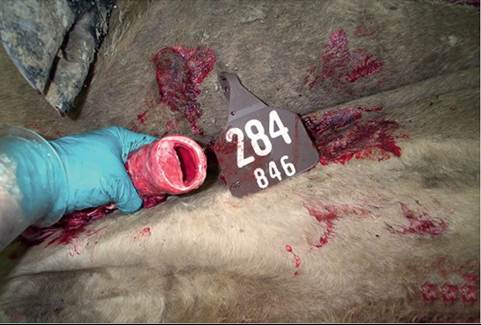
Color Plate 31.1 Postmortem photograph of tracheal edema syndrome. Note the severe mucosal and submucosal thickening, which has obstructed the tracheza by approximately 50%. (Courtesy Feedlot Health Management Services, Okotoks, Alta., Canada.)
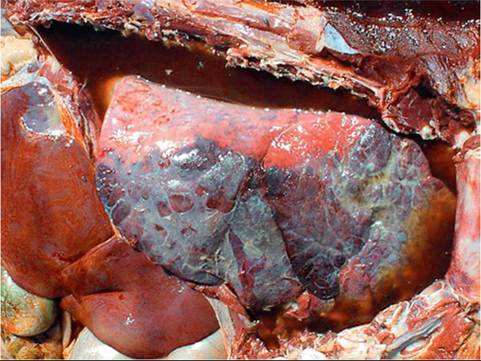
Color Plate 31.4 Postmortem photograph of Abrinopurulent pleuropneumonia caused by Mannheimia haemolytica. Note the extensive dark red consolidated ventral lung, white fibrin on lung pleural surface, and red-tinged fluid in pleural space. (Courtesy Dr Amelia Woolums, Mississippi State University, Starkville, Miss.)
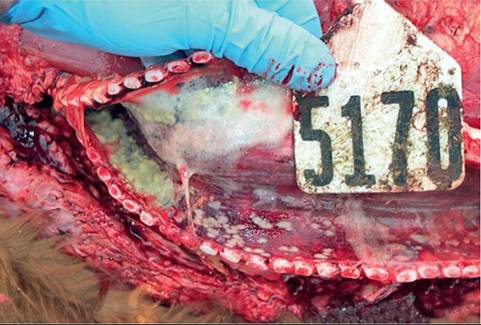
Color Plate 31.2 Postmortem photograph of opened trachea from an animal infected with bovine herpesvirus 1 (BHV-1). Note the multiple white Abrinonecrotic plaques and, distal to the plaques, yellow Abrinopurulent material on dark red tracheal mucosa. (Courtesy Feedlot Health Management Services, Okotoks, Alta., Canada.)
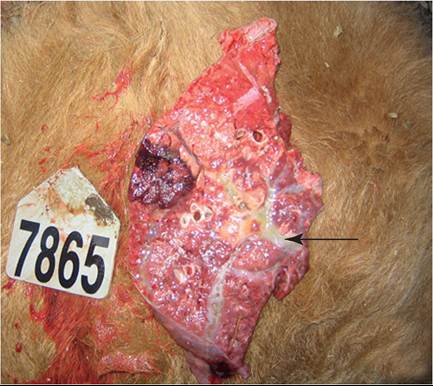
Color Plate 31.5 Postmortem photograph of cross-section of lung tissue from feedlot steer with bronchopneumonia caused by Histophilus somni. Note that the interlobular space is expanded with fibrin and edema (arrow). (Courtesy Feedlot Health Management Services, Okotoks, Alta., Canada.)
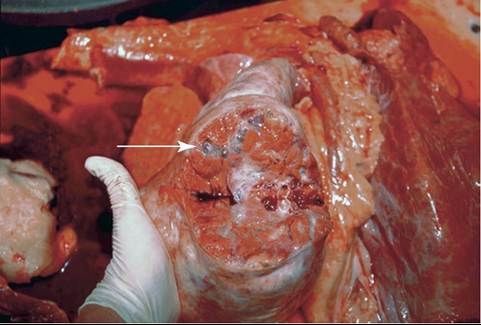
Color Plate 31.3 Postmortem photograph of bovine lung with interstitial emphysema (arrow) often seen in severe bovine respiratory syncytial virus (BRSV) infection, as well as other causes of acute interstitial pneumonia. (Courtesy Dr. Amelia Woolums, Mississippi State University, Starkville, Miss.)
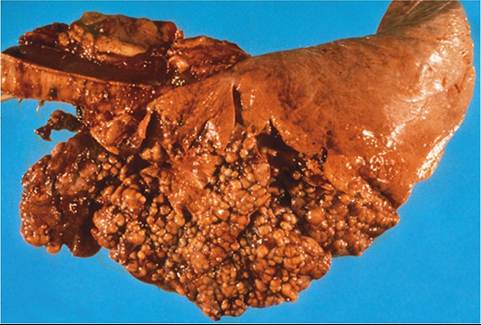
Color Plate 31.6 Postmortem photograph of lung from calf with bronchopneumonia caused by Mycoplasma bovis. Note the extensive nodular abscessation of the cranioventral lung. (Courtesy Dr Tom Mullaney, Michigan State University, East Lansing, Mich.)
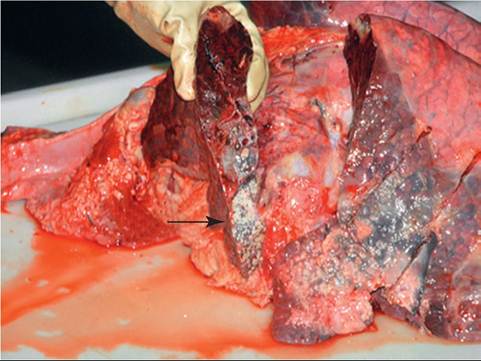
Color Plate 31.7 Postmortem photograph of lung from calf with bronchopneumonia caused by Mycoplasma bovis. Note the dark red consolidated ventral lung with white caseous material visible on cut surface (arrow). (Courtesy Dr. Ricardo Rosenbusch, Iowa State University, Ames, Iowa.)
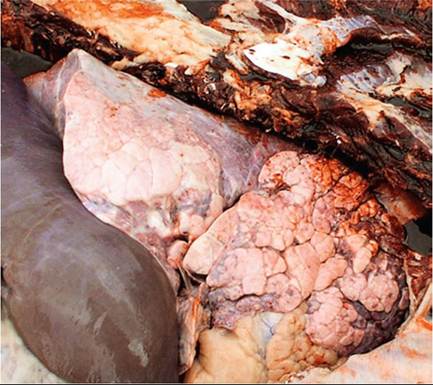
Color Plate 31.9 Postmortem photograph of lungs from heifer with acute respiratory distress syndrome (ARDS) caused by feedlot acute interstitial pneumonia (AIP). Note the expanded dorsocaudal lung and dark, collapsed lobules interspersed with pale, hyperinflated lobules. (Courtesy Dr. Amelia Woolums, Mississippi State University, Starkville, Miss.)
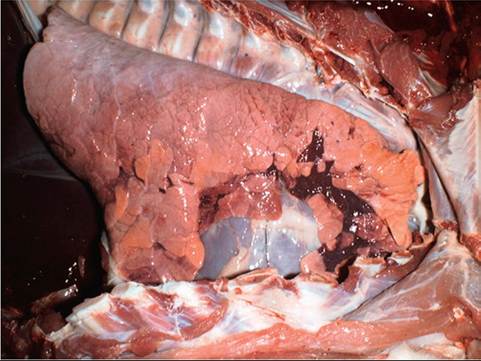
Color Plate 31.8 Postmortem photograph of lung lesions typical of enzootic calf pneumonia. Note the scattered collapsed, dark red lobules in the cranioventral lung. This type of lesion could be caused by bovine respiratory syncytial virus (BRSV), parainfluenza virus type 3 (PIV-3), Pasteurella multocida, or mycoplasmas. (Courtesy Dr. Amelia Woolums, Mississippi State University, Starkville, Miss.)
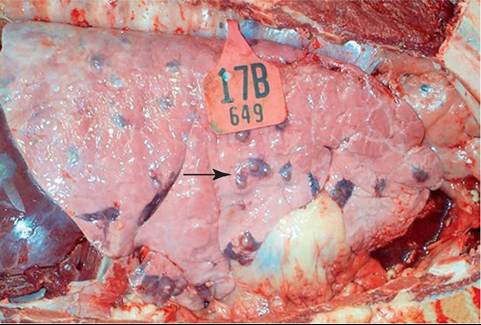
Color Plate 31.10 Postmortem photograph of lung from feedlot steer with embolic pneumonia caused by caudal vena caval thrombosis. Note the multiple dark red emboli (arrow) with raised abscesses scattered throughout lung. (Courtesy Feedlot Health Management Services, Okotoks, Alta., Canada.)