REFERENCES
The complete list of references can be found at www.expertconsult.com.
REFERENCES
Diagnostic Procedures and Imaging of the Equine Alimentary System
1. Bain FT, Petrizzi L, Valbonetti L, et al: Gastroscopy and duodenoscopy.
In Slovis N, editor: Atlas of equine endoscopy, St. Louis, MO, 2004, Mosby, pp 147-168.2. Murray MJ: Gastric endoscopy in foals. In Brown CM, Traub-Dargatz JL, editors: Equine endoscopy, St. Louis, MO, 1997, Mosby.
3. Galuppo LD, Snyder JR, Pascoe JR: Laparoscopic anatomy of the equine abdomen, Am J Vet Res 56:518, 1995.
4. Fischer AT: Standing laparoscopic surgery. In Freeman DE, editor: Veterinary clinics of North America: equine practice, surgical management of colic, Philadelphia, PA, 1997, Saunders.
5. Fischer AT, Jr, Lloyd KC, Carlson GP, et al: Diagnostic laparoscopy in the horse, J Am Vet Med Assoc 189:289, 1986.
6. Jones ARE, Ragle CA, Anderson D, et al: Laparoscopic evaluation of the small intestine in the standing horse: technique and effects, Vet Surg 46:812, 2017.
7. Freeman S, England G: Effect of romifidine on gastrointestinal motility, assessed by transrectal ultrasonography, Equine Vet J 33:570, 2001.
8. Mitchell C, Malone E, Sage A, et al: Evaluation of gastrointestinal activity patterns in healthy horses using B mode and Doppler ultrasonography, Can Vet J 46:134,
2005.
9. Gomaa N: Effect of buscopan compositum on the motility of the duodenum, cecum and left ventral colon in healthy conscious horses, Berl Munch Tierarztl Wochenschr 124:168, 2011.
10. Busoni V, De Busscher V, Lopez D, et al: Evaluation of a protocol for fast localized abdominal ultrasonography of horses (FLASH) admitted for colic, Vet J 188:77, 2011.
11. Williams S, Cooper JD, Freeman SL: Evaluation of normal findings using a detailed and focused technique for transcutatneous abdominal ultrasonography in the horse, BMC Vet Res (Suppl 1):S5, 2014.
12. Rantanen N: Diseases of the abdomen, Vet Clin North Am Equine Pract 21:7, 1986.
13. Hendrickson E, Malone E, Sage A: Identification of normal parameters for ultrasonographic examination of the equine large colon and cecum, Can Vet J 48:289, 2007.
14. Reef V: Equine diagnostic ultrasound, Philadelphia, PA, 1998, WB Saunders.
15. Freeman S: Diagnostic ultrasonography of the mature equine abdomen, Equine Vet Educ 15:319, 2003.
16. Cannon J, Andrews A: Ultrasound of the equine abdomen. Proceedings of the 38th Annual American Association of Equine Practitioners Convention, Nov 29-Dec 2, Orlando, FL, 1992.
17. Reef V, Whittier M, Allam L: Sonographic evaluation of the adult abdomen, Clin Tech Equine Pract 3:294, 2004.
18. Lores M, Stryhn H, McDuffee L, et al: Transcutaneous ultrasonographic evaluation of gastric distension with fluid in horses, Am J Vet Res 68:153, 2007.
19. Draper A, Bowen M, Hallowell G: Reference ranges and reliability of transabdominal ultrasonographic renal dimension in Thoroughbred horses, Vet Radiol Ultrasound 53:336, 2012.
20. Hoffman K, Wood A, McCarthy P: Sonographic-anatomic correlation and imaging protocol for the kidneys of horses, Am J Vet Res 56:1403, 1995.
21. Santschi E, Slone D, Frank W: Use of ultrasound in horses for diagnosis of left dorsal displacement of the large colon and monitoring its nonsurgical correction, Vet Surg 22:281, 1993.
22. Pease A, Scrivani P, Erb H, et al: Accuracy of increased large-intestine wall thickness during ultrasonography for diagnosing large-colon torsion in 42 horses, Vet Radiol Ultrasound 45:220, 2004.
23. Abutarbush S: Use of ultrasonography to diagnose large colon volvulus in horses, J Am Vet Med Assoc 228:409, 2006.
24. Ness S, Bain F, Zantingh A, et al: Ultrasonographic visualization of colonic mesenteric vasculature as an indicator of large colon right dorsal displacement or 180° volvulus (or both) in horses, Can Vet J 53:378, 2012.
25. Korolainen R, Ruohoniemi M: Reliability of ultrasonography compared to radiography in revealing intestinal sand accumulations in horses, Equine Vet J 34:499, 2002.
26. Klohnen A, Vachon A, Fisher A: Use of diagnostic ultrasound in horses with signs of acute abdominal pain, J Am Vet Med Assoc 209:1597, 1996.
27. Beccati F, Pepe M, Gialletti R, et al: Is there a statistical correlation between ultrasonographic findings and definitive diagnosis in horses with acute abdominal pain?, Equine Vet J 43:98, 2011.
28. Dechant JE, Whitcomb MB, Magdesian KG: Ultrasonographic diagnosis—idiopathic muscular hypertrophy of the small intestine in a miniature horse, Vet Radiol Ultrasound 49:300, 2008.
29. Ceriotti S, Zucca E, Stancari G, et al: Sensitivity and specifity of ultrasonographic evaluation of small intestine wall thickness in the diagnosis of inflammatory bowel disease in horses: a retrospective study, J Equine Vet Sci 37:6, 2016.
30. Bernard W, Reef V, Reimer J, et al: Ultrasonographic diagnosis of small intestinal intussusception in three foals, J Am Vet Med Assoc 194:395, 1989.
31. Kirkberger R, van den Berg J, Gottschalk R, et al: Duodenal ultrasonography in the normal adult horse, Vet Radiol Ultrasound 36:50, 1995.
32. Jones SL, Davis JL, Rowlingson K: Ultrasonographic findings in horses with right dorsal colitis: five cases (2000-2001), J Am Vet Med Assoc 222:1248, 2003.
33. Siwinska N, Zak A, Baron M, et al: Right dorsal colon ultrasonography in normal adult ponies and miniature horses, PLoS ONE 12:1, 2017.
34. Campbell ML, Ackerman N, Peyton LC: Radiographic gastrointestinal anatomy of the foal, Vet Radiol 25:194, 1984.
35. Yarbrough TB, Langer DL, Snyder JR, et al: Abdominal radiography for diagnosis of enterolithiasis in horses: 141 cases (1990-1992), J Am Vet Med Assoc 205:592,
1994.
36. Ruohoniemi M, Kaikkonen R, Raekallio M, et al: Abdominal radiography in monitoring the resolution of sand accumulations from the large colon of horses treated medically, Equine Vet J 33:59, 2001.
37. Fischer AT, Jr, Kerr LY, O'Brien TR: Radiographic diagnosis of gastrointestinal disorders in the foal, Vet Radiol 28:42, 1987.
38. Korolainen R, Ruohoniemi M: Reliability of ultrasonography compared to radiography in revealing intestinal sand accumulations in horses, Equine Vet J 34:499, 2002.
39. Bushburg JT, Siebert JA, Leidholdt EMJ, et al: Digital radiography. In The essential physics of medical imaging, ed 2, Philadelphia, PA, 2002, Lippincott Williams & Wilkins, p 293.
40. Butler JA, Colles CM, Dyson SJ, et al: The alimentary and urinary systems. In Clinical radiology of the horse, ed 2, London, 2000, Blackwell Science, pp 651-684.
41. Greet TR, Whitwell KE: Barium swallow as an aid to the diagnosis of grass sickness, Equine Vet J 18:294, 1986.
42. Watson TD, Sullivan M: Effects of detomidine on equine oesophageal function as studied by contrast radiography, Vet Rec 129:67, 1991.
43. Dik KJ, Kalsbeek HC: Radiography of the equine stomach, Vet Radiol 26:48,
1985.
44. Fischer AT, Yarbrough TY: Retrograde contrast radiography of the distal portions of the intestinal tract in foals, J Am Vet Med Assoc 207:734, 1995.
45. Bauer S, Livesey MA, Bjorling DE, et al: Computed tomographic assisted surgical correction of persistent right aortic arch in a neonatal foal, Equine Vet Educ 8:40, 2006.
46. Lohmann KL, Roussel AJ, Cohen ND, et al: Comparison of nuclear scintigraphy and acetaminophen absorption as a means of studying gastric emptying in horses, Am J Vet Res 61:310, 2000.
47. Metayer N, Lhote M, Bahr A, et al: Meal size and starch content affect gastric emptying in horses, Equine Vet J 36:436, 2004.
48. Sutton DG, Bahr A, Preston T, et al: Quantitative detection of atropine-delayed gastric emptying in the horse by the 13C-octanoic acid breath test, Equine Vet J 34:479, 2002.
49. Sutton DG, Preston T, Christley RM, et al: The effects of xylazine, detomidine, acepromazine and butorphanol on equine solid phase gastric emptying rate, Equine Vet J 34:486, 2002.
50. Sutton DG, Bahr A, Preston T, et al: Validation of the 13C-octanoic acid breath test for measurement of equine gastric emptying rate of solids using radioscintigraphy, Equine Vet J 35:27, 2003.
51. Ringger NC, Lester GD, Neuwirth L, et al: Effect of bethanechol or erythromycin on gastric emptying in horses, Am J Vet Res 57:1771, 1996.
52. East LM, Trumble TN, Steyn PF, et al: The application of technetium-99m hexamethylpropyleneamine oxime (99mTc-HMPAO) labeled white blood cells for the diagnosis of right dorsal ulcerative colitis in two horses, Vet Radiol Ultrasound 41:360, 2000.
53. Menzies-Gow NJ, Weller R, Bowen IM, et al: Use of nuclear scintigraphy with 99mTc-HMPAO-labelled leucocytes to assess small intestinal malabsorption in 17 horses, Vet Rec 153:457, 2003.
54. Bracamonte JL, Boure LP, Geor RJ, et al: Evaluation of a laparoscopic technique for collection of serial full-thickness small intestinal biopsy specimens in standing sedated horses, Am J Vet Res 69:431, 2008.
55. Pearson EG, Smith BB, McKim JM: Fecal blood determinations and interpretations, Proc Am Assoc Equine Pract 33:77, 1987.
56. Roberts MC: Carbohydrate digestion and absorption studies in the horse, Res Vet Sci 18:64, 1975.
57. Martens RJ, Malone PS, Brust DM: Oral lactose tolerance test in foals: technique and normal values, Am J Vet Res 46:63, 1985.
58. Murphy D, Reid SW, Love S: The effect of age and diet on the oral glucose tolerance test in ponies, Equine Vet J 29:467, 1997.
59. Mair TS, Hillyer MH, Taylor FG, et al: Small intestinal malabsorption in the horse: an assessment of the specificity of the oral glucose tolerance test, Equine Vet J 23:344, 1991.
60. Murphy D, Reid SW, Love S: Breath hydrogen measurement in ponies: a preliminary study, Res Vet Sci 65:47, 1998.
61. Bracher V, Steiger R, Huser S: Preliminary results using a combined xylose absorp- tion/hydrogen exhalation test in horses, Schweiz Archiv Tierheilkd 137:297, 1995.
Dentistry and Oral Diseases
1. Sisson S: Equine digestive system. In Getty R, editor: Sisson and Grossmans the anatomy of domestic animals, Philadelphia, PA, 1975, Saunders.
2. Nickel R, Schummer A, Seiferle E: The viscera of domestic animals, ed 2, Berlin, 1979, Paul Parey.
3. Liuti T, Reardon R, Dixon PM: Computed tomographic assessment of equine maxillary cheek teeth anatomical relationships, and paranasal sinus volumes, Vet Rec 2017, doi:10.1136/vr.104185.
4. Dixon PM, Froydenlund T, Luti T, et al: Empyema of the nasal conchal bullas as a cause of chronic unilateral nasal discharge in the horse: 10 cases (2013-2014), Equine Vet J 47:557-567, 2015.
5. Adams K, Schulz-Kornas E, Arzi B, et al: Functional anatomy of the equine temporomandibular joint: collagen fiber texture of the articular surfaces, Vet J 16:58-64, 2016.
6. Carmalt JL, Kneissl S, Rawlinson JE, et al: Computed tomographic appearance of the temporomandibular joint in 1018 asymptomatic horses: a multi-institutional study, Vet Rad US 57(3):237-245, 2016.
7. Carmalt JL: Dental physiology. In Easley J, Dixon PM, Schumacher J, editors: Equine dentistry, ed 3, Edinburgh, 2011, Elsevier Saunders, pp 77-84.
8. Floyd MR: The modified Triadan system nomenclature for veterinary dentistry, J Vet Dent 8:18-20, 1991.
9. Suske A, Poschke A, Schrock P, et al: Infundibula of equine maxillary cheek teeth. Part 1: development, blood supply and infundibular cementgenesis, Vet J 209:57-65, 2016.
10. White C, Dixon PM: A study of the thickness of cheek teeth sub-occlusal secondary dentine in horses of different ages, Equine Vet J 42:119, 2010.
11. Bettiol N, Dixon PM: An anatomical study to evaluate the risk of pulpar exposure during mechanical widening of equine cheek teeth diastemata and “bit seating, Equine Vet J 43:163, 2011.
12. Du Toit N, Kempson SA, Dixon PM: Donkey dental anatomy. Part 1: gross and computed axial tomography examination, Vet J 176:338-344, 2008.
13. Kopke S, Angrisani N, Staszyk C: The dental cavities of equine cheek teeth: three-dimensional reconstructions based on high resolution micro-computed tomography, BMC Vet Res 8:173, 2012.
14. Rice MK: Regional nerve blocks for equine dentistry, J Vet Dent 34(2):106-109,
2017.
15. Brown SL, Arkins S, Shaw DJ, et al: Occlusal angles of cheek teeth in normal horses and horses with dental disease, Vet Record 162:807, 2008.
16. Listmann L, Schrock P, Failing K, et al: Occlusal angles of cheek teeth, Livestock Science 186:78-84, 2016.
17. Bonin SJ, Clayton HM, Lanovaz JL, et al: Comparison of mandibular motion in horses chewing hay and pellets, Equine Vet J 39:258-262, 2007.
18. Klugh OD: Periodontal disease. In Robinson NE, Sprayberry KA, editors: Current therapy in equine medicine, ed 6, St. Louis, MO, 2009, Saunders, pp 328-334.
19. du Toit N, Burden FA, Dixon PM: Clinical dental examinations of 357 donkeys in the UK. Part 1: prevalence of dental disorders, Equine Vet J 41:390, 2009.
20. du Toit N, Burden FA, Dixon PM: Clinical dental examinations of 357 donkeys in the UK. Part 2: epidemiological studies on the potential relationships between dental disease and systemic disorders, Equine Vet J 41:395, 2009.
21. Dixon PM: The evolution of horses and the evolution of equine dentistry. In: Proceedings of the 63rd Annual AAEP Convention, San Antonio, TX: 79-116, 2017.
22. Hawkes CS, Easley J, Barakzai SZ, et al: Treatment of oromaxillary fistulae in nine standing horses (2002-2006), Equine Vet J 40(6):546-551, 2008.
23. Ramzen PH, Dixon PM, Kempson SA, et al: Dental dysplasia and oligodontia in a Throroughbred colt, Equine Vet J 33(1):99-104, 2001.
24. Easley J, Dixon PM, Reardon RJ: Orthodontic correction of overjet/overbite (Parrot mouth) in 73 foals (1999-2013), Equine Vet J 48(5):565-572, 2016.
25. Easley J, Schumacher J: Basic equine orthodontics and maxillofacial surgery. In Easley J, Dixon PM, Schumacher J, editors: Equine dentistry, ed 3, Edinburgh, 2011, Elsevier Saunders, pp 289-317.
26. Earley E, Rawlinson JT: A new understanding of oral and dental disorders of the equine incisor and canine teeth, Vet Clin North Am Equine Pract 29(2): 273-300, 2013.
27. Wilson GA, Walsh LJ: Temperature changes in dental pulp associated with use of power grinding equipment on equine teeth, Aust Vet J 83:75-77, 2005.
28. O'Leary JM, Barnett TP, Parkins TD, et al: Pulp temperature changes during mechanical reduction of equine cheek teeth: comparison of different moderized instruments, duration of treatments and use of water cooling, Equine Vet J 45(3):355-360, 2013.
29. Kennedy R, Lappin DF, Dixon PM, et al: The microbiome associated with equine periodontitis and oral health, Vet Res 47:1, 2016.
30. Dixon PM, Ceen S, Barnett T: A long-term study on the clinical effects of mechanical widening of cheek teeth diastemata for treatment of periodontitis in 202 horses (2008-2011), Equine Vet J 46(1):76-80, 2014.
31. Borkent D, Reardon RJM, McLachlan G, et al: An epidemiological survey on the prevalence of equine peripheral caries in the United Kingdom and possible risk factors for its development, Equine Vet J Online 2016, doi:10.111/evj.12610.
32. Fitzgibbons CM, du Toit N, Dixon P: Anatomical studies of maxillary cheek teeth infundibula in clinically normal horses, Equine Vet J 42:37, 2009.
33. Horbal AA, Liuti T, Reardon R, et al: Infundibular caries—what are they and why are we concerned? In: Proceedings of AAEP Focus on Dentistry, Lexington KY, 87-94, 2017.
34. Van den Enden MSD, Dixon PM: Prevalence of occlusal pulpar exposure in 110 equine cheek teeth with apical infections and idiopathic fractures, Equine Vet J 178:364, 2008.
35. Dacre IT, Kempson S, Dixon PM: Pathological studies of cheek teeth apical infections in horses. Part 1, Vet J 178:341, 2008.
36. Tremaine H: Advances in the treatment of diseased equine cheek teeth, Vet Clin Equine 29:441-465, 2013.
37. Menzies RA, Easley J: Standing equine dental surgery. In, Vet Clin Equine 30:63-90, 2014.
38. Staszyk C, Bienert A, Simhofer H, et al: Equine odontoclastic tooth resorption and hypercementosis, Vet J 178:372-379, 2008.
39. Earley ET, Rawlinson JR, Baratt RM, et al: Hematologic, biochemical and endocrine parameters in horses with tooth resorption and hypercementosis, J Vet Dent 34(3):155-160, 2017.
40. Lorello O, Foster DL, Levine DG, et al: Clinical treatment and prognosis of equine odontoclastic tooth resorption and hypercementosis, Equine Vet J 48(2):188-194, 2016.
41. Scocco P, Pedini V: Equine mandibular gland: in situ characterization of sialoderivatives, Equine Vet J 38:410, 2006.
42. Pirie RS, Tremaine WH: Neoplasia of the mouth and surrounding structures. In Robinson NE, editor: Current therapy in equine medicine, ed 4, Philadelphia, PA, 1997, Saunders, pp 153-155.
43. Knottenbelt DC, Kelly DF: Oral and dental tumors. In Easley J, Dixon PM, Schumacher J, editors: Equine dentistry, ed 3, Edenburgh, 2011, Elsevier, pp 149-181.
44. Menzies R: Oral examination and charting: setting the basis for evidence-based medicine in the oral examination of equids, Vet Clin Equine 29:325-344, 2013.
45. Henry T: Component-bases Oral examination. In: Proceedings of AAEP Resort Symposium, Bridgetown, Barbados, 1-13, 2016.
46. Milne E: Differential diagnosis of dysphagia. In Robinson NE, editor: Current therapy in equine medicine, ed 4, Philadelphia, PA, 1997, Saunders, pp 141-143.
47. Henneke D: A condition score system for horses, Equine Pract 7:13, 1985.
48. American Association of Equine Practitioners (AAEP): Official guide for determining the age of the horse, Lexington, KY, 1995, AAEP.
49. Simhofer H, Griss R, Zetner K: The use of oral endoscopy for detection of cheek teeth abnormalities in 300 horses, Vet J 178:396-404, 2008.
50. Baratt R: Advances in equine dental radiology, Vet Clin Equine 29:367-395,
2013.
51. Tucker RL, Farrell E: Computed tomography and magnetic resonance imaging of the equine head, Vet Clin North Am Equine Pract 17:131, 2001.
52. Selberg K, Easley JT: Advanced imaging in equine dental disease, Vet Clin Equine 29:397-409, 2013.
53. Rawlinson JT, Earley E: Advances in the treatment of diseased equine incisor and canine teeth, Vet Clin Equine 29:411-440, 2013.
54. Ramzan PHL, Palmer L, Barquero N, et al: The chronology and sequence of emergence of permanent premolar teeth in the horse: a study of deciduous premolar “cap” removal in thoroughbred racehorses, Equine Vet J 41:107, 2009.
Disorders of the Esophagus
1. Schummer A, Nickel R, Sack WO: The alimentary canal. The viscera of the domestic mammals, New York, 1979, Springer-Verlag.
2. Sisson S: Equine digestive system. In Getty R, editor: Sisson and Grossman’s anatomy of the domestic animals, Philadelphia, PA, 1999, Saunders.
3. Stick JA, Derksen FJ, McNitt DL, et al: Equine esophageal pressure profile, Am J Vet Res 44:272, 1983.
4. Clark ES, Morris DD, Whitlock RH: Esophageal manometry in horses, cows, and sheep during deglutition, Am J Vet Res 48:547, 1987.
5. Fubini SL, Starrack GS, Freeman DE: Esophagus. In Auer JA, Stick JA, editors: Equine surgery, Philadelphia, PA, 1999, Saunders.
6. Stick JA, Robinson NE, Krehbiel JD: Acid-base and electrolyte alterations associated with salivary loss in the pony, Am J Vet Res 42:733, 1981.
7. Greet TR: Observations on the potential role of oesophageal radiography in the horse, Equine Vet J 14:73, 1982.
8. Stick JA: Surgery of the esophagus, Vet Clin North Am Large Anim Pract 4:33, 1982.
9. Peroni JF, Horner NT, Robinson NE, et al: Equine thoracoscopy: normal anatomy and surgical technique, Equine Vet J 33:231, 2001.
10. Meagher DM, Spier SJ: Foreign body obstruction in the cervical esophagus of the horse: a case report, J Equine Vet Sci 9:137, 1989.
11. Grubb TL, von Mathiessen W, Scott EA: A stone in the esophagus of a horse— surgical removal without esophagomyotomy, Equine Pract 13:15, 1991.
12. Lundvall RL, Kingrey BW: Choke in shetland ponies caused by boluses, J Am Vet Med Assoc 132:75, 1958.
13. Appt SA, Moll HD, Scarratt WK, et al: Esophageal foreign body obstruction in a mustang, Equine Pract 18:8, 1996.
14. MacDonald MH, Richardson DW, Morse CC: Esophageal phytobezoar in a horse, J Am Vet Med Assoc 191:1455, 1987.
15. Hillyer M: Management of oesophageal obstruction (choke) in horses, In Pract 17:450, 1995.
16. Murray MJ, Ball MM, Parker GA: Megaesophagus and aspiration pneumonia secondary to gastric ulceration in a foal, J Am Vet Med Assoc 192:381, 1988.
17. Craig DR, Shivy DR, Pankowski RL, et al: Esophageal disorders in 61 horses. Results of nonsurgical and surgical management, Vet Surg 18:432, 1989.
18. Traver DS, Egger E, Moore JN: Retrieval of an esophageal foreign body in a horse, Vet Med Small Anim Clin 73:783, 1978.
19. Baird AN, True CK: Fragments of nasogastric tubes as esophageal foreign bodies in two horses, J Am Vet Med Assoc 194:1068, 1989.
20. Harris JM: Esophageal obstruction by a wood bolus, Mod Vet Pract 62:302, 1981.
21. Moore JN, Kintner LD: Recurrent esophageal obstruction due to squamous cell carcinoma in a horse, Cornell Vet 66:590, 1976.
22. Roberts MC, Kelly WR: Squamous cell carcinoma of the lower cervical oesophagus in a pony, Equine Vet J 11:199, 1979.
23. Green S, Green EM, Aronson E: Squamous cell carcinoma: an unusual cause of choke in a horse. Mod Vet Pract 67:870, 1986.
24. Butt TD, MacDonald DG, Crawford WH, et al: Persistent right aortic arch in a yearling horse, Can Vet J 39:714, 1998.
25. Scott EA, Snoy P, Prasse KW, et al: Intramural esophageal cyst in a horse, J Am Vet Med Assoc 171:652, 1977.
26. Hackett RP, Dyer RM, Hoffer RE: Surgical correction of esophageal diverticulum in a horse, J Am Vet Med Assoc 173:998, 1978.
27. Orsini JA, Sepesy L, Donawick WJ, et al: Esophageal duplication cyst as a cause of choke in the horse, J Am Vet Med Assoc 193:474, 1988.
28. Alexander JE: Radiologic findings in equine choke, J Am VetMed Assoc 151:47, 1967.
29. Quick CB, Rendano VT: Equine radiology: the esophagus, Mod Vet Pract 59:625, 1978.
30. King JN, Davies JV, Gerring EL: Contrast radiography of the equine oesophagus: effect of spasmolytic agents and passage of a nasogastric tube, Equine Vet J 22:133, 1990.
31. Meyer GA, Helms RJ, Rashmir-Ravin A, et al: Effect of oxytocin on contractility of the equine esophagus: treatment for esophageal obstruction?, Proc Am Assoc Equine Pract 43:337, 1997.
32. Hance SR, Noble J, Holcomb S, et al: Treating choke with oxytocin, Proc Am Assoc Equine Pract 43:338, 1997.
33. Wooldridge AA, Eades SC, Hosgood GL, et al: Effects of treatment with oxytocin, xylazine butorphanol, guaifenesin, acepromazine, and detomidine on esophageal manometric pressure in conscious horses, Am J Vet Res 63:1738, 2002.
34. Wooldridge AA, Eades SC, Hosgood GL, et al: In vitro effects of oxytocin, acepromazine, detomidine, xylazine, butorphanol, terbutaline, isoproterenol, and dantrolene on smooth and skeletal muscles of the equine esophagus, Am J Vet Res 63:1732, 2002.
35. Hardy J, Stewart RH, Beard WL, et al: Complications of nasogastric intubation in horses: nine cases (1987-1989), J Am Vet Med Assoc 201:483, 1992.
36. Schoeb TR, Panciera RJ: Pathology of blister beetle (Epicauta) poisoning in horses, Vet Pathol 16:18, 1979.
37. Lang J, Blikslager A, Regina D, et al: Synergistic effect of hydrochloric acid and bile acids on the pars esophageal mucosa of the porcine stomach, Am J Vet Res 59:1170, 1998.
38. Clark ES, Morris DD, Whitlock RH: Esophageal dysfunction in a weanling thoroughbred, Cornell Vet 77:151, 1987.
39. Ploeg M, Grone A, Saey V, et al: Esophageal dysfunction in Friesian horses: morphological features, Vet Pathol 52:1142, 2015.
40. Komine M, Langohr IM, Kiupel M: Megaesophagus in Friesian horses associated with muscular hypertrophy of the caudal esophagus, Vet Pathol 51:979, 2014.
41. Barber SM, McLaughlin BG, Fretz PB: Esophageal ectasia in a quarterhorse colt, Can Vet J 24:46, 1983.
42. Rohrbach BW: Congenital esophageal ectasia in a thoroughbred foal, J Am Vet Med Assoc 177:65, 1980.
43. Bowman KF, Vaughan JT, Quick CB, et al: Megaesophagus in a colt, J Am Vet Med Assoc 172:334, 1978.
44. Greet TR, Whitwell KE: Barium swallow as an aid to the diagnosis of grass sickness, Equine Vet J 18:294, 1986.
45. Watson TD, Sullivan M: Effects of detomidine on equine oesophageal function as studied by contrast radiography, Vet Rec 129:67, 1991.
46. Clabough DL, Roberts MC, Robertson I: Probable congenital esophageal stenosis in a thoroughbred foal, J Am Vet Med Assoc 199:483, 1991.
47. Peek SF, De Lahunta A, Hackett RP: Combined oesophageal and tracheal duplication cyst in an Arabian filly, Equine Vet J 27:475, 1995.
48. Gaughan EM, Gift LJ, Frank RK: Tubular duplication of the cervical portion of the esophagus in a foal, J Am Vet Med Assoc 201:748, 1992.
49. Rohrbach BW: Congenital esophageal ectasia in a thoroughbred foal, J Am Vet Med Assoc 177:65, 1980.
50. Mackey VS, Large SM, Breznock EM, et al: Surgical correction of a persistent right aortic arch in a foal, Vet Surg 15:325, 1986.
51. Sams AE, Weldon AD, Rakestraw P: Surgical treatment of intramural esophageal inclusion cysts in three horses, Vet Surg 22:135, 1993.
52. Freeman DE: Wounds of the esophagus and trachea, Vet Clin North Am Equine Pract 5:683, 1989.
53. Digby NJ, Burguez PN: Traumatic oesophageal rupture in the horse, Equine Vet J 14:169, 1982.
54. Lunn DP, Peel JE: Successful treatment of traumatic oesophageal rupture with severe cellulitis in a mare, Vet Rec 116:544, 1985.
55. Todhunter RJ, Stick JA, Trotter GW, et al: Medical management of esophageal stricture in seven horses, J Am Vet Med Assoc 185:784, 1984.
56. Craig D, Todhunter R: Surgical repair of an esophageal stricture in a horse, Vet Surg 16:251, 1987.
57. Green EM, MacFadden KE: Esophageal disorders of the horse. In Smith BP, editor: Large animal internal medicine, ed 2, St. Louis, MO, 1996, Mosby, p 98.
58. Gideon L: Esophageal anastomosis in two foals, J Am Vet Med Assoc 184:1146, 1984.
59. Suann CJ: Oesophageal resection and anastomosis as a treatment for oesophageal stricture in the horse, Equine Vet J 14:163, 1982.
60. Nixon AJ, Aanes WA, Nelson AW, et al: Esophagomyotomy for relief of an intrathoracic esophageal stricture in a horse, J Am Vet Med Assoc 183:794, 1983.
61. Wagner PC, Rantanen NW: Myotomy as a treatment for esophageal stricture in a horse, Equine Pract 2:40, 1980.
62. Hoffer RE, Barber SM, Kallfelz FA, et al: Esophageal patch grafting as a treatment for esophageal stricture in a horse, J Am Vet Med Assoc 171:350, 1977.
63. Ford TS, Schumacher J, Chaffin MK, et al: Surgical repair of an intrathoracic esophageal pulsion diverticulum in a horse, Vet Surg 20:316, 1991.
64. Frauenfelder HC, Adams SB: Esophageal diverticulectomy in a horse, J Am Vet Med Assoc 180:771, 1982.
65. Campbell-Beggs CL, Kiper ML, MacAllister C, et al: Use of esophagoscopy in the diagnosis of esophageal squamous cell carcinoma in a horse, J Am Vet Med Assoc 202:617, 1993.
66. Ford TS, Vaala WE, Sweeney CR, et al: Pleuroscopic diagnosis of gastroesophageal squamous cell carcinoma in a horse, J Am Vet Med Assoc 190:1556, 1987.
67. Boy MG, Palmer JE, Heyer G, et al: Gastric leiomyosarcoma in a horse, J Am Vet Med Assoc 200:1363, 1992.
Disorders of the Stomach
1. Rendle D, Bowen M, Brazil T, et al: Recommendations for the management of equine glandular gastric disease, UK-Vet Equine 2:2-11, 2018.
2. Campbell-Thompson ML, Merritt AM: Effect of ranitidine on gastric acid secretion in young male horses, Am J Vet Res 48:1511, 1987.
3. Murray MJ, Eichorn ES: Effects of intermittent feed deprivation, intermittent feed deprivation with ranitidine administration, and stall confinement with ad libitum access to hay on gastric ulceration in horses, Am J Vet Res 57:1599,
1996.
4. Widenhouse TV, Lester GD, Merritt AM: Effect of hydrochloric acid, pepsin, or taurocholate on bioelectric properties of gastric squamous mucosa in horses, Am J Vet Res 63:744, 2002.
5. Nadeau JA, Andrews FM, Patton CS, et al: Effects of hydrochloric, valeric, and other volatile fatty acids on pathogenesis of ulcers in the nonglandular portion of the stomach of horses, Am J Vet Res 64:413, 2003.
6. Murray MJ, Grodinsky C, Anderson CW, et al: Gastric ulcers in horses: a comparison of endoscopic findings in horses with and without clinical signs, Equine Vet J Suppl 21(Suppl 7):68-72, 1989.
7. Andrews FM, Nadeau J: Clinical syndromes of gastric ulceration in foals and mature horses, Equine Vet J 31(Suppl 29):30-33, 1999.
8. Vatistas NJ, Snyder JR, Carlson G, et al: Cross-sectional study of gastric ulcers of the squamous mucosa in Thoroughbred racehorses, Equine Vet J 31(Suppl 29):34-39, 1999.
9. Bezdekova B, Jahn P, Vyskocil M: Gastric Ulceration, appetite and feeding practices in Standardbred racehorses in the Czech Republic, Acta Vet Brno 77:603-607, 2008.
10. Dionne R, Vrins A, Doucet M: Gastric ulcers in Standardbred racehorses: prevalence, lesion description, and risk factors, J Vet Int Med 17:218, 2003.
11. Bell RJW, Kingston JK, Mogg TD, et al: The prevalence of gastric ulceration in racehorses in New Zealand, N Z Vet J 55:13, 2007.
12. McClure SR, Glickman LT, Glickman NW: Prevalence of gastric ulcers in show horses, J Am Vet Med Ass 215:1130, 1999.
13. Nicol CJC, Davidson HPD, Harris PA, et al: Study of crib-biting and gastric inflammation and ulceration in young horses, Vet Rec 151:658-662, 2002.
14. Murray MJ, Grodinsky C: The effects of famotidine, ranitidine and magnesium hydroxide/aluminium hydroxide on gastric fluid pH in adult horses, Equine Vet J Suppl 24:52, 1992.
15. Dukti S, Perkins S, Murphy J, et al: Prevalence of gastric squamous ulceration in horses with abdominal pain, Equine Vet J 38:347-349, 2006.
16. Videla R, Andrews FM: New perspectives in equine gastric ulcer syndrome, Vet Clin North Am Equine Pract 25:283-301, 2009.
17. Kollias-Baker C, Cox K, Jones J: Evaluation of the effects of omeprazole on physiological indices of performance of horses during incremental treadmill exercise, Vet Ther 2:361-369, 2001.
18. Jonsson H, Egenvall A: Prevalence of gastric ulceration in Swedish Standardbreds in race training, Equine Vet J 38:209-213, 2006.
19. Franklin SH, Brazil TJ, Allen KJ: Poor performance associated with equine gastric ulceration syndrome in four Thoroughbred racehorses, Equine Vet Educ 20:119-124, 2008.
20. Begg LM, O'Sullivan CB: The prevalence and distribution of gastric ulceration in 345 racehorses, Aust Vet J 81:199, 2003.
21. Murray MJ, Schusser GRF, Piper FS, et al: Factors associated with gastric lesions in Thoroughbred racehorses, Equine Vet J 28:368, 1996.
22. Sykes BW, Hewetson M, Hepburn RJ, et al: European College of equine internal medicine consensus Statement—Equine gastric ulcer syndrome in adult horses, J Vet Int Med. 29:1288-1299, 2015b.
23. Luthersson N, Nielsen KH, Harris P, et al: The prevalence and anatomical distribution of equine gastric ulceration syndrome (EGUS) in 201 horses in Denmark, Equine Vet J 41:619, 2010.
24. Rabuffo TS, Orsini JA, Sullivan E, et al: Associations between age or sex and prevalence of gastric ulceration in Standardbred racehorses in training, J Am Vet Med Ass 221:1156-1159, 2002.
25. Nieto JE, Snyder JR, Beldomenico P, et al: Prevalence of gastric ulcers in endurance horses—a preliminary report, Vet J 167:33, 2004.
26. Tamzali Y, Marguet C, Priymenko N, et al: Prevalence of gastric ulcer syndrome in high-level endurance horses, Equine Vet J 43:141, 2011.
27. Bertone J: Prevalence of gastric ulcers in elite heavy use western performance horses. Proceedings of the 46th Annual Convention of the American Association of Equine Practitioners, Nov 26-29, San Antonio, TX, 2000.
28. Lorenzo-Figueras M, Merritt A: Effects of exercise on gastric volume and pH in the proximal portion of the stomach of horses, Am J Vet Res 63:1481, 2002.
29. Nadeau J, Andrews F, Mathew A: Evaluation of diet as a cause of gastric ulcers in horses, Am J Vet Res 61:784, 2000.
30. Vatistas N, Sifferman R, Holste J: Induction and maintenance of gastric ulceration in horses in simulated race training, Equine Vet J 29:40, 1999.
31. McClure S, Carithers D, Gross S: Gastric ulcer development in horses in a simulated show or training environment, J Am Vet Med Assoc 227:775, 2005.
32. Habershon-Butcher JL, Hallowell GD, Bowen IM, et al: Prevalence and risk factors for ulceration of the gastric glandular mucosa in Thoroughbred racehorses in training in the UK and Australia, J Vet Int Med. 26:731, 2012.
33. Andrews FM, Sifferman RL, Bernard W, et al: Efficacy of omeprazole paste in the treatment and prevention of gastric ulcers in horses, Equine Vet J Suppl 31:81-86, 1999.
34. Doucet MY, Vrins AA, Dionne R, et al: Efficacy of a paste formulation of omeprazole for the treatment of naturally occurring gastric ulcers in training Standardbred racehorses in Canada, Can Vet J 44:581, 2003.
35. Lester GD, Smith RL, Robertson ID: Effects of treatment with omeprazole or ranitidine on gastric squamous ulceration in racing Thoroughbreds, J Am Vet Med Ass 227:1636, 2005.
36. MacAllister CG, Sifferman RL, McClure SR, et al: Effects of omeprazole paste on healing of spontaneous gastric ulcers in horses and foals: a field trial, Equine Vet J Suppl 31:77-80, 1999.
37. Murray MJ, Haven ML, Eichorn ES, et al: Effects of omeprazole on healing of naturally-occurring gastric ulcers in Thoroughbred racehorses, Equine Vet J 29:425-429, 1997.
38. Sykes BW, Sykes KM, Hallowell GD: A comparison between pre- and post exercise administration of omeprazole in the treatment of equine gastric ulcer syndrome: a blinded, randomised, clinical trial, Equine Vet J 46:422-426,
2014.
39. Jenkins CC, Frazier DL, Blackford JT, et al: Pharmacokinetics and antisecretory effects of intravenous omeprazole in horses, Equine Vet J 24:84-88, 1992.
40. Jenkins CC, Blackford JT, Andrews FM, et al: Duration of antisecretory effects of oral omeprazole in horses with chronic gastric cannulae, Equine Vet J 24:89-92, 1992.
41. Andrews F, Jenkins C: Effect of oral omeprazole on basal and pentagastrin- stimulated gastric secretion in young female horses, Equine Vet J 24:80, 1992.
42. Daurio CP, Holste JE, Andrews FM, et al: Effect of omeprazole paste on gastric acid secretion in horses, Equine Vet J 31:59-62, 1999.
43. Sandin A, Andrews FM, Nadeau JA, et al: Effects of intramuscular omeprazole on gastric acid secretion in horses over a twenty-four hour period, Equine Vet J 31:50, 1999.
44. Andrews FM, Frank N, Sommerdahl CS, et al: Effects of intravenously administrated omeprazole on gastric juice pH and gastric ulcer scores in adult horses, J Vet Int Med 20:1202-1206, 2006.
45. Haven ML, Dave K, Burrow JA, et al: Comparison of the antisecretory effects of omeprazole when administered intravenously, as acid-stable granules and as an oral paste in horses, Equine Vet J 31:54-58, 1999.
46. Merritt AM, Sanchez LC, Burrow JA, et al: Effect of GastroGard and three compounded oral omeprazole preparations on 24 h intragastric pH in gastrically cannulated mature horses, Equine Vet J 35:691, 2003.
47. Sykes BW, Sykes KM, Hallowell GD: A comparison of two doses of omeprazole in the treatment of equine gastric ulcer syndrome: a blinded, randomised, clinical trial, Equine Vet J 46:416-421, 2014.
48. Sykes BW, Sykes KM, Hallowell GD: A comparison of three doses of omeprazole in the treatment of equine gastric ulcer syndrome: a blinded, randomised, dose-response clinical trial, Equine Vet J 47:285-290, 2015.
49. Murray MJ, Schusser GF: Measurement of 24-h gastric pH using an indwelling pH electrode in horses unfed, fed and treated with ranitidine, Equine Vet J 25:417, 1993.
50. Sangiah S, McAllister CC, Amouzadeh HR: Effects of cimetidine and ranitidine on basal gastric pH, free and total acid contents in horses, Res Vet Sci 45:291,
1988.
51. Sykes BW, Kathawala K, Song Y, et al: Preliminary investigations into a novel, long-acting, injectable, intramuscular formulation of omeprazole in the horse, Equine Vet J 49:795-801, 2017.
52. Clark CK, Merritt AM, Burrow JA, et al: Effect of aluminium hydroxide/ magnesium hydroxide antacid and bismuth subsalicylate on gastric pH in horses, J Am Vet Med Ass 208:1687, 1996.
53. Delaney RS, Muller M: Proton pump inhibitors and acute interstitial nephritis, BMJ 341:1-3, 2010.
54. Sykes BW, Sykes KM, Hallowell GD: Administration of trimethoprim- sulphadimidine does not improve healing of glandular gastric ulceration in horses receiving omeprazole: a randomised, blinded, clinical study, BMC Vet Res 10:180, 2014.
55. Hepburn R: Equine glandular ulceration: pathophysiology and epidemiology. American College of Veterinary Internal Medicine Annual Congress, May 30-Jun 2, New Orleans, LA, 2012.
56. Martineau H, Thompson H, Taylor D: Pathology of gastritis and gastric ulceration in the horse. Part 1: range of lesions present in 21 mature individuals, Equine Vet J 41:638-644, 2009.
57. Husted L, Jensen TK, Olsen SN, et al: Examination of equine glandular stomach lesions for bacteria, including Helicobacter spp by fluorescence in situ hybridisation, BMC Microbiol 10:84, 2010.
58. Crumpton SM, Baiker K, Hallowell GD, et al: Diagnostic value of gastric mucosal biopsies in horses with glandular disease, Equine Vet J 47:9, 2015.
59. de LaHunta A, Glass E, Kent M: Veterinary neuroanatmoy and clinical neurology, ed 4, 2014, Elselvier.
60. Binns A, Hallowell GD, Hollands T, et al: Assessment of behavioural changes displayed in horses with equine glandular gastric disease, J Vet Int Med 30(4):1547, 2016.
61. Luthersson N, Nielsen KH, Harris P, et al: Risk factors associated with equine gastric ulceration syndrome (EGUS) in 201 horses in Denmark, Equine Vet 41:625-630, 2009.
62. Monki J, Hewetson M, Virtala AMK: Risk factors for equine gastric glandular disease: a Case-Control study in a Finnish referral Hospital population, J Vet Intern Med 30:1270-1275, 2016.
63. Pedersen S, Windeyer C, Read E, et al: Prevalence of and risk factors for gastric ulceration in showjumping warmbloods, J Vet Int Med 29:1239, 2015.
64. Macleod H, Windeyer C, Crosby C, et al: Prevalence and risk factors for gastric ulceration in polo horses, J Vet Int Med 27:1244, 2015.
65. Levenstein S, Rosenstock S, Jacobsen RK, et al: Psychological stress increases risk for peptic ulcer, regardless of Helicobacter pylori infection or use of nonsteroidal anti-inflammatory drugs, Clin Gastroenterol Hepatol 13:498-506, e1, 2015.
66. Melinder C, Udumyan R, Hiyoshi A, et al: Decreased stress resilience in young men significantly increases the risk of subsequent peptic ulcer disease—a prospective study of 233 093 men in Sweden, Aliment Pharmacol Ther 41:1005-1015, 2015.
67. Deding U, Ejlskov L, Grabas MPK, et al: Perceived stress as a risk factor for peptic ulcers: a register-based cohort study, BMC Gastroenterol 16:140, 2016.
68. Malmkvist J, Poulsen JM, Luthersson N, et al: Behaviour and stress responses in horses with gastric ulceration, Appl Anim Behav Sci 142:160-167, 2012.
69. Scheidegger MD, Gerber V, Bruckmaier RM, et al: Increased adrenocortical response to adrenocorticotropic hormone (ACTH) in sport horses with equine glandular gastric disease (EGGD), Vet J 228:7-12, 2017.
70. Scott L, De Lavis I, Daniels SP: Crib biting and equine gastic ulcer syndrome, is there an anatomical link?, Equine Vet Educ S8:11, 2017.
71. Covalesky ME, Russoniello CR, Malinowski K: Effects of show-jumping performance stress on plasma cortisol and lactate concentrations and heart rate and behavior in horses, J Equine Vet Sci 12:244-251, 1992.
72. Cayado P, Munoz-Escassi B, Dominguez C, et al: Hormone response to training and competition in athletic horses, Equine Vet J Suppl 38:274-278, 2006.
73. Chan F, Leung W: Peptic-ulcer disease, Lancet 374:1449, 2002.
74. Contreras M, Morales A, Garcia-Amado MA, et al: Detection of Helicobacter-Hke DNA in the gastric mucosa of Thoroughbred horses, Lett Appl Microbiol 45:553, 2007.
75. Morales A, Garcia F, Bermudez V: Detection of Helicobacter-like organisms in Thoroughbred horses from Venezuela, Braz J Vet Path 3:52, 2010.
76. Dong H-J, Ho H, Hwang H, et al: Diversity of the gastric microbiota in Thoroughbred racehorses having gastric ulcer, J Microbiol Biotechnol 26:763-774, 2016.
77. MacAllister CG, Morgan SJ, Borne AT, et al: Comparison of adverse effects of phenylbutazone, flunixin meglumine, and ketoprofen in horses, J Am Vet Med Assoc 202:71, 1993.
78. Andrews F, Reinemeyer CR, Longhofer SL: Effects of top-dress formulations of suxibuzone and phenylbutazone on development of gastric ulcers in horses, Vet Ther 10:113, 2009.
79. Hepburn RJ: Treatment of ulceration of the gastric glandular mucosa: retrospective evaluation of omeprazole and sucralfate combination therapy in 204 sport and leisure horses. Proceedings of the 11th Colic Symposium, Dublin. 108, 2014.
80. Varley G, Bowen IM, Nicholls V, et al: Misoprostol is superior to combined omeprazole and sucralfate for healing glandular gastric lesions, Equine Vet J 48:11, 2016.
81. Sangiah S, MacAllister CC, Amouzadeh HR: Effects of misoprostol and omeprazole on basal gastric pH and free acid content in horses, Res Vet Sci 47:350-354, 1989.
82. Martin EM, Till RL, Sheats MK, et al: Misoprostol inhibits equine neutrophil adhesion, migration, and respiratory burst in an in vitro model of inflammation, Front Vet Sci 4:159, 2017.
83. Jacobson CC, Sertich PL, McDonnell SM: Mid-gestation pregnancy is not disrupted by a 5-day gastrointestinal mucosal cytoprotectant oral regimen of misoprostol, Equine Vet J 45:91-93, 2012.
84. Hepburn R: Equine glandular ulceration: pathophysiology and epidemiology and comparative aspects and management. American College of Veterinary Internal Medicine Annual Congress, May 30-Jun 2, New Orleans, LA, 2012.
85. Cargile J, Burrow J, Kim I: Effect of dietary corn oil supplementation on equine gastric fluid acid, sodium, and prostaglandin E2 content before and during pentagastrin infusion, J Vet Int Med 18:545, 2004.
86. Murray MJ, Nout YS, Ward DL: Endoscopic findings of the gastric antrum and pylorus in horses: 162 cases (1996-2000), J Vet Int Med 15:401, 2001.
87. Andrews F, Bernard W, Byars D, et al: Recommendations for the diagnosis and treatment of equine gastric ulcer syndrome (EGUS), Equine Vet Educ 11:262, 1999.
88. Sykes BW, Jokisalo J, Hallowell GD: Evaluation of a commercial faecal blood test for the diagnosis of gastric ulceration in Thoroughbred racehorses: a preliminary report, Proc 11th International Equine Colic Research Symposium 10:4, 2014.
89. Hewetson M, Sykes BW, Hallowell GD, et al: Diagnostic accuracy of blood sucrose as a screening test for equine gastric ulcer syndrome (EGUS) in adult horses, Acta Vet Scand 59:15, 2017.
90. Murray MJ, Grodinsky C, Cowles RR, et al: Endoscopic evaluation of changes in gastric lesions of Thoroughbred foals, J Am Vet Med Assoc 196:1623-1627, 1990.
91. Elfenbein JR, Sanchez LC: Prevalence of gastric and duodenal ulceration in 691 nonsurviving foals (1995-2006), Equine Vet J Suppl 76-79, 2012.
92. Okai K, Taharaguchi S, Orita Y, et al: Comparative endoscopic evaluation of normal and ulcerated gastric mucosae in thoroughbred foals, J Vet Med Sci
2015.
93. Murray MJ, Murray CM, Sweeney HJ, et al: Prevalence of gastric lesions in foals without signs of gastric disease: an endoscopic survey, Equine Vet J 22:6-8, 1990.
94. Hewetson M, Venner M, Volquardsen J, et al: Diagnostic accuracy of blood sucrose as a screening test for equine gastric ulcer syndrome (EGUS) in weanling foals, Acta Vet Scand 2018.
95. Sanchez LC, Lester GD, Merritt AM: Intragastric pH in critically ill neonatal foals and the effect of ranitidine, J Am Vet Med Assoc 218:907-911, 2001.
96. Murray MJ: Gastroduodenal ulceration in foals, Equine Vet Educ 11:199-207,
1999.
97. Becht JL, Byars TD: Gastroduodenal ulceration in foals, Equine Vet J 18:307-312,
1986.
98. Geor RJ, Petrie L, Papich MG, et al: The protective effects of sucralfate and ranitidine in foals experimentally intoxicated with phenylbutazone, Can J Vet Res 53:231-238, 1989.
99. Blikslager AT: Misoprostol: is it safety or a lack of understanding that prevents its more frequent usage?, Equine Vet J 45:8, 2013.
100. Herzig SJ, Howell MD, Ngo LH, et al: Acid-suppressive medication use and the risk for hospital-acquired pneumonia, JAMA 301:2120-2128, 2009.
101. Buendgens L, Bruensing J, Matthes M, et al: Administration of proton pump inhibitors in critically ill medical patients is associated with increased risk of developing Clostridium difficile associated diarrhea, J Crit Care 29(696):611-695, 2014.
102. Furr M, Cohen ND, Axon JE, et al: Treatment with histamine-type 2 receptor antagonists and omeprazole increases the risk of diarrhoea in neonatal foals treated in intensive care units, Equine Vet J Suppl 80-86, 2012.
103. Vainio K, Sykes BW, Blikslager AT: Primary gastric impaction in horses: a retrospective study of 20 cases (2005-2008), Equine Vet Educ 23:186, 2011.
104. Banse H, Gilliam L: Gastric and enteric phytobezoars caused by ingestion of persimmon in equids, J Am Vet Med Ass 239:1110, 2011.
105. Murray MJ: Diseases of the stomach. In Smith BP, editor: Large animal internal medicine, ed 4, St. Louis, MO, 2009, Mosby, pp 695-702.
106. Hurtado IR, Stewart A, Pellegrini-Masini A: Successful treatment for a gastric persimmon bezoar in a pony using nasogastric lavage with a carbonated cola soft drink, Equine Vet Educ 19:571, 2007.
107. Lopes MAF, Walker BL, White NA, et al: Treatments to promote colonic hydration: enteral fluid therapy versus intravenous fluid therapy and magnesium sulphate, Equine Vet J 34:505, 2002.
108. Parker RA, Barr ED, Dixon PM: Treatment of equine gastric impaction by gastrotomy, Equine Vet Educ 23:169, 2011.
109. Todhunter RJ, Erb HN, Roth L: Gastric rupture in horses: a review of 54 cases, Equine Vet J 18:288, 1986.
110. Taylor SD, Haldorson GJ, Vaughan B, et al: Gastric neoplasia in horses, J Vet Int Med 23:1097, 2009.
111. Venner M: Pyloric stenosis: a rare disease with a typical anamnesis, Equine Vet Educ 16:176, 2010.
112. Zedler ST, Embertson RM, Bernard WV, et al: Surgical treatment of gastric outflow obstruction in 40 foals, Vet Surg 38:623, 2009.
113. Coleman MC, Slovis NM, Hunt RJ: Long-term prognosis of gastrojejunostomy in foals with gastric outflow obstruction: 16 cases (2001-2006), Equine Vet J 41:653, 2009.
Endotoxemia and Sepsis
1. Rietschel E, Kirikae T, Schade F, et al: The chemical structure of bacterial endotoxin in relation to bioactivity, Immunobiology 187:169-190, 1993.
2. Moore J, Garner H, Shapland J, et al: Equine endotoxemia: an insight into the cause and treatment, J Am Vet Med Assoc 179:473-477, 1981.
3. Rietschel E, Brade H: Bacterial endotoxins, Sci Amer 267:54-61, 1992.
4. Carroll E, Schalm O, Wheat J: Endotoxemia in the horse, J Am Vet Med Assoc 146:1300-1303, 1965.
5. Burrows G: Escherichia coli endotoxemia in the concious pony, Am J Vet Res 32:243-248, 1971.
6. Burrows G: Equine Escherichia coli endotoxemia: comparison of intravenous and intraperitoneal endotoxin administration, Am J Vet Res 40:991-998, 1979.
7. Burrows G: The effects of repeated administration of Eschericihia coli lipopolysaccharides to ponies, Can J Comp Med 43:321-327, 1979.
8. Burrows G: Dose-response on ponies to parenteral Escherichia coli endotoxin, Can J Comp Med 45:207-210, 1981.
9. Moore J, Garner H, Berg J, et al: Intracecal endotoxin and lactate during the onset of equine laminitis: a preliminary report, Am J Vet Res 40:722-723, 1979.
10. Moore J, Garner H, Shapland J, et al: Lactic acidosis and arterial hypoxemia during sublethal endotoxemia in conscious ponies, Am J Vet Res 41:1696-1698, 1980.
11. Sprouse R, Garner H, Green E: Plasma endotoxin levels in horses subjected to carbohydrate induced laminitis, Equine Vet J 19:25-28, 1987.
12. Moore J, White N, Berg J, et al: Endotoxemia following experimental intestinal strangulation obstruction in ponies, Can J Comp Med 45:330-332, 1981.
13. Breuhaus B, Gegraves F: Plasma endotoxin concentration in clinically normal and potentially septic equine neonates, J Vet Intern Med 7:296-302, 1993.
14. Fessler J, Bottoms G, Coppoc G, et al: Plasma endotoxin concentrations in experimental and clinical equine subjects, Equine Vet J Suppl 7:24-28, 1989.
15. King J, Gerring E: Detection of endotoxin in cases of equine colic, Vet Rec 123:269-271, 1988.
16. Meyers K, Reed S, Keck M, et al: Circulating endotoxin-like substance(s) and altered hemostasis in horses with gastrointestinal disorders: an interim report, Am J Vet Res 43(12):1982.
17. Moore J, Morris D: Endotoxemia and septicemia in horses: experimental and clinical correlates, J Am Vet Med Assoc 200:1903-1914, 1992.
18. Barton M, WIlliamson L, Jacks S, et al: Effects on plasma endotoxin and eicosanoid concentrations and serum cytokine activities in horses competing in a 48-, 83-, or 159-km endurance ride under similar terrain and weather conditions, Am J Vet Res 64:754-761, 2003.
19. Baker B, Gaffin S, Wells M, et al: Endotoxaemia in racehorses following exertion, J S Afr Vet Assoc 59:63-66, 1988.
20. Moore J: Endotoxemia: part 1. Definition, characterization, and host defenses, Compend Cont Educ Pract Vet 3:S357, 2007.
21. Moore J, Barton M: Treatment of endotoxemia, Vet Clin North Am Equine Pract 19:681-695, 2003.
22. Sykes B, Furr M: Equine endotoxemia—a state-of-the-art review of therapy, Aust Vet J 83:45-50, 2005.
23. Werners A, Bull S, FInk-Gremmels J: Endotoxemia: a review with implications for the horse, Equine Vet J 37:371-383, 2005.
24. Klein Klouwenberg P, Ong D, Bonten M, et al: Classification of sepsis, severe sepsis and septic shock: the impact of minor variations in data capture and definition of SIRS criteria, Intensive Care Med 38:811-819, 2012.
25. Malot I, Sprung C: Definition of sepsis, Intensive Care Med 27:S3-S9, 2001.
26. Wong DM, Ruby RE, Dembek KA, et al: Evaluation of updated sepsis scoring systems and systemic inflammatory response syndrome criteria and their association with sepsis in equine neonates, J Vet Intern Med 32:1185-1193,
2018.
27. Wong DM, Wilkins PA: Defining the systemic inflammatory response syndrome in equine neonates, Vet Clin North Am Equine Pract 31:463-481, 2015.
28. Roy MF, Kwong GP, Lambert J, et al: Prognostic value and development of a scoring system in horses with systemic inflammatory response syndrome, J Vet Intern Med 31:582-592, 2017.
29. Marshall JC, Cook DJ, Christou NV, et al: Multiple organ dysfunction score: a reliable descriptor of a complex clinical outcome, Crit Care Med 23:1638-1652,
1995.
30. McConachie E, Giguere S, Barton MH: Scoring system for multiple organ dysfunction in adult horses with acute surgical gastrointestinal disease, J Vet Intern Med 30:1276-1283, 2016.
31. Sheats MK, Cook VL, Jones SL, et al: Use of ultrasound to evaluate outcome following colic surgery for equine large colon volvulus, Equine Vet J 42:47-52, 2010.
32. Martin G: Sepis, sever sepsis and septic shock: changes in incidence, pathogens and outcomes, Expert Rev Anti Infect Ther 10:701-706, 2012.
33. Belknap J, Giguere S, Pettigrew A, et al: Lamellar pro-inflammatory cytokine expression patterns in lamintiis at the developmental stage and at the onset of lameness: innate vs. adaptive immune response, Equine Vet J 39:42-47,
2007.
34. Black S, Lunn D, Yin C, et al: Leukocyte emigration in the early stages of laminitis, Vet Immunol Immunopathol 109:161-166, 2006.
35. Blikslager A, Yin C, Cochran A, et al: Cyclooxygenase expression in the early stages of equine lamintiis: a cytologic study, J Vet Intern Med 20:1191-1196,
2006.
36. Weiss D, Geor R, Johnston G, et al: Microvascular thrombosis associated with onset of acute laminitis in ponies, Am J Vet Res 55:606-612, 1994.
37. Weiss D, Trent A, Johnston G: Prothrombotic events in the prodromal stages of acute laminitis in horses, Am J Vet Res 56:986-991, 1995.
38. Corley K, Donaldson L, Furr M: Arterial lactate concentration, hospital survival, sepsis, and SIRS, in critically ill neonatal foals, Equine Vet J 37:53-59,
2005.
39. Cotovio M, Monreal L, Armengou L, et al: Fibrin deposits and organ failure in newborn foals with severe septicemia, J Vet Intern Med 22:1403-1410, 2008.
40. Epstein K, Brainard B, Gomez-Ibanez S, et al: Thromboelastography in horses with acute gastrointestinal disease, J Vet Intern Med 25:307-314, 2011.
41. Hart K, Slovis N, Barton M: Hypothalamic-pituitary-adrenal axis dysfunction in hospitalized neonatal foals, J Vet Intern Med 23:901-912, 2009.
42. Hollis A, Furr M, Magdesian K, et al: Blood glucose concentrations in critically ill neonatal foals, J Vet Intern Med 22:1223-1227, 2008.
43. Sheats M, Cook V, Jones S, et al: Use of ultrasound to evaluate outcome following colic surgery for equine large colon volvulus, Equine Vet J 42:47-52, 2010.
44. Hollis A, Boston R, Corley K: Blood glucose in horses with acute abdominal disease, J Vet Intern Med 21:1099-1110, 2007.
45. Thomas L: Lives of a cell, New York, 1974, Viking.
46. Holbrook T, Munday J, Brown C, et al: Toxic shock syndrome in a horse with Staphylococcus aureus pneumonia, J Am Vet Med Assoc 222:601-602, 2003.
47. Dolente B, Seco O, Lewis M: Streptococcal toxic shock in a horse, J Am Vet Med Assoc 217:64-67, 2000.
48. Barton M, Collators C: Tumor necrosis factor and interleukin-6 activity and endotoxin concentration in peritoneal fluid and blood of horses with acute abdominal disease, J Vet Intern Med 13:457-464, 1999.
49. Senior J, Proudman C, Leuwer M, et al: Plasma endotoxin in horses presented to an equine referral hospital: correlation to selected clinical parameters and outcomes, Equine Vet J 43:585-591, 2011.
50. McGorum B, Ellison J, Cullen R: Total and respirable airborne dust endotoxin concentrations in three equine managements systems, Equine Vet J 30:430-434, 1998.
51. Bosmann M, Ward P: The inflammatory response in sepsis, Trends Immunol 2012.
52. Castellheim A, Brekke O-L, Espeviks T, et al: Innate immune responses to danger signals in systemic inflammatory response syndrome and sepsis, Scand J Immunol 69:479-491, 2009.
53. French K, Pollitt C, Pass M: Pharmacokinetics and metabolic effects of triamcinolone acetonide and their possible relationship to glucocorticoid-induced laminitis in horses, J Vet Pharmacol Ther 23:287-292, 2000.
54. Wright S, Tobias P, Ulevitch R, et al: Lipopolysaccharide (LPS) binding protein opsonizes LPS-bearing particles for recognition by a novel receptor on macrophages, J Exp Med 170:1231-1241, 1989.
55. Vandenplas M, Moore J, Barton M, et al: Concentrations of serum amyloid A and lipopolysaccharide-binding protein in horses with colic, Am J Vet Res 66:1509-1516, 2005.
56. Wright S, Ramos R, Tobias P, et al: CD14, a receptor for complexes of lipopolysaccharide (LPS) and LPS binding protein, Science 249:1431-1433, 1990.
57. Kiku Y, Kusano K, Miyake H, et al: Flow cytometric analysis of peripheral blood mononuclear cells induced by experimental endotoxemia in horse, J Vet Med Sci 65:857-863, 2003.
58. Rock F, Hardiman G, Timans J, et al: A family of human receptors structurally related to Drosophila toll, Proc Natl Acad Sci USA 95:588-593, 1998.
59. Vychodilova-Krenkova L, Matiasovic J, Horin P: Single nucleotide polymorphisms in four functionally related immune response genes in the horse: CD14, TLR4, Cepsilon, and Fcepsilon R1 alpha, Int J Immunogenet 32:277-283, 2005.
60. Liu S, Malik A: NF-kappa B activation as a pathological mechanism of septic shock and inflammation, Am J Physiol Lung Cell Mol Physiol 290:L622-L645,
2006.
61. Brunn G, Platt J: The etiology of sepsis: turned inside out, Trends Mol Med 12:10-16, 2006.
62. Dobrovolskaia M, Vogel S: Toll receptors, CD14, and macrophage activation and deactivation by LPS, Microbes Infect 4:903-914, 2002.
63. Mallard C: Innage immune regulation by Toll-like receptors in the brain, ISRN Neurol 2012:2012.
64. Figueiredo M, Vandenplas M, Hurley D, et al: Differential induction of MyD88- and TRIF-dependent pathways in equine monocytes by Toll-like receptor agonists, Vet Immunol Immunopathol 127:125-134, 2009.
65. Gornik K, Moore P, Figueiredo M, et al: Expression of Toll-like receptors 2, 3, 4, 6, 9 and MD-2 in the normal equine cornea, limbus, and conjunctiva, Vet Ophthalmol 14:80-85, 2011.
66. Kwon S, Vandenplas M, Figueiredo M, et al: Differential induction of Toll-like receptor gene expression in equine monocytes activated by Toll-like receptor ligands or TNF-alpha, Vet Immunol Immunopathol 138:213-217, 2010.
67. Kwon S, Gerwitz A, Hurley D, et al: Disparities in TLR5 expression and responsiveness to flagellin in equine neutrophils and mononuclear phagocytes, J Immunol 186:6263-6270, 2011.
68. Lotze M, Tracey K: High-mobility group box 1 protein (HMGB1): nuclear weapon in the immune arsenal, Nat Rev Immunol 5:331-342, 2005.
69. Fry D: Sepsis, systemic inflammatory response syndrome, and multiple organ dysfunction: the mystery continues, Am Surg 78:1-8, 2012.
70. Schroder K, Hertzog P, Ravasi T, et al: Interferon-gamma: an overview of signals, mechanisms, and functions, J Leukocyte Biol 75:163-189, 2004.
71. Cohen N, Parson E, Seahorn T, et al: Prevalence and factors associated with development of laminitis in horses with duodenitis/proximal jejunitis: 33 cases (1985-1991), J Am Vet Med Assoc 204:250-254, 1994.
72. Menzies-Gow N, Bailey S, Katz L, et al: Endotoxin-induced digital vasoconstriction in horses: associated changes in plasma concentrations of vasoconstrictor mediators, Equine Vet J 36:273-278, 2004.
73. Roberts E, Ochoa R, Haynes P: Correlation of dermal-epidermal laminar lesions of the equine hoof with various disease conditions, Vet Pathol 17:656-660, 1980.
74. Williams J, Lin Y, Loftus J, et al: Effect of intravenous lidocaine administration on laminar inflammation in the black walnut extract model of laminitis, Equine Vet J 42:261-269, 2010.
75. Toth F, Frank N, Chameroy K, et al: Effects of endotoxemia and carbohydrate overload on glucose and insulin dynamics and the development of laminitis in horses, Equine Vet J 41:852-858, 2009.
76. Toth F, Frank N, Elliott S, et al: Effects of an intravenous endotoxin challenge on glucose and insulin dynamics in horses, Am J Vet Res 69:82-88, 2008.
77. Tadros E, Frank N, Kewkirk K, et al: Effects of a “two-hit” model of organ damage on the systemic inflammatory response and development of laminitis in horses, Vet Immunol Immunopathol 150:90-100, 2012.
78. Cavaillon J, Adib-Conquy M: Bench-to-bedside review: endotoxin tolerance as a model of leukocyte reprogramming in sepsis, Crit Care 10:233, 2006.
79. Brown K, Brain S, Pearson J, et al: Neutrophils in the development of multiple organ failure in sepsis, Lancet 368:157-169, 2006.
80. Loftus J, Belknap J, Stankiewicz K, et al: Laminar xanthine oxidase, superoxide dismutase and catalase activities in the prodromal stage of black-walnut induced equine laminitis, Equine Vet J 39:48-53, 2007.
81. Parrillo J: Severe sepsis and therapy with activated protein C, N Engl J Med 353:1398-1400, 2005.
82. Barton M, Morris D, Norton N, et al: Hemostatic and fibrinolytic indices in neonatal foals with presumed septicemia, J Vet Intern Med 12:26-35, 1998.
83. Baskett A, Barton M, Norton N, et al: Effect of pentoxifylline, flunixin meglumine, and their combination on a model of endotoxemia in horses, Am J Vet Res 58:1291-1299, 1997.
84. Collatos C, Barton M, Prasse K, et al: Intravascular and peritoneal coagulation and fibrinolysis in horses with acute gastrointestinal diseases, J Am Vet Med Assoc 207:465-470, 1995.
85. Seahorn T, Gaunt S, Berry C: Blood cell deformability in horses with intestinal colic, Am J Vet Res 55:321-324, 1994.
86. Galley H: Bench-to-bedside review: targeting antioxidants to mitochondria in sepsis, Crit Care 14:230, 2010.
87. Rocha M, Herance R, Rovira S, et al: Mitochondrial dysfunction and anti-oxidant therapy in sepsis, Infect Disord Drug Targets 12:161-178, 2012.
88. Gattinoni L, Brazzi L, Pelosi P: A trial of goal-oriented hemodynamic therapy in critically ill patients. Svo2 Collaborative Group, N Engl J Med 333:1025-1032,
1995.
89. Otero R, Nguyen H, Huang D, et al: Early goal-directed therapy in severe sepsis and septic shock revisited: concepts, controversies, and contemporary findings, Chest 130:1579-1995, 2006.
90. Leligdowicz A, Richard-Greenblatt M, Wright J, et al: Endothelial activation: the Ang/Tie axis in sepsis, Front Immunol 9:838, 2018.
91. Celes M, Prado C, Rossi M: Sepsis: going to the heart of the matter, Pathobiol 2013:70-86, 2013.
92. Radcliffe R, Divers T, Fletcher D, et al: Evaluation of L-lactate and cardiac troponin I in horses undergoing emergency abdominal surgery, J Vet Emerg Crit Care 22:313-319, 2012.
93. Boomer J, To K, Change K, et al: Immunosuppression in patients who die of sepsis and multiple organ failure, J Am Med Assoc 306:2594-2605, 2011.
94. Slocombe R, Slauson D: Invasive pulmonary aspergillosis of horses: an association with acute enteritis, Vet Pathol 25:277-281, 1988.
95. Breshears M, Holbrook T, Haak C, et al: Pulmonary aspergillosis and ischemic distal limb necrosis assocaited with enteric salmonellosis in a foal, Vet Pathol 44:215-217, 2007.
96. Shubin N, Monahgan S, Ayala A: Anti-inflammatory mechanisms of sepsis, Contrib Microbiol 17:108-124, 2011.
97. Hotchkiss R, Nicholson D: Apoptosis and caspase regulate death and inflammation in sepsis, Nat Rev Immunol 6:813-822, 2006.
98. Poulin LF, Lasseaux C, Chamaillard M: Understanding the cellular origin of the mononuclear phagocyte system sheds light on the myeloid postulate of immune paralysis in sepsis, Front Immunol 9:823, 2018.
99. Marsh P, Palmer J: Bacterial isolates from blood and their suspectibility patterns in critically ill foals: 543 cases (1991-1998), J Am Vet Med Assoc 218:1608-1610, 2001.
100. Paradis M: Update on neonatal septicemia, Vet Clin North Am Equine Pract 1:1994, 1994.
101. Forrest L, Cooley A, Darien B: Digital arterial thrombosis in a septicemic foal, J Vet Intern Med 13:382-385, 1999.
102. Spier S: Arterial thrombosis as the cause of lameness in a foal, J Am Vet Med Assoc 187:164-165, 1985.
103. Dunkel B, Chan D, Boston R, et al: Association between hypercoagulability and decreased survival in horses with ischemic or inflammatory gastrointestinal disease, J Vet Intern Med 24:1467-1474, 2010.
104. Mendez-Angulo J, Mudge M, Vilar-Saavedra P, et al: Thromboelastography in healthy horses and horses with inflammatory gastrointestinal disorders and suspected coagulopathies, J Vet Emerg Crit Care 20:488-493, 2010.
105. Dallap-Schaer B, Bentz A, Boston R, et al: Comparison of viscoelastic coagulation analysis and standard coagulation profiles in critically ill neonatal foals to outcome, J Vet Emerg Crit Care 19:88-95, 2009.
106. Henry M, Moore J: Whole blood re-calcification time in equine colic, Equine Vet J 23:303-308, 1991.
107. Koenig J, Hart J, Harris D, et al: Evaluation of endotoxin activity in blood measured via neutrophil chemiluminescene in healthy horses and horses with colic, Am J Vet Res 70:1183-1186, 2009.
108. Bernard G, Vincent J, Laterre P, et al: Efficacy and safety of recombinant human activated protein C for severe sepsis, N Engl J Med 344:699-709, 2001.
109. Remnick D, Manohar P, Bolgos G, et al: Blockade of tumor necrosis factor reduces lipopolysaccharide lethality, but not the lethality of cecal ligation and puncture, Shock 4:89-95, 1995.
110. Rivers E, Nguyen B, Havstad S, et al: Early goal-directed therapy in the treatment of severe sepsis and septic shock, N Engl J Med 345:1368-1377, 2001.
111. Chen X, Zhu W, Tan J, et al: Early outcome of early-goal directed therapy for patients with sepsis or septic shock: a systematic review and meta-analysis of randomized controlled trials, Oncotarget 8:27510-27519, 2017.
112. Jiang LB, Zhang M, Jiang SY, et al: Early goal-directed resuscitation for patients with severe sepsis and septic shock: a meta-analysis and trial sequential analysis, Scand J Trauma Resusc Emerg Med 24:23, 2016.
113. Lu J, Wang X, Chen Q, et al: The effect of early goal-directed therapy on mortality in patients with severe sepsis and septic shock: a meta-analysis, J Surg Res 202:389-397, 2016.
114. Winters ME, Sherwin R, Vilke GM, et al: What is the preferred resuscitation fluid for patients with severe sepsis and septic shock?, J EmergMed 53:928-939, 2017.
115. Fielding CL, Magdesian KG: Sepsis and septic shock in the equine neonate, Vet Clin North Am Equine Pract 31:483-496, 2015.
116. Werners AH: Treatment of endotoxaemia and septicaemia in the equine patient, J Vet Pharmacol Ther 40:1-15, 2017.
117. Wittayachamnankul B, Chentanakij B, Sruamsiri K, et al: The role of central venous oxygen saturation, blood lactate, and central venous-to-arterial carbon dioxide partial pressure difference as a goal and prognosis of sepsis treatment, J Crit Care 36:223-229, 2016.
118. Kullmann A, Holcombe SJ, Hurcombe SD, et al: Prophylactic digital cryotherapy is associated with decreased incidence of laminitis in horses diagnosed with colitis, Equine Vet J 46:554-559, 2014.
119. van Eps AW, Pollitt CC, Underwood C, et al: Continuous digital hypothermia initiated after the onset of lameness prevents lamellar failure in the oligofructose laminitis model, Equine Vet J 46:625-630, 2014.
120. Asplin K, Sillence M, Pollitt C, et al: Induction of laminitis by prolonged hyperinsulinaemia in clinically normal ponies, Vet J 174:530-535, 2007.
121. de Laat M, Sillence M, McGowan C, et al: Continuous intravenous infusion of glucose induces endogenous hyperinsulinemia and lamellar histopathology in Standardbred horses, Vet J 191:317-322, 2012.
122. de Laat M, McGowan C, Sillence M, et al: Hyperinsulinemic laminitis, Vet Clin North Am Equine Pract 26:257-264, 2010.
123. Suagee J, Corl B, Wearn J, et al: Effects of the insulin-sensitizing drug pioglitazone and lipopolysaccharide administration on insulin sensitivity in horses, J Vet Intern Med 25:356-364, 2011.
124. Tinworth K, Boston R, Harris P, et al: The effect of oral metformin on insulin sensitivity in insulin-resistant ponies, Vet J 191:79-84, 2012.
125. Wearn J, Suagee J, Crisman M, et al: Effects of the insulin sensitizing drug, pioglitazone, and lipopolysaccharide administration on markers of systemic inflamamtion and clinical parameters in horses, Vet Immunol Immunopathol 145:42-49, 2012.
126. Garner H, Sprouse R, Lager K: Cross protection of ponies from sublethal Escherichia coli endotoxemia by Salmonella Typhimurium antiserum, Equine Pract 10:10, 1988.
127. Peek S, Semrad S, McGuirk S, et al: Prognostic value of clinicopathologic variables obtained at adminission and effect of antiendotoxin plasma on survival in septic and critically ill foals, J Vet Intern Med 20:569-574, 2006.
128. Spier S, Lavoie J, Cullor J, et al: Protection against clinical endotoxemia in horses by using plasma containing antibody to an Rc mutant E. coli (J5), Circ Shock 28:235-248, 1989.
129. Morris D, Whitlock R: Therapy of suspected septicemia in neonatal foals using plasma-containing antibodies to core lipopolysaccharide (LPS), J Vet Intern Med 1:175-182, 1987.
130. Morris D, Whitlock R, Corbell L: Endotoxemia in horses: protection provided by antiserum to core lipopolysaccharide, Am J Vet Res 47:544-550, 1986.
131. Durando M, Mackay R, Linda S, et al: Effects of polymixin B and salmonella typimurium antiseum on horses given endotoxin intravenously, AJVR 55:921-927, 1994.
132. Ziegler E, McCutchan J, Fierer J, et al: Treatment of gram-negative bacteremia and shock with human antiserum to a mutant Escherichia coli, N Engl J Med 307:1225-1230, 1982.
133. Angus D, Birmingham M, Balk R, et al: E5 murine monoclonal antiendotoxin antibody in gram-negative sepsis: a randominized controlled trial. E5 Study Investigators, J Am Med Assoc 283:1723-1730, 2000.
134. Ziegler E, Fisher CJ, Sprung C, et al: Treatment of gram-negative bacteremia and septic shock with HA-1A human monoclonal antibody against endotoxin. A randomized, double-blind placebo-controlled trial. The HA-1A Sepsis Study Group, N Engl J Med 324:429-436, 1991.
135. Forbes G, Church S, Savage C, et al: Effects of hyperimmune plasma on clinical and cellular responses in a low-dose endotoxaemia model in horses, Res Vet Sci 92:40-44, 2012.
136. Raisbeck M, Garner H, Osweiler G: Effects if polymyxin B on selected features of equine carbohydrate overload, Vet Hum Toxicol 31:422-426, 1989.
137. Barton M, Parviainen A, Norton N: Polymyxin B protects horses against induced endotoxaemia in vivo, Equine Vet J 36:397-401, 2004.
138. Morresey P, Mackay R: Endotoxin-neutralizing activity of polymyxin B in blood after IV administration in horses, Am J Vet Res 67:642-747, 2006.
139. Parviainen A, Barton M, Norton N: Evaluation of polymyxin B in an ex vivo model of endotoxemia in horses, Am J Vet Res 62:72-76, 2001.
140. Mackay R, Clark C, Logdberg L, et al: Effect of a conjugate of polymyxin B-dextran 70 in horses with experiementally induced endotoxemia, Am J Vet Res 60:68-75, 1999.
141. Lake P, DeLeo J, Cerasoli F, et al: Pharmacodynamic evaluation of the neutralization of endotoxin by PMX622 in mice, Antimicrob Agents Chemother 48:2987-2992, 2004.
142. Semrad S, Hardee G, Hardee M, et al: Low dose flunixin meglumine: effects on eicosanoid production and clinical signs induced by experimental endotoxemia in horses, Equine Vet J 19:201-206, 1987.
143. Jarvis G, Evans R: Endotoxin-induced platelet aggregation in heparinised equine whole blood in vitro, Res Vet Sci 57:317-324, 1994.
144. Blikslager A, Roberts M: Mechanisms of intestinal mucosal repair, J Am Vet Med Assoc 211:1437-1441, 1997.
145. Van Hoogmoed L, Rakestraw P, Snyder J, et al: In vitro effects of nonsteroidal anti-inflammatory agents and prostaglandins I2, E2, and F2alpha on contractility of taenia of the large colon of horses, Am J Vet Res 60:1004-1009, 1999.
146. Cook V, Meyer C, Campbell N, et al: Effect of firocoxib or flunixin meglumine on recovery of ischemic-injured equine jejunum, Am J Vet Res 70:992-1000, 2009.
147. Tomlinson J, Blikslager A: Effects of ischaemia and the cyclooxygenase inhibitor flunixin on in vitro passage of lipopolysaccharide across equine jejunum, Am J Vet Res 65:1377-1383, 2004.
148. Morton A, Grosche A, Matyjaszek S, et al: Effects of flunixin meglumine on the recovery of ischaemic equine colonic muscoal in vitro, Equine Vet J Suppl 39:112-116, 2011.
149. Tomlinson J, Blikslager A: Effects of cyclooxygenase inhibitors flunixin and deracoxib on permeability of ischaemic-injured equine jejunum, Equine Vet J 37:75-80, 2005.
150. Cook V, Jones Shults J, McDowell M, et al: Attenuation of ischaemic injury in the equine jejunum by administration of systemic lidocaine, Equine Vet J 40:353-357, 2008.
151. Beretta C, Garavaglia G, Cavalli M: COX-1 and COX-2 inhibition in horse blood by phenylbutazone, flunixin, carpofen, and meloxicam: an in vitro analysis, Pharmacol Res 52:302-306, 2005.
152. Kvaternick V, Pollmeier M, Fischer J, et al: Pharmacokinetics and metabolism of orally administered firocoxib, a novel second generation coxib, in horses, J Vet Pharmacol Ther 30:208-217, 2007.
153. Davis J, Papich MG, Morton A, et al: Pharmacokinetics of etodolac in the horse following oral and intravenous administration, J Vet Pharmacol Ther 30:43-48, 2007.
154. Little D, Brown S, Campbell N, et al: Effects of the cyclooxygenase inhibitor meloxicam on recovery of ischemia-injured equine jejunum, Am J Vet Res 68:614-624, 2007.
155. Fosslein E: Cardiovascular complications of non-steroidal anti-inflammatory drugs, Ann Clin Lab Sci 35:347-385, 2005.
156. Bryant C, Farnfield B, Janicke H: Evaluation of the ability of carprofen and flunixin meglumine to inhibit activation of nuclear factor kappa B, Am J Vet Res 64:211-215, 2003.
157. Daels P, Stabenfeldt G, Hughes J, et al: Effects of flunixin meglumine on endotoxin-induced prostaglandin F2 alpha secretion during early pregnancy in mares, Am J Vet Res 52:276-281, 1991.
158. Ewert K, Fessler J, Templeton C, et al: Endotoxin-induced hematologic and blood chemical changes in ponies: effects of flunixin meglumine, dexamethasone, and prednisolone, Am J Vet Res 46:24-30, 1985.
159. Mackay R, Daniels C, Bleyaert H, et al: Effect of eltenac in horses with induced endotoxemia, Equine Vet J Suppl 32:2000.
160. Moore J, Garner H, Shapland J, et al: Prevention of endotoxin-induced arterial hypoxaemia and lactic acidosis with flunixin meglumine in the conscious pony, Equine Vet J 13:95-98, 1981.
161. Moore J, Hardee M, Hardee G: Modulation of arachidonic acid metabolism in endotoxic horses: comparison of flunixin meglumine, phenylbutazone, and a selective thromboxane synthetase inhibitor, AJVR 47:110-113, 1986.
162. Olson N, Meyer R, Anderson D: Effects of flunixin meglumine on cardiopulmonary responses to endotoxin in ponies, J Appl Physiol 59:1464-1471, 1985.
163. Semrad S, Moore J: Effects of multiple low doses of flunixin meglumine on repeated endotoxin challenge in the horse, Prostaglandings Leukot Med 27:169-181, 1987.
164. Bernard G, Wheeler S, Russell J, et al: The effects of ibuprofen on the physiology and survival of patients with sepsis. The ibuprofen in Sepsis Study Group, N Engl J Med 336:912-918, 1997.
165. Weiss D, Evanson O, Geor R: The effects of furosemide and pentoxyfylline on the flow properties of equine erythrocytes: in vitro studies, Vet Res Commun 18:373-381, 1994.
166. Barton M, Ferguson D, Davis P, et al: The effects of pentoxifylline infusion on plasma 6-keto-prostaglandin F1 alpha and ex vivo endotoxin-induced tumour necrosis factor activity in horses, J Vet Pharmacol Ther 20:487-492,
1997.
167. Barton M, Moore J: Pentoxifylline inhibits mediator synthesis in an equine in vitro whole blood model of endotoxemia, Circ Shock 44:216-220, 1994.
168. Coimbra R, Melbostad H, Loomis W, et al: Phosphodiesterase inhibition decreases nuclear factor-kabba B activation and shifts the cytokine response toward anti-inflammatory activity in acute endotoxemia, J Trauma 59:3,
2005.
169. Liska D, Akucewich LH, Marsella R, et al: Pharmacokinetics of pentoxifylline and its 5-hydroxyhexyl metabolite after oral and intravenous administration of pentoxifylline to healthy adult horses, Am J Vet Res 67:1621-1627, 2006.
170. Barton M, Moore J, Norton N: Effects of pentoxifylline infusion on respone of horses to in vivo challenge of exposure with endotoxin, Am J Vet Res 58:1300-1307, 1997.
171. Schade U: The role of prostacyclin in the protective effects of pentoxifylline and other xanthine derivatives in endotoxin action in mice, Eicosanoids 2:183-188, 1989.
172. Schade U, von der Bosch J, Schonharting M: Pentoxifylline increases survival of mice in endotoxic shock, Prog Clin Biol Res 301:1989.
173. Minneci P, Deans K, Banks S, et al: Meta-analysis: the effect of steroids on survival and shock during sepsis depends on the dose, Ann Intern Med 141:47-56, 2004.
174. Bailey S: Corticosteroid-associated laminitis, Vet Clin Equine 26:277-285, 2010.
175. Aneja R, Carcillo J: What is the rationale for hydrocortisone treatment in children with infection-related adrenal insufficiency and septic shock, Arch Dis Child 92:165-169, 2007.
176. Annane D, Sebille V, Charpentier C, et al: Effect of treatment with low dose hydrocortisone and fludrocortisone on mortality in patients with septic shock, J Am Med Assoc 288:862-871, 2002.
177. Fernandez E, Watterberg K: Relative adrenal insufficiency in the preterm and term infant, J Perinatol 29:S44-S49, 2009.
178. Marik P: Critical illness-related corticosteroid insufficiency, Chest 135:181-193,
2009.
179. Hurcombe S, Toribio R, Slovis N, et al: Blood arginine vasopressin, adrenocorticotropin hormone, and cortisol concentrations at admission in septic and critically ill foals and their association with survival, J Vet Intern Med 22:639-647, 2008.
180. Stewart A, Hackett E, Towns T, et al: Identification of critical illness related corticosteroid insufficiency in critically ill horses, Annual Forum of the American College of Veterinary Internal Medicine, 2011.
181. Wong D, Vo D, Alcott C, et al: Baseline plasma cortisol and ACTH concentrations and response to low dose ACTH stimulation testing in ill foals, J Am Vet Med Assoc 234:126-132, 2009.
182. Keh D, Sprung C: Use of corticosteroid therapy in patients with sepsis and septic shock: an evidence-based review, Crit Care Med 32:S527-S533, 2004.
183. Marik P, Pastores S, Annane D, et al: Recommendations for the diagnosis and management of corticosteroid insufficiency in critically ill adult patients: consensus statements from an international task force by the American College of Critical Care Medicine, Crit Care Med 36:1937-1949, 2008.
184. Marik P, Zaloga G: Adrenal insufficiency during septic shock, Crit Care Med 31:141-145, 2003.
185. Sprung C, Annane D, Keh D, et al: Hydrocortisone therapy for patients with septic shock, N Engl J Med 358:111-124, 2008.
186. Hart K, Barton M, Vandenplas M, et al: Effects of low-dose hydrocortisone therapy on immune function in neonatal horses, Pediatr Res 70:72-77, 2011.
187. Moore J, Mahaffey E, Zboran M: Heparin-induced agglutination of erythrocytes in horses, Am J Vet Res 48:68-71, 1987.
188. Monreal L, Villatoro A, Monreal M, et al: Comparison of the effects of low- molecular-weight and unfractionated heparin in horses, Am J Vet Res 56:1281-1285, 1995.
189. de la Rebiere de Pouvade G, Grulke S, Detilleux J, et al: Evaluation of low- molecular-weight heparin for the prevention of equine laminitis after colic surgery, J Vet Emerg Crit Care 19:113-119, 2009.
190. Feige K, Schwarzwald C, Bombeli T: Comparison of unfractionated and low-molecular-weight heparin for prophylaxis of coagulopathies in 52 horses with colic: a randomised double-blind clinical trial, Equine Vet J 35:506-513,
2003.
191. Armengou L, Monreal L, Delgado M, et al: Low-molecular weight heparin dosage in newborn foals, J Vet Intern Med 24:1190-1195, 2010.
192. Brainard BM, Epstein KL, LoBato D, et al: Effects of clopidogrel and aspirin on platelet aggregation, thromboxane production, and serotonin secretion in horses, J Vet Intern Med 25:116-122, 2011.
193. Brainard BM, Epstein KL, LoBato DN, et al: Treatment with aspirin or clopidogrel does not affect equine platelet expression of P selectin or platelet-neutrophil aggregates, Vet Immunol Immunopathol 149:119-125, 2012.
194. Watts AE, Ness SL, Divers TJ, et al: Effects of clopidogrel on horses with experimentally induced endotoxemia, Am J Vet Res 75:760-769, 2014.
195. Lochner F, Sangiah S, Burrows G, et al: Effects of allopurinol in experimental endotoxin shock in horses, Res Vet Sci 47:178-184, 1989.
196. Chang C, Albarillo M, Schumer W: Therapeutic effect of dimethyl sulfoxide on ICAM-1 gene expression and activation of NF-kappaB and AP-1 in septic rats, J Surg Res 95:181-187, 2001.
197. Kelmer G, Doherty T, Elliott S, et al: Evaluation of dimethyl sulphoxide effects on initial response to endotoxin in the horse, Equine Vet J 40:358-363, 2008.
198. Das U: Pyruvate is an endogenous anti-inflammatory and anti-oxidant molecule, Med Sci Monit 12:RA79-RA84, 2006.
199. Cook V, Holcombe S, Gandy J, et al: Ethyl pyruvate decreases proinflammatory gene expression in lipopolysaccharide-stimulated equine monocytes, Vet Immunol Immunopathol 141:92-99, 2011.
200. Jacobs C, Holcombe S, Cook V, et al: Ethyl pyruvate diminishes the inflammatory response to lipopolysaccharide infusion in horses, Equine Vet J 2012.
201. Schroeder E, Holcombe S, Cook V, et al: Preliminary safety and biological efficiacy studies of ethyl pyruvate in normal mature horses, Equine Vet J 43:341-347, 2011.
202. Weld J, Kamerling S, Combie J, et al: The effects of naloxone on endotoxic and hemorrhagic shock in horses, Res Commun Chem Pathol Pharmacol 44:227-238, 1984.
203. Moore A, Roesel O, Fessler J, et al: Effects of naloxone on endotoxin-induced changes in ponies, Am J Vet Res 44:103-109, 1983.
204. Kamerling S, Hamra J, Bagwell C: Naloxone-induced abdominal distress in the horse, Equine Vet J 22:241-243, 1990.
205. Longworth K, Smith B, Staub N, et al: Use of detergent to prevent initial responses to endotoxin in horses, Am J Vet Res 57:1063-1066, 1996.
206. Winchell W, Hardy J, Levine D, et al: Effect of administration of a phospholipid emulsion on the initial response of horses administered endotoxin, Am J Vet Res 63:1370-1378, 2002.
207. Harkins J, Carney J, Meier M, et al: Effect of alpha-phenyl-tert-butylnitrone on endotoxin toxemia in horses, Vet Hum Toxicol 39:268-271, 1997.
208. Carrick J, Morris D, Moore J: Administration of a receptor antagonist for platelet-activating factor during equine endotoxemia, Equine Vet J 25:152-157, 1993.
209. Kilbourn R, Jubran A, Gross S, et al: Reversal of endotoxin-mediated shock by NG-methyl-L-arginine, an inhibitor of nitric oxide synthesis, Biochem Biophys Res Commun 172:1132-1138, 1990.
210. Bueno A, Seahorn T, Cornick-Seahorn J, et al: Plasma and urine nitric oxide concentrations in horses given below a low dose of endotoxin, Am J Vet Res 60:969-976, 1999.
211. Poulin Braim A, MacDonald M, Bruss M, et al: Effects of intravenous administration of pirfenidone on horses with experimentally induced endotoxemia, Am J Vet Res 70:1031-1042, 2009.
212. Baumwart C, Doherty T, Schumacher J, et al: Effects of hyperbaric oxygen treatment on horses with experimentally induced endotoxemia, Am J Vet Res 72:1266-1275, 2011.
213. Lankveld D, Bull S, Van Dijk P, et al: Ketamine inhibits LPS-induced tumour necrosis factor-alpha and interleukin-6 in an equine macrophage cell line, Vet Res 36:257-262, 2005.
214. Alcott C, Sponseller B, Wong D, et al: Clinical and immunomodulating effects of ketamine in horses with experimental endotoxemia, J Vet Intern Med 25:934-943, 2011.
215. Mazar J, Rogachev B, Saked G, et al: Involvement of adenosine in the antiinflammatory action of ketamine, Anesthesiology 102:1174-1181, 2005.
216. Riedel S: Procalcitonin and the role of biomarkers in the diagnosis and management of sepsis, Diagn Microbiol Infect Dis 73:221-227, 2012.
217. Sankar V, Webster N: Clinical applications of sepsis biomarkers, J Anesth 2012.
218. Giamarellos-Bourboulis E, Raftogiannis M: The immune response to severe bacterial infections: consequences for therapy, Expert Rev Anti Infect Ther 10:369-380, 2012.
219. Joshi A, Pancari G, Cope L, et al: Immunization with Staphylococcus aureus iron regulated surface determinant B (IsdB) confers protection via Th17∕IL17 pathway in a murine sepsis model, Hum Vaccin Immunother 8:336-346, 2012.
220. Marik PE, Khangoora V, Rivera R, et al: Hydrocortisone, vitamin C, and thiamine for the treatment of severe sepsis and septic shock: a retrospective Before-After study, Chest 151:1229-1238, 2017.
221. Keshari RS, Silasi R, Popescu NI, et al: Inhibition of complement C5 protects against organ failure and reduces mortality in a baboon model of Escherichia coli sepsis, Proc Natl Acad Sci USA 2017.
222. Kong Q, Chen Y, Lv Z, et al: Infecting mice with recombinant Ad5-BPI23- Fcgamma1 virus protects against systemic Escherichia coli challenge, J Med Microbiol 61:1262-1269, 2012.
223. Liu X, Ren H, Peng D: Sepsis biomarkers: an omics perspective, Front Med 8:58-67, 2014.
224. Brubaker SW, Bonham KS, Zanoni I, et al: Innate immune pattern recognition: a cell biological perspective, Annu Rev Immunol 33:257-290, 2015.
225. Venereau E, Ceriotti C, Bianchi ME: DAMPs from cell death to new life, Front Immunol 6:422, 2015.
226. Vijay K: Toll-like receptors in immunity and inflammatory diseases: past, present, and future, Int Immunopharmacol 59:391-412, 2018.
Medical Disorders of the Small Intestine
1. Elfenbein JR, Sanchez LC: Prevalence of gastric and duodenal ulceration in 691 nonsurviving foals (1995-2006), Equine Vet J Suppl 44:76, 2012.
2. McColl K, el-Omar EM, Gillen D: The role of H. pylori infection in the pathophysiology of duodenal ulcer disease, J Physiol Pharmacol 48:287,
1997.
3. Miller TA: Bicarbonate secretory breakdown: explanation for increased incidence of duodenal ulcer with age?, Gastroenterology 100:1471, 1991.
4. Wilson JH: Gastric and duodenal ulcers in foals: a retrospective study, pp 126-129. Proceedings of the Second Annual Equine Colic Research Symposium, Athens, GA, 1986.
5. Ettlinger JJ, Ford T, Palmer JE: Ulcerative duodenitis with luminal constriction in two horses, J Am Vet Med Assoc 196:1628, 1990.
6. Acland HM, Gunson DE, Gillette DM: Ulcerative duodenitis in foals, Vet Pathol 20:653, 1983.
7. Murray MJ: Pathophysiology of peptic disorders in foals and horses: a review, Eq Vet J S29:14, 1999.
8. Becht JL, Byars TD: Gastroduodenal ulcers in foals, Equine Vet J 18:307, 1986.
9. Campbell-Thompson ML, Brown MP, Slone DE, et al: Gastroenterostomy for treatment of gastroduodenal ulcer disease in 14 foals, J Am Vet Med Assoc 188:840, 1986.
10. Jenkins CC, Blackford JT, Andrews F, et al: Duration of antisecretory effects of oral omeprazole in horses with chronic gastric cannulae, Equine Vet J Suppl 13:89, 1992.
11. Moshal MG, Spitaels JH, Manion GL: Double-blind placebo-controlled evaluation of one-year therapy with sucralfate in healed duodenal ulcer, Scand J Gastroenterol 18(Suppl 83):57, 1982.
12. Blackwell RB, White NA: Duodenitis proximal jejunitis in the horse. Proceedings of the First Equine Colic Research Symposium, vol. 1, Athens, GA, 1982.
13. White NA, 2nd, Tyler DE, Blackwell RB, et al: Hemorrhagic Abrinonecrotic duodenitis-proximal jejunitis in horses: 20 cases (1977-1984), J Am Vet Med Assoc 190:311, 1987.
14. Johnston JK, Morris DD: Comparison of duodenitis proximal jejunitis and small intestinal obstruction in horses: 68 cases (1977-1985), J Am Vet Med Assoc 91:849, 1987.
15. Morris DD: Medical therapy of colic. In Gordon BJ, Allen D, editors: Colic management in the horse, Lenexa, KS, 1988, Veterinary Medicine Publishing.
16. Davis JL, Blikslager AT, Catto K, et al: A retrospective analysis of hepatic injury in horses with proximal enteritis (1984-2002), J Vet Intern Med 17:896, 2003.
17. Davis JL, Jones SL: Suppurative cholangiohepatitis and enteritis in adult horses, J Vet Intern Med 17:583, 2003.
18. Arroyo LG, Stampfli HR, Weese JS: Potential role of Clostridium difficile as a cause of duodenitis-proximal jejunitis in horses, J Med Microbiol 55(Pt 5):605,
2006.
19. Gilbert RJ, Pothoulakis C, LaMont JT: Effect of purified Clostridium difficile toxins on intestinal smooth muscle. II. Toxin B, Am J Physiol 256(4 Pt 1):G767,
1989.
20. Gilbert RJ, Triadafilopoulos G, Pothoulakis C, et al: Effect of purified Clostridium difficile toxins on intestinal smooth muscle. I. Toxin a, Am J Physiol 256(4 Pt 1):G759, 1989.
21. Kalff JC, Schraut WH, Simmons RL, et al: Surgical manipulation of the gut elicits an intestinal muscularis inflammatory response resulting in postsurgical ileus, Ann Surg 228:652, 1998.
22. Arroyo LG, Costa MC, Guest BB, et al: Duodenitis-proximal jejunitis in horses after experimental administration of Clostridium difficile toxins, J Vet Intern Med 31:158, 2017.
23. Schoster A, Arroyo LG, Staempfli HR, et al: Presence and molecular characterization of Clostridium difficile and Clostridium perfringens in intestinal compartments of healthy horses, BMC Vet Res 8:94, 2012.
24. Cohen ND, Toby E, Roussel AJ, et al: Are feeding practices associated with duodenitis-proximal jejunitis?, Equine Vet J 38:526, 2006.
25. Schumacher J, Mullen J, Shelby R, et al: An investigation of the role of Fusarium moniliforme in duodenitis∕proximal jejunitis of horses, Vet Hum Toxicol 37:39,
1995.
26. Helman RG, Edwards WC: Clinical features of blister beetle poisoning in equids: 70 cases (1983-1996), J Am Vet Med Assoc 211:1018, 1997.
27. Seahorn TL, Cornick JL, Cohen ND: Prognostic indicators for horses with duodenitis- proximal jejunitis. 75 horses (1985-1989), J Vet Intern Med 6:307, 1992.
28. Luth B, Robertson J: A retrospective comparison of surgical to medical management of proximal enteritis in the horse. Proceedings of the Thirty-Fourth Annual Convention of the American Association of Equine Practitioners, San Diego, CA, 1988, p. 69.
29. Dukti SA, Perkins S, Murphy J, et al: Prevalence of gastric squamous ulceration in horses with abdominal pain, Equine Vet J 38:347, 2006.
30. Cesarini C, Monreal L, Armengou L, et al: Association of admission plasma D-dimer concentration with diagnosis and outcome in horses with colic, J Vet Intern Med 24:1490, 2010.
31. Jones PA, Bain FT, Byars TD, et al: Effect of hydroxyethyl starch infusion on colloid oncotic pressure in hypoproteinemic horses, J Am Vet Med Assoc 218:1130, 2001.
32. Jones PA, Tomasic M, Gentry PA: Oncotic, hemodilutional, and hemostatic effects of isotonic saline and hydroxyethyl starch solutions in clinically normal ponies, Am J Vet Res 58:541, 1997.
33. Steinman A, Gips M, Lavy E, et al: Pharmacokinetics of metronidazole in horses after intravenous, rectal and oral administration, J Vet Pharmacol Ther 23:353, 2000.
34. Van Hoogmoed LM, Nieto JE, Snyder JR, et al: Survey of prokinetic use in horses with gastrointestinal injury, Vet Surg 33:279, 2004.
35. Malone E, Ensink J, Turner T, et al: Intravenous continuous infusion of lidocaine for treatment of equine ileus, Vet Surg 35:60, 2006.
36. Underwood C, Southwood LL, McKeown LP, et al: Complications and survival associated with surgical compared with medical management of horses with duodenitis-proximal jejunitis, Equine Vet J 40:373, 2008.
37. Cohen ND, Parson EM, Seahorn TL, et al: Prevalence and factors associated with development of laminitis in horses with duodenitis/proximal jejunitis: 33 cases (1985-1991), J Am Vet Med Assoc 204:250, 1994.
38. Lavoie JP, Drolet R, Parsons D, et al: Equine proliferative enteropathy: a cause of weight loss, colic, diarrhoea and hypoproteinemia in foals on three breeding farms in Canada, Equine Vet J 32:418, 2000.
39. Frazer ML: Lawsonia intracellularis infection in horses: 2005-2007, J Vet Intern Med 22:1243, 2008.
40. McGurrin MK, Vengust M, Arroyo LG, et al: An outbreak of Lawsonia intracellularis infection in a standardbred herd in Ontario, Can Vet J 48:927,
2008.
41. Merlo JL, Sheats MK, Elce Y, et al: Outbreak of Lawsonia intracellularis on a standardbred farm in North Carolina, Equine Vet Educ 21:179, 2009.
42. Shimizu C, Shibahara T, Takai S, et al: Lawsonia intracellularis and virulent Rhodococcus equi infection in a thoroughbred colt, J Comp Pathol 143:303,
2010.
43. Jordan DM, Knittel JP, Schwartz KJ, et al: A Lawsonia intracellularis transmission study using a pure culture inoculated seeder-pig sentinel model, Vet Microbiol 104:83, 2004.
44. Friedman M, Bednar V, Klimes J, et al: Lawsonia intracellularis in rodents from pig farms with the occurrence of porcine proliferative enteropathy, Lett Appl Microbiol 47:117, 2008.
45. Collins AM, Fell S, Pearson H, et al: Colonisation and shedding of Lawsonia intracellularis in experimentally inoculated rodents and in wild rodents on pig farms, Vet Microbiol 150:384, 2011.
46. Vannucci FA, Pusterla N, Mapes SM, et al: Evidence of host adaptation in Lawsonia intracellularis infections, Vet Res 43:53, 2012.
47. Pusterla N, Mapes SM, Rejmanek D, et al: Detection of Lawsonia intracellularis by real-time PCR in the feces of free-living animals from equine farms with documented occurrence of equine proliferative enteropathy, J Wildl Dis 44:992, 2008.
48. Pusterla N, Mapes S, Gebhart CJ: A follow up study on the investigation of the occurrence of Lawsonia intracellularis infection in wild and feral animals captured on horse properties with equine proliferative enteropathy, Vet J 194:253,
2012.
49. Pusterla N, Wattanaphansak S, Mapes SM, et al: Oral infection of weanling foals with an equine isolate of Lawsonia intracellularis, agent of equine proliferative enteropathy, J Vet Intern Med 24:622, 2010.
50. Pusterla N, Sanchez-Migallon Guzman D, Vannucci FA, et al: Transmission of Lawsonia intracellularis to weanling foals using feces from experimentally infected rabbits, Vet J 195:241, 2013.
51. Collins AM, Love RJ: Re-challenge of pigs following recovery from proliferative enteropathy, Vet Microbiol 120:381, 2007.
52. Collins A, Love RJ, Pozo J, et al: Studies on the ex vivo survival of Lawsonia intracellularis, J Swine Health Prod 8:211, 2000.
53. Lawson GH, Gebhart CJ: Proliferative enteropathy, J Comp Pathol 122:77,
2000.
54. Smith DG, Lawson GH: Lawsonia intracellularis: getting inside the pathogenesis of proliferative enteropathy, Vet Microbiol 82:331, 2001.
55. Page AE, Fallon LH, Bryant UK, et al: Acute deterioration and death with necrotizing enteritis associated with Lawsonia intracellularis in 4 weanling foals, J Vet Intern Med 26:1476, 2012.
56. Wong DM, Alcott CJ, Sponseller BA, et al: Impaired intestinal absorption of glucose in 4 foals with Lawsonia intracellularis infection, J Vet Intern Med 23:940, 2009.
57. Nathues H, Holthaus K, Beilage E: Quantification of Lawsonia intracellularis in porcine faeces by real-time PCR, J Appl Microbiol 107:2009, 2009.
58. Pusterla N, Mapes SM, Johnson C, et al: Comparison of feces versus rectal swabs for the molecular detection of Lawsonia intracellularis in foals with equine proliferative enteropathy, J Vet Diagn Invest 22:741, 2010.
59. Richter B, Ladinig A, Nedorost N, et al: A TaqMan quantitative polymerase chain reaction assay for the detection of Lawsonia intracellularis in fecal and tissue samples from pigs, J Vet Diagn Invest 22:70, 2010.
60. Guedes RM, Gebhart CJ, Winkelman NL, et al: Comparison of different methods for diagnosis of porcine proliferative enteropathy, Can J Vet Res 66:99, 2002.
61. Guedes RM, Gebhart CJ, Winkelman NL, et al: A comparative study of an indirect fluorescent antibody test and an immunoperoxidase monolayer assay for the diagnosis of porcine proliferative enteropathy, J Vet Diagn Invest 14:420, 2002.
62. Wattanaphansak S, Asawakarn T, Gebhart CJ, et al: Development and validation of an enzyme-linked immunosorbent assay for the diagnosis of porcine proliferative enteropathy, J Vet Diagn Invest 20:170, 2008.
63. Gebhart CJ, Page AE, Kelley M, et al: Comparative study of serology assays for equine proliferative enteropathy, Proc Am Assoc Equine Pract 58:503, 2012.
64. Frazer M: Sale price and race earnings in horses previously diagnosed by Lawsonia intracellularis, J Vet Intern Med 25:677, 2011.
65. Guedes RM, Gebhart CJ: Onset and duration of fecal shedding, cell-mediated and humoral immune responses in pigs after challenge with a pathogenic isolate or attenuated vaccine strain of Lawsonia intracellularis, Vet Microbiol 91:35, 2003.
66. Kroll JJ, Roof MB, McOrist S: Evaluation of protective immunity in pigs following oral administration of an avirulent live vaccine of Lawsonia intracellularis, Am J Vet Res 65:559, 2004.
67. McOrist S, Smits RJ: Field evaluation of an oral attenuated Lawsonia intracel- lularis vaccine for porcine proliferative enteropathy (ileitis), Vet Rec 161:26,
2007.
68. Pusterla N, Hilton H, Wattanaphansak S, et al: Evaluation of the humoral immune response and fecal shedding in weanling foals after oral and intra-rectal administration of an avirulent live vaccine of Lawsonia intracellularis, Vet J 182:458, 2009.
69. Pusterla N, Mapes S, Gebhart CJ: Lawsonia intracellularis-specific interferon γ gene expression by peripheral blood mononuclear cells in vaccinated and naturally infected foals, Vet J 192:249, 2012.
70. Nogradi N, Slovis NM, Gebhart CJ, et al: Evaluation of the field efficacy of an avirulent live Lawsonia intracellularis vaccine in foals, Vet J 192:511, 2012.
71. Pusterla N, Vannucci FA, Mapes SM, et al: Efficacy of an avirulent live vaccine against Lawsonia intracellularis in the prevention of proliferative enteropathy in experimentally infected weanling foals, Am J Vet Res 73:741, 2012.
72. Reuss SM, Chaffin MK, Cohen ND: Extrapulmonary disorders associated with Rhodococcus equi infection in foals: 150 cases (1987-2007), J Am Vet Med Assoc 235:855, 2009.
73. Takai S, Iimori S, Tsubaki S: Quantitative fecal culture for early diagnosis of Corynebacterium (Rhodococcus) equi enteritis in foals, Can J Vet Res 50:479,
1986.
74. Cimprich RE, Rooney JR: Corynebacterium equi enteritis in foals, Vet Pathol 14:95, 1977.
75. Takai S, Murata N, Kudo R, et al: Two new variants of the Rhodococcus equi virulence plasmid, 90 kb type III and type IV, recovered from a foal in Japan, Vet Microbiol 82:373, 2001.
76. Shimizu C, Shibahara T, Takai S, et al: Lawsonia intracellularis and virulent Rhodococcus equi infection in a thoroughbred colt, J Comp Pathol 143:303, 2010.
77. De Cock AW, Mendoza L, Padhye AA, et al: Pythium insidiosum sp. nov., the etiologic agent of pythiosis, J Clin Microbiol 25:344, 1987.
78. Miller RI: Gastrointestinal phycomycosis in 63 dogs, J Am Vet Med Assoc 186:473, 1985.
79. Purcell KL, Johnson PJ, Kreeger JM, et al: Jejunal obstruction caused by a Pythium insidiosum granuloma in a mare, J Am Vet Med Assoc 205:337, 1994.
80. Allison N, Gillis JP: Enteric pythiosis in a horse, J Am Vet Med Assoc 196:462,
1990.
81. Brown CC, Roberts ED: Intestinal pythiosis in a horse, Aust Vet J 65:88, 1988.
82. Morton LD, Morton DG, Baker GJ, et al: Chronic eosinophilic enteritis attributed to Pythium sp. in a horse, Vet Pathol 28:542, 1991.
83. Platt H: Chronic inflammatory and lymphoproliferative lesions of the equine small intestine, J Comp Pathol 96:671, 1986.
84. Pass DA, Bolton JR: Chronic eosinophilic gastroenteritis in the horse, Vet Pathol 19:486, 1983.
85. Pass DA, Bolton JR, Mills JN: Basophilic enterocolitis in a horse, Vet Pathol 21:362, 1984.
86. MacAllister CG, Mosier D, Qualls CW, Jr, et al: Lymphocytic-plasmacytic enteritis in two horses, J Am Vet Med Assoc 196:1995, 1990.
87. Schumacher J, Edwards JF, Cohen ND: Chronic idiopathic inflammatory bowel diseases of the horse, J Vet Intern Med 14:258, 2000.
88. Kemper DL, Perkins GA, Schumacher J, et al: Equine lymphocytic-plasmacytic enterocolitis: a retrospective study of 14 cases, Equine Vet J Suppl 32:108, 2000.
89. Scott EA, Heidel JR, Snyder SP, et al: Inflammatory bowel disease in horses: 11 cases (1988-1998), J Am Vet Med Assoc 214:1527, 1999.
90. Fiocchi C: Intestinal inflammation: a complex interplay of immune and nonimmune cell interactions, Am J Physiol 273:G769, 1997.
91. Gibson KT, Alders RG: Eosinophilic enterocolitis and dermatitis in two horses, Equine Vet J 19:247, 1987.
92. Boshuizen B, Ploeg M, Dewulf J, et al: Inflammatory bowel disease (IBD) in horses: a retrospective study exploring the value of different diagnostic approaches, BMC Vet Res 14:21, 2018.
93. Morris DD, Vaala WE, Sarton E: Protein-losing enteropathy in a yearling filly with subclinical DIC and autoimmune hemolytic disease, Compend Cont Educ Pract Vet 4:S542, 1982.
94. van der Kolk JH, van Putten LA, Mulder CJ, et al: Gluten-dependent antibodies in horses with inflammatory small bowel disease (ISBD), Vet Q 32:3, 2012.
95. Lindberg R, Nygren A, Oersson SGB: Rectal biopsy diagnosis in horses with clinical signs of intestinal disorders: a retrospective study of 116 cases, Equine VetJ 28:275, 1996.
96. Proudman CJ, Kipar A: IFEE: new acronym, new challenge, Equine Vet J 38:290, 2006.
97. Archer DC, Barrie Edwards G, Kelly DF, et al: Obstruction of equine small intestine associated with focal idiopathic eosinophilic enteritis: an emerging disease?, Vet J 171:504, 2006.
98. Southwood LL, Kawcak CE, Trotter GW, et al: Idiopathic focal eosinophilic enteritis associated with small intestinal obstruction in 6 horses, Vet Surg 29:415, 2000.
99. Makinen PE, Archer DC, Baptiste KE, et al: Characterisation of the inflammatory reaction in equine idiopathic focal eosinophilic enteritis and diffuse eosinophilic enteritis, Equine Vet J 40:386, 2008.
100. Perez Olmos JF, Schofield WL, Dillon H, et al: Circumferential mural bands in the small intestine causing simple obstructive colic: a case series, Equine Vet J 38:354, 2006.
101. Kaikkonen R, Niinisto K, Sykes B, et al: Diagnostic evaluation and short-term outcome as indicators of long-term prognosis in horses with findings suggestive of inflammatory bowel disease treated with corticosteroids and anthelmintics, Acta Vet Scand 56:35, 2014.
102. Duryea JH, Ainsworth DM, Mauldin EA, et al: Clinical remission of granulomatous enteritis in a standardbred gelding long-term dexamethasone administration, Equine Vet J 29:164, 1997.
103. Barr BS: Infiltrative intestinal disease, Vet Clin North Am Equine Pract 22:1, 2006.
104. Cotchin C: A general survey of tumours in the horse, Equine Vet J 9:16, 1977.
105. Taylor SD, Pusterla N, Vaughan B, et al: Intestinal neoplasia in horses, J Vet Intern Med 20:1429, 2006.
106. Rebhun WC, Bertone A: Equine lymphosarcoma, J Am Vet Med Assoc 184:720,
1984.
107. Janvier V, Evrard L, Cerri S, et al: Ultrasonographic findings in 13 horses with lymphoma, Vet Radiol Ultrasound 57:65, 2016.
108. Saulez MN, Schlipf JW, Jr, Cebra CK, et al: Use of chemotherapy for treatment of a mixed-cell thoracic lymphoma in a horse, J Am Vet Med Assoc 224:733,
2004.
109. Honnas CM, Snyder JR, Olander HJ, et al: Small intestinal adenocarcinoma in a horse, J Am Vet Med Assoc 191:845, 1987.
110. Mair TS, Taylor FG, Brown PJ: Leiomyosarcoma of the duodenum in two horses, J Comp Pathol 102:119, 1990.
111. Kirchhof N, Scheidemann W, Baumgartner W: Multiple peripheral nerve sheath tumors in the small intestine of a horse, Vet Pathol 33:727, 1996.
112. Ogilvie GK: Paraneoplastic syndromes, Vet Clin North Am Equine Pract 14:439,
1998.
113. Kim DY, Taylor HW, Eades SC, et al: Systemic AL amyloidosis associated with multiple myeloma in a horse, Vet Pathol 42:81, 2005.
114. Schultheiss PC, Traub-Dargatz JL, Knight AP, et al: Intestinal fibrosis and vascular remodeling in ten horses and two ponies, J Vet Diagn Invest 7:575,
1995.
115. Traub-Dargatz JL, Schultheiss PC, Kiper ML, et al: Intestinal fibrosis with partial obstruction in five horses and two ponies, J Am Vet Med Assoc 201:603, 1992.
116. Johnson PJ, Pace LW, Mrad DR, et al: Small intestinal fibrosis in two horses, J Am Vet Med Assoc 211:1013, 1997.
117. Hanselaer JR, Nyland TG: Chyloabdomen and ultrasonographic detection of an intra-abdominal abscess in a foal, J Am Vet Med Assoc 183:1465, 1983.
118. Campbell-Beggs CL, Johnson PJ, Wilson DA, et al: Chyloabdomen in a neonatal foal, Vet Rec 137:96, 1995.
119. May KA, Cheramie HS, Prater DA: Chyloperitoneum and abdominal adhesions in a miniature horse, J Am Vet Med Assoc 215:676, 1999.
Surgical Disorders of the Small Intestine
1. Clarke LL, Roberts MC, Argenzio RA: Feeding and digestive problems in horses. Physiologic responses to a concentrated meal, Vet Clin North Am Equine Pract 6:433, 1990.
2. Clarke LL, Argenzio RA, Roberts MC: Effect of meal feeding on plasma volume and urinary electrolyte clearance in ponies, Am J Vet Res 51:571, 1990.
3. Dabareiner RM, Sullins KE, Snyder JR, et al: Evaluation of the microcirculation of the equine small intestine after intraluminal distention and subsequent decompression, Am J Vet Res 54:1673, 1993.
4. Dabareiner RM, Sullins KE, White NA, et al: Serosal injury in the equine jejunum and ascending colon after ischemia-reperfusion or intraluminal distention and decompression, Vet Surg 30:114, 2001.
5. Allen DJ, White NA, Tyler DE: Morphologic effects of experimental distention of equine small intestine, Vet Surg 17:10, 1988.
6. Southwood LL, Ragle CA, Snyder JR, et al: Surgical treatment of ascarid impactions in horses and foals, pp 258-263. Proceedings of the Forty-Second Annual Convention of the American Association of Equine Practitioners, Denver, CO,
1996.
7. Clayton HM: Ascarids. Recent advances, Vet Clin North Am Equine Pract 2:313,
1986.
8. Tatz AJ, Segev G, Steinman A, et al: Surgical treatment for acute small intestinal obstruction caused by Parascaris equorum infection in 15 horses (2002-2011), Equine Vet J 44:111, 2012.
9. Parks AH, Allen D: The purported role of coastal Bermuda hay in the etiology of ileal impactions: results of a questionnaire, Proc Equine Colic Res Symp 6:37,
1998.
10. Little D, Blikslager AT: Factors associated with development of ileal impaction in horses with surgical colic: 78 cases (1986-2000), Equine Vet J 34:464, 2002.
11. Proudman CJ, French NP, Trees AJ: Tapeworm infection is a significant risk factor for spasmodic colic and ileal impaction colic in the horse, Equine Vet J 30:194, 1998.
12. Hanson RR, Wright JC, Schumacher J, et al: Surgical reduction of ileal impactions in the horse: 28 cases, Vet Surg 27:555, 1998.
13. Parks AH, Doran RE, White NA, et al: Ileal impaction in the horse: 75 cases, Cornell Vet 79:83, 1989.
14. Hanson RR, Schumacher J, Humburg J, et al: Medical treatment of horses with ileal impactions: 10 cases (1990-1994), J Am Vet Med Assoc 208:898, 1996.
15. Blikslager AT, Bowman KF, Levine JF, et al: Evaluation of factors associated with postoperative ileus in horses: 31 cases (1990-1992), J Am Vet Med Assoc 205:1748, 1994.
16. Fleming K, Mueller POE: Ileal impaction in 245 horses: 1995-2007, Can Vet J 52:759, 2011.
17. Pavone S, Veronesi F, Piergili FD, et al: Pathological changes caused by Anop- locephala perfoliata in the equine ileocecal junction, Vet Res Comm 34:S53, 2010.
18. Chaffin MK, Fuenteabla IC, Schumacher J, et al: Idiopathic muscular hypertrophy of the equine small intestine: 11 cases (1980-1991), Equine Vet J 24:372, 1992.
19. Dechant JE, Whitcomb MB, Magdesian KG: Ultrasonographic diagnosis—idiopathic muscular hypertrophy of the small intestine in a miniature horse, Vet Radiol Ultrasound 49:300, 2008.
20. Hooper RN: Small intestinal strangulation caused by Meckel's diverticulum in a horse, J Am Vet Med Assoc 194:943, 1989.
21. Grant BD, Tennant B: Volvulus associated with Meckel’s diverticulum in the horse, J Am Vet Med Assoc 162:550, 1973.
22. Freeman DE, Koch DB, Boles CL: Mesodiverticular bands as a cause of small intestinal strangulation and volvulus in the horse, J Am Vet Med Assoc 175:1089,
1979.
23. Abutarbush SM, Shoemaker RW, Bailey JV: Strangulation of the small intestines by a mesodiverticular band in 3 adult horses, Can Vet J 44:1005, 2003.
24. Archer DC, Edwards BG, Kelly DF, et al: Obstruction of equine small intestine associated with focal idiopathic eosinophilic enteritis: an emerging disease?, Vet J 171:504, 2006.
25. Southwood LL, Kawcak CE, Trotter GW, et al: Idiopathic focal enteritis associated with small intestinal obstruction in 6 horses, Vet Surg 29:415, 2000.
26. Archer DC, Costain DA, Sherlock C: Idiopathic focal eosinophilic enteritis (IFEE), an emerging cause of abdominal pain in horses: the effect of age, time and geographical location on risk, PLoS ONE 9:e112072, 2014.
27. Meschter CL, Tyler DE, White NA, et al: Histologic findings in the gastrointestinal tract of horses with colic, Am J Vet Res 47:598, 1986.
28. White NA, Moore JN, Trim CM: Mucosal alterations in experimentally induced small intestinal strangulation obstruction in ponies, Am J Vet Res 41:193,
1980.
29. Laws EG, Freeman DE: Significance of reperfusion injury after venous strangulation obstruction of equine jejunum, J Invest Surg 8:263, 1995.
30. Blikslager AT, Roberts MC, Gerard MP, et al: How important is intestinal reperfusion injury in horses?, J Am Vet Med Assoc 211:1387, 1997.
31. Gerard MP, Blikslager AT, Roberts MC, et al: The characteristics of intestinal injury peripheral to strangulating obstruction lesions in the equine small intestine, Equine Vet J 31:331, 1999.
32. Horne MM, Pascoe PJ, Ducharme NG, et al: Attempts to modify reperfusion injury of equine jejunal mucosa using dimethylsulfoxide, allopurinol, and intraluminal oxygen, Vet Surg 23:241, 1994.
33. Van Hoogmoed LM, Nieto JE, Spier SJ, et al: In vivo investigation of the efficacy of a customized solution to attenuate injury following low-flow ischemia and reperfusion injury in the jejunum of horses, Am J Vet Res 65:485, 2004.
34. Mair TS, Smith LJ: Survival and complication rates in 300 horses undergoing surgical treatment of colic. Part 1: Short-term survival following a single laparotomy, Equine Vet J 37:296, 2005.
35. Freeman DE, Hammock P, Baker GJ, et al: Short- and long-term survival and prevalence of postoperative ileus after small intestinal surgery in the horse, Equine Vet J 32:42, 2000.
36. Freeman DE, Schaeffer DJ, Cleary OB: Long-term survival in horses with strangulating obstruction of the small intestine managed without resection, Equine Vet J 46:711, 2014.
37. Fugaro MN, Cote NM: Survival rates for horses undergoing stapled small intestinal anastomosis: 84 cases (1988-1997), J Am Vet Med Assoc 218:1603,
2001.
38. Mair TS, Smith LJ: Survival and complication rates in 300 horses undergoing surgical treatment of colic. Part 3: Long-term complications and survival, Equine Vet J 37:310, 2005.
39. Semevolos SA, Ducharme NG, Hackett RP: Clinical assessment and outcome of three techniques for jejunal resection and anastomosis in horses: 59 cases (1989-2000), J Am Vet Med Assoc 220:215, 2002.
40. Proudman CJ, Edwards GB, Barnes J, et al: Factors affecting long-term survival of horses recovering from surgery of the small intestine, Equine Vet J 37:360,
2005.
41. Baxter GM, Broome TE, Moore JN: Abdominal adhesions after small intestinal surgery in the horse, Vet Surg 18:409, 1989.
42. Gorvy DA, Edwards GB, Proudman CJ: Intra-abdominal adhesions in horses: a retrospective evaluation of repeat laparotomy in 99 horses with acute gastrointestinal disease, Vet J 175:194, 2008.
43. Vachon AM, Fischer AT: Small intestinal herniation through the epiploic foramen: 53 cases (1987-1993), Equine Vet J 27:373, 1995.
44. Turner TA, Adams SB, White NA: Small intestine incarceration through the epiploic foramen of the horse, J Am Vet Med Assoc 184:731, 1984.
45. Freeman DE, Schaeffer DJ: Age distributions of horses with strangulation of the small intestine by a lipoma or in the epiploic foramen: 46 cases (1994-2000), J Am Vet Med Assoc 219:87, 2001.
46. Archer DC, Proudman CJ, Pinchbeck G, et al: Entrapment of the small intestine in the epiploic foramen in horses: a retrospective analysis of 71 cases recorded between 1991 and 2001, Vet Rec 155:793, 2004.
47. Archer DC, Freeman DE, Doyle AJ, et al: Association between cribbing and entrapment of the small intestine in the epiploic foramen in horses: 68 cases (1991-2002), J Am Vet Med Assoc 224:562, 2004.
48. Deleted in review.
49. Hammock PD, Freeman DE, Magid JH, et al: Parietal hernia of the small intestine into the epiploic foramen of a horse, J Am Vet Med Assoc 214:1354, 1999.
50. Foerner JJ, Ringle MJ, Junkins DS, et al: Transection of the pelvic flexure to reduce incarceration of the large colon through the epiploic foramen in a horse, J Am Vet Med Assoc 203:1312, 1993.
51. Engelbert TA, Tate LP, Bowman KF, et al: Incarceration of the small intestine in the epiploic foramen. Report of 19 cases (1983-1992), Vet Surg 22:57, 1993.
52. Freeman DE, Schaeffer DJ: Short-term survival after surgery for epiploic foramen entrapment compared with other strangulating diseases of the small intestine in horses, Equine Vet J 37:292, 2005.
53. Blikslager AT, Bowman KF, Haven ML, et al: Pedunculated lipomas as a cause of intestinal obstruction in horses: 17 cases (1983-1990), J Am Vet Med Assoc 201:1249, 1992.
54. Edwards GB, Proudman CJ: An analysis of 75 cases of intestinal obstruction caused by pedunculated lipomas, Equine Vet J 26:18, 1994.
55. Hughes KJ, Dowling BA, Matthews SA, et al: Results of surgical treatment of colic in miniature breed horses: 11 cases, Aust Vet J 81:260, 2003.
56. Dunkerley SA, Williams A, Gillis JP: Lipoma in a foal, J Am Vet Med Assoc 210:332, 1997.
57. Garcia-Seco E, Wilson DA, Kramer J, et al: Prevalence and risk factors associated with outcome of surgical removal of pedunculated lipomas in horses? 102 cases (1987-2002), J Am Vet Med Assoc 226:1537, 2005.
58. Dukti S, White NA: Prognosticating equine colic, Vet Clin North Am Equine Pract 25:217, 2009.
59. Robertson JT: Diseases of the small intestine. In White NA, editor: The equine acute abdomen, Philadelphia, PA, 1990, Lea & Febiger, p 347.
60. Orsini JA: Abdominal surgery in foals, Vet Clin North Am Equine Pract 13:393,
1997.
61. Stephen JO, Corley KT, Johnston JK, et al: Small intestinal volvulus in 115 horses: 1988-2000, Vet Surg 33:333, 2004.
62. Tate LP, Ralston SL, Koch CM, et al: Effects of extensive resection of the small intestine in the pony, Am J Vet Res 44:1187, 1983.
63. Freeman DE, Kilgallon EG: Effect of venous strangulation obstruction on length of equine jejunum and relevance to small-intestinal resection, Vet Surg 30:218, 2001.
64. Schneider RK, Milne DW, Kohn CW: Acquired inguinal hernia in the horse: a review of 27 cases, J Am Vet Med Assoc 180:317, 1982.
65. van der Velden MA: Surgical treatment of acquired inguinal hernia in the horse: a review of 51 cases, Equine Vet J 20:173, 1988.
66. Spurlock GH, Robertson JT: Congenital inguinal hernias associated with a rent in the common vaginal tunic in five foals, J Am Vet Med Assoc 193:1087, 1988.
67. van der Velden MA: Ruptured inguinal hernia in new-born colt foals: a review of 14 cases, Equine Vet J 20:178, 1988.
68. Rossignol F, Perrin R, Boening KJ: Laparoscopic hernioplasty in recumbent horses using transposition of a peritoneal flap, Vet Surg 36:557, 2007.
69. Freeman DE, Orsini JA, Harrison IA, et al: Complications of umbilical hernias in horses: 13 cases (1972-1986), J Am Vet Med Assoc 192:804, 1988.
70. Markel MD, Pascoe JR, Sams AE: Strangulated umbilical hernias in horses: 13 cases (1974-1985), J Am Vet Med Assoc 190:692, 1987.
71. Bristol DG: Diaphragmatic hernias in horses and cattle, Compend Cont Educ Pract Vet 8:S407, 1986.
72. Wimberly HC, Andrews EJ, Haschek WM: Diaphragmatic hernias in the horse: a review of the literature and an analysis of six additional cases, J Am Vet Med Assoc 170:1404, 1977.
73. Orsini JA, Koch C, Stewart B: Peritoneopericardial hernia in a horse, J Am Vet Med Assoc 179:907, 1981.
74. Santschi EM, Juzwiak JS, Moll HD, et al: Diaphragmatic hernia repair in three young horses, Vet Surg 26:242, 1997.
75. Romero AE, Rodgerson DH: Diaphragmatic herniation in the horse: 31 cases from 2001-2006, Can Vet J 51:1247, 2010.
76. Hart SK, Brown JA: Diaphragmatic hernia in horses: 44 cases (1986-2006), J Vet Emerg Crit Care 19:357, 2009.
77. Edwards GB: Surgical management of intussusception in the horse, Equine Vet J 18:313, 1986.
78. Ford TS, Freeman DE, Ross MW, et al: Ileocecal intussusception in horses: 26 cases (1981-1988), J Am Vet Med Assoc 196:121, 1990.
79. Bernard WV, Reef VB, Reimer JM, et al: Ultrasonographic diagnosis of small- intestinal intussusception in three foals, J Am Vet Med Assoc 194:395, 1989.
80. Gift LJ, Gaughan EM, Debowes RM, et al: Jejunal intussusception in adult horses: 11 cases (1981-1991), J Am Vet Med Assoc 202:110, 1993.
81. Yovich JV, Stashak TS, Bertone AL: Incarceration of small intestine through rents in the gastrosplenic ligament in the horse, Vet Surg 14:303,
1985.
82. Gayle JM, Macharg MA, Smallwood JE: Strangulating obstruction caused by intestinal herniation through the proximal aspect of the cecocolic fold in 9 horses, Vet Surg 30:40, 2001.
83. Gayle JM, Blikslager AT, Bowman KF: Mesenteric rents as a source of small intestinal strangulation in horses: 15 cases (1990-1997), J Am Vet Med Assoc 216:1446, 2000.
84. Lawless SP, Werner LA, Baker WT, et al: Duodenojejunal mesenteric rents: survival and complications after surgical correction in 38 broodmares (2006-2014), Vet Surg 46:367, 2017.
85. White NA: Intestinal infarction associated with mesenteric vascular thrombotic disease in the horse, J Am Vet Med Assoc 178:259, 1981.
Medical Disorders of the Large Intestine
1. Sullins KE: Diseases of the large colon. In White NA, editor: The equine acute abdomen, Philadelphia, PA, 1990, Lea & Febiger, p 375.
2. House JK, Mainar-Jaime RC, Smith BP, et al: Risk factors for nosocomial Salmonella infection among hospitalized horses, J Am Vet Med Assoc 214:1511,
1999.
3. Par J, Carpenter TE, Thurmond MC: Analysis of spatial and temporal clustering of horses with Salmonella Krefeld in an intensive care unit of a veterinary hospital, J Am Vet Med Assoc 209:626, 1996.
4. Hartmann FA, Callan RJ, McGuirk SM, et al: Control of an outbreak of salmonellosis caused by drug-resistant Salmonella anatum in horses at a veterinary hospital and measures to prevent future infections, J Am Vet Med Assoc 209:629,
1996.
5. Tillotson K, Savage CJ, Salman MD, et al: Outbreak of Salmonella infantis infection in a large animal veterinary teaching hospital, J Am Vet Med Assoc 211:1554, 1997.
6. Dallap Schaer BL, Aceto H, Rankin SC: Outbreak of salmonellosis caused by Salmonella enterica serovar newport MDR-AmpC in a large animal veterinary teaching hospital, J Vet Intern Med 24:1138, 2010.
7. Hird DW, Casebolt DB, Carter JD, et al: Risk factors for salmonellosis in hospitalized horses, J Am Vet Med Assoc 188:173, 1986.
8. Dallap Schaer BL, Linton JK, Aceto H: Antimicrobial use in horses undergoing colic surgery, Vet Intern Med 26:1449, 2012.
9. Dallap Schaer BL, Aceto H, Caruso MA, 3rd, et al: Identification of predictors of Salmonella shedding in adult horses presented for acute colic, J Vet Intern Med 26:1177, 2012.
10. Hartnack AK, Van Metre DC, Morley PS: Salmonella enterica shedding in hospitalized horses and associations with diarrhea occurrence among their stablemates and gastrointestinal-related illness or death following discharge, J Am Vet Med Assoc 240:726, 2012.
11. Walker RL, de Peralta TL, Villanueva MR, et al: Genotypic and phenotypic analysis of Salmonella strains associated with an outbreak of equine neonatal salmonellosis, Vet Microbiol 43:143, 1995.
12. Smith BP, Reina-Guerra M, Hardy AJ: Prevalence and epizootiology of equine salmonellosis, J Am Vet Med Assoc 172:353, 1978.
13. Roberts MC, O'Boyle DA: Prevalence and epizootiology of salmonellosis among groups of horses in southeast Queensland, Aust Vet J 57:27, 1981.
14. Traub-Dargatz JL: National Animal Health Monitoring System (NAHMS) Equine '98 study: Salmonella spp. fecal shedding in the U.S. horse population 1998, Proc Am Coll Vet Intern Med 17:153, 1999.
15. Cohen ND, Martin LJ, Simpson RB, et al: Comparison of polymerase chain reaction and microbiological culture for detection of salmonellae in equine feces and environmental samples, Am J Vet Res 57:780, 1996.
16. Burgess BA, Weller CB, Pabilonia KL, et al: Detection of different serotypes of Salmonella enterica in experimentally inoculated equine fecal samples by commercially available rapid tests, J Vet Intern Med 28:1853, 2014.
17. Palmer JE, Whitlock RH, Benson CE, et al: Comparison of rectal mucosal cultures and fecal cultures in detecting Salmonella infection in horses and cattle, Am J Vet Res 46:697, 1985.
18. Pusterla N, Byrne BA, Hodzic E, et al: Use of quantitative real-time PCR for the detection of Salmonella spp. in fecal samples from horses at a veterinary teaching hospital, Vet J 186:252, 2010.
19. Leon IM, Lawhon SD, Norman KN, et al: Serotype diversity and antimicrobial resistance among Salmonella enterica isolates from patients at an equine referral hospital, Appl Environ Microbiol 84:2018.
20. Rikihisa Y, Perry BD: Causative ehrlichial organisms in Potomac horse fever, Infect Immun 49:513, 1985.
21. Holland CJ, Ristic M, Cole AI: Isolation, experimental transmission, and characterization of causative agent of Potomac horse fever, Science 227:522,
1985.
22. Dumler JS, Barbet AF, Bekker CP, et al: Reorganization of genera in the families Rickettsiaceae and Anaplasmataceae in the order Rickettsiales: unification of some species of Ehrlichia with Anaplasma, Cowdria with Ehrlichia and Ehrlichia with Neorickettsia, descriptions of six new species combinations and designation of Ehrlichia equi and “HGE agent” as subjective synonyms of Ehrlichia phagocytophila, Int J Syst Evol Microbiol 51(Pt 6):2145, 2001.
23. Rikihisa Y, Perry BD, Cordes DO: Ultrastructural study of ehrlichial organisms in the large colons of ponies infected with Potomac horse fever, Infect Immun 49:505, 1985.
24. Ziemer EL, Whitlock RH, Palmer JE, et al: Clinical and hematologic variables in ponies with experimentally induced equine ehrlichial colitis (Potomac horse fever), Am J Vet Res 48:63, 1987.
25. Long MT, Goetz TE, Whiteley HE, et al: Identification of Ehrlichia risticii as the causative agent of two equine abortions following natural maternal infection, J Vet Diagn Invest 7:201, 1995.
26. Burg JG, Roberts AW, Williams NM, et al: Attempted transmission of Ehrlichia risticii (Rickettsiaceae) with Stomoxys calcitrans (Diptera: Muscidae), J Med Entomol 27:874, 1990.
27. Hahn NE, Fletcher M, Rice RM, et al: Attempted transmission of Ehrlichia risticii, causative agent of potomac horse fever, by the ticks, Dermacentor variabilis, Rhipicephalus sanguineus, Ixodes scapularis and Amblyomma americanum, Exp Appl Acarol 8:41, 1990.
28. Wen B, Rikihisa Y, Yamamoto S, et al: Characterization of the SF agent, an Ehrlichia sp. isolated from the fluke Stellantchasmus falcatus, by 16S rRNA base sequence, serological, and morphological analyses, Int J Syst Bacteriol 46:149, 1996.
29. Barlough JE, Reubel GH, Madigan JE, et al: Detection of Ehrlichia risticii, the agent of Potomac horse fever, in freshwater stream snails (Pleuroceridae: Juga spp.) from northern California, Appl Environ Microbiol 64:2888, 1998.
30. Pusterla N, Hagerty D, Mapes S, et al: Detection of Neorickettsia risticii from various freshwater snail species collected from a district irrigation canal in Nevada County, California, Vet J 197:489, 2013.
31. Chae JS, Pusterla N, Johnson E, et al: Infection of aquatic insects with trematode metacercariae carrying Ehrlichia risticii, the cause of potomac horse fever, J Med Entomol 37:619, 2000.
32. Reubel GH, Barlough JE, Madigan JE: Production and characterization of Ehrlichia risticii, the agent of Potomac horse fever, from snails (Pleuroceridae: juga spp.) in aquarium culture and genetic comparison to equine strains, J Clin Microbiol 36:1501, 1998.
33. Pusterla N, Johnson EM, Chae JS, et al: Digenetic trematodes. Acanthatrium sp. and Lecithodendrium sp., as vectors of Neorickettsia risticii, the agent of Potomac horse fever, J Helminthol 77:335, 2003.
34. Palmer JE, Benson CE, Lotz GW: Serological response of experimental ponies orally infected with Ehrlichia risticii, Equine Vet J Suppl 7:19, 1989.
35. Madigan JE, Pusterla N, Johnson E, et al: Transmission of Ehrlichia risticii, the agent of potomac horse fever, using naturally infected aquatic insects and helminth vectors: preliminary report, Equine Vet J 32:275, 2000.
36. Mott J, Muramatsu Y, Seaton E, et al: Molecular analysis of Neorickettsia risticii in adult aquatic insects in Pennsylvania, in horses infected by ingestion of insects, and isolated in cell culture, J Clin Microbiol 40:690, 2002.
37. Madigan JE, Rikihisa Y, Palmer JE, et al: Evidence for a high rate of false-positive results with the indirect fluorescent antibody test for Ehrlichia risticii, J Am Vet Med Assoc 207:1448, 1995.
38. Pusterla N, Leutenegger CM, Sigrist B, et al: Detection and quantitation of Ehrlichia risticii genomic DNA in infected horses and snails by real-time PCR, Vet Parasitol 90:129, 2000.
39. Palmer JE: Prevention of Potomac horse fever, Cornell Vet 79:201, 1989.
40. Vemulapalli R, Biswas B, Dutta SK: Pathogenic, immunologic, and molecular differences between two Ehrlichia risticii strains, J Clin Microbiol 33:2987,
1995.
41. Chaichanasiriwithaya W, Rikihisa Y, Yamamoto S, et al: Antigenic, morphologic, and molecular characterization of new Ehrlichia risticii isolates, J Clin Microbiol 32:3026, 1994.
42. Wierup M: Equine intestinal clostridiosis. An acute disease in horses associated with high intestinal counts of Clostridium perfringens type a, Acta Vet Scand Suppl 62:1, 1977.
43. Donaldson MT, Palmer JE: Prevalence of Clostridium perfringens enterotoxin and Clostridium difficile toxin A in feces of horses with diarrhea and colic, J Am Vet Med Assoc 215:358, 1999.
44. Gerding DN, Johnson S, Peterson LR, et al: Clostridium difficile--associated diarrhea and colitis, Infect Control Hosp Epidemiol 16:459, 1995.
45. Diab SS, Songer G, Uzal FA: Clostridium difficile infection in horses: a review, Vet Microbiol 167:42, 2013.
46. Rocha MF, Soares AM, Flores CA, et al: Intestinal secretory factor released by macrophages stimulated with Clostridium difficile toxin A: role of interleukin 1 beta, Infect Immun 66:4910, 1998.
47. Riegler M, Sedivy R, Sogukoglu T, et al: Epidermal growth factor attenuates Clostridium difficile toxin A- and B-induced damage of human colonic mucosa, Am J Physiol 273:G1014, 1997.
48. Triadafilopoulos G, Pothoulakis C, O'Brien MJ, et al: Differential effects of Clostridium difficile toxins A and B on rabbit ileum, Gastroenterology 93:273,
1987.
49. Wershil BK, Castagliuolo I, Pothoulakis C: Direct evidence of mast cell involvement in Clostridium difficile toxin A-induced enteritis in mice, Gastroenterology 114:956, 1998.
50. Linevsky JK, Pothoulakis C, Keates S, et al: IL-8 release and neutrophil activation by Clostridium difficile toxin-exposed human monocytes, Am J Physiol 273:G1333, 1997.
51. Castagliuolo I, Keates AC, Wang CC, et al: Clostridium difficile toxin A stimulates macrophage-inflammatory protein-2 production in rat intestinal epithelial cells, J Immunol 160:6039, 1998.
52. Castagliuolo I, Keates AC, Qiu B, et al: Increased substance P responses in dorsal root ganglia and intestinal macrophages during Clostridium difficile toxin A enteritis in rats, Proc Natl Acad Sci USA 94:4788, 1997.
53. Riegler M, Sedivy R, Pothoulakis C, et al: Clostridium difficile toxin B is more potent than toxin A in damaging human colonic epithelium in vitro, J Clin Invest 95:2004, 1995.
54. Shone CC, Hambleton P: Toxigenic clostridia. In Minto NP, Clarke DJ, editors: Biotechnology handbooks: clostridia, New York, 1989, Plenum, p 265.
55. East LM, Savage CJ, Traub-Dargatz JL, et al: Enterocolitis associated with Clostridium perfringens infection in neonatal foals: 54 cases (1988-1997), J Am Vet Med Assoc 212:1751, 1998.
56. Netherwood T, Wood JL, Mumford JA, et al: Molecular analysis of the virulence determinants of Clostridium perfringens associated with foal diarrhoea, Vet J 155:289, 1998.
57. Herholz C, Miserez R, Nicolet J, et al: Prevalence of 2-toxigenic Clostridium perfringens in horses with intestinal disorders, J Clin Microbiol 37:3583,
1999.
58. Netherwood T, Wood JL, Townsend HG, et al: Foal diarrhoea between 1991 and 1994 in the United Kingdom associated with Clostridium perfringens, rotavirus, Strongyloides westeri and Cryptosporidium spp, Epidemiol Infect 117:375, 1996.
59. Baverud V, Gunnarsson A, Karlsson M, et al: Antimicrobial susceptibility of equine and environmental isolates of Clostridium difficile, Microb Drug Resist 10:57, 2004.
60. Weese JS, Staempfli HR, Prescott JF: A prospective study of the roles of Clostridium difficile and enterotoxigenic Clostridium perfringens in equine diarrhoea, Equine Vet J 33:403, 2001.
61. Donaldson MT, Palmer JE: Prevalence of Clostridium perfringens enterotoxin and Clostridium difficile toxin A in feces of horses with diarrhea and colic, J Am Vet Med Assoc 215:358, 1999.
62. Schoster A, Arroyo LG, Staempfli HR, et al: Presence and molecular characterization of Clostridium difficile and Clostridium perfringens in intestinal compartments of healthy horses, BMC Vet Res 29:8, 2012.
63. Baverud V, Gustafsson A, Franklin A, et al: Clostridium difficile: prevalence in horses and environment, and antimicrobial susceptibility, Equine Vet J 35:465,
2003.
64. Magdesian KG, Dujowich M, Madigan JE, et al: Molecular characterization of Clostridium difficile isolates from horses in an intensive care unit and association of disease severity with strain type, J Am Vet Med Assoc 228:751,
2006.
65. Arroyo LG, Costa MC, Guest BB, et al: Duodenitis-proximal jejunitis in horses after experimental administration of Clostridium difficile toxins, J Vet Intern Med 31:158, 2017.
66. Madewell BR, Tang YJ, Jang S, et al: Apparent outbreaks of Clostridium difficile- associated diarrhea in horses in a veterinary medical teaching hospital, J Vet Diagn Invest 7:343, 1995.
67. McClane BA: An overview of Clostridium perfringens enterotoxin, Toxicology 34:1335, 1996.
68. Magdesian KG, Leutenegger CM: Real-time PCR and typing of Clostridium difficile isolates colonizing mare-foal pairs, Vet J 190:119, 2011.
69. Jang SS, Hansen LM, Breher JE, et al: Antimicrobial susceptibilities of equine isolates of Clostridium difficile and molecular characterization of metronidazole- resistant strains, Clin Infect Dis 25(Suppl 2):S266, 1997.
70. Castagliuolo I, Riegler MF, Valenick L, et al: Saccharomyces boulardii protease inhibits the effects of Clostridium difficile toxins A and B in human colonic mucosa, Infect Immun 67:302, 1999.
71. Boyle AG, Magdesian KG, Durando MM, et al: Saccharomyces boulardii viability and efficacy in horses with antimicrobial-induced diarrhoea, Vet Rec 172:128,
2013.
72. Desrochers AM, Dolente BA, Roy MF, et al: Efficacy of Saccharomyces boulardii for treatment of horses with acute enterocolitis, J Am Vet Med Assoc 227:954,
2005.
73. Weese JS, Cote NM, deGannes RV: Evaluation of in vitro properties of di-tri- octahedral smectite on clostridial toxins and growth, Equine Vet J 35:638, 2003.
74. Pusterla N, Vin R, Leutenegger CM, et al: Enteric coronavirus infection in adult horses, Vet J 231:13, 2018.
75. Oue Y, Morita Y, Kondo T, et al: Epidemic of equine coronavirus at Obihiro Racecourse, Hokkaido, Japan in 2012, J Vet Med Sci 75:1261, 2013.
76. Oue Y, Ishihara R, Edamatsu H, et al: Isolation of an equine coronavirus from adult horses with pyrogenic and enteric disease and its antigenic and genomic characterization in comparison with the NC99 strain, Vet Microbiol 150:41,
2011.
77. Pusterla N, Mapes S, Wademan C, et al: Emerging outbreaks associated with equine coronavirus in adult horses, Vet Microbiol 162:228, 2013.
78. Fielding CL, Higgins JK, Higgins JC, et al: Disease associated with equine coronavirus infection and high case fatality rate, J Vet Intern Med 29:307, 2015.
79. Slovis NM, Elam J, Estrada M, et al: Infectious agents associated with diarrhoea in neonatal foals in central Kentucky: a comprehensive molecular study, Equine Vet J 46:311, 2014.
80. Giannitti F, Diab S, Mete A, et al: Necrotizing enteritis and hyperammonemic encephalopathy associated with equine coronavirus infection in equids, Vet Pathol 52:1148, 2015.
81. Miszczak F, Tesson V, Kin N, et al: First detection of equine coronavirus (ECoV) in Europe, Vet Microbiol 171:206, 2014.
82. Pusterla N, Holzenkaempfer N, Mapes S, et al: Prevalence of equine coronavirus in nasal secretions from horses with fever and upper respiratory tract infection, Vet Rec 177:289, 2015.
83. Nemoto M, Oue Y, Morita Y, et al: Experimental inoculation of equine coronavirus into Japanese draft horses, Arch Virol 159:3329, 2014.
84. Schmitz DG: Cantharidin toxicosis in horses, J Vet Intern Med 3:208, 1989.
85. Shawley RV, Rolf LL, Jr: Experimental cantharidiasis in the horse, Am J Vet Res 45:2261, 1984.
86. Schoeb TR, Panciera RJ: Pathology of blister beetle (Epicauta) poisoning in horses, Vet Pathol 16:18, 1979.
87. Helman RG, Edwards WC: Clinical features of blister beetle poisoning in equids: 70 cases (1983-1996), J Am Vet Med Assoc 211:1018, 1997.
88. Ray AC, Kyle AL, Murphy MJ, et al: Etiologic agents, incidence, and improved diagnostic methods of cantharidin toxicosis in horses, Am J Vet Res 50:187, 1989.
89. Raisbeck MF, Holt GR, Osweiler GD: Lincomycin-associated colitis in horses, J Am Vet Med Assoc 179:362, 1981.
90. Andersson G, Ekman L, Mansson I, et al: Lethal complications following administration of oxytetracycline in the horse, Nord Vet Med 23:9, 1971.
91. Wilson DA, MacFadden KE, Green EM, et al: Case control and historical cohort study of diarrhea associated with administration of trimethoprim- potentiated sulphonamides to horses and ponies, J Vet Intern Med 10:258,
1996.
92. Cohen ND, Woods AM: Characteristics and risk factors for failure of horses with acute diarrhea to survive: 122 cases (1990-1996), J Am Vet Med Assoc 214:382, 1999.
93. Baverud V, Franklin A, Gunnarsson A, et al: A Clostridium difficile associated with acute colitis in mares when their foals are treated with erythromycin and rifampicin for Rhodococcus equi pneumonia, Equine Vet J 30:482, 1998.
94. Palmer JE, Benson CE, Whitlock RH: Effect of treatment with oxytetracycline during the acute stages of experimentally induced equine ehrlichial colitis in ponies, Am J Vet Res 53:2300, 1992.
95. Palmer JE, Whitlock RH, Benson CE: Equine ehrlichial colitis: effect of oxytetracycline treatment during the incubation period of Ehrlichia risticii infection in ponies, J Am Vet Med Assoc 192:343, 1988.
96. Love S, Mair TS, Hillyer MH: Chronic diarrhoea in adult horses: a review of 51 referred cases, Vet Rec 130:217, 1992.
97. Merritt AM, Smith DA: Osmolality and volatile fatty acid content of feces from horses with chronic diarrhea, Am J Vet Res 41:928, 1980.
98. Lindberg R, Nygren A, Oersson SGB: Rectal biopsy diagnosis in horses with clinical signs of intestinal disorders: a retrospective study of 116 cases, Equine Vet J 28:275, 1996.
99. Minder HP, Merritt AM, Chalupa W: In vitro fermentation of feces from normal and chronically diarrheal horses, Am J Vet Res 41:564, 1980.
100. Hammock PD, Freeman DE, Baker GJ: Failure of psyllium mucilloid to hasten evaluation of sand from the equine large intestine, Vet Surg 27:547, 1998.
Surgical Disorders of the Large Intestine
1. Dabareiner RM, White NA: Large colon impaction in horses: 147 cases (1985-1991), J Am Vet Med Assoc 206:679, 1995.
2. Campbell ML, Colahan PC, Brown MP, et al: Cecal impaction in the horse, J Am Vet Med Assoc 184:950, 1984.
3. Gerard MP, Bowman KF, Blikslager AT, et al: Jejunocolostomy or ileocolostomy for treatment of cecal impaction in horses: nine cases (1985-1995), J Am Vet Med Assoc 209:1287, 1996.
4. Dabareiner RM, White NA: Diseases and surgery of the cecum, Vet Clin North Am Equine Pract 13:303, 1997.
5. Aitken MR, Southwood LL, Ross BM, et al: “Outcome of surgical and medical management of cecal impaction in 150 horses (1991-2011), Vet Surg 44(5):540-546, 2015.
6. Dart AJ, Hodgson DR, Snyder JR: Caecal disease in equids, Aust Vet J 75:552,
1997.
7. Little D, Redding WR, Blikslager AT: Risk factors for reduced postoperative fecal output in horses: 37 cases (1997-1998), J Am Vet Med Assoc 218:414, 2001.
8. Sherlock CE, Eggleston RB: “Clinical signs, treatment, and prognosis for horses with impaction of the cranial aspect of the base of the cecum: 7 cases (2000-2010), J Am Vet Med Assoc 243(11):1596-1601, 2013.
9. Collatos C, Romano S: Cecal impaction in horses: causes, diagnosis, and medical treatment, Compend Cont Educ Pract Vet 15:976, 1993.
10. Craig DR, Pankowski RL, Car BD, et al: Ileocolostomy. A technique for surgical management of equine cecal impaction, Vet Surg 16:451, 1987.
11. Plummer AE, Rakestraw PC, Hardy J, et al: Outcome of medical and surgical treatment of cecal impaction in horses : 114 cases (1994 - 2004), J Am Vet Med Assoc 231:1378, 2007.
12. Smith LCR, Payne RJ, Boys Smith SJ, et al: Outcome and long-term follow-up of 20 horses undergoing surgery for caecal impaction: a retrospective study (2000-2008), Equine Vet J 42:388, 2010.
13. White NA, Dabareiner RM: Treatment of impaction colics, Vet Clin North Am Equine Pract 13:243, 1997.
14. Jennings K, Curtis L, Burford J, et al: Prospective survey of veterinary practitioners' primary assessment of equine colic: clinical features, diagnoses, and treatment of 120 cases of large colon impaction, BMC Vet Res 10(Suppl 1):S2, 2014.
15. Clarke LL, Roberts MC, Argenzio RA: Feeding and digestive problems in horses. Physiologic responses to a concentrated meal, Vet Clin North Am Equine Pract 6:433, 1990.
16. Clarke LL, Roberts MC, Grubb BR, et al: Short-term effect of aldosterone on Na-Cl transport across equine colon, Am J Physiol 262:R939, 1992.
17. Ziegler A, Fogle C, Blikslager A: Update on the use of cyclooxygenase-2-selective nonsteroidal anti-inflammatory drugs in horses, J Am Vet Med Assoc 250:1271, 2017.
18. Lopes MA, White NA, Donaldson L, et al: Effects of enteral and intravenous fluid therapy, magnesium sulfate, and sodium sulfate on colonic contents and feces in horses, Am J Vet Res 65:695, 2004.
19. Lopes MA, Walker BL, White NA, 2nd, et al: Treatments to promote colonic hydration: enteral fluid therapy versus intravenous fluid therapy and magnesium sulphate, Equine Vet J 34:505, 2002.
20. Blue MG, Wittkopp RW: Clinical and structural features of equine enteroliths, J Am Vet Med Assoc 179:79, 1981.
21. Lloyd K, Hintz HF, Wheat JD, et al: Enteroliths in horses, Cornell Vet 77:172,
1987.
22. Hassel DM, Langer DL, Snyder JR, et al: Evaluation of enterolithiasis in equids: 900 cases (1973-1996), J Am Vet Med Assoc 214:233, 1999.
23. Hassel DM, Rakestraw PC, Gardner IA, et al: Dietary risk factors and colonic pH and mineral concentrations in horses with enterolithiasis, J Vet Intern Med 18:346, 2004.
24. Blue MG: Enteroliths in horses—a retrospective study of 30 cases, Equine Vet J 11:76, 1979.
25. Specht TE, Colahan PT: Surgical treatment of sand colic in equids: 48 cases (1978-1985), J Am Vet Med Assoc 193:1560, 1988.
26. Ragle CA, Meagher DM, Lacroix CA, et al: Surgical treatment of sand colic. Results in 40 horses, Vet Surg 18:48, 1989.
27. Bertone JJ, Traub-Dargatz JL, Wrigley RW, et al: Diarrhea associated with sand in the gastrointestinal tract of horses, J Am Vet Med Assoc 193:1409, 1988.
28. Ragle CA, Meagher DM, Schrader JL, et al: Abdominal auscultation in the detection of experimentally induced gastrointestinal sand accumulation, J Vet Intern Med 3:12, 1989.
29. Hart KA, Linnenkohl W, Mayer JR, et al: Medical management of sand enteropathy in 62 horses, Equine Vet J 45:465, 2013.
30. Kilcoyne I, Dechant JE, Spier SJ, et al: Clinical findings and management of 153 horses with large colon sand accumulations, Vet Surg 46:860, 2017.
31. Hammock PD, Freeman DE, Baker GJ: Failure of psyllium mucilloid to hasten evaluation of sand from the equine large intestine, Vet Surg 27:547,
1998.
32. Granot N, Milgram J, Bdolah-Abram T, et al: Surgical management of sand colic impactions in horses: a retrospective study of 41 cases, Aust Vet J 86:404,
2008.
33. McGovern KF, Bladon BM, Fraser BS, et al: Attempted medical management of suspected ascending colon displacement in horses, Vet Surg 41:399, 2012.
34. Johnston JK, Freeman DE: Diseases and surgery of the large colon, Vet Clin North Am Equine Pract 13:317, 1997.
35. Hackett RP: Nonstrangulated colonic displacement in horses, J Am Vet Med Assoc 182:235, 1983.
36. Dukti S, White NA: Prognosticating equine colic, Vet Clin North Am Equine Pract 25:217, 2009.
37. Huskamp B: Displacement of the large colon. In Robinson NE, editor: Current therapy in equine medicine, Philadelphia, PA, 1987, WB Saunders, p 60.
38. Smith LJ, Mair TS: Are horses that undergo an exploratory laparotomy for correction of a right dorsal displacement of the large colon predisposed to post operative colic, compared to other forms of large colon displacement?, Equine Vet J 42:44, 2010.
39. Santschi EM, Slone DEJ, Frank WM: Use of ultrasound in horses for diagnosis of left dorsal displacement of the large colon and monitoring its nonsurgical correction, Vet Surg 22:281, 1993.
40. Hardy J, Minton M, Robertson JT, et al: Nephrosplenic entrapment in the horse: a retrospective study of 174 cases, Equine Vet J Suppl 32:95, 2000.
41. Baker WT, Frederick J, Giguere S, et al: Reevaluation of the effect of phenylephrine on resolution of nephrosplenic entrapment by the rolling procedure in 87 horses, Vet Surg 40:825, 2011.
42. Hardy J, Bednarski RM, Biller DS: Effect of phenylephrine on hemodynamics and splenic dimensions in horses, Am J Vet Res 55:1570, 1994.
43. Van Harreveld PD, Gaughan EM, Valentino LW: A retrospective analysis of left dorsal displacement of the large colon treated with phenylephrine hydrochloride and exercise in 12 horses (1996-98), N Z Vet J 47:109, 1999.
44. Kalsbeek HC: Further experiences with non-surgical correction of nephrosplenic entrapment of the left colon in the horse, Equine Vet J 21:442, 1989.
45. Fultz LE, Peloso JG, Giguere S, et al: Comparison of phenylephrine administration and exercise versus phenylephrine administration and a rolling procedure for the correction of nephrosplenic entrapment of the large colon in horses: 88 cases (2004-2010), J Am Vet Med Assoc 242:1146, 2013.
46. Lindegaard C, Ekstrom CT, Wulf SB, et al: Nephrosplenic entrapment of the large colon in 142 horses (2000-2009): analysis of factors associated with decision of treatment and short-term survival, Equine Vet J Suppl 43:63, 2011.
47. Nelson BB, Ruple-Czerniak AA, Hendrickson DA, et al: Laparoscopic closure of the nephrosplenic space in horses with nephrosplenic colonic entrapment: factors associated with survival and colic recurrence, Vet Surg 45(S1):O60, 2016.
48. Rocken M, Schubert C, Mosel G, et al: Indications, surgical technique, and long-term experience with laparoscopic closure of the nephrosplenic space in standing horses, Vet Surg 34:637, 2005.
49. Burke MJ, Parente EJ: Prosthetic mesh for obliteration of the nephrosplenic space in horses: 26 clinical cases, Vet Surg 45:201, 2016.
50. Benamou A, Blikslager AT, Sellon D: Intestinal atresia in horses, Compend Cont Educ Pract Vet 17:1510, 1995.
51. Gonzalez LM, Fogle CA, Baker WT, et al: Operative factors associated with short-term outcome in horses with large colon volvulus: 47 cases from 2006 to 2013, Equine Vet J 47:279, 2015.
52. Hackett ES, Embertson RM, Hopper SA, et al: Duration of disease influences survival to discharge of Thoroughbred mares with surgically treated large colon volvulus, Equine Vet J 47:650, 2015.
53. Hughes FE, Slone DE: Large colon resection, Vet Clin North Am Equine Pract 13:341, 1997.
54. Snyder JR, Pascoe JR, Olander HJ, et al: Strangulating volvulus of the ascending colon in horses, J Am Vet Med Assoc 195:757, 1989.
55. Snyder JR, Olander HJ, Pascoe JR, et al: Morphologic alterations observed during experimental ischemia of the equine large colon, Am J Vet Res 49:801, 1988.
56. Kelleher ME, Brosnan RJ, Kass PH, et al: Use of physiologic and arterial blood gas variables to predict short-term survival in horses with large colon volvulus, Vet Surg 42:107, 2012.
57. Johnston K, Holcombe SJ, Hauptman JG: Plasma lactate as a predictor of colonic viability and survival after 360 volvulus of the ascending colon in horses, Vet Surg 36:563, 2007.
58. Harrison IW: Equine large intestinal volvulus. A review of 124 cases, Vet Surg 17:77, 1988.
59. Van Hoogmoed L, Snyder JR, Pascoe JR, et al: Evaluation of uniformity of morphological injury of the large colon following severe colonic torsion, Equine Vet J Suppl 32:98, 2000.
60. Van Hoogmoed L, Snyder JR, Pascoe JR, et al: Use of pelvic flexure biopsies to predict survival after large colon torsion in horses, Vet Surg 29:572, 2000.
61. Van Hoogmoed L, Snyder JR: Adjunctive methods in equine gastrointestinal surgery, Vet Clin North Am Equine Pract 13:221, 1997.
62. Levi O, Affolter VK, Benak J, et al: Use of pelvic flexure biopsy scores to predict short-term survival after large colon volvulus, Vet Surg 41:582, 2012.
63. Mathis SC, Slone DE, Lynch TM, et al: Use of colonic luminal pressure to predict outcome after surgical treatment of strangulating large colon volvulus in horses, Vet Surg 35:356, 2006.
64. Ellis CM, Lynch TM, Slone DE, et al: Survival and complications after large colon resection and end-to-end anastomosis for strangulating large colon volvulus in seventy-three horses, Vet Surg 37:786, 2008.
65. Suthers JM, Pinchbeck GL, Proudman CJ, et al: Survival of horses following strangulating large colon volvulus, Equine Vet J 2012, doi:10.1111/ j.2042-3306.2012.00620.x.
66. Driscoll N, Baia P, Fischer AT, et al: Large colon resection and anastomosis in horses: 52 cases (1996-2006), Equine Vet J 40:342, 2008.
67. Mair TS, Smith LJ: Survival and complication rates in 300 horses undergoing surgical treatment of colic. Part 1: short-term survival following a single laparotomy, Equine Vet J 37:296, 2005.
68. Hance SR: Colopexy, Vet Clin North Am Equine Pract 13:351, 1997.
69. Hance SR, Embertson RM: Colopexy in broodmares: 44 cases (1986-1990), J Am Vet Med Assoc 201:782, 1992.
70. Gaughan EM, Hackett RP: Cecocolic intussusception in horses: 11 cases (1979-1989), J Am Vet Med Assoc 197:1373, 1990.
71. Martin BB, Freeman DE, Ross MW, et al: Cecocolic and cecocecal intussusception in horses: 30 cases (1976-1996), J Am Vet Med Assoc 214:80, 1999.
72. Mair TS, Sutton DG, Love S: Caecocaecal and caecocolic intussusceptions associated with larval cyathostomosis in four young horses, Equine Vet J Suppl 32:77, 2000.
73. Robertson JT, Tate LP: Resection of intussuscepted large colon in a horse, J Am Vet Med Assoc 181:927, 1982.
74. Dyson S, Orsini J: Intussusception of the large colon in a horse, J Am Vet Med Assoc 182:720, 1983.
75. Wilson DG, Wilson WD, Reinertson EL: Intussusception of the left dorsal colon in a horse, J Am Vet Med Assoc 183:464, 1983.
76. Meagher DM, Stirk AJ: Intussusception of the colon in a filly, Mod Vet Pract 55:951, 1974.
Disorders of the Descending (Small) Colon
1. Edwards GB: Diseases and surgery of the small colon, Vet Clin North Am Equine Pract 13:359, 1997.
2. Dart A, Snyder J, Meagher D: Abnormal conditions of the equine descending (small) colon: 102 cases (1979-1989), J Am Vet Med Assoc 200:971, 1992.
3. Rhoads WS: Small colon impactions in adult horses, Compend Cont Educ Pract Vet 21:770, 1999.
4. Ragle CA, Snyder JR, Meagher DM, et al: Surgical treatment of colic in American miniature horses: 15 cases (1980-1987), J Am Vet Med Assoc 201:329,
1992.
5. Haupt JL, McAndrews AG, Chaney KP, et al: Surgical treatment of colic in the miniature horse: a retrospective study of 57 cases (1993-2006), Equine Vet J 40:364, 2008.
6. Edwards GB: A review of 38 cases of small colon obstruction in the horse, Equine Vet J 24(S13):42-50, 1992.
7. Prange T, Holcombe SJ, Brown JA, et al: Resection and anastomosis of the descending colon in 43 horses, Vet Surg 39:748, 2010.
8. Frederico LM, Jones SL, Blikslager AT: Predisposing factors for small colon impaction in horses and outcome of medical and surgical treatment: 44 cases (1999-2004), J Am Vet Med Assoc 229:1612, 2006.
9. Ruggles AJ, Ross MW: Medical and surgical management of small-colon impaction in horses: 28 cases (1984-1989), J Am Vet Med Assoc 199:1762, 1991.
10. Nappert G, Laverty S, Drolet R, et al: Atresia coli in 7 foals (1964-1990), Equine Vet J 24(S13):57, 1992.
11. Benamou A, Blikslager A, Sellon D: Intestinal atresia in foals, Compend Cont Educ Pract Vet 17:1510, 1995.
12. Louw JH, Barnard CN: Congenital intestinal atresia observations on its origin, Lancet 265:1069, 1955.
13. Fairbanks TJ, Kanard RC, Del Moral PM, et al: Colonic atresia without mesenteric vascular occlusion. The role of the fibroblast growth factor 10 signaling pathway, J Pediatr Surg 40:390, 2005.
14. Young RL, Linford RL, Olander HJ: Atresia coli in the foal: a review of six cases, Equine Vet J 24:60-62, 1992.
15. Van Der Gaag I, Tibboel D: Intestinal atresia and stenosis in animals: a report of 34 cases, Vet Pathol 17:565, 1980.
16. Santschi EM, Vrotsos PD, Purdy AK, et al: Incidence of the endothelin receptor B mutation that causes lethal white foal syndrome in white-patterned horses, Am J Vet Res 62:97, 2001.
17. Santschi EM, Purdy AK, Valberg SJ, et al: Endothelin receptor B polymorphism associated with lethal white foal syndrome in horses, Mamm Genome 9:306, 1998.
18. Doxey DL, Milne EM, Woodman MP, et al: Small intestine and small colon neuropathy in equine dysautonomia (grass sickness), Vet Res Commun 19:529,
1995.
19. Hunter B, Belgrave RL: Atresia coli in a foal: diagnosis made with colonoscopy aided by N-butylscopolammonium bromide, Equine Vet Educ 22:429, 2010.
20. Fischer AT, Yarbrough TY: Retrograde contrast radiography of the distal portions of the intestinal tract in foals, J Am Vet Med Assoc 207:734, 1995.
21. Constable PD, Rings DM, Hull BL, et al: Atresia coli in calves: 26 cases (19771987), J Am Vet Med Assoc 195:118, 1989.
22. Smith DF, Ducharme NG, Fubini SL, et al: Clinical management and surgical repair of atresia coli in calves: 66 cases (1977-1988), J Am Vet Med Assoc 199:1185, 1991.
23. Rhoads WS, Barton MH, Parks AH: Comparison of medical and surgical treatment for impaction of the small colon in horses: 84 cases (1986-1996), J Am Vet Med Assoc 214:1042, 1999.
24. Blikslager AT: The paradox of diarrhoeal disease and small colon obstruction, Equine Vet Educ 28:424, 2016.
25. Freeman DE, Ferrante PL, Palmer JE: Comparison of the effects of intragastric infusions of equal volumes of water, dioctyl sodium sulfosuccinate, and magnesium sulfate on fecal composition and output in clinically normal horses, Am J Vet Res 53:1347, 1992.
26. Clark ES, Becht JL: Clinical pharmacology of the gastrointestinal tract, Vet Clin North Am Equine Pract 3:101, 1987.
27. Luo T, Bertone JJ, Greene HM, et al: A comparison of N-butylscopolammonium and lidocaine for control of rectal pressure in horses, Vet Ther 7:243, 2006.
28. Keller S, Horney F: Diseases of the equine small colon, Compend Cont Educ Pract Vet 7:113, 1985.
29. McClure JT, Kobluk C, Voller K, et al: Fecalith impaction in four miniature foals, J Am Vet Med Assoc 200:205, 1992.
30. Hughes FE, Moll HD, Slone DE: Outcome of surgical correction of meconium impaction in 8 foals, J Equine Vet Sci 16:172, 1996.
31. Boles CL, Kohn CW: Fibrous foreign body impaction colic in young horses, J Am Vet Med Assoc 171:193, 1977.
32. Mogg TD, Palmer JE: Hyperlipidemia, hyperlipemia, and hepatic lipidosis in American miniature horses: 23 cases (1990-1994), J Am Vet Med Assoc 207:604, 1995.
33. Hassel DM, Schiffman PS, Snyder JR: Petrographic and geochemic evaluation of equine enteroliths, Am J Vet Res 62:350, 2001.
34. Hassel DM, Langer DL, Snyder JR, et al: Evaluation of enterolithiasis in equids: 900 cases (1973-1996), J Am Vet Med Assoc 1999.
35. Cohen ND, Vontur CA, Rakestraw PC: Risk factors for enterolithiasis among horses in Texas, J Am Vet Med Assoc 216:1787, 2000.
36. Blue MG: Colonic obstructions due to enteroliths in four horses, Vet Rec 104:209,
1979.
37. Blue MG: Enteroliths in Horses-a retrospective study of 30 cases, Equine Vet J 11:76, 1979.
38. Pierce RL, Fischer AT, Rohrbach BW, et al: Postoperative complications and survival after enterolith removal from the ascending or descending colon in horses, Vet Surg 39:609, 2010.
39. Kelleher ME, Puchalski SM, Drake C, et al: Use of digital abdominal radiography for the diagnosis of enterolithiasis in equids: 238 cases (2008-2011), J Am Vet Med Assoc 245:126, 2014.
40. Maher O, Puchalski SM, Drake C, et al: Abdominal computed radiography for the diagnosis of enterolithiasis in horses: 142 cases (2003-2007), J Am Vet Med Assoc 239:1483, 2011.
41. Yarbrough TB, Langer DL, Snyder JR, et al: Abdominal radiography for diagnosis of enterolithiasis in horses: 141 cases (1990-1993), J Am Vet Med Assoc 205:592, 1994.
42. Gay CC, Speirs VC, Christie BA, et al: Foreign body obstruction of the small colon in six horses, Equine Vet J 11:60, 1979.
43. Archer RM, Parsons JC, Lindsay WA, et al: A comparison of enterotomies through the antimesenteric band and the sacculation of the small (descending) colon of ponies, Equine Vet J 20:406, 1988.
44. Beard WL, Robertson JT, Getzy DM: Enterotomy technique in the descending colon of the horse effect of location and suture pattern, Vet Surg 18:135,
1989.
45. Hassel DM, Yarbrough TB: A modified teniotomy technique for facilitated removal of descending colon enteroliths in horses, Vet Surg 27:1, 1998.
46. McCue P: Meconium impaction in newborn foals, J Equine Vet Sci 26:152,
2006.
47. Pusterla N, Magdesian KG, Maleski K, et al: Retrospective evaluation of the use of acetylcysteine enemas in the treatment of meconium retention in foals: 44 cases (1987-2002), Equine Vet Educ 16:133, 2004.
48. Barton MH: Gastrointestinal disease. In Paradis MR, editor: Equine neonatal medicine, Philadelphia, PA, 2006, Elsevier Saunders., p 197.
49. Reef VB: Equine diagnostic ultrasound, Philadelphia, PA, 1998, W. B. Saunders Company., p 389.
50. McAuliffe SB: Abdominal ultrasonography of the foal, Clin Tech Equine Pract 3:308, 2004.
51. Ryan CA, Sanchez LC: Nondiarrheal disorders of the gastrointestinal tract in neonatal foals, Vet Clin North Am Equine Pract 21:313, 2005.
52. Cable CS, Fubini SL, Erb HN, et al: Abdominal surgery in foals: a review of 119 cases (1977-1994), Equine Vet J 29:257, 1997.
53. Evard JH, Fischer AT, Greenwood LD: Ovarian strangulation as a cause of small colon obstruction in a foal, Equine Vet J 20:217, 1988.
54. Parks AH, Wyn-Jones G, Cox JE, et al: Partial obstruction of the small colon associated with an abdominal testicular teratoma in a foal, Equine Vet J 18:342,
1986.
55. Taylor SD, Pusterla N, Vaughan B, et al: Intestinal neoplasia in horses, J Vet Intern Med 20:1429, 2006.
56. Mair TS, Davies EV, Lucke VM: Small colon intussusception associated with an intralumenal leiomyoma in a pony, Vet Rec 130:403, 1992.
57. Pearson H, Waterman AE: Submucosal haematoma as a cause of obstruction of the small colon in the horse: a review of four cases, Equine Vet J 18:340,
1986.
58. Speirs VC, van Veenendaal JC, Christie BA, et al: Obstruction of the small colon by intramural haematoma in three horses, Aust Vet J 57:88, 1981.
59. Karjoo M, Domachowske J, Trust S: Intramural hematoma of the descending colon after blunt abdominal trauma, Clin Pediatr (Phila) 39:373, 2000.
60. Livesey M, Keller S: Segmental ischemic necrosis following mesocolic rupture in postparturient mares, Compend Cont Educ Pract Vet 8:763, 1986.
61. Dart AJ, Pascoe JR, Snyder JR: Mesenteric tears of the descending (small) colon as a postpartum complication in two mares, J Am Vet Med Assoc 200:971, 1991.
62. Freeman D: Rectum and anus. In Stick A, editor: Equine surgery, ed 3, St. Louis, MO, 2006, Elsevier, p 479.
63. Ragle CA, Southwood LL, Galuppo LD, et al: Laparoscopic diagnosis of ischemic necrosis of the descending colon after rectal prolapse and rupture of the mesocolon in two postpartum mares, J Am Vet Med Assoc 210:1646, 1997.
64. Freeman DE, Richardson DW, Tulleners EP, et al: Loop colostomy for management of rectal tears and small-colon injuries in horses: 10 cases (1976-1989), J Am Vet Med Assoc 200:1365, 1992.
65. Bailey GD, Hutchins DR: Small colon intussusception in a mare managed with a diverting colostomy, Aust Vet J 64:114, 1987.
66. Garcia-Seco E, Wilson DA, Kramer J, et al: Prevalence and risk factors associated with outcome of surgical removal of pedunculated lipomas in horses: 102 cases (1987-2002), J Am Vet Med Assoc 226:1529, 2005.
67. Blikslager a T, Bowman KF, Haven ML, et al: Pedunculated lipomas as a cause of intestinal obstruction in horses: 17 cases (1983-1990), J Am Vet Med Assoc 201:1249, 1992.
68. Rhoads WS, Parks AH: Incarceration of the small colon through a rent in the gastrosplenic ligament in a pony, J Am Vet Med Assoc 214:226, 1999.
69. Ross MW, Stephens PR, Reimer JM: Small colon intussusception in a broodmare, J Am Vet Med Assoc 192:372, 1988.
70. McClure S, Faber N, Mealey R: Diagnosing and correcting an intussusception of the small colon in a foal, Vet Med 90:177, 1995.
71. Mair TS, Smith LJ: Survival and complication rates in 300 horses undergoing surgical treatment of colic. Part 3: long-term complications and survival, Equine Vet J 37:310, 2005.
Disorders of the Peritoneum in Horses
1. Hosgood G: Peritonitis part 1: a review of pathophysiology and diagnosis, Aust Vet Pract 16:184, 1986.
2. Henderson IS, Mair TS, Keen JA, et al: Study of the short- and long-term outcomes of 65 horses with peritonitis, Vet Rec 163:293, 2008.
3. Nogradi N, Toth B, MacGillivray KC: Peritonitis in horses: 55 cases, Acta Vet Hung 59:181, 2011.
4. Baxter GM: Intraabdominal adhesions in horses, Compend Cont Educ Pract Vet 13:1587, 1991.
5. Hawkins JF, Bowman KF, Roberts MC: Peritonitis in horses: 67 cases (1985-1990), J Am Vet Med Assoc 203:284, 1993.
6. Rumbaugh GE, Smith BP, Carlson GP: Internal abdominal abscesses in the horse: a study of 25 cases, J Am Vet Assoc 172:304, 1978.
7. Nelson AW: Analysis of equine peritoneal fluid, Vet Clin North Am Large Animal Pract 2:267, 1979.
8. Santschi EM, Grindem CP, Tate LP, et al: Peritoneal fluid analysis in ponies after abdominal surgery, Vet Surg 17:6, 1988.
9. Schumacher J, Spano JS, McGuire J, et al: Effects of castration on peritoneal fluid in the horse, J Vet Intern Med 2:22, 1988.
10. Van Hoogmoed L, Snyder JR, Christopher M, et al: Peritoneal fluid analysis in peripartum mares, J Am Vet Med Assoc 209:1280, 1996.
11. Zicker SC, Wilson WD, Medearis I: Differentiation between intra-abdominal neoplasms and abscesses in horses, using clinical and laboratory data: 40 cases (1973-1988), J Am Vet Med Assoc 196:1130, 1990.
12. Van Hoogmoed L, Rodger LD, Spier SJ, et al: Evaluation of peritoneal fluid pH, glucose concentration, and lactate dehydrogenase activity for the detection of septic peritonitis in horses, J Am Vet Med Assoc 214:1032, 1999.
13. Yamout SZ, Nieto JE, Beldomenico PM, et al: Peritoneal and plasma D-lactate concentrations in horses with colic, Vet Surg 40:817, 2011.
14. Arguelles D, Casteljins G, Carmona JU, et al: Peritoneal concentrations of transforming growth factor beta in horses with colic, Equine Vet J 42:451, 2010.
15. Delgado MA, Monreal L, Armengou L, et al: Peritoneal D-dimer concentration for assessing peritoneal fibrinolytic activity in horses with colic, J Vet Intern Med 23:882, 2009.
16. Javsicas L: Peritonitis. In Reed SM, Bayly WM, Sellon DC, editors: Equine internal medicine, ed 3, St. Louis, MO, 2010, Saunders, pp 895-899.
17. Jones PA, Tomasic M, Gentry PA: Oncotic, hemodilutional, and hemostatic effects of isotonic saline and hydroxyethyl starch solutions in clinically normal ponies, Am J Vet Res 58:541, 1997.
18. Davis JL: Treatment of peritonitis, Vet Clin North Am Equine Pract 19:765, 2003.
19. Davis JL, Gardner SY, Jones SL, et al: Pharmacokinetics of azithromycin in foals after IV and oral dose and disposition into phagocytes, J Vet Pharmacol Ther 25:99, 2002.
20. Giguere S, Jacks S, Roberts GD, et al: Retrospective comparison of azithromycin, clarithromycin, and erythromycin for the treatment of foals with Rhodococcus equi pneumonia, J Vet Intern Med 18:568, 2004.
21. Peiro JR, Barnabe PA, Cadioli FA, et al: Effects of lidocaine infusion during experimental endotoxemia in horses, J Vet Intern Med 24:940, 2010.
22. Hague BA, Honnas CM, Berridge BK, et al: Evaluation of postoperative peritoneal lavage in standing horses for prevention of experimentally induced abdominal adhesions, Vet Surg 27:122, 2008.
23. Chase JP, Beard WL, Bertone AL, et al: Open peritoneal drainage in horses with experimentally induced peritonitis, Vet Surg 25:189, 1996.
24. Nieto JE, Snyder JR, Vatistas NJ, et al: Use of an active intra-abdominal drain in 67 horses, Vet Surg 32:1, 2003.
25. Eggleston RB, Mueller POE: Prevention and treatment of gastrointestinal adhesions, Vet Clin North Am Equine Pract 19:741, 2003.
26. Kelmer G: Update on recent advances in equine abdominal surgery, Vet Clin North Am Equine Pract 25:271, 2009.
27. Hay WP, Mueller POE, Harmon B, et al: One percent sodium carboxymethylcellulose prevents experimentally induced abdominal adhesions in horses, Vet Surg 30:223, 2001.
28. Fogle CA, Gerard MP, Elce YA, et al: Analysis of sodium carboxymethylcellulose administration and related factors associated with postoperative colic and survival in horses with small intestinal disease, Vet Surg 37:558, 2008.
29. Golland LC, Hodgson DR, Hodgson JL, et al: Peritonitis associated with Actinobacillus equuli in horses: 15 cases (1982-1992), J Am Vet Med Assoc 205:340, 1994.
30. Matthews S, Dart AJ, Dowling BA, et al: Peritonitis associated with Actinobacillus equuli in horses: 51 cases, Aust Vet J 79:536, 2001.
31. Watts AE, Johnson AL, Felippe MJ, et al: Recurrent Actinobacillus peritonitis in an otherwise healthy Thoroughbred horse, Aust Vet J 89:143, 2011.
32. Pusterla N, Fecteau ME, Madigan JE, et al: Acute hemoperitoneum in horses: a review of 19 cases (1992-2003), J Vet Intern Med 19:344, 2005.
33. Dechant JE, Nieto JE, LeJune SS: Hemoperitoneum in horses: 67 cases (1989-2004), J Am Vet Med Assoc 229:253, 2006.
34. Conwell RC, Hillyer MH, Mair TS, et al: Haemoperitoneum in horses: a retrospective review of 54 cases, Vet Rec 167:514, 2010.
35. Ross J, Dallap BL, Dolente BA, et al: Pharmacokinetics and pharmacodynamics of epsilon-aminocaproic acid in horses, Am J Vet Res 68:1016, 2007.
Gastrointestinal Ileus
1. Sanders KM, Koh SD, Ward SM: Interstitial cells of Cajal as pacemakers in the gastrointestinal tract, Annu Rev Physiol 68:307, 2006.
2. Fintl C, Hudson NP, Mayhew IG, et al: Interstitial cells of Cajal (ICC) in equine colic: an immunohistochemical study of horses with obstructive disorders of the small and large intestines, Equine Vet J 36:474, 2004.
3. Hudson N, Mayhew I, Pearson G: A reduction in interstitial cells of Cajal in horses with equine dysautonomia (grass sickness), Auton Neurosci 92:37, 2001.
4. Sanders KM, Koh SD: Two-pore-domain potassium channels in smooth muscles: new components of myogenic regulation, J Physiol 570:37, 2006.
5. Bertaccini G, Coruzzi G: Receptors in the gastrointestinal tract, Pharmacol Res Commun 19:87, 1987.
6. Van Citters GW, Lin HC: Ileal brake: neuropeptidergic control of intestinal transit, Curr Gastroenterol Rep 8:367, 2006.
7. Re G, Belloli C, Badino P, et al: Identification of beta-adrenergic receptor subtypes mediating relaxation in isolated equine ileum, Am J Vet Res 58:621,
1997.
8. Malone ED, Kannan MS, Brown DR, et al: Adrenergic, cholinergic, and nonadrenergic-noncholinergic intrinsic innervation of the jejunum in horses, Am J Vet Res 60:898, 1999.
9. Rakestraw PC, Snyder JR, Woliner MJ, et al: Involvement of nitric oxide in inhibitory neuromuscular transmission in equine jejunum, Am J Vet Res 57:1206,
1996.
10. Malone ED, Kannan MS, Brown DR: Evaluation of substance P as a neurotransmitter in equine jejunum, Am J Vet Res 61:1178, 2000.
11. Sellers AF, Lowe JE, Cummings JF: Trials of serotonin, substance P and alpha 2-adrenergic receptor effects on the equine large colon, Cornell Vet 75:319,
1985.
12. Van Hoogmoed LM, Snyder JR, Harmon F: In vitro investigation of the effect of prostaglandins and nonsteroidal anti-inflammatory drugs on contractile activity of the equine smooth muscle of the dorsal colon, ventral colon, and pelvic flexure, Am J Vet Res 61:1259, 2000.
13. Merritt AM, Panzer RB, Lester GD, et al: Equine pelvic flexure myoelectric activity during fed and fasted states, Am J Physiol 269:G262, 1995.
14. Schwarz NT, Kalff JC, Turler A, et al: Selective jejunal manipulation causes postoperative pan-enteric inflammation and dysmotility, Gastroenterology 126:159, 2004.
15. Kalff JC, Turler A, Schwarz NT, et al: Intra-abdominal activation of a local inflammatory response within the human muscularis externa during laparotomy, Ann Surg 237:301, 2003.
16. Kalff JC, Carlos TM, Schraut WH, et al: Surgically induced leukocytic infiltrates within the rat intestinal muscularis mediate postoperative ileus, Gastroenterology 117:378, 1999.
17. Kalff JC, Schraut WH, Simmons RL, et al: Surgical manipulation of the gut elicits an intestinal muscularis inflammatory response resulting in postsurgical ileus, Ann Surg 228:652, 1998.
18. Turler A, Kalff JC, Moore BA, et al: Leukocyte-derived inducible nitric oxide synthase mediates murine postoperative ileus, Ann Surg 244:220, 2006.
19. Zittel TT, Meile T, Jehle EC, et al: Intraperitoneal capsaicin treatment reduces postoperative gastric ileus in awake rats, Langenbecks Arch Surg 386:204, 2001.
20. Lowe JE, Sellers AF, Brondum J: Equine pelvic flexure impaction. A model used to evaluate motor events and compare drug response, Cornell Vet 70:401,
1980.
21. MacHarg MA, Adams SB, Lamar CH, et al: Electromyographic, myomechanical, and intraluminal pressure changes associated with acute extraluminal obstruction of the jejunum in conscious ponies, Am J Vet Res 47:7, 1986.
22. King JN, Gerring EL: The action of low dose endotoxin on equine bowel motility, Equine Vet J 23:11, 1991.
23. Eades SC, Moore JN: Blockade of endotoxin-induced cecal hypoperfusion and ileus with an alpha 2 antagonist in horses, Am J Vet Res 54:586, 1993.
24. King JN, Gerring EL: Antagonism of endotoxin-induced disruption of equine bowel motility by flunixin and phenylbutazone, Equine Vet J Suppl 7:38, 1989.
25. Eskandari MK, Kalff JC, Billiar TR, et al: Lipopolysaccharide activates the muscularis macrophage network and suppresses circular smooth muscle activity, Am J Physiol 273:G727, 1997.
26. Campbell ML, Colahan PC, Brown MP, et al: Cecal impaction in the horse, J Am Vet Med Assoc 184:950, 1984.
27. Hilbert BJ, Little CB, Bolton JR, et al: Caecal overload and rupture in the horse, Aust Vet J 64:85, 1987.
28. Roberts CT, Slone DE: Caecal impactions managed surgically by typhlotomy in 10 cases (1988-1998), Equine Vet J Suppl 32:74, 2000.
29. Ross MW, Martin BB, Donawick WJ: Cecal perforation in the horse, J Am Vet Med Assoc 187:249, 1985.
30. Tabar JJ, Cruz AM: Cecal rupture in foals—7 cases (1996-2006), Can Vet J 50:65, 2009.
31. Lester GD, Bolton JR, Cullen LK, et al: Effects of general anesthesia on myoelectric activity of the intestine in horses, Am J Vet Res 53:1553, 1992.
32. Roussel AJ, Hooper RN, Cohen ND, et al: Prokinetic effects of erythromycin on the ileum, cecum, and pelvic flexure of horses during the postoperative period, Am J Vet Res 61:420, 2000.
33. Smith LC, Payne RJ, Boys Smith SJ, et al: Outcome and long-term follow-up of 20 horses undergoing surgery for caecal impaction: a retrospective study (2000-2008), Equine Vet J 42:388, 2010.
34. Plummer AE, Rakestraw PC, Hardy J, et al: Outcome of medical and surgical treatment of cecal impaction in horses: 114 cases (1994-2004), J Am Vet Med Assoc 231:1378, 2007.
35. Adams SB: Recognition and management of ileus, Vet Clin North Am Equine Pract 4:91, 1988.
36. Freeman DE, Hammock P, Baker GJ, et al: Short- and long-term survival and prevalence of postoperative ileus after small intestinal surgery in the horse, Equine Vet J Suppl 32:42, 2000.
37. Holcombe SJ, Rodriguez KM, Haupt JL, et al: Prevalence of and risk factors for postoperative ileus after small intestinal surgery in two hundred and thirty-three horses, Vet Surg 38:368, 2009.
38. Cohen ND, Lester GD, Sanchez LC, et al: Evaluation of risk factors associated with development of postoperative ileus in horses, J Am Vet Med Assoc 225:1070,
2004.
39. Freeman DE: Post operative ileus (POI): another perspective, Equine Vet J 40:297, 2008.
40. Merritt AM, Blikslager AT: Post operative ileus: to be or not to be?, Equine Vet J 40:295, 2008.
41. Semevolos SA, Ducharme NG, Hackett RP: Clinical assessment and outcome of three techniques for jejunal resection and anastomosis in horses: 59 cases (1989-2000), J Am Vet Med Assoc 220:215, 2002.
42. van den BR, van der Velden MA: Short-and long-term evaluation of surgical treatment of strangulating obstructions of the small intestine in horses: a review of 224 cases, Vet Q 23:109, 2001.
43. Torfs S, Delesalle C, Dewulf J, et al: Risk factors for equine postoperative ileus and effectiveness of prophylactic lidocaine, J Vet Intern Med 23:606,
2009.
44. Roussel AJ, Jr, Cohen ND, Hooper RN, et al: Risk factors associated with development of postoperative ileus in horses, J Am Vet Med Assoc 219:72,
2001.
45. Mair TS, Smith LJ: Survival and complication rates in 300 horses undergoing surgical treatment of colic. Part 2: short-term complications, Equine Vet J 37:303, 2005.
46. Adams SB, Lamar CH, Masty J: Motility of the distal portion of the jejunum and pelvic flexure in ponies: effects of six drugs, Am J Vet Res 45:795, 1984.
47. Clark ES, Thompson SA, Becht JL, et al: Effects of xylazine on cecal mechanical activity and cecal blood flow in healthy horses, Am J Vet Res 49:720, 1988.
48. Lester GD, Merritt AM, Neuwirth L, et al: Effect of alpha 2-adrenergic, cholinergic, and nonsteroidal anti-inflammatory drugs on myoelectric activity of ileum, cecum, and right ventral colon and on cecal emptying of radiolabeled markers in clinically normal ponies, Am J Vet Res 59:320, 1998.
49. Merritt AM, Campbell-Thompson ML, Lowrey S: Effect of xylazine treatment on equine proximal gastrointestinal tract myoelectrical activity, Am J Vet Res 50:945, 1989.
50. Merritt AM, Burrow JA, Hartless CS: Effect of xylazine, detomidine, and a combination of xylazine and butorphanol on equine duodenal motility, Am J Vet Res 59:619, 1998.
51. Roger T, Ruckebusch Y: Colonic alpha 2-adrenoceptor-mediated responses in the pony, J Vet Pharmacol Ther 10:310, 1987.
52. Rutkowski JA, Ross MW, Cullen K: Effects of xylazine and/or butorphanol or neostigmine on myoelectric activity of the cecum and right ventral colon in female ponies, Am J Vet Res 50:1096, 1989.
53. Sasaki N, Mizuno Y, Yoshihara T: The application of electrocecography for evaluation of cecum motility in horses, J Vet Med Sci 60:1221, 1998.
54. Mitchell CF, Malone ED, Sage AM, et al: Evaluation of gastrointestinal activity patterns in healthy horses using B mode and Doppler ultrasonography, Can Vet J 46:134, 2005.
55. Wood JD, Galligan JJ: Function of opioids in the enteric nervous system, Neurogastroenterol Motil 16:17, 2004.
56. Boscan P, Van Hoogmoed LM, Farver TB, et al: Evaluation of the effects of the opioid agonist morphine on gastrointestinal tract function in horses, Am J Vet Res 67:992, 2006.
57. Kohn CW, Muir WW, III: Selected aspects of the clinical pharmacology of visceral analgesics and gut motility modifying drugs in the horse, J Vet Intern Med 2:85, 1988.
58. Merritt AM, Campbell-Thompson ML, Lowrey S: Effect of butorphanol on equine antroduodenal motility, Equine Vet J Suppl 7:21, 1989.
59. Roger T, Bardon T, Ruckebusch Y: Comparative effects of mu and kappa opiate agonists on the cecocolic motility in the pony, Can J Vet Res 58:163, 1994.
60. Menozzi A, Pozzoli C, Zullian C, et al: Inhibition of motility in isolated horse small intestine is mediated by kappa but not micro opioid receptors, Equine Vet J 44:368, 2012.
61. Elfenbein JR, Robertson SA, Corser AA, et al: Systemic effects of a prolonged continuous infusion of ketamine in healthy horses, J Vet Intern Med 25:1134, 2011.
62. Lester GD: The development and application of a computer system for the recording and analysis of intestinal myoelectrical activity in the horse. Doctoral dissertation. Murdoch University, Perth, Australia, 1990.
63. Williams MM, Spiess BM, Pascoe PJ, et al: Systemic effects of topical and subconjunctival ophthalmic atropine in the horse, Vet Ophthalmol 3:193, 2000.
64. Patipa LA, Sherlock CE, Witte SH, et al: Risk factors for colic in equids hospitalized for ocular disease, J Am Vet Med Assoc 240:1488, 2012.
65. Hillyer MH, Smith MR, Milligan PJ: Gastric and small intestinal ileus as a cause of acute colic in the post parturient mare, Equine Vet J 40:368, 2008.
66. Cruz AM, Li R, Kenney DG, et al: Effects of indwelling nasogastric intubation on gastric emptying of a liquid marker in horses, Am J Vet Res 67:1100, 2006.
67. Lammers TW, Roussel AJ, Boothe DM, et al: Effect of an indwelling nasogastric tube on gastric emptying rates of liquids in horses, Am J Vet Res 66:642, 2005.
68. Gerard MP, Bowman KF, Blikslager AT, et al: Jejunocolostomy or ileocolostomy for treatment of cecal impaction in horses: nine cases (1985-1995), J Am Vet Med Assoc 209:1287, 1996.
69. Lisowski ZM, Pirie RS, Blikslager AT, et al: An update on equine post-operative ileus: definitions, pathophysiology and management, Equine Vet J 50:292, 2018.
70. Durham AE, Phillips TJ, Walmsley JP, et al: Study of the clinical effects of postoperative parenteral nutrition in 15 horses, Vet Rec 153:493, 2003.
71. Durham AE, Phillips TJ, Walmsley JP, et al: Nutritional and clinicopathological effects of post operative parenteral nutrition following small intestinal resection and anastomosis in the mature horse, Equine Vet J 36:390, 2004.
72. Lopes MA, White NA: Parenteral nutrition for horses with gastrointestinal disease: a retrospective study of 79 cases, Equine Vet J 34:250, 2002.
73. Waldhausen JH, Schirmer BD: The effect of ambulation on recovery from postoperative ileus, Ann Surg 212:671, 1990.
74. Van Hoogmoed L, Rakestraw PC, Snyder JR, et al: In vitro effects of nonsteroidal anti-inflammatory agents and prostaglandins I2, E2, and F2alpha on contractility of taenia of the large colon of horses, Am J Vet Res 60:1004, 1999.
75. Roger T, Ruckebusch Y: Pharmacological modulation of postprandial colonic motor activity in the pony, J Vet Pharmacol Ther 10:273, 1987.
76. Ziegler A, Fogle C, Blikslager A: Update on the use of cyclooxygenase-2-selective nonsteroidal anti-inflammatory drugs in horses, J Am Vet Med Assoc 250:1271, 2017.
77. Paradelis AG: Inhibition of the pendular movements of the intestine by aminoglycoside antibiotics, Methods Find Exp Clin Pharmacol 3:173, 1981.
78. Andersen MS, Clark L, Dyson SJ, et al: Risk factors for colic in horses after general anaesthesia for MRI or nonabdominal surgery: absence of evidence of effect from perianaesthetic morphine, Equine Vet J 38:368, 2006.
79. Roussel AJ, Hooper RN, Cohen ND, et al: Evaluation of the effects of penicillin G potassium and potassium chloride on the motility of the large intestine in horses, Am J Vet Res 64:1360, 2003.
80. Sparnon AL, Spitz L: Pharmacological manipulation of postoperative intestinal adhesions, Aust N Z J Surg 59:725, 1989.
81. Eggleston RB, Mueller PO: Prevention and treatment of gastrointestinal adhesions, Vet Clin North Am Equine Pract 19:741, 2003.
82. Garcia-Olmo D, Paya J, Lucas FJ, et al: The effects of the pharmacological manipulation of postoperative intestinal motility on colonic anastomoses. An experimental study in a rat model, Int J Colorectal Dis 12:73, 1997.
83. Mattei P, Rombeau JL: Review of the pathophysiology and management of postoperative ileus, World J Surg 30:1382, 2006.
84. Van Hoogmoed LM, Nieto JE, Snyder JR, et al: Survey of prokinetic use in horses with gastrointestinal injury, Vet Surg 33:279, 2004.
85. Rusiecki KE, Nieto JE, Puchalski SM, et al: Evaluation of continuous infusion of lidocaine on gastrointestinal tract function in normal horses, Vet Surg 37:564,
2008.
86. Malone E, Ensink J, Turner T, et al: Intravenous continuous infusion of lidocaine for treatment of equine ileus, Vet Surg 35:60, 2006.
87. Li CY, Tsai CS, Hsu PC, et al: Lidocaine attenuates monocyte chemoattractant protein-1 production and chemotaxis in human monocytes: possible mechanisms for its effect on inflammation, Anesth Analg 97:1312, 2003.
88. Peiro JR, Barnabe PA, Cadioli FA, et al: Effects of lidocaine infusion during experimental endotoxemia in horses, J Vet Intern Med 24:940, 2010.
89. Cook VL, Jones SJ, McDowell M, et al: Attenuation of ischaemic injury in the equine jejunum by administration of systemic lidocaine, Equine Vet J 40:353,
2008.
90. Cook VL, Jones Shults J, McDowell MR, et al: Anti-inflammatory effects of intravenously administered lidocaine hydrochloride on ischemia-injured jejunum in horses, Am J Vet Res 70:1259, 2009.
91. Robertson SA, Sanchez LC, Merritt AM, et al: Effect of systemic lidocaine on visceral and somatic nociception in conscious horses, Equine Vet J 37:122,
2005.
92. Guschlbauer M, Feige K, Geburek F, et al: Effects of in vivo lidocaine administration at the time of ischemia and reperfusion on in vitro contractility of equine jejunal smooth muscle, Am J Vet Res 72:1449, 2011.
93. Brianceau P, Chevalier H, Karas A, et al: Intravenous lidocaine and small- intestinal size, abdominal fluid, and outcome after colic surgery in horses, J Vet Intern Med 16:736, 2002.
94. Salem SE, Proudman CJ, Archer DC: Has intravenous lidocaine improved the outcome in horses following surgical management of small intestinal lesions in a UK hospital population?, BMC Vet Res 12:157, 2016.
95. Marti M, Mevissen M, Althaus H, et al: In vitro effects of bethanechol on equine gastrointestinal contractility and functional characterization of involved muscarinic receptor subtypes, J Vet Pharmacol Ther 28:565, 2005.
96. Eglen RM: Muscarinic receptors and gastrointestinal tract smooth muscle function, Life Sci 68:2573, 2001.
97. Ringger NC, Lester GD, Neuwirth L, et al: Effect of bethanechol or erythromycin on gastric emptying in horses, Am J Vet Res 57:1771, 1996.
98. Gerring EE, Hunt JM: Pathophysiology of equine postoperative ileus: effect of adrenergic blockade, parasympathetic stimulation and metoclopramide in an experimental model, Equine Vet J 18:249, 1986.
99. Doherty TJ, Andrews FM, Abraha TW, et al: Metoclopramide ameliorates the effects of endotoxin on gastric emptying of acetaminophen in horses, Can J Vet Res 63:37, 1999.
100. Dart AJ, Peauroi JR, Hodgson DR, et al: Efficacy of metoclopramide for treatment of ileus in horses following small intestinal surgery: 70 cases (1989-1992), Aust Vet J 74:280, 1996.
101. Nieto JE, Snyder JR, Kollias-Baker C, et al: In vitro effects of 5-hydroxytryptamine and cisapride on the circular smooth muscle of the jejunum of horses, Am J Vet Res 61:1561, 2000.
102. Gerring EL, King JN: Cisapride in the prophylaxis of equine post operative ileus, Equine Vet J Suppl 7:52, 1989.
103. Milne EM, Doxey DL, Woodman MP, et al: An evaluation of the use of cisapride in horses with chronic grass sickness (equine dysautonomia), Br Vet J 152:537,
1996.
104. Steinebach MA, Cole D: Use of cisapride in the resolution of pelvic flexure impaction in a horse, Can Vet J 36:624, 1995.
105. Valk N, Doherty TJ, Blackford JT, et al: Effect of cisapride on gastric emptying in horses following endotoxin treatment, Equine Vet J 30:344, 1998.
106. Okamura K, Sasaki N, Yamada M, et al: Effects of mosapride citrate, metoclopramide hydrochloride, lidocaine hydrochloride, and cisapride citrate on equine gastric emptying, small intestinal and caecal motility, Res Vet Sci 86:302, 2009.
107. Okamura K, Sasaki N, Kikuchi T, et al: Effects of mosapride on motility of the small intestine and caecum in normal horses after jejunocaecostomy, J Vet Sci 10:157, 2009.
108. Camilleri M: Management of the irritable bowel syndrome, Gastroenterology 120:652, 2001.
109. Lippold BS, Hildebrand J, Straub R: Tegaserod (HTF 919) stimulates gut motility in normal horses, Equine Vet J 36:622, 2004.
110. Delco ML, Nieto JE, Craigmill AL, et al: Pharmacokinetics and in vitro effects of tegaserod, a serotonin 5-hydroxytryptamine 4 (5-HT4) receptor agonist with prokinetic activity in horses, Vet Ther 8:77, 2007.
111. Weiss R, Abel D, Scholtysik G, et al: 5-Hydroxytryptamine mediated contractions in isolated preparations of equine ileum and pelvic flexure: pharmacological characterization of a new 5-HT(4) agonist, J Vet Pharmacol Ther 25:49, 2002.
112. Ahmad N, Keith-Ferris J, Gooden E, et al: Making a case for domperidone in the treatment of gastrointestinal motility disorders, Curr Opin Pharmacol 6:571, 2006.
113. Gerring EL: Effects of pharmacological agents on gastrointestinal motility, Vet Clin North Am Equine Pract 5:283, 1989.
114. Lester GD, Merritt AM, Neuwirth L, et al: Effect of erythromycin lactobionate on myoelectric activity of ileum, cecum, and right ventral colon, and cecal emptying of radiolabeled markers in clinically normal ponies, Am J Vet Res 59:328, 1998.
115. Koenig JB, Cote N, LaMarre J, et al: Binding of radiolabeled porcine motilin and erythromycin lactobionate to smooth muscle membranes in various segments of the equine gastrointestinal tract, Am J Vet Res 63:1545, 2002.
116. Galligan JJ, Vanner S: Basic and clinical pharmacology of new motility promoting agents, Neurogastroenterol Motil 17:643, 2005.
117. Koenig JB, Sawhney S, Cote N, et al: Effect of intraluminal distension or ischemic strangulation obstruction of the equine jejunum on jejunal motilin receptors and binding of erythromycin lactobionate, Am J Vet Res 67:815,
2006.
118. Baverud V, Franklin A, Gunnarsson A, et al: Clostridium difficile associated with acute colitis in mares when their foals are treated with erythromycin and rifampicin for Rhodococcus equi pneumonia, Equine Vet J 30:482, 1998.
119. Roger T, Bardon T, Ruckebusch Y: Colonic motor responses in the pony: relevance of colonic stimulation by opiate antagonists, Am J Vet Res 46:31, 1985.
120. Luckey A, Livingston E, Tache Y: Mechanisms and treatment of postoperative ileus, Arch Surg 138:206, 2003.
121. Van Hoogmoed LM, Boscan PL: In vitro evaluation of the effect of the opioid antagonist N-methylnaltrexone on motility of the equine jejunum and pelvic flexure, Equine Vet J 37:325, 2005.
122. Boscan P, Van Hoogmoed LM, Pypendop BH, et al: Pharmacokinetics of the opioid antagonist N-methylnaltrexone and evaluation of its effects on gastrointestinal tract function in horses treated or not treated with morphine, Am J Vet Res 67:998, 2006.
Nonsteroidal Antiinflammatory Drug Toxicity
1. Taylor JB, Walland A, Lees P, et al: Biochemical and hematological effects of a revised dosage schedule of phenylbutazone in horses, Vet Rec 112:599, 1983.
2. Lees P, Creed RF, Gerring EE, et al: Biochemical and hematological effects of phenylbutazone in horses, Equine Vet J 15:158, 1983.
3. Cohen ND: Medical management of right dorsal colitis in 5 horses: a retrospective study (1987-1993), J Vet Intern Med 9:272, 1995.
4. Tomlinson J, Blikslager A: Role of nonsteroidal anti-inflammatory drugs in gastrointestinal tract injury and repair, J Am Vet Med Assoc 222:946, 2003.
5. Beretta C, Garavaglia G, Cavalli M: COX-1 and COX-2 inhibition in horse blood by phenylbutazone, flunixin, carprofen and meloxicam: an in vitro analysis, Pharmacol Res 52:302, 2005.
6. Brideau C, Van Staden C, Chan CC: In vitro effects of cyclooxygenase inhibitors in whole blood of horses, dogs, and cats, Am J Vet Res 62:1755, 2001.
7. Kvaternick V, Pollmeier M, Fischer J, et al: Pharmacokinetics and metabolism of orally administered firocoxib, a novel second generation coxib, in horses, J Vet Pharmacol Ther 30:208, 2007.
8. Tomlinson JE, Blikslager AT: Effects of cyclooxygenase inhibitors flunixin and deracoxib on permeability of ischaemic-injured equine jejunum, Equine Vet J 37:75, 2005.
9. Wallace JL, Bak A, McKnight W, et al: Cyclooxygenase 1 contributes to inflammatory responses in rats and mice: implications for gastrointestinal toxicity, Gastroenterology 115:101, 1998.
10. McCarthy DM: COX-1 and COX-2 in health and disease, Proc Am Coll Vet Intern Med 17:593, 1999.
11. MacAllister CG, Morgan SJ, Borne AT, et al: Comparison of adverse effects of phenylbutazone, flunixin meglumine, and ketoprofen in horses, J Am Vet Med Assoc 202:71, 1993.
12. McCarthy DM: Mechanisms of mucosal injury and healing: the role of nonsteroidal anti-inflammatory drugs, Scand J Gastroenterol 30:24, 1995.
13. Ehnen SJ, Divers TJ, Gillette D, et al: Obstructive nephrolithiasis and uretero- lithiasis associated with chronic renal failure in horses: eight cases (1981-1987), J Am Vet Med Assoc 197:249, 1990.
14. McCafferty DM, Granger DN, Wallace JL: Indomethacin-induced gastric injury and leukocyte adherence in arthritic versus healthy rats, Gastroenterology 109:1173, 1995.
15. Semrad SD, Sams RA, Harris ON, et al: Effects of concurrent administration of phenylbutazone and flunixin meglumine on pharmacokinetic variables and in vitro generation of thromboxane B2 in mares, Am J Vet Res 54:1901,
1993.
16. East LM, et al: Nuclear imaging of right dorsal colitis with Tc-99m hexamethylpropyleneamine oxime (99mTc-HMPOA) labeled white blood cells in two horses, Proc Am Coll Vet Intern Med 17:739, 1999.
17. Jones SL, Davis J, Rowlingson K: Ultrasonographic findings in horses with right dorsal colitis: five cases (2000-2001), J Am Vet Med Assoc 222:1248, 2003.
18. Geor RJ, Petrie L, Papich MG, et al: The protective effects of sucralfate and ranitidine in foals experimentally intoxicated with phenylbutazone, Can J Vet Res 53:231, 1989.
19. Collins LG, Tyler DE: Experimentally induced phenylbutazone toxicosis in ponies: description of the syndrome and its prevention with synthetic prostaglandin E2, Am J Vet Res 46:1605, 1985.
20. Cook VL, Meyer CT, Campbell NB, et al: Effect of firocoxib or flunixin meglumine on recovery of ischemic-injured equine jejunum, Am J Vet Res 70:992,
2009.
21. Martin EM, Messenger KM, Sheats MK, et al: Misoprostol inhibits lipopolysaccharide-induced pro-inflammatory cytokine production by equine leukocytes, Front Vet Sci 4:160, 2017.
22. Martin EM, Till RL, Sheats MK, et al: Misoprostol inhibits equine neutrophil adhesion, migration, and respiratory burst in an in vitro model of inflammation, Front Vet Sci 4:159, 2017.
23. Yamada T, Deitch E, Specian RD, et al: Mechanisms of acute and chronic intestinal inflammation induced by indomethacin, Inflammation 17:641, 1993.
24. Fahey GC: Dietary fiber: definition and influence on enteric physiology, colonic proliferation, and inflammatory mediators, Proc Am Coll VetIntern Med 12:536, 1994.
Fluid Therapy for Horses with Gastrointestinal Diseases
1. Furr MO, Lessard P, White NA: Development of a colic severity score for predicting the outcome of equine colic, Vet Surg 24:97, 1995.
2. Corley KTT, Marr CM: Pathophysiology, assessment and treatment of acid-base disturbances in the horse, Equine Vet Educ 10:255, 1998.
3. Tennant B, Lowe JE, Tasker JB: Hypercalcemia and hypophosphatemia in ponies following bilateral nephrectomy, Proc Soc Exp Biol Med 167:365, 1981.
4. Magdesian KG: Monitoring the critically ill equine patient, Vet Clin North Am Equine Pract 20:11, 2004.
5. Rivers E, Nguyen B, Havstad S, et al: Early goal-directed therapy in the treatment of severe sepsis and septic shock, N Engl J Med 345:1368, 2001.
6. Moon PF, Snyder JR, Haskins SC, et al: Effects of a highly concentrated hypertonic saline-dextran volume expander on cardiopulmonary function in anesthetized normovolemic horses, Am J Vet Res 52:1611, 1991.
7. Bertone JJ, Shoemaker KE: Effect of hypertonic and isotonic saline solutions on plasma constituents of conscious horses, Am J Vet Res 53:1844, 1992.
8. Seahorn JL, Seahorn TL: Fluid therapy in horses with gastrointestinal disease, Vet Clin North Am Equine Pract 19:665, 2003.
9. Fielding CL, Magdesian KG: A Comparison of hypertonic (7.2%) and isotonic saline (0.9%) saline for fluid resuscitation in horses: a randomized double-blinded, clinical trial, J Vet Intern Med 25:1138, 2011.
10. Schusser GF, Rieckhoff K, Ungemach FR, et al: Effect of hydroxyethyl starch solution in normal horses and horses with colic or acute colitis, J Vet Med 54:592, 2007.
11. Hallowell GD, Corely KTT: Preoperative administration of hydroxyethyl starch or hypertonic saline to horses with colic, J Vet Intern Med 20:980, 2006.
12. Houpt KA, Eggleston A, Kunkle K, et al: Effect of water restriction on equine behaviour and physiology, Equine Vet J 32:341, 2000.
13. Rainger JE, Dart AJ: Enteral fluid therapy in large animals, Aust Vet J 84:447,
2006.
14. Sosa Leon LA, Hodgson DR, Carlson GP, et al: Effects of concentrated electrolytes administered via a paste on fluid, electrolyte, and acid base balance in horses, Am J Vet Res 59:898, 1998.
15. Lopes MAF, Walker BL, White NA, et al: Treatments to promote colonic hydration: enteral fluid therapy versus intravenous fluid therapy and magnesium sulphate, Equine Vet J 34:505, 2002.
16. Lopes MAF, White NA, Donaldson L, et al: Effects of enteral and intravenous fluid therapy, magnesium sulfate, and sodium sulfate on colonic contents and feces in horses, Am J Vet Res 65:695, 2004.
17. Corely KTT: Fluid therapy for horses with gastrointestinal diseases. In Smith BP, editor: Large animal internal medicine, ed 4, St. Louis, MO, 2009, Elsevier, p 770.
18. Monreal L, Navarro M, Armengou L, et al: Enteral fluid therapy in 108 horses with large colon impactions and dorsal displacements, Vet Rec 166:259, 2010.
19. Brownlow MA, Hutchins DR: The concept of osmolality: its use in the evaluation of dehydration in the horse, Equine Vet J 14:106, 1982.
20. Svendsen CK, Hjortkjaer RK, Hesselholt M: Colic in the horse. A clinical and clinical chemical study of 42 cases, Nord Vet Med 31:1, 1979.
21. Dart AJ, Snyder JR, Spier SJ, et al: Ionized calcium concentration in horses with surgically managed gastrointestinal disease: 147 cases (1988-1990), J Am Vet Med Assoc 201:1244, 1992.
22. Costa LRR, Eades SE, Tulley RT, et al: Plasma magnesium concentrations in horses with gastrointestinal tract disease, J Vet Intern Med 13:274, 1999.
23. McFarlane D: Hetastarch: a synthetic colloid with potential in equine patients, Compend Cont Educ Pract Vet 21:867, 1999.
24. Boscan P, Steffey EP: Plasma colloid oncotic pressure and total protein in horses during colic surgery, Vet Anaesth Analg 34:408, 2007.
25. Collatos C: Blood and blood component therapy. In Robinson NE, editor: Current therapy in equine medicine, ed 4, Philadelphia, PA, 1997, Saunders.
26. Jones PA, Bain FT, Byars TD, et al: Effect of hydroxyethyl starch infusion on colloid oncotic pressure in hypoproteinemic horses, J Am Vet Med 218:1130, 2001.
27. Wendt-Hornickle EL, Snyder LBC, Tang R, et al: The effects of lactated Ringer's solution (LRS) or LRS and 6% hetastarch on the colloid osmotic pressure, total protein, and osmolality in healthy horses under general anesthesia, Vet Anaesth Analg 38:336, 2011.
28. Mazzoni MC, Borgstrom P, Intaglietta M, et al: Capillary narrowing in hemorrhagic shock is rectified by hyperosmotic saline-dextran reinfusion, Circ Shock 31:407, 1990.
29. Bertone JJ, Gossett KA, Shoemaker KE, et al: Effect of hypertonic vs isotonic saline solution on responses to sublethal Escherichia coli endotoxemia in horses, Am J Vet Res 51:999, 1990.
30. Pantaleon LG, Furr MO, McKenzie HC, et al: Cardiovascular and pulmonary effects of hetastarch plus hypertonic saline solutions during experimental endotoxemia in anesthetized horses, J Vet Int Med 20:1422, 2006.
31. Pantaleon LG, Furr MO, McKenzie HC, et al: Effects of small- and large-volume resuscitation on coagulation and electrolytes during experimental endotoxemia in anesthetized horses, J Vet Med 21:1374, 2007.
32. Spurlock SL, Ward MV: Parenteral nutrition in equine patients: principles and theory, Compend Cont Educ Pract Vet 13:461, 1991.
Ruminant Alimentary Disease
Dental and Oral Diseases
1. Budras KD, Habel RE: Skull with teeth. In Bovine anatomy, Hannover, Germany, 2003, Schlutersche GmbH &Co, pp 32-33.
2. Andrews AH: First molar eruption in cattle and its use in age determination, Vet Rec 107:419, 1980.
3. Andrews AH: A comparison of first molar eruption in Friesian steers and heifers, Br Vet J 137:31, 1981.
4. Hofmeyr CFB: The digestive system. In Oehme FW, editor: Textbook of large animal surgery, Baltimore, MD, 1982, Williams & Wilkins.
5. St Clair LE: Teeth. In Getty R, editor: The anatomy of the domestic animal, Philadelphia, PA, 1975, Saunders.
6. Garlick NL: The teeth of the ox in clinical diagnosis. III, developmental anomalies and general pathology, Am J Vet Res 15:500, 1957.
7. Spense J, Aitchison G: Clinical aspects of dental disease in sheep, In Pract 8:128,
1986.
8. Rogers GM, Poore MH, Ferko BL, et al: Dental wear and growth performance in steers fed sweet potato cannery waste, J Am Vet Med Assoc 214:681, 1999.
9. Rogers GM, Poore MH, Ferko BL, et al: In vitro effects of an acidic by-product feed on bovine teeth, Am J Vet Res 58:498, 1997.
10. Moxham BJ, Shore RC, Berkovitz BKB: Effects of inflammatory periodontal disease (broken mouth) on the mobility of the sheep incisor, Res Vet Sci 48:99,
1990.
11. Barnicoat CP, Hall DM: Attritions of incisors of grazing sheep, Nature 185:179, 1960.
12. Steenkamp JDG: Effect of the brittle hardness and abrasive hardness of enamel on the degree of attrition of deciduous teeth of representative breeds of Bos indicus and bos taurus origin, Agroanimalia 1:23, 1969.
13. Denholm LJ, Vizard A: Periodontal disease and premature incisor tooth loss (broken mouth) in Australian sheep: is tooth grinding an effective solution?, Wool Tech Sheep Breed 34:113, 1986.
14. MacKinnon MM: A pathological study of an enzootic parodontal disease of mature sheep, N Z Vet J 7:18, 1959.
15. Bruere AN, West DM, Orr MB, et al: A syndrome of dental abnormalities of sheep. I, clinical aspects on a commercial sheep farm in the Wairarapa, N Z Vet J 27:152, 1979.
16. Andrews AH: Acquired diseases of the teeth and mouth in ruminants. In Harvey CE, editor: Veterinary dentistry, Philadelphia, PA, 1985, Saunders.
17. Cutress TW, Ludwig TG: Periodontal disease in sheep. I, review of the literature, J Periodontol 40:529, 1969.
18. Cutress TW: Histopathology of periodontal disease in sheep, Periodontology 47:643, 1976.
19. Blobel H, Dobereiner J, Rosa IV, et al: Bakteriologische Untersuchungen an der “cara inchada,” einer periodontalen erkrankung bei Rindern in Brasilien, Tierarztl Umschau 42:152, 1987.
20. Dobereiner J, Rosa IV, Dutra IS, et al: Efeito de espiramicina na profilaxia DA “cara inchada” dos bovinos, Pesq Vet Bras 10:27, 1990.
21. Borsanelli AC, Viora L, Lappin DF, et al: Periodontal lesions in slaughtered cattle in the west Scotland, Vet Rec 179:652, 2016.
22. McCourtie J: The bacteriology of periodontal disease in sheep, Rev Med Microbiol 1:116, 1990.
23. Spence JA, Aitchison GH, Fraser J: Development of periodontal disease in a single flock of sheep: clinical signs, morphology of subgingival plaque, and influence of antimicrobial agents, Res Vet Sci 45:324, 1988.
24. Spence JA, Aitchison GH: Early tooth loss in sheep: a review, Vet Ann 25:125, 1985.
25. Spence JA, Sykes AR, Atkinson PJ, et al: Skeletal and blood biochemical characteristics of sheep during growth and breeding: a comparison of flocks with and without broken mouth, J Comp Pathol 95:505, 1985.
26. Van Dyke TE, Levine MJ, Genco RJ: Periodontal diseases and neutrophil abnormalities. In Genco RJ, Mergenhagen SE, editors: Host-parasite interactions in periodontal diseases, Washington, DC, 1982, American Society for Microbiology, pp 235-245.
27. Healy WB, Ludwig TG: Wear of sheep's teeth, N Z J Agric Res 8:737, 1965.
28. Mitchum GD, Bruere AN: Solubilization of sheep's teeth: a new look at a widespread New Zealand problem, pp 44-56. Proceedings of the 14th Seminar of the Sheep and Beef Cattle Society of the New Zealand Veterinary Association Bulls, New Zealand, 1984.
29. Cutress TW, Suckling GW, Healy WB, et al: Periodontal disease in sheep. II, the composition of sera from sheep with periodontosis, Periodontology 43:668, 1972.
30. Aitchinson GH, Spense JA: Dental disease in hill sheep: an abattoir survey, J Comp Pathol 94:285, 1984.
31. Anderson BC, Bulgin MS: Starvation associated with dental disease in range ewes, J Am Vet Med Assoc 184:737, 1984.
32. Orr MB, Mackey D, McNally K: A pilot study of the effects of mechanical shortening of ewes' incisors (bite correction) on body weight and the development of periodontal disease, Vet J 39:108, 1991.
33. Orr MB, O'Callaghan MW, West DM, et al: A syndrome of dental abnormalities of sheep. II, the pathology and radiology, N Z Vet J 27:276, 1979.
34. St. Jean G, Basaraba RJ, Kennedy GA, et al: Maxillary lymphosarcoma in a cow, Can Vet J 35:56, 1994.
35. Andrews AH, Ingram PL, Longstaffe JA: Osteodystrophia fibrosa in young goats, Vet Rec 112:404, 1983.
36. Nourani H, Dehkordi EV, Namjoo A: Vascular hamartoma in the gingiva of a calf, J Bio Sci 6:460-461, 2007.
37. Yeruham I, Abramovitch Q, Perl S: Gingival vascular hamartoma in two calves, Aust Vet J 82:152-153, 2004.
38. Tsuka T, Okamoto Y, Yamamoto N, et al: Unilateral rostral mandibulectomy for gingival vascular hamartoma in two calves, J Vet Sci 2018. Epub ahead of print.
39. Varga A, Samii VF, Rings DM: Vet med today: what is your diagnosis?, J Am Vet Med Assoc 237:903-904, 2010.
40. Gardner DG: Ameloblastic fibromas and related tumors in cattle, J Oral Pathol Med 25:119-124, 1996.
41. Tetens J, Ross MW, Sweeney RW: Rostral mandibulectomy for treatment of an ameloblastic fibro-odontoma in a cow, J Am Vet Med Assoc 207:1616-1617, 1995.
Salivary Gland Diseases
1. Williams EL: The mouth and salivary glands. In Amstutz HE, editor: Bovine medicine and surgery, ed 2, Santa Barbara, CA, 1980, American Veterinary Publication.
2. Budras KD, Habel RE: Trigeminal n., masticatory mm., salivary gll., and lymphatic system. In Bovine anatomy, Hannover, Germany, 2003, Schlutersche GmbH &Co, pp 38-39.
3. Sjaastad OV, Sand O, Hove K: Physiology of domestic animals, ed 2, Oslo, 2010, Scandinavian Veterinary Press, pp 548-551.
4. Hagler WM, Croom WJ, Jr: Slaframine: occurrence, chemistry, and physiological activity. In Cheeke PR, editor: Toxicants of plant origin, (vol 1). Boca Raton, FL, 1989, Alkaloids CRC.
5. Ducharme NG: Surgery of the bovine digestive system: surgical diseases of the oral cavity. In Fubini SL, Ducharme NG, editors: Farm animal surgery, ed 2, St. Louis, MO, 2017, Elsevier, pp 223-228.
6. Misk NA, Hifny A, Ahmed IH: Extirpation of the mandibular salivary glands in equine and ruminants, Vet Med J 25:169, 1991.
7. Mouli SP: Surgical treatment and chemical debridement of parotid salivary cysts in bovines: report of three cases, Indian Vet J 65:725, 1988.
8. Bundza A: Primary salivary gland neoplasia in three cows, J Comp Pathol 93:629,
1983.
9. Kainer RA: Current concepts in the treatment of bovine ocular squamous cell tumors. In Moore CP, editor: Large animal ophthalmology, Philadelphia, PA,
1984, Saunders.
Actinobacillosis (Woody Tongue, Wooden Tongue)
1. Buttenschon J: The occurrence of lesions in the tongue of adult cattle and their implications for the development of actinobacillosis, J Vet Med Assoc 36:393, 1989.
2. Campbell SG, Whitlock TRH, Timoney JF, et al: An unusual epizootic of actinobacillosis in dairy heifers, J Am Vet Med Assoc 166:604, 1975.
3. Hebeler HF, Linton AH, Osborne AD: Atypical actinobacillosis in a dairy herd, Vet Rec 73:517, 1961.
4. Rebhun WC, King JM, Hillman RB: Atypical actinobacillosis granulomas in cattle, Cornell Vet 78:125, 1988.
5. Smith HW: A laboratory consideration of the treatment of Actinobacillus lignieresii infection, Vet Rec 63:674, 1951.
6. Miller HV, Drost M: Failure to cause abortion in cows with intravenous sodium iodide treatment, J Am Vet Med Assoc 172:466, 1978.
Actinomycosis (Lumpy Jaw)
1. Vos NJ: Actinomycosis of the mandible mimicking malignancy in a horse, Can Vet J 48:1261, 2007.
2. Fagin DA, Oosterhuis JF, Benirschke K: Lumpy jaw in exotic hoof stock. A histopathologic interpretation with a treatment proposal, J Zoo Wildlife Med 360:36, 2005.
3. Bose VSC, Nath I, Patnaik TK, et al: Cryotherapy for actinomycosis in crosses bred cows, Indian Vet J 81:76, 2004.
4. Miller HV, Drost M: Failure to cause abortion in cows with intravenous sodium iodide treatment, J Am Vet Med Assoc 172:466, 1978.
5. Watts TC, Olson SM, Rhodes CS: Treatment of bovine actinomycosis with isoniazid, Can Vet J 14:223, 1973.
Pharyngeal Trauma and Abscess
1. Davidson HP, Rebhun WC, Habel RE: Pharyngeal trauma in cattle, Cornell Vet 71:15, 1981.
2. Dougherty RW, Habel RE, Bond HE: Esophageal innervation and eructation reflex in sheep, Am J Vet Res 19:115, 1958.
3. Dougherty RW, Hill KJ, Campeti FL, et al: Studies of the pharyngeal and laryngeal activity during eructation of ruminants, Am J Vet Res 23:213, 1962.
Contagious Ecthyma (Sore Mouth, Orf, Contagious Pustular Dermatitis, Scabby Mouth)
1. Anonymous: Contagious ecthyma, 2007. www.cfsph.iastate.edu/Factsheets/pdfs/ contagious_ecthyma.pdf. (Accessed 7 November 2012).
2. Avra TD, Miesner M, Almes KM: Pathology in practice, JAVMA 252(4):419, 2018.
3. Barraviera SRCS: Diseases caused by poxvirus-orf and milker's nodules: a review, J Venom Anim Toxins 11:102, 2005.
4. Spyrou V, Valiakos G: Orf Virus infection in sheep and goats, Vet Micro 181:178, 2015.
5. Feng CY, Min XY, Cheng PG, et al: Molecular detection of a mixed infection of goatpox virus, orf virus, and Mycoplasma capripneumoniae in goats, J Vet Diag Invest 23:786, 2011.
6. Smith GW, Scherba G, Constable PD, et al: Atypical parapoxvirus infection in sheep, J Vet Intern Med 16:287, 2002.
7. de la Concha-Bermejillo A, Guo J, Ahang Z, et al: Severe persistent orf in young goats, J Vet Diagn Invest 15:423, 2003.
8. Leavell UW, Jr, McNamara MJ, Muelling R, et al: Orf: report of 19 human cases with clinical and pathological observations, JAMA 204:657, 1968.
9. Wise LM, Veikkola T, Mercer AA, et al: Vascular endothelial growth factor (VEGF)-like protein from orf virus NZ2 binds to VEGFR-2 and neuropilin-1, Proc Natl Acad Sci USA 96:3071, 1999.
10. Nettleton PF, Gilray JA, Yirrell DL, et al: Natural transmission of orf virus from clinically normal ewes to orf-naive sheep, Vet Rec 139:364, 1996.
11. Musser JMB, Waldron DF, Taylor CA: Evaluation of homologous and heterologous protection induced by a virulent field strain of orf virus and an orf vaccine for goats, Am J Vet Res 73:86, 2012.
12. Buddle BM, Pulford HD: Effect of passively acquired antibodies and vaccination on the immune response to contagious ecthyma virus, Vet Microbiol 9:515,
1984.
13. Musser JMB, Taylor CA, Guo CA, et al: Development of a contagious ecthyma vaccine for goats, Am J Vet Res 69:1366, 2008.
Bovine Papular Stomatitis (Proliferative Stomatitis)
1. Gonzales GS, Romero RA, Tortora PJ: Antigenic relationships between samples of contagious ecthyma (orf) and bovine parapox by immuno-diffusion and counterimmunoelectrophoresis, Proc Eighth Nat Cong AZTECA 1:151,
1991.
2. Roess AA, McCollum AM, Gruszynski K, et al: Surveillance of parapoxvirus among ruminants in Virginia and Connecticut, Zoonoses Public Health 60:543, 2013.
3. Laguardia-Nascimento M, de Oliveira APF, Azevedo IC, et al: Spread of poxviruses in livestock in Brazil associated with cases of double and triple infection, Arch Virol 162:2797, 2017.
4. Chalmers GA: Papular stomatitis in beef calves, Can Vet J 28:108, 1987.
5. Yeruham I, Abraham A, Nyska A: Clinical and pathological description of a chronic form of bovine papular stomatitis, J Comp Pathol 111:279, 1994.
6. Crandell RA, Gosser HS: Ulcerative esophagitis associated with poxvirus infection in a calf, J Am Vet Med Assoc 165:282, 1974.
7. de SantAna FJ, Rabelo RE, Vulcani VA, et al: Bovine papular stomatitis affecting dairy cows and milkers in midwestern Brazil, J Vet Diag Invest 24:442, 2012.
8. Inoshima Y, Nakane T, Sentsui H: Severe dermatitis on cattle teats caused by bovine papular stomatitis virus, Vet Rec 164:311, 2009.
9. Jeckel S, Bidewell C, Everest C, et al: Severe oesophagitis in an adult bull caused by bovine papular stomatitis virus, Vet Rec 169:317, 2011.
10. Griesemer RA, Cole CR: Bovine papular stomatitis. I. Recognition in the United States, J Am Vet Med Assoc 37:404, 1960.
11. Schaaf J, Traub E, Beller K: Untersuchungen uber die stomatitis papulosa des Rindes, Z Hyg Infektionskr 56:85, 1940.
12. Irwin MR, Brown LN, Deyhle CE, et al: Association of bovine papular stomatitis with the “rat tail” syndrome of feedlot cattle, Southwest Vet 29:120, 1976.
13. Schnurrenberger PR, Swango LJ, Bowman GM, et al: Bovine papular stomatitis incidence in veterinary students, Can J Comp Med 44:239, 1980.
Bluetongue
1. Verwoerd DW, Erasmus BJ: Bluetongue. In Coetzer JA, Tustin RC, editors: Infectious diseases of livestock, ed 2, Cape Town, South Africa, 2004, Oxford Press, pp 1201-1220.
2. Maclachlan NJ: Bluetongue: history, global epidemiology, and pathogenesis, Prev Vet Med 102:107-111, 2011.
3. Gibbs EP, Greiner EC: The epidemiology of bluetongue, Comp Immunol Microbiol Infect Dis 17:207-220, 1994.
4. Tabachnick WJ: Culicoides and the global epidemiology of bluetongue virus infection, Vet Ital 40:144-150, 2004.
5. Purse BV, Mellor PS, Rogers DJ, et al: Opinion: climate change and the recent emergence of bluetongue in Europe, Nat Rev Microbiol 3:171-181, 2005.
6. Purse BV, Brown HE, Harrup L, et al: Invasion of bluetongue and other orbivirus infections into Europe: the role of biological and climatic processes, Rev Sci Tech Int Des Epizoot 27:427-442, 2008.
7. Guis H, Caminade C, Calvete C, et al: Modelling the effects of past and future climate on the risk of bluetongue emergence in Europe, J R Soc Interface 9:339-350, 2012.
8. Saegerman C, Berkvens D, Mellor PS: Bluetongue epidemiology in the European Union, Emerg Infect Dis 14:539-544, 2008.
9. Johnson DJ: Identification of new United States bluetongue types, Proc Annu Meet United States Anim Heal Assoc 2007.
10. Jewiss-Gaines A, Barelli L, Hunter FF, et al: First records of Culicoides sonorensis (Diptera: Ceratopogonidae), a known vector of bluetongue virus, in Southern Ontario, J Med Entomol 54:757-762, 2017.
11. Maclachlan NJ: Global implications of the recent emergence of bluetongue virus in Europe, Vet Clin North Am Food Anim Pr 26:163-171, table of contents,
2010.
12. MacLachlan NJ, Osburn BI: Impact of bluetongue virus infection on the international movement and trade of ruminants, J Am Vet Med Assoc 228:1346-1349, 2006.
13. Maan S, Maan NS, Nomikou K, et al: Novel bluetongue virus serotype from Kuwait, Emerg Infect Dis 17:886-889, 2011.
14. Caporale M, Di Gialleonorado L, Janowicz A, et al: Virus and host factors affecting the clinical outcome of bluetongue virus infection, J Virol 88:1039910411, 2014.
15. Balasuriya UB, Nadler SA, Wilson WC, et al: The NS3 proteins of global strains of bluetongue virus evolve into regional topotypes through negative (purifying) selection, Vet Microbiol 126:91-100, 2008.
16. Bonneau KR, Mullens BA, MacLachlan NJ: Occurrence of genetic drift and founder effect during quasispecies evolution of the VP2 and NS3/NS3A genes of bluetongue virus upon passage between sheep, cattle, and Culicoides sonorensis, J Virol 75:8298-8305, 2001.
17. Maclachlan NJ, Drew CP, Darpel KE, et al: The pathology and pathogenesis of bluetongue, J Comp Pathol 141:1-16, 2009.
18. Savini G, Puggioni G, Meloni G, et al: Novel putative Bluetongue virus in healthy goats from Sardinia, Italy, Infect Genet Evol 51:108-117, 2017.
19. Batten C, Darpel K, Henstock M, et al: Evidence for transmission of bluetongue virus serotype 26 through direct contact, PLoS ONE 9:2014.
20. Vogtlin A, Hofmann MA, Nenniger C, et al: Long-term infection of goats with bluetongue virus serotype 25, Vet Microbiol 166:165-173, 2013.
21. Breard E, Schulz C, Sailleau C, et al: Bluetongue virus serotype 27: experimental infection of goats, sheep and cattle with three BTV-27 variants reveal atypical characteristics and likely direct contact transmission BTV-27 between goats, Transbound Emerg Dis 65:e251-e263, 2018.
22. Schultz G, Delay PD: Losses in newborn lambs associated with bluetongue vaccination of pregnancy ewes, J Am Vet Med Assoc 127:224, 1955.
23. Maclachlan NJ, Osburn BI: Teratogenic bluetongue and related orbivirus infections in pregnant ruminant livestock: timing and pathogen genetics are critical, Curr Opin Virol 27:31-35, 2017.
24. Savini G, Lorusso A, Paladini C, et al: Bluetongue serotype 2 and 9 modified live vaccine viruses as causative agents of abortion in livestock: a retrospective analysis in Italy, Transbound Emerg Dis 61:69-74, 2014.
25. MacLachlan NJ, Conley AJ, Kennedy PC: Bluetongue and equine viral arteritis viruses as models of virus-induced fetal injury and abortion, Anim Reprod Sci 60-61:643-651, 2000.
26. Osburn BI, Johnson RT, Silverstein AM, et al: Experimental viral-induced congenital encephalopathies. II. The pathogenesis of bluetongue vaccine virus infection in fetal lambs, Lab Invest 25:206-210, 1971.
27. MacLachlan NJ, Conley AJ, Kennedy PC: Bluetongue and equine viral arteritis viruses as models of virus-induced fetal injury and abortion, Anim Reprod Sci 60-61:643-651, 2000.
28. Saegerman C, Bolkaerts B, Baricalla C, et al: The impact of naturally-occurring, trans-placental bluetongue virus serotype-8 infection on reproductive performance in sheep, Vet J 187:72-80, 2011.
29. Savini G, Afonso A, Mellor P, et al: Epizootic heamorragic disease, Res Vet Sci 91:1-17, 2011.
30. Holzhauer M, Vos J: Blue eyes” in newborn calves associated with bluetongue infection, Vet Rec 164:403-404, 2009.
31. Makoschey B, Maclachlan J, v Wuijckhuise L, et al: Bluetongue control in Europe-new challenges and achievements, Berl Munch Tierarztl Wochenschr 122:314-324, 2009.
32. Reynolds GE, Schmitz JA, Mattson DE, et al: White eye calf” syndrome in Oregon associated with bluetongue and epizootic hemorrhagic disease viruses, Prog Clin Biol Res 178:67, 1985.
33. Nomikou K, Hughes J, Wash R, et al: Widespread reassortment shapes the evolution and epidemiology of bluetongue virus following European invasion, PLoS Pathog 11:1-23, 2015.
34. DeMaula CD, Leutenegger CM, Bonneau KR, et al: The role of endothelial cell-derived inflammatory and vasoactive mediators in the pathogenesis of bluetongue, Virology 296:330-337, 2002.
35. Tabachnick WJ: Culicoides and the global distribution of bluetongue virus infections, Vet Ital 40:145-150, 2004.
36. Jochim MM, Luedke AJ, Bowne JG: The clinical and immunogenic response of sheep to oral and intradermal administrations of bluetongue virus, Am J Vet Res 26:1254-1260, 1965.
37. Mayo CE, Crossley BM, Hietala SK, et al: Colostral transmission of bluetongue virus nucleic acid among newborn dairy calves in California, Transbound Emerg Dis 57:2010.
38. Mayo CE, Mullens BA, Reisen WK, et al: Seasonal and interseasonal dynamics of bluetongue virus infection of dairy cattle and Culicoides sonorensis midges in northern California - Implications for virus overwintering in temperate zones, PLoS ONE 9:2014.
39. Mayo CE, Mullens BA, Gibbs EPJ, et al: Overwintering of bluetongue virus in temperate zones, Vet Ital 52:2016.
40. Veronesi E, Darpel KE, Hamblin C, et al: Viraemia and clinical disease in Dorset Poll sheep following vaccination with live attenuated bluetongue virus vaccines serotypes 16 and 4, Vaccine 28:1397-1403, 2010.
41. MacLachlan NJ, Crafford JE, Vernau W, et al: Experimental reproduction of severe bluetongue in sheep, Vet Pathol 45:310-315, 2008.
42. Caporale V: Bluetongue control strategy, including recourse to vaccine. A critical review, Conf OIE 189-207, 2008.
43. Zientara S, MacLachlan NJ, Calistri P, et al: Bluetongue vaccination in Europe, Expert Rev Vaccines 9:989-991, 2010.
44. Boone JD, Balasuriya UB, Karaca K, et al: Recombinant canarypox virus vaccine co-expressing genes encoding the VP2 and VP5 outer capsid proteins of bluetongue virus induces high level protection in sheep, Vaccine 25:672-678,
2007.
Diseases Caused by Bovine Viral Diarrhea Virus (BVDV)
1. Walz PH, Grooms DL, Passler T, et al: Control of bovine viral diarrhea virus in ruminants, J Vet Intern Med 24:476-486, 2010.
2. Grooms DL: Reproductive consequences of infection with bovine viral diarrhea virus, Vet Clin North Am Food Anim Pract 20:5-19, 2004.
3. McClurkin AW, Littledike ET, Cutlip RC, et al: Production of cattle immunotoler- ant to bovine viral diarrhea virus, Can J Comp Med 48:156-161, 1984.
4. Smith DB, Meyers G, Bukh J, et al: Proposed revision to the taxonomy of the genus Pestivirus, family Flaviviridae, J Gen Virol 98:2106-2112, 2017.
5. Yesilbag K, Alpay G, Becher P: Variability and global distribution of subgenotypes of bovine viral diarrhea virus, Viruses 9:2017.
6. Workman AM, Heaton MP, Harhay GP, et al: Resolving bovine viral diarrhea virus subtypes from persistently infected U.S. beef calves with complete genome sequence, J Vet Diagn Invest 28:519-528, 2016.
7. Fulton RW: Impact of species and subgenotypes of bovine viral diarrhea virus on control by vaccination, Anim Health Res Rev 16:40-54, 2015.
8. Harding MJ, Cao X, Shams H, et al: Role of bovine viral diarrhea virus biotype in the establishment of fetal infections, Am J Vet Res 63:1455-1463,
2002.
9. Fulton RW, Ridpath JF, Ore S, et al: Bovine viral diarrhoea virus (BVDV) subgenotypes in diagnostic laboratory accessions: distribution of BVDV1a, 1b, and 2a subgenotypes, Vet Microbiol 111:35-40, 2005.
10. Bauermann FV, Ridpath JF, Dargatz DA: A serosurvey for ruminant pestivirus exposure conducted using cattle sera collected for brucellosis surveillance in the United States, J Vet Diagn Invest 29:76-82, 2017.
11. Wittum TE, Grotelueschen DM, Brock KV, et al: Persistent bovine viral diarrhoea virus infection in US beef herds, Prev Vet Med 49:83-94, 2001.
12. O'Connor AM, Reed MC, Denagamage TN, et al: Prevalence of calves persistently infected with Bovine viral diarrhea virus in beef cow-calf herds enrolled in a voluntary screening project, J Am Vet Med Assoc 230:1691-1696, 2007.
13. Fulton RW, Hessman BE, Ridpath JF, et al: Multiple diagnostic tests to identify cattle with bovine viral diarrhea virus and duration of positive test results in persistently infected cattle, Can J Vet Res 73:117-124, 2009.
14. Bolin SR, McClurkin AW, Coria MF: Frequency of persistent bovine viral diarrhea virus infection in selected cattle herds, Am J Vet Res 46:2385-2387,
1985.
15. Houe H, Baker JC, Maes RK, et al: Comparison of the prevalence and incidence of infection with bovine virus diarrhoea virus (BVDV) in Denmark and Michigan and association with possible risk factors, Acta Vet Scand 36:521-531, 1995.
16. O’Connor AM, Sorden SD, Apley MD: Association between the existence of calves persistently infected with bovine viral diarrhea virus and commingling on pen morbidity in feedlot cattle, Am J Vet Res 66:2130-2134, 2005.
17. Hessman BE, Fulton RW, Sjeklocha DB, et al: Evaluation of economic effects and the health and performance of the general cattle population after exposure to cattle persistently infected with bovine viral diarrhea virus in a starter feedlot, Am J Vet Res 70:73-85, 2009.
18. Passler T, Walz PH: Bovine viral diarrhea virus infections in heterologous species, Anim Health Res Rev 11:191-205, 2010.
19. Bedenice D, Dubovi E, Kelling CL, et al: Long-term clinicopathological characteristics of alpacas naturally infected with bovine viral diarrhea virus type ib, J Vet Intern Med 25:605-612, 2011.
20. Kim SG, Anderson RR, Yu JZ, et al: Genotyping and phylogenetic analysis of bovine viral diarrhea virus isolates from BVDV infected alpacas in North America, Vet Microbiol 136:209-216, 2009.
21. Passler T, Walz PH, Ditchkoff SS, et al: Experimental persistent infection with bovine viral diarrhea virus in white-tailed deer, Vet Microbiol 122:350-356,
2007.
22. Passler T, Ditchkoff SS, Givens MD, et al: Transmission of bovine viral diarrhea virus among white-tailed deer (Odocoileus virginianus), Vet Res 41:20,
2010.
23. Raizman EA, Pogranichniy R, Levy M, et al: Experimental infection of whitetailed deer fawns (Odocoileus virginianus) with bovine viral diarrhea virus type-1 isolated from free-ranging white-tailed deer, J Wildl Dis 45:653-660,
2009.
24. Duncan C, Van Campen H, Soto S, et al: Persistent Bovine viral diarrhea virus infection in wild cervids of Colorado, J Vet Diagn Invest 20:650-653, 2008.
25. Passler T, Walz PH, Ditchkoff SS, et al: Evaluation of hunter-harvested whitetailed deer for evidence of bovine viral diarrhea virus infection in Alabama, J Vet Diagn Invest 20:79-82, 2008.
26. Pogranichniy RM, Raizman E, Thacker HL, et al: Prevalence and characterization of bovine viral diarrhea virus in the white-tailed deer population in Indiana, J Vet Diagn Invest 20:71-74, 2008.
27. Ridpath JF, Fulton RW: Knowledge gaps impacting the development of bovine viral diarrhea virus control programs in the United States, J Am Vet Med Assoc 235:1171-1179, 2009.
28. Thurmond MC: Virus transmission. In Goyal SM, Ridpath JF, editors: Bovine viral diarrhea virus - Diagnosis, management, and control, ed 1, Ames, IA, 2005, Blackwell Publishing, pp 91-104.
29. Houe H: Epidemiology of bovine viral diarrhea virus, Vet Clin North Am Food Anim Pract 11:521-547, 1995.
30. Walz PH, Bell TG, Wells JL, et al: Relationship between degree of viremia and disease manifestation in calves with experimentally induced bovine viral diarrhea virus infection, Am J Vet Res 62:1095-1103, 2001.
31. Niskanen R, Lindberg A, Larsson B, et al: Lack of virus transmission from bovine viral diarrhoea virus infected calves to susceptible peers, Acta Vet Scand 41:93-99, 2000.
32. Moen A, Sol J, Sampimon O: Indication of transmission of BVDV in the absence of persistently infected (PI) animals, Prev Vet Med 72:93-98, 2005.
33. Botner A, Belsham GJ: Virus survival in slurry: analysis of the stability of foot-and-mouth disease, classical swine fever, bovine viral diarrhoea and swine influenza viruses, Vet Microbiol 157:41-49, 2012.
34. Edwards S: Survival and inactivation of classical swine fever virus, VetMicrobiol 73:175-181, 2000.
35. Gunn HM: Role of fomites and flies in the transmission of bovine viral diarrhoea virus, Vet Rec 132:584-585, 1993.
36. Niskanen R, Lindberg A: Transmission of bovine viral diarrhoea virus by unhygienic vaccination procedures, ambient air, and from contaminated pens, VetJ 165:125-130, 2003.
37. Tarry DW, Bernal L, Edwards S: Transmission of bovine virus diarrhoea virus by blood feeding flies, Vet Rec 128:82-84, 1991.
38. Chamorro MF, Passler T, Givens MD, et al: Evaluation of transmission of bovine viral diarrhea virus (BVDV) between persistently infected and naive cattle by the horn fly (Haematobia irritans), Vet Res Comm 35:123-129, 2011.
39. Givens MD, Heath AM, Brock KV, et al: Detection of bovine viral diarrhea virus in semen obtained after inoculation of seronegative postpubertal bulls, Am J Vet Res 64:428-434, 2003.
40. Kirkland PD, McGowan MR, Mackintosh SG, et al: Insemination of cattle with semen from a bull transiently infected with pestivirus, Vet Rec 140:124-127,
1997.
41. Voges H, Horner GW, Rowe S, et al: Persistent bovine pestivirus infection localized in the testes of an immuno-competent, non-viraemic bull, Vet Microbiol 61:165-175, 1998.
42. Kirkland PD, Mackintosh SG, Moyle A: The outcome of widespread use of semen from a bull persistently infected with pestivirus, Vet Rec 135:527-529,
1994.
43. Givens MD, Riddell KP, Edmondson MA, et al: Epidemiology of prolonged testicular infections with bovine viral diarrhea virus, Vet Microbiol 139:42-51, 2009.
44. Reardon F, Graham DA, Clegg TA, et al: Quantifying the role of Trojan dams in the between-herd spread of bovine viral diarrhoea virus (BVDv) in Ireland, Prev Vet Med 152:65-73, 2018.
45. Mainar-Jaime RC, Berzal-Herranz B, Arias P, et al: Epidemiological pattern and risk factors associated with bovine viral-diarrhoea virus (BVDV) infection in a non-vaccinated dairy-cattle population from the Asturias region of Spain, Prev Vet Med 52:63-73, 2001.
46. Baker JC: The clinical manifestations of bovine viral diarrhea infection, Vet Clin North Am Food Anim Pract 11:425-445, 1995.
47. Olafson P, MacCallum A, Fox F: An apparently new transmissible disease of cattle, Cornell Vet 36:205-213, 1946.
48. Liebler-Tenorio EM: Pathogenesis. In Goyal SM, Ridpath JF, editors: Bovine viral diarrhea virus: diagnosis, management and control, Ames, IA, 2005, Blackwell Publishing, pp 121-144.
49. Liebler-Tenorio EM, Ridpath JF, Neill JD: Lesions and tissue distribution of viral antigen in severe acute versus subclinical acute infection with BVDV2, Biologicals 31:119-122, 2003.
50. Bauermann FV, Ridpath JF, Weiblen R, et al: HoBi-like viruses: an emerging group of pestiviruses, J Vet Diagn Invest 25:6-15, 2013.
51. Liebler-Tenorio EM, Kenklies S, Greiser-Wilke I, et al: Incidence of BVDV1 and BVDV2 infections in cattle submitted for necropsy in Northern Germany, J Vet Med B Infect Dis Vet Public Health 53:363-369, 2006.
52. Munoz-Zanzi CA, Thurmond MC, Johnson WO, et al: Predicted ages of dairy calves when colostrum-derived bovine viral diarrhea virus antibodies would no longer offer protection against disease or interfere with vaccination, J Am Vet Med Assoc 221:678-685, 2002.
53. Fulton RW, Briggs RE, Payton ME, et al: Maternally derived humoral immunity to bovine viral diarrhea virus (BVDV) 1a, BVDV1b, BVDV2, bovine herpesvirus-1, parainfluenza-3 virus bovine respiratory syncytial virus, Mannheimia haemolytica and Pasteurella multocida in beef calves, antibody decline by half-life studies and effect on response to vaccination, Vaccine 22:643-649,
2004.
54. Carman S, van Dreumel T, Ridpath J, et al: Severe acute bovine viral diarrhea in Ontario, 1993-1995, J Vet Diagn Invest 10:27-35, 1998.
55. Pellerin C, van den Hurk J, Lecomte J, et al: Identification of a new group of bovine viral diarrhea virus strains associated with severe outbreaks and high mortalities, Virology 203:260-268, 1994.
56. Ridpath JF, Bolin SR, Dubovi EJ: Segregation of bovine viral diarrhea virus into genotypes, Virology 205:66-74, 1994.
57. Bolin SR, Ridpath JF: Differences in virulence between two noncytopathic bovine viral diarrhea viruses in calves, Am J Vet Res 53:2157-2163, 1992.
58. Rebhun WC, French TW, Perdrizet JA, et al: Thrombocytopenia associated with acute bovine virus diarrhea infection in cattle, J Vet Intern Med 3:42-46, 1989.
59. Grooms DL, Kaiser L, Walz PH, et al: Study of cattle persistently infected with Bovine viral diarrhea virus that lack detectable virus in serum, J Am Vet Med Assoc 219:629-631, 2001.
60. Blanchard PC, Ridpath JF, Walker JB, et al: An outbreak of late-term abortions, premature births, and congenital deformities associated with a bovine viral diarrhea virus 1 subtype b that induces thrombocytopenia, J Vet Diagn Invest 22:128-131, 2010.
61. Walz PH, Bell TG, Grooms DL, et al: Platelet aggregation responses and virus isolation from platelets in calves experimentally infected with type I or type II bovine viral diarrhea virus, Can J Vet Res 65:241-247, 2001.
62. Ellis JA, West KH, Cortese VS, et al: Lesions and distribution of viral antigen following an experimental infection of young seronegative calves with virulent bovine virus diarrhea virus-type II, Can J Vet Res 62:161-169, 1998.
63. Fulton RW: Host response to bovine viral diarrhea virus and interactions with infectious agents in the feedlot and breeding herd, Biologicals 41:31-38, 2013.
64. Chase CC: The impact of BVDV infection on adaptive immunity, Biologicals 41:52-60, 2013.
65. Liebler-Tenorio EM, Ridpath JE, Neill JD: Distribution of viral antigen and development of lesions after experimental infection with highly virulent bovine viral diarrhea virus type 2 in calves, Am J Vet Res 63:1575-1584, 2002.
66. Welsh MD, Adair BM, Foster JC: Effect of BVD virus infection on alveolar macrophage functions, Vet Immunol Immunopathol 46:195-210, 1995.
67. Roth JA, Kaeberle ML: Suppression of neutrophil and lymphocyte function induced by a vaccinal strain of bovine viral diarrhea virus with and without the administration of ACTH, Am J Vet Res 44:2366-2372, 1983.
68. Atluru D, Xue W, Polam S, et al: In vitro interactions of cytokines and bovine viral diarrhea virus in phytohemagglutinin-stimulated bovine mononuclear cells, Vet Immunol Immunopathol 25:47-59, 1990.
69. Ketelsen AT, Johnson DW, Muscoplat CC: Depression of bovine monocyte chemotactic responses by bovine viral diarrhea virus, Infect Immun 25:565-568, 1979.
70. Bruschke CJ, Haghparast A, Hoek A, et al: The immune response of cattle, persistently infected with noncytopathic BVDV, after superinfection with antigenically semi-homologous cytopathic BVDV, Vet Immunol Immunopathol 62:37-50, 1998.
71. Adler H, Jungi TW, Pfister H, et al: Cytokine regulation by virus infection: bovine viral diarrhea virus, a flavivirus, downregulates production of tumor necrosis factor alpha in macrophages in vitro, J Virol 70:2650-2653, 1996.
72. Richer L, Marois P, Lamontagne L: Association of bovine viral diarrhea virus with multiple viral infections in bovine respiratory disease outbreaks, Can Vet J 29:713-717, 1988.
73. Potgieter LN, McCracken MD, Hopkins FM, et al: Comparison of the pneumopathogenicity of two strains of bovine viral diarrhea virus, Am J Vet Res 46:151-153, 1985.
74. Potgieter LN, McCracken MD, Hopkins FM, et al: Effect of bovine viral diarrhea virus infection on the distribution of infectious bovine rhinotracheitis virus in calves, Am J Vet Res 45:687-690, 1984.
75. Brodersen BW, Kelling CL: Effect of concurrent experimentally induced bovine respiratory syncytial virus and bovine viral diarrhea virus infection on respiratory tract and enteric diseases in calves, Am J Vet Res 59:1423-1430, 1998.
76. Shahriar FM, Clark EG, Janzen E, et al: Coinfection with bovine viral diarrhea virus and Mycoplasma bovis in feedlot cattle with chronic pneumonia, Can Vet J 43:863-868, 2002.
77. Burciaga-Robles LO, Step DL, Krehbiel CR, et al: Effects of exposure to calves persistently infected with bovine viral diarrhea virus type 1b and subsequent infection with mannheima haemolytica on clinical signs and immune variables: model for bovine respiratory disease via viral and bacterial interaction, J Anim Sci 88:2166-2178, 2010.
78. Niskanen R, Alenius S, Belak K, et al: Insemination of susceptible heifers with semen from a non-viraemic bull with persistent bovine virus diarrhoea virus infection localized in the testes, Reprod Domest Anim 37:171-175, 2002.
79. Dubovi EJ: Impact of bovine viral diarrhea virus on reproductive performance in cattle, Vet Clin North Am Food Anim Pract 10:503-514, 1994.
80. McGowan MR, Kirkland PD, Richards SG, et al: Increased reproductive losses in cattle infected with bovine pestivirus around the time of insemination, Vet Rec 133:39-43, 1993.
81. Grooms DL, Brock KV, Ward LA: Detection of bovine viral diarrhea virus in the ovaries of cattle acutely infected with bovine viral diarrhea virus, J Vet Diagn Invest 10:125-129, 1998.
82. Grooms DL, Brock KV, Ward LA: Detection of cytopathic bovine viral diarrhea virus in the ovaries of cattle following immunization with a modified live bovine viral diarrhea virus vaccine, J Vet Diagn Invest 10:130-134, 1998.
83. Grooms DL, Brock KV, Pate JL, et al: Changes in ovarian follicles following acute infection with bovine viral diarrhea virus, Theriogenology 49:595-605,
1998.
84. Bolin SR, Grooms DL: Origination and consequences of bovine viral diarrhea virus diversity, Vet Clin North Am Food Anim Pract 20:51-68, 2004.
85. Kirkbride CA: Viral agents and associated lesions detected in a 10-year study of bovine abortions and stillbirths, J Vet Diagn Invest 4:374-379, 1992.
86. Woodard L: BVD virus associated with outbreaks of abortion, stillbirths, and weak calves, Vet Med 89:379-384, 1994.
87. Duffell SJ, Sharp MW, Winkler CE, et al: Bovine virus diarrhoea-mucosal disease virus-induced fetopathy in cattle: efficacy of prophylactic maternal pre-exposure, Vet Rec 114:558-561, 1984.
88. Munoz-Zanzi CA, Hietala SK, Thurmond MC, et al: Quantification, risk factors, and health impact of natural congenital infection with bovine viral diarrhea virus in dairy calves, Am J Vet Res 64:358-365, 2003.
89. Houe H: Survivorship of animals persistently infected with bovine virus diarrhoea virus (BVDV), Prev Vet Med 15:275-283, 1993.
90. Bolin SR: The pathogenesis of mucosal disease, Vet Clin North Am Food Anim Pract 11:489-500, 1995.
91. Tautz N, Thiel HJ, Dubovi EJ, et al: Pathogenesis of mucosal disease: a cyto- pathogenic pestivirus generated by an internal deletion, J Virol 68:3289-3297,
1994.
92. Bielefeldt-Ohmann H: The pathologies of bovine viral diarrhea virus infection. A window on the pathogenesis, Vet Clin North Am Food Anim Pract 11:447-476,
1995.
93. Dubovi EJ: Laboratory diagnosis of bovine viral diarrhea virus, Biologicals 41:8-13, 2013.
94. Saliki JT, Dubovi EJ: Laboratory diagnosis of bovine viral diarrhea virus infections, Vet Clin North Am Food Anim Pract 20:69-83, 2004.
95. Driskell EA, Ridpath JF: A survey of bovine viral diarrhea virus testing in diagnostic laboratories in the United States from 2004 to 2005, J Vet Diagn Invest 18:600-605, 2006.
96. Zimmer GM, Van Maanen C, De Goey I, et al: The effect of maternal antibodies on the detection of bovine virus diarrhoea virus in peripheral blood samples, Vet Microbiol 100:145-149, 2004.
97. Grooms DL, Keilen ED: Screening of neonatal calves for persistent infection with bovine viral diarrhea virus by immunohistochemistry on skin biopsy samples, Clin Diagn Lab Immunol 9:898-900, 2002.
98. Fulton RW, Johnson BJ, Briggs RE, et al: Challenge with bovine viral diarrhea virus by exposure to persistently infected calves: protection by vaccination and negative results of antigen testing in nonvaccinated acutely infected calves, Can J Vet Res 70:121-127, 2006.
99. Cornish TE, van Olphen AL, Cavender JL, et al: Comparison of ear notch immunohistochemistry, ear notch antigen-capture ELISA, and buffy coat virus isolation for detection of calves persistently infected with bovine viral diarrhea virus, J Vet Diagn Invest 17:110-117, 2005.
100. Njaa BL, Clark EG, Janzen E, et al: Diagnosis of persistent bovine viral diarrhea virus infection by immunohistochemical staining of formalin-fixed skin biopsy specimens, J Vet Diagn Invest 12:393-399, 2000.
101. Ridpath JF, Hietala SK, Sorden S, et al: Evaluation of the reverse transcription- polymerase chain reaction/probe test of serum samples and immunohistochemistry of skin sections for detection of acute bovine viral diarrhea infections, J Vet Diagn Invest 14:303-307, 2002.
102. Weinstock D, Bhudevi B, Castro AE: Single-tube single-enzyme reverse transcriptase PCR assay for detection of bovine viral diarrhea virus in pooled bovine serum, J Clin Microbiol 39:343-346, 2001.
103. Brock KV: Diagnosis of bovine viral diarrhea virus infections, Vet Clin North Am Food Anim Pract 11:549-561, 1995.
104. Brock KV: The persistence of bovine viral diarrhea virus, Biologicals 31:133-135,
2003.
105. Stahl K, Alenius S: BVDV control and eradication in Europe-an update, Jap J Vet Res 60(Suppl):S31-S39, 2012.
106. Larson RL: Management systems and control programs. In Goyal SM, Ridpath JF, editors: Bovine viral diarrhea virus: diagnosis, management and control, Ames, IA, 2005, Blackwell Publishing, pp 223-238.
107. Smith DR, Grotelueschen DM: Biosecurity and biocontainment of bovine viral diarrhea virus, Vet Clin North Am Food Anim Pract 20:131-149, 2004.
108. Houe H, Meyling A: Surveillance of cattle herds for bovine virus diarrhoea virus (BVDV)-infection using data on reproduction and calf mortality, Arch Virol Suppl 3:157-164, 1991.
109. Kennedy JA, Mortimer RG, Powers B: Reverse transcription-polymerase chain reaction on pooled samples to detect bovine viral diarrhea virus by using fresh ear-notch-sample supernatants, J Vet Diagn Invest 18:89-93, 2006.
110. Fulton RW: Vaccines. In Goyal SM, Ridpath JF, editors: Bovine viral diarrhea virus: diagnosis, management and control, Ames, IA, 2005, Blackwell Publishing, pp 209-222.
111. Rauff Y, Moore DA, Sischo WM: Evaluation of the results of a survey of dairy producers on dairy herd biosecurity and vaccination against bovine viral diarrhea, J Am Vet Med Assoc 209:1618-1622, 1996.
112. van Oirschot JT, Bruschke CJ, van Rijn PA: Vaccination of cattle against bovine viral diarrhoea, Vet Microbiol 64:169-183, 1999.
113. Dean HJ, Leyh R: Cross-protective efficacy of a bovine viral diarrhea virus (BVDV) type 1 vaccine against BVDV type 2 challenge, Vaccine 17:1117-1124, 1999.
114. Cortese VS, Grooms DL, Ellis J, et al: Protection of pregnant cattle and their fetuses against infection with bovine viral diarrhea virus type 1 by use of a modified-live virus vaccine, Am J Vet Res 59:1409-1413, 1998.
115. Martin SW, Bohac JG: The association between serological titers in infectious bovine rhinotracheitis virus, bovine virus diarrhea virus, parainfluenza-3 virus, respiratory syncytial virus and treatment for respiratory disease in Ontario feedlot calves, Can J Vet Res 50:351-358, 1986.
116. Newcomer BW, Walz PH, Givens MD, et al: Efficacy of bovine viral diarrhea virus vaccination to prevent reproductive disease: a meta-analysis, Theriogenology 83:360-365, e361, 2015.
117. Brock KV, McCarty K, Chase CC, et al: Protection against fetal infection with either bovine viral diarrhea virus type 1 or type 2 using a noncytopathic type 1 modified-live virus vaccine, Vet Ther 7:27-34, 2006.
118. Dean HJ, Hunsaker BD, Bailey OD, et al: Prevention of persistent infection in calves by vaccination of dams with noncytopathic type-1 modified-live bovine viral diarrhea virus prior to breeding, Am J Vet Res 64:530-537, 2003.
119. Ellsworth MA, Fairbanks KK, Behan S, et al: Fetal protection following exposure to calves persistently infected with bovine viral diarrhea virus type 2 sixteen months after primary vaccination of the dams, Vet Ther 7:295-304, 2006.
120. Fairbanks KK, Rinehart CL, Ohnesorge WC, et al: Evaluation of fetal protection against experimental infection with type 1 and type 2 bovine viral diarrhea virus after vaccination of the dam with a bivalent modified-live virus vaccine, J Am Vet Med Assoc 225:1898-1904, 2004.
121. Brock KV, Cortese VS: Experimental fetal challenge using type II bovine viral diarrhea virus in cattle vaccinated with modified-live virus vaccine, Vet Ther 2:354-360, 2001.
Malignant Catarrhal Fever (Bovine Malignant Catarrh, Malignant Head Catarrh)
1. Li H, Cunha CW, Taus NS: Malignant catarrhal Fever: understanding molecular diagnostics in context of epidemiology, Int J Mol Sci 12:6881-6893, 2011.
2. Russell GC, Stewart JP, Haig DM: Malignant catarrhal fever: a review, Vet J 179:324-335, 2009.
3. Ackermann M: Pathogenesis of gammaherpesvirus infections, Vet Microbiol 113:211-222, 2006.
4. Li H, Gailbreath K, Flach EJ, et al: A novel subgroup of rhadinoviruses in ruminants, J Gen Virol 86:3021-3026, 2005.
5. Li H, Cunha CW, Taus NS, et al: Malignant catarrhal fever: inching toward understanding, Annu Rev Anim Biosci 2:209-233, 2014.
6. O'Toole D, Li H: The pathology of malignant catarrhal fever, with an emphasis on ovine herpesvirus 2, Vet Pathol 51:437-452, 2014.
7. ICTV: Virus Taxonomy, 2018. https://talk.ictvonline.org/taxonomy/. (Accessed 6 March 2018).
8. Davison AJ, Eberle R, Ehlers B, et al: The order Herpesvirales, Arch Virol 154:171-177, 2009.
9. Li H, Gailbreath K, Bender LC, et al: Evidence of three new members of malignant catarrhal fever virus group in muskox (Ovibos moschatus), Nubian ibex (Capra nubiana), and gemsbok (Oryx gazella), J Wildl Dis 39:875-880, 2003.
10. Lapp S, Forster C, Kummrow M, et al: Malignant catarrhal fever in a Vietnamese pot-bellied pig. A potential threat to pigs in mixed-species exhibits?, Tierarztl Prax Ausg G Grosstiere Nutztiere 43:165-168, 2015.
11. Syrjala P, Saarinen H, Laine T, et al: Malignant catarrhal fever in pigs and a genetic comparison of porcine and ruminant virus isolates in Finland, Vet Rec 159:406-409, 2006.
12. Li H, Brooking A, Cunha CW, et al: Experimental induction of malignant catarrhal fever in pigs with ovine herpesvirus 2 by intranasal nebulization, Vet Microbiol 159:485-489, 2012.
13. Alcaraz A, Warren A, Jackson C, et al: Naturally occurring sheep-associated malignant catarrhal fever in North American pigs, J Vet Diagn Invest 21:250-253, 2009.
14. Goerigk D, Merbach S: [Clinical and pathological findings in an alpaca suffering from malignant catarrhal fever], Tierarztl Prax Ausg G Grosstiere Nutztiere 40:112-118, 2012.
15. Pretorius JA, Oosthuizen MC, van Vuuren M: Gammaherpesvirus carrier status of black wildebeest (Connochaetes gnou) in South Africa, J S Afr Vet Assoc 79:136-141, 2008.
16. Li H, Keller J, Knowles DP, et al: Transmission of caprine herpesvirus 2 in domestic goats, Vet Microbiol 107:23-29, 2005.
17. Palmer MV, Thacker TC, Madison RJ, et al: Active and latent ovine herpesvirus-2 (OvHV-2) infection in a herd of captive white-tailed deer (Odocoileus virgin- ianus), J Comp Pathol 149:162-166, 2013.
18. Li H, Cunha CW, Abbitt B, et al: Goats are a potential reservoir for the herpesvirus (MCFV-WTD), causing malignant catarrhal fever in deer, J Zoo Wildl Med 44:484-486, 2013.
19. Li H, Dyer N, Keller J, et al: Newly recognized herpesvirus causing malignant catarrhal fever in white- tailed deer (Odocoileus virginianus), J Clin Microbiol 38:1313-1318, 2000.
20. Li H, Westover WC, Crawford TB: Sheep-associated malignant catarrhal fever in a petting zoo, J Zoo Wildl Med 30:408-412, 1999.
21. Zhu H, Huang Q, Hu X, et al: Caprine herpesvirus 2-associated malignant catarrhal fever of captive sika deer (Cervus nippon) in an intensive management system, BMC Vet Res 14:38, 2018.
22. Frontoso R, Autorino GL, Friedrich KG, et al: An acute multispecies episode of Sheep-Associated malignant catarrhal fever in captive wild animals in an Italian zoo, Transbound Emerg Dis 63:621-627, 2016.
23. Keel MK, Patterson JG, Noon TH, et al: Caprine herpesvirus-2 in association with naturally occurring malignant catarrhal fever in captive sika deer (Cervus nippon), J Vet Diagn Invest 15:179-183, 2003.
24. Crawford TB, Li H, Rosenburg SR, et al: Mural folliculitis and alopecia caused by infection with goat-associated malignant catarrhal fever virus in two sika deer, J Am Vet Med Assoc 221:843-847, 801, 2002.
25. Vikoren T, Li H, Lillehaug A, et al: Malignant catarrhal fever in free-ranging cervids associated with OvHV-2 and CpHV-2 DNA, J Wildl Dis 42:797-807, 2006.
26. Modesto P, Grattarola C, Biolatti C, et al: First report of malignant catarrhal fever in a captive pudu (Pudu puda), Res Vet Sci 99:212-214, 2015.
27. Stahel AB, Baggenstos R, Engels M, et al: Two different macaviruses, ovine herpesvirus-2 and caprine herpesvirus-2, behave differently in water buffaloes than in cattle or in their respective reservoir species, PLoS ONE 8:e83695, 2013.
28. Cunha CW, O'Toole D, Taus NS, et al: Are rabbits a suitable model to study sheep-associated malignant catarrhal fever in susceptible hosts?, Vet Microbiol 163:358-363, 2013.
29. Li H, Cunha CW, Gailbreath KL, et al: Characterization of ovine herpesvirus 2-induced malignant catarrhal fever in rabbits, Vet Microbiol 150:270-277,
2011.
30. Slater OM, Peters-Kennedy J, Lejeune M, et al: Sheep-Associated malignant catarrhal Fever-Like skin disease in a Free-Ranging bighorn sheep (Ovis canadensis), Alberta, Canada, J Wildl Dis 53:153-158, 2017.
31. Munday JS, French AF, Smith A, et al: Probable malignant catarrhal fever presented as transient generalised crusting dermatitis in a cow, N Z Vet J 56:89-93,
2008.
32. O'Toole D, Li H, Miller D, et al: Chronic and recovered cases of sheep-associated malignant catarrhal fever in cattle [see comments], Vet Rec 140:519-524, 1997.
33. Zemljic T, Pot SA, Haessig M, et al: Clinical ocular findings in cows with malignant catarrhal fever: ocular disease progression and outcome in 25 cases (2007-2010), Vet Ophthalmol 15:46-52, 2012.
34. Whiteley HE, Young S, Liggitt HD, et al: Ocular lesions of bovine malignant catarrhal fever, Vet Pathol 22:219-225, 1985.
35. Ababneh MM, Hananeh WM, Dalab AE: Molecular and histopathological characterization of Sheep-Associated malignant catarrhal fever (SA-MCF) outbreak in beef cattle, Transbound Emerg Dis 2012.
36. Gailbreath KL, O'Toole D, Taus NS, et al: Experimental nebulization of American bison (Bison bison) with low doses of ovine herpesvirus 2 from sheep nasal secretions, Vet Microbiol 143:389-393, 2010.
37. O’Toole D, Taus NS, Montgomery DL, et al: Intra-nasal inoculation of American bison (Bison bison) with ovine herpesvirus-2 (OvHV-2) reliably reproduces malignant catarrhal fever, Vet Pathol 44:655-662, 2007.
38. Taus NS, Oaks JL, Gailbreath K, et al: Experimental aerosol infection of cattle (Bos taurus) with ovine herpesvirus 2 using nasal secretions from infected sheep, Vet Microbiol 116:29-36, 2006.
39. Taus NS, Traul DL, Oaks JL, et al: Experimental infection of sheep with ovine herpesvirus 2 via aerosolization of nasal secretions, J Gen Virol 86:575-579,
2005.
40. Li H, O’Toole D, Kim O, et al: Malignant catarrhal fever-like disease in sheep after intranasal inoculation with ovine herpesvirus-2, J Vet Diagn Invest 17:171-175, 2005.
41. Cunha CW, Gailbreath KL, O’Toole D, et al: Ovine herpesvirus 2 infection in American bison: virus and host dynamics in the development of sheep-associated malignant catarrhal fever, Vet Microbiol 159:307-319, 2012.
42. Nelson DD, Davis WC, Brown WC, et al: CD8(+)∕perforin(+)∕WC1(-) gammadelta T cells, not CD8(+) alphabeta T cells, infiltrate vasculitis lesions of American bison (Bison bison) with experimental sheep-associated malignant catarrhal fever, Vet Immunol Immunopathol 136:284-291, 2010.
43. Dewals BG, Vanderplasschen A: Malignant catarrhal fever induced by alcelaphine herpesvirus 1 is characterized by an expansion of activated CD3+CD8+CD4- T cells expressing a cytotoxic phenotype in both lymphoid and non-lymphoid tissues, Vet Res 42:95, 2011.
44. Li H, Shen DT, O’Toole D, et al: Investigation of sheep-associated malignant catarrhal fever virus infection in ruminants by PCR and competitive inhibition enzyme-linked immunosorbent assay, J Clin Microbiol 33:2048-2053, 1995.
45. Li H, Snowder G, O’Toole D, et al: Transmission of ovine herpesvirus 2 in lambs, J Clin Microbiol 36:223-226, 1998.
46. Li H, Taus NS, Lewis GS, et al: Shedding of ovine herpesvirus 2 in sheep nasal secretions: the predominant mode for transmission, J Clin Microbiol 42:5558-5564,
2004.
47. Kim O, Li H, Crawford TB: Demonstration of sheep-associated malignant catarrhal fever virions in sheep nasal secretions, Virus Res 98:117-122, 2003.
48. Li H, Snowder G, Crawford TB: Production of malignant catarrhal fever virus-free sheep, Vet Microbiol 65:167-172, 1999.
49. Li H, Snowder G, O’Toole D, et al: Transmission of ovine herpesvirus 2 among adult sheep, Vet Microbiol 71:27-35, 2000.
50. Li H, Shen DT, Jessup DA, et al: Prevalence of antibody to malignant catarrhal fever virus in wild and domestic ruminants by competitive-inhibition ELISA, J Wildl Dis 32:437-443, 1996.
51. Moore DA, Kohrs P, Baszler T, et al: Outbreak of malignant catarrhal fever among cattle associated with a state livestock exhibition, J Am Vet Med Assoc 237:87-92, 2010.
52. Loken T, Bosman AM, van Vuuren M: Infection with Ovine herpesvirus 2 in Norwegian herds with a history of previous outbreaks of malignant catarrhal fever, J Vet Diagn Invest 21:257-261, 2009.
53. Li H, Karney G, O’Toole D, et al: Long distance spread of malignant catarrhal fever virus from feedlot lambs to ranch bison, Can Vet J 49:183-185,
2008.
54. Li H, Taus NS, Jones C, et al: A devastating outbreak of malignant catarrhal fever in a bison feedlot, J Vet Diagn Invest 18:119-123, 2006.
55. Berezowski JA, Appleyard GD, Crawford TB, et al: An outbreak of sheep- associated malignant catarrhal fever in bison (Bison bison) after exposure to sheep at a public auction sale, J Vet Diagn Invest 17:55-58, 2005.
56. Powers JG, VanMetre DC, Collins JK, et al: Evaluation of ovine herpesvirus type 2 infections, as detected by competitive inhibition ELISA and polymerase chain reaction assay, in dairy cattle without clinical signs of malignant catarrhal fever, J Am Vet Med Assoc 227:606-611, 2005.
57. Schultheiss PC, Collins JK, Spraker TR, et al: Epizootic malignant catarrhal fever in three bison herds: differences from cattle and association with ovine herpesvirus-2 [In Process Citation], J Vet Diagn Invest 12:497-502, 2000.
58. O’Toole D, Li H, Sourk C, et al: Malignant catarrhal fever in a bison (Bison bison) feedlot, 1993-2000, J Vet Diagn Invest 14:183-193, 2002.
59. Liggitt HD, DeMartini JC, McChesney AE, et al: Experimental transmission of malignant catarrhal fever in cattle: gross and histopathologic changes, Am J Vet Res 39:1249-1257, 1978.
60. Russell GC, Benavides J, Grant D, et al: Duration of protective immunity and antibody responses in cattle immunised against alcelaphine herpesvirus-1-induced malignant catarrhal fever, Vet Res 43:51, 2012.
61. Lankester F, Russell GC, Lugelo A, et al: A field vaccine trial in Tanzania demonstrates partial protection against malignant catarrhal fever in cattle, Vaccine 34:831-838, 2016.
62. Haig DM, Grant D, Deane D, et al: An immunisation strategy for the protection of cattle against alcelaphine herpesvirus-1-induced malignant catarrhal fever, Vaccine 26:4461-4468, 2008.
63. Li H, Taus NS, Oaks JL: Sheep-associated malignant catarrhal fever virus: prospects for vaccine development, Expert Rev Vaccines 5:133-141, 2006.
64. Taus NS, O’Toole D, Herndon DR, et al: Malignant catarrhal fever in American bison (Bison bison) experimentally infected with alcelaphine herpesvirus 2, Vet Microbiol 172:318-322, 2014.
65. Klieforth R, Maalouf G, Stalis I, et al: Malignant catarrhal fever-like disease in Barbary red deer (Cervus elaphus barbarus) naturally infected with a virus resembling alcelaphine herpesvirus 2, J Clin Microbiol 40:3381-3390, 2002.
66. Gasper D, Barr B, Li H, et al: Ibex-associated malignant catarrhal fever-like disease in a group of bongo antelope (Tragelaphus eurycerus), Vet Pathol 49:492-497, 2012.
67. Schock A, Reid HW: Characterisation of the lymphoproliferation in rabbits experimentally affected with malignant catarrhal fever, Vet Microbiol 53:111-119,
1996.
68. Reid HW, Bridgen A: Recovery of a herpesvirus from a roan antelope (Hippotragus equinus), Vet Microbiol 28:269-278, 1991.
Vesicular Stomatitis
1. Spickler, Anna Rovid: Vesicular stomatitis, 2016. [WWW page]. http://www. cfsph.iastate.edu/Factsheets/pdfs/vesicular_stomatitis.pdf. (Accessed 8 October 2017).
2. Anonymous: Vesicular stomatitis, 2016. [WWW page]. https://www.aphis.usda. gov/aphis/ourfocus/animalhealth/sa_animal_disease_information/sa_equine_ health/sa_vesicular_stomatitis/ct_vesicular_stomatitis. (Accessed 8 October 2017).
3. Hansen DE, Thurmond MC, Thorburn M: Factors associated with the spread of clinical vesicular stomatitis in California dairy cattle, Am J Vet Res 46:789,
1985.
4. Thurmond MC, Ardans AA, Picanso JP, et al: Vesicular stomatitis virus (New Jersey strain) infection in two California dairy herds: an epidemiologic study, J Am Vet Med Assoc 191:965, 1987.
5. Gearhart MA, Webb PA, Knight AP, et al: Serum neutralizing antibody titers in dairy cattle administered an inactivated vesicular stomatitis virus vaccine, J Am Vet Med Assoc 191:819, 1987.
6. Drolet BS, Stuart MA, Derner JD: Infection of Melanoplus sanguinipes grasshoppers following ingestion of rangeland plant species harboring vesicular stomatitis virus, Appl Environ Microbiol 75:3029, 2009.
7. Anonymous: Vesicular stomatitis, 2016. [WWW page]. http://www.oie.int/fil- eadmin/Home/eng/Animal_Health_in_the_World/docs/pdf/Disease_cards/ VESICULAR_STOMATITIS.pdf. (Accessed 8 October 2017).
8. House JA, House C, Dubourget P, et al: Protective immunity in cattle vaccinated with a commercial scale, inactivated, bivalent vesicular stomatitis vaccine, Vaccine 21:1932, 2003.
Foot-and-Mouth Disease (Aftosa, Aphthous Fever)
1. Anonymous: Foot and mouth disease, OIE disease card, 2017. [WWW page]. http://www.oie.int/fileadmin/Home/eng/Animal_Health_in_the_World/docs/ pdf/Disease_cards/FOOT_AND_MOUTH_DISEASE.pdf. (Accessed 8 October 2017).
2. Tekleghiorghis T, Mormann RJ, Weerdmeester K, et al: Foot and mouth disease transmission in Africa: implications for control, a review, Transbound Emerg Dis 63(2):136-151, 2016.
3. Center for Food Security and Public Health, Iowa State University: Approved Disinfectants for FMD Virus. Sep 2017. [WWW page]. http://www.cfsph.iastate. edu/pdf-library/FMD-Resources/DisinfectantsForFMDVirus.pdf. (Accessed February 2018).
4. Sumption K, Domenech J, Ferrari G: Progressive control of FMD on a global scale, Vet Rec 170:637, 2012.
Peste des Petits Ruminants (Sheep and Goat Plague) and
Rinderpest (Cattle Plague)
1. http://www.oie.int/en/animal-health-in-the-world/ppr-portal/. (Accessed 14 March 2018).
2. Baron MD, Diallo A, Lancezlott R, et al: Peste des petits ruminants virus, Adv Virus Res 95:1-42, 2016.
3. Yamanouchi K: Scientific background to the global eradication of rinderpest. Vet Immunol Immunopathol 148:12, 2012.
4. Bruning-Richardson A, Akerblom L, Klingeborn B, et al: Improvement and development of rapid chromatographic strip-tests for the diagnosis of rinderpest and peste des petits ruminants viruses, J Virol Methods 174:42, 2011.
5. http://www.oie.int/fileadmin/Home/eng/Health_standards/tahm/2.07.10_PPR. (Accessed 14 March 2018).
6. Rossiter PB, Kariuki DP: Single and combined rinderpest vaccines, Vet Rec 121:230,
1987.
7. Mariner JC, Gachanja J, Tindih SH, et al: A thermostable presentation of the live, attenuated peste des petits ruminants vaccine in use in Africa and Asia, Vaccine 35(30):3773, 2017.
8. Balamurugan V, Hemadri D, Gajendragad MR, et al: Diagnosis and control of peste des petits ruminants: a comprehensive review, Virus Dis 25(1):39, 2014.
Choke and Esophageal Disorders
1. Jattennavar PS, Kalmath GP: Choke due to cotton thread ball with sieving needle in a goat, Indian J Anim Res 44:228, 2010.
2. Vishwanatha B, Ranganath L, Mahesh V, et al: Choke in a cow—a case report, Vet World 5:40, 2012.
3. Kennerman E, Senturk S, Ozyigit MO: Megaesophagus in a calf, Indian Vet J 83:209, 2006.
Esophageal Dilation (Megaesophagus) and Hiatal Hernia
1. Ross CE, Rebhun WC: Megaesophagus in a cow, J Am Vet Med Assoc 188:623,
1986.
2. Anderson NV, Vestweber JG, Voisin AJ, et al: Hiatal hernia and segmental megaesophagus in a cow, J Am Vet Med Assoc 184:193, 1984.
3. Vestweber JG, Leipold HW, Knighton RG: Idiopathic megaesophagus in a calf: clinical and clinicopathologic features, J Am Vet Med Assoc 187:1369, 1985.
4. Braun U, Steiger R, Fluckiger M, et al: Regurgitation due to megaesophagus in a ram, Can Vet J 31:391, 1990.
5. Bargai U, Nathan AT, Pearl S: Acquired megaesophagus in a heifer, Vet Radiol 32:259, 1991.
6. Mozaffari AA, Vosough D: Idiopathic megaesophagus in a goat: clinical and radiological features, Iranian J Vet Surg 2:94, 2007.
7. Troutt HF, Fessler JF, Page EH, et al: Diaphragmatic defects in cattle, J Am Vet Med Assoc 151:1421, 1967.
Ultrasonography of the Ruminant Abdomen
1. Braun U, Gotz M: Ultrasonography of the reticulum in cows, Am J Vet Res 55:325-332, 1994.
2. Buczinski S, Belanger AM, Francoz D: Ultrasonographic appearance of lym- phomatous infiltration of the abomasum in cows with lymphoma, J Am Vet Med Assoc 238:1044-1047, 2011.
3. Braun U: Ultrasonography of the gastrointestinal tract in cattle, Vet Clin North Am Food Anim Pract 25:567-590, Table of Contents, 2009.
4. Braun U, Amrein E, Koller U, et al: Ultrasonographic findings in cows with dilatation, torsion and retroflexion of the caecum, Vet Rec 150:75-79, 2002.
5. Braun U: Ultrasonography of the liver in cattle, Vet Clin North Am Food Anim Pract 25:591-609, Table of Contents, 2009.
6. Braun U, Gerber D: Influence of age, breed, and stage of pregnancy on hepatic ultrasonographic findings in cows, Am J Vet Res 55:1201-1205, 1994.
7. Amachawadi RG, Nagaraja TG: Liver abscesses in cattle: a review of incidence in Holsteins and of bacteriology and vaccine approaches to control in feedlot cattle, J Anim Sci 94:1620-1632, 2016.
8. Liberg P, Jonsson G: Ultrasonography and determination of proteins and enzymes in blood for the diagnosis of liver abscesses in intensively fed beef cattle, Acta Vet Scand 34:21-28, 1993.
9. Braun U, Nuss K, Soldati G, et al: Clinical and ultrasonographic findings in four cows with liver tumours, Vet Rec 157:482-484, 2005.
10. Tharwat M: Ultrasonographic findings in cattle and buffaloes with chronic hepatic fascioliosis, Trop Anim Health Prod 44:1555-1560, 2012.
11. Braun U, Wolfensberger R, Hertzberg H, et al: Diagnosis of liver flukes in cows-a comparison of the findings in the liver, in the feces, and in the bile: percutaneous ultrasound-guided cholecystocentesis in cows, Schweiz Arch Tierheilkd 137:438-444, 1995.
12. Banzato T, Fiore E, Morgante M, et al: Texture analysis of B-mode ultrasound images to stage hepatic lipidosis in the dairy cow: a methodological study, Res Vet Sci 108:71-75, 2016.
13. Starke A, Haudum A, Weijers G, et al: Noninvasive detection of hepatic lipidosis in dairy cows with calibrated ultrasonographic image analysis, J Dairy Sci 93:2952-2965, 2010.
14. Steiner A, Lejeune B: Ultrasonographic assessment of umbilical disorders, Vet Clin North Am Food Anim Pract 25:781-794, Table of Contents, 2009.
15. Sigrist I, Francoz D, Leclere M, et al: Antemortem diagnosis of caudal vena cava thrombosis in 2 cows, J Vet Intern Med 22:684-686, 2008.
16. Pusterla N, Braun U, Mohamed T, et al: Ultrasonic examination of the pancreas in healthy cows: ultrasonographic imaging of experimentally induced pancreatitis in cattle, Vet Radiol Ultrasound 38:63-67, 1997.
17. Mohamed T, Sato H, Kurosawa T, et al: Transcutaneous ultrasound-guided pancreatic biopsy in cattle and its safety: a preliminary report, Vet J 166:188-193, 2003.
18. Mohamed T, Sato H, Kurosawa T, et al: Ultrasonographic imaging of experimentally induced pancreatitis in cattle, Vet J 165:314-324, 2003.
19. Floeck M: Ultrasonography of bovine urinary tract disorders, Vet Clin North Am Food Anim Pract 25:651-667, Table of Contents, 2009.
Acute Abdomen in Ruminants
1. Guyton AC, Hall JE: Somatic sensations: II. Pain, Headache, and thermal sensations. In Guyton AC, Hall JE, editors: Textbook of medical physiology, ed 10, Toronto ON., 2000a, W.B. Saunders, pp 552-563.
2. Silen W: Douleurs abdominales. In Braunwald E, Fauci AS, Kasper DL, et al, editors: Harrison. Principes de medecine interne, ed 15, Paris, 2002, Medecine- Sciences Flammarion, pp 67-70.
3. Belknap EB, Navarre CB: Differentiation of gastrointestinal diseases in adult cattle, Vet Clin North Am Food Anim Pract 16:59-86, 2000.
4. Constable PD, Miller GY, Hoffsis GF, et al: Risk factors for abomasal volvulus and left abomasal displacement in cattle, Am J Vet Res 7:1184-1192, 1992.
5. Roussel AJ, Cohen ND, Hooper RN: Abomasal displacement and volvulus in beef cattle: 19 cases (1988-1998), J Am Vet Med Assoc 5:730-733, 2000.
6. Dennison AC, VanMetre DC, Callan RJ, et al: Hemorrhagic bowel syndrome in dairy cattle : 22 cases (1997-2000), J Am Vet Med Assoc 221:686-689, 2002.
7. Goff JP: Pathophysiology of calcium and phosphorus disorders, Vet Clin North Am Food Anim Pract 16:319-337, 2000.
8. Fubini SL, Trent AM: Small intestine surgery. In Fubini SL, Ducharme NG, editors: Farm animal surgery, ed 1, Saint Louis, Missouri, 2004, Saunders, pp 240-248.
9. Walters PC: Approach to the acute abdomen, Clin Tech Small Anim Pract 15:63-69, 2000.
10. Constable PD, St Jean G, Hull BL, et al: Intussusception in cattle: 336 cases (1964-1993), J Am Vet Med Assoc 210:531-536, 1997.
11. Anderson DE, Constable PD, St Jean G, et al: Small-intestinal volvulus in cattle: 35 cases (1967-1992), J Am Vet Med Assoc 203(8):1178-1183, 1993.
12. Garber JL, Madison JB: Signs of abdominal pain caused by disruption of the small intestinal mesentery in three postparturient cows, J Am Vet Med Assoc 198:864-866, 1991.
13. Constable PD, St Jean G, Hull BL, et al: Preoperative indicators in cattle with abomasal volvulus, J Am Vet Med Assoc 198:2077-2085, 1991.
14. Boulay G, Francoz D, Dore E, et al: Preoperative cow-side lactatemia measurement predicts negative outcome in Holstein dairy cattle with right abomasal disorders, J Dairy Sci 97(1):212-221, 2014.
15. Fecteau G: Management of peritonitis in cattle, Vet Clin North Am Food Anim Pract 21:155-171, 2005.
16. Wittek T, Grosche A, Locher LF, et al: Diagnostic accuracy of d-dimer and other peritoneal fluid analysis measurements in dairy cows with peritonitis, J Vet Intern Med 24(5):1211-1217, 2010.
17. Roussel AJ, Cohen ND, Holland PS, et al: Alterations in acid-base balance and serum electrolyte concentrations in cattle : 632 cases (1984-1994), J Am Vet Med Assoc 212:1769-1775, 1998.
18. Roussel AJ: Fluid therapy in mature cattle, Vet Clin North Am Food Anim Pract 15:545-557, 1999.
19. Smith DF: Right-side torsion of the abomasums in dairy cows:classification of severity and evaluation of outcome, J Am Vet Med Assoc 173:108-111, 1978.
20. Simpson DF, Erb HN, Smith DF: Base excess as a prognostic and diagnostic indicator in cows with abomasal volvulus or right displacement of the abomasum, Am J Vet Res 46:796-797, 1985.
21. Garry FB, Hull BL, Rings DM, et al: Prognostic value of anion gap calculation in cattle with abomasal volvulus:58 cases (1980-1985), J Am Vet Med Assoc 192:1107-1112, 1988.
22. Murakami T, Nakao S, Sato Y, et al: Blood lactate concentration as diagnostic predictors of uterine necrosis and its outcome in dairy cows with uterine torsion, J Vet Med Sci 79:513-516, 2017.
23. Buczinski S, Boulay G, Francoz D: Preoperative and postoperative L-lactatemia assessment for the prognosis of right abomasal disorders in dairy cattle, J Vet Intern Med 29:375-380, 2015.
24. Grosche A, Furll M, Wittek T: Peritoneal fluid analysis in dairy cows with left displaced abomasum and abomasal volvulus, Vet Rec 170:413, 2012.
25. Figueiredo MD, Nydam DV, Perkins GA, et al: Prognostic value of plasma L-lactate concentration measured cow-side with a portable clinical analyzer in Holstein dairy cattle with abomasal disorders, J Vet Intern Med 20:1463-1470, 2006.
26. Constable PD, Streeter RK, Koening GR, et al: Blood L-lactate and pyruvate concentrations and lactate-pyruvate ration in 41 cattle with abomasla volvulus, in Proceedings XXth World Buiatrics Congress, Sydney, Australia 1998: 121-123.
27. Thoefner MB, Ersboll AK, Hesselholt M: Prognostic indicators in a Danish hospital-based population of colic horses, Equine Vet J S32:11-18, 2000.
28. Delgado MA, Monreal L, Armengou L, et al: Peritoneal D-dimer concentration for assessing peritoneal fibrinolytic activity in horses with colic, J Vet Intern Med 23:882-889, 2009.
29. Saulez MN, Cebra CK, Tornquist SJ: The diagnostic and prognostic value of alkaline phosphatase activity in serum and peritoneal fluid from horses with acute colic, J Vet Intern Med 18:564-567, 2004.
30. Braun U, Fluckiger M, Nageli F: Radiography as an aid in the diagnosis of traumatic reticuloperitonitis in cattle, Vet Rec 132:103-109, 1993.
31. Partington BP, Biller DS: Radiography of the bovine cranioventral abdomen, Vet Radiol 32:155-168, 1991.
32. Fubini SL, Yeager AE, Mohammed HO, et al: Accuracy of radiography of the reticulum for predicting surgical findings in adult dairy cattle with traumatic reticuloperitonitis:123 cases (1981-1987), J Am Vet Med Assoc 197:1060-1064,
1990.
33. Pearson H, Pinsent PJN: Intestinal obstruction in cattle, Vet Rec 101:162-166, 1977.
34. Constable PD: Fluid and electrolyte therapy in ruminants, Vet Clin North Am Food Anim Pract 19:557-597, 2003.
35. Kasari TR, Naylor JM: Further studies on the clinical features and clinicopathologi- cal findings of a syndrome of metabolic acidosis with minimal dehydration in neonatal calves, Can J Vet Res 50:505-508, 1986.
36. Papadopoulos P, Raptopoulos D, Dessiris A, et al: Experimental intestinal obstruction in cattle, Zbl Vet Med A 34:7-12, 1987.
37. Walker PG, Constable PD, Morin DE, et al: Comparison of hypertonic saline- dextran solution and lactate Ringers solution for resuscitating severely dehydrated calves with diarrhea, J Am Vet Med Assoc 213:113-121, 1998.
38. Constable PD: Hypertonic saline, Vet Clin North Am Food Anim Pract 15:559-585,
1999.
39. Geishauser T, Oekentorp N: The association between blood calcium and selected parameters in dairy cows diagnosed with left displaced abomasum, Zbl Vet Med A 44:493-500, 1997.
40. Guyton AC, Hall JE: General principles of gastrointestinal function- Motility, Nervous control, and blood circulation. In Guyton AC, Hall JE, editors: Textbook of medical physiology, ed 10, Toronto ON., 2000b, WB. Saunders, pp 718-727.
41. Malone E, Graham L: Management of gastrointestinal pain, Vet Clin North Am Equine Pract 18:133-158, 2002.
42. Bauer A, Schwaz NT, Moore BA, et al: Ileus in critical illness: mechanisms and mangement, Curr Opin Crit Care 8:152-157, 2002.
43. Gieseler T, Wittek T, Furll M: Effects of preoperative flunixin meglumine in cows with left abomasal displacement (LDA), Tierarztl Prax 36:15-19, 2008.
44. Newby NC, Pearl DL, LeBlanc SJ, et al: The effect of administering ketoprofen on the physiology and behavior of dairy cows following surgery to correct a left displaced abomasum, J Dairy Sci 96:1511-1520, 2013a.
45. Newby NC, Tucker CB, Pearl DL, et al: Short communication: a comparison of 2 nonsteroidal antiinflammatory drugs following the first stage of a 2-stage fistulation surgery in dry dairy cows, J Dairy Sci 96:6514-6519, 2013b.
46. Newby NC, Tucker CB, Pearl DL, et al: An investigation of the effects of ketoprofen following rumen fistulation surgery in lactating dairy cows, Can Vet J 55:442-448,
2014.
47. Stock ML, Coetzee JF: Clinical pharmacology of analgesic drugs in cattle, Vet Clin North Am Food Anim Pract 31:113-138, 2015.
48. Semrad SD: Comparative efficacy of flunixin, ketoprofen, and ketoralc for treating endotoxemic neonatal calves, Am J Vet Res 54:1511-1516, 1993.
49. Salamon E, Schmidt H, Henderson A, et al: Effects of meloxicam on thromboxane levels in calves with experimentally induced endotoxemia, Cattle Pract 8:37-38,
2000.
50. Steiner A, Roussel AJ, Ellis WC: Colic motor complex of the cecum and proximal loop of the ascending colon observed in an experimental cow with large intestinal obstruction, Zbl Vet Med A 41:53-61, 1994.
51. Steiner A: Modifiers of gastrointestinal motility of cattle, Vet Clin North Am Food Anim Pract 19:647-660, 2003.
52. Gross ME: Tranquilizers, α2-adrenergic agonists and related agents. In Adams HR, editor: Veterinary pharmacology and therapeutics, ed 8, Ames, IA, 2001, Iowa State University Press, pp 299-342.
53. Luckey A, Livingston E, Tache Y: Mechanism and treatment of postoperative ileus, Arch Surg 138:206-214, 2003.
54. Braun U, Steiner A, Bearth G: Therapy and clinical progress of cattle with dilatation and torsion of the caecum, Vet Rec 21:430-433, 1989.
55. Kasari TR, Woodbury AH, Morcom-Kasari E: Adverse effect of orally administered magnesium hydroxide on serum magnesium concentration and systemic acid-base balance in adult cattle, J Am Vet Med Assoc 196:735-742, 1990.
56. Smith GW, Correa MT: The effects of oral magnesium hydroxide administration on rumen fluid in cattle, J Vet Intern Med 18:109-112, 2004.
57. Constable PD, Nouri M, Sen I, et al: Evidence-based use of prokinetic drugs for abomasal disorders in cattle, Vet Clin North Am Food Anim Pract 28:51-70,
2012.
58. Ghoreishi SM, Nouri M, Rasooli A, et al: Effect of orally administered cisapride, bethanechol, and erythromycin on the apparent efficiency of colostral IgG absorption in neonatal Holstein-Friesian calves, J Vet Intern Med 29:714-720,
2015.
59. Michel A, Mevissen M, Burkhardt HW, et al: In vitro effects of cisapride, metoclopramide and bethanechol on smooth muscle preparations from abomasal antrum and duodenum of dairy cows, J Vet Pharmacol Ther 26:413-420, 2003.
60. Steiner A, Roussel AJ, Martig J: Effect of bethanechol, neostigmine, metoclopramide, and propranolol on myoelectric activity of the ileocecocolic area in cows, Am J Vet Res 56:1081-1086, 1995.
61. Rager KD, George LW, House JK, et al: Evaluation of rumen transfaunation after surgical correction of left-sided displacement of the abomasum in cows, J Am Vet Med Assoc 225:915-920, 2004.
Indigestion in Ruminants
1. Aiumlamai S, Kindahl H, Fredriksson G, et al: The role of endotoxins in induced ruminal acidosis in calves, Acta Vet Scand 33:117-127, 1992.
2. Allen MS: Relationship between fermentation acid production in the rumen and the requirement for physically effective fiber, J Dairy Sci 80:1447, 1997.
3. AlZahal O, Dionissopoulos L, Laarman AH, et al: Active dry Saccharomyces cerevisiae can alleviate the effect of subacute ruminal acidosis in lactating dairy cows, J Dairy Sci 97:7751-7763, 2014.
4. Andersen PH: Bovine endotoxicosis-some aspects of relevance to production diseases. A review, Acta Vet Scand Suppl 98:141-155, 2003.
5. Andersen PH, Bergelin B, Christensen KA: Effect of feeding regimen on concentration of free endotoxin in ruminal fluid of cattle, J Anim Sci 72:487-491,
1994.
6. Andersen PH, Hesselholt M, Jarlov N: Endotoxin and arachidonic acid metabolites in portal, hepatic and arterial blood of cattle with acute ruminal acidosis, Acta Vet Scand 35:223-234, 1994.
7. Andersson B, Kitchell R, Persson N: A study of rumination induced by milking in the goat, Acta Physiol Scand 44:92-102, 1958.
8. Aschenbach JR, Gabel G: Effect and absorption of histamine in sheep rumen: significance of acidotic epithelial damage, J Anim Sci 78:464-470, 2000.
9. Backus RC, Colvin HW, Jr, DePeters EJ: The effect of elevation of intrarumen pressure by nitrogen insufflation on eructation in cattle (Bos taurus), Comp Biochem Physiol 106:731-738, 1993.
10. Balcells J, Aris A, Serrano A, et al: Effects of an extract of plant flavonoids (Bioflavex) on rumen fermentation and performance in heifers fed high- concentrate diets, J Anim Sci 90:4975-4984, 2012.
11. Baldwin RLT, Connor EE: Rumen function and development, Vet Clin North Am Food Anim Pract 33:427-439, 2017.
12. Baldwin RLT, Wu S, Li W, et al: Quantification of transcriptome responses of the rumen epithelium to butyrate infusion using RNA-seq technology, Gene Regul Syst Bio 6:67-80, 2012.
13. Bartley EE, Nagaraja TG, Pressman ES, et al: Effects of lasalocid or monensin on legume or grain (feedlot) bloat [Cattle], J Anim Sci 56:1400-1406, 1983.
14. Bide RW: Excess rumen product anions in cattle. I. Blood clearance rates and reduced liver function from sublethal doses of volatile fatty acids, lactate and succinate, Can J Comp Med 47:222-229, 1983.
15. Braun U: Ultrasonography of the gastrointestinal tract in cattle, Vet Clin North Am Food Anim Pract 25:567-590, Table of Contents, 2009.
16. Braun U, Gautschi A: Ultrasonographic examination of the forestomachs and the abomasum in ruminal drinker calves, Acta Vet Scand 55:1, 2013.
17. Braun U, Gotz M: Ultrasonography of the reticulum in cows, Am J Vet Res 55:325-332, 1994.
18. Braun U, Hausammann K, Oertle C: [Hoflund syndrome due to anterior functional stenosis in 20 cows], Berl Munch Tierarztl Wochenschr 103:192-197,
1990.
19. Braun U, Rauch S: Ultrasonographic evaluation of reticular motility during rest, eating, rumination and stress in 30 healthy cows, Vet Rec 163:571-574, 2008.
20. Braun U, Rauch S, Hassig M: Ultrasonographic evaluation of reticular motility in 144 cattle with vagal indigestion, Vet Rec 164:11-13, 2009.
21. Braun U, Rihs T, Eicher R: Rumen fluid investigations in cows with chronic inactivity of forestomach flora and fauna before and after treatment and change of diet, Schweiz Arch Tierh 130:545-558, 1988.
22. Braun U, Rihs T, Schefer U: Ruminal lactic acidosis in sheep and goats, Vet Rec 130:343-349, 1992.
23. Braun U, Schweizer A, Trosch L: Ultrasonography of the rumen of dairy cows, BMC Vet Res 9:44, 2013.
24. Brikas P, Tsiamitas C, Wyburn RS: On the effect of xylazine on forestomach motility in sheep, J Vet Med A Physiol Pathol Clin Med 33:174-179, 1986.
25. Cable CS, Rebhun WC, Fubini SL, et al: Concurrent abomasal displacement and perforating ulceration in cattle: 21 cases (1985-1996), J Am Vet Med Assoc 212:1442, 1998.
26. Callan RJ, Applegate TJ: Temporary rumenostomy for the treatment of forestomach diseases and enteral nutrition, Vet Clin North Am Food Anim Pract 33:525-537, 2017.
27. Chapman HW, Butler DG, Newell M: The route of liquids administered to calves by esophageal feeder, Can J Vet Res 50:84-87, 1986.
28. Cheng KJ, McAllister TA, Popp JD, et al: A review of bloat in feedlot cattle, J Anim Sci 76:299-308, 1998.
29. Chibisa GE, Gorka P, Penner GB, et al: Effects of partial replacement of dietary starch from barley or corn with lactose on ruminal function, short-chain fatty acid absorption, nitrogen utilization, and production performance of dairy cows, J Dairy Sci 98:2627-2640, 2015.
30. Chihaya Y, Matsukawa K, Ohshima K, et al: A pathological study of bovine alimentary mycosis, J Comp Pathol 107:195-206, 1992.
31. Connor EE, Baldwin RL, Li C-J, et al: Gene expression in bovine rumen epithelium during weaning identifies molecular regulators of rumen development and growth, Funct Integr Genomics 13:133-142, 2013.
32. Constable PD, Hoffsis GF, Rings DM: The reticulorumen: normal and abnormal motor function. Part I. Primary contraction cycle, Compend Cont Educ Pract Vet 12:1008-1014, 1990.
33. Constable PD, Hoffsis GF, Rings DM: The reticulorumen: normal and abnormal motor function. Part II. Secondary contraction cycles, rumination, and esophageal groove closure, Compend Cont Educ Pract Vet 12:1169-1174, 1990.
34. Coverdale JA, Tyler HD, Quigley JD, III, et al: Effect of various levels of forage and form of diet on rumen development and growth in calves, J Dairy Sci 87:2554, 2004.
35. Crichlow EC, Chaplin RK: Ruminal lactic acidosis: relationship of forestomach motility to nondissociated volatile fatty acids levels, Am J Vet Res 46:1908-1911, 1985.
36. Cummings BA, Gould DH, Caldwell DR, et al: Ruminal microbial alterations associated with sulfide generation in steers with dietary sulfate-induced polioencephalomalacia, Am J Vet Res 56:1390-1395, 1995.
37. Davis CL, Drackley JK: The development, nutrition, and management of the young calf, Ames, IA, 1998, Iowa State University Press.
38. De Nardi R, Marchesini G, Plaizier JC, et al: Use of dicarboxylic acids and polyphenols to attenuate reticular pH drop and acute phase response in dairy heifers fed a high grain diet, BMC Vet Res 10:277, 2014.
39. DePeters EJ, George LW: Rumen transfaunation, Immunol Lett 162:69-76,
2014.
40. DeVries TJ, Beauchemin KA, Dohme F, et al: Repeated ruminal acidosis challenges in lactating dairy cows at high and low risk for developing acidosis: feeding, ruminating, and lying behavior, J Dairy Sci 92:5067-5078, 2009.
41. Dirksen G: Digestive system. In Dirksen G, Grunder HD, Stober M, editors: Die klinische untersuchung des rindes (clinical examination of cattle), ed 3, Berlin, 1990, Paul Parey, pp 288-400.
42. Dirksen G: Krankheiten der verdauungsorgane und der bauchwand. In Dirksen G, Grunder HD, Stober M, editors: Innere medizin und chirurgie des rindes, ed 4, 2002, Parey Buchverlag, pp 357-695.
43. Dirksen GU: Krankheiten der haube und des pansens. In Rosenberger G, editor: Krankheiten des rindes, ed 2, Berlin, 1978, Verlag Paul Parey, pp 216-275.
44. Dirksen GU, Garry FB: Diseases of the forestomachs in calves. I. II, Compend Cont Educ Pract Vet 9:F140-F147, F173-F180, 1987.
45. Doll K: Bloat in calves-some aspects of differential diagnosis and therapy. In Doll K, editor: Bov pract, 1989, pp 49-52.
46. Durand M, Kawashima R: Influence of minerals in rumen microbial digestion / [Review]. In Durand M, editor: Digestive physiology and metabolism in ruminants, Lancaster, 1980, MTP Press Limited, p 375.
47. Eastridge ML: Major advances in applied dairy cattle nutrition, J Dairy Sci 89:1311, 2006.
48. Enemark JMD: The monitoring, prevention and treatment of sub-acute ruminal acidosis (SARA): a review, Vet J 176:32-43, 2009.
49. Enemark JMD, Jorgensen RJ, Kristensen NB: An evaluation of parameters for the detection of subclinical rumen acidosis in dairy herds, Vet Res Commun 28:687-709, 2004.
50. Espinasse J, Kuiper R, Schelcher F: Pathophysiology of the bovine stomach. In Espinasse J, editor: Bov pract, 1991, pp 105-110.
51. Fernando SC, Purvis HT, II, Najar FZ, et al: Rumen microbial population dynamics during adaptation to a high-grain diet, Appl Environ Microbiol 76:7482-7490, 2010.
52. Ferrante PL, Whitlock RH: Chronic vagal indigestion in cattle, Comp Cont Ed 3:S231-S237, 1981.
53. Foster D: Disorders of rumen distension and dysmotility, Vet Clin North Am Food Anim Pract 33:499-512, 2017.
54. Franco A, Regodon S, Robina A, et al: Histomorphometric analysis of the rumen of sheep during development, Am J Vet Res 53:1209-1217, 1992.
55. Gabel G: Rumen acidosis: interactions between changes in the lumen and the rumen wall / Pansenazidose: interaktionen zwischen den veranderungen im lumen und in der wand des pansens, Ubersichten zur Tierernahrung 18:11,
1990.
56. Garner MR, Flint JF, Russell JB: Allisonella histaminiformans gen. nov., sp. nov. A novel bacterium that produces histamine, utilizes histidine as its sole energy source, and could play a role in bovine and equine laminitis, Syst Appl Microbiol 25:498-506, 2002.
57. Garrett EF, Pereira MN, Nordlund KV, et al: Diagnostic methods for the detection of subacute ruminal acidosis in dairy cows, J Dairy Sci 82:1170-1178, 1999.
58. Gentile A, Rademacher G, Seemann G, et al: Systemic effects of ruminal acidosis following ruminal drinking in young calves. A retrospective analysis of 293 cases / Systemische auswirkungen der pansenazidose im gefolge von pansen- trinken beim milchkalb. Retrospektive analyse von 293 fallen. Tierarztliche Praxis Ausgabe G, Grosstiere/Nutztiere 26:205-209, 1998.
59. Goad DW, Goad CL, Nagaraja TG: Ruminal microbial and fermentative changes associated with experimentally induced subacute acidosis in steers, J Anim Sci 76:234-241, 1998.
60. Golder HM, Celi P, Rabiee AR, et al: Effects of feed additives on rumen and blood profiles during a starch and fructose challenge, J Dairy Sci 97:985-1004,
2014.
61. Golder HM, Denman SE, McSweeney C, et al: Ruminal bacterial community shifts in grain-, sugar-, and histidine-challenged dairy heifers, J Dairy Sci 97:5131-5150, 2014.
62. Gordon PJ: Surgical removal of a fibropapilloma from the reticulum causing apparent vagal indigestion, Vet Rec 140:69-70, 1997.
63. Gould DH, Cummings BA, Hamar DW: In vivo indicators of pathologic ruminal sulfide production in steers with diet-induced polioencephalomalacia, J Vet Diagn Invest 9:72-76, 1997.
64. Greenwood RH, Morrill JL, Titgemeyer EC, et al: A new method of measuring diet abrasion and its effect on the development of the forestomach, J Dairy Sci 80:2534, 1997.
65. Grilli DJ, Fliegerova K, Kopecny J, et al: Analysis of the rumen bacterial diversity of goats during shift from forage to concentrate diet, Anaerobe 42:17-26,
2016.
66. Grovum WL: Factors affecting the voluntary intake of food by sheep. 3. The effect of intravenous infusions of gastrin, cholecystokinin and secretin on motility of the reticulo-rumen and intake, Br J Nutr 45:183-201, 1981.
67. Grovum WL: The control of motility of the ruminoreticulum, Englewood Cliffs, NJ, 1986, Prentice-Hall.
68. Guard C, Schwark W, Kelton D, et al: Effects of metoclopramide, clenbuterol and butorphanol on ruminoreticular motility of calves, Cornell Vet 78:89-98,
1988.
69. Hartnack AK, Niehaus AJ, Rousseau M, et al: Indications for and factors relating to outcome after rumenotomy or rumenostomy in cattle: 95 cases (1999-2011), J Am Vet Med Assoc 247:659-664, 2015.
70. Heinrichs AJ, Lesmeister KE: Rumen development in the dairy calf, in Calf and heifer rearing: principles of rearing the modern dairy heifer from calf to calving. 60th University of Nottingham Easter School in Agricultural Science 2005;53.
71. Hespell RB, Akin DE, Dehority BA: Bacteria, fungi and protozoa of the rumen. In Mackie RI, White BA, Isaacson R, editors: Gastrointestinal microbiology, New York, NY, 1997, Chapman and Hall, pp 59-186.
72. Hoflund S: Investigations of functional defects of the ruminant stomach caused by damage to the vagus nerve, Svensk Vet Tidskr 45, 1940.
73. Hook SE, Steele MA, Northwood KS, et al: Impact of subacute ruminal acidosis (SARA) adaptation and recovery on the density and diversity of bacteria in the rumen of dairy cows, FEMS Microbiol Ecol 78:275-284, 2011.
74. Howarth RE, Cheng KJ, Majak W: Ruminant bloat, Englewood Cliffs, NJ, 1986, Prentice-Hall.
75. Iwaniuk ME, Erdman RA: Intake, milk production, ruminal, and feed efficiency responses to dietary cation-anion difference by lactating dairy cows, J Dairy Sci 98:8973-8985, 2015.
76. Jensen HE, Schonheyder H, Basse A: Acute disseminated Aspergillosis in a cow with special reference to penetration and spread, J Comp Pathol 104:411-417,
1991.
77. Jorgensen RJ, Nyengaard NR, Hara S, et al: Rumen motility during induced hyper- and hypocalcaemia, Acta Vet Scand 39:331-338, 1998.
78. Kania BF, Zaremba-Rutkowska M, Romanowicz K: Experimental intestinal stress induced by duodenal distention in sheep, J Animal Feed Sci 8:233-245, 1999.
79. Kasari TR: Medical management of common physiologic and metabolic abnormalities in anorectic cattle, Vet Med 89:898-909, 1994.
80. Katz MP, Nagaraja TG, Fina LR: Ruminal changes in monensin- and lasalocid-fed cattle grazing bloat-provocative alfalfa pasture, J Anim Sci 63:1246, 1986.
81. Kendall PE, McLeay LM: Excitatory effects of volatile fatty acids on the in vitro motility of the rumen of sheep, Res Vet Sci 61:1-6, 1996.
82. Khan MA, Weary DM, von Keyserlingk MA: Hay intake improves performance and rumen development of calves fed higher quantities of milk, J Dairy Sci 94:3547-3553, 2011.
83. Kirchman SE, Pinedo PJ, Maunsell FP, et al: Evaluation of milk components as diagnostic indicators for rumen indigestion in dairy cows, J Am Vet Med Assoc 251:580-586, 2017.
84. Kleen JL, Hooijer GA, Rehage J, et al: Subacute ruminal acidosis (SARA): a review, J Vet Med A Physiol Pathol Clin Med 50:406, 2003.
85. Klieve AV, Hennessy D, Ouwerkerk D, et al: Establishing populations of Megasphaera elsdenii YE 34 and Butyrivibrio fibrisolvens YE 44 in the rumen of cattle fed high grain diets, J Appl Microbiol 95:621-630, 2003.
86. Kohler M, Doll K: Causes and treatment of recurrent ruminal tympany in calves and young cattle, Tierarztl Umsch 51:340-345, 1996.
87. Krause DO, Nagaraja TG, Wright AD, et al: Board-invited review: rumen microbiology: leading the way in microbial ecology, J Anim Sci 91:331-341,
2013.
88. Krause KM, Combs DK, Beauchemin KA: Effects of forage particle size and grain fermentability in midlactation cows. II. Ruminal pH and chewing activity, J Dairy Sci 85:1947, 2002.
89. Krause KM, Oetzel GR: Understanding and preventing subacute ruminal acidosis in dairy herds: a review, Anim Feed Sci Tech 126:215, 2006.
90. Krehbiel CR: Invited review: applied nutrition of ruminants: fermentation and digestive physiology, Prof Anim Sci 30:129-139, 2014.
91. Krehbiel CR, Britton RA, Harmon DL, et al: The effects of ruminal acidosis on volatile fatty acid absorption and plasma activities of pancreatic enzymes in lambs, J Anim Sci 73:3111-3121, 1995.
92. Kumar A, Saini NS: Reliability of ultrasonography at the fifth intercostal space in the diagnosis of reticular diaphragmatic hernia, Vet Rec 169:391, 2011.
93. Leedle JA, Coe ML, Frey RA: Evaluation of health and ruminal variables during adaptation to grain-based diets in beef cattle, Am J Vet Res 56:885-892,
1995.
94. Leek BF: Reticulo-ruminal function and dysfunction, Vet Rec 84:238-243, 1969.
95. Leek BF: Review: reticuloruminal motility - a pharmacological target with a difference?, Vet Q 23:26, 2001.
96. Leek BF, Harding RH: Sensory nervous receptors in the ruminant stomach and the reflex control of reticuloruminal motility. In McDonald IW, Warner ACI, editors: Digestion and metabolism in the ruminant, Armidale, NSW, Australia, 1975, New England Publishing Unit.
97. Lirette A, Kelly JM, Milligan LP, et al: Effects of psychological stress, acute cold stress, and diet on forestomach contractions in cattle, Can J Anim Sci 68:399-407, 1988.
98. Lorenz I, Gentile A: D-Lactic acidosis in neonatal ruminants, Vet Clin North Am Food Anim Pract 30:317-331, v, 2014.
99. Lozier JW, Niehaus AJ: Surgery of the forestomach, Vet Clin North Am Food Anim Pract 32:617-628, 2016.
100. Mackie RI, Aminov RI, White BA, et al: Molecular ecology and diversity in gut microbial ecosystems. In Cronje PB, editor: Ruminant physiology: digestion, metabolism, growth and reproduction, Cambridge, MA, 2000, CABI Publishing, pp 61-77.
101. Mackie RI, White BA: Recent advances in rumen microbial ecology and metabolism: potential impact on nutrient output, J Dairy Sci 73:2971-2995, 1990.
102. Maekawa M, Beauchemin KA, Christensen DA: Effect of concentrate level and feeding management on chewing activities, saliva production, and ruminal pH of lactating dairy cows, J Dairy Sci 85:1165, 2002.
103. Marshall TS: Abomasal ulceration and tympany of calves. (special Issue: Bovine neonatology.), Vet Clin North Am Food Anim Pract 25:209-220, 2009.
104. Maulfair DD, McIntyre KK, Heinrichs AJ: Subacute ruminal acidosis and total mixed ration preference in lactating dairy cows, J Dairy Sci 96:6610-6620, 2013.
105. McCann JC, Elolimy AA, Loor JJ: Rumen microbiome, probiotics, and fermentation additives, Vet Clin North Am Food Anim Pract 33:539-553, 2017.
106. McGuirk SM, Bednarski RM, Clayton MK: Bradycardia in cattle deprived of food, J Am Vet Med Assoc 196:894-896, 1990.
107. Meyer NF, Bryant TC: Diagnosis and management of rumen acidosis and bloat in feedlots, Vet Clin North Am Food Anim Pract 33:481-498, 2017.
108. Miesner MD, Reppert EJ: Diagnosis and treatment of hardware disease, Vet Clin North Am Food Anim Pract 33:513-523, 2017.
109. Mould FL, Kliem KE, Morgan R, et al: In vitro microbial inoculum: a review of its function and properties, Anim Feed Sci Tech 123(124):31, 2005.
110. Nagaraja TG: Liver abscesses in beef cattle: potential for dairy monitoring? Proceedings of the Thirty-Third Annual Conference, American Association of Bovine Practitioners 2000;65.
111. Nagaraja TG, Lechtenberg KF: Acidosis in feedlot cattle. (Topics in nutritional management of feedlot cattle.), Vet Clin North Am Food Anim Pract 23:333-350, 2007.
112. Nagaraja TG, Sun Y, Wallace N, et al: Effects of tylosin on concentrations of Fusobacterium necrophorum and fermentation products in the rumen of cattle fed a high-concentrate diet, Am J Vet Res 60:1061-1065, 1999.
113. Narayanan S, Nagaraja TG, Wallace N, et al: Biochemical and ribotypic comparison of actinomyces pyogenes and a pyogenes-like organisms from liver abscesses, ruminal wall, and ruminal contents of cattle, Am J Vet Res 59:271-276, 1998.
114. Nocek JE: Bovine acidosis: implications on laminitis, J Dairy Sci 80:1005, 1997.
115. Nocek JE, Allman JG, Kautz WP: Evaluation of an indwelling ruminal probe methodology and effect of grain level on diurnal pH variation in dairy cattle, J Dairy Sci 85:422, 2002.
116. Nordlund KV, Garrett EF: Rumenocentesis: a technique for collecting rumen fluid for the diagnosis of subacute rumen acidosis in dairy herds, Bov Pract 28:109-112, 1994.
117. NRC: National academies of sciences, engineering, and medicine. Nutrient requirements of beef cattle, eighth revised edition, Washington, DC, 2016, The National Academies Press.
118. Oetzel GR: Clinical aspects of ruminal acidosis in dairy cattle. Proceedings of the Thirty-Third Annual Conference, American Association of Bovine Practitioners 2000;46.
119. Owens FN, Secrist DS, Hill WJ, et al: Acidosis in cattle: a review, J Anim Sci 76:275-286, 1998.
120. Panciera RJ, Boileau MJ, Step DL: Tympany, acidosis, and mural emphysema of the stomach in calves: report of cases and experimental induction, J Vet Diagn Invest 19:392-395, 2007.
121. Rademacher G, Korn N, Friedrich A: The ruminal drinker as patient in practice / Der Pansentrinker als Patient in der Praxis, Tierarztl Umsch 58:115, 2003.
122. Rager KD, George LW, House JK, et al: Evaluation of rumen transfaunation after surgical correction of left-sided displacement of the abomasum in cows, J Am Vet Med Assoc 225:915-920, 2004.
123. Ras A, Janowski T, Zdunczyk S: Effect of subclinical and acute acidosis in pregnant cows on the course of pregnancy and the steroid hormone profile / Einfluss subklinischer und akuter Azidose ante partum bei Kuhen auf den Graviditatsverlauf unter Berucksichtigung der Steroidhormonprofile, Tierarztl Prax 24:347-352, 1996.
124. Rehage J, Kaske M, Stockhofe-Zurwieden N, et al: Evaluation of the pathogenesis of vagus indigestion in cows with traumatic reticuloperitonitis, J Am Vet Med Assoc 207:1607-1611, 1995.
125. Rehage J, Stockhofe-Zurwieden N, Kaske M: Hoflunds syndrome: the consequence of failure in the selective retention of particles in the reticulorumen?, Proc XVII World Buiatrics Congr 1:131-135, 1992.
126. Reid CS, Clarke RT, Cockrem FR, et al: Physiological and genetic aspects of pasture (legume) bloat, Armidale, NSW, Australia, 1975, University of New England Publishing Unit.
127. Riek RF: The influence of sodium salts on the closure of the oesophageal groove in calves, Aust Vet J 30:29-37, 1954.
128. Sakauchi R, Hoshino S: Effects of monensin on ruminal fluid viscosity, pH, volatile fatty acids and ammonia levels, and microbial activity and population in healthy and bloated feedlot steers, Z Tierphysiol Tierernahr Futtermittelkd 46:21-33, 1981.
129. Sattler N, Fecteau G, Helie P, et al: Etiology, forms, and prognosis of gastrointestinal dysfunction resembling vagal indigestion occurring after surgical correction of right abomasal displacement, Can Vet J 41:777-785, 2000.
130. Schelcher F, Valarcher JF, Espinasse J: Abnormal ruminal digestion in cattle with dominantly non-digestive disorders, Dtsch Tierarztl Wochenschr 99:175-182,
1992.
131. Scholz H: Utilization of the reticular groove contraction in adult cattle - a therapeutical alternative for the practitioner?, Bov Pract 148-152, 1988.
132. Schweigel M, Freyer M, Leclercq S, et al: Luminal hyperosmolarity decreases Na transport and impairs barrier function of sheep rumen epithelium, J Comp Physiol [B] 175:575, 2005.
133. Selim HM, Yamato O, Tajima M, et al: Rumen bacteria are involved in the onset of onion-induced hemolytic anemia in sheep, J Vet Med Sci 61:369-374, 1999.
134. Shearer JK: Nutrition and claw health. Proceedings of the Tri-State Dairy Nutrition Conference 2005;1-10.
135. Shen JS, Chai Z, Song LJ, et al: Insertion depth of oral stomach tubes may affect the fermentation parameters of ruminal fluid collected in dairy cows, J Dairy Sci 95:5978-5984, 2012.
136. Shoemaker DE, Midla LT, Rajala-Schultz PJ: Factors associated with acute bloat syndrome in pre-weaned dairy heifers. Proceedings of the 17th Annual Tri-State Dairy Nutrition Conference 2008;85-90.
137. Slyter LL: Influence of acidosis on rumen function, J Anim Sci 43:910-929, 1976.
138. Snyder E, Credille B: Diagnosis and treatment of clinical rumen acidosis, Vet Clin North Am Food Anim Pract 33:451-461, 2017.
139. Sorraing JM, Fioramonti J, Bueno L: Effects of dopamine and serotonin on eructation rate and ruminal motility in sheep, Am J Vet Res 45:942-947, 1984.
140. Stangaferro ML, Wijma R, Caixeta LS, et al: Use of rumination and activity monitoring for the identification of dairy cows with health disorders: part I. Metabolic and digestive disorders, J Dairy Sci 99:7395-7410, 2016.
141. Steele MA, AlZahal O, Hook SE, et al: Ruminal acidosis and the rapid onset of ruminal parakeratosis in a mature dairy cow: a case report, Acta Vet Scand 51:39, 2009.
142. Steele MA, Penner GB, Chaucheyras-Durand F, et al: Development and physiology of the rumen and the lower gut: targets for improving gut health, J Dairy Sci 99:4955-4966, 2016.
143. Steiner S, Neidl A, Linhart N, et al: Randomised prospective study compares efficacy of five different stomach tubes for rumen fluid sampling in dairy cows, Vet Rec 176:50, 2015.
144. Stewart CS, Flint HJ, Bryant MP: The rumen bacteria. In Hobson PN, Stewart CS, editors: The rumen microbial ecosystem, London, 1997, Blackie Academic and Professional.
145. Stocker H, Rusch P: [Chronic indigestion in milk-fed calves], Schweiz Arch Tierheilkd 141:407-411, 1999.
146. Stockhofe-Zurwieden N, Rehage J, Yalcin E Morphological investigations of the forestomach in cows suffering from Hoflund syndrome, in Proc XVII World Buiatrics Congress. Proc XVII World Buiatrics Congress 1992;127-130.
147. Suarez BJ, Reenen CGV, Gerrits WJJ, et al: Effects of supplementing concentrates differing in carbohydrate composition in veal calf diets: II. Rumen development, J Dairy Sci 89:4376-4386, 2006.
148. Suarez BJ, Reenen CGV, Stockhofe N, et al: Effect of roughage source and roughage to concentrate ratio on animal performance and rumen development in veal calves, J Dairy Sci 90:2390-2403, 2007.
149. Svendson PE: Experimental studies of gastrointestinal atony in ruminants. In McDonald IW, Warner ACI, editors: Digestion and metabolism in the ruminant, Armidale, NSW, Australia, 1975, New England Publishing Unit.
150. Tajima K, Arai S, Ogata K, et al: Rumen bacterial community transition during adaptation to high-grain diet, Anaerobe 6:273-284, 2000.
151. Takayama Y, Kanoe M, Maeda K, et al: Adherence of Fusobacterium necrophorum subsp. necrophorum to ruminal cells derived from bovine rumenitis, Lett Appl Microbiol 30:308-311, 2000.
152. Titchen D: Nervous control of the motility of the forestomach of ruminants. In Code C, editor: Handbook of physiology, Washington DC, 1968, American Physiological Society, pp 2705-2724.
153. Titchen DA: Reflex stimulation and inhibition of reticulum contractions in the ruminant stomach, J Physiol 141:1-21, 1958.
154. van Soest PJ: Rumen microbes. In Van Soest PJ, editor: Nutritional ecology of the ruminant, Corvallis, OR, 1982, O & B Books, pp 152-177.
155. van Soest PJ: Nutritional ecology of the ruminant, Ithaca, 1994, Comstock Publishing Associates.
156. Wells JE, Krause DO, Callaway TR, et al: A bacteriocin-mediated antagonism by ruminal lactobacilli against Streptococcus bovis, FEMS Microbiol Ecol 22:237-243, 1997.
157. Westra R, Christopherson RJ: Effects of cold on digestibility, retention time of digesta, reticulum motility and thyroid hormones in sheep, Can J Anim Sci 56:699-708, 1976.
158. Wetzels SU, Mann E, Pourazad P, et al: Epimural bacterial community structure in the rumen of Holstein cows with different responses to a long-term subacute ruminal acidosis diet challenge, J Dairy Sci 100:1829-1844, 2017.
159. Williams AG, Coleman GS: Role of protozoa in the rumen. In Williams AG, Coleman GS, editors: The rumen protozoa, New York, 1992, Springer-Verlag, pp 317-374.
160. Zitnan R, Voigt J, Schonhusen U, et al: Influence of dietary concentrate to forage ratio on the development of rumen mucosa in calves, Arch Anim Nutr 51:279, 1998.
Peritonitis in Ruminants
1. Ahrenholz DH, Simmons RL: Peritonitis and other intra-abdominal infections. In Simmons RL, Howard RJ, editors: Surgical infectious diseases, New York, 1982, Appleton-Century-Crofts, pp 795-841.
2. Crowe DT, Bjorling DE: Peritoneum and peritoneal cavity. In Slatter DH, editor: Textbook of small animal surgery, ed 2, Philadelphia, PA, 1993, WB Saunders, pp 407-425.
3. Kopcha M, Schultze AE: Peritoneal fluid. Part I. Pathophysiology and classification of nonneoplastic effusions, Compend Cont Educ Pract Vet 13:519, 1991.
4. Kopcha M, Schultze AE: Peritoneal fluid. Part II. Abdominocentesis in cattle and interpretation of nonneoplastic samples, Compend Contin Educ Pract Vet 13:703, 1991.
5. Oehme FW, Noordsy JL: Examination of peritoneal fluid in differential diagnosis of bovine diseases, Vet Med Small Anim Clin 65:54, 1970.
6. Oehme FW: Cytologic examination of the peritoneal fluid in the diagnosis of cattle disease, J Am Vet Med Assoc 155:1923, 1969.
7. Rosenberger G: Abdomen and abdominal cavity. In Rosenberger G, Dirksen G, editors: Clinical examination of cattle, Philadelphia, PA, 1979, WB Saunders, pp 252-258.
8. Radostits OM, Gay CC, Blood DC, et al: Diseases of the alimentary tract I. In Radostits OM, Arundel JH, editors: Veterinary medicine: a textbook of the diseases of cattle, sheep, pigs, goats and horses, ed 9, Philadelphia, PA, 2000, WB Saunders, pp 169-258.
9. Anderson DE, Cornwell D, Anderson LS, et al: Comparative analyses of peritoneal fluid from calves and adult cattle, Am J Vet Res 56:973, 1995.
10. Wittek T, Grosche A, Locher L, et al: Biochemical constituents of peritoneal fluid in cows, Vet Rec 166:15, 2010.
11. Wilson AD, Hirsch VM, Osborne AD: Abdominocentesis in cattle: technique and criteria for diagnosis of peritonitis, Can Vet J 26:74, 1985.
12. Anderson DE, Cornwell D, St-Jean G, et al: Comparison of peritoneal fluid analysis before and after exploratory celiotomy and omentopexy in cattle, Am J Vet Res 55:1633, 1994.
13. Platell C, Papadimitriou JM, Hall JC: The influence of lavage on peritonitis, J Am Coll Surg 191:672, 2000.
Traumatic Reticuloperitonitis (Hardware Disease,
Traumatic Reticulitis)
1. Hill A, Bruun J, Chriel M, et al: Abattoir detection of welfare-related conditions: Danish dairy cows and traumatic reticuloperitonitis, p 912. Proceedings of the 11th International Symposium on Veterinary Epidemiology and Economics, Aug, Cairns, Australia, 2006.
2. Grohn YT, Bruss ML: Effect of diseases, production, and season on traumatic reticuloperitonitis and ruminal acidosis in dairy cattle, J Dairy Sci 73:2355, 1990.
3. Orpin P, Harwood D: Clinical management of traumatic reticuloperitonitis in cattle, In Pract 30:544, 2008.
4. Waldner CL, Kennedy RI, Rosengren L, et al: A field study of culling and mortality in beef cows from western Canada, Can Vet J 50:491, 2009.
5. Grunberg W: Treatment of phosphorus balance disorders, Vet Clin North Am Food Anim Pract 30:383, 2014.
6. Ward JL, Ducharme NG: Traumatic reticuloperitonitis in dairy cows, J Am Vet Med Assoc 204:74, 1994.
7. Rehage J, Kaske M, Stockhofe-Zurwieden N, et al: Evaluation of the pathogenesis of vagus indigestion in cows with traumatic reticuloperitonitis, J Am Vet Med Assoc 207:1607, 1995.
8. Braun U: Traumatic pericarditis in cattle: clinical, radiographic and ultrasonographic findings, Vet J 182:176, 2009.
9. Gokce HI, Gokce G, Cihan M: Alterations in coagulation profiles and biochemical and haematological parameters in cattle with traumatic reticuloperitonitis, Vet Res Commun 31:529, 2007.
10. Ghanem MM: A comparative study on traumatic reticuloperitonitis and traumatic pericarditis in Egyptian cattle, Turk J Vet Anim Sci 34:143, 2010.
11. Gunes V, Atalan G, Citil M, et al: Use of cardiac troponin kits for the qualitative determination of myocardial cell damage due to traumatic reticuloperitonitis in cattle, Vet Rec 162:514, 2008.
12. Hirvonen J, Pyorala S: Acute-phase response in dairy cows with surgically-treated abdominal disorders, Vet J 155:53, 1998.
13. Jafarzadeh SR, Nowrouzian I, Khaki Z, et al: The sensitivities and specificities of total plasma protein and plasma fibrinogen for the diagnosis of traumatic reticuloperitonitis in cattle, Prev Vet Med 65:1, 2004.
14. Kirbas A, Ozkanlar Y, Aktas MS, et al: Acute phase biomarkers for inflammatory response in dairy cows with traumatic reticuloperitonitis, Isr J Vet Med 70:23,
2015.
15. Nazifi S, Ansari-Lari M, Asadi-Fardagi J, et al: The use of receiver operating characteristic (ROC) analysis to assess the diagnostic value of serum amyloid a, haptoglobin and fibrinogen in traumatic reticuloperitonitis in cattle, Vet J 182:315, 2009.
16. Nazifi S, Ansari-Lari M, Tabandeh MR, et al: Clinical relevance of serum sialic acids evaluation and correlation with haptoglobin and serum amyloid a in diseases cattle, Bulg J Vet Med 13:45, 2010.
17. Braun U, Fluckiger M, Gotz M: Comparison of ultrasonographic and radiographic findings in cows with traumatic reticuloperitonitis, Vet Rec 135:470, 1994.
18. Braun U, Fluckiger M, Nageli F: Radiography as an aid in the diagnosis of traumatic reticuloperitonitis in cattle, Vet Rec 132:103, 1993.
19. Fubini SL, Yeager AE, Mohammed HO, et al: Accuracy of radiography of the reticulum for predicting surgical findings in adult dairy cattle with traumatic reticuloperitonitis: 123 cases (1981-1987), J Am Vet Med Assoc 197:1060, 1990.
20. Braun U: Ultrasonography of the gastrointestinal tract in cattle, Vet Clin North Am Food Anim Pract 25:567, 2009.
21. Braun U, Gansohr B, Fluckiger M: Effects of atropine, scopolamine and xylazine on the placement of an orally administered magnet in cows, Vet Rec 152:258, 2003.
22. Braun U, Gansohr B, Fluckiger M: Radiographic findings before and after oral administration of a magnet in cows with traumatic reticuloperitonitis, Am J Vet Res 64:115, 2003.
23. Stock ML, Coetzee JF: Clinical pharmacology of analgesic drugs in cattle, Vet Clinic North Am Food Anim Pract 31:113, 2015.
24. Braun U, Tschoner T, Haessig M, et al: Eating and rumination behaviour in cows with traumatic reticuloperitonitis, Schweiz Arch Tierh 159:101, 2017.
25. Braun U, Iselin U, Lischer C, et al: Ultrasonographic findings in five cows before and after treatment of reticular abscesses, Vet Rec 142:84, 1998.
26. Herzog K, Kaske M, Bischoff C, et al: Post surgical development of inflammatory adhesions and reticular function in cows suffering from traumatic reticulo- peritonitis, Dtsch Tierarztl Wochenschr 111:57, 2004.
27. Hartnack AK, Niehaus A, Rousseau M, et al: Indications for and factors relating to outcome after rumenotomy or rumenostomy in cattle: 95 cases (199-2011), J Am Vet Med Assoc 246:659, 2015.
Abomasal Displacement and Volvulus
1. McArt JA, Nydam DV, Oetzel GR: Epidemiology of subclinical ketosis in early lactation dairy cattle, J Dairy Sci 95:5056, 2012.
2. Duffield TF, Lissemore KD, McBride BW, et al: Impact of hyperketonemia in early lactation dairy cows on health and production, J Dairy Sci 92:571, 2009.
3. LeBlanc SJ, Leslie KE, Duffield TF: Metabolic predictors of displaced abomasum in dairy cattle, J Dairy Sci 88:159, 2005.
4. Chapinal N, Carson M, Duffield TF, et al: The association of serum metabolites with clinical disease during the transition period, J Dairy Sci 94:4897, 2011.
5. Stengarde L, Holtenius K, Emanuelson U, et al: Blood parameters in Swedish dairy herds with high or low incidence of displaced abomasum or ketosis, Vet J 190:124, 2011.
6. Stengarde L, Holtenius K, Traven M, et al: Blood profiles in dairy cows with displaced abomasum, J Dairy Sci 93:4691, 2010.
7. Fubini SL, Ducharme NG: Surgery of the bovine digestive system. In Fathman EM, Merchant T, editors: Farm animal surgery, St. Louis, MO, 2004, Saunders, pp 161-281.
8. Mulon PY, Babkine M, Desrochers A: Ventral laparoscopic abomasopexy in 18 cattle with displaced abomasum, Vet Surg 35:347, 2006.
9. Babkine M, Desrochers A, Boure L, et al: Ventral laparoscopic abomasopexy on adult cows, Can Vet J 47:343, 2006.
10. Seeger T, Kumper H, Failing K, et al: Comparison of laparoscopic-guided abomasopexy versus omentopexy via right flank laparotomy for the treatment of left abomasal displacement in dairy cows, Am J Vet Res 67:472, 2006.
11. Newman KD, Anderson DE, Silveira F: One-step laparoscopic abomasopexy for correction of left-sided displacement of the abomasum in dairy cows, J Am Vet Med Assoc 227:1142, 2005.
12. Roy JP, Harvey D, Belanger AM, et al: Comparison of 2-step laparoscopy-guided abomasopexy versus omentopexy via right flank laparotomy for the treatment of dairy cows with left displacement of the abomasum in on-farm settings, J Am Vet Med Assoc 232:1700, 2008.
13. Wittek T, Furll M, Grosche A: Peritoneal inflammatory response to surgical correction of left displaced abomasum using different techniques, Vet Rec 171:594, 2012.
14. Jorritsma R, Westerlaan B, Bierma MP, et al: Milk yield and survival of Holstein- Friesian dairy cattle after laparoscopic correction of left-displaced abomasum, Vet Rec 162:743, 2008.
15. Wittek T, Locher LF, Alkaassem A, et al: Effect of surgical correction of left displaced abomasum by means of omentopexy via right flank laparotomy or two-step laparoscopy-guided abomasopexy on postoperative abomasal emptying rate in lactating dairy cows, J Am Vet Med Assoc 234:652, 2009.
16. Remsburg DW, Galligan DT, Ferguson JD: Use of decision analysis to evaluate the delivery method of veterinary health care on dairy farms as measured by correction of left displaced abomasum, J Am Vet Med Assoc 238:60, 2011.
17. Sterner KE, Grymer J, Bartlett PC, et al: Factors influencing the survival of dairy cows after correction of left displaced abomasum, J Am Vet Med Assoc 232:1521, 2008.
18. Wittek T, Constable PD, Morin DE: Ultrasonographic assessment of change in abomasal position during the last three months of gestation and first three months of lactation in Holstein-Friesian cows, J Am Vet Med Assoc 227:1469, 2005.
19. Guzelbektes H, Sen I, Ok M, et al: Serum amyloid A and haptoglobin concentrations and liver fat percentage in lactating dairy cows with abomasal displacement, J Vet Intern Med 24:213, 2010.
20. Kalaitzakis E, Roubies N, Panousis N, et al: Evaluation of ornithine carbamoyl transferase and other serum and liver-derived analytes in diagnosis of fatty liver and postsurgical outcome of left-displaced abomasum in dairy cows, J Am Vet Med Assoc 229:1463, 2006.
21. Grunberg W, Constable P, Schroder U, et al: Phosphorus homeostasis in dairy cows with abomasal displacement or abomasal volvulus, J Vet Intern Med 19:894, 2005.
22. Grosche A, Furll M, Wittek T: Peritoneal fluid analysis in dairy cows with left displaced abomasum and abomasal volvulus, Vet Rec 170:413, 2012.
23. Stengarde L, Hultgren J, Traven M, et al: Risk factors for displaced abomasum or ketosis in Swedish dairy herds, Prev Vet Med 103:280, 2012.
24. Fox FH: Abomasal disorders, J Am Vet Med Assoc 147:383, 1965.
25. Becker JC, Heins BJ, Hansen LB: Costs for health care of Holstein cows selected for large versus small body size, J Dairy Sci 95:5384, 2012.
26. Wittek T, Sen I, Constable PD: Changes in abdominal dimensions during late gestation and early lactation in Holstein-Friesian heifers and cows and their relationship to left displaced abomasum, Vet Rec 161:155, 2007.
27. Braun U, Feller B, Hassig M, et al: Ultrasonographic examination of the omasum, liver, and small and large intestines in cows with right displacement of the abomasum and abomasal volvulus, Am J Vet Res 69:777, 2008.
28. Irmak K, Turgut K: Disseminated intravascular coagulation in cattle with abomasal displacement, Vet Res Commun 29:61, 2005.
29. Sharifi K, Mostaghni K, Maleki M, et al: IschaemiaZreperfusion injury in experimentally induced abomasal volvulus in sheep, Vet Res Commun 31:575, 2007.
30. Grohn YT, Fubini SL, Smith DF: Use of a multiple logistic regression model to determine prognosis of dairy cows with right displacement of the abomasum or abomasal volvulus, Am J Vet Res 51:1895, 1990.
31. Constable PD, St-Jean G, Hull BL, et al: Prognostic value of surgical and postoperative findings in cattle with abomasal volvulus, J Am Vet Med Assoc 199:892, 1991.
32. Menard L, St-Pierre H, Lamothe P: Les affections de la caillette chez la vache laitiere au Quebec II. Etude retrospective de 1000 cas, Can Vet J 19:143, 1978.
33. Smith DF: Right-side torsion of the abomasum in dairy cows: classification of severity and evaluation of outcome, J Am Vet Med Assoc 173:108, 1978.
34. Garry FB, Hull BL, Rings DM, et al: Prognostic value of anion gap calculation in cattle with abomasal volvulus: 58 cases (1980-1985), J Am Vet Med Assoc 192:1107, 1988.
35. Wallace CE: Reticulo, omasal, abomasal volvulus in dairy cows, Bovine Pract 24:74, 1989.
36. Pearson H: The treatment of surgical disorders of the bovine abdomen, Vet Rec 92:245, 1973.
37. Esperson G: Dilatation and displacement of the abomasum to the right, flank and dilatation and dislocation of the caecum, Vet Rec 76:1423, 1964.
38. Fubini SL, Grohn YT, Smith DF: Right displacement of the abomasum and abomasal volvulus in dairy cows: 458 cases (1980-1987), J Am Vet Med Assoc 198:460, 1991.
39. Hjortkjear RK, Svendsen CK: Right abomasal displacement in dairy cows: clinical, clinical chemistry and hemodynamic findings with special reference to prognosis and circulatory disturbance, Nord Vet Med 31:1, 1979.
40. Sattler N, Fecteau G, Helie P, et al: Etiology, forms, and prognosis of gastrointestinal dysfunction resembling vagal indigestion occurring after surgical correction of right abomasal displacement, Can Vet J 41:777, 2000.
41. Rebhun WC, Fubini SL, Miller TK: Vagus indigestion in cattle: clinical features, causes, treatments and long-term follow-up of 112 cases, Compend Cont Educ Pract Vet 10:387, 1998.
42. Wittek T, Tischer K, Korner I, et al: Effect of preoperative erythromycin or dexamethasone/vitamin C on postoperative abomasal emptying rate in dairy cows undergoing surgical correction of abomasal volvulus, Vet Surg 37:537, 2008.
43. Constable PD, Nouri M, Sen I, et al: Evidence-based use of prokinetic drugs for abomasal disorders in cattle, Vet Clin North Am Food Anim Pract 28:51, 2012.
Abomasal Ulcers
1. Smith DF, Munson L, Erb HN: Abomasal ulcer disease in adult dairy cattle, Cornell Vet 73:213, 1983.
2. Braun U, Eicher R, Ehrensperger F: Type 1 abomasal ulcers in dairy cattle, Zentralbl Veterinarmed A 38:357, 1991.
3. Constable PD: Abomasal ulcers, 2016. Merck Veterinary Manual, ed 11. Available at: http://www.merckvetmanual.com/mvm/digestive_system/diseases_of_the_ abomasum/abomasal_ulcers.html?qt5abomasal_ulcers&alt5sh. (Accessed 9 May 2018).
4. Welchman DD, Baust GN: A survey of abomasal ulceration in veal calves, Vet Rec 121:586, 1987. Lilley CW, Hamar DW, Gerlach M, et al. 1985. Linking copper and bacteria with abomasal ulcers in beef calves. Vet Med 80:85.
5. Wiepkema PR, Van Hellemond KK, Roessingh P, et al: Behaviour and abomasal damage in individual veal calves, Appl Anim Behav Sci 18:257, 1987.
6. Waldner CL, Kennedy RI, Rosengren LB, et al: Gross postmortem and histologic examination findings from abortion losses and calf mortalities in western Canadian beef herds, Can Vet J 51:1227, 2010.
7. Palmer JE, Whitlock RH: Bleeding abomasal ulcers in adult dairy cattle, J Am Vet Med Assoc 183:448, 1983.
8. Palmer JE, Whitlock RH: Perforated abomasal ulcers in adult dairy cows, J Am Vet Med Assoc 184:171, 1984.
9. Mostaghni K: Abomasal ulceration in goats and its association with the presence of nematodes, Zbl Vet Med B 26:353, 1979.
10. Jassim A, Yousif ABR, Kshash QH: Study on abomasal ulcer in sheep in Iraq, Int J Adv Res 2:342, 2014.
11. Khodakaram-Tafti A, Hajimohammadi A, Amiri F: Prevalence and pathology of abomasal abnormalities in sheep in southern Iran, Bulg J Vet Med 18:270,
2015.
12. Hund A, Wittek T: Abomasal and third compartment ulcers in ruminants and south American camelids, Vet Clin North Am Food Anim Pract 34:35, 2017.
13. Smith DF, Munson L, Erb HN: Predictive values for clinical signs of abomasal ulcer disease in adult dairy cattle, Prev Vet Med 3:573, 1986.
14. Constable PD, St Jean G, Hull BL, et al: Intussusception in cattle: 336 cases (1964-1993), J Am Vet Med Assoc 210:531, 1997.
15. Dennison AC, Van Metre DC, Callan RJ, et al: Hemorrhagic bowel syndrome in dairy cattle: 22 cases (1997-2000), J Am Vet Med Assoc 221:686, 2002.
16. Francoz D, Babkine M, Couture Y, et al: [Hemorrhagic bowel syndrome in cattle: a retrospective study of 37 cases], Medecin Veterinaire du Quebec 35:65, 2005.
17. Peek SF, Santschi EM, Livesey MA, et al: Surgical findings and outcome for dairy cattle with jejunal hemorrhage syndrome: 31 cases (2000-2007), J Am Vet Med Assoc 234:1308, 2009.
18. Braun U, Bretscher R, Gerber D: Bleeding abomasal ulcers in dairy cows, Vet Rec 129:279, 1991.
19. Mesaric M: Role of serum pepsinogen in detecting cows with abomasal ulcer, Vet Arh 75:111, 2005.
20. Mesaric M, Zadnik T, Klinkon M: Comparison of serum pepsinogen activity between enzootic bovine leukosis (EBL) positive beef cattle and cows with abomasal ulcers, Slov Vet Res 39:227, 2002.
21. Ok M, Sen I, Turgut K, et al: Plasma gastrin activity and the diagnosis of bleeding abomasal ulcers in cattle, J Vet Med A Physiol Pathol Clin Med 48:563,
2001.
22. Marshall TS: Abomasal ulceration and tympany of calves, Vet Clin North Am Food Anim Pract 25:209, 2009.
23. Hund A, Beer T, Wittek T: Abomasal ulcers at slaughtered cattle in Austria, Tierazlt Prax G N 44:279, 2016.
24. Bucsinki S, Belanger AM, Francoz D: Ultrasonographic appearance of lympho- matous infiltration of the abomasum in cows with lymphoma, J Am Vet Med Assoc 238:1044, 2011.
25. Braun U, Wild K, Merz M, et al: Percutaneous ultrasound-guided abomasocentesis in cows, Vet Rec 140:599, 1997.
26. Rebhun WC: The medical treatment of abomasal ulcers in dairy cattle, Compend Cont Educ Vet Med 4:S91, 1982.
27. Constable PD, Wittek T, Ahmed AF, et al: Abomasal pH and emptying rate in the calf and dairy cow and the effect of commonly administered therapeutic agents, pp 54-68. Proceedings of the 24th Annual World Buiatrics Congress, Nice, France, 2006.
28. Ahmed AF, Constable PD, Misk NA: Effect of orally administered omeprazole on abomasal luminal pH in dairy calves fed milk replacer, J Vet Med A Physiol Pathol Clin Med 52:238, 2005.
29. Mikhail M, Brugere H, Le Bars H, et al: Stimulated esophageal groove closure in adult goats, Am J Vet Res 49:1713, 1988.
30. Morgado AA, Nunes GR, Martins AS, et al: Metabolic profile and ruminal and abomasal pH in sheep subjected to intravenous ranitidine, Pesq Vet Bras 34:17,
2014.
31. Balcomb C, Heller M, Kynch H, et al: Efficacy and pharmacokinetics of intravenous famotidine in adult steers, J Vet Intern Med 30:1518, 2016.
32. Tulleners EP, Hamilton GF: Surgical resection of perforated abomasal ulcers in calves, Can Vet J 21:262, 1980.
33. Mulon PY, Desrochers A: Surgical abdomen of the calf, Vet Clin North Am Food Anim Pract 21:101, 2005.
34. Cable CS, Rebhun WC, Fubini SL, et al: Concurrent abomasal displacement and perforating ulceration in cattle: 21 cases (1985-1996), J Am Vet Med Assoc 212:1442, 1998.
Abomasal Dilation and Emptying Defect of Suffolk Sheep
1. Pruden SJ, McAllister MM, et al: Abomasal emptying defect of sheep may be an acquired form of dysautonomia, Vet Pathol 41:164, 2004.
2. Smith RM, Underwood WJ, Petersen GC, et al: Abomasal dilatation and impaction in two Hampshire rams, Vet Rec 130:468, 1992.
3. Gabb K, Lofstedt J, Bildfell R: Abomasal emptying defect in a ewe of predominantly Dorset breeding, Vet Rec 131:127, 1992.
4. Sharp MW, Collings DF: Ovine abomasal enlargement and scrapie, Vet Rec 120:215, 1987.
5. Edwards GT, Nevel A: Abomasal emptying defect in two British Toggenburg goats, Vet Rec 162:418, 2008.
6. Ruegg PL, George LW, East NE: Abomasal dilatation and emptying defect in a flock of Suffolk ewes, J Am Vet Med Assoc 193:1534, 1988.
7. Kopcha M: Abomasal dilatation and emptying defect in a ewe, J Am Vet Med Assoc 192:783, 1988.
8. Kline EE, Meyer JR, Nelson DR, et al: Abomasal impaction in sheep, Vet Rec 113:177, 1983.
9. Rings DM, Welker FH, Hull BL, et al: Abomasal emptying defect in Suffolk sheep, J Am Vet Med Assoc 185:1520, 1984.
10. Constable PD, Nouri M, Sen I, et al: Evidence-based use of prokinetic drugs for abomasal disorders in cattle, Vet Clin North Am Food Anim Pract 28(1):51-70, 2012.
11. Steiner A: Modifiers of gastrointestinal motility of cattle, Vet Clin North Am Food Anim Pract 19:647, 2003.
12. Fazeli M, Shomali T, Firouzi MJ, et al: Erythromycin enhances abomasal emptying in healthy unweaned lambs as shown by acetaminophen absorption test, J Vet Pharmacol Ther 35(4):410-412, 2012.
Abomasal Impaction
1. Wittek T, Constable PD, Morin DE: Abomasal impaction in Holstein-Friesian cows: 80 cases (1980-2003), J Am Vet Med Assoc 227:287, 2005.
2. Cebra C, Cebra M, Garry F: Gravel obstruction in the abomasum or duodenum of two cows, J Am Vet Med Assoc 209:1294-1296, 1996.
3. Melendez P, Krueger T, Benzaquen M, et al: An outbreak of sand impaction in postpartum dairy cows, Can Vet J 48:1067-1070, 2007.
4. Erickson N, Hendrick S: Sand impactions in a Saskatchewan beef cow-calf herd, Can Vet J 52:74, 2011.
5. Simsek A, Sekin S, Icen H, et al: Abomasal impaction due to sand accumulation in two cows, Large Anim Rev 21:125, 2015.
6. Constable PD, Nouri M, Sen I, et al: Evidence-based use of prokinetic drugs for abomasal disorders in cattle, Vet Clin North Am Food Anim Pract 28:51, 2012.
Obstructive Intestinal Diseases
1. Vogel SR, Nichols S, Buczinski S, et al: Duodenal obstruction caused by duodenal sigmoid flexure volvulus in dairy cattle: 29 cases (2006-2010), J Am Vet Med Assoc 241:621, 2012.
2. Barker IK, Van Dreumel AA, et al: Congenital anomalies of the intestine. In Jubb KVF, Kennedy PC, Palmer N, editors: Pathology of domestic animals, ed 4, Toronto, ON, 1993, Academic Press, pp 85-87.
3. Syed M, Shanks RD: Incidence of atresia coli and relationships among the affected calves born in one herd of Holstein cattle, J Dairy Sci 75:1357, 1992.
4. Constable PD, Shanks RD, Huhn J, et al: Evaluation of breed as a risk factor for atresia coli in cattle, Theriogenology 48:775, 1997.
5. Brenner J, Orgad U: Epidemiological investigations of an outbreak of intestinal atresia in two Israeli dairy herds, J Vet Med Sci 65:141, 2003.
6. Mulon PY, Desrochers A: Surgical abdomen of the calf, Vet Clin North Am Food Anim Pract 21:101, 2005.
7. Ducharme NG, Arighi M, Horney FD, et al: Colonic atresia in cattle: a prospective study of 43 cases, Can Vet J 29:818, 1988.
8. Smith DF, Ducharme NG, Fubini SL, et al: Clinical management and surgical repair of atresia coli in calves: 66 cases (1977-1988), J Am Vet Med Assoc 199:1185,
1991.
9. Anderson DE, Ewoldt JM: Intestinal surgery of adult cattle, Vet Clin Food Anim 21:133, 2005.
10. Constable PD, St Jean G, Hull BL, et al: Intussusception in cattle: 336 cases (1964-1993), J Am Vet Med Assoc 210:531, 1997.
11. Mitchell WC: Intussusception in goats, Vet Med Small Anim Clin 78:1918, 1983.
12. Khodakaram Tafti A: Ileoileal intussusception associated with coccidiosis in sheep, Zentralbl Veterinarmed B 46:659, 1999.
13. Shakespeare A: Intussusception as a complication of rectal prolapse replacement in a ewe, Vet Rec 147:78, 2000.
14. Braun U: Ultrasonography of the gastrointestinal tract in cattle, Vet Clin North Am Food Anim Pract 25:567, 2009.
15. Ducharme NG, Smith DF, Koch DB: Small intestinal obstruction caused by a persistent round ligament of the liver in a cow, J Am Vet Med Assoc 180:1234,
1982.
16. Boerboom D, Mulon PY, Desrochers A: Duodenal obstruction caused by malposition of the gallbladder in a heifer, J Am Vet Med Assoc 223:1475, 2003.
17. Steiner A: Surgery of the cecum. In Fubini SL, Ducharme NG, editors: Farm animal surgery, St. Louis, MO, 2004, Saunders, p 249.
18. Braun U, Beckmann C, Gerspach C, et al: Clinical findings and treatment in cattle with caecal dilatation, BMC Vet Res 8:75, 2012.
19. Meylan M, Eicher R, Blum JW, et al: Effects of an abrupt increase of starch-rich concentrates in the diet of dairy cows on concentrations of volatile fatty acids in the rumen and large intestine and on myoelectric activity of the spiral colon, Am J Vet Res 63:857, 2002.
20. Braun U, Steiner A, Bearth G: Therapy and clinical progress of cattle with dilatation and torsion of the caecum, Vet Rec 125:430, 1989.
21. Kasari TR, Woodbury AH, Morcom-Kasari E: Adverse effect of orally administered magnesium hydroxide on serum magnesium concentration and systemic acid-base balance in adult cattle, J Am Vet Med Assoc 196:735, 1990.
22. Smith GW, Correa MT: The effects of oral magnesium hydroxide administration on rumen fluid in cattle, J Vet Intern Med 18:109, 20o4.
23. Bertone AL: Neoplasms of the bovine gastrointestinal tract, Vet Clin North Am Food Anim Pract 6:515, 1990.
24. Munday JS, Keenan JI, Beaugie CR, et al: Ovine small intestinal adenocarcinomas are not associated with infection by herpesviruses, Helicobacter species or Mycobacterium avium subspecies paratuberculosis, J Comp Pathol 140:177, 2009.
25. Loken T, Bjornstad ER, Ersdal C: Intestinal adenocarcinomas in three generations of sheep, Vet Rec 170:54, 2012.
26. Bristol DG, Baum KH, Mezza LE: Adenocarcinoma of the jejunum in two cows, JAm VetMed Assoc 185:551, 1984.
27. el Sebaie A, el Amrousi S: Bovine fat necrosis (Lipomatosis): an overview, Berl Munch Tierarztl Wochenschr 108:427, 1995.
28. Smith GW, Rotstein DS, Brownie CF: Abdominal fat necrosis in a pygmy goat associated with fescue toxicosis, J Vet Diagn Invest 16:356, 2004.
29. Oka A, Yamasaki T, Shibatani M, et al: Efficacy of isoprothiolane for the treatment of fat necrosis in cattle, Br Vet J 144:507, 1988.
30. Johnson R, Ames NK, Dunstan R: Abdominal fat necrosis in a heifer, Compend Cont Educ Pract Vet 7:S103, 1985.
31. Tharwat M, Buczinski S: Diagnostic ultrasonography in cattle with abdominal fat necrosis, Can Vet J 53:41, 2012.
32. Ruggles AJ, Sweeney RW, Freeman DE, et al: Intraluminal hemorrhage from small intestinal ulceration in two cows, Cornell Vet 82:181, 1992.
33. Abutarbush SM, Radostits OM: Jejunal hemorrhage syndrome in dairy and beef cattle: 11 cases (2001 to 2003), Can Vet J 46:711, 2005.
34. Francoz D, Babkine M, Couture Y, et al: [Hemorrhagic bowel syndrome in cattle: a retrospective study of 37 cases], Medecin Veterinaire du Quebec 35:65, 2005.
35. Godden S, Frank R, Ames T: Survey of Minnesota Dairy veterinarians on the occurrence of and potential risk factors for jejunal hemorrhage syndrome in adult dairy cows, Bovine Pract 35:97, 2001.
36. Kirkpatrick MA, Timms LL: Case report—Jejunal hemorrhage syndrome of dairy cattle, Bovine Pract 35:104, 2001.
37. Dennison AC, Van Metre DC, Callan RJ, et al: Hemorrhagic bowel syndrome in dairy cattle: 22 cases (1997-2000), J Am Vet Med Assoc 221:686, 2002.
38. Peek SF, Santschi EM, Livesey MA, et al: Surgical findings and outcome for dairy cattle with jejuna hemorrhage syndrome: 31 cases (2000-2007), J Am Vet Med Assoc 234:1308, 2009.
Diseases Caused by Clostridium Perfringens Toxins (Enterotoxemia, Yellow Lamb Disease, Lamb Dysentery, Necrotic Enteritis, Enterotoxemia)
1. Rood JI, Adams V, Lacey J, et al: Expansion of the Clostridium perfringens toxin-based typing scheme, Anaerobe 2018.
2. Uzal FA, Navarro M, Li J, et al: Comparative pathogenesis of enteric clostridial infections in humans and animals, Anaerobe 2018.
3. Uzal FA, Hostetter J, Plattner B: The alimentary system. In Maxie MG, editor: Jubb, Kennedy, and Palmers Pathology of domestic animals, (vol 2). ed 6, St. Louis, MO, 2016, Elsevier., p 1.
4. Uzal FA, Songer JG: Diagnosis of Clostridium perfringens intestinal infections in sheep and goats, J Vet Diagn Invest 20:253, 2008.
5. Meer RR, Songer JG: Multiplex PCR method for genotyping Clostridium per- fringens, Am J Vet Res 58:702, 1997.
6. Macias Rioseco M, Beingesser J, Uzal FA: Freezing or adding trypsin inhibitor to equine intestinal contents extends the lifespan of Clostridium perfringens beta toxin for diagnostic purposes, Anaerobe 18:357, 2012.
7. Uzal FA: Diseases produced by Clostridium perfringens type A in mammalian species. In Uzal FA, Songer JG, Prescott J, et al, editors: Clostridial diseases of animals, Ames, IA, 2016, Willey and Blackwell, p 109.
8. Ewoldt JM, Anderson DE: Determination of the effect of single abomasal or jejunal inoculation of Clostridium perfringens type A in dairy cows, Can Vet J 46:821, 2005.
9. Kirkpatrick MA, Timms LL, Kersting KW, et al: Case report—jejunal hemorrhage syndrome of dairy cattle, Bovine Pract 35:104, 2001.
10. Uzal FA, Songer JG: Infections by Clostridium perfringens type B. In Uzal FA, Songer JG, Prescott J, et al, editors: Clostridial diseases of animals, Ames, IA, 2016, Willey and Blackwell, p 139.
11. Rumah KR, Linden J, Fischetti VA, et al: Isolation of Clostridium perfringens type B in an individual at first clinical presentation of multiple sclerosis provides clues for environmental triggers of the disease, PLoS ONE 8:e76359, 2013.
12. Wagley S, Bokori-Brown M, Morcrette H, et al: Evidence of Clostridium perfringens epsilon toxin associated with multiple sclerosis, Mult Scler 1:2018. [Epub ahead of print].
13. Fernandez-Miyakawa ME, Fisher DJ, Poon R, et al: Both epsilon-toxin and beta-toxin are important for the lethal properties of Clostridium perfringens typeb isolates in the mouse intravenous injection model, Infect Immun 75:1443, 2007.
14. Sayeed S, Uzal FA, Fisher DJ, et al: Beta toxin is essential for the intestinal virulence of Clostridium perfringens type C disease isolate CN3685 in a rabbit ileal loop model, Mol Microbiol 67:15, 2008.
15. Diab SS, Kinde H, Moore J, et al: Pathology of Clostridium perfringens type C enterotoxemia in horses, Vet Pathol 49:255, 2012.
16. Diab SS: Diseases produced by Clostridium perfringens type C. In Uzal FA, Songer JG, Prescott J, et al, editors: Clostridial diseases of animals, Ames, IA, 2016, Willey and Blackwell, p 143.
17. Uzal FA, Diab SS, Blanchard P, et al: Clostridium perfringens type C and Clostridium difficile co-infection in foals, Vet Microbiol 156:395, 2012.
18. Garcia JP, Beingesser J, Fisher DJ, et al: The effect of Clostridium perfringens type C strain CN3685 and its isogenic beta toxin null mutant in goats, Vet Microbiol 157:412, 2012.
19. Johnson S, Gerding DN: Enterotoxemic infections. In Rood JI, McClaine BA, Songer JG, et al, editors: The clostridia: molecular biology and pathogenesis, San Diego, CA, 1997, Academic Press, p 117.
20. Lawrence G, Cooke R: Experimental pigbel: the production and pathology of necrotizing enteritis due to Clostridium welchii Type C in the guinea pig, Br J Exp Path 61:261, 1980.
21. Li J, McClane BA: Contributions of NanI sialidase to Caco-2 cell adherence by Clostridium perfringens type A and C strains causing human intestinal disease, Infect Immun 82:4620, 2014.
22. East LM, Dargatz DA, Traub-Dargatz JL, et al: Foaling management practices associated with the occurrence of enterocolitis attributed to C. perfringens infection in the equine neonate, Prev Vet Med 46:61, 2000.
23. Scholes SE, Welchman Dde B, Hutchinson JP, et al: Clostridium perfringens type D enterotoxaemia in neonatal lambs, Vet Rec 160:811, 2007.
24. Filho EJF, Carvalho A, Assis RA, et al: Clinicopathologic features of experimental Clostridium perfringens type D enterotoxemia in cattle, Vet Pathol 46:1213, 2009.
25. Uzal FA, Kelly WR: Experimental Clostridium perfringens type D enterotoxaemia in goats, Vet Path 35:132, 1998.
26. Uzal FA, Kelly WR, Morris WE, et al: Effects of intravenous injection of Clostridium perfringens type D epsilon toxin in calves, J Comp Path 126:71,
2002.
27. Uzal FA, Giannitti F, Finnie JW, et al: Infections by Clostridium perfringens type D. In Uzal FA, Songer JG, Prescott J, et al, editors: Clostridial diseases of animals, Ames, IA, 2016, Willey and Blackwell, p 157.
28. Dorca-Arevalo J, Martin-Satue M, Blasi J: Characterization of the high affinity binding of epsilon toxin from Clostridium perfringens to the renal system, Vet Microbiol 157:179, 2012.
29. Popoff MR: Epsilon toxin: a fascinating pore-forming toxin, FEBS J 278:4602, 2011.
30. Buxton D, Morgan KT: Studies of lesions produced in the brains of colostrum deprived lambs by Clostridium welchii (Clostridium perfringens) type D toxin, J Comp Path 86:435, 1976.
Oak (Acorn) Toxicosis in Ruminants and Horses
1. Spier SJ, Smith BP, Seawright AA, et al: Oak toxicosis in cattle in northern California: clinical and pathological findings, J Am Vet Med Assoc 191:958, 1987.
2. Kasari TR, Pearson EG, Hultgren BD: Oak (Quercus garryana) poisoning of range cattle in southern Oregon, Compend Cont Educ Pract Vet 8:F17,
1986.
3. Anderson GA, Mount ME, Vrins AA, et al: Fatal acorn poisoning in a horse: pathological findings and diagnostic considerations, J Am Vet Med Assoc 182:1105,
1983.
4. Basden KW, Dalvi RR: Determination of total phenolics in acorns from different species of oak trees in conjunction with acorn poisoning in cattle, Vet Hum Toxicol 29:305, 1987.
5. Merrill LB, Schuster JL: Grazing management practices affect livestock losses from poisonous plants, J Range Manage 31:351, 1978.
6. Hume T: Oak poisoning in cattle, Vet Rec 159:860, 2006.
7. Doce RR, Belenguer A, Toral PG, et al: Effect of administration of young leaves of Quercus pyrenaica on rumen fermentation in relation to oak tannin toxicosis in cattle, J Anim Physiol Anim Nutr 97:48, 2013.
8. Dollahite JW, Houshoulder BS, Camp BJ: Effect of calcium hydroxide on the toxicity of post oak (Quercus stellata) in calves, J Am Vet Med Assoc 148:908, 1966.
Winter Dysentery in Cattle (Bovine Coronavirus)
1. MacPherson LW: Bovine virus enteritis (winter dysentery), Can J Comp Med 16:149, 1957.
2. Takahashi E, Inaba Y, Sato K, et al: Epizootic diarrhoea of adult cattle associated with a coronavirus-like agent, Vet Microbiol 5:151, 1980.
3. Espinasse J, Viso M, Laval A, et al: Winter dysentery: a coronavirus-like agent in the faeces of beef and dairy cattle with diarrhoea, Vet Rec 110:385, 1982.
4. Broes A, Van Opdenbosch E, Wellemans G: Isolement d'un coronavirus chez des bovins atteints denterite hemorragique hivernale (winter dysentery) en Belgique, Ann Med Vet 128:299, 1984.
5. Van Kruiningen HJ, Khairallah LH, Sasseville VG, et al: Calfhood coronavirus enterocolitis: a clue to the etiology of winter dysentery, Vet Pathol 24:564,
1987.
6. Saif LJ, Redman DR, Brock KV, et al: Winter dysentery in adult dairy cattle: detection of coronavirus in the faeces, Vet Rec 123:300, 1988.
7. Van Kruiningen HJ, Hiestand L, Hill DL, et al: Winter dysentery in dairy cattle: recent findings, Compend Cont Educ Pract Vet 7:S591, 1985.
8. Campbell SG, Cookingham CA: The enigma of winter dysentery, Cornell Vet 68:423, 1978.
9. Kahrs RF, Scott FW, Hillman RB: Epidemiologic observations on bovine winter dysentery, Bovine Pract 8:36, 1973.
10. Roberts SJ: Winter dysentery in dairy cattle, Cornell Vet 47:373, 1957.
Salmonellosis in Ruminants
1. Harvey RR, Friedman CR, Crim SM, et al: Epidemiology of Salmonella enterica serotype Dublin infections among humans, United States, 1968-2013, Emerg Infect Dis 23(9):1493, 2017.
2. Ruzante JM, Lombard JE, Wagner B, et al: Factors associated with Salmonella presence in environmental samples and bulk tank milk from US dairies, Zoonoses Public Health 57:e217, 2010.
3. Nielsen TD, Green LE, Kudahl AB, et al: Evaluation of milk yield losses associated with Salmonella antibodies in bulk tank milk in bovine dairy herds, J Dairy Sci 95:4873, 2012.
4. Smith BP, Da Roden L, Thurmond MC, et al: Prevalence of Salmonella on California dairies, J Am Vet Med Assoc 205:467, 1994.
5. Callaway TR, Keen JE, Edrington TS, et al: Fecal prevalence and diversity of Salmonella species in lactating dairy cattle in four states, J Dairy Sci 88:3603, 2005.
6. Anonymous: Salmonellosis, 2005. [WWW page]. http://www.cfsph.iastate.edu/ Factsheets/pdfs/nontyphoidal_salmonellosis.pdf. (Accessed 24 November 2012).
7. Cobbold RN, Rice DH, Davis MA, et al: Long-term persistence of multi-drugresistant Salmonella enterica serovar Newport in two dairy herds, J Am Vet Med Assoc 228:588, 2006.
8. Morningstar-Shaw BR, Barker DA, Mackie TA, et al: Salmonella serotypes isolated from animals in the United States, 2010, Proc US Animal Health Assoc 397, 2011.
9. Wray C, Sojka WJ: Bovine salmonellosis, J Dairy Res 44:383, 1977.
10. Gibson EA: Salmonella infection in cattle, J Dairy Res 32:97, 1965.
11. Anderson M, Blanchard P: The clinical syndromes caused by Salmonella infection, VetMed 84:816, 1989.
12. Loeb E, Toussaint MJM, Rutten VP, et al: Dry gangrene of the extremities in calves associated with Salmonella Dublin infection; a possible immune-mediated reaction, J Comp Pathol 134:366, 2006.
13. McCuddin Z, Carlson S, Sharma V: Experimental reproduction of bovine Salmonella encephalopathy using a norepinephrine- based stress model, Vet J 175:82, 2008.
14. Xiong N, Brewer MT, Anderson KL, et al: Beta-lactam antibiotics prevent Salmonella-mediated bovine encephalopathy regardless of the β-lactam resistance status of the bacteria, Vet J 192(3):535-537, 2012.
15. Smith BP, Habasha FG, Reina-Guierra M, et al: Immunization of calves against salmonellosis, Am J Vet Res 41:1947, 1980.
16. Smith BP: Understanding the role of endotoxins in gram-negative septicemia, VetMed 81:1148, 1986.
17. Eriksson E, Aspan A: Comparison of culture, ELISA and PCR techniques for salmonella detection in faecal samples for cattle, pig and poultry, BMC Vet Res 3:21, 2007.
18. Abu Aboud OA, Adaska JM, Williams DR, et al: Epidemiology of Salmonella sp. in California cull dairy cattle: prevalence of fecal shedding and diagnostic accuracy of pooled enriched broth culture of fecal samples, Peer J 4:e2386,
2016.
19. Jones GW, Richardson LA: The attachment to and invasion of HeLa cells by Salmonella typhimurium: the contribution of mannose-sensitive and mannoseresistant hemagglutinating antibodies, J Gen Microbiol 127:361, 1981.
20. Takeuchi A: Electron microscope studies of experimental Salmonella infection.
I. Penetration into the intestinal epithelium by Salmonella typhimurium, Am J Pathol 50:109, 1967.
21. Lawhon SD, Khare S, Rossetti CA, et al: Role of SPI-1 secreted effectors in acute bovine response to Salmonella enterica serovar Typhimurium: a systems biology analysis approach, PLoS ONE 6(11):e26869, 2011.
22. Takeuchi A, Sprinz H: Electron-microscope studies of experimental Salmonella infections in the preconditioned guinea pig. II. Response of the intestinal mucosa to invasion by Salmonella Typhimurium, Am J Pathol 51:137, 1967.
23. Clarke RC, Gyles CL: Virulence of wild and mutant strains of Salmonella typhimurium in ligated intestinal segments of calves, pigs, and rabbits, Am J Vet Res 48:504, 1987.
24. Collins FM, Campbell SG: Immunity to intracellular bacteria, Vet Immunol Immunopathol 3:5, 1982.
25. Kirchner M, McLaren I, Clifton-Hadley FA, et al: A comparison between longitudinal shedding patterns of Salmonella Typhimurium and Salmonella dublin on dairy farms, Vet Rec 171:194, 2012.
26. Cummings KJ, Warnick LD, Alexander KA, et al: The incidence of salmonellosis among dairy herds in the northeastern United States, J Dairy Sci 92:3766, 2009.
27. Hanson DL, Loneragan GH, Brown TR, et al: Evidence supporting vertical transmission of Salmonella in dairy cattle, Epidemiol Infect 144(5):962-967,
2016.
28. Berge ACB, Moore DA, Sischo WM: Prevalence and antimicrobial resistance patterns of Salmonella enterica in preweaned calves from dairies and calf ranches, Am J Vet Res 67:1580, 2006.
29. Peek SF, Cummings KJ, McGuirk SM, et al: Infectious diseases of the gastrointestinal tract. In Peek SF, Divers TJ, editors: Diseases of dairy cattle, ed 3, St. Louis, MO, 2017, Elsevier.
30. Smith BP, Oliver DG, Singh P, et al: Detection of Salmonella Dublin mammary gland infection in carrier cows using an enzyme-linked immunosorbent assay for antibody in milk and serum, Am J Vet Res 50:1352, 1989.
31. Nielsen LR, Schukken YH, Grohn YT, et al: Salmonella Dublin infection in dairy cattle: risk factors for becoming a carrier, Prev Vet Med 65:47, 2004.
32. Parker AM, House JK, Hazelton MS, et al: Milk acidification to control the growth of Mycoplasma bovis and Salmonella Dublin in contaminated milk, J Dairy Sci 99(12):9875-9884, 2016.
33. Likavec T, Pires AF, Funk JA: Association between thermal environment and Salmonella in fecal samples from dairy cattle in the midwestern United States, Can J Vet Res 80(3):183-188, 2016.
34. Forshell LP, Ekesbo I: Salmonella Dublin survival in dry feces in a cow barn and the implications thereof, Dtsch Veterinarmed Ges 229, 1990.
35. Daniels EK, Woollen NE, Fryda-Bradley SJ, et al: Salmonella viability in frozen bovine feces, Bovine Pract 27:166, 1993.
36. Habing GG, Lombard JE, Kopral CE, et al: Farm level associations with the shedding of Salmonella and antimicrobial resistant Salmonella in US dairy cattle, Foodborne Pathog Dis 9(9):815-821, 2012.
37. Kinde H, Adelson M, Ardans A, et al: Prevalence of Salmonella in municipal sewage treatment plant effluents in Southern California, Avian Dis 41:392, 1997.
38. Anderson RJ, House JK, Smith BP, et al: Epidemiologic and biological characteristics of salmonellosis in three dairy herds, JAVMA 219:310, 2001.
39. Fedorka-Cray PJ, Dargatz DA, Thomas LA, et al: Survey of Salmonella serotypes in feedlot cattle, J Food Protect 61:525, 1998.
40. Dargatz DA, Kopral CA, Erdman MM, et al: Prevalence and antimicrobial resistance of Salmonella isolated from cattle feces in United States feedlots in 2011, Foodborne Pathog Dis 13(9):483-489, 2016.
41. Galland JC, House JK, Hyatt DR, et al: Prevalence of Salmonella in beef feeder steers as determined by bacterial culture and ELISA serology, Vet Microbiol 76:143, 2000.
42. Belk AD, Arnold AN, Sawyer JE, et al: Comparison of Salmonella prevalence rates in bovine lymph nodes across feeding stages, J Food Prot 81(4):549-553, 2018.
43. Purdy CW, Straus DC, Clark RN: Diversity of Salmonella serovars in feedyard and nonfeedyard playas of the southern high plains in the summer and winter, Am J Vet Res 65:40, 2004.
44. Daly RF, Neiger RD: Outbreak of Salmonella enterica serotype Newport in a beef cow-calf herd associated with exposure to bovine viral diarrhea virus, J Am Vet Med Assoc 233:618, 2008.
45. Murphy A: Salmonella Dublin: the impact of infection and means of on farm control, UK Vet Livestock 17:26, 2012.
46. Mohler VL, Izzo MM, House JK: Salmonella in calves, Vet Clin North Am Food Anim Pract 25:37, 2009.
47. Fossler CP, Wells SJ, Kaneene JB, et al: Cattle and environmental sample-level factors associated with the presence of Salmonella in a multi-state study of conventional and organic dairy farms, Prev Vet Med 67:39, 2005.
48. Nielsen TD, Vesterbaek IL, Kudahl AB, et al: Effect of management on prevention of Salmonella Dublin exposure of calves during a one-year control programme in 84 Danish dairy herds, Prev Vet Med 105:101, 2012.
49. Hoorfar J, Bitsch V: Evaluation of an O antigen ELISA for screening cattle herds for S. Typhimurium, Vet Rec 137:374, 1995.
50. Gay JM, Rice DH, Steiger JH: Prevalence of fecal Salmonella shedding by cull dairy cattle marketed in Washington state, J Food Protect 57:195, 1994.
51. Smith BP, House JK: Prospects for Salmonella control in cattle, Proc XVII World Buiatrics Congr 67:73, 1992.
52. House JK, Smith BP, Dilling GW, et al: Enzyme-linked immunosorbent assay for serologic detection of Salmonella Dublin carriers on a large dairy, Am J Vet Res 54:1391, 1993.
53. Nielsen BB, Vestergaard EM: Use of ELISA in the eradication of Salmonella Dublin infection, pp 220-224. Proceedings of the International Symposium on Salmonella, Ploufragan, France, 1992.
54. Holschbach CL, Peek SF: Salmonella in dairy cattle, Vet Clin Food Anim 34:133-154, 2018.
55. Hoorfar J, Wedderkopp A, Lind P: Comparison between persisting anti-lipo- polysaccharide antibodies and culture at postmortem in Salmonella-infected cattle herds, Vet Microbiol 50:81, 1996.
56. Nielsen LR, Toft N, Ersboll AK: Evaluation of an indirect serum ELISA and a bacteriological faecal culture test for diagnosis of Salmonella serotype Dublin in cattle using latent class models, J ApplMicrobiol 96:311, 2004.
57. Davies RH: A 2-year study of S. Typhimurium DT104 infection and contamination on cattle farms, Cattle Pract 5:189, 1997.
58. Tublante NL, Lane VM: Wild mice as potential reservoirs of Salmonella Dublin in a closed dairy herd, Can Vet J 30:590, 1989.
59. Evans SJ: A case control study of multiple-resistant S. Typhimurium DT104 infection of cattle in great britain, Cattle Pract 4:259, 1996.
60. Habasha FG, Smith BP, Schwartz L, et al: Correlation of macrophage migration inhibition factor and protection from challenge exposure in calves vaccinated with S. Typhimurium, Am J Vet Res 46:1415, 1985.
61. Johnson E, Hietala S, Smith BP: Chemiluminescence of bovine alveolar macrophages as an indicator of developing immunity in calves vaccinated with aromatic-dependent Salmonella, Vet Microbiol 10:451, 1985.
62. Clarke RC, Cyles CL: Salmonella. In Gyles CL, Thoen CO, editors: Pathogenesis of bacterial infections in animals, Ames, IA, 1986, Iowa State University Press.
63. Smith BP, Reina-Guerra M, Hoiseth SK, et al: Aromatic-dependent Salmonella Typhimurium as modified live vaccine for calves, Am J Vet Res 45:59, 1984.
64. Cullor J, Fenwick BW, Smith BP, et al: Decreased mortality and severity of infection from salmonellosis in calves immunized with E. coli (J5), abstract #352. Conference of Research Workers in Animal Diseases, November, Chicago, IL, 1985.
65. Smith GW, Smith F, Zuidhof S, et al: Characterization of the serologic response induced by vaccination of late gestation cows with a Salmonella Dublin vaccine, J Dairy Sci 98(4):2529-2532, 2015.
66. Cernicchiaro N, Ives SE, Edrington TS, et al: Efficacy of a Salmonella siderophore receptor protein vaccine on fecal shedding and lymph node carriage of Salmonella in commercial feedlot cattle, Foodborne Pathog Dis 13(9):517, 2016.
67. Bairey M: Immunization of calves against salmonellosis, J Am Vet Med Assoc 173:610, 1978.
68. Da Roden L, Smith BP, Spier SJ, et al: Effects of calf age and Salmonella bacterin type on ability to produce immunoglobulins directed against Salmonella whole cells or lipopolysaccharide, Am J Vet Res 53:1895, 1992.
69. Spier SJ, Smith Bp, Tyler JW, et al: Use of ELISA for detection of immunoglobulins G and M that recognize Salmonella Dublin lipopolysaccharide for prediction of carrier status in cattle, Am J Vet Res 51:1900, 1990.
70. Mohler VL, Heithoff DM, Mahan MJ, et al: Cross-protective immunity in calves conferred by a DNA adenine methylase deficient Salmonella enterica serovar Typhimurium vaccine, Vaccine 24:1339, 2006.
71. Fox BC, Roof MB, Carter DP, et al: Safety and efficacy of an avirulent live Salmonella choleraesuis vaccine for protection of calves against S. Dublin infection, Am J Vet Res 58:265, 1997.
72. Pecoraro HL, Thompson B, Duhamel G: Histopathology case definition of naturally acquired Salmonella enterica serovar Dublin infection in young Holstein cattle in the northeastern United States, J Vet Diagn Invest 29(6):860, 2017.
73. Dargatz DA, Fedorka-Cray PJ, Ladely SR, et al: Antimicrobial susceptibility patterns of Salmonella isolates from cattle in feedlots, J Am Vet Med Assoc 221:268, 2002.
74. Fecteau ME, House JK, Kotarski SE, et al: Efficacy of ceftiofur for treatment of experimental salmonellosis in neonatal calves, Am J Vet Res 65:918, 2003.
75. Mollenkopf DF, Mathys DA, Dargatz DA, et al: Genotypic and epidemiologic characterization of extended-spectrum cephalosporin resistant Salmonella enterica from US beef feedlots, Prev Vet Med 146:143, 2017.
76. Hong S, Rovira A, Davies P, et al: Serotypes and antimicrobial resistance in Salmonella enterica recovered from clinical samples from cattle and swine in Minnesota, 2006 to 2015, PLoS ONE 11(12):e0168016, 2016.
77. Valenzuela JR, Sethi AK, Aulik NA, et al: Antimicrobial resistance patterns of bovine Salmonella enterica isolates submitted to the Wisconsin Veterinary Diagnostic Laboratory: 2006-2015, J Dairy Sci 100(2):1319, 2017.
78. Smith AB, Renter DG, Natalia C, et al: Prevalence and quinolone susceptibilities of Salmonella isolated from the feces of preharvest cattle within feedlots the used a fluoroquinolone to treat bovine respiratory disease, Foodborne Pathog Dis 13(6):303, 2016.
79. Carroll LM, Wiedmann M, den Bakker H, et al: Whole-Genome sequencing of Drug-Resistant Salmonella enterica isolates from dairy cattle and humans in New York and Washington States reveals source and geographic associations, Appl Environ Microbiol 8.3(12):2017.
80. Mather AE, Reid SW, Maskell DJ, et al: Distinguishable epidemics of multidrugresistant Salmonella Typhimurium DT104 in different hosts, Science 341:1514-1517, 2013.
81. Smith BP, House JK, Magdesian KG, et al: Principles of an infectious disease control program for preventing nosocomial gastrointestinal and respiratory tract diseases in large animal veterinary hospitals, J Am Vet Med Assoc 225:1186,
2004.
82. Ravary B, Fecteau G, Higgins R, et al: Prevalence of Salmonella spp. infections in cattle and horses from the veterinary teaching hospital, University of montreal, Can Vet J 39:566, 1998.
83. Cummings KJ, Divers TJ, McDonough PL, et al: Temporal clusters of bovine Salmonella cases at a veterinary medical teaching hospital, 1996-2007, Vector Borne Zoonotic Dis 10:471, 2010.
Paratuberculosis (Johne's Disease)
1. USDA: Johne's disease on US dairies, 1991-2007. USDA-APHIS-VS, CEAH, National Animal Health Monitoring System N521.0408, Fort Collins, CO, 2008.
2. USDA: What do I need to know about Johne's disease in beef cattle? USDA- APHIS-VS, CEAH, National Animal Health Monitoring System N309.899, Fort Collins, CO, 1999.
3. Lamont EA, Bannantine JP, Armien A, et al: Identification and characterization of a spore-like morphotype in chronically starved Mycobacterium avium subsp. paratuberculosis cultures, PLoS ONE 7:e30648, 2012.
4. Eisenberg SW, Koets AP, Nielen M, et al: Intestinal infection following aerosol challenge of calves with Mycobacterium avium subsp. paratuberculosis, Vet Res 42:117, 2011.
5. Eisenberg SW, Nielen M, Koets AP: Within-farm transmission of bovine paratuberculosis: recent developments, Vet Q 32:31, 2012.
6. Sweeney RW, Whitlock RH, Rosenberger EA: Mycobacterium paratuberculosis isolated from fetuses of infected cows not manifesting signs of the disease, Am J Vet Res 53:477, 1992.
7. Seitz SE, Heider LE, Heuston WD, et al: Bovine fetal infection with Mycobacterium paratuberculosis, J Am Vet Med Assoc 194:1423, 1989.
8. Larsen AB, Merkal RS, Cutlip RC: Age of cattle related to resistance to infection with Mycobacterium paratuberculosis, Am J Vet Res 36:255, 1975.
9. Mortier RAR, Barkema HW, Bystrom JM, et al: Evaluation of age-dependent susceptibility in calves infected with two doses of Mycobacterium avium subspecies paratuberculosis using pathology and tissue culture, Vet Res 44:94, 2013.
10. Kirkpatrick BW, Shook GE: Genetic susceptibility to paratuberculosis, Vet Clin Food Anim 27:559, 2011.
11. Momotani E, Whipple DL, Thiermann AB, et al: Role of M cells in the entrance of Mycobacterium paratuberculosis into domes of ileal Peyer's patches in calves, Vet Pathol 25:131, 1988.
12. Stabel JR: Cytokine secretion by peripheral blood mononuclear cells from cows infected with Mycobacterium paratuberculosis, Am J Vet Res 61:754, 2000.
13. Sweeney RW, Jones DE, Habecker P, et al: Interferon-gamma and interleukin-4 gene expression in cows infected with Mycobacterium paratuberculosis, Am J Vet Res 59:842, 1998.
14. Dennis MM, Reddacliff LA, Whittington RJ: Longitudinal study of clinico- pathological features of Johne's disease in sheep naturally exposed to Mycobacterium avium subspecies paratuberculosis, Vet Pathol 48:565, 2011.
15. Gonzalez J, Geijo MV, Garcia-Pariente C: Histopathologic classification of lesions associated with natural paratuberculosis infection in cattle, J Comp Path 133:184,
2005.
16. Stabel JR: Transitions in immune responses to Mycobacterium paratuberculosis, Vet Microbiol 77:465, 2000.
17. Sweeney RW, Whitlock RH, McAdams S, et al: Longitudinal study of ELISA reactivity to Mycobacterium avium subsp. paratuberculosis in infected cattle and culture negative herd mates, J Vet Diagn Invest 18:2, 2006.
18. Nielsen SS, Krogh MA, Enevoldsen C: Time to the occurrence of a decline in milk production in cows with various paratuberculosis antibody profiles, J Dairy Sci 92:149, 2009.
19. Benedictus G, Dijkhuizen AA, Stelwagen J: Economic losses due to paratuberculosis in dairy cattle, Vet Record 121:142, 1987.
20. Gonda MG, Chang YM, Shook GE, et al: Effect of Mycobacterium paratuberculosis infection on production, reproduction, and health traits in US cattle, Prev Vet Med 80:103, 2007.
21. Johnson-Ifearulundu YJ, Kaneene JB, Sprecher DJ, et al: The effect of subclinical Mycobacterium paratuberculosis infection on days open in Michigan, USA dairy cow, Prev Vet Med 46:171, 2000.
22. Mackintosh CG, Griffin JF: Pararuberculosis in deer, camelids, and other ruminants. In Behr MA, Collins DM, editors: Pararuberculosis: organism, disease, control, Oxfordshire, UK, 2010, CABI International, pp 180-187.
23. Sweeney RW, Whitlock RH, Buckley C, et al: Evaluation of a commercial enzyme-linked immunosorbent assay for the diagnosis of paratuberculosis in cattle, J Vet Diagn Invest 7:488, 1995.
24. Collins MT, Wells SJ, Petrini KR, et al: Evaluation of five antibody detection tests for bovine paratuberculosis, Clin Diagn Lab Immunol 12:685, 2005.
25. Raizman EA, Wells SJ, Godden SM, et al: The distribution of Mycobacterium avium ssp. paratuberculosis in the environment surrounding Minnesota dairy farms, J Dairy Sci 87:2959, 2004.
26. Sweeney RW, Collins MT, Koets AP, et al: ACVIM consensus statement: paratuberculosis (Johne's Disease) in cattle and other susceptible species, J Vet Int Med 26:1239-1250, 2012.
27. Greenstein RJ, Su L, Whitlock RH, et al: Monensin causes dose dependent inhibition of Mycobacterium avium subspecies paratuberculosis in radiometric culture, Gut Path 1:4, 2009.
28. Brumbaugh GW, Edwards JF, Roussel AJ, et al: Effect of monensin sodium on histological lesions of naturally occurring bovine paratuberculosis, J Comp Path 123:22, 2000.
29. Feller M, Huwiler K, Stephan R, et al: Mycobacterium avium subspecies paratuberculosis and Crohn's disease: a systematic review and meta-analysis, Lancet Infect Dis 7:607, 2007.
30. Behr M, Hanley J: Antimycobacterial therapy for Crohn's disease: a reanalysis, Lancet Infect Dis 8:344, 2008.
31. Waddell LA, Rajic A, Stark KD, et al: The zoonotic potential of Mycobacterium avium spp. Paratuberculosis: a systematic review and meta-analyses of the evidence, Epidemiol Infect 143:3135-3157, 2015.
Copper Deficiency in Ruminants
1. Dittmer KE, Hitchcock B, McDougall S, et al: Pathophysiology of humeral fractures in a sample of dairy heifers, N Z Vet J 64:230-237, 2016.
2. National Research Council: Nutrient requirements of beef cattle, Washington, DC, 1996, National Academy of Sciences, pp 62-64.
3. National Research Council: Nutrient requirements of dairy cattle, Washington, DC, 1978, National Academy of Sciences, pp 14-15.
4. National Research Council: Nutrient requirements of sheep, Washington, DC, 1975, National Academy of Sciences, p 10.
5. Blood DC, Radostits OM, Henderson JA: Veterinary medicine, ed 6, London, 1983, Bailliere Tindall, pp 1021-1031.
6. Smith BP, Fisher GL, Poulos PW, et al: Abnormal bone development and lameness associated with secondary copper deficiency in young cattle, J Am Vet Med Assoc 166:682, 1975.
7. Schalm OW, Jain NC, Carrol EJ: Veterinary hematology, ed 3, Philadelphia, PA, 1975, Lea & Febiger, p 422.
8. Weiner G, Sales DI, Field AC: Libido and fertility in rams in relation to plasma copper levels, Vet Rec 19:115, 1976.
9. Jones DG, Suttle NF: Some effects of copper deficiency on leucocyte function in sheep and cattle, Res Vet Sci 31:151, 1981.
10. Boyne R, Arthur JR: Effects of molybdenum or iron induced copper deficiency on the viability and function of neutrophils from cattle, Res Vet Sci 41:417,
1986.
11. Suttle NF: Copper deficiency in ruminants: recent developments, Vet Rec 119:519, 1986.
12. Phillippo M, Humphries WR, Lawrence CB, et al: The effect of dietary molybdenum and iron on copper status, puberty, fertility and estrous cycles in cattle, J Agric Sci Camb 109:321, 1987.
13. Hawley J, Kegley EB, Bauer JM, et al: Effects of copper oxide bolus administration on productivity and copper and zinc status in grazing beef calves supplemented with dried distillers grain, Prof Anim Sci 33:205-211, 2017.
14. Campbell AG, Coup MR, Bishop WH, et al: Effect of elevated iron intake on the copper status of grazing cattle, NZ J Agric Res 17:393, 1974.
15. Mills CF, Dalgarno AC: Copper and zinc status of ewes and lambs receiving increased dietary concentrations of cadmium, Nature 239:171, 1972.
16. Brenner I, Young BW Mills CF: Protective effect of zinc supplementation against copper toxicosis in sheep, Br J Nutr 36:551, 1976.
17. Maas J, Peauroi JR, Weber DW, et al: Safety, efficacy, and effects on copper metabolism of intrareticularly placed selenium boluses in beef heifer calves, Am J Vet Res 55:247, 1994.
18. Lehninger AL: Principles of biochemistry, New York, 1982, Worth Publishers.
19. Gay CC, Pritchett LC, Madson W: Copper deficiency in cattle: a review. In Young RJ, Jr, editor: Selenium and copper deficiencies in cattle, Lenexa, KS, 1988, Veterinary Medicine Publishing, pp 10-14.
20. Puls R: Veterinary trace mineral deficiency and toxicity information, Ottawa, ON, 1981, Agriculture Canada, pp 28-38.
21. Claypool DW, Adams FW, Pendell HW, et al: Relationship between the level of copper in the blood plasma and liver of cattle, J Anim Sci 41:911, 1975.
22. Kincaid RL, Gay CC, Krieger RI: Relationship of serum and plasma copper and ceruloplasmin concentrations of cattle and the effects of whole blood sample storage, Am J Vet Res 47:1157, 1986.
23. Rogers GM, Capucille DJ, Poore MH, et al: Growth performance of cattle following percutaneous biopsy utilizing a Schackelford-Courtney biopsy instrument, Bovine Pract 35:177, 2001.
24. Underwood EJ: Copper. In Trace elements in human and animal nutrition, ed 4, New York, 1977, Academic Press, pp 56-108.
25. Bingley JB, Dufty JH: Distribution of copper in the tissues of the bovine neonate and dam, Res Vet Sci 13:8, 1972.
26. Huber JT, Price NO, Engel RW: Response of lactating dairy cows to high levels of dietary molybdenum, J Anim Sci 32:364, 1971.
27. Ludwick TP, Poppenga RH, Green PG, et al: The correlation of potassium content and moisture in bovine liver samples analyzed for trace mineral concentrations, J Vet Diagn Invest 20:314, 2008.
28. Bulgin MS, Maas J, Anderson BC, et al: Death associated with parenteral administration of copper disodium edetate in calves, JAm VetMedAssoc 188:406, 1986.
29. Langlands JP, Bowles JE, Donald GE, et al: Copper oxide particles for grazing sheep, Aust J Agri Res 34:751, 1983.
30. Inglis DM, Gilmour JS, Murray IS: A farm investigation into swayback in a herd of goats and the result of administration of copper needles, Vet Rec 118:657,
1986.
31. Beguin JM, Dargone RP, Lecrubier R: Effect of sustained-release mineral dietetic feed bolus on plasma trace mineral status in grazing heifers, J Anim Sci 93(Suppl):T473, 2015.
32. National Research Council: Nutrient requirements of dairy cattle, Washington, DC, 2001, National Academy of Sciences, p 136.
33. EFSA FEEDAP Panel: Revision of the currently authorized maximum copper content in complete feed, EFSA J 14:4563, 2016.
Cobalt Deficiency in Ruminants
1. Kennedy DG, Kennedy S, Blanchflower WJ, et al: Cobalt-vitamin Bn deficiency causes accumulation of odd-numbered, branched-chain fatty acids in the tissues of sheep, Brit J Nutr 71:67, 1994.
2. Kennedy DG, Young PB, Blanchflower WJ, et al: Cobalt-vitamin B12 deficiency causes lipid accumulation, lipid peroxidation, and decreased alpha-tocopherol concentrations in the liver of sheep, Int J Vitam Nutr Res 64:270, 1994.
3. Kennedy S, McConnell S, Anderson H, et al: Histopathologic and ultrastructural alterations of white liver disease in sheep experimentally depleted of cobalt, Vet Pathol 34:575, 1997.
4. MacPherson A, Gray D, Mitchell GBB, et al: Ostertagia infection and neutrophil function in cobalt-deficient and cobalt-supplemented cattle, Br Vet J 143:348,
1987.
5. Sager B: Cobalt supplement affecting immune response. Masters thesis, Bozeman, MT, 2011, Montana State University.
6. Andrews ED, Hart LI: A comparison of vitamin B12 concentrations in liver and kidneys from cobalt-treated and mildly cobalt-deficient lambs, NZ J Agri Res 5:403, 1962.
7. Andrews ED, Hart LI, Stephenson BJ: A comparison of the vitamin B12 and cobalt content of livers from normal lambs, cobalt-dosed lambs, and others with a recent history of mild cobalt deficiency disease, NZ J Agri Res 2:274, 1959.
8. Somers M, Gawthorne JM: The effect of dietary cobalt intake on the plasma vitamin B12 concentration of sheep, Aust J Exp Biol Med Sci 47:227, 1969.
9. Andrews ED, Stephenson BJ: Vitamin B12 in the blood of grazing cobalt-deficient sheep, NZ J Agri Res 9:491, 1966.
10. Maas J: Diagnostic considerations for evaluating nutritional problems in cattle, Vet Clin Food Anim 23:527, 2007.
11. Puls R: Veterinary trace mineral deficiency and toxicity information, Ottawa, ON, 1981, Agriculture Canada.
12. Herdt TH: Personal communication, East Lansing, MI, 2012, Michigan State University, Diagnostic Center for Population and Animal Health.
13. Smith RM, Marston HR: Production, absorption, distribution and excretion of vitamin B12 in sheep, Br J Nutr 24:857, 1970.
14. Kercher CJ, Smith SE: The response of cobalt-deficient lambs to orally administered vitamin B12, J Anim Sci 14:458, 1955.
15. Lehninger AL: Biochemistry, ed 2, New York, 1975, Worth Publishers.
16. Marston HR, Allen SH, Smith RM: Primary metabolic defect supervening on vitamin B12 deficiency in the sheep, Nature 190:1085, 1961.
17. Marston HR, Allen SH, Smith RM: Production within the rumen and removal from the bloodstream of volatile fatty acids in sheep given a diet deficient in cobalt, Br J Nutr 27:147, 1972.
18. Judson GJ, Gifford KE: Hematological values in vitamin B12 responsive calves, Aust Vet J 55:504, 1979.
19. Gawthorne JM, Smith RM: Folic acid metabolism in vitamin B12-deficient sheep. Effects of injected methionine on methotrexate transport and the activity of enzymes associated with folate metabolism in liver, Biochem J 142:119, 1974.
20. Kubota J: Distribution of cobalt deficiency in grazing animals in relation to soils and forage plants of the United States, Soil Sci 106:122, 1968.
21. Poole DBR, Fleming GA, Kiely J: Cobalt deficiency in Ireland-soil, plant and animal, Irish Vet J 26:109, 1972.
22. National Research Council: Nutrient requirements of beef cattle, ed 6, Washington, DC, 1984, National Academy of Sciences, pp 13-14.
23. National Research Council: Nutrient requirements of sheep, ed 5, Washington, DC, 1985, National Academy of Sciences, pp 18-19.
24. National Research Council: Nutrient requirements of dairy cattle, ed 5, Washington, DC, 1978, National Academy of Sciences, pp 13-14.
25. Lee HJ, Marston HR: The requirement for cobalt of sheep grazed on cobalt- deficient pastures, Aust J Agri Res 20:905, 1969.
26. Andrews ED, Anderson JP: Responses of cobalt-deficient lambs to cobalt and to vitamin B12, NZ J Sci Tech 35:483, 1954.
27. Adams SN, Honeysett JL, Tiller KG, et al: Factors controlling the increase of cobalt in plants following the addition of a cobalt fertilizer, Aust J Soil Res 7:29, 1919.
28. Poole DBR, Connolly JF: Some observations on the use of the cobalt heavy pellet in sheep, Ir J Agri Res 6:281, 1967.
29. Lee HJ, Kuchel RE: The etiology of Phalaris staggers in sheep. 1. Preliminary observations on the preventive role of cobalt, Aust J Agri Res 4:88, 1953.
30. Ludwick TP, Poppenga RH, Green PG, et al: The correlation of potassium content and moisture in bovine liver samples analyzed for trace mineral concentrations, J Vet Diagn Invest 20:314, 2008.
Rectal Prolapse in Ruminants and Horses
1. Welker B, Modransky M: Rectal prolapse in food animals. I. Cause and conservative management, Compend Cont Educ Pract Vet 13:1869, 1991.
2. Turner T: Rectal prolapse. In Robinson NE, editor: Current therapy in equine medicine, ed 2, Philadelphia, PA, 1987, Saunders.
3. Thomas D, Waldron D, Lowe G, et al: Length of docked tail and the incidence of rectal prolapse in lambs, J Anim Sci 81:2725, 2003.
4. Anderson DE: Rectal prolapse. In Anderson DE, Rings M, editors: Current veterinary therapy: food animal practice, ed 5, Philadelphia, PA, 2009, Saunders, pp 125-127.
5. Steiner A: Surgery of the colon. In Fubini SL, Ducharme NG, editors: Farm animal surgery, St. Louis, MO, 2004, Saunders, pp 257-262.
6. Freeman DE: Rectum and anus. In Auer JA, Stick JA, editors: Equine surgery, ed 4, St. Louis, MO, 2012, Elsevier Saunders, pp 494-505.
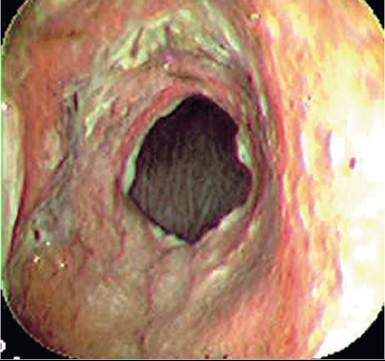
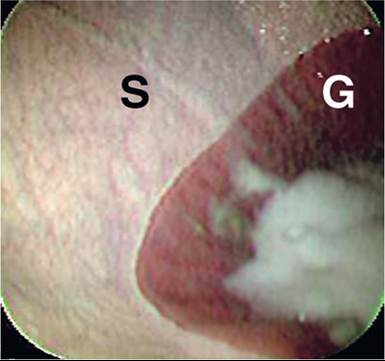
Color Plate 32.1 Endoscopic view of the esophagus of a 20-year- old gelding that presented with a 3-day history of esophageal obstruction. The horse had recently been rescued, and its previous history was unknown. After an obstruction consisting of grass was forcefully relieved by flushing water through a nasogastric tube, endoscopy revealed ulceration of the esophageal mucosa just orad to a stricture of the esophageal lumen. (Courtesy Dr. MJ. Murray.)
Color Plate 32.4 Endoscopic view of the right side of a normal stomach in a horse. Note the pale squamous mucosa (S) and the red glandular mucosa (G).
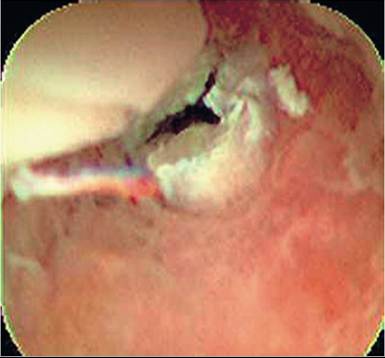
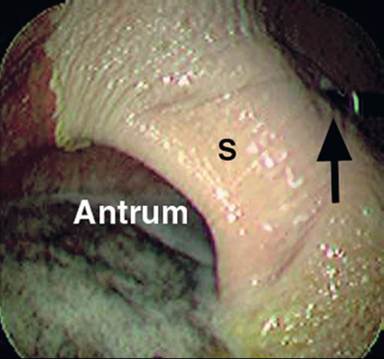
Color Plate 32.2 Endoscopic view of the esophagus of the same horse as in Plate 32.1, 14 days after flushing. The mucosa adjacent to the stricture remained ulcerated, and the diameter of the esophageal lumen had progressively diminished. At this point, it was not possible to advance the 10-mm-diameter endoscope through the stricture. (Courtesy Dr MJ. Murray.)
Color Plate 32.5 Endoscopic view of the lesser curvature of a normal stomach in a horse, showing the pale squamous mucosa (S). The antrum lies ventral to a fold formed by the squamous mucosa along the lesser curvature, and the pylorus is immediately ventral to the cardia, through which the endoscope (arrow) can be seen entering the stomach.
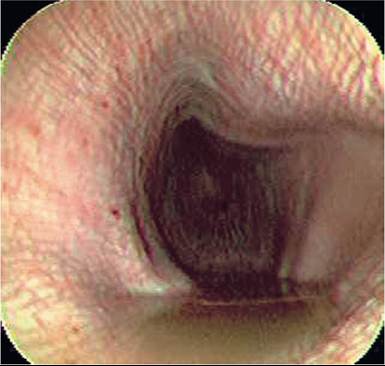
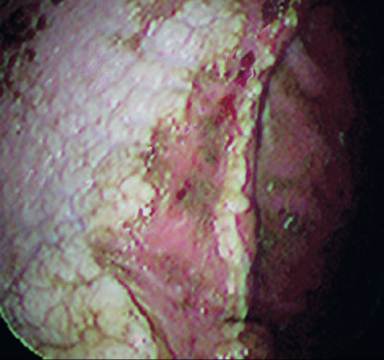
Color Plate 32.3 Endoscopic view of megaesophagus in a 10-month-old foal (also shown in Fig. 32.45). The esophageal lumen is greatly distended, and the mucosa has multifocal erosion. (Courtesy Dr MJ. Murray.)
Color Plate 32.6 Endoscopic view of a large area of ulceration of the squamous mucosa adjacent to the margo plicatus along the right side of the stomach in a horse.
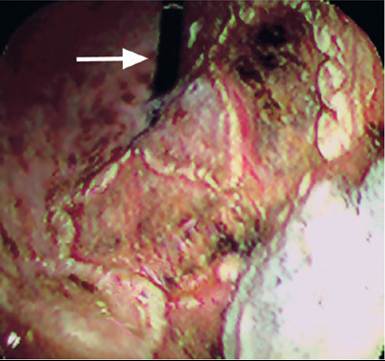
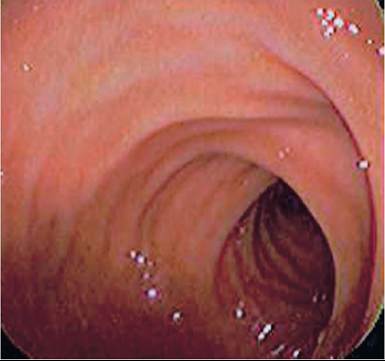
Color Plate 32.7 Endoscopic view of a large area of ulceration of the squamous mucosa along the lesser curvature of the stomach in a horse. The ulceration has a “butterfly” pattern, which is typical of ulcers at this site, and this pattern may reflect protection of the mucosa immediately ventral to the cardia by saliva entering the stomach from the esophagus. The endoscope (arrow) is entering the stomach through the cardia.
Color Plate 32.10 Endoscopic view of normal duodenal mucosa in a horse. The endoscope has advanced aborad to the major duodenal papilla, which in most foals and horses is difficult and unusual to accomplish because of the anatomic configuration of duodenum in relation to the stomach.
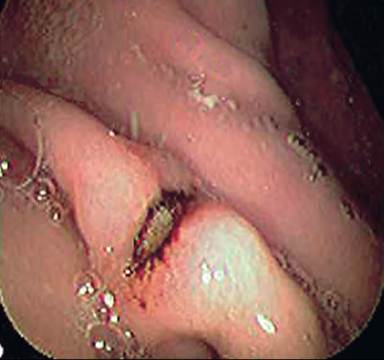
Color Plate 32.8 Endoscopic view of an ulcer in the gastric glandular mucosa in a horse. The ulcer is in a rugal fold, which is a typical site of ulcers in the glandular portion of the stomach.
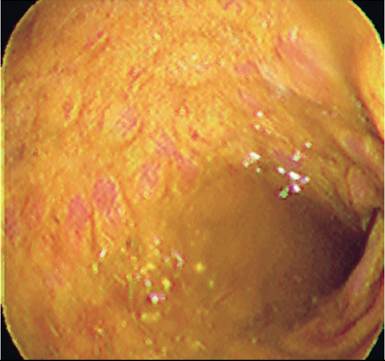
Color Plate 32.11 Duodenum of a foal that presented with fever, depression, leukocytosis, and hyperfibrinogenemia. This endoscopic view is orad to the major duodenal papilla. The mucosa is inflamed, and a yellow-orange fibrinous exudate adheres to the mucosal surface.
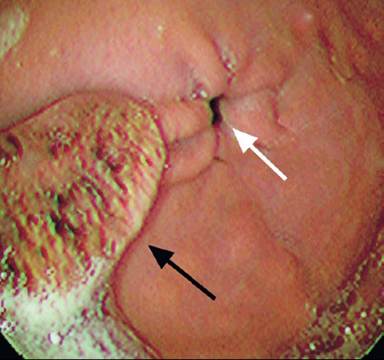
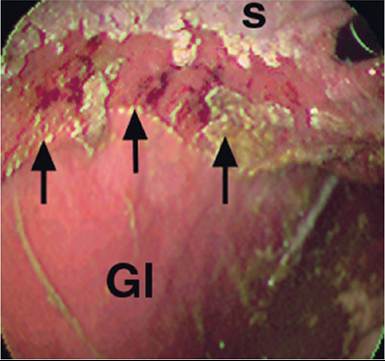
Color Plate 32.9 Endoscopic view of an ulcer in the antrum of the stomach in a horse. The white arrow points at the pylorus. The black arrow points at an area of ulceration and thickening of a rugal fold leading to the pylorus. This is a severe example of a frequent finding in the stomach of adult horses: thickening of a rugal fold in the antrum in association with erosion or ulceration of the mucosa. The cause of these lesions is undetermined.
Color Plate 32.12 Endoscopic view of the stomach of the foal in Color Plate 32.11. Severe ulceration of the squamous mucosa (S) adjacent to the margo plicatus (arrows) was caused by delayed gastric emptying secondary to the severe duodenitis. Many foals with duodenitis present with classic gastric ulcer signs because of delayed stomach emptying, accumulation of acidic peptic secretions in the stomach, and, often, gastroesophageal reflux. GI, Glandular mucosa.