Snake Bites and Blister Beetle
C. Langdon Fielding
Most snakebites reported in horses and other large animal species in North America are associated with rattlesnakes, which belong to a group of venomous snakes, the pit vipers.1-5 Other recent retrospective studies describing snakebites in horses include reports of elapid snake envenomation in Australia and viperid envenomation in Israel.6-7
Rattlesnake Envenomation
There are approximately 30 different species of rattlesnakes found globally, and their venom contains various enzymes, proteins, and peptides.
Mortality rates for horses envenomated by rattlesnakes may be as high as 10% to 20%, but this depends on the severity of the bite and the response to treatment.1-3 Rattlesnake bites typically occur during the spring and summer and should be suspected only in regions where the snakes are known to exist.2The muzzle is the most commonly described location for rattlesnake bites in horses, and rapid, severe swelling is common (Fig. 54.5).2 As the nostrils become swollen and the airways narrow, respiratory distress is common. In more severe cases, swelling may continue to spread up the head and down the neck. Epistaxis is observed in many horses following rattlesnake bite, and bleeding from the ocular tissues occurs as an effect of the venom progress (Fig. 54.6). Arrhythmias have been described in horses after rattlesnake envenomation, both acutely and chronically.1,3,4 Diagnosis of rattlesnake bite is based on the characteristic swelling in a horse from an appropriate region during the typical time of year (spring and summer). The presence of fang marks, which are difficult to find in some cases, supports the diagnosis and helps to differentiate from other causes of acute head swelling. An ELISA to detect
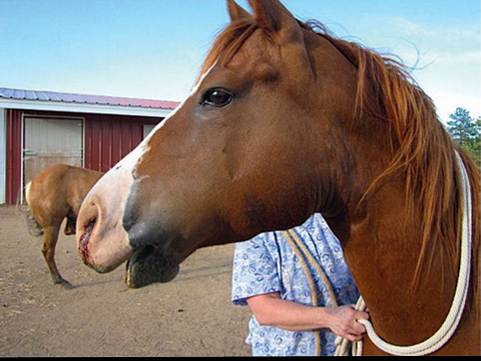
FIG.
54.5 A horse with swelling in the muzzle and throatlatch area due to rattlesnake bite. (Courtesy Dr. Skip Aaroe, Trinidad, Colo.)
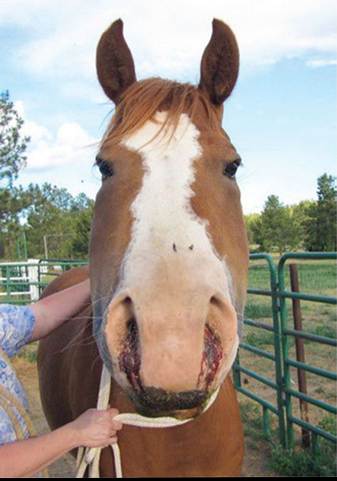
FIG. 54.6 A horse with bilateral epistaxis and swollen muzzle due to rattlesnake bite. (Courtesy Dr. Skip Aaroe, Trinidad, Colo.)
rattlesnake venom in the bite tissue and the urine of horses has been described.8
Thrombocytopenia and prolongation of clotting times are described hematologic abnormalities but have not been consistent across various studies in horses.1-3 Anemia can also be observed and is suspected to be due to both hemolysis and blood loss. Increases in cardiac troponin I (cTnI) have been described in a recent study, confirming myocardial damage in horses with envenomation.1
Treatment of horses with rattlesnake envenomation largely depends on the severity of the clinical signs, with many animals requiring only careful monitoring for respiratory distress. Maintenance of a patent airway is the single most important aspect of treatment, and a tracheostomy may be necessary in up to 50% of animals presented for veterinary care.2 A nasal stent (plastic tubing placed up one or both nostrils) can be used but may be challenging to place and maintain in a distressed horse experiencing pain.
Antivenin has been described for the treatment of horses with rattlesnake envenomation.2 Although clinical trials in other species have suggested efficacy, antivenin use in horses has only been retrospectively reported.9,10 Currently, there are three USDA-approved veterinary antivenoms, but only one (Rattler Antivenin [Mg Biologics, Ames, Iowa]) is labeled for use in horses. Another product labeled for use in dogs (Antivenin, a polyvalent antivenin marketed by Boehringer Ingelheim Vetmedica, Inc., St. Joseph, Mo. [formerly by Fort Dodge Animal Health, Fort Dodge, Iowa]) was rehydrated according to the label directions, diluted in saline, and administered slowly to horses over 30 minutes.2 Horses typically required 1 to 2 vials, and beneficial effects were anecdotally observed even when given 24 hours after envenomation.2 Antivenin polyvalent crotalidae (VenomVet [MT Venom, LLC, Canoga Park, Calif.]) is approved for use in dogs, but use in horses has not been reported.
A polyvalent antivenin (Crofab [BTG International (formerly Protherics), West Conshohocken, Pa.]) is labelled for use in humans, but its use has also not been reported in horses.9Wound care, particularly cleaning of the bite site, and tetanus prophylaxis are important components of treatment. Intravenous fluids are often necessary if the horse is unable to drink, but catheter placement should be performed carefully because affected animals may be prone to bleeding. Many horses may not be able to eat well immediately following a bite, but soaked pellets or mashes can often be hand fed as the swelling subsides. The use of broad-spectrum antibiotics is controversial and not recommended in other species but has been advocated by some authors due to concerns of aspiration pneumonia and infection at the bite site. Nonsteroidal antiinflammatory drugs (NSAIDs) are frequently administered to horses and may help to decrease pain and inflammation. There is no evidence to support the use of corticosteroids or antihistamines for rattlesnake envenomation.
Elapid Envenomation
A large case series of elapid snake envenomation in horses was reported from Australia, where elapids represent the most common snake envenomations.6 Envenomations had a seasonal pattern, with the spring and summer months most common. Neuromuscular weakness was the most commonly described clinical sign, with rhabdomyolysis and hemolysis occurring less frequently (Fig. 54.7). Increased creatine kinase (CK)
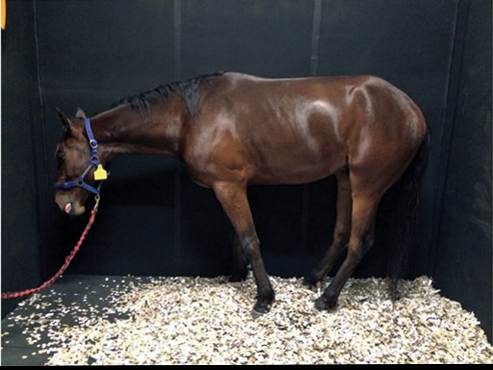
FIG. 54.7 A 3-year-old Standardbred gelding with profound generalized neuromuscular weakness and mental obtundation (note inability to retract the tongue). The horse returned to normal strength within 24 hours after administration of multivalent elapid antivenom. (Courtesy Nicholas Bamford, BVSc(Hons), PhD, DACVIM, Melbourne Veterinary School, Faculty of Veterinary & Agricultural Sciences, The University of Melbourne, Australia.)
activity, cTnI, and coagulation times were present in some horses but inconsistent in others.
Treatment with polyvalent elapid snake antivenom was common, and the overall survival rate was 86%.Daboia (Vipera) palaestinae Envenomation
A large cases series of Daboia palaestinae envenomation in horses was reported from Israel, where most envenomations are caused by this snake.7 A seasonal pattern also existed in this study. Most horses were bitten on the head, and local swelling was common. Other frequently reported signs included tachycardia and increased respiratory effort. Laboratory abnormalities included increased CK activity, hypoproteinemia, and hyperphosphatemia. Many of the horses in the study were treated with antivenom for Vipera palaestinae.
Blister Beetle
Cantharidin toxicosis in horses occurs following ingestion of alfalfa hay that is contaminated with blister beetles.11 Affected animals are typically found in the midwestern United States due to the swarming of beetles in this region and subsequent incorporation into cut hay. In one study, cases were most likely to occur during the late summer and early fall.12 Cantharidin causes irritation to the mucous membranes and interferes with a family of enzymes called the phosphoprotein phosphatases.13
Horses with cantharidin toxicosis develop signs of GI disease (colic, diarrhea), urinary system disease (renal failures, cystitis), and cardiac disease (arrhythmias).11,14 Affected horses may also exhibit a stiff gait.14 With increased severity, horses may exhibit synchronous diaphragmatic flutter, hypovolemic shock, and death.11,14 Laboratory data reflect abnormal renal function (azotemia), as well as hypocalcemia, hypomagnesemia, and hypoproteinemia.11 Myocardial damage may be reflected in changes in myocardial enzymes; however, this has not been evaluated in horses.
Presumptive diagnosis of cantharidin toxicosis in horses can be made following the identification of the beetles present in ingested hay.
Testing of stomach contents and urine for cantharidin levels has been suggested as a common means for definitive diagnosis.12,15 It has been shown that 450 μgZkg body weight of ingested cantharadin can cause clinical signs and even mortality.14Treatment of cantharidin toxicosis is primarily supportive. Administration of activated charcoal to animals with recent exposure may be appropriate. Intravenous fluid therapy is important to correct hypovolemia and dehydration. If renal failure is present, therapy should be directed toward maintaining urine production. A balanced isotonic intravenous fluid can be used for resuscitation. Electrolyte and acid-base abnormalities should be corrected using additional supplements to intravenous fluids (e.g., calcium gluconate, magnesium sulfate). GI protectants are indicated, as are pain medications to provide relief for the ulceration of the GI and urinary systems. Hay that is suspected of contamination should be removed and not fed to animals.