Stringhalt
Robert J. MacKay
Stringhalt is a condition of horses characterized by sudden exaggerated flexion of one or both pelvic limbs during the swing phase of locomotion. Two distinct syndromes are recognized: classical stringhalt, a persistent condition of individual horses involving only one limb; and pasture-associated or Australian stringhalt, which involves both pelvic limbs and occurs in outbreaks in horses at pasture.
Both forms occur worldwide, but pasture-associated stringhalt is most common in Australasia, South America, and the western United States.1-6■ Clinical Signs The defining clinical sign of stringhalt is abrupt hyperflexion of the hock and stifle during attempted movement. In classical stringhalt, typically only one limb is affected; in contrast, Australian stringhalt is almost always bilateral, although signs may be asymmetric (Fig. 35.23). Stringhalt is most evident during backing, sharp turning, when the horse goes down a slope, after a sudden stop, and during the transition from standing still to walking forward.2,7 Signs may be exacerbated by excitement, cold weather, or hard exer- cise.2,8 During forward walking, the flexing limb snaps forward and upward in an adducted or sagittal plane; this feature of stringhalt distinguishes it from similar presentations of shivers, in which the limb is abducted during protraction.9 The clinical presentation of stringhalt varies greatly, even among horses with
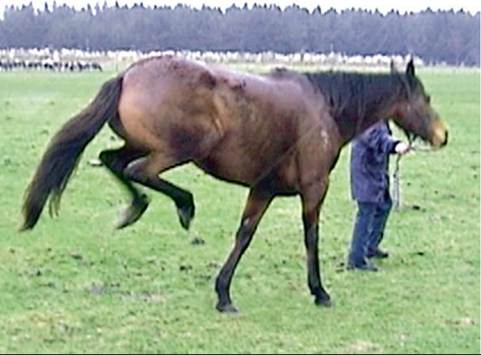
FIG. 35.23 Bilateral hyperflexion of the pelvic limbs in a horse with pasture-associated (Australian) stringhalt.
pasture-associated stringhalt grazing on the same pasture. In mild cases, flexion is only slightly exaggerated and pelvic limb action may be completely normal at gaits above the walk.
Such horses are able to perform without impairment. At the other end of the spectrum, the upper joints of the limb flex so violently that the dorsum of the fetlock slaps against the horse's abdomen with each stride.7 When the condition is bilateral, the result is a bouncing bunny-hopping gait in which “progression can only be accomplished with a series of bounds and plunges extremely painful to witness.”4,10 In the most severe cases, ambulation is impossible. An atypical pasture-associated stringhalt syndrome is described wherein the forelimbs are also involved and there are signs of generalized weakness.1,2,4,11,12 Signs of obtundation, nervousness, hyperesthesia, or increased aggressiveness have occasionally been reported.2,4,6,13 A variable proportion of horses with pasture-associated stringhalt have abnormal laryngeal movement, stridor, or abnormal vocalization.4,5,13,14Onset of stringhalt is usually sudden. Signs may fluctuate but tend to worsen over several weeks in horses with pasture- associated stringhalt, before plateauing, often for several months; then they begin to improve.2 Within 2 weeks after onset of severe pasture-associated stringhalt, atrophy of the muscles of the gaskin and, less obviously, the thigh and other parts of the body, becomes apparent.2,15 Horses with severe or atypical pasture-associated stringhalt may develop profound generalized neurogenic muscle atrophy that results in marked weight loss despite normal appetite and food consumption.12
■ Clinical Pathology No abnormal clinical pathologic findings are associated with stringhalt. EMG of affected muscles reveals increased insertion activity and abnormal spontaneous activity such as fibrillation potentials and positive sharp waves consistent with denervation.2,14 NCV is slowed in the peroneal nerves of affected limbs, which indicates demyelination, and improves as animals recover clinically.2
■ Pathophysiology The cause of classical stringhalt is unknown.
Foot conditions and articular lesions of the hock or stifle are possible risk factors.4,7,16 Trauma to the proximal dorsal metatarsus, particularly over the digital extensor tendons, often precedes classical stringhalt and probably is an important factor in the development of this form of the condition.2,4 Months may elapse between injury and the onset of stringhalt.17Since 1884,10 most reports of pasture-associated stringhalt have implicated the common pasture weed Hypochaeris radicata (also known as flatweed, castear, cat's ear, or false dandelion).1,3,4,8,12,13,16 Most outbreaks occur in late summer or autumn among horses grazing on drought-damaged pastures heavily infested with H. radicata. Cases often occur after weeks to months of grazing on suspect pastures.10,13 Interestingly, some affected horses are thought to have developed a taste for flatweed, to the exclusion of other forage.13 Several outbreaks have been associated with “true” dandelion (Taraxacum officinale), and one has been associated with mallow (Malva parviflora).w9 During pasture-associated stringhalt outbreaks, less than 50% of populations are usually affected, but attack rates vary 2813
widely.2,8,13 Some attempts at producing pasture-associated stringhalt by feeding cut H. radicata to horses have been unsuccessful; however, stringhalt was induced in a 6-month-old colt fed a daily average amount of nearly 10 kg of H. radicata harvested from a pasture where the disease had occurred.3
Pasture-associated stringhalt is a distal neuropathy primarily affecting large myelinated axons of the peripheral nervous system.15,19 The longest nerves in the body—namely, the recurrent laryngeal nerves and the peroneal and tibial branches of the sciatic nerve—appear to be most severely affected. This also explains why tall horses are more prone to the condition than young horses, ponies, or small native Chilean breeds.18 Shetland ponies have been affected, however.8 The lesions of pasture-associated stringhalt are consistent with ingestion of a neurotoxin produced by either pasture weeds such as H.
radicata or, less probably, by associated fungi.Pasture-associated stringhalt and some cases of classical stringhalt probably result from interference with myotatic reflexes.17 The immediate cause of pelvic limb hyperflexion in pasture-associated stringhalt is presumably progressive degeneration of large myelinated axons in tibial and peroneal nerve branches, including α motor neurons to skeletal muscle, 1A and 1B sensory neurons from muscle spindles, and Golgi tendon organs. Classical stringhalt may be the final common sign of a variety of insults: besides interference with limb reflexes, mechanical effects of adhesions involving the muscles and tendons of the digital extensors of the pelvic limb may occur, as may painful conditions of the hock or distal limb.
■ Pathology In long-standing cases of pasture-associated stringhalt, affected animals exhibit variable, often severe atrophy of the muscles of the pelvic limbs, especially distally, and atrophy of the muscles of the larynx supplied by the recurrent laryngeal nerves.1,12,19 Peripheral nerves demonstrate axonal degeneration of large diameter fibers acutely and decreased numbers of myelinated fibers in chronic cases, with perineural fibrosis and accumulation of myelin debris. Evidence of nerve regeneration, including regenerating nerve clusters, “onion bulb” formations, and Schwann cell proliferation, is usually found. Recurrent laryngeal nerves, branches of the sciatic nerves, and variably other nerves are affected with a proximal to distal gradient of increasing severity.
■ Treatment Care should be taken to identify sources of pain (e.g., arthritis, hoof abscess, recent hoof trimming) that might account for stringhalt-like signs. Signs of stringhalt were blocked in one horse by intraarticular anesthesia of the distal tarsal joints; use of intraarticular corticosteroids permanently resolved the problem.
Several skeletal muscle relaxants have been investigated in horses with pasture-associated stringhalt.
Phenytoin, an inhibitor of voltage-gated sodium channels, gives partial to complete remission of signs in horses in a dosage of 10 to 15 mg/kg PO, once or twice daily.2,12,14 Mephenesin, which acts in the spinal cord to specifically inhibit polysynaptic reflexes, suppressed signs in a horse with chronic pasture-associated stringhalt7 but was ineffective in an outbreak of pasture-associated stringhalt.1 Baclofen, an analog of the inhibitory neurotransmitter GABA, had no effect in a horse with severe stringhalt.8,14 Taurine (10 mg PO q24h) may help with behavioral abnormalities.13Although the results of the procedure are unpredictable, surgical removal of the distal muscle belly and tendon of insertion of the lateral digital extensor effects a clinical cure in a proportion of horses with either classical stringhalt or pasture-associated stringhalt.3,4 Of four horses with classical stringhalt treated with lateral digital extensor myotenectomy, two resolved and the other two improved partially. The surgery was precluded in two other horses because of adhesions involving the tendon.17 Responses to a survey of veterinarians in Australia indicated that more than 50% of over 100 lateral digital extensor operations had been successful in eliminating signs of stringhalt.2 Even more impressive was that 11 of 13 horses with pasture-associated stringhalt were normal within 12 days of surgery.5 The surgery can be performed with horses standing or in lateral or dorsal recumbency. An initial skin incision is made over the lateral digital extensor tendon immediately proximal to its junction with the long digital extensor, and the tendon is isolated and exposed. A second incision is made over the muscle belly proximal to the hock, and the muscle belly is dissected free of overlying fascia. The tendon is severed through the distal incision, and then the tendon is pulled through its sheath into the proximal incision by means of traction on the muscle.
The muscle belly is then incised 2 cm proximal to the musculotendinous junction. In a modification of the technique, which may improve success rate, 7 to 10 cm of muscle is removed. After the fascial and skin layers have been closed, a bandage is applied over the surgical site and maintained, with box stall rest, for 2 to 3 weeks.■ Prognosis There is almost no information on outcomes for horses with classical stringhalt; however, it is commonly supposed that most cases persist, although they may improve with time. Of one series of four cases that developed after proximal dorsal metatarsal trauma, one horse recovered, two improved, and one's condition was unchanged for at least 6 months after onset of signs. Many cases of pasture-associated stringhalt recover normal gait and muscle mass if removed from toxic pasture. In a series of 70 cases monitored over several years in France, 36 recovered in an average of 8 months, 6 died, and 14 still had stringhalt signs at least 2 years after onset.13 The few reported deaths were in horses that were either unable to stand or unable to move to sources of water and feed; they were euthanized for humane reasons. Recovery times of 3 days to 3 years have been recorded; most horses take 6 to 12 months.2,7 It is unclear to what extent athletic performance returns after clinical recovery from severe pasture-associated stringhalt. There is evidence that laryngeal dysfunction may persist beyond the time of recovery from gait abnormalities.
Tick Paralysis minimal spontaneous activity and lack of evoked CMAPs in response to motor nerve stimulation.14 Findings in large animals are expected to be similar. CSF is normal in tick paralysis, which helps differentiate it from some, but not all, myelopathies.
■ Pathophysiology The cause of tick paralysis is believed to be a neurotoxin in the saliva of female ticks that is inoculated into the host when the tick feeds. Nymphs and larvae in large numbers may also cause the disease. In the case of I. holocyclus, the toxin has been named holocyclotoxin.1 The toxin or toxins elaborated by Dermacentor spp. have not been as well characterized. Holocyclotoxin acts by inhibiting release of acetylcholine from nerve terminals at the neuromuscular junction.
■ Epidemiology The disease occurs worldwide, in association with different tick species in different areas. In North America the region from the Pacific coastal range to the Continental Divide provides especially favorable conditions for the proliferation of D. andersoni.9 Tick paralysis in the United States and Canada occurs mainly in the Pacific Northwest and the Rocky Mountains, although the geographic range of the responsible tick species is much larger. The disease tends to be seasonal in both North America and Australia; most cases occur in the spring, when ticks are most active. In North America, smaller animals such as sheep and New World camelids are more often affected than cattle.16 In Australia, affected horses were of multiple different breeds, were between 1 week and 18 years of age, and weighed from from 9 to 450 kg.7 Tick factors probably influence disease severity, and genetic variation within I. holocyclus may play a role in toxin potency.17 A short-lived immunity has been demonstrated in dogs and sheep exposed to ticks.10
■ Necropsy Findings There is no pathognomonic finding at necropsy, although the presence of ticks should increase suspicion of this disease. Death usually results from respiratory paralysis.
■ Treatment and Prognosis Treatment is supportive after removal of every tick and topical application of an acaricide. Lack of improvement suggests that ticks remain on the animal, except in cases of I. holocyclus infestation, in which signs persist and may worsen for 1 to 2 days after removal of all ticks. In small animals, shaving the hair coat may be necessary to ensure detection and removal of all ticks. Areas such as the axillae and groin, in particular, provide good sites of attachment for ticks. The prognosis is good in the case of Dermacentor-induced paralysis when tick removal and supportive care are instituted before animals are recumbent. Fatalities occur in cases of Ixodes-induced paralysis despite removal of ticks. Cooling of the patient has been suggested in treatment of I. holocyclus toxicity, but this practice is controversial; a better approach may be to avoid warming the patient excessively.
Administration of a canine-origin hyperimmune serum has been shown to be beneficial in treatment of horses and a llama.7,18 In horses, doses exceeding 0.5 mL/kg produced a higher odds ratio for survival than did a lower dose.7 Adverse reactions such as anaphylaxis, bradycardia, and hypotension occur in a small number of dogs and cats treated with hyperimmune serum, but these can be avoided by of atropine. Two of 95 horses given antiserum had reactions, one of which was fatal.7
Of 103 horses treated for tick paralysis in Australia, 27 (26%) died or were euthanized.7 Paradoxically, the odds of survival were inversely related to the weight of the horse.
■ Control Environmental control to reduce tick populations and routine use of acaricides may decrease the incidence of tick paralysis.