The Doe
The female goat is called a doe in polite circles or when discussing valuable or cherished animals. A doeling is a young female, often one that has not yet kidded. The term “nanny” should be avoided when there is a chance of offending an owner by its use, although this is the standard terminology for an Angora doe in Texas.
The anatomic features of the reproductive tract of nonpregnant and pregnant goats have been reviewed by Lyngset (1968b, c). The uterus is bicornual and the cervix has approximately five fibrous rings. These rings impede passage of a pipette if the doe is not in estrus. A canine vaginal speculum, caprine artificial insemination speculum, human proctoscope, or glass test tube (22-25 mm diameter) with a hole fire-polished in its rounded end permits visualization of the vagina and external cervical os (Haibel 1986b).
The Estrous Cycle
In temperate regions, goats are seasonally polyestrous. Cycling begins under the influence of decreasing day length. After the days begin to lengthen again in winter, cycling gradually ceases. The duration of the period when regular estrous cycles occur varies with the region, breed, and herd. Individual factors also come into play, as high- producing dairy goats are less likely to exhibit estrus shortly after parturition than are healthy animals producing little or no milk. As a rough approximation, August until March in the northern hemisphere, and particularly October until December, encompass the normal breeding season. Some animals in a herd in temperate regions may be capable of cycling year-round, and this is typical in the tropics, where the availability of forage is more important than day length. Owners who desire out-of-season breeding should select as herd replacements the offspring of animals that bred in the traditionally anestrous period.
Macroscopic and histologic changes occurring in the ovarian structures of the goat during the estrous cycle have been reported by Harrison (1948).
The estrous cycle, and particularly the ovulation, of research goats (Dukelow et al. 1971) and sheep (Oldham and Lindsay 1980) has been monitored by laparoscopic methods since the early 1970s. Equipment and techniques used for laparoscopic artificial insemination of sheep (Seeger and Klatt 1980; Gourley and Riese 1990; Hill et al. 1998) are also suitable for goats.Transrectal ultrasonography using a probe extender or transvaginal scanning with a sector scanner may be useful for monitoring ovarian activity in select cases, if a probe with adequate resolution (at least 7.5 MHz) is available. The ovaries can be visualized to the left and right of the bladder by slow methodical scanning. Normal mature follicles are 9-12 mm in diameter (Buergelt 1997). Other ultrasonographic studies in Boer goats (Padilla and Holtz 2000), Shiba goats (Medan et al. 2003), Serrana goats (Simoes et al. 2006), and Nubian goats (Filho et al. 2007) have documented three to five waves of follicles per cycle (reviewed by Rubianes and Menchaca 2003), with follicular diameter at ovulation varying by study, but typically 5-8 mm. The emergence of a follicular wave is correlated with increased follicle-stimulating hormone (FSF) and decreased inhibin levels in the blood (Medan et al. 2003). Ovulation can be confirmed by disappearance of one or more large follicles and development of corpora lutea (Baril et al. 1999). A corpus luteum is less echogenic than the surrounding ovarian stroma and may have a central fluid-filled cavity (Kahn 2004; Simoes et al. 2007). Inactive ovaries and follicles smaller than 4 mm are difficult to identify. Large, cystic follicles have been identified and monitored over time (Medan et al. 2004). Ovarian cysts have also been identified by ultrasound in goats with hydrometra accompanied by presence of a corpus luteum (Souza et al. 2013).
Cycle Length
The typical length of an estrous cycle for European dairy breeds is 21 days. African Pygmy goats are more variable (18-24 days).
At the beginning and end of the season, cycles of irregular length, not always accompanied by overt estrus, may occur (Phillips et al. 1943; Camp et al. 1983). Short cycles of five to seven days are to be considered normal during the transition periods, especially in kids, but persist throughout the breeding season in certain populations of goats, and more importantly in certain individual problem breeders and in some goats superovulated for embryo transfer purposes (Armstrong et al. 1983, 1987; Stubbings et al. 1986). In these does, the corpus luteum is short-lived, demonstrated by only a brief increase in progesterone. The problem can be circumvented in embryo transfer donors by administering a progestogen sponge, controlled internal drug releaser (CIDR), or implant four days after breeding. Pretreatment with a progestogen (45 mg Auorogestone acetate [FGA]-impregnated sponge for 17 days or a single injection of 5.2 mg FGA) eliminated the occurrence of short-lived corpora lutea associated with introduction of the buck to anestrous does (Chemineau 1985). Injection of 25 mg of progesterone two days before introduction of the buck was also effective (Andrade-Esparza et al. 2019).Short cycles are also common after prostaglandin-induced abortion and are associated with delayed pre-ovulatory luteinizing hormone surges of reduced magnitude (Bretzlaff et al. 1988). Elevated prostaglandin F2α levels and shortened estrous cycles have been documented in goats in Kenya infected with Trypanosoma congolense (Mutayoba et al. 1989). Nymphomania has been observed in mature goats after several years of a copper-deficient diet (Anke et al. 1977). Synthetic corticosteroids (dexamethasone 10 mg twice daily for 10 days) extend the cycle length by prolonging luteal function (Alan et al. 1989).
Empirical treatments for short cycles or continuous signs of estrus include gonadotropin-releasing hormone (GnRH, one-fourth to one-half a bovine dose), human chorionic gonadotropin (hCG, 1000 IU), a pregnant mare serum gonadotropin-hCG product for swine (PG600, Merck, 2 cc) at the time of estrus, or a three- week application of exogenous progesterone (by implant, sponge, CIDR, or injection, as discussed below under control of estrus).
In an ultrasonographic study of five goats from Japan, cystic ovaries (defined as persistence of a follicle greater than 10 mm in diameter for 10 days or more in the absence of a corpus luteum) was successfully treated with GnRH followed 10 days later by prostaglandin. Four of the goats became pregnant to the induced estrus (Medan et al. 2004).Signs of Estrus
Standing estrus lasts approximately 24 hours in doelings, but may last two to three days in mature does. It is shortened if service by a buck is permitted (Romano and Benech 1996). The estrous doe is generally easy to identify if a mature and odoriferous buck is nearby; the doe walks restlessly along the perimeter of her enclosure, searching for a way to reach the buck, or remains close to the fence (Figure 13.1). The vulva becomes somewhat swollen and the doe's tail wags vigorously. This tail wag, which can often be observed even in the absence of a buck, presumably has the function of sending pheromones from the doe's reproductive tract into the environs to attract a buck. Other signs of estrus include a plaintive voice, increased frequency of urination, decreased appetite, and decreased milk yield. The doe in estrus normally stands firmly when a buck attempts to mount and may even back up to the buck. Some does, however, find some bucks (for instance, young or descented males) sexually unattractive and will not stand to be bred.
The vaginal discharge at the beginning of estrus is thin, clear, and colorless. It becomes progressively thicker and whiter toward the end of standing estrus and ovulation (Pretorius 1977). It is important to recognize this aspect of caprine physiology as normal; otherwise practitioners might mistakenly assume that animals with a cloudy white discharge full of neutrophils need antibiotic therapy. Ovulation typically occurs near the end of standing estrus and approximately 24 hours after a serum peak in luteinizing hormone (Greyling and van Niekerk 1990).
Vaginal cytology during the estrous cycle has been studied, but appears to have limited clinical application.
During estrus, superficial keratinized acidophilic cells from the stratum corneum predominate in the vaginal smear. At the time of ovulation there is a sudden influx of leukocytes. Superficial cells and leukocytes are soon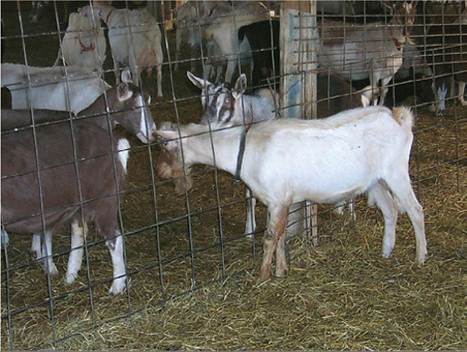
Figure 13.1 This buck in rut is teasing does in estrus through the panel. Note staining of the beard and front legs where he has urinated on himself. Source: Courtesy of Dr. M.C. Smith.
replaced by basal and parabasal cells from the stratum ger- minativum and intermediate cells from the stratum spino- sum, which predominate during the corpus luteum phase (Schmidt 1961; Fatet et al. 2011). Histologic changes of the vaginal mucosa have also been described (Hamilton and Harrison 1951).
Control of Estrus
Although a full discussion of estrus induction and synchronization can be found in other texts, any practitioner dealing with dairy goats will want to be familiar with some of the problems and techniques involved in year-round breeding or synchronization for artificial insemination.
Breeding Season
The methods that can be used successfully vary with the physiologic state of the goat (Smith 1986b). Thus, during the regular breeding season, prostaglandin F2 alpha (2.5 mg) or cloprostenol (62 μg) during the luteal phase of the cycle normally induces estrus in approximately 48 hours, although some researchers have seen better response with and producers commonly use double these doses (Nuti et al. 1992; Mellado et al. 1994). Even lower doses of prostaglandin F2 alpha (1.25 mg) have been documented to be effective (Bretzlaff et al. 1981). If the doe is not known to be at day five or beyond in the cycle, paired prostaglandin injections 10 days apart increase the probability of response to prostaglandin by the time of the second injection.
Although not currently available in the United States, in other countries various progestogens can be placed for 5-10 days and prostaglandin given at the time of implant or pessary removal.
Products that have been used this way include ear implants (3 mg norgestomet, half of a 6 mg Synchro-Mate-B implant - no longer available in the United States), vaginal pessaries (45 mg FGA, as well as 60 mg methyl-acetoxy progesterone [MAP]) and CIDR with 300 mg progesterone). Melengestrol acetate (MGA) can also be fed in some countries. A typical dose is 0.125 mg/ head twice a day for 10-14 days, followed by a prostaglandin injection. Concerns about unknown meat and milk residues plague the use of most of these products.Transition
During the transitional period (between the anestrous and breeding seasons), response to prostaglandin alone would be erratic, but either sudden introduction of a buck or application of exogenous progestogens followed by prostaglandin should be effective in inducing cyclicity. Although not currently available in the United States, both vaginal pessaries and subcutaneous progestogen implants work well during the transition period (East and Rowe 1989). Adding gonadotropins such as hCG combined with equine chorionic gonadotropin (eCG, also called pregnant mare serum gonadotrophin, PMSG; P.G. 600®, Merck Animal Health, Madison, NJ, USA) to the regimen may be beneficial, as during the anestrous season (Rowe and East 1996).
The buck effect usually synchronizes a group of does to begin cycling within eight days (Shelton 1960; Ott et al. 1980). The buck effect also hastens the onset of puberty in doelings (Amoah and Bryant 1984). If more precise control is needed, the does could be aborted very early in pregnancy and rebred to the buck of choice. Bright security lights in the barnyard might delay the onset of cyclicity in the fall (Bretzlaff 1989).
Anestrous Season
Breeding during the anestrous season is not so easily achieved. Two injections of prostaglandin are ineffective (Greyling and Van Niekerk 1991a), because (except for goats in false pregnancy) there is no corpus luteum available for luteolysis. Some herds, including those in the tropics (Chemineau 1984), may respond to the buck effect. One study in Mexico showed that the buck effect induced ovulation in does that were not otherwise manipulated, as long as the bucks used were sexually active. This state was achieved by exposing the bucks in confinement under controlled electric lighting to 16-hour-long days for two months, and then inserting two subcutaneous melatonin implants of 18 mg each when the bucks were returned to ambient day length for a further two months, before being used as teasers (Flores et al. 2000). Progesterone priming of the does before buck exposure may accelerate the response without increasing pregnancy rates (Veliz et al. 2009). Based on research done with rams (Pearce and Oldham 1988), it is likely that introduction of a novel buck would be effective in inducing ovulation if does have become habituated to a resident buck by continuous contact.
Photoperiod manipulation of does is a commonly used technique in North America. Herds can be subjected to two months of artificially lengthened days (19-20 hours of light per day) or to a one- to two-hour “flash” of light beginning 16 hours after dawn (minimum 200 lx) and then returned to a shorter day length. Cycling begins approximately six weeks later. Some herd owners find the cost of electricity prohibitive. Goats experiencing hydrometra are unlikely to respond, but could be identified by ultrasound and treated in advance (see below).
Abrupt introduction of a buck (also light-treated, but held away from the does) six weeks after the end of the long days appears to improve the success rate with photoperiod treatment (BonDurant 1986; Pellicer-Rubio et al. 2007). Improved fertility out of season also seems possible with administration to the does of a melatonin implant at the end of the artificially long days (Chemineau et al. 1986a, 1999; Chemineau 1989; du Preez et al. 2001). Melatonin, a hormone normally produced by the pineal gland during hours of darkness, serves as a signal that the nights are now long. These implants are not currently available in the United States.
Finally, the various exogenous progestogen treatments discussed under breeding season can be applied for 21 days, with good fertility on the induced estrus if eCG can be given two days before removal of pessary or implant. Fertility is improved if the progestogen treatment is reduced to 11days and prostaglandin is given simultaneously with the eCG (Corteel et al. 1988). The dose of eCG needed varies with the age and milk production of the goat (400 IU for a nulliparous doeling, 750 IU for a mature doe in early lactation). A generic protocol is then to insert progestogen source on day 0, give prostaglandin and eCG on day 9, remove progestogen on day 11, and expect estrus 36-48 hours later. In goat herds where eCG is not available, there has been little success with sponges and implants during the anestrous season, although some producers in the United States have successfully used the available swine hCG/eCG product (P.G. 600). Adding the buck effect may improve pregnancy rates (Bretzlaff et al. 1991).