Although the nervous system forms a single, integrated whole, it is useful to discuss several anatomic and functional divisions (Fig. 8.1).
The most fundamental division can be made on an anatomic basis, distinguishing the central nervous system— consisting of the brain (Fig. 8.1/1) and spinal cord (Fig. 8.1/2)—from the peripheral nervous system (Fig.
8.1/3), which includes the spinal nerves, which travel throughout the body and limbs, and the cranial nerves, which travel in the head. Although these two parts of the nervous system function closely together, they have distinct embryologic origins, as we discuss later in the chapter, and also respond differently to injury—that is, the peripheral nervous system has some capacity for regeneration of damaged fibers, but the central nervous system does not regenerate.The peripheral nervous system is further divided functionally into afferent and efferent divisions. The afferent component of the peripheral nervous system, also termed the sensory component, conducts impulses toward the spinal cord and brain (Fig. 8.1/4); the efferent, or motor component of the peripheral nervous system conveys impulses away from the brain and spinal cord (Fig. 8.1/5). Each of the afferent and efferent components of the peripheral nervous system is further subdivided into the somatic and visceral systems. The somatic system is concerned with both sensory and motor functions that determine the relationship of the organism to the outside world. They include detection of stimuli in the skin and tissues of the limbs and torso as well as behavioral actions such as locomotion. The somatic system is sometimes referred to as the voluntary system, because there is a greater conscious awareness and greater voluntary control of somatic functions than of the visceral functions. The visceral system is concerned with sensory and motor functions that relate to the internal viscera: the regulation of the blood pressure and heart rate, the control of glandular activity and digestive processes, and so forth.
The motor component of the visceral peripheral nervous system is also referred to as the autonomic nervous system, discussed in more detail here and later in the chapter.There are several significant subdivisions of the sensory or afferent system that warrant further description. The general classification refers to that part of the sensory system that senses pressure, stretch, temperature, and noxious stimuli from tissues throughout the body and head. The special classification refers to those senses in the head for vision, audition, taste, smell, and balance.
General somatic afferent pathways originate in receptors within the skin and deeper somatic tissues of the body wall and limbs. The pathways that arise from skin receptors are concerned with the exteroceptive sensations, such as touch, temperature, and pain, that respond to stimuli delivered from outside the organism. Receptors within the deeper tissues, the proprioceptive category, include stretch and tension receptors in muscle and joint capsules. These receptors provide information about the position and movements of the muscles and body segments relative to one another. General somatic afferent fibers are present in all spinal nerves and in cranial nerve V, the trigeminal nerve (see Table 8.2).
General visceral afferent pathways originate in the receptors of vessels and glands and the viscera of the head and trunk that respond largely to stretch and chemical stimuli. The fibers of this division are found in the cranial nerves III, V, VII, IX, and X and all spinal nerves.
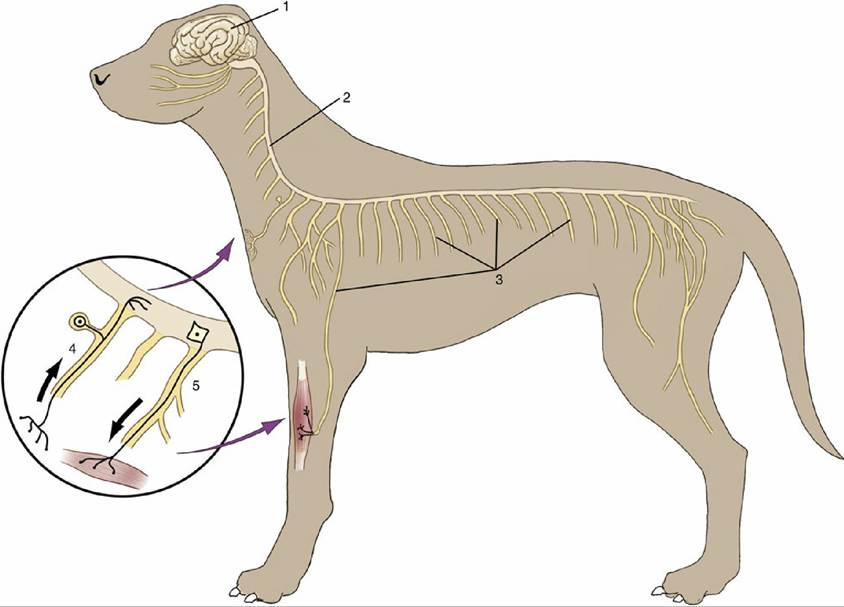
FIG. 8.1 The nervous system can be divided into the central nervous system, comprised of the (1) brain plus (2) spinal cord, and the peripheral nervous system, comprised of the peripheral nerves (3) and associated ganglia. The peripheral nervous system is further divided into the sensory, or afferent system (4) and the motor or efferent system (5).
See text for details.Special somatic afferent pathways have a more restricted origin within certain special sense organs of the head: the retina of the eye and the cochlear and vestibular components of the inner ear, which are concerned with vision, hearing, and balance, respectively. Special somatic afferent fibers are thus found only within two cranial nerves, the optic (II) and vestibulocochlear (VIII) nerves.
Special visceral afferent pathways arise from the special sense organs of smell and taste. Fibers conveying olfactory information are confined to the olfactory nerve (I); those conveying gustatory (taste) information are confined to a small group of cranial nerves, VII and IX.
Efferent or motor systems are divided more simply:
• Somatic efferent pathways innervate striated muscles. In the body and limbs, these are the muscles that arise from somites. In the head, striated muscles arise from the pharyngeal, or branchial, arches. Somatic efferent fibers are found in all spinal nerves and in all cranial nerves except those that are exclusively sensory nerves (I, II, VIII).
• Visceral efferent pathways—that is, the autonomic nervous system, innervate the smooth muscle of blood vessels, viscera, heart muscle, and glands. The autonomic system has two major divisions —the sympathetic and parasympathetic components. Most organs receive innervation from both components (p. 313). The sympathetic and parasympathetic components are often described as having antagonistic actions on each organ, although "balancing" might better describe their cooperative role. Visceral efferent fibers of the sympathetic division leave the central nervous system via the spinal nerves in the thoracolumbar regions of the spinal cord; those of the parasympathetic division are found in a small group of cranial nerves (III, VII, IX, X) and in spinal nerves in the sacral region of the spinal cord. Many visceral efferent fibers travel to their target organ by joining with other nerves so that they obtain a very widespread peripheral distribution.
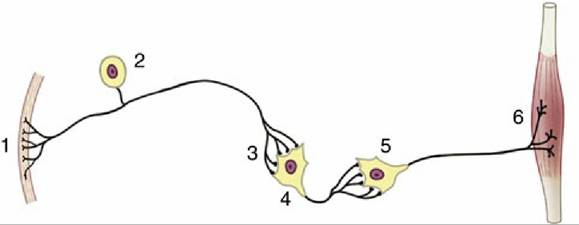
FIG. 8.2 A simplified receptor:effector neural circuit. 1. Skin receptor; 2, afferent or sensory neuron; 3, synapses on interneuron; 4, interneuron; 5, efferent or motor neuron; 6, striated muscle (effector). See text for details.