Apoptosis Is the Process of Cell Suicide
The process of cell death by external damage, involving cellular swelling, bursting, and engagement of the inflammatory response, has been well described for more than 100 years.
This form of cell death is called necrosis and is familiar from experiences as common as a cut or abrasion. A rather different process of cell death was described in the 1970s in which cells shrink, the DNA fragments in a systematic way, the plasma membrane bubbles and churns, and the cell breaks up into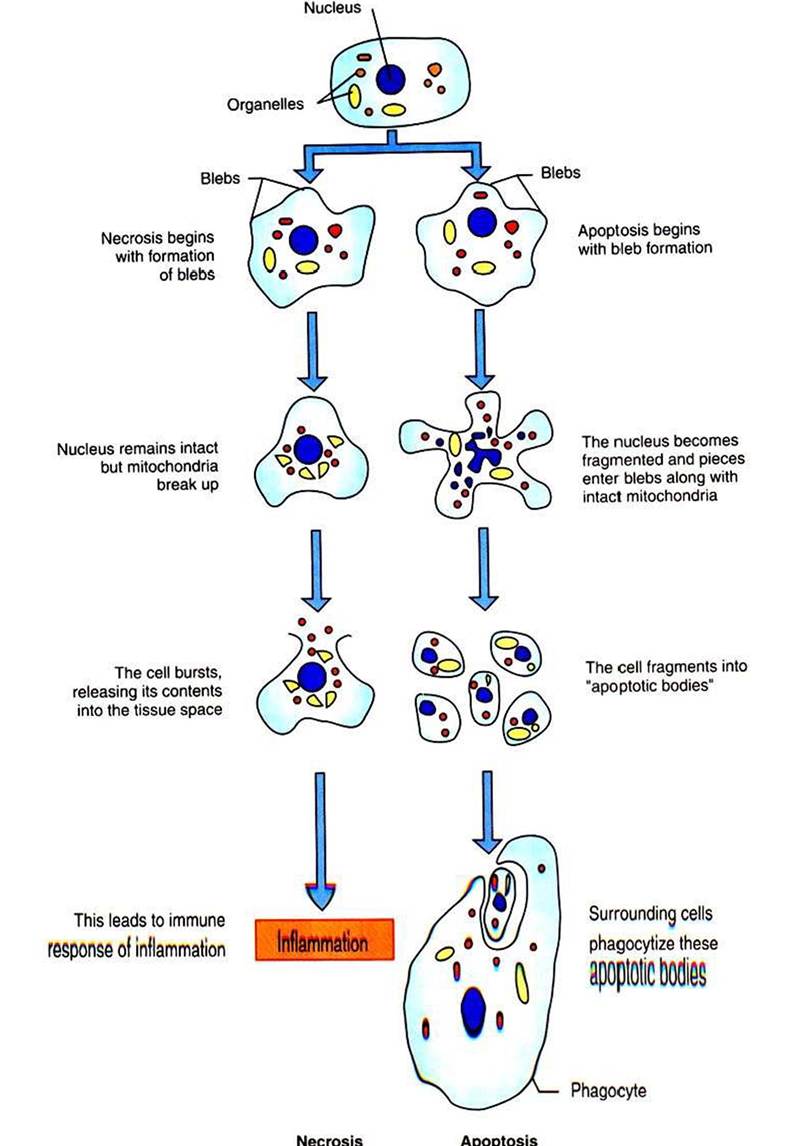
FIGURE 2-10 Necrosis vs. apoptosis. Necrosis is cell death as a result of external damage to the cell that leads to bursting of the cell and release of cell contents, leading to inflammation. Apoptosis is cell death as a result of intrinsic mechanisms in which the cell is broken down into cell fragments that then undergo phagocytosis by neighboring cells.This produces no inflammatory reaction and is so "tidy" that apoptosis is difficult to observe.
small pieces that are rapidly engulfed by neighboring cells (Figure 2-l0). This “neater and cleaner” form of cell death was named apoptosis (a-pah-toe-sis; Greek, “falling off”). Apoptosis was largely ignored for the next 20 years, until studies of nematode development discovered genes whose only role was to control apoptosis. Further studies revealed the highly conserved mechanisms of apoptosis and its importance in normal development, immune function, and disease. Resistance to apoptosis is clearly a major contributor to cancer. (Conversely, too much apoptosis plays an important role in neuro-
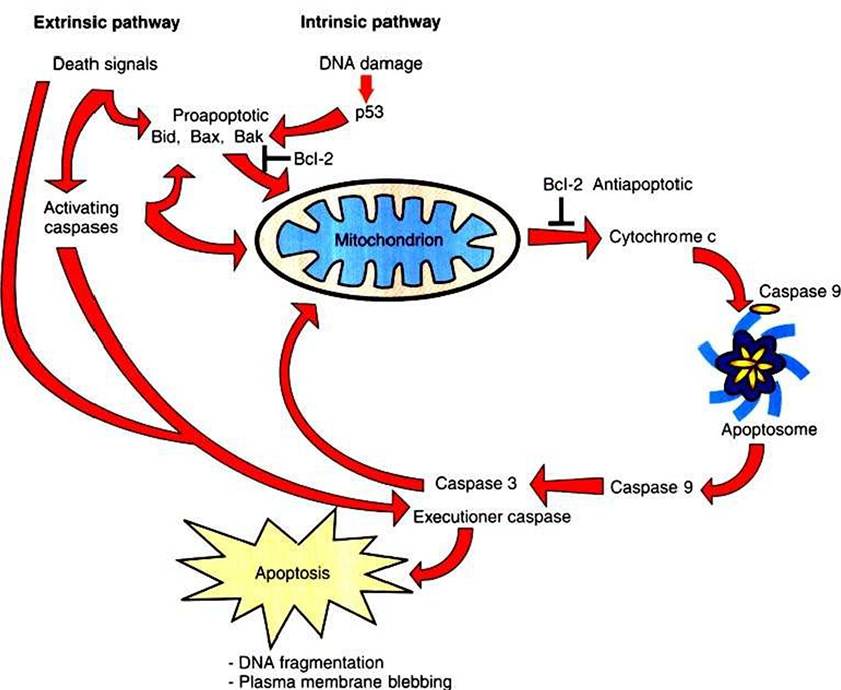
FIGURE 2-11 Extrinsic and intrinsic pathways for apoptosis. See text for details.
degenerative diseases and stroke.) Particularly relevant to clinical practice, most cancer drugs and radiation therapy kill the target cells (and unfortunately many bystander cells) by stimulating apoptosis.
There are two broad pathways that lead to apoptosis. The intrinsic pathway of apoptosis responds to internal damage or stress.from within the cell. I he extrinsic pathway begins with a signal molecule binding to a “death receptor” on the cell surface (Figure 2-ll). However, both pathways converge on the same “executioners.” Caspases are a family of proteolytic enzymes that have a cysteine amino acid at their active site (the“c” in caspase) and that cleave the substrate proteins at an aspartate amino acid (the “asp” in caspase). Similar to many other proteases, including digestive enzymes and bloodclotting factors, caspases are themselves activated by proteolytic cleavage. That is, as initially translated, the protease contains an inhibitory peptide that must be cleaved away to allow active proteolysis by the enzyme. In the case of the caspases, the activating protease is itself another caspase. Thus, caspases are divided into activating caspases, which respond directly to one or another element in the intrinsic or extrinsic pathway, and downstream executioner caspases, which lead to specific cleavage of cellular structures. Among other tasks, executioner caspases cleave Cytoskeletal proteins, leading to cell shrinkage, and activate the DNA- degrading enzymes involved in the systematic fragmentation of DNA.
The basic extrinsic pathway of apoptosis, also called the “death receptor pathway,” is unusually short and straightforward considering the extreme and irreversible outcome. An extracellular signal, which can be either soluble or attached to the surface of another cell, binds to and activates a death receptor on the cell destined to commit suicide. The cytoplasmic domain of the death receptor recruits one or two adapter proteins that directly activate an activating caspase, which in turn activates one or more executioner caspases (see Figure 2-11). The activating caspase of the extrinsic pathway can also engage in “cross-talk” with the intrinsic pathway, described shortly, to increase the extent of caspase activation. The extrinsic pathway plays a crucial role in regulating the immune system, where the vast majority of immune cells initially generated are eliminated. The role of the extrinsic pathway in cancer is more limited. A few types of cancers overexpress “decoy receptors,” which bind to the death signals but attenuate, rather than activate, the apoptotic response. Interestingly, cancer cells are often responsive to an extrinsic pathway, including the one involved in immune cell elimination, but their normal counterparts are not. It is hoped that this differential sensitivity to extrinsic death signals can be exploited as a therapeutic cancer treatment in the future.