Basic Design and Function of the Cardiovascular System
The cardiovascular system consists of the heart and the many vessels through which blood flows. While the actual anatomy of the system makes it difficult to appreciate easily, the basic design of the system is a continuous loop of branching vessels with two pumps in the loop (Fig.
18-1). The loop design can be best understood by tracing the path of a single erythrocyte as it travels. When the erythrocyte is pumped out of the left side of the heart, it enters the aorta and passes into the systemic circulation. The systemic circulation is a subdivision of the cardiovascular system consisting of all vessels associated with all organs other than the parts of the lungs where exchange of gases—oxygen and carbon dioxide—takes place. When blood returns from the systemic circulation, it enters the right side of the heart. The right side of the heart pumps blood into the pulmonary circulation. The pulmonary circulation consists of vessels associated with the parts of the lungs where the exchange of gases takes place. From the pulmonary circulation, blood reenters the heart on the left side, and from here it is pumped out into the systemic circulation to begin the loop again. The loop design means that all components of the system must function together in a highly coordinated and integrated fashion to maintain blood flow throughout the system.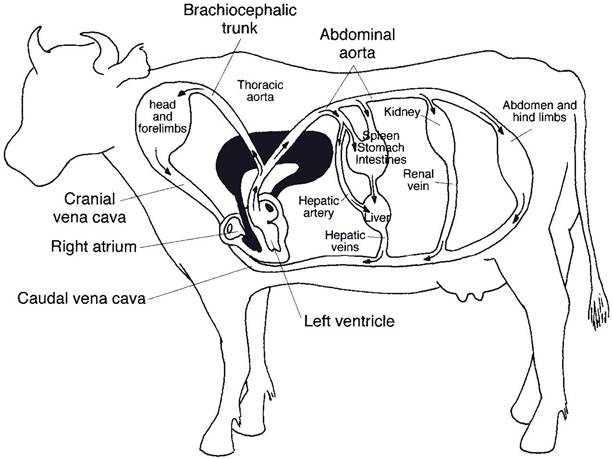
Figure 18-1. General design of cardiovascular system illustrating the systemic and pulmonary circulations. Pulmonary circulation is shown in black. (Reprinted with permission of Wiley-Blackwell from Reece W.O. Physiology of Domestic Animals. 2nd ed. Baltimore: Williams & Wilkins, 1997.)
For example, if the right side of the heart cannot pump an adequate amount of blood into the pulmonary circulation, the left side of the heart will not receive enough blood to maintain flow into the systemic circulation.
Blood flows through the vessels of the cardiovascular system because of a driving force generated by the contraction of the heart. Hydrostatic pressure, or mean blood pressure, in vessels is a measure of this driving force. (Chapter 2 explains hydrostatic pressure.) Blood flows from a point of high mean pressure to a point of low mean pressure. in the systemic circulation, mean blood pressure is higher in the arteries than in the capillaries and higher in the capillaries than in the veins, from which blood reenters the right side of the heart (Fig. 18-1). A series of one-way valves described in Chapter 17 regulates blood flow though the heart.
The driving force of blood pressure is necessary to overcome the vascular resistance provided by the blood vessels. Any tube offers a resistance to the flow of liquid through it. The resistance (R) to flow through a single tube depends on the length (L) of the tube, the radius (r) of the tube, and the character of the fluid flowing through the tube (viscosity, η). The resistance increases with the length of the tube, decreases as the radius of the tube increases, and increases with the viscosity of the fluid. While all three factors can affect resistance, changes in the radius have the largest effect, as shown in the following formula. (Poi- seuille first described this formula and the mathematical relations between these factors.)

According to this formula alone, the vessels with the smallest radius, the capillaries, would have the greatest resistance. This is true for a single vessel, but it is not true when considering the total combined resistance for the different types of vessels in the systemic circulation. Rather, the vessels on the arterial side of the circulation just before the capillaries have the greatest combined resistance. The total resistance at the level of the capillaries is less because of the extensive branching in capillary networks. Branching of vessels tends to lower resistance, and the extensive branching of capillaries in their networks is responsible for a relatively low resistance at this point in spite of the small diameter of an individual capillary. The type of arterial vessel found just outside of a capillary network (before the extensive branching) is an arteriole, and these vessels contribute most to the total vascular resistance in the systemic circulation.
Transport is the ultimate function of the cardiovascular system. Blood is the transport medium; the heart provides the force for moving blood (i.e., pump function) around the circulation; and vessels provide a path for the movement and permit exchange between blood and interstitial fluids at the level of the capillaries. The rate of transport and exchange is usually determined by the rate of blood flow through the capillaries.