Because Tissues Are Poor Conductors, Heat Is Most Effectively Transferred in the Blood
Because heat is produced primarily in muscles of the limbs and in the Iiverand is eliminated through the skin and the respiratory tract, it is necessary to transfer heat around the body.
Tissues have a thermal conductivity similar to that of cork; therefore, conduction is not an efficient means of heat redistribution.The blood perfusing a metabolically active organ collects heat and transfers it to cooler parts of the body by circulatory convection. Redistribution of blood flow can deliver heat preferentially to certain body regions, or it can allow regions to cool when the maintenance of the temperature of the brain and major viscera (core temperature) is threatened.
Under conditions of heat stress, circulatory transfer of heat to the skin can be increased dramatically by two mechanisms. First, the arterioles of skin vascular beds dilate, which results in increased capillary blood flow. Second, arteriovenous anastomoses open in the limbs, ears, and muzzles. These two actions greatly increase the total blood flow to the periphery, and the increased heat delivery increases the temperature of the skin, which facilitates heat loss. Conversely, under cold stress, skin vascular beds Vasoconstrict, and arteriovenous anastomoses close; thus skin and limb temperatures decrease. This results in reduced heat loss from the skin and in a gradient of temperatures along the limb (Figure 53-3). Under severe cold stress, the skin temperature of the extremities can approach ambient temperature. Interestingly, the lipids in the limb extremities have a lower melting point than those in the core, so fats do not solidify in extreme cold stress.
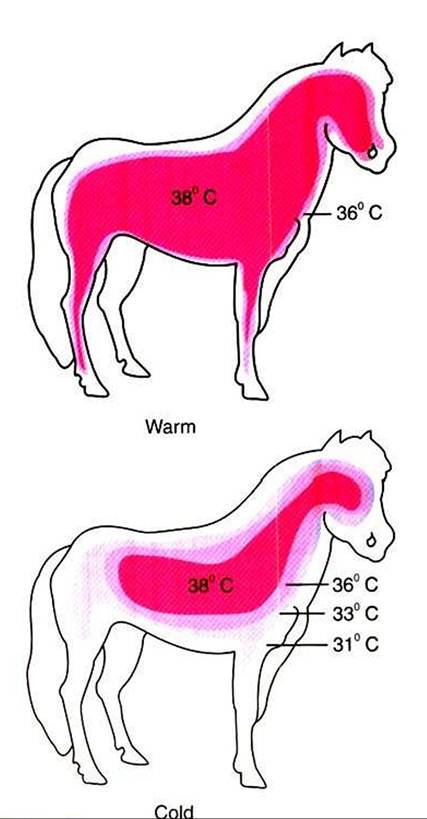
FIGURE 53-3 Representation of the distribution of temperatures in a pony under warm and cold environmental conditions. Under warm conditions, the core body temperature extends into the limbs and close to the skin surface of the animal. Under cold conditions, vasoconstriction in the peripheral blood vessels results in a gradient of temperatures between the core and the extremities.The core temperature is maintained only in the abdomen, thorax, and brain of the animal.The more peripheral tissues are allowed to cool considerably.