Countercurrent Heat Exchange Mechanisms Are Used Both to Conserve and to Lose Heat
When the environmental temperature is high, the blood perfusing the skin vascular beds returns to the core through superficial veins from which heat is lost to the skin and air. Under cold conditions, limb blood flow returns to the core through deep veins that accompany arteries (Figure 53-4).
Heat is transferred by countercurrent exchange from the warm arterial blood to the cooler venous blood and thereby returned to the core of the bodv.A similar countercurrent exchange of heat occurs in a carotid rete in sheep and some other ungulates. In this system the carotid artery forms a rete bathed in a sinus of venous blood
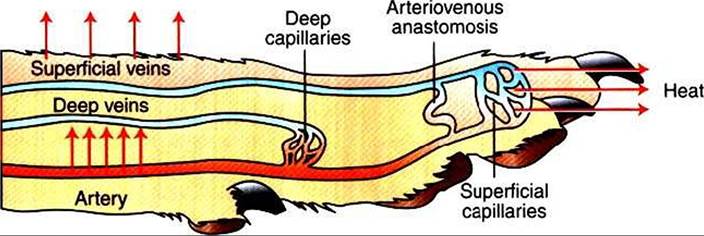
FIGURE 53-4 Representation of a limb showing the arterial supply and venous drainage by deep and superficial veins. Under warm conditions, blood perfuses the more superficial capillary beds, and heat is lost to the environment through the skin. Blood returns from these superficial vascular beds through the superficial veins, and this provides an additional source of heat loss. Under cold conditions, peripheral vasoconstriction occurs, and the blood flow to the limb is directed to the deeper vascular beds and returns to the trunk through the deep veins. Countercurrent heat exchange between the arteries and veins conserves body heat.
that has drained the nasal cavity. The colder venous blood from the nose cools the arterial blood supplying the brain and protects the temperature of the brain. This mechanism becomes important during exercise, when the increase in ventilation aids in cooling the blood that drains from the nose. As a result, the arterial blood carrying heat from the exercising muscles is cooled before it enters the brain.
Some mammals, including humans and horses, do not possess a carotid rete and must rely on other thermoregulatory mechanisms to cool their brains during exercise.
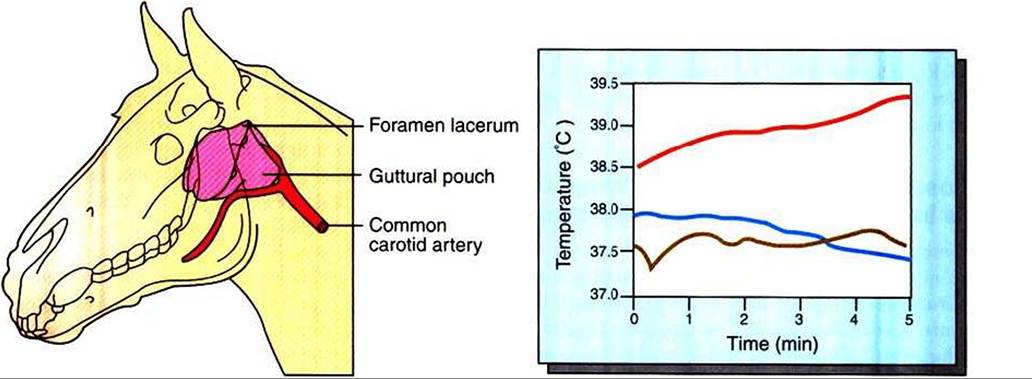
Inthe horse Iheguttural pouches may serve as such a mechanism. The guttural pouches contain air that is cooler than the arterial blood carried in the internal carotid artery. Because anatomically these guttural pouches surround the internal carotid arteries, heat is transferred from the blood to the air in the guttural pouches, thus protecting the brain from hyperthermia (Figure 53-5). In addition, the intracranial cavernous venous sinuses may assist in cooling the horses brain during exercise. This mechanism is thought to function in the same manner as the carotid rete, but less efficiently.
— Common carotid artery
------ Foramen Iacerum
------ Guttural pouch
FIGURE 53-5 Guttural pouches cool the blood passing through the internal carotid artery on its way to the brain. Left, Anatomic arrangement of the guttural pouches and carotid arteries in the skull.The location of the temperature probes used to measure blood temperature is indicated. Right, Graph of blood and guttural pouch temperatures during a period of cantering. Note that even though the temperature of blood entering the guttural pouch in the common carotid artery increases with the duration of exercise, temperature at the foramen Iacerum (where the internal carotid artery enters the cranium) decreases slightly.