Buffers Are Combinations of Salts and Weak Acids That Prevent Major Changes in pH
Buffers “soak up” free hydrogen ions and prevent their accumulation in body fluids. By so doing, buffers prevent drastic changes in pH. Buffers are mixtures of weak acids and their salts.
For example, sodium bicarbonate dissociates completely into sodium and bicarbonate ions; carbonic acid dissociates incompletely into hydrogen and bicarbonate ions. Thus, in a solution containing sodium bicarbonate and carbonic acid, there are sodium, hydrogen, and bicarbonate ions and undissociated carbonic acid. If a strong acid such as hydrochloric acid is added to the solution, the added hydrogen ions upset the dissociation equilibrium of carbonic acid. Hydrogen ions combine with bicarbonate ion to form carbonic acid, thus reducing the concentration of hydrogen ions, that is, preventing a major change in pH.If, in contrast, sodium hydroxide is added to the solution, the hydroxyl ions, formed by dissociation of sodium hydroxide, combine with hydrogen ion to form water. The decrease in hydrogen ion causes dissociation of more carbonic acid and liberation of hydrogen ions, again preventing a large change in pH.
The dissociation of a weak acid, and therefore the concentration of H4, base, and undissociated acid, is determined by the dissociation constant (Ka) and can be described by the law of mass action. For carbonic acid:

Taking logarithms of both sides of this equation results in:

Rearrangement of this equation yields:
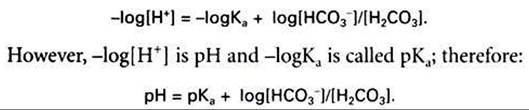
This is the Henderson-Hasselbalch equation written for the bicarbonate-carbonic acid system. It can be written for any buffering system in the generic form:

This equation shows that the pH of a solution is determined by the ratio of the concentration of base (the H+ acceptor) to that of undissociated acid (the H' donor) and by the pKa of the buffering system.
Figure 52-1 shows the change in pH that results when acid is added to a phosphate buffer with a pKa of 6.8. This is a graphic presentation of the Henderson-Hasselbalch equation. Initially, as acid is added, there is a large decrease in pH. As considerably more acid is added to the solution, the pH changes little. H4 ions combine with HPO12" and form H2PO4". Finally, the pH decreases considerably. The zone over which the pH changes little as acid is added (i.e., where buffering capacity is optimal) is within ±1 pH unit of the pKa. Note that when the pH equals the pKa, 50% of the buffer has been consumed. From this buffer curve, it is obvious that an effective buffer must have a pKa within ±1 pH unit of the solution in which it operates. Thus the optimal blood buffers should have a pKa between 6.4 and 8.4. In addition, buffers must be sufficiently plentiful to be effective.