Cancer Arises from Genetic Dysfunction in the Regulation of the Cell Cycle, Cell Life Span, and Cell Suicide
Cancer is a genetic disease (but not usually a hereditary disease) and a uniquely cellular disease. As shown in Figure 2-1, tumors and other cancers arise from the division of a single mutant cell whose descendants accumulate several additional mutations to become increasingly damaged with respect to control of cellular proliferation, life span, and cell death.
That is, cancer is a genetic disease caused by the accumulation of mutations in body cells, such as those of the epithelia lining the lungs or the secretory epithelia of the mammary glands.All the cells of a tumor can trace their ancestry back to a single cell that developed an initial deleterious mutation. This first mutation usually occurs in a gene controlling proliferation, such that the cell produces a mutant protein that is a dysfunctional, more permissive regulator of the cell cycle. This greater “permissiveness” provides the mutant cell with more opportunity to proliferate, and it thus has a selective advantage compared with its normal neighbors. Perhaps because of this selective advantage, or because of continued exposure to mutagens (e.g., cigarette smoke, agricultural chemicals), a descendant of this cell accumulates another mutation that also affects some aspect of the cell cycle or cell death. I his increases the doubly mutant cells selective advantage further still, and the downward spiral of increasingly abnormal, dividing cells begins to spin out of control. Scientists agree that this accumulation of mutations in individual genes is necessary for cancer to develop, but some think it is not sufficient. Rather, they argue that cancer only results when the accumulation of mutations eventually leads to large-scale genetic instability, such that whole chromosomes are gained and lost. The majority of spontaneous tumors do have cells with abnormal sets of chromosomes, a phenomenon called aneιφloi(ly.
Whether aneuploidy is necessary for cancer remains to be seen, but there is no disagreement that cancer cells are in some way badly damaged with respect to genes controlling growth.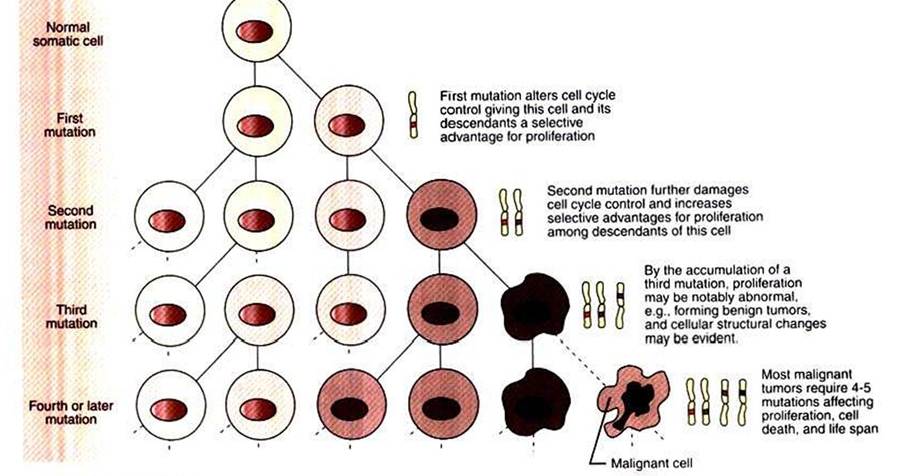
FIGURE 2-1 Clonal basis of cancer. Cancer is the result of the accumulation of mutations in a cell lineage of somatic (nongamete) cells of the body. Beginning with a normal cell, mutations occur by chance or by environmental inputs, such as radiation or cancer-causing chemicals, and accumulate to cause cancer.
The mutations leading to cancer are the same type as those that underlie MendeFs familiar laws of heredity. These include base-pair changes, deletions or additions of nucleotides in the gene, and translocation of one piece of a chromosome to another. However, it is important to understand that the cells in which the mutations are occurring are different than those underlying Mendels laws of inheritance. Mendelian inheritance results from mutations occurring in the germ line of the organism. These are the cells that will become gametes, either sperm or eggs, and whose deoxyribonucleic acid (DNA) will be passed down to every cell of the offspring. The mutations leading to cancer are occurring in non reproductive cells throughout the body, called somatic cells. These are passed down only to a limited number of other somatic cells by cell division, not to offspring through sexual reproduction. Thus, although cancer is a genetic disease, only about I0°∕o of the time is it a “hereditary disease," that is, the result of mutation inherited from a parent. In general, cancer appears to be the result of the accumulation of mutations leading to genetic instability in a particular lineage of somatic cells.
Traditionally, cancers are divided into categories based on the cell type involved. Carcinomas are cancers of epithelial cells; sarcomas are derived from connective tissue or muscle; and leukemias are cancers of blood-forming cells. There are many subdivisions based on specific cell types and location of the tumors. However, these names are traditional only; they do not reflect any fundamental differences in the biology of the cancer. Rather, it is now clear that cancers of all types share broadly similar types of dysfunctions controlling cell proliferation, cell suicide, and cell life span.