Cell Division Is the Result of a Clocklike Cell Cycle
The “Rube Goldberg device" that controls cell growth is particularly complex, with many, many more components than the “garage door opener" of Figure I -13. To explain these pathways, we begin with the cell cycle that, like the carriage house door, is near the end of the system of control.
That is, most of the control elements feed “downstream" to control the cell cycle, or intersect with some aspect of cell cycle control.Figure 2-2 shows the classic diagram of the cell cycle in which the cell changes its state toward division, progressively going around the diagram, like the hands of a clock. For most mammalian cells, the duration of one cell cycle in culture varies between )8 and 30 hours. Two phases of the cell cycle were identified first and seemed to be where the most important events of the cell cycle occurred. One is S (synthesis) phase, during which the DNA is duplicated. The second is M (mitosis) phase, during which the duplicated chromosomes are separated to opposite sides of the cell and the cytoplasm divides. In addition to the obvious need for such events if cells are to reproduce, note that both phases must be highly precise. It is crucial for the cell that DNA synthesis produces exactly twice the original amount of DNA, no more and no less. Otherwise, there will not be two identical copies of the genetic material to pass on to two identical cells. Similarly, the machinery segregating the duplicated chromosomes during mitosis must partition exactly equal numbers and types of chromosomes to daughter cells, or the cells will be aneuploid. If DNA
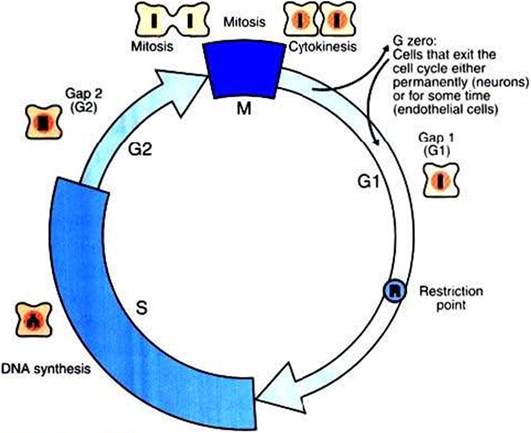
FIGURE 2-2 The mammalian cell cycle. Cell proliferation occurs by a clocklike progression of phases in which characteristic events occur.The most familiar is M phase (mitosis), during which the cytoplasm and replicated chromosomes are distributed to the daughter cells. Cells then enter G1, during which a "decision" is made whether or not to go forward with the cell cycle; this is the R (restriction) point.The events in G1 then allow S (synthesis) phase to proceed, during which the DNA is replicated to produce exactly two copies.
After DNA synthesis, the cell prepares for mitosis during G1, and the cycle is complete. Although cells in culture typically go around the cycle continuously, most cells in the body divide only Occasionally-These quiescent cells, as well as cells such as neurons that never divide after differentiation, are in GO, a nondividing phase. Under appropriate stimulation, cells can then exit GO and are said to reenter the cell cycle.is not precisely replicated, or if the chromosomes are not properly aligned, the cell cycle is halted, by “checkpoints,” as described later.
However, the events during Gl (“gee-one”) and G2 phases remained a mystery. The “G” stands for grip, because of the decades-long gap in our understanding of what was happening during this time. Although it was suspected that the cell was preparing itself for DNA synthesis during Gl and preparing for mitosis during G2, the nature of these “preparations” proved difficult to determine. In the mid-1980s, work initially conducted on frog oocytes revealed that specialized protein kinases were activated during Gl and G2 to drive the cell into S phase and M phase, respectively. These special protein kinases are now called cyclin-dependent kinases (CDKs).