Cancer Cells May Be Related to Stem Cells
As noted in the previous section, some normal adult cells do have unlimited replicative potential. These are “stem cells,” and that term has been much in the news recently. A stem cell is a self-renewing cell of high proliferative potential that can also give rise to differentiated cells.
'Fypically, stem cell division produces one cell that remains a stem cell while the other daughter cell differentiates into a specialized cell with the usual limited life span (Figure 2-12). Fhe cell that continues being a stem cell does not lose any developmental capacity and can divide indefinitely, continuing to produce additional stem cells and additional differentiated cells.Much of the recent attention in the news centers on embryonic stem cells. Fhese are embryonic cells that can either continue to form stem cells or differentiate, in principle, to any and every cell type within the body. Even in the adult, however, the maintenance of many normal tissues is critically dependent on stem cells. Adult stem cells, however, can only differentiate into a limited array of different cell types, not every cell type in the body. Best understood is that all the
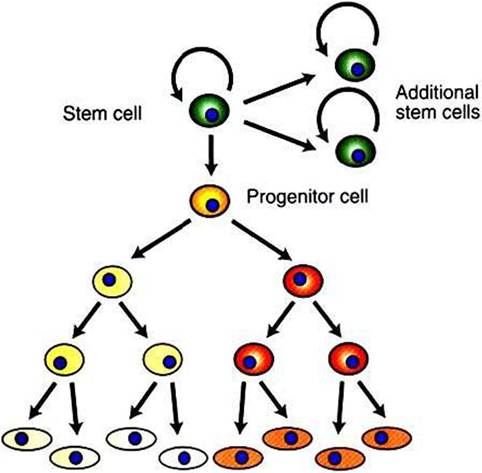
Differentiated cell type A Differentiated cell type B FIGURE 2-12 Stem cells. Stem cells are self-renewing cells of high, sometimes unlimited, replicative potential. Their proliferation forms both additional stem cells and "progenitor cells." These progenitor cells divide and eventually differentiate to become one or more types of differentiated somatic cells specialized for certain tasks (e.g., erythrocytes and monocytes of blood).
various cells of the blood arise from the division of hematopoietic stem cells in the bone marrow; one daughter cell remains a stem cell in the bone marrow while the other differentiates to become one of the several types of blood cells (but the blood stem cell can only form blood cells, not nonblood cells).
The cells lining the gut and skin cells also arise from a stable population of adult stem cells, some of whose descendants differentiate into specialized gut and skin cells. For this reason, chemotherapy that is intended to cause apoptosis in cancer cells typically also affects these same populations of normal stem cells; common side effects of chemotherapy include anemia, hair loss, and digestive dysfunction.Cancer cells resemble stem cells in their immortality, but the relationship of cancer cells to stem cells may go further. Based on the presentation thus far, you may have the mental image of a tumor composed of a uniform population of badly damaged cells, any of which would be capable of forming a new tumor if transplanted. In fact, real tumors are not a homogeneous population of cells, but rather are composed of a variety of cells that differ significantly in their phenotype, despite all being clonal descendants of a single somatic cell, as shown in Figure 2-1. (Keep in mind that all somatic cells of the body are clonal descendants of the fertilized egg, so phenotypic differences arising within clonal lines is not surprising by itself.) Further, experiments with a variety of cancers show that only 1% or less of tumor cells are capable of forming another tumor, even in the same patient (or mouse). Thus, tumors may contain a small subpopulation of cancer stem cells that are responsible for producing the heterogeneous cells in the tumor and are uniquely able to continue cancer growth. This would also give tumors the capacity to adapt to their surroundings; because stem cells can differentiate in various ways, differentiated cells that allowed continued growth and survival would be selected.
This hypothesis has been persuasively supported only in leukemias, but it may apply to other cancers as well. Also for leukemias, the cancer stem cells express some marker proteins characteristic of normal hematopoietic stem cells. Further, only those leukemia stem cells expressing certain normal markers are capable of forming new cancers when transplanted.
However, blood is unusual in ways other than being a fluid, not a solid tissue, and it is unknown whether other types of cancers will prove similar. Nevertheless, these results suggest that cancer therapy should be directed primarily at cancer stem cells and not the majority of cells in a tumor. Also, stem cell markers might be used for drug targeting, thus sparing the vast majority of cells in the body from side effects of the treatment.Finally, the genetic changes summarized in this chapter might need to occur in a normal adult stem cell to produce cancer cells. This “cancer stem cell hypothesis” is controversial and remains to be proved, but it suggests that most cells of the adult are not capable of giving rise to cancer; only changes in stem cells can give rise to tumors. This is the most extreme of the controversial ideas surrounding the relationships between stem cells and cancer cells. Given the results for certain leukemias, however, and the resulting “revolution” if found to be characteristic of other cancers, it seems worthwhile to consider the emerging ideas about stem cells and cancer.