CARBON DIOXIDE TRANSPORT
1. What is the predominant form of CO2 transport that results from the hydration reaction?
2. Why is venous blood more acidic than arterial blood?
3. What is the most plentiful compound available for buffering H+ formed during the hydration reaction?
4.
What is a carbamino compound?The transport of carbon dioxide is facilitated by several reactions that effectively provide other CO2 forms in addition to that which is in solution. Even though CO2 is more soluble in water than O2, the amount produced exceeds the amount that can be carried in solution. The general scheme for CO2 transport is shown in Figure 10-18.
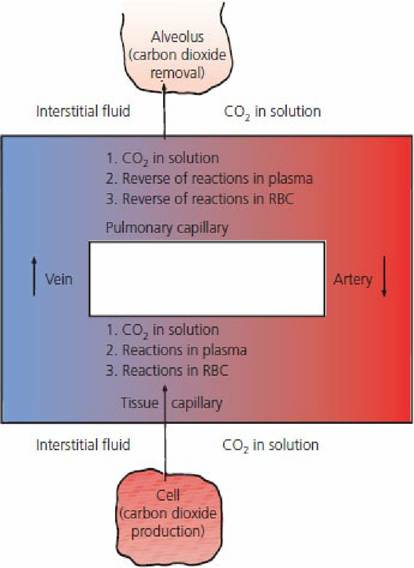
■ FIGURE 10-18 General scheme of carbon dioxide transport showing carbon dioxide procession. Procession occurs because of the presence of pressure gradients. In this diagram, flow is clockwise; carbon dioxide is taken up from cells (bottom location) and removed from blood (top location). In each location, items are numbered in the order of their occurrence. (From Reece WO. Respiration in mammals. In: Reece WO, ed. Dukes’ Physiology of Domestic Animals. 13th edn. Ames, IA: Wiley- Blackwell, 2015.)
Hydration Reaction
About 80% of carbon dioxide transport occurs in the form of bicarbonate (HCO3-). Its formation results from the following hydration reaction:
CO2+ H2O H2CO3 H++ HCO3' (¾10-1)
The equilibrium of the hydration reaction is far to the left in plasma, and the reaction in plasma accounts for little transport of CO2. The reaction is favored within erythrocytes because of the presence of the enzyme carbonic anhydrase and it proceeds with ease, forming H+ and HCO3-.
It would be a rate-limited reaction, however, if the reaction products were not removed. Removal is accomplished by chemical buffering of the H+ and by diffusion of HCO3- out of the erythrocytes into the plasma. Not all of the hydrogen ions are buffered, so venous blood has a lower pH (more acidic) than arterial blood. Also, because of the diffusion of HCO3-.from erythrocytes to plasma, venous blood has a higher HCO3- concentration than arterial blood.The most plentiful compound available for buffering H+ formed during the hydration reaction is hemoglobin. When hemoglobin is deficient, as in anemia, buffering of H+ from all sources is jeopardized and acidemia (increased H+ concentration in blood) results during periods of increased H+ production, such as exertion.
The erythrocyte processes involved.in carbon dioxide transport are shown in Figure 10-19.
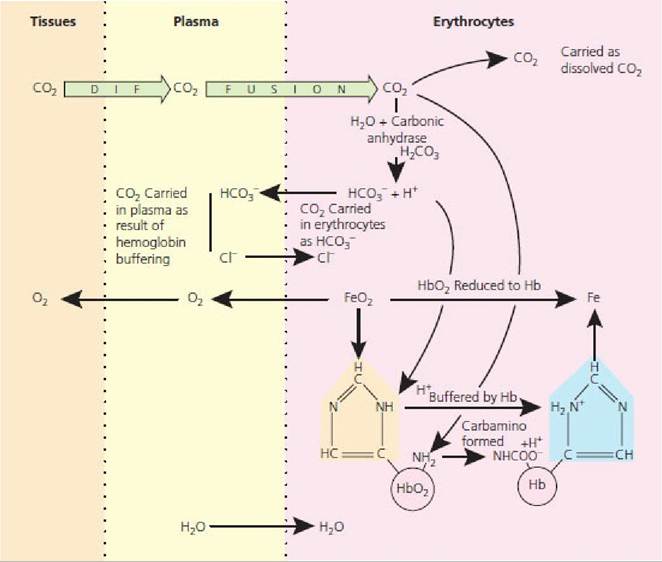
■ FIGURE 10-19 Schematic representation of the processes that occur when carbon dioxide diffuses from tissues into erythrocytes. The reactions shown as occurring in erythrocytes provide the principal methods of transporting carbon dioxide from the cells to the lung. (From Davenport HW. The ABC of Acid-Base Chemistry. 6th edn. Chicago, IL: University of Chicago Press, 1974.)
Carbamino Compounds
Another reaction accounting for CO2 transport involves the combination of CO2 with terminal amino groups on the proteins of plasma and hemoglobin to form carbamino compounds:

Loss of Carbon Dioxide at the Alveolus
When the venous blood reaches the alveoli, the CO2 pressure difference favors diffusion of CO2 in solution from the plasma to the alveoli, followed by a prompt reversal of the hydration reaction (see Figure 10-18) and the reaction that forms carbamino compounds with return of CO2 to solution from both reactions and subsequent loss to the alveoli. The effect is loss of the CO2 that was transported from the tissues.
■