Carbon Dioxide Is Transported in the Blood Both in Solution in Plasma and in Chemical Combination
Unlike oxygen, which is bound only to hemoglobin, carbon dioxide (CO2) is transported in several forms (Figure 48-5). Carbon dioxide is produced in the tissue; therefore tissue Pco2 is higher than the Pco2 of the blood arriving in the capillaries.
CO2 diffuses down a concentration gradient from the tissues into the blood. When the blood leaves the tissues, Peo2 has risen from 40 to approximately 46 mm Hg, with exact values depending on the ratio of blood flow to metabolism.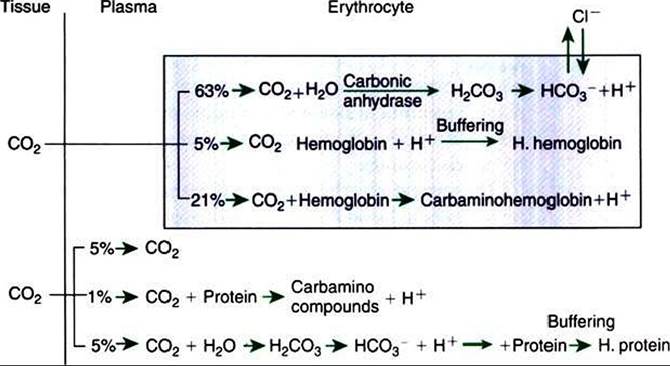
FIGURE 48-5 Forms of carbon dioxide (CO2) transport in the blood. All reactions displayed in this diagram can be reversed when the blood reaches the lung and CO2 diffuses into the alveolus. H2CO3, Carbonic acid; HCO3, bicarbonate.
Approximately 5% of the CO2 entering the blood is transported in solution. The majority of CO2 diffuses into the erythrocyte, where it undergoes one of two chemical reactions. Most of the CO2 combines with water and forms carbonic acid (H2CO3), which then dissociates into bicarbonate (HCO3") and hydrogen ion (H4), as follows:
H2O + CO2 - H2CO3 < > H* + HCO3-
This reaction also occurs in plasma, but in the erythrocyte, the presence of carbonic anhydrase accelerates the hydration of CO2 several hundred-fold. Ionization of H2CO3 occurs rapidly, and H* and HCO3- accumulate within the erythrocyte. The reversible reaction is kept moving to the right because H+ is buffered by hemoglobin. Most of the HCO3- that is produced in the erythrocyte diffuses out along a concentration gradient into the plasma.
Chloride ion (CΓ) diffuses into the erythrocyte to maintain the Gibbs-Donnan equilibrium.The addition of CO2 to capillary blood is facilitated by the deoxygenation of hemoglobin occurring in the tissues. Deoxyhemoglobin is a weaker acid than oxyhemoglobin and therefore a better buffer. Thus it combines more readily with H+ and facilitates the formation of HCO3- from CO2.
The carbamino compounds are the second form in which CO2 is transported in the blood. Carbamino compounds are formed by coupling of CO2 to the -NH groups of proteins, particularly hemoglobin. Although carbamino compounds account for only 15% to 20% of the total CO2 content of the blood, they are responsible for 20% to 30% of the CO2 exchange between the tissues and the lungs.
When venous blood reaches the lungs, CO2 diffuses into the alveoli from plasma and erythrocytes, thus causing the reactions shown in Figure 48-5 to move to the left. Simultaneously, the oxygenation of hemoglobin releases H+ ions, which combine with HCO3- to form H2CO3 and thus CO2.
The blood content of carbon dioxide as a function of Pco2 is depicted in the CO2 equilibrium curves shown in Figure 48-6. Curves are shown for oxygenated blood (Po2 = IOO mm Hg), for partially deoxygenated blood (Po2 = 50), and for deoxygenated blood (Po2 = O). The curves are almost linear and have no plateau in the physiological range; CO2 can be added to the blood as long as the buffering capacity is available. The higher CO2 content of deoxygenated blood resulting from the higher buffering capacity of deoxyhemoglobin is clearly visible.
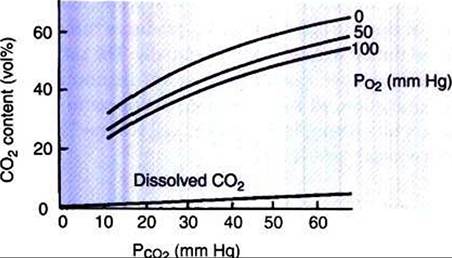
FIGURE 48-6 Carbon dioxide equilibration curves showing the amount of CO2 contained in the blood (CO2 content) as a function of CO2 tension (Pco2). Curves are shown for dissolved CO2 and for total CO2 content at various oxygen tensions (Po2).