Oxygen Demands of ExerciseAre Met by Increases in Blood Flow, in Hemoglobin Levels, and in Oxygen Extraction from Blood
The demands for gas transport in the blood are not constant but vary with metabolism. Strenuous exercise represents the most extreme demand placed on the gas transport mechanisms.
In the galloping horse, oxygen consumption can increase 30-fold. Figure 48-7 shows how this extra demand for oxygen is met. Part of the demand is provided by an increase in cardiac output, which causes the amount of blood flowing through the lungs per minute to increase. This allows an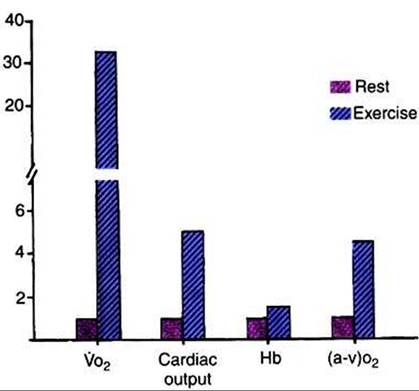
FIGURE 48-7 Oxygen consumption (Vo2), cardiac output, hemoglobin level (Hb), and arteriovenous oxygen difference ∣(a-v)o2l in a horse at rest and during strenuous exercise at a gallop.The 30-fold increase in Vo2 is accomplished by a fivefold increase in cardiac output, a 50% increase in Hb, and a fourfold increase in (a-v)o2.
is high, with 75% saturation at a Po2 of 20 mm Hg, and the steepest slope of the dissociation curve at Po2 equaling 5 mm Hg. As a result of these dissociation characteristics, myoglobin releases oxygen only when intracellular Po2 is low. Myoglobin is more plentiful in slow-twitch aerobic muscle fibers than in fast-twitch fibers, and the amount of myoglobin is increased by exercise training.
Thus, in exercise the increased demand for oxygen is met by increases in blood flow, hematocrit, oxygen extraction from blood, and to a small degree by oxygen release from myoglobin. These mechanisms are available whenever unusual demands for gas exchange arise. In anemia, for example, oxygen capacity is reduced, but oxygen delivery to the tissues can be preserved somewhat by an increase in cardiac output and increased extraction of oxygen from the hemoglobin.
The respiratory systems role in acid-base balance is discussed in Chapter 52.
increased uptake of oxygen from the lungs. The cardiac output also is redistributed, with an increased fraction of output going to the exercising muscles. The increase in cardiac output and redistribution increases muscle blood flow by 20-fold.
The horse also meets the increased oxygen demand with an increase in the number of circulating erythrocytes, and therefore an increased amount of hemoglobin. Contraction of the spleen forces stored erythrocytes into the circulation and can increase the hematocrit from 35% to 50%. This provides almost 50% more binding sites for oxygen, which raises the oxygen capacity of the blood. The usefulness of an increase in hematocrit is limited because it increases blood viscosity, which tends to slow the flow of blood through the capillaries and increase the work of the heart. The increase in muscle blood flow and hematocrit together increase the delivery of oxygen to the muscle. An exercising muscle extracts a larger percentage of the oxygen from the blood than does a muscle at rest. This is accomplished as follows: (1) the diffusion gradient for oxygen is increased by the decrease in muscle Po2, which results from the increase in metabolic rate, and (2) the affinity of hemoglobin for oxygen is decreased by the higher temperature of the exercising muscle and by the lower pH that results from release of carbon dioxide and hydrogen ions from the muscle. As a result of the increased extraction of oxygen, the arteriovenous oxygen content difference is increased.
Muscle itself contains an oxygen-binding pigment, myoglobin, which provides a small store of oxygen. However, myoglobin’s main function is the transfer of oxygen within the muscle cell. Myoglobin, like hemoglobin, is an iron-containing pigment, but unlike hemoglobin, it contains only one heme group. As a result, the dissociation curve is not sigmoid but is a rectangular hyperbola. The affinity of myoglobin for oxygen