Cell Signaling Usually Occurs by a Lengthy Chain of Sequential Molecular Interactions
One of the areas of most rapid progress in cellular physiology has been our understanding of the mechanisms by which extracellular signals, such as hormones, growth factors, and neurotransmitters, alter cellular function, which in turn alters tissue, organ, and animal function.
At the molecular level, almost all chemical signaling shares a common “strategy” of mechanism: signals are sent as a long chain of chemical cause- and-effect interactions transmitted between many sequential chemical steps. Indeed, chemical signaling pathways are structured similar to the whimsical “machines” in the cartoons of Rube Goldberg (1883-1970), a famous American newspaper cartoonist. Figure 1-13 shows one of his cartoons from 1928 illustrating an outlandish contraption (a “Rube Goldberg device") to serve as an automatic garage door opener, realistic versions of which had not yet been invented. The automobile (A) drives in, causing hammer (B) to ignite a toy cap gun (C), which frightens rabbit (D) with string (F) tied to its leg, thus firing pistol (G), and so forth, until a connection to a rotating water sprinkler causes the carriagehouse door to slide open (overhead doors also had not yet been invented). Although much of the humor of this parody of a machine is lost on us (our attitudes about machines have changed greatly since Goldbergs heyday), Rube Goldberg devices are a surprisingly useful analogy to the overall mechanism of cellular chemical signaling.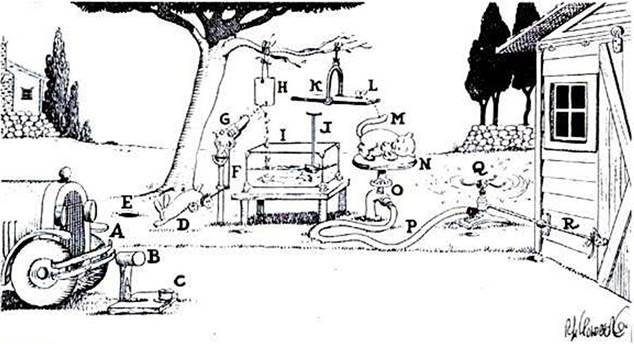
FIGURE 1-13 Rube Goldberg device (garage door opener, circa 1928) as an analogy for the complex cause-and-effect sequence characteristic of cellular chemical signaling. Automobile (A) drives into driveway, causing hammer (B) to ignite toy cap (C)t frightening rabbit (D) into its burrow (E) and causing a pistol (G) to fire and so forth, ultimately leading to the opening of the garage door (R).
As explained in the text, this whimsical "machine" serves as an analogy for chemical signaling within cells because of the multiple control elements, their connection as a cause-and-effect sequence, and the use of household items, similar to the use of evolutionarily conserved proteins of cells in signaling.Just as the garage door opener of Figure 1-13 depends on a series of sequential cause-and-effect interactions, so chemical signaling occurs by a series of cause-and-effect changes in protein shape and binding. Jusl as the complex events of Goldberg’s device are linked to signal and to actuate garage door opening, so a cascade of changes in protein shape and function are linked to signal and actuate physiological events. Our earlier example of muscle contraction illustrates such a pathway of cause and effect and the analogy to Rubc Goldberg devices. Electrical excitation (A) of a muscle cell increases intracellular Ca2+ concentration (B), causing Ca2* to bind to troponin (C). This in turn alters the binding of tropomyosin (D) to actin (E) allowing the myosin heads (F) to bind to actin, thus leading to cross-bridging (G) and hydrolysis of ATP and contraction.
As this example indicates, the sequence of cause and effect for both chemical signaling and Rube Goldberg devices is complex. Both involve many different elements, none of which can be identified as the controller; all the elements are involved in control. Importantly, this creates multiple sites for regulation and for therapeutic drug action. Just as increasing the caliber of the pistol in the garage door opener would change the response time for opening, so a drug that bound to an element in the middle of a signaling pathway in a cell could increase or decrease the final physiological change in response to a particular hormone, for example. Also related to complexity is that the chain of cause and effect is not obvious; the particular sequence connecting a particular signal (adrenaline binding to a receptor on heart muscle) to a particular outcome (increased cardiac output) must be memorized. However, once the sequence is understood, you can predict from the state of one element in the chain what should happen next. Finally, Rube Goldberg devices were cobbled together from reasonably common household items, such as the bucket, fish tank, sprinkler, and even pistols. Similarly, the elements of chemical-signaling pathways are often highly conserved, and you will see throughout your studies that the same molecules or same basic types of molecules are used in a wide variety of different stimulus-response pathways.